



Abstract
Background
Fostering a healthy upbringing is of utmost importance to an individual and a supportive family system helps them grow holistically. Adolescence is an important stage for an individual to grow and form strong bonds with their peers.
Purpose
The objective of the current study was to ascertain the level of self-esteem, resilience and suicidal ideation among orphan and non-orphan adolescents. Gender differences in self-esteem, resilience and suicidal ideation were also studied.
Method
A sample of 160 adolescents (80 orphan and 80 non-orphan adolescents) comprising of equal number of male and female participants in the age group of 15–18 years were included in the study. Data was collected from adolescent orphans and non-orphans going to government schools in the urban sector in Pune, Maharashtra.
Results
Means, S. Ds, Pearson’s correlation and t-test were calculated: Mean resilience score was found to be significantly (P = .048) higher among orphans (129.73 + 29.53) as compared to non-orphans (120.39 + 29.70). Mean self-esteem and suicidal ideation did not vary significantly among orphans and non-orphans. The mean self-esteem score was significantly higher (P = .048) among females (27.61 + 4.09) as compared to males (26.43 + 3.41). There was no significant gender difference in resilience and suicidal ideation scores. The high resilience scores emphasise the need to study ways to enhance well-being among both orphans and non-orphan adolescents to foster a healthy fulfilling upbringing.
Conclusion
The study goes on to show that a similar upbringing would foster similar results in individuals, irrespective of their backgrounds. Since self-esteem and suicidal ideation are similar among orphans and non-orphans, further research would help identify the various factors that foster self-esteem and resilience among these adolescents and likewise plan interventions in the future.
Introduction
Adolescence represents a challenging phase marked by identity formation, autonomy exploration and the understanding of intimacy and sexuality. Puberty initiates sudden physiological and cognitive changes, further complicating the adolescent experience. Numerous factors, including hormonal shifts, contribute to mental health complexities, with heightened sexual attraction posing challenges. Societal taboos, such as those surrounding homosexuality, can induce shame, depression and suicidal thoughts in adolescents.
Physical transformations during adolescence, particularly the pursuit of an idealised body image, may lead to disordered eating habits. Females, driven by a desire for a slender figure, may neglect proper nutrition, contributing to issues like bulimia and anorexia. Conversely, males may succumb to muscle dysmorphia, engaging in harmful body practices.
Lack of positive role models and exposure to peer pressure may expose adolescents to substance abuse. This, coupled with societal expectations and moral conflicts, can result in eating disorders, body dysmorphic disorder, low self-esteem, loneliness, stress and suicidal thoughts. Resilience emerges as a critical factor influencing the quality of life in adolescents.
The World Health Organisation defines orphans as children under 18 who have lost one or both parents. Orphans face significant life challenges, impacting their psychological well-being. The absence of parental love contributes to vulnerability, leading to distress, suicidal ideation, anxiety and depression.
Research indicates higher resilience in orphans compared to non-orphans, but the latter exhibit more delinquent tendencies. Psychosocial behaviours in orphans remain underexplored, and the importance of perceived support, especially in orphanages, on achievement motivation, crisis coping and social support requires more extensive investigation.
Parental psychological abuse, both from fathers and mothers, significantly influences adolescents’ mental health problems. Peer influence shapes self-esteem, with social acceptance contributing positively and rejection leading to decreased self-esteem. Orphanages recognising the importance of education in building confidence demonstrate positive impacts on adolescents’ lives.
Personality development in orphanages exposes individuals to adversity, fostering social responsibility. However, re-homed orphans may encounter behavioural issues, often linked to psychological damage experienced in orphanages. Suicidal ideation is prevalent among orphans due to a lack of support, making them a high-risk group. Social support is crucial for self-esteem and resilience, inversely impacting suicidal ideation.
The study focuses on self-esteem, resilience and suicidal ideation in orphan and non-orphan adolescents. Self-esteem and resilience play vital roles in an adolescent’s life, influencing satisfaction, risk-taking behaviours and future vision. Early home environments, poverty, abuse and neglect significantly impact a child’s development, emphasising the need for emotional support and bonding. Quality time, a positive physical environment and proper nutrition are essential for a child’s mental and physical well-being.
The aim of including both orphan and non-orphan adolescents was to investigate the impact of home environments on a child’s development. Orphan participants in this study originate from well-supported orphanages, attending regular schools similar to their non-orphan counterparts. Conversely, non-orphan adolescents are from lower-income families. This approach allows for an examination of how self-esteem, resilience and suicidal ideation are influenced when individuals share comparable backgrounds. The current research exclusively focuses on these three variables, with plans for future studies to explore additional factors contributing to enhanced self-esteem and resilience.
The study’s primary objective is to analyse disparities in self-esteem, resilience and suicidal ideation between orphans and non-orphans. Previous research suggests that despite experiencing higher levels of depression and suicidal thoughts, orphans often exhibit elevated self-esteem and resilience. By incorporating participants from similar economic backgrounds who attend school, the study aims to uncover additional factors influencing the levels of self-esteem, resilience and suicidal ideation in both groups.
The study had three specific objectives. First, it sought to determine the levels of self-esteem, resilience and suicidal ideation among orphans and non-orphans. Second, it aimed to identify gender differences in self-esteem, resilience and suicidal ideation. Last, the study aimed to explore correlations between self-esteem, resilience and suicidal ideation.
Tools Used
Rosenberg self-esteem scale 1 has a 10-item scale which is to be self-answered. The scale measures both negative and positive feelings, about the global self-worth of the individual. The 4-point Likert Scale format is used to answer all the items. Scales 1–4 indicate strongly disagree to strongly agree. Some of the items are reverse-scored. Internal Consistency is 0.85
The Resilience Scale 2 is a scale that measures components of resilience in different domains of young people’s lives, ranging from planning and thinking ahead to a level of independence. Resilience is the ability to cope with and respond successfully to various life stressors. No. of items-25. (score range: 25–175). The internal reliability of the scale is 0.91
Suicidal Ideation Questionnaire 3 which assesses the frequency of suicidal ideation and gives a comprehensive assessment of adolescent mental health. The internal reliability of the scale is 0.89
Methods
The present study proceeded through the following stages.
Data collection was done through purposive sampling, on a population of 160. The procedure of back-translation and the inclusion and exclusion criteria were mentioned.
Construction of Questionnaire
The questionnaire was prepared both in English and Marathi. The Marathi version was administered to the respondents. For this, the three scales were translated into Marathi. The three scales were back-translated from English to Marathi and from Marathi to English by two language experts. The three measures translated into Marathi were given to a sample of 10 adolescents first to assess any difficulty encountered by adolescents in comprehending the items and then the researcher proceeded with the data collection. The questionnaire booklet consisted of four sections. Section A asked for personal details of the respondents; Section B consisted of 10 items of the Rosenberg self-esteem scale; Section C consisted of 25 items of the resilience scale and Section D consisted of 30 items of the suicidal ideation scale. The questionnaire consisted of 65 items typed across nine pages. It required approximately 30 minutes to be completed.
Sample Selection
The sample was selected utilising purposive sampling. Adolescents in the age group of 15–18 years of age. The sample was collected from two government schools namely MES SOU Vimlabai Garware High School, Junior College Pune and Sanas Marathi Medium School, Pune. Adolescents fitting the inclusion/exclusion criteria were taken.
The total strength was 160. The age range was 15–18 years. The sample was divided into two categories- orphans and non-orphans from the city of Pune. Each group had been divided into an equal number of male and female adolescents. The adolescents study in a government school and come from similar backgrounds.
Inclusion/Exclusion Criteria
Inclusion Criteria
The sample includes adolescents in the age group 15–18 years.
Adolescents who are studying in class 10th–12th.
Adolescents who are residing in urban areas.
Only day scholars have been included in the present study.
Exclusion Criteria
The sample will not include adolescents below or above the age group 15–18 years.
Adolescents who are not studying in class 10th–12th.
Adolescents from rural, semi-rural and semi-urban schools have not been taken.
No hostelers have been included in the present study.
Analytical Strategies
The data collected was scored, tabulated and analysed. Statistical analysis was done of the data tabulated.
Data analysis was done using means, SDs, percentages, t-tests and correlation.
Results
Hypothesis: No Gender Differences Between Self-esteem, Resilience and Suicidal Ideation
Results
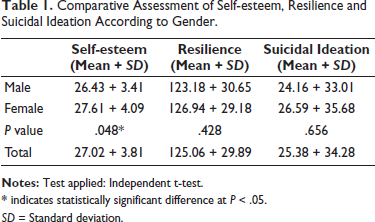
Table 1 depicts the mean self-esteem, resilience and suicidal ideation scores of the study population as 27.02 + 3.81, 125.06 + 29.89 and 25.38 + 34.28, respectively. The mean self-esteem score was significantly higher (P = .048) among females (27.61 + 4.09) as compared to males (26.43 + 3.41). There was no significant gender difference in resilience and suicidal ideation scores.
Comparative Assessment of Self-esteem, Resilience and Suicidal Ideation According to Gender.
* indicates statistically significant difference at P < .05.
SD = Standard deviation.
The hypothesis of no gender difference between resilience and suicidal ideation is accepted.
The hypothesis of no gender difference in self-esteem is rejected.
Female adolescents scored higher on the self-esteem inventory. 4 One of the reasons stated by the researcher was that since girls are becoming more independent in their personal and social choices, are receiving the same quality of education and treatment that has given rise to their levels of self-esteem. Self-esteem is the favourable opinion one has towards oneself. Resilience fosters self-esteem in individuals.
There is no gender difference in self-esteem. 5 The researchers found that extraversion, a sense of mastery, emotional stability, conscientiousness and extraversion are important in increasing self-esteem in young adults as well the adolescents. The researcher found that there is a general notion that men tend to have higher self-esteem. Due to this misconception, males are often ignored by their peers, parents, teachers or even the school counsellors. The research studied the big five personality traits- neuroticism, openness, agreeableness, extraversion and conscientiousness. Income, risk-taking behaviour, the subject’s sense of mastery of his health, and ethnicity were some of the factors that were studied as predictors of self-esteem. The study showed no gender difference in the self-esteem of females and males.
Self-esteem was high and mastery was present. Income had no great influence on the self-esteem of teenagers and young adults. Gender similarity is often a topic of debate. Ethnicity, however, had a greater role in self-esteem whereas the whites scored lower in self-esteem than their Black counterparts. Control over one’s life increases resilience and self-esteem. Perceiving control over your own life and mastery over sense of control had significant ethnic differences and these influenced the self-esteem of the individuals.
Increasing self-esteem in women is a long-term continuous process. A woman often feels victimised by the people around her and often feels that her efforts are being taken for granted. Assertive training for women is essential in increasing their self-esteem. This would help build her confidence and she would feel ready to face the world. Taking care of her health and access to rich nutritious food has a major effect on her body and her confidence. Negative thoughts and emotions need to be channelled and kept under control so that they do not manifest into disorders. Harbouring positive beliefs towards oneself helps increase self-esteem in individuals. Education and jobs have played a major role in enhancing women’s self-esteem. Although this gender difference still exists in many parts of the world, many countries have adapted and helped women get better opportunities through various policies, maternity leave, permanent jobs, free education, non-government organisations and safety to travel. These factors have played a major role in increasing the self-esteem of women.
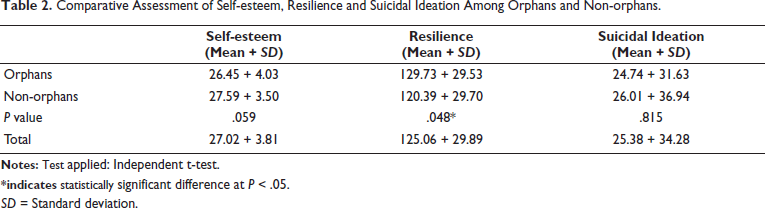
Comparative Assessment of Self-esteem, Resilience and Suicidal Ideation Among Orphans and Non-orphans.
SD = Standard deviation.
Hypothesis: Orphans Will Have Higher Self-esteem, Resilience and Suicidal Ideation
Results
Mean resilience score was found to be significantly (P = .048) higher among orphans (129.73 + 29.53) as compared to non-orphans (120.39 + 29.70). Mean self-esteem and suicidal ideation did not vary significantly among orphans and non-orphans (Table 2).
The hypothesis that orphans will have higher resilience is accepted.
The hypothesis that orphans will have higher self-esteem and suicidal ideation is rejected.
Youth who grew up in orphanages had a high resilience. 6 The ones who had scored high revealed that education played a great role in preparing them for jobs and increasing their resilience. A sense of social responsibility was enhanced by the fact that these adolescents had a social connection with their peers in the orphanages. High levels of self-efficacy were observed in these youth and their situations and lines seemed to be in their control. The results of the study made one thing clear, well-being in such youth was enhanced by the fact that they go through difficult times and that prepares them to face any difficulty in the future. Making a transition to the top becomes easy for these youth.
Pienaar et al. explored the various factors that help in facilitating increasing resilience among orphans. The findings of the study indicated that the various developmental factors that foster resilience are external stressors and challenges, external supports, inner strengths and interpersonal and problem-solving skills. 7 Qualities like optimism, perseverance and hope seem to permeate the children’s process of recovery. Strong networks of support, particularly friendships with other children, also seem to contribute to developing and maintaining resilience. Orphans had higher resilience than non-orphans. 8 Mostly, the relatives or their own mothers left them in the orphanages. Death of the parent/parents and single parenthood and the financial problems associated with it were some of the major reasons for the orphans to live in the orphanages. Some of the children did have relatives, who visited them once or twice a year.
Orphans had higher resilience compared to the non-orphans. 9 Non-orphans were found to have greater delinquent tendencies as compared to the orphans. Delinquent tendencies and self-esteem had a negative correlation. Resilience and self-esteem were found to have a positive correlation.
Resilience for both non-orphans and orphans was high as well as their self-efficacy levels were found to be high. 10 One of the positive factors that affected resilience in orphan children was the self-efficacy of these children. Perceived social support as well as self-efficacy was one of the reasons for high resilience in non-orphans.
Resilience must be fostered in adolescents to decrease suicidal ideations among the adolescents. To increase self-esteem, focusing on experiences, and not looks. Opportunities for accomplishments must be provided. One must be taught to take responsibility; assertive training should be taught, and self-affirmations should be fostered. Resilience plays a major role in improving self-esteem and decreasing suicidal ideation. Stress should be laid on the various ways resilience can be fostered in adolescents both in schools and their place of residence. To increase resilience, teaching adolescents to find a purpose in life, building positive beliefs in their own abilities, helping them build strong social network connections, not just through social media, teaching one that change is the only constant, helping develop problem-solving skills, experimentation with different strategies and developing a logical way to tackle problems in their own way, constantly practising one’s problem-solving abilities, establishing goals, achievement motivation, honing one’s skills are some of the ways resilience can be increased in the adolescents.
Identifying and treating suicidal ideation is particularly important as this could manifest into more serious disorders like major depression and bipolar disorder depressive episodes. Early intervention in suicidal ideation will help decrease the risk of suicide and can help in increasing resilience and hopefulness in adolescents. Finding a purpose in life, positive beliefs help in the decrease of suicidal ideation. Gender differences must also be considered when tackling adolescents with suicidal ideations.
Correlation Between Self-esteem, Resilience and Suicidal Ideation Among Study Population.
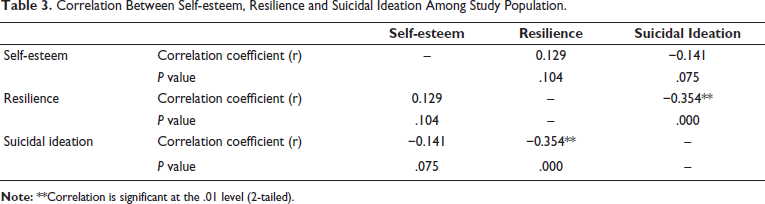
The objective was to study the relationship between the variables self-esteem, resilience and suicidal ideation.
As predicted, there is a positive correlation between self-esteem and resilience. there is a negative correlation between self-esteem and suicidal ideation. There is a negative correlation between resilience and suicidal ideation.
As predicted, there is a positive correlation between self-esteem and resilience. There is a negative correlation between self-esteem and suicidal ideation. There is a negative correlation between resilience and suicidal ideation.
Significant correlation between resilience and suicidal ideation, resilience and depression and suicidal ideation and depression. Significant gender difference was found in resilience but surprisingly no gender difference was found in suicidal ideation and depression among adolescents. 11
George and Moolman studied how resilience in adolescents influenced the suicidal ideation of individuals. Suicidal ideation risk was low for those teenagers who have a sense of relatedness and a sense of mastery on the resilience scale. 12
Orphans had higher resilience than their non-orphan counterparts. There was no significant difference in the levels of self-esteem and suicidal ideation for the orphans and the non-orphans. This means that nurture plays a greater role in fostering the resilience of individuals rather than just nature. Females have higher self-esteem. There was no significant gender difference in resilience and suicidal ideation. This means males are equally at risk of suicidal ideation and prevention strategies should be developed keeping this factor in mind. There was a significant negative correlation between resilience and suicidal ideation. Self-esteem and resilience had a positive correlation and self-esteem and suicidal ideation had a negative correlation.
Sanz et al. examined the relationship between low self-esteem and suicide attempts in young people aged 12–26. Meta-analysis was done that showed that future suicide attempts were more likely to happen in youths who had lower self-esteem. In adolescents, a major risk probability for a suicide attempt would be low self-esteem. 13
The lower the self-esteem, the higher the chances of suicidal ideation.14, 15 Individuals with high efficacy experience less suicidal ideation compared to those with low self-efficacy. 16 Navpreet, Kaur S, Meenakshi and Kaur A highlighted that orphan children in selected orphanage homes face significant physical health problems and psychological well-being issues, emphasising the need for targeted interventions to improve their quality of life. 17 Rizvi SFI and Wayam N concluded that parental psychological abuse significantly contributes to health problems in adolescence, underlining the importance of preventive measures and support systems. 18 Soto-Sanz V and colleagues found a strong association between low self-esteem and suicidal behaviour in youth through a meta-analysis, stressing the importance of self-esteem enhancement in suicide prevention programmes. 19 Wanyoike B and collaborators demonstrated that self-esteem significantly influences suicidal ideation among university youth in Nairobi County, suggesting the need for mental health initiatives focused on building self-esteem. 20 Warshak R concluded that effective management and intervention strategies are crucial in addressing parental alienation, offering valuable practice tips for professionals handling such cases. 21
Discussions
The study population had a moderate level of self-esteem, resilience and suicidal ideation.
Orphans had a high resilience compared to the non-orphan adolescents.
Females had a high self-esteem compared to males.
There is a significant negative correlation between resilience and suicidal ideation.
In this current investigation, orphans demonstrated significantly higher levels of resilience compared to their non-orphan counterparts. This heightened resilience among orphans can be attributed to the meaningful connections they form with their peers in orphanages, shaping their sense of social responsibility and equipping them for the future. The study emphasises the importance of education in boosting a child’s confidence and preparing them for diverse occupational roles. Given the challenging experiences that orphans often endure, they appear better equipped to confront life’s adversities.
The nurturing environment plays a crucial role in the psychological development of adolescents. Interestingly, the research findings indicated that, despite living with their parents, non-orphans exhibited levels of self-esteem and suicidal ideation comparable to orphaned adolescents. Conversely, despite facing hardships, orphans seem better prepared to handle various challenges and rebound from stressful situations more easily than their non-orphan counterparts. This resilience is fostered by the fact that orphans attend school alongside non-orphan peers, receiving similar treatment and achieving comparable academic performance. The orphanages, functioning as a second home since infancy, contribute to the resilience of orphan adolescents.
No significant mean score differences were observed in self-esteem and suicidal ideation between orphans and non-orphans. However, females scored significantly higher in self-esteem compared to males, suggesting that equal opportunities can have similar positive effects on the self-esteem of individuals regardless of gender. While there may be a misconception, males may also exhibit lower suicidal ideation. The lower self-esteem scores could be attributed to other forms of psychological distress. Gender differences were not significant in resilience and suicidal ideation. As expected, there was a significant negative correlation between resilience and suicidal ideation, and a positive correlation between self-esteem and resilience. Additionally, a negative correlation was found between self-esteem and suicidal ideation (Table 3).
In summary, the study revealed that the average levels of self-esteem and resilience among adolescents were moderate, with similar levels of suicidal ideation. Adolescents, being in a developmental stage where self-confidence is still evolving, are influenced by coping resources that impact their self-esteem, resilience and suicidal ideation.
While the study contributes valuable insights, it is not without limitations. The sample size of 160 may be considered small for studying variables among orphans and non-orphans, and a larger sample size could yield different results. The study focused solely on urban areas in Pune, Maharashtra and a more comprehensive analysis including rural areas and other cities would enhance generalizability. Exploring additional variables and employing advanced statistical analyses could provide a deeper understanding of the factors contributing to the differences observed between the two groups.
Conclusion
Conducting additional research on suicidal ideation among both orphans and non-orphans is crucial for monitoring the mental health of adolescents and aiding in the prevention of adolescent suicide. The current study indicated no significant disparity in suicidal ideation between orphans and non-orphans, suggesting that both groups face comparable risks. It emphasises the need to cultivate resilience in adolescents as a means to reduce suicidal ideation.
To enhance self-esteem, the focus should shift towards valuing experiences over appearance. Providing opportunities for achievements, instilling a sense of responsibility, incorporating assertive training and encouraging self-affirmations are essential strategies. The study underscores the pivotal role of resilience in improving self-esteem and reducing suicidal ideation.
Promoting resilience involves guiding adolescents to find purpose in life, nurturing positive beliefs in their capabilities, fostering strong social connections (beyond social media), instilling the understanding that change is constant, developing problem-solving skills, experimenting with various strategies, practicing problem-solving abilities, setting goals, cultivating achievement motivation and honing skills in their unique way.
Early identification and intervention in cases of suicidal ideation are critical, as it can escalate into more severe disorders such as major depression and bipolar disorder depressive episodes. Timely intervention not only reduces the risk of suicide but also enhances resilience and hopefulness in adolescents. Recognising gender differences is imperative in addressing adolescents with suicidal ideation.
Further research on suicidal ideation among orphans can provide insights into emotional well-being patterns and associated factors. The present study contributes to the existing literature by delving into crucial psychological issues affecting the adolescent population. It underscores those adolescents, regardless of their familial background, are a high-risk group for suicide. Additionally, the study introduces Marathi-translated versions of three widely used scales measuring self-esteem, suicidal ideation and resilience, enriching the available resources for psychological assessment in the Marathi-speaking population.
Footnotes
Acknowledgement
The authors of this study thank the orphanage and the government school for their cooperation and consent for data collection. The authors thank the participants of the study. The authors also thank the expert translators who helped with the Marathi translation of the scales.
Authors’ Contribution
The authors confirm that the following research has been divided:
All three authors contributed to the research design and conceptual framework. All three authors contributed to the data collection and analysis of the data. All three authors contributed to writing the research article.
Declaration of Conflicting Interests
The authors declared no potential conflicts of interest with respect to the research, authorship and/or publication of this article.
Funding
The authors disclosed receipt of the following financial support for the research, authorship, and/or publication of this article: The research work was self-financed by the authors.
ICMJE Statement
The authors confirm that the following research has been divided:
All three authors contributed to the research design and conceptual framework. All three authors contributed to the data collection and analysis of the data. All three authors contributed to writing the research article.
Patient Consent
Informed consent was taken from the participants of the study in a written format. Debriefing was also done after the completion of the study to maintain transparency as well as privacy of the study participants.
Statement of Ethics
Ethical guidelines were strictly followed so that no harm was caused to the participants during the study. The authors take full responsibility for the ethics to be maintained.
