




Abstract
Background
Autism spectrum disorder (ASD) is a highly heritable neurodevelopmental disorder. Research has shown that parents and relatives of children with ASD often exhibit subthreshold ASD-like characteristics known as broad autism phenotype (BAP) as well as impairments in motor behaviours.
Purpose
The current study aimed to examine the BAP traits and motor behaviours, that is, gait in 44 parents of children with ASD and in 48 parents of typically developing children (TD).
Methods
The BAP traits were measured using the broad autism phenotype questionnaire (BAPQ), and a low-cost computer vision-based framework was utilised to quantify the gait in children with ASD and their parents and TD children and their parents.
Results
The parents of children with ASD consistently displayed significantly higher scores on rigid personality and pragmatic language, however, there were no significant differences between the two group of parents on aloof personality of BAP traits. On gait parameters, the parents of children with ASD had a reduced gait speed in comparison to parents of TD children. There were no meaningful similarities in gait parameters of children with ASD and their parents.
Conclusions
These findings support the presence of ASD-like traits in the parents of children with ASD and gait speed as a putative motor endophenotype of ASD.
Introduction
Autism spectrum disorder (ASD) is defined as a neurodevelopmental disorder with the presence of social and communication deficits, and narrowed ranges of behavioural patterns. 1 ASD has a strong heritable component as shown by family and twin studies. 2 Around 65%–90% of the variance in ASD phenotype can be explained by genetic factors.3–5 A twin study by Folstein and Rutter 6 suggests that the susceptibility to ASD could potentially be inherited through less severe characteristics that bear resemblance to the key attributes of ASD.
The presence of subthreshold ASD-like symptoms in the non-autistic relatives of ASD participants is known as broad autism phenotype (BAP). 7 In the earliest descriptions, Kanner 8 observed that the ‘parents of ASD children were serious minded, perfectionistic individuals, with an intense interest in abstract ideas.’ These parents further had little interest in developing relationships with others. Non-clinical population-based twin studies have revealed that autistic traits have a heritability component. These heritability rates range between 36% and 87%.9, 10 Therefore, BAP is believed to represent a genetic inclination or predisposition toward the disorder.
The traits that constitute BAP include rigid behaviour, anxiety, heightened sensitivity to criticism, difficulties in maintaining genuine friendships, poor executive function, language difficulties, and unsociable tendencies. 11 Consequently, different tools are available for quantifying these elements, such as the Autism Family History Interview, 12 Modified Personality Assessment Schedule, 13 Pragmatic Rating Scale, 14 Social Responsiveness Scale, 15 and Autism Spectrum Quotient. 16 However, these tools have limitations in terms of specialised training and being time-consuming, which pose challenges for their widespread implementation.
The Broad Autism Phenotype Questionnaire (BAPQ) 7 has recently emerged as an efficient and convenient tool for measuring BAP traits. The BAPQ is derived from the Modified Personality Assessment Schedule (MPASR) and Pragmatic Rating Scale (PRS). It consists of both self-report and informant versions and comprises three subscales designed to assess aloof and rigid personality traits, as well as pragmatic language problems, which aligns with the core symptoms of ASD. BAPQ has superior incremental validity in comparison to Autism Spectrum Quotient 16 and overall adequate inter-item reliability of 0.95, indicating its effectiveness as a reliable measure for assessing BAP characteristics in a wide population.7, 17, 18 It has also been adapted into different languages including Hindi.19, 20
The cardinal behavioural characteristics that define ASD, such as social and communication impairments, stereotypes, and repetitive behaviours are mirrored in the personality, social, and language features that make up the BAP. 21 Rigid personality refers to the insistence on the sameness, aloofness indicates a diminished inclination or pleasure in engaging in social interactions, and pragmatic language impairments hamper the pragmatic use of language in social interactions.7, 20
In the relatives of individuals with ASD, the prevalence of BAP traits range from 12% to 30%. Studies have shown that fathers of individuals with ASD tend to exhibit higher rates of BAP traits compared to mothers.7, 22, 23 Different profiles of BAP traits have been identified in parents of individuals with ASD. Fathers of individuals with ASD tend to score higher on BAP traits related to aloofness and rigidity.24, 25 Impairments in pragmatic language and social communication have been found in parents of individuals with ASD, with fathers often experiencing more significant difficulties than mothers.26, 27 Non-clinical studies have also reported distinct profiles of BAP traits in adult males and females, with adult males generally scoring higher on BAP traits than adult females. 28 However, there are conflicting findings regarding the specific profiles of BAP traits in parents of individuals with ASD based on sex differences. 29
The first objective of the present study is to explore potential differences in BAP traits between fathers and mothers of children diagnosed with and without ASD. By investigating the variation in BAP characteristics within these two parental groups, the aim is to shed light on the potential influence of sex on the expression of BAP traits in the context of ASD.
Besides the presence of BAP traits in the parents and relatives of children with ASD, motor deficits such as gross and fine motor skills, atypical posture and gait, clumsiness, and weak muscle strength have been commonly observed in children with ASD. Studies examining motor impairment in children with ASD have consistently found that approximately 90% of these children exhibit some form of motor abnormality.30–32 Due to the significant heritability rates observed in ASD, studies have shown that the relatives of ASD individuals also display some ASD-like impairments, which include motor impairments. This suggests that motor impairments associated with ASD may have a genetic basis and can be observed beyond the diagnosed ASD children. Recent research on genetics has provided compelling evidence indicating a substantial association between the newly occurring genetic de novo mutations and the manifestation of motor skill impairments in individuals with ASD. This implies that genetic alterations may play a role in the development of motor impairments in ASD individuals. 33
Insights into endophenotypes, which are heritable traits observed in relatives in a particular diagnostic condition, may enhance the understanding of underlying factors contributing to ASD. Non-autistic relatives of ASD children have been observed to exhibit a cluster of subclinical traits related to social impairment. 34 This provides compelling evidence on the notion that the subthreshold traits resembling the social impairments in ASD are present among the relatives of ASD individuals who do not have a formal ASD diagnosis. This further indicates a potential shared underlying genetic influence and supports the concept of an ASD endophenotype. Additionally, immunological functions and face processing have been recognised as ASD endophenotypes.35, 36 Few studies aimed at investigating the potential endophenotypes for motor impairments in ASD. A study by Bhat et al. 37 observed that motor delays are prevalent among the siblings of individuals diagnosed with ASD. These motor delays have been shown to have a predictive relationship with communication delays in these participants. Furthermore, a strong association between the autistic-like traits and physical clumsiness has been revealed by a bivariate twin analysis. This association is best explained by genetic factors that contribute to both the characteristics, suggesting a genetic etiological overlap. 38 However, a study by Hilton et al. 39 observed motor impairments in ASD children but could not identify impaired motor skills in the siblings of children diagnosed with ASD, implying motor impairments do not constitute ASD endophenotypes.
Therefore, it is crucial to reconsider the notion of motor impairments as an endophenotype in ASD. To achieve this, the second objective of the proposed study is to analyse spatial, temporal, and kinematic joint angles of gait in parents of children with ASD and in parents of TD children. To the best of our knowledge, this is the first ever attempt in this direction. By examining these specific aspects of motor behaviour, valuable insights can be gained into the potential motor impairments exhibited by parents in each group. Furthermore, the study seeks to explore the association between motor behaviour, that is, gait parameters and BAP traits in these two groups of parents. A better understanding of the shared underlying mechanisms and potential genetic contributions can be obtained by investigating the relationship between motor behaviour and the BAP traits in two groups of parents. This examination will provide valuable information on the extent to which motor behaviour and BAP traits are interconnected in parents of children with ASD. By incorporating these comprehensive analyses and exploring the association between motor behaviour and BAP traits, the study aims to contribute to the ongoing efforts to redefine and refine the concept of motor impairments as an endophenotype in ASD.
Males are more often diagnosed with ASD than females. The estimated male-to-female ratio of ASD diagnosis is approximately 4:1. 40 The exact nature of the high prevalence of ASD in males is not yet understood. Several theories have been put forward to explain the sex differences in ASD. The widely discussed multiple threshold liability model proposes that females require a higher threshold for genetic liability than males, leading to a reduced susceptibility to ASD in females.41–43 Another prominent hypothesis is ‘extreme male brain theory’ to explain the sex differences in ASD. This hypothesis assumes that higher exposure to foetal testosterone during foetal development might lead to the expression of autistic traits, particularly in males.44, 45 While it is widely recognised that there are male-to-female sex prevalence differences in ASD, the clinical presentation of restricted and repetitive behaviours including motor behaviours in males and female has been inconsistent. 46 Several studies have indicated that males with ASD exhibit more stereotypical play and repetitive and restricted behaviours compared to females with ASD.46–49 However, contrasting findings have also been reported, with some studies observing no significant differences between the two sexes50, 51 and others suggesting that females may experience more significant abnormal motor disturbances.52, 53
Previous research has shown that the parents of ASD children display autistic characteristics relative to parents of typically developing (TD) children, for example, poor eye contact, theory of mind deficits, and social cognition.54, 55 Other studies report that there were no statistical differences between the parents of children with ASD and parents of TD children in identifying the fundamental emotions and reading the mind in the eyes test.54, 56, 57 Given the high heritability of ASD, to the best of our knowledge, no study has examined the association between motor behaviour, that is, gait, between the children with ASD and their parents, and TD children and their parents. Thus, the third objective of this study is to examine the association between the parents and children on their gait parameters. More specifically, the study aims to investigate if there are associations between ASD male children and their fathers, TD male children and their fathers, ASD female children and their mothers, and TD female children and their mothers on gait patterns.
Methods
Participants
The ASD group consisted of 32 participants, comprising 22 males and 10 females. The TD group consisted of 29 children, with 14 males and 15 females. Children with ASD were recruited from two autism rehabilitation centres in Kanpur, India. TD children were recruited from schools in the same vicinity. In terms of parents, the parents of children with ASD group included 44 participants (16 fathers and 28 mothers). The parents of TD children group consisted of 48 participants (22 fathers and 26 mothers). Detailed demographic information of the sample is summarised in Supplementary Table 1.
The presence/absence of clinically diagnosed ASD was the inclusion criteria for the ASD and TD groups, respectively. Accordingly, parent groups were also formed. Unwillingness to participate and incomplete data were the exclusion criteria. Written consent from the parents of the children was obtained, and the research protocol was approved by the Institutional Ethics Committee of the Indian Institute of Technology Kanpur (protocol number IITK/IEC/2021-22/I/24).
Measures
Clinical Measures of ASD Children
The ASD children were previously diagnosed by a consultant paediatrician who specialises in the diagnosis and treatment of neurodevelopmental disorders. The further diagnosis of ASD was established by a licensed clinical psychologist using the Indian Scale for the Assessment of Autism (ISAA 58 ). ISAA is a 40 item 5-point Likert-type scale measuring the six sub-dimensions of social relationship and reciprocity, emotional responsiveness, speech-language and communication, behaviour patterns, sensory aspects, and cognitive component. The higher scores indicate severe expression of ASD. The scale has acceptable psychometric properties, and its reliability and internal consistency (0.932) and criterion validity (r = 0.765) are statistically adequate compared to the Childhood Autism Rating Scale.59, 60
Broad Autism Phenotype in Parents
The broad autism phenotype traits were measured in the parents of children with ASD and in parents of TD children by using the short version of the Broad Autism Phenotype Questionnaire 7 adapted by Sharma and Bhushan. 20 It has three components: rigid personality, aloof personality, and pragmatic language. Rigid personality measures inflexibility, aloof personality indicates detachment and unconcerned interest in social interactions, and pragmatic language measures impairments in the use of language. The original BAPQ has 36 items measuring the three components of BAP traits. 7 The short and adapted version of BAPQ has the same three components and consists of 15 items. 20 The items are scored on a 6-point Likert scale (very rarely = 1 to very often = 6) and then averaged to obtain a score for each of the three subscales of the Broad Autism Phenotype Questionnaire
Experimental Setup and Data Acquisition
The experiment took place in a large hall with sufficient lighting. The participants performed a simple walk at a self-styled pace, standing upright facing the walk pathway from Point A to Point B at least five times or for 120 seconds. The distance between these two points was 15 feet. A trial walk was done by the participants before the actual walk to make them familiar with the task. The start and end points of the walk pathway were marked with a coloured tape.
The RGB videos of the walk were recorded by a DJI Osmo Pocket camera put on a tripod. The RGB camera was placed 8 feet from the walk pathway 2 feet above the ground. The distance and height of the RGB camera were adjusted every time to bring a participant in full frame length in the practice trial. The camera has a highest resolution of 3,840 × 2,160 pixels. It delivers 120 frames per second. The current study used a resolution of 1,920 × 1,080 and a frame rate of 30 per second.
Data Processing and Calculation of Gait Parameters
The Google open-pose estimation library MediaPipe (MP) was used to extract the coordinates of joint anatomical positions from the RGB videos. 61 MP is a two-dimensional top-down approach to pose estimation. MP has several advantages and has been shown to perform better in comparison to other two-dimensional pose estimation models, and the joint kinematic derived by MP has the highest correlation with the standard gait measurement instrument. 62
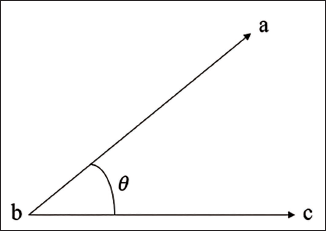
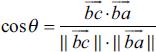
Based on the RGB input, MP brings out 33 coordinates of joint anatomical positions of the human body. In the current study, MP was tailored to produce 18 joint anatomical coordinate positions to compute the 12 joint anatomical angles on both sides of the body. These angles are left–right shoulders, left–right elbows, left–right wrists, left–right hips, left–right knees, and left–right heel angles. From the joint coordinates, the required kinematic angles were calculated using Equation (1):



The coefficient of variability (CoV) of these angles were calculated by dividing the standard deviation with the mean multiplied by 100 (SD/mean × 100).
Further, the X coordinates of the left and right ankle were graphically plotted using a Python program to identify the intersection points and their corresponding frame positions. Based on the intersection points, step length was defined as the difference between successive intersection points and step time as the difference between successive frame positions of the intersection points. Stride length was defined in feet as the distance between the subsequent ankle contact of the same foot, and stride time was defined as the time in seconds between the subsequent ankle contact of the same foot. Given the total time in seconds and distance in feet, speed was defined as the total distance covered in feet per second, and it was simply obtained by dividing the total distance in feet and the total time taken in seconds. Cadence was defined as the total number of steps divided by the total time taken.
Statistical Analysis
Principal Component Analysis
In previous research, several conceptual models of gait have been proposed with the aim of identifying specific domains of gait.63–65 These models have sought to improve our understanding of impaired gait by selecting a concise yet meaningful set of variables from numerous gait-related measures within each domain.66, 67 Such models have proven valuable in assessing gait impairments across various populations, including older adults, individuals with Parkinson’s disease, traumatic brain injury, mild cognitive impairment, and hip fracture, and children with cerebral palsy.63, 66, 68–70
Numerous distinct and independent domains of gait have been proposed in the literature, including pace, rhythm, asymmetry, variability, regularity, stability, amplitude, and postural control.66, 70–73 In this study, following the methodology outlined by Carcreff et al.70, 73 the focus was placed on investigating these different aspects of gait function, commonly referred to as ‘domains’. By carefully selecting the most relevant variables within each domain—specifically pace, rhythm, amplitude, and variability—the study aimed to identify representative variables that effectively capture the essential characteristics of each gait domain. This approach aimed to prevent unnecessary duplication of variables both within and across the domains, facilitating a comprehensive and concise assessment of gait function.
Machine learning techniques, such as principal component analysis (PCA), have been extensively used to reduce the redundancy of high dimensional data and extricate the relevant variables that constitute original high dimensional data. PCA preserves the originality and variability of the data by extracting significant information from a large set of variables.74, 75 To determine the most influential gait parameters within the parents of children with and without ASD, PCA was employed. Through PCA, the principal components (PCs) that accounted for a minimum of 95% of the total variance were identified. In selecting these PCs, the parameters with correlation coefficients or the loading factors (the extent to which individual variables contribute to specific PCs) between variables and PCs greater than 0.5, in absolute values, as indicative of their significance were considered. In the case of more than one variable found to be relevant in gait domains, the variables with the highest loading factor were selected. By using this approach, the gait parameters that exhibited strong associations with the PCs were prioritised, thereby highlighting their relevance in the analysis.
A second PCA was performed on the participants including the ASD and TD children and their respective parents to select the parameters in each domain of gait that explained 95% of the variance. A cutoff of 0.5 in absolute values of correlation coefficients or loading factors between the PCs and variables was identified in each domain, and the variable with the highest value was selected in each domain. The PCA was performed in an open statistical software R using the package ‘FactoMineR’. 76 All other analyses were performed in SPSS (version 27).
The normality assumptions were assessed using the Shapiro–Wilk test. To evaluate potential statistical differences in BAP traits and gait between parents of children with ASD and parents of TD children, either independent sample t-tests or Mann–Whitney tests were employed. We further employed either a parametric ANCOVA or Quade’s ANCOVA to investigate the differences in gait parameters between parents of children with ASD and parents of TD children, where anthropometric factors such as age, height, and weight were added as covariates. 77 The relationships between parents’ gait and BAP traits were examined using non-parametric Spearman’s correlations. Additionally, a non-parametric Spearman’s correlation was used to investigate the association between parents’ and children’s gait while controlling for age, height, and weight.
Results
Demographics of Parents With and Without ASD Children
Table 1 presents the age, height, and weight measurements of parents belonging to both the group of children with ASD and the group of children without ASD. Statistical analysis indicated no significant differences between the two groups of parents in terms of age, height, and weight.
Demographics of Parents.
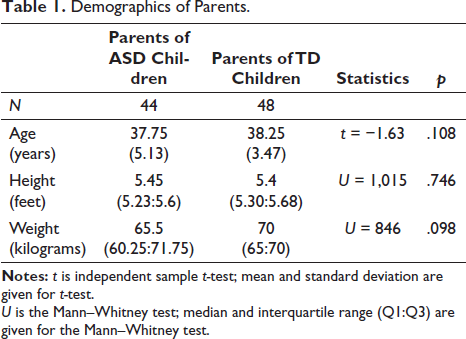
U is the Mann–Whitney test; median and interquartile range (Q1:Q3) are given for the Mann–Whitney test.
BAP Traits of Parents With and Without ASD Children
The results of statistical analysis for the BAP traits of parents with and without ASD children are presented in Tables 2, 3, and 4. Parents of ASD children exhibited significantly higher scores on measures of rigid personality (p = .001), pragmatic language (p = .000), and composite BAP traits (p = .000) compared to parents of TD children. However, there were no significant differences between the two groups of parents in terms of aloof personality (p = .68).
BAP Traits Between the Parents of Children With and Without ASD.
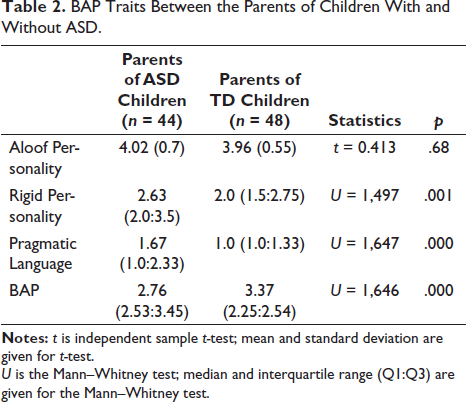
U is the Mann–Whitney test; median and interquartile range (Q1:Q3) are given for the Mann–Whitney test.
BAP Traits Between the Fathers of Children With and Without ASD.
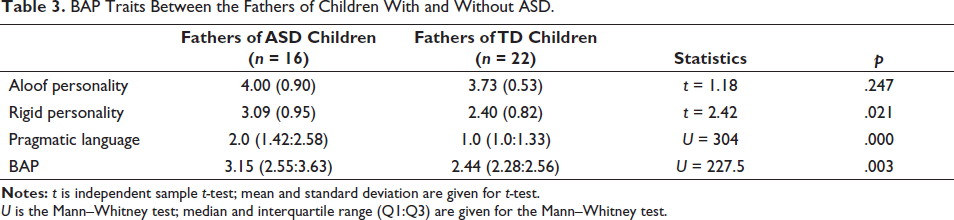
U is the Mann–Whitney test; median and interquartile range (Q1:Q3) are given for the Mann–Whitney test.
BAP Traits Between the Mothers of Children With and Without ASD.
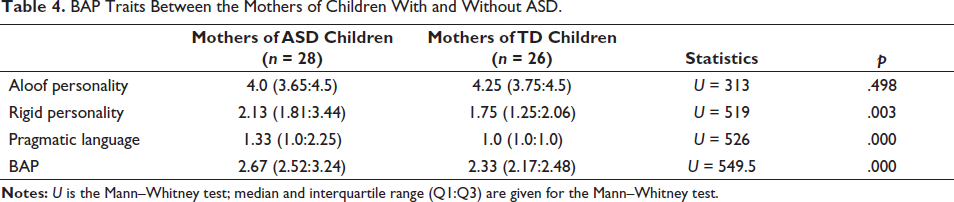
Both the parents of children with ASD did not differ significantly from fathers and mothers of TD children in terms of aloof personality. However, both fathers and mothers of children with ASD displayed significant differences in scores on measures of rigid personality (p = .021; p = .003), pragmatic language (p = .000; p = .000), and composite BAP traits (p = .003; p = .000).
In summary, parents of children with ASD exhibited higher BAP trait scores compared to parents of TD children, particularly in terms of rigid personality and pragmatic language. These differences were observed in both fathers and mothers of children with ASD. However, there were no significant group differences in aloof personality between the parents of children with ASD and parents of TD children.
Gait in Parents of Children With and Without ASD
The analysis of gait variables revealed that for the pace and rhythm domains, the first two PCs explained 95% of the variance. Among the six variables examined, speed and cadence showed the highest loading factors for the pace and rhythm domains, respectively, and were chosen as representative variables.
Regarding the amplitude domain, the first three PCs accounted for 95% of the variance, with the left heel angle displaying the highest loading factor. Thus, the left heel angle variable was selected to represent the amplitude domain of gait.
Similarly, for the variability domain, the first four PCs explained 95% of the variance, and the right heel angle CoV had the highest loading factor. Consequently, the right heel angle CoV variable was chosen as representative of the variability domain of gait.
Supplementary Figures S1a, S1b, and S1c display the correlation coefficients or loading factors between the PCs and the variables for the pace and rhythm, amplitude, and variability domains of gait, respectively. The scree plots depicting the explained variance are illustrated in Supplementary Figures S2a, S2b, and S2c, corresponding to the pace and rhythm, amplitude, and variability domains, respectively. As a result of the PCA, four variables—speed, cadence, left heel angle, and right heel angle CoV—were chosen from the initial 30 gait parameters. These variables were deemed representative of the pace, rhythm, amplitude, and variability domains of gait, respectively.
Table 5 presents the results of gait parameters obtained through PCA for parents of children with ASD and parents of TD children. Tables 6 and 7 specifically illustrate the gait parameters of fathers and mothers, respectively, of children with and without ASD.
Gait in Parents of Children With and Without ASD.
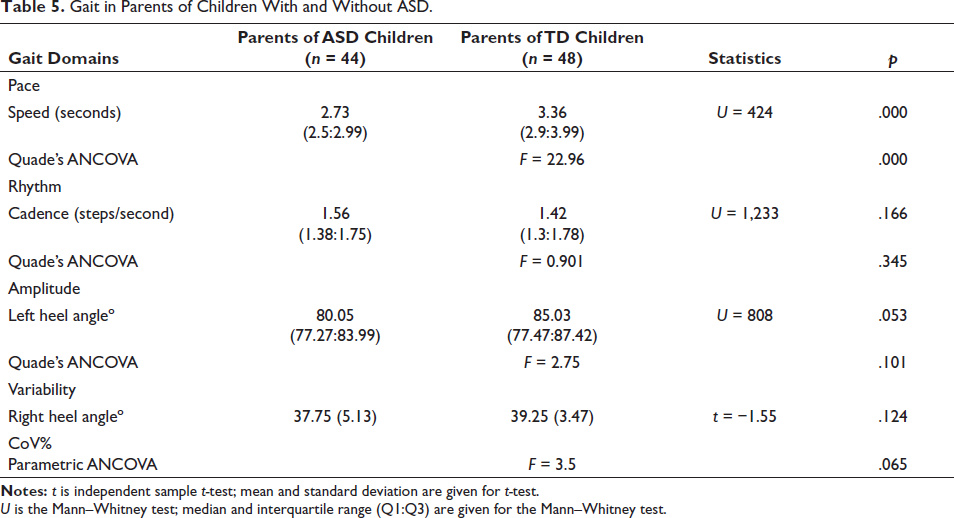
U is the Mann–Whitney test; median and interquartile range (Q1:Q3) are given for the Mann–Whitney test.
Gait in Fathers of Children With and Without ASD.
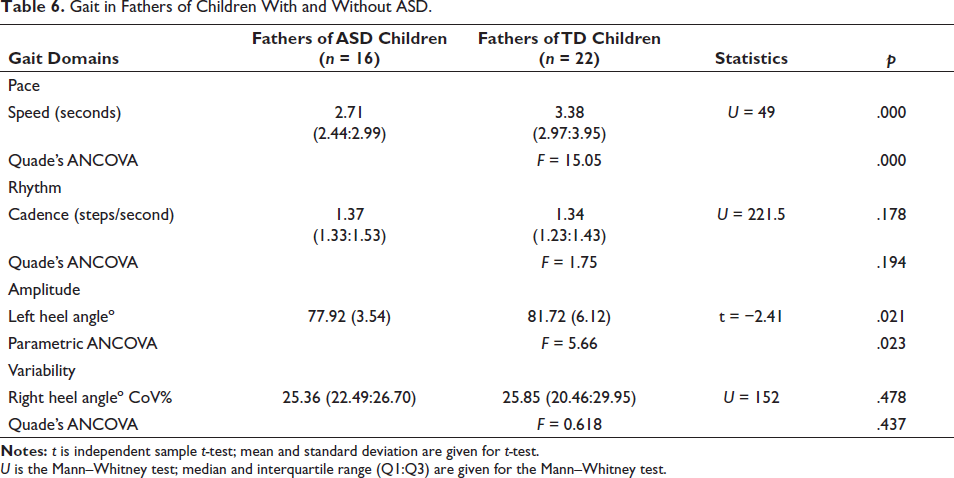
U is the Mann–Whitney test; median and interquartile range (Q1:Q3) are given for the Mann–Whitney test.
Gait in Mothers of Children With and Without ASD.
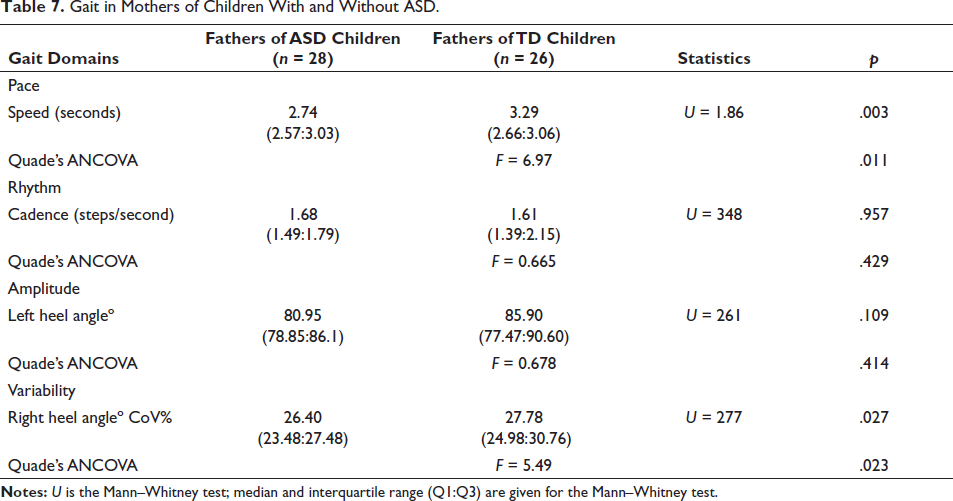
Overall, it was found that parents of children with ASD exhibited a significantly slower gait speed (p = .000). Specifically, fathers of children with ASD walked at a slower pace compared to fathers of TD children (p = .000), and they also had a reduced left heel angle CoV (p = .021). Similarly, mothers of children with ASD displayed a slower walking speed compared to mothers of TD children (p = .003), and they had a significantly lower right heel angle CoV (p = .027).
Association Between the Gait of Parents and Their BAP Traits
The associations between the gait parameters and the BAP traits were examined with non-parametric Spearman’s correlations. The correlation between the gait and BAP traits of parents of ASD children are given in Supplementary Table 2a. The rigid personality of BAP was significantly and negatively associated with the left heel angle (p = .011) in parents of children with ASD. In both the fathers and mothers of children with ASD, there were no significant associations between BAP traits and gait parameters (Supplementary Table 2b and 2c).
Supplementary Table 3a summarises correlations between the gait and BAP traits of parents of TD children. There were no significant associations between the gait and BAP traits in fathers of TD children (Supplementary Table 3b). However, in mothers of TD children, cadence was significantly and positively associated with aloof personality (Supplementary Table 3c).
Association Between the Gait of Children With and Without ASD and Their Parents
A second PCA was performed, including all participants, which comprised both ASD and TD children as well as their parents. In the domains of pace and rhythm for gait, the first three PCs accounted for 95% of the variance. Step length and stride time demonstrated high loading factors and were chosen as representative variables for the pace and rhythm domains. Regarding the amplitude and variability domains of gait, three and five PCs, respectively, explained 95% of the variance. The left heel angle and right heel angle CoV exhibited the highest loading factors and were selected as representative variables for the amplitude and variability domains, respectively. The correlation coefficients between the PCs and the variables or loading factors are illustrated in Supplementary Figures S3a, S3b, and S3c, which represent the pace and rhythm, amplitude, and variability domains, respectively. Furthermore, Figures S4a, S4b, and S4c illustrate the scree plots, providing an explanation of the variance.
Spearman’s non-parametric partial correlation was conducted between the ASD male children and their fathers, ASD female children and their mothers, TD male children and their fathers, and TD female children and their mothers on four gait parameters of step length, stride time, left heel angle, and right heel angle CoV. The age, height, and weight were added as control variables. A total of 11 fathers of ASD male children and 8 mothers of ASD female children had completed the data. A total of 9 fathers of TD male children and 14 mothers of TD children had completed the data.
There were no significant associations between step length, stride time, left heel angle, and right heel angle CoV of male children with ASD and their fathers (Supplementary Table 4a) and female children with ASD and their mothers (Supplementary Table 4b). The step length of the TD children was positively and significantly correlated with the stride time of their fathers (Supplementary Table 4c; p = .043). There were no significant associations between the TD female children and their mothers on gait parameters (Supplementary Table 4d).
Discussion
The current study examined the differences between the parents of children with ASD and in parents of TD children on BAP traits. A similar pattern was observed regarding the BAP traits in parents of children with and without ASD. Overall, the parents of children with ASD had significantly higher scores on rigid personality, pragmatic language, and composite BAP traits than the parents of TD children. No significant differences were observed in aloof personality between the two groups of parents. These results are partially consistent with the previous findings.7, 18, 78 Sasson et al. 18 observed that parents of children with ASD had significantly higher scores on all the subscales of BAP and on the composite BAP score. However, in the aloof personality, scores of fathers of children with ASD were higher than those of parents of TD children but were statistically not significant. The mothers of TD children had a higher score on aloof personality than the mothers of ASD children. These were also not statistically significant.
The study also assessed the differences in gait parameters between the parents of children with ASD and parents of TD children. The association between the gait parameters and BAP traits of two groups of parents were also examined. The parents of children with ASD walked slower than the parents of TD children and hence exhibited a significantly slower gait speed. This pattern was observed in both the fathers and the mothers of children with ASD. The fathers of children with ASD displayed a significantly reduced left heel angle than the fathers of TD children, and the mothers of children with ASD had significantly lower right heel angle CoV than the mothers of TD children.
In summary, the results indicate that parents of children with ASD demonstrate slower gait speed compared to parents of TD children. This finding is particularly significant for both fathers and mothers of children with ASD, with additional differences observed in specific gait parameters such as left heel angle CoV for fathers and right heel angle CoV for mothers. Previous studies have shown that adults with ASD walk slower compared to healthy participants.79, 80 In a classical study of gait in children with autism, Vilensky et al. 81 observed that ASD children had significantly reduced dorsiflexion angle at heel strike. The significant differences in gait speed, left heel angle, and right heel angle between the parents of children with and without ASD are unique in the current study because the gait patterns in parents of children with ASD were studied for the first time to the best of the researchers’ knowledge. These findings indicate a unique gait pattern of parents of children with ASD and may be indicative of motor and gait endophenotype in ASD. Further studies are needed to establish these findings within the context of parents of children with ASD.
A significant negative correlation was seen in parents of children with ASD between the left heel angle and rigid personality of BAP. There were no significant associations between the gait and overall BAP traits of both the fathers and mothers of children with ASD. In fathers of TD children, no significant association was observed between the gait parameters and the overall BAP traits. However, in mothers of TD children, a positive and significant association was seen between the cadence and aloof personality.
The parents of children with ASD displayed high scores on BAP compared to parents of TD children. The decreased left heel angle may be indicative of inflexibility in the human body during locomotion and, therefore, was significantly associated with the rigid personality of BAP traits. The mothers of TD children had a slightly higher but non-significant score on aloof personality of BAP traits than the mothers of children with ASD. The aloof personality of mothers of TD children has a significant positive association with the cadence. Shigeta et al. 82 have reported that healthy participants high on autistic traits display greater waist angular velocity when passing another person to avoid contact. The researchers have argued that the participants high on autistic traits find it difficult to perceive the motion of others when they approach. This notion is reinforced by Asada et al. 83 who demonstrated that individuals with autistic traits have a smaller personal space compared to those who are typically developed, and they also exhibit reduced distances between themselves and others when approaching each other. Other studies have also suggested that individuals with autistic traits perceive motion differently compared to individuals who develop typically. 84
It is noteworthy here that both fathers and mothers of children with ASD exhibited reduced gait speed compared to parents of TD children. However, no significant association was observed between the gait speed of parents of children with ASD and any BAP trait subscales. The BAPQ questionnaire assesses aloof personality, rigid personality, and pragmatic language impairments, none explicitly measuring motor behaviour or gait speed. Given that parents of children with ASD walk slower and gait speed may be a motor endophenotype, there is a need to revise the BAPQ or develop a comprehensive version that includes items or subscales indicating gait speed or motor behaviours.
This study further investigated the relationship between the walking patterns of fathers and mothers and their male and female children. The results indicate no significant correlations in the gait parameters between fathers and their male children with ASD, mothers and their female children with ASD, as well as mothers and their TD female children. However, a notable association was observed between the stride time of fathers with TD children and the step length of the TD children. Despite these findings, there were no discernible similarities in gait patterns between children with ASD and their parents or between TD children and their parents. Therefore, it can be concluded that the observed gait phenotype of both male and female children with ASD did not exhibit any significant connection with the gait patterns of their fathers or mothers.
Conclusion and Limitations
The parents of children with ASD displayed significantly higher scores on rigid personality, pragmatic language, and overall composite score of BAP. The parents of children with ASD walked slower than the parents of TD children. This finding provides preliminary evidence suggesting gait as an endophenotype in parents of children with ASD. Further studies are needed to corroborate these findings. There were no significant associations in gait patterns between the children with ASD and their parents.
Despite these findings, several limitations of the study need to be acknowledged. First, the sample size of the two groups of parents was insufficient, and caution should be exercised when interpreting the sex-based differences in BAP traits and gait patterns in these groups. Second, the sample of male and female children and their corresponding sex-based parents was also small, suggesting that the results regarding the association between children’s gait and their parents’ gait patterns may be preliminary. Future studies should aim to include larger sample sizes to address these limitations adequately. Third, the children’s groups and the parents’ groups were not matched for age and sex, although statistical analysis indicated no significant differences in these demographics between the groups. Future studies could consider recruiting participants matched for these demographics to minimise their potential influence on gait and BAP traits. Lastly, the parents of children with ASD displayed higher scores on BAP traits, but it remains uncertain whether these parents may meet the criteria for ASD.
Footnotes
Acknowledgements
We extend our gratitude to the children and their parents who participated in our research. Additionally, our appreciation goes to the two autism rehabilitation centres in Kanpur, India—Amrita Rehabilitation Center and Keshav Devi Autism Rehabilitation Centre—for their valuable assistance in the study. Special thanks are also due to Dr Rashmi Kapoor, the founder and director of Amrita Rehabilitation Center; Dr Vibha Gupta, the head of Amrita Rehabilitation Center; and Dr Arun Tiwari, of Keshav Devi Autism Rehabilitation Center.
Authors’ Contribution
UJG: Conceptualization, data curation, methodology, data analysis, writing & reviewing the draft.
BB: Conceptualization, data curation, methodology, writing and reviewing the draft, & supervision.
KSV: Conceptualization, data curation, methodology, reviewing the draft, & supervision.
Declaration of Conflicting Interests
The authors declared no potential conflicts of interest with respect to the research, authorship, and/or publication of this article.
Funding
The author disclosed receipt of the following financial support for the research, authorship, and/or publication of this article: The study was partly supported by Pavitar Joneja Chair fund to the second author, Braj Bhushan.
ICMJE Statement
This article complies with the International Committee of Medical Journal Editors (ICMJE) uniform requirements for the manuscript.
Informed Consent
Written consent from the parents of the children was obtained.
Statement of Ethics
The research protocol was approved by the Institutional Ethics Committee of the Indian Institute of Technology Kanpur (protocol number IITK/IEC/2021-22/I/24).
Supplemental Material

References
Supplementary Material
Please find the following supplemental material available below.
For Open Access articles published under a Creative Commons License, all supplemental material carries the same license as the article it is associated with.
For non-Open Access articles published, all supplemental material carries a non-exclusive license, and permission requests for re-use of supplemental material or any part of supplemental material shall be sent directly to the copyright owner as specified in the copyright notice associated with the article.
