




Abstract
Background
The education system is the lifeline of a nation. If the education system is strong and free from issues, the nation will, certainly, progress. Teachers have a key role in nation-building. Their opinions for overcoming the issues and challenges of education in the changing horizon can work as a roadmap to quality education.
Purpose
The researcher has surveyed 450 teaching professionals to explore the issues and challenges of the changing horizon for teaching professionals in India.
Methods
The researcher has developed a five-point rating scale, after an extensive literature review of regulations and reports of commissions and regulatory bodies. MS Excel 2016 version is used and analysis has been done by finding the frequency of respondents on each point of the rating scale. Then, the results have been interpreted and concluded.
Results
The recommendations to overcome the issues and challenges for teaching professionals are also given in the changing horizon in India.
Conclusion
Concerned professionals must consider factors including adequate infrastructure, up-to-date curricula, qualified faculty, suitable class sizes, learning materials, financial support and well-planned guidelines for quality education in order to improve education quality. A new teacher education program named as Integrated Teacher Education Programme (ITEP) 1 and a reform in educational policy as New Education Policy (2020) 2 have begun. All the teaching professionals are hopefully waiting for their implementation. A great future for everyone will undoubtedly result from our work.
Keywords
Introduction
The future of a country is in the hands of bright students of the country. The learning of the students mainly depends on the qualified teachers. 3 There is no monitoring tool for a teacher’s knowledge once he becomes a teacher. With the lack of IT resources good vocational courses in teacher education, and a lack of connection between teacher education and other disciplines of higher education, the teachers are not in a position to prepare students for further education with their respective skills. 4 Hence, it is necessary to have skilful and resourceful teachers at all levels of education. The emphasis is always to improve school education and teacher education. Several committees and commissions are set in India for this purpose. A few main recommendations regarding teaching professionals are as follows:
Radhakrishnan Commission (1948–1949)
Radhakrishnan Commission was the first education commission post-independence that accepted that the conditions of teachers are very challenging. It proposed, among other things, that they get a certain percentage of increased salary.
Kothari Commission (1964–1966)
The commission recommended that research should be given maximum priority to accelerate the national economy.
Mudaliar Commission
The commission advocated criteria for the selection of teachers. The provisions made to improve teacher education.
The National Policy on Education (1986)
The policy focussed on child-centred education and launched different programmes to improve primary education.
National Knowledge Commission
The main recommendations of this commission are as follows:
Creation of universities
Achieve excellence
Creation of regulatory institutions
National Educational Policy 2020
The main objective of New Education Policy 2020 (NEP) is to bring changes in the current levels of studies as follows:
Preschool: Up to Class 5
Middle school: Class 6 to 8
High school: Class 9 to 12
Degree: Class 12 onwards
The four-year Integrated Teacher Education Programme (ITEP) has been introduced. This teacher education program integrates Liberal Science and Liberal Arts with pedagogy. 5 This professional training program is qualitative and well-designed. NEP and ITEP have also given guidelines for good infrastructure facilities like libraries and laboratories for teachers and students in teacher’s training institutes, the guidelines for appointments of teachers, and so many other guidelines related to many aspects.
Intellectual curiosity, scientific temperament, creativity, good professional spirit and the latest skills across a range of fields like sciences, social sciences, the arts, humanities, languages, technological and vocational subjects are expected from a teacher. Apart from this, several issues and challenges are there for teaching professionals to face. The researcher has surveyed to explore the issues and challenges for a teaching professional in the present time.
Objectives of the Study
To identify the current issues and challenges for teaching professionals in India.
To explore the attitude of teaching professionals for the current issues and challenges of teaching.
Hypothesis
The study was exploratory; hence, the researchers have framed no hypothesis.
Method
The researcher reviewed the literature related to primary, secondary, higher and teacher education and tried to identify the main issues and challenges of education. Then, the researchers discussed them with the experts and prepared the tool to explore the attitude of the teachers towards these issues and challenges.
Research Tool
The researchers have prepared a testing tool to collect data and validated it. The pilot test was conducted on a small sample of teachers. The content validity was verified. The reliability was found to be 0.81 by the split-half method.
The item analysis was done with the help of the experts. The tool was a 5-point rating scale for measuring satisfaction with the concerned statement. These statements were related to the different aspects of the education system. The statistical techniques were also discussed with the experts.
Sample
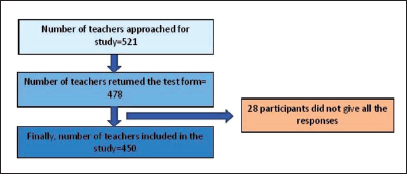
The sampling technique is convenient sampling. The sample size taken is 450 teachers teaching at different levels of education (Figure 1).
Flowchart to Show the Number of Participants.
Statistical Analysis
The researcher tabulated the data carefully. MS Excel 2016 version has been used and analysis has been done through finding the frequency of the responses on the scale. The researchers themselves prepared the figures, and tables to represent the data.
Delimitation of the Study
The researcher has collected data from the teachers in India. Hence, the survey is confined to India only.
The recommendations are derived from the views and discussions with the experts.
Results
The researcher has analysed the data on MS Excel version 2016 and summarised as below:
Infrastructural Facilities
The sustainable development goals, which are defined by the United Nations and scope the development agenda for all countries in the world, require countries to build and upgrade education facilities that are child, disability and gender-sensitive, and provide safe, non-violent, inclusive and effective learning environments for all. 6 The first statement was related to the infrastructural facilities of the educational institutions.
To Show the Data Concerning Infrastructural Facilities.
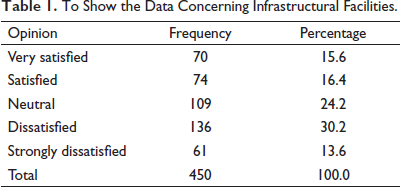
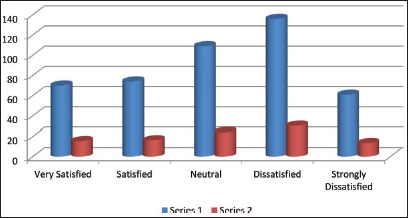
According to the data collected, 24.2%, that is, 109 teachers were neutral about infrastructural facilities available in the educational institution, and only 30.2%, that is, 136 teachers were dissatisfied (Table 1 and Figure 2).
To Represent the Data Concerning Infrastructural Facilities.
Basic infrastructural facilities like toilet facilities separate for boys and girls, facilities for students of special needs, a library, safe drinking water and a playground. 7
The quality of education depends directly on the learning process. There is less availability of learning resources in schools/colleges. Most of the schools/colleges have poor-quality library facilities. All this leads to poor service to the library. Very few institutions have digital libraries. There are no internet facilities for accessing online databases and resources.
Human Resource Management is putting efforts into providing these facilities as early as possible by taking the initiatives at the Panchayat level to the national level of authorities whether government or non-government.
Size of Class
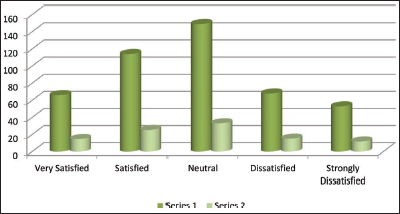
Large class sizes are widespread in the education system. With classrooms filled with students and teachers insufficient to provide enough individual attention, the student learning experience is mostly sacrificed. Teachers try to manage classes for 50 to 60 students in some regions of the country.
To Show the Data Concerning Class Size.
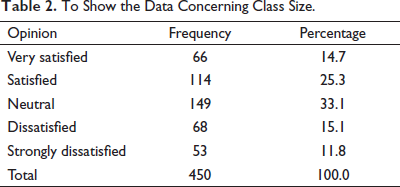
According to the data collected, 33.1%, that is, 149 teachers were neutral about the size of the class and only 25.3%, that is, 114 teachers were satisfied with the class size (Table 2 and Figure 3).
To Represent the Data Concerning Class Size.
Level of Student Intake
Another factor affecting the quality of education is the level of students admitted to schools and universities.
To Represent the Data Concerning the Levels of Student Intake.
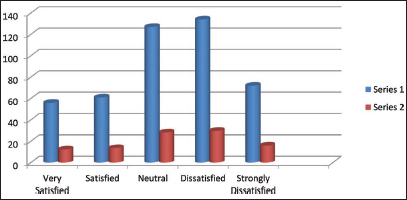
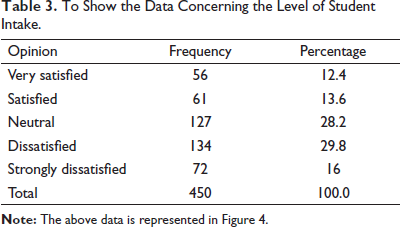
According to Table 3, 28.2%, that is, 127 teachers were neutral about the level of student intake and only 29.8%, that is, 134 teachers were satisfied (Table 3 and Figure 4).
To Show the Data Concerning the Level of Student Intake.
Central or state governments have made serious attempts to open any new schools in primary, secondary and upper-secondary levels and colleges over the past few decades.
Teaching Faculties
The lack of teachers and the inability of the government educational system to attract and retain well-qualified teachers have challenged the quality of education for many years at every level of education.
The percentage of teachers teaching only primary (36% in 2020–21 from 37% in 2019–20) and only upper primary (22% in 2020–21 from 23% in 2019–20) has reduced. 8 This reduction has been compensated mainly through a percentage of teachers teaching secondary and higher secondary (4% in 2020–21, from 3% in 2019–20), primary and upper primary (8% in 2020–21 from 7% in 2019–20). 9
To Show the Data Concerning the Teaching Faculties.
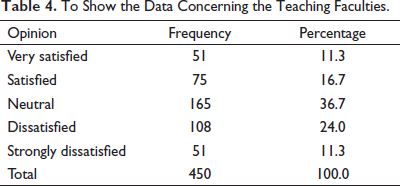
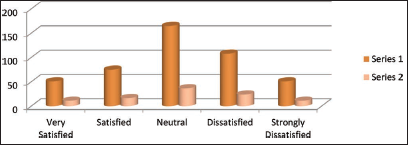
In total, 36.7%, that is, 165 teachers were neutral about teaching faculties and only 16.7%, that is, 75 teachers were satisfied with the present situation of availability of teaching faculties (Table 4 and Figure 5).
To Represent the Data Concerning the Teaching Faculties.
Large numbers of PhD/NET candidates are unemployed even if there are many vacancies in higher education, and these eligible candidates apply at the school level. 10 This situation is increasing dissatisfaction among teachers. One should get a job, that meets one’s capabilities and potential. The revised salaries in government schools are far better than salaries in private higher education institutions. The private institutions exploit the teaching professionals at this point.
Quality Education
The overall standard of education is not meeting the international standards in many institutions. So many experiments are being started at all levels of education, providing no proper guidelines to teachers.
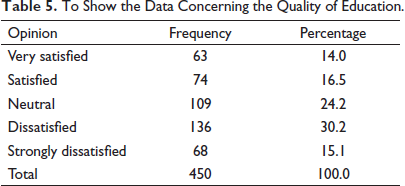
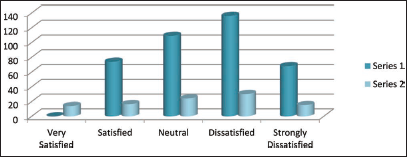
According to the above Table 5, 24.2%, that is, 109 teachers were neutral about the quality of education and only 16.5%, that is, only 74 teachers were satisfied (Table 5 and Figure 6).
To Show the Data Concerning the Quality of Education.
To Represent the Data Concerning the Quality of Education.
The efforts are initiated in the NEP, yet to be implemented effectively for better results.
Quality of Teaching
The quality of teaching depends mainly on the quality of teachers we have. 11 The teachers must have extensive knowledge of their subject matter, curriculum, educational standards, enthusiasm and desire to learn throughout their careers. There are several educational institutions in India, but 20 to 30 % of them have a high-level teaching staff. 12
To Show the Data Concerning the Quality of Teaching.
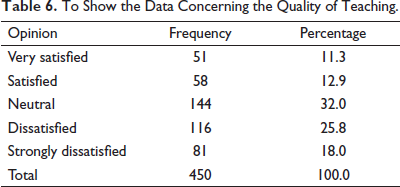
According to the data collected 32.0%, that is, 144 teachers were neutral about the quality of teaching and only 12.9%, that is, 58 teachers were satisfied (Table 6 and Figure 7).
To Represent the Data Concerning the Quality of Teaching.
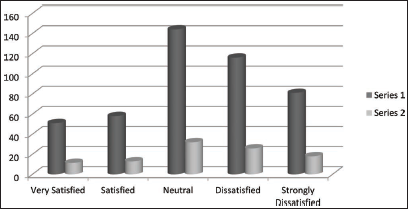
Project-Based Learning
Generally, the classroom teaching lacks learning-based projects, which results in lack of project-based learning. The students at every level need to learn new skills, especially vocational skills. The theoretical knowledge is not enough, and the students also need practical knowledge as well.
To Show the Data Concerning the Project-Based Learning.
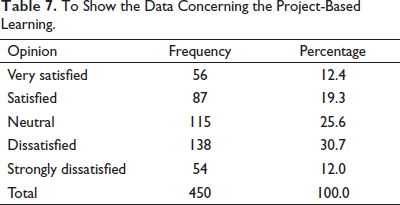
According to the data collected, 12.4%, that is, 56 teachers were neutral about project-based learning in different classes and streams, 30.7%, that is, 138 teachers were dissatisfied and 12%, that is, 54 teachers were strongly dissatisfied (Table 7 and Figure 8).
To Represent the Data Concerning the Project-Based Learning.
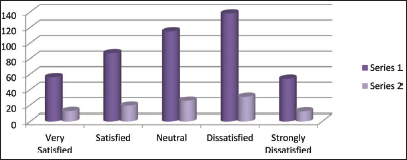
Relation Between Education Provided and Job-Oriented Education
Good and project-based learning experiences can provide a good job to the students.
To Show the Data Concerning the Relation Between Education Provided and Job-Oriented Education.
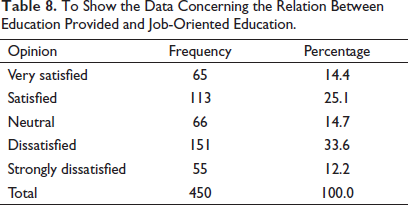
According to the above analysis of data, 14.7%, that is, 66 teachers were neutral about and 25.1%, that is, 113 teachers were satisfied (Table 8, Figure 9).
To Represent the Data Concerning the Relation Between Education Provided and Job-Oriented Education.
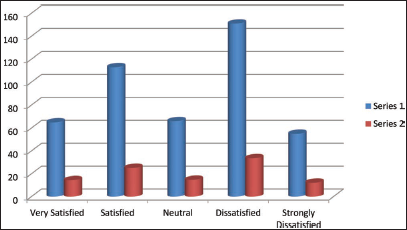
The industries are facing trouble finding a suitable employee because the education provided is not appropriate to work directly in the industry, so before that, a company is required to spend a large amount on offering training to employees, which is a drawback of the present education system. The focus should be there on job-oriented education.
Curriculum
The opinions on the suitability of the curriculum were also taken from the teaching professionals.
To Show the Data Concerning Curriculum.
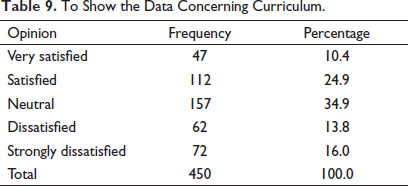
According to the data collected, 34.9%, that is, 157 teachers were neutral about the curriculum and only 24.9%, that is, 112 teachers were satisfied (Table 9 and Figure 10).
To Represent the Data Concerning Curriculum.
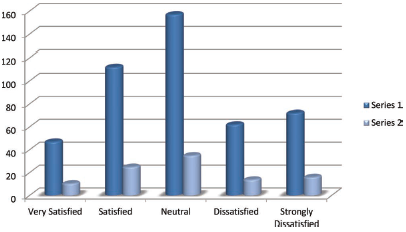
The curriculum is overloaded with theoretical knowledge. The curriculum is concerned with passing the examinations. Not only that, the curriculum does not meet the market demand. 13 Old and outdated curriculums are followed, whereas the demands for quality and skills are changing rapidly due to globalisation. The curriculums are revised without emphasis on the requirements of the industries. There is a lack of subjects that one can take in college.
Research and Innovation
The opinions on the scope of research and innovation were also taken from the teaching professionals.
To Show the Data Concerning Research and Innovation.
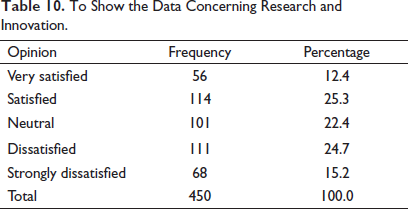
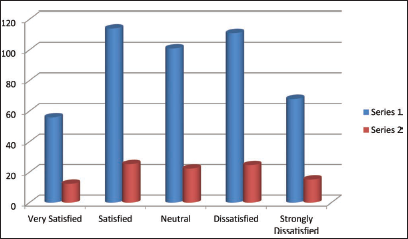
According to the data collected, 22.4%, that is, 101 teachers were neutral about research and innovation 25.3%, that is, 114 teachers were satisfied, whereas 24.7%, that is, 111 teachers were dissatisfied (Table 10 and Figure 11).
To Represent the Data Concerning Research and Innovation.
There is not enough focus on research in institutions of education for most in teacher education and other higher education specifications. 14 There are insufficient resources and facilities and a limited number of quality faculties to advise the students. Most research scholars do not have any ‘fellowships’ or do not receive their ‘fellowships’ on time, which affects their research. Moreover, institutions are not attached to the research centres. So, this is another challenging area of education in India. 15 All this results in limited numbers of innovations and choices in front of teachers and students at every level of education.
Conclusion
We know the importance of quality education. It directly affects all aspects of the growth of a nation and helps to stand high. In India, education has developed a lot in quantity and quality. However, we are still missing quality as expected globally. To improve the quality of education, the concerned experts have to think of parameters such as enough infrastructure, updated curriculum, skilled faculties, appropriate class size, learning resources, financial help and well-planned guidelines for quality education. The change of education policy and a new teacher education program has started. This effort will certainly bring a bright future for all.
Recommendations
The availability of infrastructural facilities should be ensured.
The teacher–student ratio should be monitored in both private and government educational institutions.
Revision of syllabus from a theory-based system to a system and more emphasis should be paid to practical knowledge, skill development and preparation for the job market.
There is an excessive dependence of the education system on marks and grades rather than considering skill and knowledge. The skill-development programs should start for all.
Facilities and incentives should be given to teachers. Teaching should be one of the highest-paid services in the country. Uniform salary scales should be there in private and government sectors. At least, a respectable amount should be paid as salaries.
Skill development programs, which the government is doing, now need to be encouraged.
Footnotes
Acknowledgements
We want to acknowledge Dr Ajay Singh, JD (SSA) and Principal, DIET, Lucknow, Uttar Pradesh, who gave me motivation for this study. We are grateful to Prof Dr Mala Tandon, HOI, Amity Institute of Education, Amity University, Lucknow, Uttar Pradesh for supporting this project. Last but not the least, thankful to all participating teacher educators for giving their time, guidance and support.
Authors’ Contribution
All the authors contributed equally.
Declaration of Conflicting Interests
The authors declare no conflicts of interest with respect to the research, authorship or publication of this article.
Funding
The author received no financial support for this research, authorship and publication of this article.
Informed Consent
All the participants gave their written informed consent to take part in the study.
Statement of Ethics
The Ethics Committee of Amity University, Lucknow, Uttar Pradesh, gave the approval for the study.
