




Abstract
Background
Employees are the real capital of any organisation, and to keep the employees productive and functional, employers need to focus on the psychological capital and social relationship of the employees to keep them engaged in their work. This study examined the emerging field of constructs of psychological and social capital to examine Indian employee’s behaviour.
Purpose
The purpose of this study is to examine a comprehensive model of the relationship between employees’ psychological capital and work engagement. Furthermore, it examines the moderating effect of social relationships between them.
Methods
This is a primary survey conducted mainly on the manufacturing industry. A sample of 375 mid- and senior-level executives of different age groups was considered in the study from India’s public and private manufacturing sectors administering a questionnaire survey. A random sampling technique was used for data collection. This study applied SPSS and Amos software to validate the measurement model.
Results
The results indicate a significant correlation among PsyCap, work engagement, and social relationships. PsyCap and social relationships are positively connected to work engagement. Thus, these results provide preliminary support for our hypotheses. The finding suggests that psychological capital and social relationships positively influence work engagement, and social relationships moderate the association between positive psychological capital and work engagement. It helps employees get better engaged at work.
Conclusion
Organisations must develop psychological capital to provide resources to employees and share a supportive relationship. Developing and maintaining a supportive relationship for employees and employers is important. In the future, both qualitative research methods and longitudinal data from other sectors can be used to understand the interplay between social and psychological capital for enhancing work engagement. Developing and cultivating positive social relations can help employees utilise their psychological strength to better engage in work.
Keywords
Introduction
In an ever-changing and uncertain work environment, employees face higher work pressure, greater job insecurity, diminished choice, control and lack of role clarity.1, 2 As a result, employees confront various mental and emotional demands, threats and conflicts in their jobs, leading to poor performance and distressing personal and social relationships (SR). Psychological capital (PsyCap) helps people engage themselves, improving positive social relationships at the workplace for optimal functioning. 3 PsyCap provides strengths that employees can use to engage at work.4, 5 Good workplace relationships help employees to thrive and flourish. It also helps in fostering positive emotions and meaningful engagement between individuals. 6 Many studies have explored the relationship of PsyCap with work engagement. However, empirical evidence on the significance of psychological capital and social relationship in meaningful work engagement is scarce in the Indian organisational context. Additionally, the legal setup and economic environment that influence Indian organisations may differ from other countries.
This study draws input from the conservation of resources (CoR) 7 theory and the broaden-and-build theory. 8 The CoR theory emphasises positive adaption under the loss and explains employee’s ability to obtain, manage and foster essential resources to fulfil work-life demands. 9 Employees with high cognitive and emotional work resources influence their well-being.9, 10 Similarly, broaden-and-build theory (BBT) mentioned that positive emotions trigger employees’ desirable behaviour and positive engagement and facilitate psycho-social resources. 11 Positive social relationships at work strengthen the development of positive emotions at the workplace for better utilisation of psychological resources resulting in higher levels of engagement. The study intends to examine a model with a theoretical premise that SR would moderate the relationship of PsyCap on work engagement (WE) in the Indian cultural context. The contributions of the study are many. First, it examines how the individual PsyCap (hope, resilience, optimism and efficacy) can enhance WE in Indian manufacturing sectors. Second, it emphasises the significance of positive WE in building an effective organisation based on the CoR 7 and affective event theory. 12 Third, it also contributes by explaining the significance of SR in strengthening the connection between work engagement and PsyCap. This study explores the underlying psychosocial concept that extends our idea of workers’ work perspective and behaviour and formulates policies to improve positive WE.
PsyCap refers to a positive condition of worker’s psychological growth and comprises self-efficacy, optimism, hope and resilience. 5 Hope indicates one’s ability to be clear about purpose, develop schemes for achieving those goals, and be enthusiastic about sustaining the effort.13, 14 Self-efficacy is the certainty of a person to identify the pathway and faith in their abilities to achieve the desired results.15, 16 Resilience helps individuals to revert back from adversity with increased positivity. 17 Optimism is an attitude or approach to look at the brighter side of events to expect a favourable outcome, indicating how people frequently explain actions in their lives. 18 PsyCap helps increase an individual’s ability to manage challenging circumstances and be more proactive in promoting engagement. Employees can utilise these psychological strengths to generate enough confidence to complete tasks, meet their desired goals, remain optimistic when things are unfavourable and bounce back after an adverse event. In spite of the significance of PsyCap to organisational performance, its link with (WE) is inadequately examined. 19 Therefore, it is vital to explore the influence of PsyCap on WE in the Indian cultural factors.20, 21 Thus, we propose utilising these psychological capacities as strengths/resources for employee engagement.
Work engagement is a situation-specific concept that passes a positive concept that develops in individuals. 22 WE23, 24 emphasises the employee’s association with work roles and includes inspecting physical, emotional energy and cognitive.25, 26 The job demand resource model (JD-R) also specifies that individual resources can motivate people to get involved in work. 27 The positive psychology perspective 28 suggests that such persons get engaged in their work even in a high job demand context. Work engagement comprises three aspects-vigour (resilience and persistence during adversity and the readiness to make an attempt in one’s work); sedication (engaged in one’s work and feeling a sense of importance, pride, challenge, idea and enthusiasm) and absorption (focused and absorbed in one’s work). 29 Work engagement states changes over time with the availability of PsyCap and external factors. 30 The purpose and persistence of engaged employees are guided by a strong belief of future success.30, 31 PsyCap is a mental asset that facilitates work engagement, assuming executives with personal resources conserve and expand them to attain goals. Thus, we propose to examine how psychological capital explains the variance in executives’ work engagement and improved well-being.
Social relations refer to the connections and frequent interactions among various stakeholders, which can improve mental and physical health. SR also provide opportunities for enjoyable interaction and companionship. SR and interactions get marked by compassion, loyalty, honesty, respect and forgiveness. Positive relationships enable positive outcomes, including physiological, psychological, emotional and organisational.32, 33 Seligman suggests that happiness is achieved with good SR, though it is not always guaranteed. 34 Engaged employees spend time socialising and working as volunteers. 29 The SR provides a contextual resource and helps individuals grow and succeed at work and health. 35 The presence and absence of support from SR impact the employee’s motivation, dedication and engagement to work. Similarly, well-being represents the psychological outcome that an employee experiences from social support; in return, it better engages in work and values the organisation. Thus, we propose that social relationships foster psychological capital development for better work engagement and well-being between workers.
This study focuses on employees of manufacturing organisations in India, the most impacted sector during the pandemic, leading to productivity loss due to the shutdown. The companies responded by going digital in their operations, using technology to connect with stakeholders and utilising ecosystem partnerships for growth and data monetisation. However, management faced challenges in engaging employees meaningfully in an uncertain and volatile environment. PsyCap and social relationships are thus critical for employees to facilitate and motivate them to engage in the workplace. It can happen through a supportive organisational environment and utilising their strengths and resources. Guidance and physical support from colleagues at work lead to coping with workplace demands.36, 37 Studies of Luthans et al. 36 and Nigah et al. 37 indicate the importance of social relationships (including relationships between family members, friends, neighbours, co-workers and associates) in influencing employees’ work engagement. We propose addressing the gap by identifying the function of social relationships and PsyCap in work engagement. It might help employees thrive even in odd situations. 38 Employees must utilise their psychological resources and develop excellent SR to remain productive through better engagement. SR and PsyCap may thus reduce the adverse effects of work pressure in an uncertain work environment. The study will add on to the literature by examining the underlying mechanism of association between the PsyCap and WE and exploring the moderating role of SR between the PsyCap and WE. It will have implications for management to create an enabling environment, develop a positive SR for better coping with the job demands and remain productive. Thus, we propose the following research objectives.
Examine how psychological capital explains the variance in executives’ work engagement.
Investigate the degree to which social relationships would moderate the relation of psychological capital with work engagement.
When employees are aware of how their psychological resources affect their work engagement the emphasis on psychological resources increases. Work engagement refers to vigour, dedication and absorption of employees. Optimal work engagement is possible when employees have better psychological resources such as hope, efficacy, resilience and optimism. As PsyCap is a personal resource that helps employees to stay engaged in their work, PsyCap in this study is measured as the employees’ motivating factor for work engagement. This discussion brings us to our first hypothesis.
H1: Psychological capital will positively relate to work engagement.
When employees are in a state of positive emotions, it triggers desirable behaviour and engagement and facilitates psycho-social resources as per the BBT theory. The COR theory conveys similar idea with regard to employees ability of positive adaptation under any loss and also their potential to manage resources to cope with work demands. Thus, social relationship is measured as employees’ resources to be engaged in work. This discussion brings us to our second hypothesis.
H2: Social relationships will positively relate to work engagement.
Employees with better social relationship at workplace are better able to deal with the work demands. Individual resources can motivate employees to get engaged in their work even in a high job demand context as per the JD-R model. Thus, we propose that good social relationship foster PsyCap development and better work engagement among employees, which leads us to our third hypothesis.
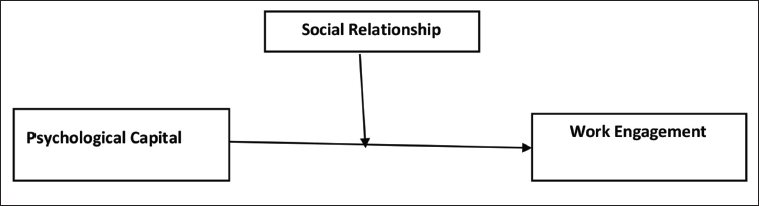
H3: Social relationships would moderate the relationship of PsyCap with work engagement.
The proposed conceptual diagram presenting the hypothesised relation among the variables is given in Figure 1.
A Proposed Conceptual Diagram Presenting the Hypothesised Relation Among Variables.
Methods
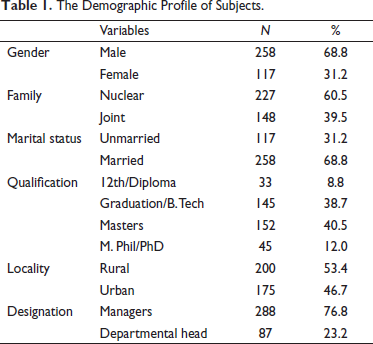
A quantitative research method is used in this research. Data were collected through survey questionnaires. We have used convenience sampling for selecting organisations as we approached them for permission to collect data. We selected respondents using a random sampling process from participants willing to participate. The sample consists of 375 employees (117 females and 258 males) from three public and three private sector organisations. The data were collected from leaders (managers/team leaders) and subordinates, including both males and females. The subjects’ ages ranged from 21 to 59 years, and they belong to nuclear and joint families, with rural and urban backgrounds. Educational qualifications range from 10, 12th/Diploma to PhD holders, and work experience ranges from 1 to 38 years. Table 1 shows the demographic data of the sample distribution.
The Demographic Profile of Subjects.
Measures
To maintain uniformity, we used the following measures and followed a five-point Likert scale “1” (= strongly disagree) to “5” (= strongly agree) to measure the various variables. A brief description of these measures is as follows.
Psychological Capital
A total of 12 items of PsyCap 39 were used to assess and consisted of 12 items and four dimensions: resilience, efficacy, hope and optimism. The reliability coefficient was 0.89.
Work Engagement
A total of 17 items of Work Engagement Survey 22 were used to measure three constructs: Vigour, Dedication and Absorption. The reliability coefficient was 0.91.
Social relationships40, 41
It comprised 16 items related to social support, social integration and stress. The reliability coefficient was 0.56.
Data Collection Process
We have collected data from three public and three private manufacturing organisations that agreed to participate in the survey. From each organisation, we selected respondents randomly after their consent. We gave them the questionnaire and described the intent of the study. Participants got basic instructions regarding filling out the questionnaires. We have dropped the incomplete responses (25%). Finally, we got 375 (75%) completed questionnaires out of 500 distributed in all respects.
Results
First, we examined the inter-correlation among the variables (see Table 2). Structural equation modelling (SEM) was used to examine and evaluate contributing relationships and examine these hypotheses. It helped us specify estimates and evaluate models of linear relationships among observed variables. The correlation matrix shows that most of the variables had a significant relation.
Descriptive Statistics, Reliability and Correlations Among Study Variables.

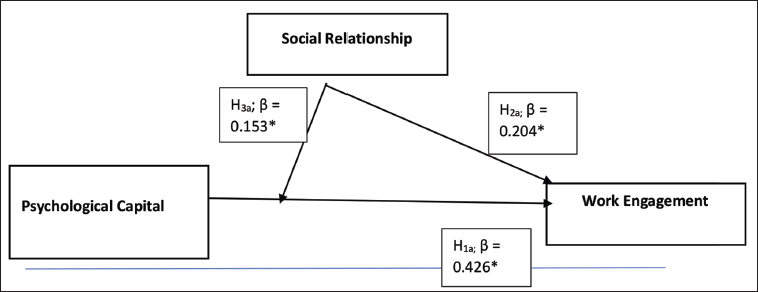
The outcomes show that all the scales had a good reliability index. The results indicate a significant correlation among PsyCap, work engagement and social relationships. PsyCap and social relationships are positively connected to work engagement. Thus, these results provide preliminary support for our hypotheses. After examining the relationship among the variables, we conducted a confirmatory factor analysis using SEM to determine the model fit and hypothesised relationship among the variables. The results are in Figure 2 and Tables 3 and 4, showing path analysis and model fit.
A Path Analysis.
Path Analysis Among Variables.

Model Fit.

The Moderating Effect of Social Relationships Among PsyCap and Work Engagement.

Table 3 shows that PsyCap and social relationships significantly correlate with work engagement. The model fit is in Table 4. The discriminant criteria of each index are as follows: χ²/df < 3; AGFI, CFI > 0.9 and RMSEA < 0.08. Table 4 shows the fit indexes of the model of organisational identification. The χ2/df = 1.91, P = .000*, AGFI = 0.818, PCFI = 0.837, CFI = 0.907 and RMSEA = 0.050.
The first hypothesis proposed that positive psychological capital is connected to work engagement. The results (Table 3) indicate that the PsyCap significantly predicted WE (PsyCap, b = 0.48, P < .01) in public and private sector organisations. The results are supported by Simons et al. 42 and Bakker et al. 43 Luthans et al.44, 39 observed the connection of each element of PsyCap to overall workplace attitudes and performance. It might be because hopeful employees are more resilient and can overcome difficulties. Confident individuals are more likely to be capable of dealing with the obstacles of different life areas by referring to these resources. Resilient employees successfully avail realistic and flexible optimism through their adaptation mechanism. The results suggest that it helps employees better engage themselves at work. For example, their optimistic solid ways of thinking, self-efficacy skills to complete the task and resilient nature help to bounce back from adversity, influencing their work engagement.
The second hypothesis proposed a positive relationship between SR and WE. The analysis shows that the SR significantly predicted WE (b = 0.41, P = .01). Studies support our findings that employees’ well-being influences employee quality of work-life, positive emotion and satisfaction. 45 Biétry and Creusier 46 indicate that well-being at the workplace combines hedonic and eudaimonic aspects resulting from a positive relation with self, time and physical working surroundings and the manager’s reaction to aspirations personal development. Thus, employees’ well-being at the workplace includes cognitive and emotional characteristics supported on their relation with co-workers and the pleasurable work environment. It also depends on the employees’ interest in learning and attaining their new set of skills and goals, and the managers’ acknowledgement of their efforts.
Moderation Analysis
The third hypothesis proposed that social relationships would moderate the relationship between PsyCap and work engagement.
Table 5 showing moderation analysis results. The results showed that social relationships significantly moderated the relationship between PsyCap and WE (PsyCap and SR, b = 0.15, P < .01). Thus, SR, along with PsyCap, motivates employees to engage better.47–49 Employment resources, such as work influence and social capital, are negatively connected with undesirable output, like depression risk, 50 and long-term sick leave. 51
The significance of social support in preserving one’s well-being is well recognised. Organisations should regularly examine their employees’ well-being to ensure they feel supported, as this will enhance their ability to be more engaged at work. Managers should be approachable and promote a welcoming, non-discriminatory workplace atmosphere. It could be accomplished by facilitating team-building workshops or encouraging teamwork through team-building exercises.
CoR theory links three different types of social support (SS) such as perceived organisational support/POS, perceived family support or PFS and perceived supervisor support. The core principle of CoR theory is that persons are interested in enhancing their resources. Hobfoll 52 differentiated among social contexts in which the person operates and the contextual resources, such as SS outside. Mental resources are essential to the person and include developmental states and personality traits such as optimism, hope, resilience and self-efficacy. 53 There are supporting findings that PsyCap is state-like, and we can develop it. 36 Earlier studies highlight that access to contextual resources like a supportive organisational climate and social support54, 55 play a crucial role in developing a person’s psychological resources. Getting support in the workplace will improve workers’ PsyCap. Co-workers’ support in the work domain (one’s supervisor and the organisation more generally) will improve employees’ work engagement via encouraging their mental resources or PsyCap.
Discussion
Psychological and social capital make use of employees’ behaviour to boost their work engagement and, ultimately organiational growth. In order to understand how employees react to work and social pressure, psychological and social support play an important role in tracking employee WE. The study’s objective was to examine the impact of PsyCap on WE and the moderating effect of SR of employees in the Indian manufacturing sector. Evidence suggests that PsyCap had positive associations with engagement and positive employee behaviour.56–58 Employers need to enhance employee WE by strengthening resources such as self-efficacy and resilience to bounce back from adversity. A positive SR helps employees deal effectively with their work and personal life-related problems through a support system and good social connections. Social relationships did strengthen the association between PsyCap and WE. Thus, PsyCap has a significant positive impact on WE and employees’ SR. It suggests that employees could have an increased/decreased effect of PsyCap on WE based on their relationships. SR are based on interaction quality, which requires better collaboration among employees, social integration and cohesion.
The JDR theory is consistent with studies showing differences in the effect of PsyCap on workers’ outcomes, 59 an important association among self-efficacy and WE. Employees experience support as personal resources cause interaction between PsyCap and SR. SR acts as a social resource and permits employees to evaluate events and situations as opportunistic, favourable and adaptive, contributing to engagement as a form of social support. The need for more social resources may lead to adversity and result in a low level of PsyCap in employees. Hsu et al.60, 61 reported that supportive environment positively impacted PsyCap. SR moderated the impact of PsyCap on WE suggesting that workers with good SR are better engaged in their workplace. Lack of good SR leads to poor work performance or less engagement in work.
Conclusion
In this fast-growing and demanding work environment, an organisation must develop PsyCap to provide strength/resources to employees and share a robust supportive relationship. It is challenging to keep employees engaged and productive at work. Creating and maintaining supportive manager–subordinate relationships for employees and employers are crucial. Thus, maximising engagement levels can be done by enhancing social capital by eliminating obstacles that hinder communication in the work environment by creating options for employees to interact with each other and enhance their psychological resources. The findings help identify components that are individualistic in nature of the PsyCap process while using more valid and reliable measurements for theoretical and practical reasons. The study provides a comprehensive knowledge of the association among SR, PsyCap and WE. First, the research empirically establishes the role of SR in WE and PsyCap. Second, the study emphasises that positive psychological resources significantly motivate people to engage in work. Third, this study provides theoretical understanding by empirically examining the moderating effect of SR to strengthen the relationship of PsyCap with WE. It will help further explore the mechanism of influencing engagement among leaders, strengthen existing knowledge about using social and psychological resources for better engagement and strengthen the literature on positive psychology, positive organisational behaviour and human resources management. The study also supports CoR theory, 62 considering PsyCap and SR as resources employees can conserve to cope with work challenges.
The study has implications for managers to facilitate better interaction and relationships for executives’ WE. Management should support social connections in the workplace, help employees form solid relationships and build an engaged and productive workforce. Creating chances for positive social communication should be a vital objective for managers. Organisations should adopt a more relationship-centric outlook to foster positive employee interactions so that employees can flourish. PsyCap, as a resource, helps managers deal effectively with their subordinates and keep them better engaged in work, as SR helps them deal effectively with challenges, leading to WE. Organisations should develop a sound social support system for better interaction and social relationships while improving employees’ PsyCap.
The study has some limitations. First, we collected data through self-report measures, which might have the issues of common method variance and biased ratings. 63 Future researchers could include different organisations and longitudinal research settings to enhance validity. Furthermore, we can use qualitative studies to get deeper insights.
Footnotes
Acknowledgements
We acknowledge the contribution of employees in the organisation, whose enthusiastic participation was the main driving force for the successful accomplishment of this project and also for the assistance received from HR and other officials who participated in the survey.
Authors’ Contribution
Kalyani Biswal has contributed to Literature review, data collection and analysis, writing the whole paper, and editing. Both Kailash B. L. Srivastava and Sayed Firoj Alli helped in writing results and discussion. Also in checking the draft for corrections in language, and structure of the paper.
Consent to Participate
Informed consent was obtained from all individual participants included in the study.
Declaration of Conflicting Interests
The authors declared no potential conflicts of interest with respect to the research, authorship and/or publication of this article.
Funding
The authors received no financial support for the research, authorship and/or publication of this article.
ICMJE Statement
This article complies with the International Committee of Medical Journal Editors (ICMJE) uniform requirements for the manuscript.
Statement of Ethics
The study follows all ethical guidelines. As applicable to social science and management studies, this study does not include any clinical trial.
