




Abstract
Background
Working memory (WM) is one of the most influential cognitive functions in encoding, registering, and retrieving information. It influences the learning process in children. Its role becomes essential, especially in a child with a learning disability (LD). Researchers worldwide are giving much prominence to WM, especially in devising cognitive retraining strategies for better cognitive functioning and academic attainment in these children. This current study aims to explore globally used instruments to measure this construct and review effective WM training models in the cognitive rehabilitation of children with LD. This study used a systematic review, availing the elaborate “Preferred Reporting Items for Systematic Reviews and Meta-analysis (PRISMA)” guidelines.
Summary
The databases of Google Scholar, PubMed, and Web of Science were searched thoroughly, and those studies, which met the inclusion criteria, were considered for this review. Out of 770 studies found with keywords, only six met the inclusion criteria and were selected for a detailed analysis. The outcome of the current review provides trustworthy evidence of poor performance, especially in tasks involving verbal and executive WM in children with all types of learning disabilities (LD) and difficulties. The studies reviewed support the hypothesis that WM can improve with training and significantly improve children’s academic attainment.
Key Message
Further this review recommends that research and efforts must go into devising these cognitive training techniques. Children have high cerebral plasticity; hence, using cognitive training (emphasizing WM training and other cognitive functions) with them would enhance their cognitive functioning and capacity, improving their academic performance.
Introduction
Working Memory (WM) was coined in 1960 by Miller, Galanter, and Pribam in their book “Plans and the Structure of Behaviour.” WM is probably the most controversial construct since the researchers have argued about its existence as a separate entity.1, 2 Still, some use it interchangeably with short-term memory (STM) or as a new name given to an old construct. 3 But, structural equation modeling conducted by Engle et al. in their study has given evidence for its existence as a separate construct from STM and that they work independently. 4
Over the years, psychologists have tried to define the construct of “working memory” in many ways. According to Baddeley, WM is a comprehensive system that unites various short- and long-term memory (LTM) subsystems and functions. 5 “WM is the system (or more accurately the set of systems) responsible for temporarily storing information during the performance of cognitive tasks.” 6 The amalgamation of all the definitions given prior is seen in Dehn’s definition, which defines it as a combination of three vital components, that is, moment-to-moment awareness, maintenance of information in STM, and successful retrieval of archived information. 5 A review of the history of WM reveals that there are many different models of working memory. A few notable ones among them are the Information Processing Model, which drew parallels from the working of a computer with selective perception, encoding, storage, retrieval, response organization, and system control as its subsystems; the Atkinson-Shiffrin Model with its three components―sensory storage, STM, and LTM proposed by Richard Atkinson and Richard Shiffrin (1968); the Levels of processing model by Craig and Lockhart (1972) suggested three levels of processing, thus deeper and more elaborate processing and encoding lead to more long-term learning as the memory traces last for a longer time; Baddeley and Hitch’s Multifaceted Model (1974), which is hierarchical in nature with central executive as the top-level, domain-free factor that controls the sub components―a phonological loop, a visuospatial sketchpad, and episodic buffer (which was added later on in 2000). 5
Kane and Engle’s Executive Attention Model defined WM capacity as executive attention function or controlled attention and separable from STM which successfully maintains the relevant goal in an easily accessible state while suppressing the irrelevant interfering stimulus and hence is able to help in switching tasks effortlessly.7, 8 Cowan’s Embedded-Process Model (2005) embeds WM within LTM while still recognizing both WM and STM as separable from LTM and the Integrated model of WM proposed by Milton Dehn (2008), which suggests that STM, WM, and LTM are all distinct but inter-related memory systems with WM acting as the interface between STM and LTM, working both with units temporarily retained in STM and recently activated units from LTM. 5
An extensive body of research has given corroborating evidence of the essential role of WM in different areas of academic achievement, particularly concerning reading decoding, reading comprehension, spelling, written expressions, mathematics, note taking, and reasoning.9–14
WM has a significant role to play not only in just reading decoding but also in reading comprehension.6, 10 Reading comprehension directly correlates to verbal and visual-spatial working memory.6, 15 The readers need to consistently store parts of information and details while processing other details to integrate all the information later to comprehend the text, which puts a load on WM. Performance is greatly hindered if the WM already has deficits, as in the case of children with LD. Reading also requires verbal rehearsal and inhibiting disruptive visual representation, which children with learning disabilities fail in.6, 16, 17
Mathematics not only requires just activation of specific information from LTM and its successful retrieval12, 18 but also involves inhibition of irrelevant information for successful switching of operations in which children with mathematical disabilities fail.19, 20
Recent studies show that the prevalence of learning disabilities in India is 1%–19% in school-going children. 21 In Samuel Kirk’s paper entitled ‘‘Learning Disabilities,’’ based on his recently published book, “Educating Exceptional Children,” the term LD was used for the first time in 1963. He defined the term LD “as retardation, disorder, or delayed development in one or more of the processes of speech, language, reading, writing, arithmetic, or other school subjects resulting from a psychological handicap caused by a possible cerebral dysfunction and emotional or behavioral disturbances. It is not the result of mental retardation, sensory deprivation, or cultural and instructional factors.”
The most acceptable definition of LD is the one given by IDEA (Individuals with Disabilities Education Act, 2004) “The term ‘specific learning disability’ means a disorder in one or more of the basic psychological processes involved in understanding or in using language, spoken or written, which may manifest itself in the imperfect ability to listen, think, speak, read, spell, or do mathematical calculations. Such a term includes such conditions as perceptual disabilities, brain injury, minimal brain dysfunction, dyslexia, and developmental aphasia. Such a term does not include a learning problem primarily resulting from visual, hearing, or motor disabilities; of mental retardation; of emotional disturbance; or environmental, cultural, or economic disadvantage.” 22
The DSM-5, 2013, classifies Specific learning disorders into three types: with impairment in reading (word reading accuracy, reading rate, or fluency and reading comprehension), with impairment in written expression (spelling accuracy, grammar and punctuation accuracy, and clarity or organization of written word), and with impairment in mathematics (number sense, memorization of arithmetic facts, accurate or fluent calculation, and exact math reasoning). 23
The ICD-10, 2006 classifies it as a specific reading disorder, spelling disorder, a specific disorder of Arithmetical skills, Mixed disorder of scholastic skills, and other developmental disorders of scholastic skills and developmental disorder of scholastic skills, unspecified. 24
IDEA, 2004 classifies it as a specific learning disability in Oral Expression, Listening Comprehension, Written Expression, Basic Reading Skill, Reading Fluency, Reading Comprehension, Mathematics Calculation, and Mathematics Problem Solving. 22
The double-deficit hypothesis in dyslexia suggests deficits in two areas related to WM, that is, Phonological awareness and rapid automatized naming leads to difficulties in reading. 25 Hence, the literature review indicates that children with Learning Disabilities (LD) usually perform weakly in areas such as working memory, attention, planning, and problem-solving, and other executive functions, when compared to nondisabled peers.26, 27
A typical classroom situation does overload the WM capacity wherein the child has to pay attention to new information simultaneously, retrieve the prior knowledge from LTM, and process it and use it in the present context, all while also taking notes and listening to the instructions being given filtering out disruptive visual and auditory stimulus vying for their attention along with task-specific stimulation. Hence, adequate classroom accommodations such as differential instructions, providing visual aids (charts with tables, formulas, etc.), allowing printed notes, activity checklists, and step-wise repeated instructions for a particular task by the teacher, and a buddy to help him in class and between classes would go a long way to reduce this load on the child and increase the capacity and efficiency of the working memory.
WM training, in theory, has both near and far transfers, that is, in-trained tasks and general nontrained tasks requiring inputs from working memory.
28
But, the claim has yet to be backed up with enough data and follow-up of long-term cognitive training studies to support it and requires further research.
29
The question remains whether WM can be trained to improve its capacity and efficacy, especially in children with low WM capacities and with learning disabilities. What training strategies and which domains of WM are trainable? The most important question that must be answered is whether training in WM aid in improving the learning outcomes of the child with learning disabilities. Hence, a detailed literature analysis was required to seek answers to these questions.
Method
The current study was carried out according to Preferred Reporting Items for Systematic Reviews and Meta-analysis (PRISMA) guidelines, 2020. 30 Search Strategy: Electronic databases scanned for the review were Google Scholar, PubMed, and Web of Science. The search was conducted in July–October 2022 with no filters regarding the date and year. The terms used in the investigation were “Children + Learning disabilities,” “Working memory + Learning disabilities,” “Learning disability + Measurement,” “Working Memory + Cognitive draining,” and “Learning disability + Working memory training.”
Eligibility Criteria
The current review included studies with intervention in WM in children (5–12 years) with learning disabilities. Articles with children having intellectual disabilities, autism, or not having samples as children between the age group 5–12 years were not included. Only those studies, which were in English, were selected. The studies with 141 inconclusive results were discarded.
Selection of Studies and Data Extraction
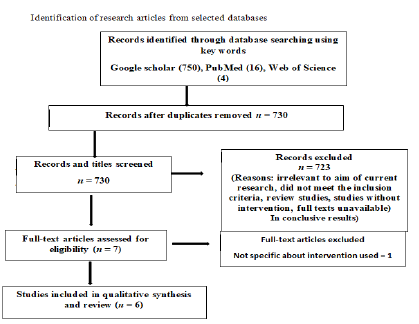
The titles and abstracts of all the studies found through the search strategies were studied thoroughly. Those that met the inclusion criteria were chosen, and the data regarding year, author, language and country of origin, journal, instruments used, constructs measured, summary, goal, sample and results of the intervention of the studies were carefully noted. The studies with inconclusive results were excluded. An analysis of the selection criteria is described in Figure 1.
Results and Discussion
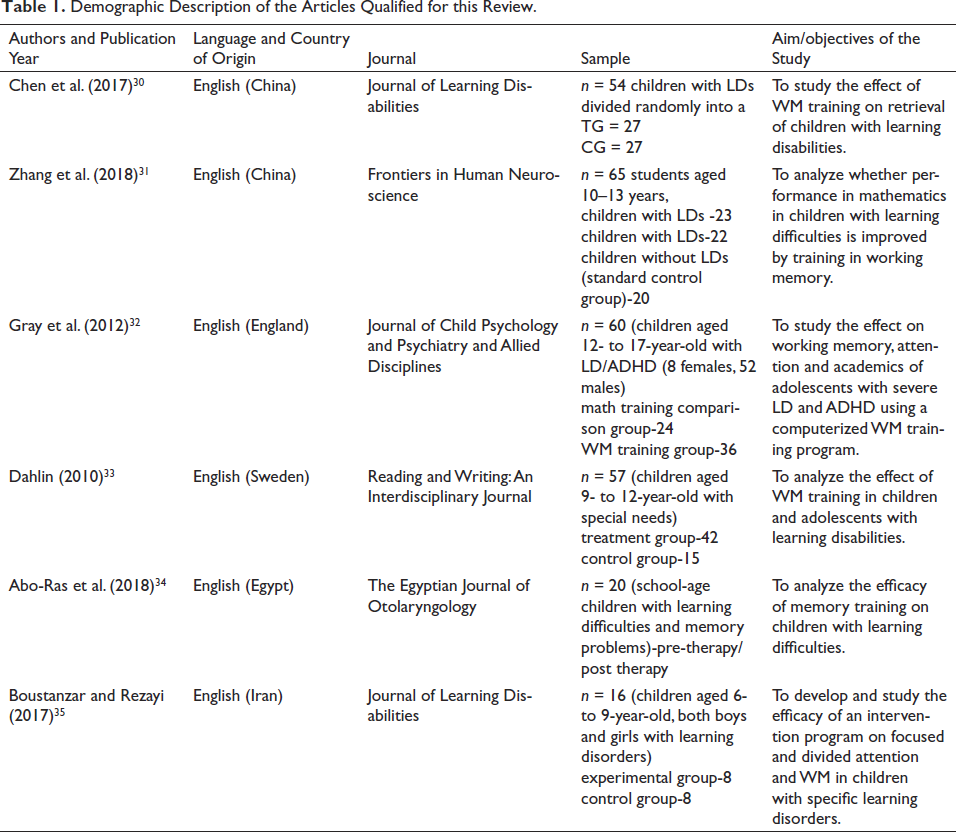
The literature search yielded 770 studies based on the specified keywords, covering the period between 2010 and 2018, which was unexpected and may raise questions about the comprehensiveness of the search. Only six studies met the inclusion criteria and were included in this review. Table 1 provides the demographic details extracted pertaning to the studies selected for the review.
Demographic Description of the Articles Qualified for this Review.
The selected studies varied in their methods of assessing WM and implementing intervention strategies. Table 2 furnishes a detailed analysis of the characteristics of the interventions adopted by each study selected for this review. For instance, Chen et al. conducted a study using adaptive running WM training for 20 days, 30 while Zhang et al. used three versions of an adaptive running memory task, that is, letters, animals, and locations for 39 min per day over 28 days. 31 Gray et al. and Dahlin utilized the Cogmed RoboMemo, a computerized program designed to train WM, for 25 sessions, each lasting 30–39 min.32, 33
Characteristics of the Intervention Used in the Studies.
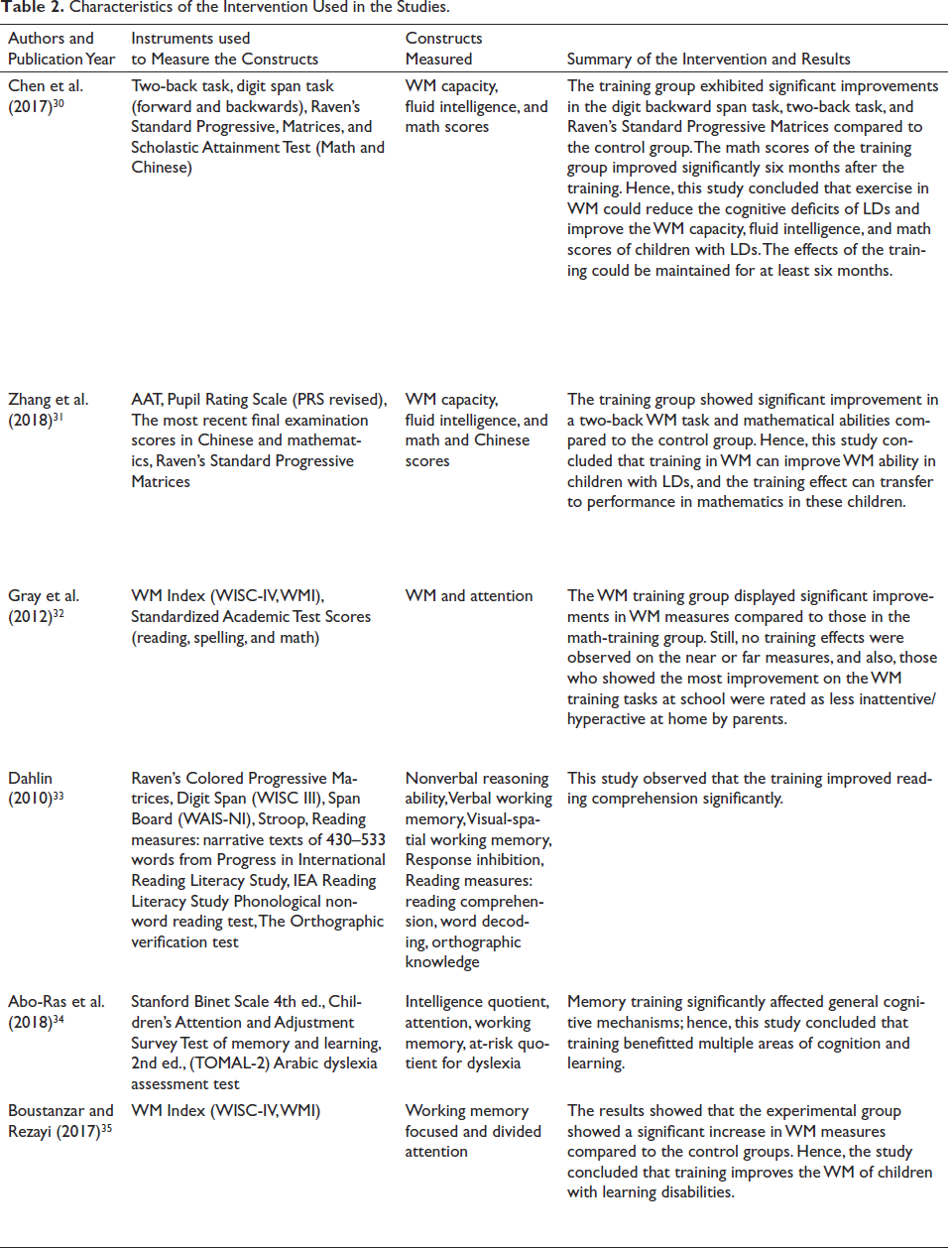
Abo-Ras et al. employed a “no-glamour” memory training program consisting of auditory (rehearsing and sub-vocalizing, chunking, creating lists and taking notes, graphing and charting, identifying key concepts, linking and associations, visualizing, paraphrasing) and visual memory (chunking, acronyms and silly sentences, drawing and defining, graphing and charting, identifying key concepts, visualizing, paraphrasing and saying, tracing, writing, and drawing sounds) sections spanning 3–6 months. 34 However, this study could not confirm the extent to which WM learning can be transferred to untrained tasks in different fields such as phonological skills, which may limit its practical application. 34 Similarly, the study conducted by Boustanzar and Rezayi had eight individual focused and divided attention sessions. 35
All the selected studies used an experimental research design, with all but one using a randomized control trial (Zhang et al.). 31 WM training has been recognized as an emerging area of support for children with learning disabilities, as it has shown a high correlation with fluid intelligence and school performance.36–39 Thus, effective WM training could help mitigate cognitive deficits in these children, ultimately enhancing their academic achievements.
The sample sizes in the studies ranged from 16 to 65 participants, and some studies employed pre-test/post-test methods without control groups, while others used control groups. These variations may affect the generalization of the results and highlight the need for further research 200 with more extensive and diverse samples.
The study conducted by Zhang et al. revealed that cognitive training is more closely related to mathematical skills than reading skills. They also observed an improvement in fluid intelligence over time though this improvement was delayed post-training. Gray et al. noticed treatment-related effects of the WM training program on two measures: a test of auditory verbal WM and short-term visual-spatial storage. However, they did not see any transfer effects to other measures of WM or attention and concluded that long-term follow-up might have been required as such improvement might have been noticed later. The limitation of their study was that it lacked long-term follow-up. They did not categorize the sample based on the type of LD diagnoses, which could be a predictor variable for future studies to consider.31, 32
In his study, Dahlin confirmed the central role of WM in reading comprehension, both in the phonological loop and in the major executive and visuospatial working memory. Since reading comprehension improved as a result of the intervention, whereas word-level reading skills did not, it was concluded that WM training might facilitate and directly enhance reading comprehension processes, not through improvements in word-level reading processes. 33
The study that used no-glamour memory training noticed compelling attainment on untrained WM tasks that suggests WM training has far transfer, but to what extent was not determined. For example, the learning in unskilled tasks involving phonological skills still needs to be confirmed. The study concluded that processes such as encoding, covert maintenance, attention, updating, interference resolution, and controlled memory search are integrated into the compound WM span tasks and that one or more of these processes may be affected by training. This study gives empirical evidence to the theoretical framework of the possibility of developing LTM mnemonic strategies to meet the enormous demands on WM during text comprehension. The studies conducted had limitations that could affect the generalization of results. Most studies used a small sample size, often producing overestimated effect sizes. The low number of studies conducted on effective WM training strategies to help children with learning disabilities indicate there is a dire need for developing cognitive strategies to counter the WM deficits in children with learning disabilities.
All of the above studies have been able to study the effect of WM training in children with learning disabilities, hence successfully meeting the objectives of the studies. But, since most of the studies had diminutive sample sizes and the effect of the study could not be studied over an extended period. Hence, there is still scope for further research in the area so better strategies could be devised.
Implications
The findings of this review have significant implications for both research and practical applications in the field of working memory (WM) training for children with learning disabilities.
The limited number of studies meeting the inclusion criteria (only six out of 770) highlights the need for more extensive and comprehensive research on effective WM training strategies. Future researchers should conduct more studies to build a robust body of evidence in this area, employing larger and more diverse samples to improve the generalizability of the results. Standardizing the assessment tools used to measure WM and related constructs ensures comparability across studies. Researchers should strive to adopt consistent and validated measurement instruments, enabling more reliable comparisons and meta-analyses to gain deeper insights into the effectiveness of WM training interventions. Longitudinal studies with extended follow-up periods are necessary to track the long-term impact of WM training on children with learning disabilities. This will shed light on the sustainability of WM improvements and its influence on academic performance and other cognitive functions over time.
The recognition of WM training as an emerging area of support for children with learning disabilities calls for developing tailored cognitive training techniques. Educators, clinicians, and parents can incorporate evidence-based WM training programs into intervention plans for children with learning disabilities, targeting enhancing cognitive abilities, and academic achievements. The variability in WM training interventions observed in the selected studies indicates the need for a personalized approach. Tailoring WM training programs to suit individual needs and learning styles can lead to more effective outcomes. To ensure the success of WM training interventions, early detection of learning disabilities and cognitive deficits is crucial. Identifying and addressing WM issues in children early can prevent academic challenges and provide them with the necessary support to reach their full potential. Practitioners and policymakers should promote and invest in research exploring the far transfer of WM training to untrained tasks, such as phonological skills. Understanding how WM improvements can generalize to various cognitive domains will inform the development of more comprehensive and versatile interventions.
Limitations
This review focused solely on articles published in English, and searches were limited to Google Scholar, PubMed, and Web of Science databases. Paid articles were excluded, which might have excluded relevant studies from consideration. Future reviews could benefit from including a broader range of databases and considering studies in other languages. One notable limitation across these studies was the use of small sample sizes, which could lead to overestimated effect sizes and limit the generalizability of the findings. This highlights the need for future studies with larger sample sizes to provide more robust evidence.
Conclusion
The research reviewed provides substantial evidence of poor performance in verbal and executive WM tasks in children with learning disabilities. The studies support the hypothesis that WM can improve with training, but more efforts are needed to devise effective cognitive training techniques. Early detection and intervention using WM training could enhance cognitive functioning and capacity in children, thereby improving their academic performance. Further research with larger sample sizes and longitudinal follow-ups is warranted to advance our understanding and application of WM training strategies for children with learning disabilities. This review underscores the importance of further research in WM training for children with learning disabilities. By addressing the identified limitations and implications, researchers and practitioners can work together to develop more effective, evidence-based interventions to help children with learning disabilities overcome cognitive deficits and achieve academic success.
Authors’ Contribution
All authors contributed to the study’s conceptualization, planning, design, and execution. PSR and MKP performed research conceptualization and a plan for the search strategy. Literature search, categorization, and selection of articles as per criteria for the current research were carried out by PSR. PSR and MKP completed manuscript writing. The authors individually carried out the final manuscript’s critical reviewing, editing, and correction, i.e., PM, SD, MJ, and SMJ, and submitted their comments and modifications to the corresponding authors. All authors read and approved the final manuscript.
Statement of Ethics
Ethical permission was not required for this review research work.
Footnotes
Declaration of Conflicting Interests
The authors declared no conflict of interest in the context of the research, authorship, and publication of this article.
Funding
The authors received no financial support for the research, authorship and/or publication of this article.
