




Abstract
Background
Naegleria fowleri, a “brain-eating” amoeba, is the cause of primary amoebic meningoencephalitis. It spreads through the nasal route via contaminated water sources and invades the central nervous system.
Purpose
The objective of our study was to assess the knowledge, attitude, and practices about N. fowleri among the general population of Karachi, Pakistan.
Methods
This study was conducted on the general population in Karachi to assess their knowledge, attitudes, and practices regarding N. fowleri. Data was collected using a questionnaire with four parts, covering demographics, N. fowleri knowledge, attitudes, and preventive practices. The sample size of 400 was determined using the Raosoft Survey Tool. Data analysis was performed using SPSS 25.0, including descriptive analysis and the Pearson chi-square test. Non-probability convenience sampling was used. The study period was June–December 2022.
Results
This study showed that around 80% of people had never heard about N. fowleri.
Conclusion
This study revealed the level of awareness of N. fowleri and measures to avoid its infection in Karachi is very low, where N. fowleri infections are reported every year. Hence, appropriate measures should be taken to increase knowledge and awareness to avoid the spread of N. fowleri infection among the population.
Introduction
Naegleria fowleri, a “brain-eating” amoeba, is the cause of primary amoebic meningoencephalitis (PAM). 1 The amoeba can survive in the heat and is mainly found in water sources, that is, lakes, ponds, swimming pools, and so on. 2 It spreads through the nasal route through contaminated water sources, invades the central nervous system, and results in brain hemorrhage and death. 3 Primary meningoencephalitis appears with signs and symptoms of headache, fever, neck stiffness, altered mental state, convulsions, and coma. 4
Up to date, 431 cases of PAM have been diagnosed in the world, of which only 5% have recovered. 5 Though the small number of infected cases indicates N. fowleri as a rare type of infection, the reported cases seem to be increasing rapidly over the last few years. 6 The mortality rate of the disease is 95%–98%. 7 In Pakistan, just within the months of May to July 2021, six deaths were reported due to N. fowleri. Among these, five deaths were from Karachi. 8 Till March 2022, six deaths were also reported in Karachi. 9 Most documented cases are between 26 and 45 years of age. 7 The actual number of cases remains low, mainly due to misdiagnosis. 10 The causes of this emerging disease are reduced levels of chlorination in water and defective water distribution systems. 11 In July 2021, water samples from different areas of Karachi were collected, which revealed that 95% of the water supply provided to Karachi remains unfit for human consumption. 9 People involved in water sports are at a high risk of being infected. 11 Control strategies to prevent the spread of infection include nose clips, keeping one’s head out of the water during water activities, using boiled water for ablution purposes, filtering and chlorinating water, and educating the public regarding sanitary precautions. 12
Karachi is the metropolitan city and a coastal region of Pakistan. 7 As N. fowleri can survive in 45°C temperatures and the weather in Karachi stays mostly warm, 13 t poses a threat to residents of Karachi. Less knowledge and awareness about the disease in the public makes the diagnosis and treatment difficult for health-care workers. 10 This study aims to assess the knowledge, attitude, and practices of people related to N. fowleri visiting the Medicine OPD of Jinnah Sindh Medical University (JSMU), Karachi.
Aims and Objectives
The aim of this study is to assess the knowledge, attitude, and practices related to N. fowleri among the general population of Karachi, Pakistan.
The three objectives of this study include:
To assess knowledge regarding N. fowleri among the people of Karachi, Pakistan. To assess the attitude of people regarding the N. fowleri infection. To determine the practices done by the people to avoid the spread of N. fowleri.
Methods
After receiving the Institutional Review Board (IRB) approval, reference number JSMU/IRB/2022/-641 was obtained from the institute. This descriptive cross-sectional study was conducted during June–December 2022 by MBBS students of JSMU among the general population of Karachi.
In similar research to assess knowledge of N. fowleri among pharmacy students in Karachi, 450 survey questionnaires were distributed, out of which 314 responded. 4 The response rate was 69.77%, and 55.1% of respondents considered themselves to be knowledgeable, and 47.77% of respondents avoided swimming or jumping into freshwater lakes in the summer. To find out the sample size, the Raosoft Survey Tool was utilized. The population size was determined to be 20,000,000, with a response distribution of 50%. The confidence interval was 95%, with a 5% margin of error. The value of p < .05 was considered significant. The analysis of the Raosoft Survey Tool concluded that 385 responses needed to be distributed among people. Considering the margin of error and response rate from the previous study, we distributed 400 questionnaires among the people. A non-probability convenient sampling method has been used to collect the data.
The inclusion criteria were both males and females of Karachi, people who are >18 years of age, and those who gave consent and voluntarily participated in the study. Exclusion criteria included patients who were unable to respond and people who were unable to understand Urdu or English.
A questionnaire has been used to collect data in this study. It is designed based on similar studies done in Pakistan.4, 12 The questionnaire contains four parts. The first part is about the biodata of the respondents and contains six questions. The second section is based on knowledge about N. fowleri and its infection, with nine questions. The third section is about the attitude of people regarding N. fowleri with four questions. The fourth section has seven questions and is based on the practices of people in preventing infection with N. fowleri.
Data collection has been done by students fluent in both English and Urdu. After completing the questionnaire, the researchers 0 about N. fowleri and its prevention. The data has been analyzed using SPSS 25.0. Descriptive analysis has been performed. The results for each item on the questionnaire have been reported as frequencies and percentages. The Pearson chi-square test was used for analysis of the results.
The STROCSS Guidelines
The work has been reported in accordance with the STROCSS guidelines. 14
Results
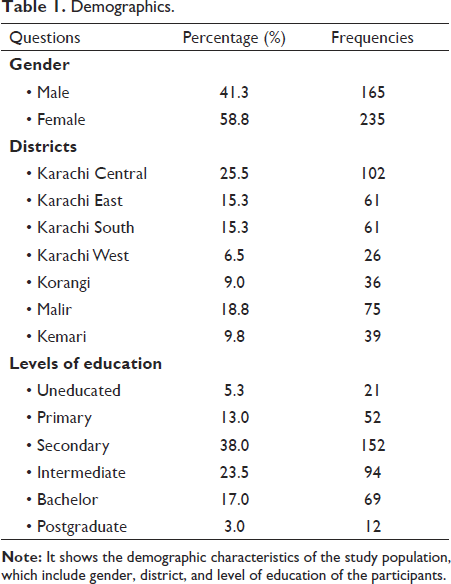
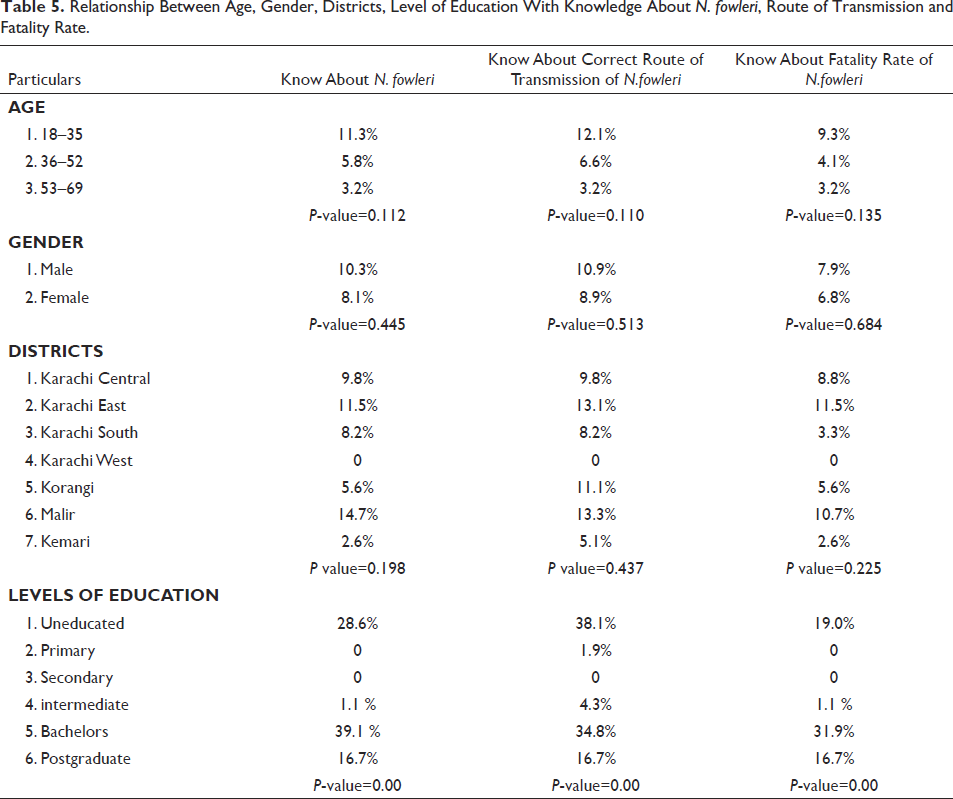
Out of 400 survey questionnaires, all were returned (the response rate was 100.0%) (Tables 1–5).
Demographics.
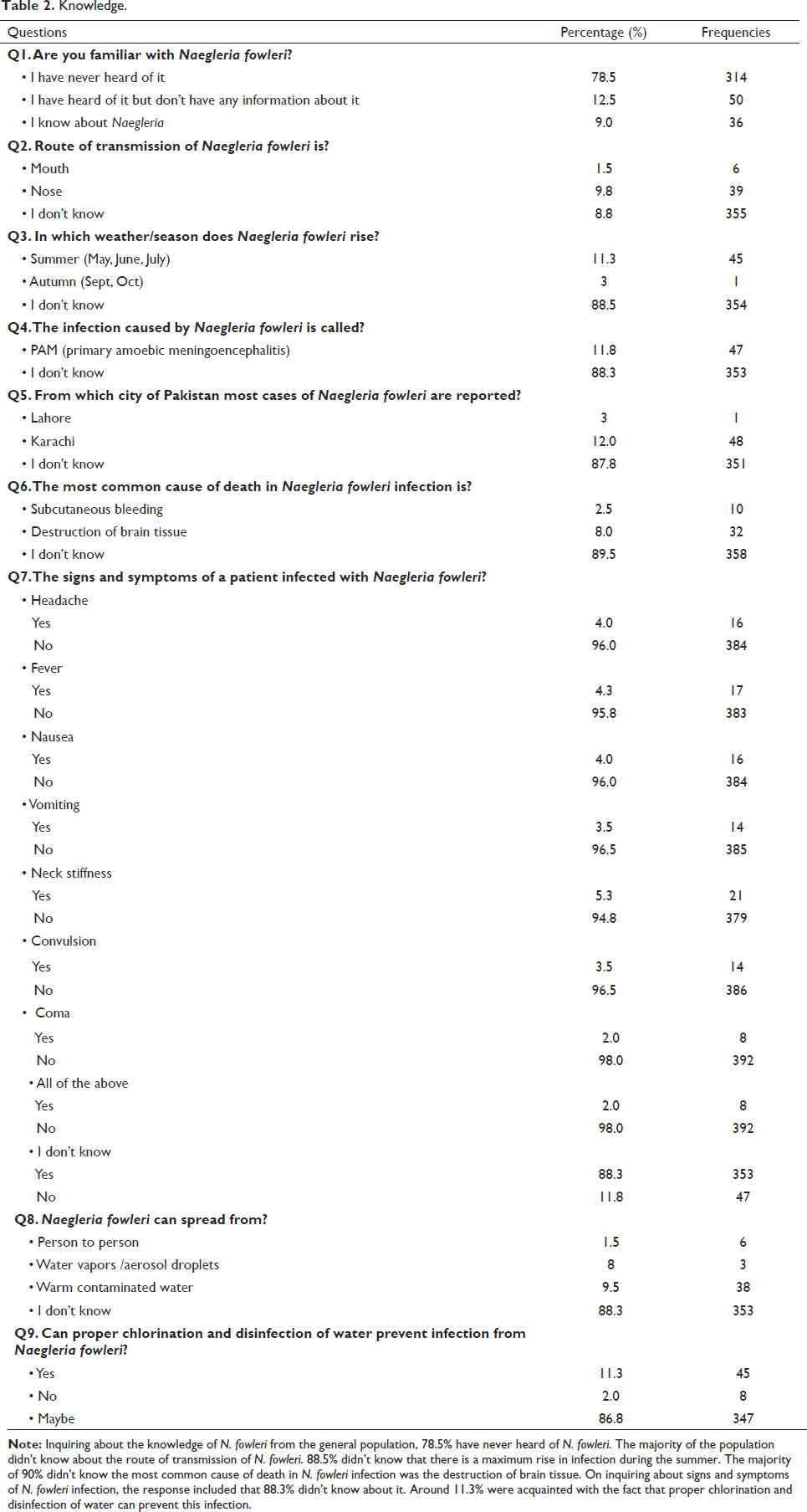
Knowledge.
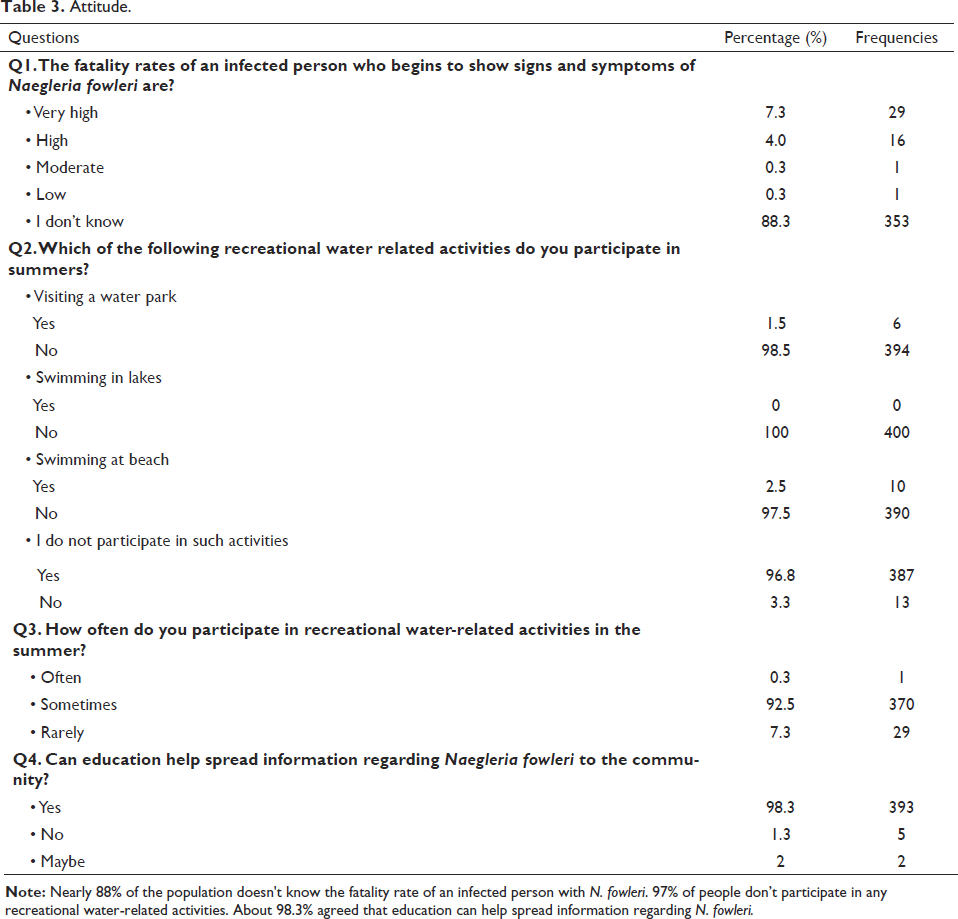
Attitude.
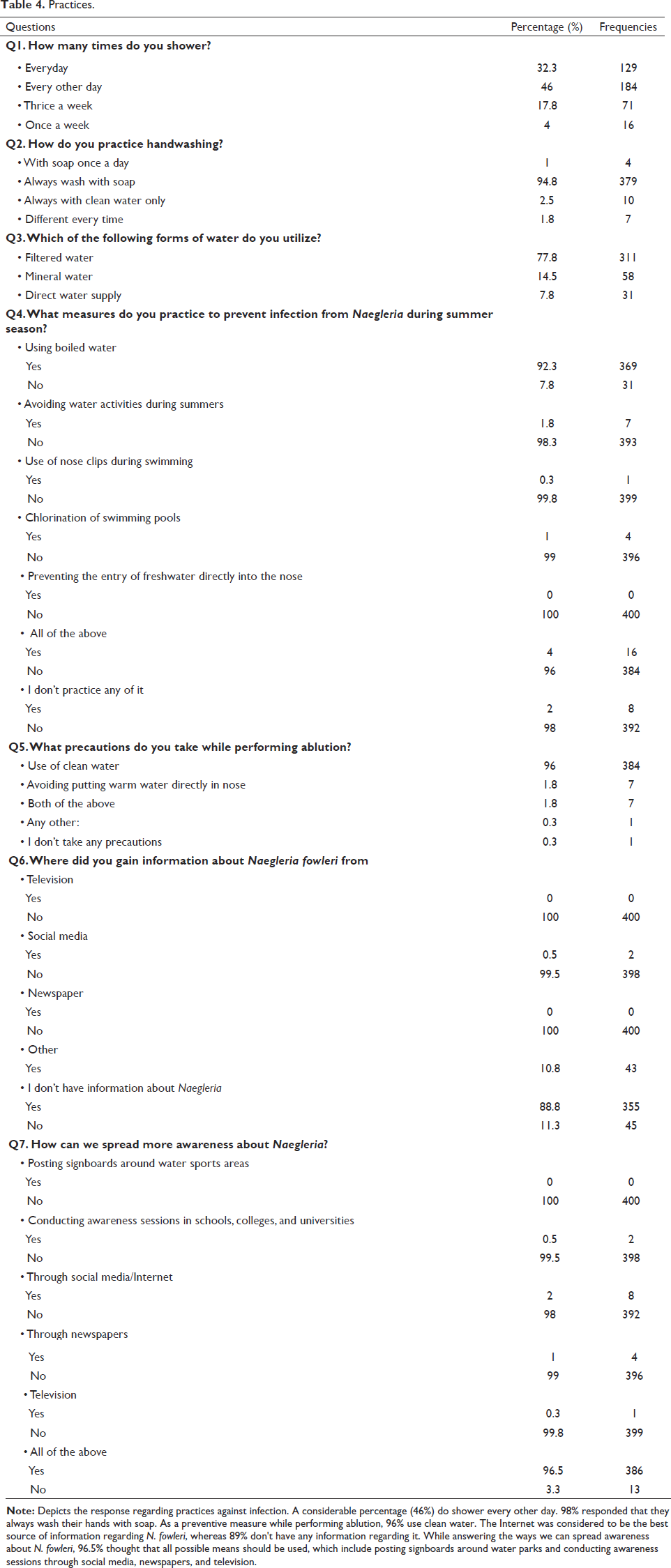
Practices.
Relationship Between Age, Gender, Districts, Level of Education With Knowledge About N. fowleri, Route of Transmission and Fatality Rate.
Discussion
N. fowleri is a deadly pathogen that destroys the brain tissue. In Karachi, no previous community-based research has been performed on N. fowleri. In our study, the results showed that nearly 80% of people had never heard of N. fowleri, which shows a lack of awareness among the community. The majority of our population has no knowledge about the fatality rate of this amoeba. According to a similar study, N. fowleri has a high fatality rate of almost 100%. 4 This lack of knowledge in our community poses an alarming situation for the population.
The infection caused by N. fowleri presents with signs and symptoms of headache, fever, nausea, vomiting, neck stiffness, convulsions, and coma. Symptoms may present as early as 24 h or up to 2–8 days after the infection. Other signs and symptoms include those of meningitis, such as fever with chills and positive Brudzinski and Kernig’s signs associated with photophobia. 13 From our research, we concluded that the majority of people had no idea about the signs and symptoms; furthermore, only 11% knew that the infection rises in the summer.
Summer is a time when people participate in recreational water activities such as visiting water parks and swimming at beaches and lakes. In our study, almost 97% of participants responded that they do not participate in any recreational water-related activities during the summer. Though it is rare to contract PAM after swimming in hot bodies of water, people should still avoid water-related activities in the summer, considering its high mortality rate. 15 N. fowleri is not associated with drinking contaminated water, but it has transmission through the nasal route. Pakistan is a Muslim-majority country, and the ritual of ablution (wudhu) is highly associated with exposure to N. fowleri among individuals since ablution involves rinsing the nose with water. In the endemic areas, people are at risk of getting infected by PAM during ablution. 3 The findings of our study showed that 98% of the population does not avoid putting warm water directly in their noses. We suggest that people use clean, chlorinated water and avoid putting warm water directly into the nose while performing ablution.
N. fowleri has been detected in engineered water systems such as drinking water distribution systems (DWDSs). Fatal infections are recorded from Pakistan, the United States, and Australia, and it appears that the physical, chemical, and biological conditions of DWDSs have an impact on the presence of N. fowleri. 16 According to our study, the majority of people utilize filtered and boiled water in their daily water usage as a preventive measure from N. fowleri. It is suggested that biological tools can be used as biomarkers to detect chlorine residual and temperature in the DWDSs. These biological tools can pave the way to predict the colonizable sights of N. fowleri so that pre-emptive measures can be taken. 17
Spreading awareness about N. fowleri is the key process to bring it to the attention of high authorities and also to alert people regarding the severity of this infection. Almost 97% of participants responded that methods of spreading awareness include posting signboards around water sports areas, conducting awareness sessions in schools’ colleges and universities, and through social media, the Internet, newspapers, and television. To improve the condition of knowledge regarding N. fowleri among the general population, we need to strengthen more community-based research to make people aware of N. fowleri. Moreover, there is also a need to improve diagnosis and develop drugs that can prevent the disease as well as cure it. Public health professionals should monitor and analyze cases of N. fowleri and develop such programs that can protect communities.
Recommendations
N. fowleri is a life-threatening condition, so measures should be taken to prevent the rise of N. fowleri in the general population. We recommend that appropriate measures be taken by the government from time to time to increase public awareness about the knowledge and transmission of N. fowleri. People should be guided about relevant preventive measures to overcome this fatal infection, which include posting sign boards around water parks, avoiding entry of warm water directly into the nose during summers, and spreading awareness through social media, newspapers, and television in those areas where the awareness of N. fowleri is deficient.
Limitations
Our research is a baseline survey and has some potential limitations. The data was only collected from the medicine OPD of JSMU Karachi, and we assumed that these statistics represented data from different districts of Karachi. The research was restricted to a limited time frame, and the knowledge, attitude, and practices of people are subject to change with time.
Conclusion
The results of this research concluded that people did not have adequate knowledge about N. fowleri and the infection it causes. The response of people suggested the lack of awareness that prevails in a city like Karachi, where N. fowleri infections are reported every year. The knowledge about preventive measures that should be taken to avoid the spread of N. fowleri was also very low. Hence, appropriate measures should be taken, especially in those cities where N. fowleri cases are reported annually.
Footnotes
Authors’ Contributions
The supervision and conceptualization of this study were done by HF. Material preparation, data collection and analysis, and the first draft of the manuscript were written by SY, HF, BSR, AM, SMA, SRA, and WN. The final editing was performed by HF and HSR. All authors commented on previous versions of the manuscript and read and approved the final manuscript.
Declaration of Conflicting Interests
The authors declared no potential conflicts of interest with respect to the research, authorship, and/or publication of this article.
Funding
The author received no financial support for the research, authorship and/or publication of this article.
Statement of Ethics
The study has been conducted according to the ethical guidelines for human experimentation. The study was approved by the IRB of JSMU. Verbal consent has been obtained from every participant prior to the initiation of research.
