



Abstract
Background
Earlier researchers have explored the individual impacts of locus of control and self-esteem on academic as well as nonacademic success. But limited attention was given to their interplay within a university context. By integrating these variables into a unified framework, a more comprehensive understanding of the learning processes of university students can be achieved, which can further help in developing strategies to improve the overall learning outcome and come out as successful individuals.
Purpose
The aim of this study is to find out the contribution of locus of control and self-esteem toward academic achievement at graduation and across various demographic factors—socioeconomic status, family type, age, and different streams of graduation).
Methods
The sample consists of MBA students (n = 200) coming from different graduation streams, both male and female, in the age group of 21–27 years. Data was collected through the Rosenberg Self-esteem Scale and Rotter’s Locus of control. A descriptive analysis and Chi-square test were used to analyze the data.
Results
Sixty-two percent had an internal locus of control, and 38% had an external locus of control. Forty-one percent had low self-esteem, and 59% had high self-esteem. There was a significant correlation between self-esteem, locus of control, and academic achievement. Self-esteem and locus of control totally predicted 41% of the variation in academic achievement, with self-esteem and locus of control both being stronger factors to predict academic achievement. Area (rural, urban), family type (nuclear, joint), and academic scores have a strong correlation with locus of control and self-esteem.
Conclusion
MBA students are the future leaders. For them to be successful leaders, interventions can be designed to increase self-esteem, which would help them have faith in their abilities and achieve their objectives by taking responsibility for the outcome of challenging situations.
Introduction
A student today is juggling many stressors and research has shown that academics is one of the major causes of stress. 1 Trying to balance their personal, social, and emotional well-being, they end up with emotional difficulties.2, 3 With all this struggle, they are unable to give their maximum performance in academics and face mental health issues. 4 Studies show that academic performance can drop due to issues related to the mind and behavior which in turn are associated with self-esteem and locus of control.5–7 Further studies also show that self-esteem is an important factor in educational progress. 8 Self-esteem is described as a person’s overall sense of worthiness, 9 a self-evaluation of one’s own thoughts and feelings, 10 it is the extent of a person’s self-approval, value, or appreciation of oneself, 11 awareness about value system and an emotional assessment of self-worth. 12 High self-esteem also shows an extreme degree of social adjustment. 13 It is seen that those with low self-esteem display negative responses to life situations, but those with high self-esteem are less affected because they may reject or not allow the scope of a negative perspective. 14 Quality of life can be negatively affected due to the relationship between reduced self-esteem and social adjustment. 15 Locus of control is an important aspect of personality, as given by Rotter. 16 Graduate students deal with a lack of academic motivation, which is related to their self-esteem, locus of control, and daily life endeavors. 17 Locus of control refers to the extent to which people believe they have control over the events that influence their lives. A person is said to have an internal locus of control if the belief is that they have control over what happens in their life. If one blames external variables for the situations in their life, then they are said to have an external locus of control. 18 The locus of control is a continuum; people lie somewhere on the spectrum between the two extremes. Thus, the locus of control is whether an individual’s action is controlled by himself, by somebody else, or by fate. 19 According to Skinner, higher the internal locus of control and chance locus of control, the higher the growth and development toward their academic enhancement. 20 Research by Shepherd et al. has found a significant relationship between internal locus of control and academic growth, which shows that students with improved internal locus of control show high growth in education while those with having inferior external locus of control show inferior growth in the educational sector. 21 The present research deals with graduate students from different streams pursuing MBAs. Some have work experience, and some are freshers. It is important, therefore, to explore the locus of control and self-esteem of these students with respect to academic achievement.
Methods
Objectives
To study the locus of control and academic achievement of MBA students in Nagpur region and to find whether there exists any significant difference in the dimensions of locus of control, self-esteem, and academic achievement with regard to gender, socioeconomic status, family type, age, and different streams of graduation. It also aims to predict the contribution of dimensions of locus of control and self-esteem to academic achievements.
Research Methodology
This cross-sectional study consists of students doing an MBA in their first year from different colleges in Nagpur. These students had graduated from different streams like Bachelor of Engineering (BE), Bachelor of Arts (BA), Bachelor of Commerce (BCom), Bachelor of Business Administration (BBA), Bachelor of Computer Application (BCA), Bachelor of Science (BSc), and Bachelor of Laws (LLB). A self-report questionnaire was given online after consent. It had three sections. The first was the demographic information sheet; the second was the Rosenburg Self-esteem scale; and the third was the Rotter locus of control scale. The students were randomly selected in clusters from different graduation streams. The colleges were selected based on their geographic location, which was conveniently accessible to the researchers for data collection. The students belonged to the age group of 21–27 years, both male and female. The sample size was 200. The sampling technique was non-probability-convenient sampling. Students with any of the following conditions were excluded from this study: students having any major psychiatric issues or chronic health issues, or those having family members with chronic disease conditions. This was confirmed during the telephone conversation with participants, and a set of five questions was given in the demographic section to identify those and were excluded from the study. We confirm that all methods of data collection were carried out as per relevant guidelines and regulations. The participants were first contacted by telephone and explained about the study. Their doubts were clarified. Informed consent was obtained from the participants. They were then shared with the online form consisting of the tools. In all, 250 students shared the online data collection tool. The forms received back were 216. Thirty-four participants did not respond. The response rate was 86%. But some of the responses received were not complete, and some participants had major psychiatric disorders or chronic diseases and were hence excluded. Responses from 200 participants were included in this research.
Tools for Data Collection
Results
Data Analysis
Data were analyzed by SPSS version 21 using appropriate statistical tests, including correlation and linear regression at a significant level of 95%.
Descriptive Analysis
Table 1 shows that 59% of students have high self-esteem and 41% have low self-esteem. Most of the high self-esteem students believe in an internal locus of control. However, it is seen that low self-esteem students believe mostly in external locus of control. Sixty-two percent of students have an internal locus of control, whereas 38% have an external locus of control.
Locus of Control and Self-esteem in MBA Students.

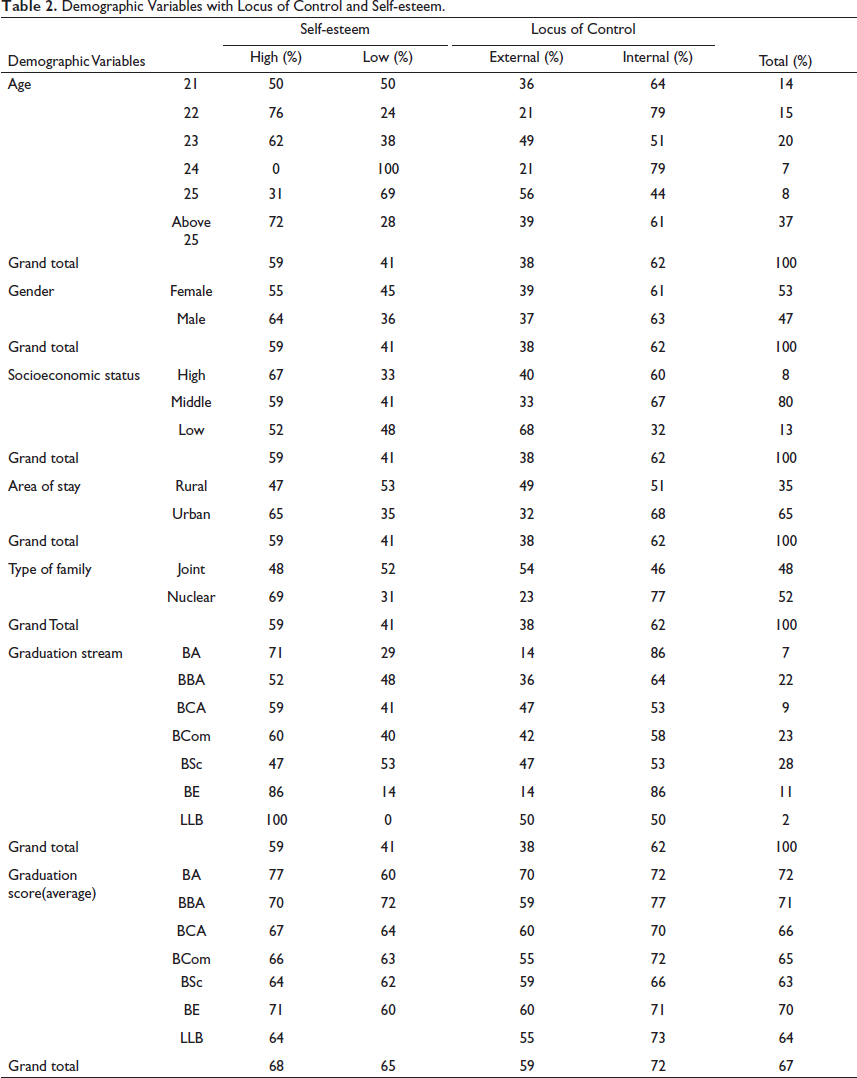
Table 2 shows the demographic variables associated with locus of control and self-esteem. In the study, 37% of students are aged above 25 years, 20% are aged 23 years, and the 24–25 age group is only 15%. It is seen that 75% of students aged above 25 years have high self-esteem, and 61% believe in internal locus of control. The trend is similar for high self-esteem and internal locus of control. Females are 53% and males are 47%. Males have higher self-esteem compared to females. The internal locus of control is higher for both males and females. In this study, 80% of the students are from middle socioeconomic strata, 13% are from low socioeconomic status, and 8% are from high socioeconomic strata. Students in high socioeconomic strata have higher self-esteem than those in the middle and lower classes. Students from low socioeconomic classes believe in external locus of control. However, students of high and middle socioeconomic class have a higher weightage toward internal locus of control. Students belonging to urban area are 65%, and among them, 60–65% are high on self-esteem and believe in internal locus of control. Students belonging to nuclear family are 52% and joint family are 48%. Seventy-seven percent of nuclear family students have high self-esteem and believe in internal locus of control. Only 23% of nuclear family students believe in external locus of control and 54% of joint family students believe in external locus of control. Law, BE, BA, and BCom students have higher self-esteem than BBA, BCA, and BSc students. Internal locus of control is higher among Engineering, BA, and BBA students. Average graduation scores are higher for BA, Engineering, and BBA students. Average graduation scores are higher among high self-esteem students. Average graduation scores are higher among internal locus of control students than external locus of control students.
Demographic Variables with Locus of Control and Self-esteem.
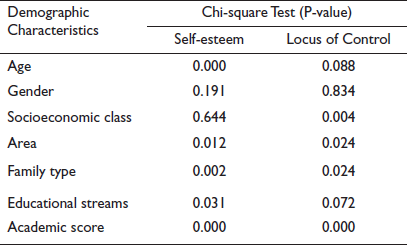
To test the hypotheses, Chi-square test was performed. The results are shown below
Self-esteem
Since the P-value for age, area, family type, educational streams, and academic score is lower than .05 at the 95% confidence interval, it is concluded that age, area, family type, educational streams, and academic score are correlated with self-esteem whereas gender and socioeconomic class are not correlated with self-esteem.
Locus of Control
Since the P-value for socioeconomic class, area, family type, and academic score is lower than .05 at the 95% confidence interval, it is concluded that socioeconomic class, area, family type, and academic score are correlated with locus of control, whereas gender, age, and education are not correlated with locus of control.
Gender is the only factor that came out as insignificant and has no correlation with self-esteem and locus of control.
Predictors of the Academic Achievement
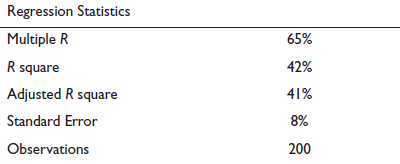
The total number of students in this study was 200. Out of which 62% (n = 124) had internal locus of control and 38% (n = 76) had external locus of control. Students with high self-esteem were 59% (n = 118), and those with low self-esteem were 41% (n = 82). There was a significant correlation between self-esteem, locus of control, and academic achievement. Furthermore, self-esteem and locus of control totally predicted 41% of the variation in academic achievement, in which self-esteem and locus of control were both strong factors to predict academic achievement.


Discussion
This study shows a significant correlation between locus of control, self-esteem, and academic achievement. Students joining MBA programs aim for high positions like administrators, managers, leaders, and advisors. As seen in this study, most of the students joining MBA have shown high self-esteem with a belief in their internal locus of control. Research done since the 1970s has shown that leaders who are successful have a high internal locus of control, but those who are not able to make a mark have a low internal locus of control.22–24 Even earlier research on students has shown that those with an internal locus of control have faith in their ability to achieve their goals. 25 They have the ability to turn situations in their favor. 26 They take full responsibility for their successes as well as their failures. 25 Some studies from 2001 to 2005 have reported the importance of self-esteem in predicting academic achievement.27–29 Alavijeh et al. and Hosseini et al. also reported a meaningful correlation among locus of control, self-esteem, and average scores among college students belonging to the medical sciences.30, 31 Recent research (2022) on white-collar participants placed in different sectors showed that with an increase in external locus of control, the self-esteem of employees decreases, and vice versa. 32
This study also brought out that gender had no correlation with self-esteem or locus of control. This is in line with another study where results were non-significant for association and comparison between adolescent males and females context to the locus of control, self-esteem, and decision-making. 33 The mean scores in this study show males have a higher self-esteem than girls and believe in an internal locus of control. Similar results were reported by other studies, showing that boys were experiencing an internal locus of control and high self-esteem. 34 Some studies have reported that higher self-esteem is seen in men during the stage of young adulthood.35–37 Another finding from this study was that the strata of high socioeconomic status showed no correlation to self-esteem but had a positive correlation to internal locus of control as compared to those of low socioeconomic status. Though not many studies were found in this regard. But one study reported a small but significant relationship between socioeconomic status and self-esteem in young adulthood. 38 A drop in socioeconomic status showed a normative decline in self-esteem. 39 Another finding was that students in urban areas and those belonging to nuclear families showed higher self-esteem and believed in an internal locus of control as compared to students coming from rural areas and those belonging to joint families. But a study by Kaura and Sharma showed that adolescents staying in joint families had a higher internal locus of control as compared to adolescents from nuclear families, who showed a higher external locus of control. 40 Overall, this study brings out a correlation among self-esteem, locus of control, and academic scores. It is necessary to consider these factors in developing strategies for student’s overall progress, especially in the educational field.
Limitations
The findings reported in this study have certain limitations. First, the data collected was based on self-reporting, which may have certain inhibitions as it is sometimes prone to recall bias. Second, the data were collected from a certain region and hence cannot be generalized to other populations of college students. In spite of these limitations, our study can be a guide for educational policymakers and planners to implement programs for improving self-esteem and internal locus of control and enhancing academic achievement among MBA students.
Conclusions
Our findings show that overall academic achievement can be improved with better self-esteem and an internal locus of control, hence the need to develop and implement such interventions that incorporate a sense of worth in graduate students who will be stepping into the competitive world, with faith in their abilities and being responsible for all situations in their lives.
Footnotes
Authors’ Contribution
All authors contributed to the study’s conception and design. Research conceptualization, data collection, analysis, and plagiarism checks were performed by Dr Shaini Suraj, Rucha Lohi, The first manuscript draft was prepared by Dr Shaini Suraj, Dr Brij Singh, and Dr Pradeep Patil. All authors reviewed the results and approved the final version of the manuscript.
Statement of Ethics
Institutional Ethical Committee has confirmed that no ethical approval is required due to the nature of the study. Due permission was taken from concerned authorities of the institutes where study was conducted. Confidentiality was maintained by assigning a code to each participating student’s document. Data was stored with security code.
Declaration of Conflicting Interests
The authors declared no potential conflicts of interest with respect to the research, authorship, and/or publication of this article.
Funding
The authors received no financial support for the research, authorship, and/or publication of this article.
Informed Consent
Participants were informed of the confidentiality of their responses and all doubts of the students were clarified before they filled the on-line questionnaire.
