




Abstract
Background
The typology of word order in Hindi (Subject-Object-Verb, SOV) differs from that of English (Subject-Verb-Object, SVO). Bilinguals whose two languages have conflicting word order provide a unique opportunity to understand how word order affects language processing. Earlier behavioural and event-related brain potential (ERP) studies with Spanish-Basque bilinguals showed longer reading times and more errors in the comprehension of OSV sentences than SOV sentences in Basque language, indicating that non-canonical word orders (OSV) were difficult to process than canonical word order (SOV).
Purpose
This study was designed to explore how the difference in word order in Hindi and English languages affects N400 parameters in proficient Hindi−English bilinguals, using semantic congruity paradigm.
Methods
Twenty-five proficient Hindi−English bilingual subjects were asked to silently read the congruent and incongruent sentences presented in one word at a time in both the languages. ERPs were recorded from midline frontal, central and parietal sites.
Results
The mean amplitude of the N400 effect at the parietal sites in Hindi−English proficient bilinguals was larger for English than for Hindi but there was no significant difference in the N400 latencies.
Conclusion
Hindi−English bilingual subjects processed SOV and SVO sentences with equal ease as evidenced by the N400 latencies. Higher amplitude of the N400 effect with English sentences indicate that placing ‘Object’ as the final word makes sentences more predictable than verb as the final word. Understanding the word order difference might help to unravel the neurophysiological mechanisms of language comprehension and may offer some insights in terms of functional advantage of a particular word order in bilinguals.
Keywords
Introduction
Word Order Affects Sentence Processing in Bilinguals
The majority of the languages worldwide fall into two main categories: 48% of them are ‘Subject-Object-Verb’ (SOV) languages and 41% are ‘Subject-Verb-Object’ (SVO) languages. 1 For example, the predominant word order in Hindi is SOV whereas that of English is SVO.1, 2 SOV word order is the default word order and all human languages with SVO word order originated from the SOV word order. 3 Bilinguals whose two languages have conflicting word order could provide a unique opportunity to understand how word order affects language comprehension.
Language comprehension has extensively been studied in bilinguals using behavioural measures (i.e., reaction time, comprehension time) and event-related brain potentials (ERPs) (i.e., N400, P600). For bilinguals, sentences with canonical word order (word order similar to native language) are easier to comprehend than non-canonical word order. For example, canonical word order for German language is SVO, whereas Dutch language has a flexible word order either SVO or SOV. While processing Dutch sentences with SOV word order (conflicting structure), German−Dutch bilinguals showed delay in P600, suggesting that sentences with non-canonical word order are difficult to process than canonical word order. 4
Earlier studies with Spanish−Basque bilinguals showed longer reading times and more errors in comprehension of OSV sentences than SOV sentences in Basque language, indicating that derived word orders (OSV) were difficult to process than canonical word order due to syntactic complexity.5, 6 Processing of non-canonical OVS sentences in Basque language involves structural reanalysis. Natives display N400 as they complete the sentence processing at the OV position without waiting for the subject, whereas non-natives elicit P600 while waiting for the subject, indicating that native and non-native Basque speakers use different processing strategies. 7 Similarly, Spanish native speakers with Spanish OVS sentences elicit P600. 8 Thus, evidence from behavioural and ERP studies suggest that non-canonical word order sentences are difficult to process.
How Difference in Word Order Influences the N400 Congruity Effect?
N400 ERP has been used extensively to study language comprehension in bilinguals. Earlier studies with semantic violation paradigm reported delayed N400 peak latency in bilinguals’ second language (L2) compared to their native language (L1).9–14 The N400 effect of amplitude was reduced for L29, 10, 12 or did not show any difference13, 14 in their less proficient L2 compared to L1. In these studies, the word order in L1 and L2 were similar (SVO in both L1 and L2). Using semantic violation paradigm, language comprehension was studied in Japanese-German bilinguals (word order for Japanese language is SOV and that for German is SVO). Japanese-German Bilinguals showed no significant difference in amplitude of the N400 effect in L1 and L2. Participants in their study were late learners and their age of acquisition (AOA) was 18–31 years for L2. 11
There is a paucity of studies in examining the effect of difference in word order on sentence comprehension to the semantic anomalies in proficient bilinguals. Hindi is a head-final language with SOV order and is different from English which is a head-medial language with SVO word order. We exploited this difference in word order to understand how word order affects comprehension in Hindi-English proficient bilinguals using the N400 semantic congruity effect paradigm.
Methods
Participants
Twenty-five Hindi−English bilingual subjects (18 men and 7 women) between 18 and 25 years old participated in this cross-sectional study. Procedures were approved by Institutional Research and Ethical Committees. All the participants had normal or corrected-to-normal vision, and no previous history of hearing, learning, neurological or cognitive impairment. The Edinburgh Handedness Inventory (EHI) was used to assess the quantitative handedness of the participants 15 ; all participants were right-handed. Participants were asked to rate their language experience and proficiency using Language Experience and Proficiency Questionnaire (LEAP-Q) for Hindi and English languages. 16 Domains assessed in the LEAP-Q were acquisition history, contexts of acquisition, current language usage, language preference and proficiency ratings (across the four domains of language use: speaking, understanding, reading and writing) and accent.
Stimulus Presentation
Prior to the experiment, 10 subjects (who did not take part in the present study) were provided a list of 120 paired highly contextually constrained congruent and incongruent sentences of both the languages (Hindi and English) and then asked to rate the degree of the contextuality and anomaly for each sentence final words on a scale from 0.1 to 1. Thirty highly contextually constrained congruent endings and thirty incongruent endings for each of the languages whose ratings ≥0.9 were selected in the present study. We ensured that none of the sentence contexts were repeated for congruent and incongruent endings or across languages within subjects. This rating enabled us to select contextually high constrained congruent sentences and anomalous incongruent sentences for each of the languages studied.
For actual experiments, study participants were seated comfortably in the chair 33 inches away from a computer screen. Hindi and English (congruent and incongruent) sentences were randomised and language blocks were presented in counterbalanced design. The sentences were five to seven words in length and were presented word-by-word (rapid serial visual presentation or RSVP) in the centre of a computer screen with a yellow-on-black background. The central RSVP presentation of words was used to avoid contamination of ERPs with eye movements. 17 A warning sign ‘plus’ appeared before the first word in the sentence and a ‘full stop’ appeared after the last word. Each word appeared for 200 ms and was followed by a blank screen for 300 ms, the inter-sentence interval was 2 seconds (Figure 1).
Stimulus Presentation Scheme.
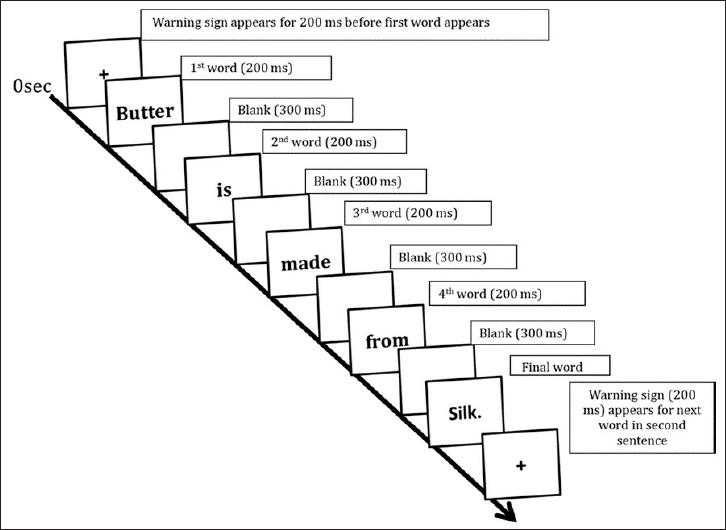
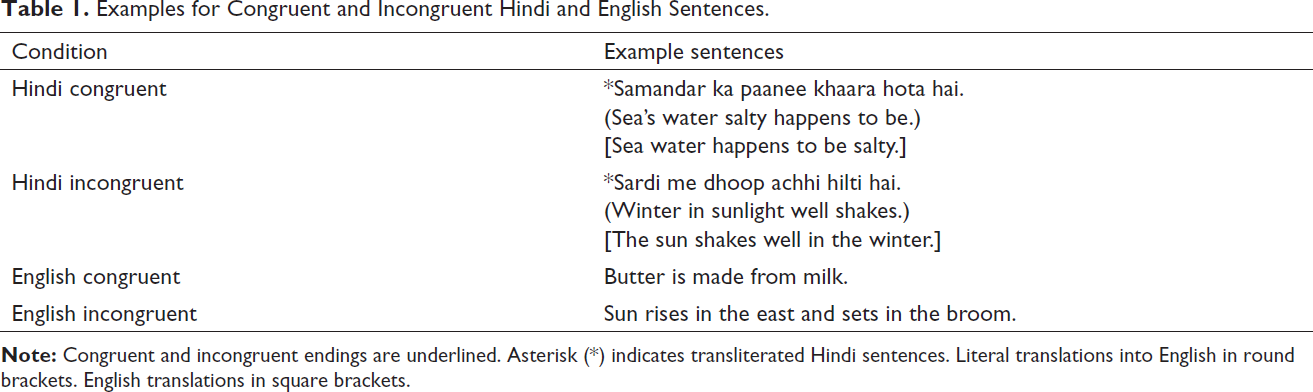
Participants were asked to read the words silently without blinking. For Hindi sentences the auxiliary verbs (e.g., hai) were presented together with main verbs (e.g., hota) as final words (Table 1).
Examples for Congruent and Incongruent Hindi and English Sentences.
ERP Recording Procedure
The electroencephalogram (EEG) was recorded with EMG/EP System MEB-2300K (Nihon Kohden, Japan), with AgCl scalp electrodes. Three electrodes were placed according to the International 10-20 system at frontal (Fz), central (Cz) and parietal (Pz) midline locations, and each referenced to two linked mastoids. In addition, eye blinks and horizontal eye movements were monitored by placing electrodes on the outer canthus and infraorbital ridge of each eye. Electrode impedance was kept less than 5 kΩ. EEG signals were filtered online within a bandpass of 0.1–20 Hz and sampled at 1024 Hz. A light sensor patch (1 cm × 1 cm) was placed on the right upper corner of the screen along with the last word of the sentence. Light sensor with StimTracker Quad (Cedrus, US) was used to trigger signal acquisition. ERPs were acquired for epochs extending from 100 ms before to 700 ms after the stimulus onset. The N400 peak latencies, amplitudes and the N400 semantic congruity effect (incongruent minus congruent ERP) were measured for semantically congruent and incongruent sentences time-locked to the sentence final words.
ERP Data Analysis
ERP data were exported to MATLAB for further analysis. EEG data of the individual ERP trials (30 congruent and 30 incongruent) were detrended and stitched together. Event list was created using presentation sequence and timing. EEG data were converted to EEGLAB and ERPLAB format. Trials with artefacts were flagged using ERPLAB’s threshold and flatline detection utilities. Flagged blink artefacts were visually inspected and confirmed with electrooculogram (EOG) data. The data of subjects with fewer than 20 artefact free trials (out of 30) in either block were not further analysed. Overall, data from only 25 of the subjects were included. EEG data of congruent and incongruent sentences were averaged separately for each subject with pre-stimulus baseline correction. The N400 effect was determined by subtracting the congruent ERP from the incongruent one, point by point for each participant. The N400 peaks were marked manually and latencies were determined. Mean amplitudes were measured between 250 and 500 ms window relative to 100 ms prestimulus baseline.
N400 Latency and Amplitude Analyses
We examined the effect of word order difference on semantic processing in both languages of Hindi-English bilinguals who did not vary much in their age of exposure to both L1 and L2, and were equally proficient in both of their languages. We averaged N400 ERPs elicited with congruent and incongruent sentence final words in Hindi and English. We measured the peak latencies and mean amplitudes of the N400 effect (semantic violation minus congruent ending ERPs) for verb final sentences and compared with object final sentences.
Statistical Analysis
Data analysis was done using R software. Normality was tested with frequency histograms and Shapiro-Wilk test. Non-parametric tests were used where data were not normally distributed. Paired comparisons were analysed using Wilcoxon-Sign Rank test or Student t test. Kendall’s correlation was done to analyse association between the N400 congruity effect and components of LEAP-Q. A two-sided p-value less than 0.05 was considered significant.
Results
Our primary objective was to examine as to how a word order of Hindi (L1) with SOV word order and English (L2) with SVO word order affect sentence processing in Hindi−English bilinguals. The N400 peak latencies and mean amplitudes were measured in the 250–500 ms time window at three midline electrodes (Fz, Cz and Pz) to semantically congruent and semantically incongruent sentence final words of Hindi and English sentences. We also measured the N400 congruity effect (N400 to the final word of congruent sentences minus N400 for the final word of congruent sentences).
Baseline Characteristics of the Participants
All our participants were right-handed according to the EHI score and come from a homogeneous group with regard to formal education and professional training (Table 2).
Baseline Characteristics of the Subjects.

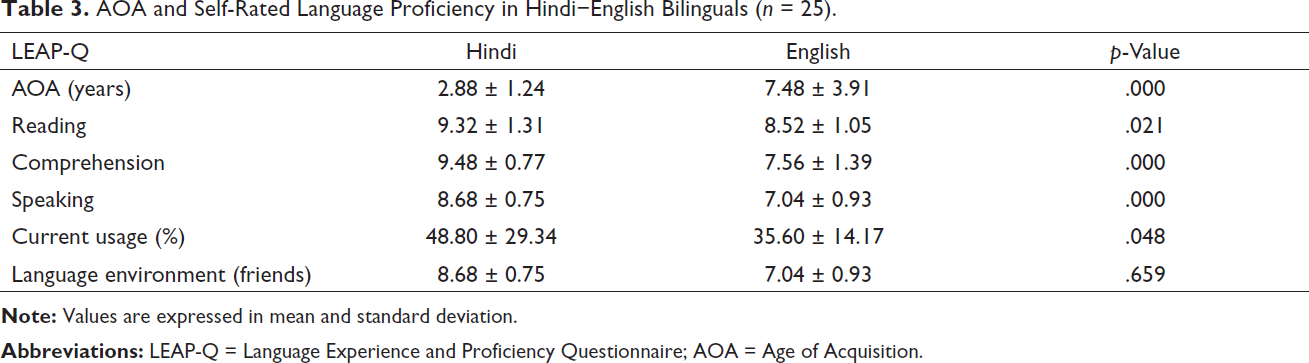
AOA for Hindi language was earlier than for English. Further, self-rated LEAP-Q score in language proficiency and the percentage of current usage was marginally higher for native Hindi language than for English language. Language environment in the workplace (with friends) was comparable in the two languages (Table 3).
AOA and Self-Rated Language Proficiency in Hindi−English Bilinguals (n = 25).
Effect of Word Order on N400 Latencies to Sentence Congruent and Incongruent Final Words of Hindi (L1) and English (L2) Sentences in Hindi−English Bilinguals (n = 25)
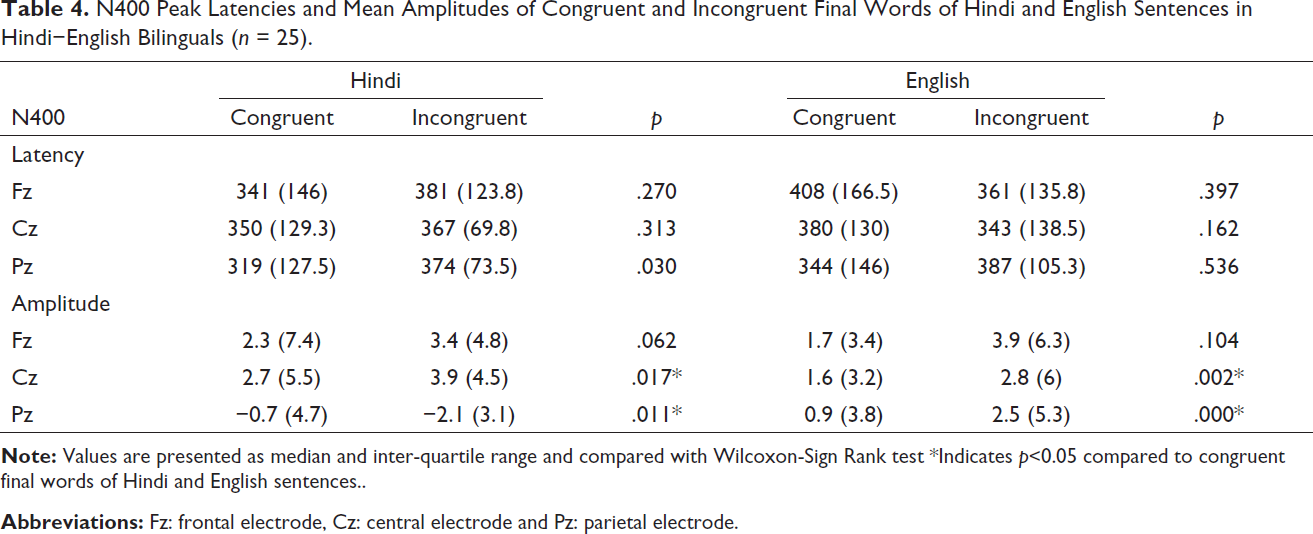
Pairwise comparisons (congruent vs incongruent for English and Hindi) were analysed with Wilcoxon-Sign Rank test. The median peak N400 latency for Hindi sentence congruence (congruent vs incongruent) was significantly prolonged only at Pz but the difference in English was not significant in any of the electrode sites (Table 4).
N400 Peak Latencies and Mean Amplitudes of Congruent and Incongruent Final Words of Hindi and English Sentences in Hindi−English Bilinguals (n = 25).
Effect of Word Order on N400 Amplitude to Sentence Congruent and Incongruent Final Words of Hindi (L1) and English (L2) Sentences in Hindi−English Bilinguals
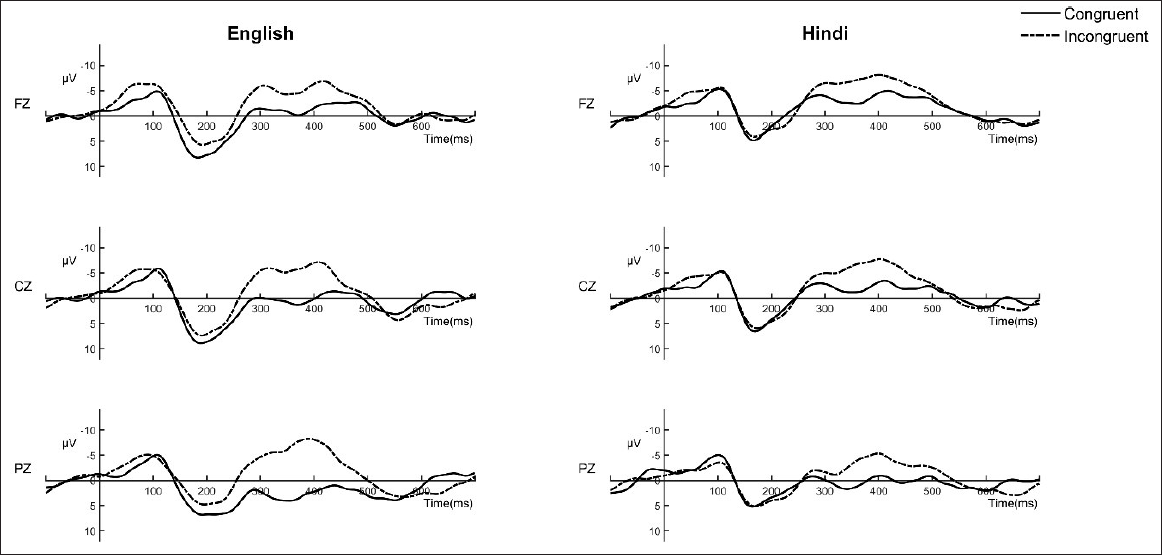
Median peak amplitude was measured in the 250–500 ms time window at Fz, Cz and Pz electrodes and analysed using Wilcoxon-Sign Rank test. Compared to congruent final words, incongruent final words elicited strong N400 negativity, gradually increasing from the frontal towards the parietal electrodes in both languages. The maximum N400 amplitude was observed for the English incongruent final words than for the Hindi (Table 4).
Comparison of N400 Semantic Congruity Effect (Incongruent Minus Congruent ERP) Between Hindi (L1) and English Final Words in Hindi−English Bilinguals
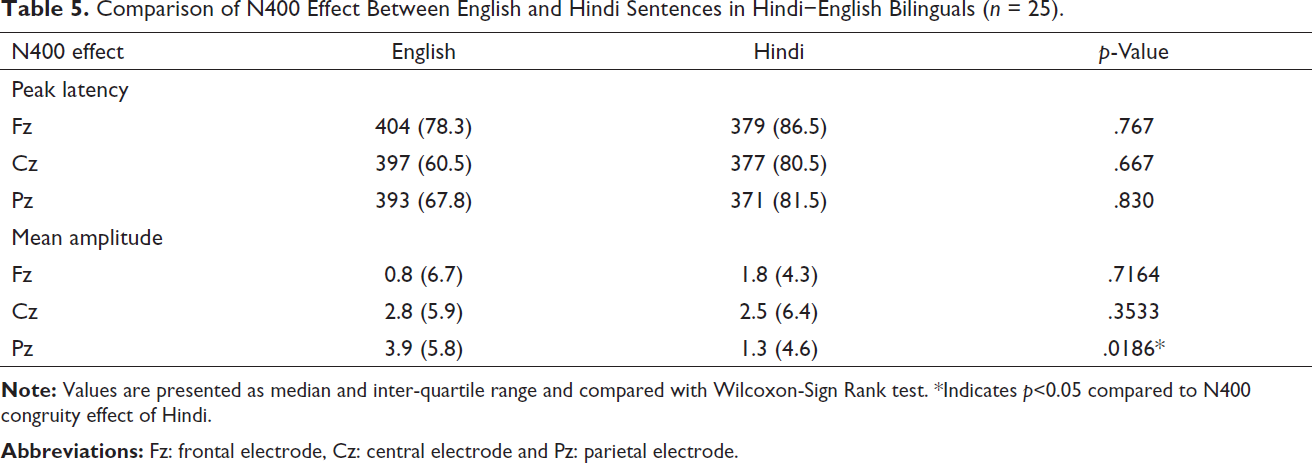
Here, we aimed to investigate the effect of word order type in Hindi and English final words on N400 latency and amplitude. The latency of the N400 congruity effect was not significantly different for the two languages. However, the amplitude of the N400 congruity effect was significantly greater (Table 5 and Figure 2) for English, but only at Pz electrode. The difference in N400 congruity effect between English and Hindi did not correlate with AOA, language proficiency in comprehension, current usage of the language and language environment for L2.
Comparison of N400 Effect Between English and Hindi Sentences in Hindi−English Bilinguals (n = 25).
Grand Average ERPs (n = 25) Elicited by Semantically Congruent (Solid Line) and Incongruent Sentence (Dashed Line) Final Words of English and Hindi Sentences.
Discussion
In the present study, we explored the effect of word order difference (SOV vs SVO) in proficient Hindi−English bilinguals on the N400 congruity effect. The peak latencies and mean amplitudes of the N400 effect were recorded to the sentences ending either with a verb (in the case of Hindi sentences) or with an object (in the case of English sentences). The amplitude of the N400 effect at parietal site in Hindi-English proficient bilinguals was higher in L2 as compared to L1 but had no significant difference in the latency. Earlier studies with semantic violation paradigm reported that N400 peak latency was delayed in bilinguals’ second language (L2) compared to their native language (L1).9–14 One might expect a shorter N400 latencies for their native Hindi language compared to the English language being L2. Previous study suggested that native like processing (P600 characteristics to syntactic violations) of L2 was difficult even for the proficient L2 learners because of the difference in the word order. 4 In addition, it has been demonstrated that the N400 peak latency was slowed in bilinguals if the AOA is more than 11 years. 14 Our study participants acquired both the languages much before the age of 11 and were equally proficient in both L1 and L2. Therefore, equal latencies in our study indicate that processing of SOV and SVO sentences took almost similar time in bilinguals.
Earlier studies with semantic violation paradigm reported reduction in the N400 amplitude for L29, 10, 12 or did not show any difference13, 14 in their less proficient L2 compared to L1. In these studies, the word order was SVO in both L1 and L2. In addition, Japanese-German Bilinguals also did not show any significant difference in amplitude of the N400 effect in L1 and L2. But their L1 (Japanese) word order was SOV and L2 (German) word order was SVO. However, their age of acquisition for L2 was late (18–31 years). 11 In contrast, Hindi−English bilinguals showed larger amplitude of the N400 effect to the English (L2) anomalous (vs. congruent) final words than Hindi (L1) final words. In the present study, the participants’ age of exposure to English was early and they were equally proficient in both L1 and L2. Moreover, participants had similar background in terms of years of education and academic levels, and their medium of instruction has been English from the beginning.
There is a possibility that both the word order and L1 vs. L2 are confounded and the observed difference in the N400 effect for amplitude between Hindi and English sentences may not actually be due to difference in word order alone. However, this may not be the case because in the present study, the participants’ age of exposure to English was early and they were equally proficient in both L1 and L2. Moreover, participants had similar backgrounds in terms of years of education and academic levels, and their medium of instruction has been English from the beginning. One might argue that this difference could be due to the way how the brain processes semantic anomaly at noun or verb. However, the degree of semantic anomalies in Hindi and English sentences was equal in the present study. Therefore, we assume that preceding context with respect to a particular word order would have influenced the N400 amplitude. The difference in the N400 amplitude may be explained on the basis of predictability hypothesis. As per ‘predictability maximization principle’ the verb should be placed last in a sentence (as in SOV) because it increases predictability and decreases the uncertainty for target element. 18 On the contrary, placing objects after the verb (as in SVO) could be even more efficient in terms of predictability of the object than SOV word order. 19 Replacing highly predictable final word with anomalous word would have elicited larger amplitude of the N400 effect. The large amplitude for L2 in the present study may suggest that predictability of object in SVO sentences is higher than that of a verb in SOV sentences. Another possibility is that, in Hindi, the auxiliary verb follows the main verb and therefore the repetition of these auxiliary verbs could have resulted in the reduction of amplitude of SOV word order. However, we presented these auxiliary verbs together with main verbs as sentence final words.
In the present study, latency of the N400 effect was equal for SOV and SVO sentences; hence, it is difficult to be certain about which word order is advantageous in terms of comprehension. Sentences with SVO word order (English) may be equally easy to comprehend by Hind-English bilinguals despite English being their L2. One might argue that the decrease in N400 effect in L1 may be due to attrition of L1. However, attrition of the native language is a distant possibility in our group of subjects as the environment provided an almost equal opportunity to be exposed to Hindi as well.
Conclusion
Hindi−English bilingual subjects processed SOV and SVO sentences with equal ease as indicated by N400 latencies. ‘Object’ final words in SVO sentences appear to be more predictable than ‘verb’ final words in SOV sentences that would have resulted in higher amplitude for SVO word order. Since the use of more than one language is a global phenomenon, understanding the word order difference might help to unravel the neurophysiological mechanisms of language comprehension and may offer some insights in terms of functional advantage of a particular word order in bilinguals. Further research is warranted to explore the effect of word order by counter balancing Hindi-dominant group with English-dominant group.
Authors’ Contribution
B.N.R. and K.K.B. were responsible for the conceptualization of the research hypothesis and deciding on the methodology to be followed. G.G.A. carried out the investigations and analysis, and the interpretation of the data was done by M.G., B.N.R. and G.G.A. The manuscript was prepared by G.G.A. and revised, reviewed and intellectual inputs provided by B.N.R., K.K.B. and M.G. The overall mentorship and supervision were provided by B.N.R.
Statement of Ethics
All experiments and protocols were approved by Institutional Ethics Committee, AIIMS-Bhubaneswar (Registration No: ECR/534/Inst/OD/2014/RR-17).
Informed Consent
All experiments and protocols were approved by Institutional Ethics Committee, AIIMS-Bhubaneswar (Reference No: IEC/AIIMS BBSR/PG Thesis/2018-19/25). The present research complies with the guidelines for human studies and includes evidence that the research was conducted in accordance with the World Medical Association Declaration of Helsinki. Written informed consent was obtained from all the study participants.
ICMJE Statement
I/we had full access to all of the data in this study and I/we take complete responsibility for the integrity of the data and the accuracy of the data analysis.
Footnotes
Acknowledgements
We thank all the participants in this study. We also thank the technical staff for their support in the study.
Declaration of Conflicting Interests
The authors declared no potential conflicts of interest with respect to the research, authorship and/or publication of this article.
Funding
The authors received no financial support for the research, authorship, and/or publication of this article.
