



Abstract
Background:
The existing structural framework of defining gender and sexuality based on heteronormative ideology led to the succession of the notions of stigma, prejudice, and hate towards the sexual and gender minority population. The presence of strong scientific evidence for the negative consequences of discriminatory and violent events has directed the association with mental and emotional distress. This study aims to comprehend the role of minority stress in emotional regulation and suppression among the sexual minority population globally using systematic review of literature through elaborate Preferred Reporting Items for Systematic Reviews and Meta-analyses (PRISMA) guidelines.
Summary:
The analyses of the sorted literature premised on the PRISMA guidelines revealed that minority stress mediates the emotion regulation processes among the individuals who witness continuous episodes of discrimination and violence leading to emotional dysregulation and emotion suppression. Studies also reported the dominance of various health-risk behaviors such as alcohol addiction, drug abuse, and other forms of intoxication among sexual minority individuals. Increased instances of anxiety, stress, depression, and suicidal ideations were prominent in the findings of the empirical research suggesting an intricate role of minority stress in advancing the faulty emotion suppression and mental health concerns among the sexual and gender minority population.
Key message:
Minority stressors among sexual and gender minority individuals mediate emotion suppression and mental distress.
Introduction
The legal and constitutional progression of sexual and gender diverse communities from repealing of Section 377 of the Indian Penal Code (IPC), a colonial-era law had led to the recognition of their basic human rights. The essence of homosexuality as deviant sexual behavior is decriminalized by the constitutional forces, but the responses of the mainstream society are yet to be of desired behavior. The reactions of society toward LGBTQIA+ individuals are detrimental to their mental health and well-being. 1 The prevalence of underlying stressors relating to sexual and gender preferences is associated with a degree of psychological and emotional distress. Stigma associated with their identities, discrimination projected in lieu of their orientation, and prejudices directed towards these individuals for larger part of their lives lead to faulty emotional responses. Socially ostracized and laden with psychological trauma, the sexual minorities are often the focal point of discrimination, prejudice, and stigma associated with heterosexism. Heterosexism is defined as the projection of prejudice, stigma, and discrimination against individuals who do not conform to the norms of the patriarchal heteronormative society. The sexual minorities, inclusive of lesbian, gay, bisexual, trans-persons, queer, and other trans-identities, have been at the juncture of expressing and validating their gender identity at the expense of binary heteronormative society. Research has elicited that the social burden of acting and reproducing the behavioral patterns that align with the norms and values of the society, despite their incongruence, had led to adverse mental health outcomes among sexual minority individuals.2, 3
Progressing on the realm of neo-functionalism theory by Jeffrey C. Alexander in 1990, 4 which incorporates multidimensional micro as well the macro level of analysis, the emotions have been prospected to yield psychologically beneficial and proficient behavioral outcomes.5–7 Emotions are the central sources that provide impetus to the acts and behaviors of individuals. They are proficient means of delivering crucial information about the state of one’s interactions with the external environment 8 or defining and directing the responses of individuals in life-threatening situations. 9 The ability to manage the emotions, underlying feelings, and responses helps to shape the decision-making of individuals. The emotional regulation processes commence whenever an individual encounters external or internal stimuli that signals the urgency of the situation. These cues are then evaluated and attended through a coordinated set of response tendencies including behavioral, experiential, and peripheral physiological measures. Once these response tendencies arise, they could be modulated or altered in various manners, thereby reflecting as perceptible responses. Whenever the individual fails to follow the requisite pathway of addressing the emotional requirements of the situation, the emotion regulation process is irregulated. 10 Emotional regulation, defined as processes and activities adopted by the individual in response to arousal of emotional reactions,11, 12 contributes to the psychological output in terms of behaviors and attitudes. The central premise of emotional regulation rests on the efficacy and ability of an individual to influence emotions in the context of situation, experiences, time-limit, and valanced states which could be either negative or positive. 13 The impact of erroneous regulation of emotional arousal on subsequent functioning and behavioral outcomes has been addressed by traditional conceptualizations. The correspondence of emotional regulation in terms of psychological defenses 14 has been addressed in modern times as well. The psychological repercussions of erroneous dysregulation of emotions are reflected in various forms of distress including anxiety, stress, depression, suicidal ideations, and neglect. Emotional expression satiates the requirement for cognitive reappraisal for any external or internal stimuli.
The disadvantaged and marginalized sections of the society are the bearers of such emotional dysregulation owing to their underprivileged status. The sexual minority population is predisposed to social biases, indifferences, and prejudices that limit their emotional expression over the years. This suppression of emotional expression is highly correlated to the mental distress of the individuals. The marginalized communities often succumb to depressive and negative emotions, which hamper their interpersonal and intrapersonal relationships. 15 The prior literature has elicited concerns of emotional dysregulation and emotion suppression among individuals. Emotion suppression is attributed to various antecedents including the dominance of social and cultural norms. 16
Human sexuality is an individual’s unique way of experiencing and expressing sexual drives which are reflected through their feelings, thoughts, attractions, and behaviors. Sexual minority individuals—who identify themselves as lesbian, gay, bisexual, transgender, or with any other identity—challenge the deeply set notions of sexuality and gender in society to foster such incongruence in their gender and sexual expression. They presumably fall outside the norms of the mainstream society. Often sexual and gender minority individuals are burgeoned to adopt means for surviving their marginalized status in society. 17 It endangers the cultural norms established on the premise of heteronormativity.
Heteronormativity is a social prerogative for gender conformity and sexual congruence.18, 19 It tends to demean and stigmatize all other forms of gender and sexual expression that do not conform to the binary picture of heterosexual norms. The rising familiarity with the concept of Cisgenderism—which is defined as an ideology that denigrates, denies, and demeans any form of non-conforming and self-identified gender identities contrary to the one assigned at the birth 20 —is due to the significant attention shifted toward the discriminatory and stigmatized experiences of gender and sexual minority individuals.
LGBT minority stress is conceptualized as the burden of witnessing negative attitudes and objective reactions from the society relating to one’s sexual and gender identity. 21 Minority stress encompasses all those stressors that reflect negative mental health status owing to social ostracization and stigmatization. Minority stress theory postulates identifications for the experiences of victimization that are cordially related to the psychological and mental health issues of LGBTQIA+ individuals. 22 It is essentially related to the processes that underline negative social interactions laid in the context of gender and sexual non-conformity. The persistence of these forms of discriminatory events over an extended period is often linked to degrading mental health and well-being of individuals and coaxes them to adapt to regressive attitudes such as substance abuse, suicidal tendencies, ineffective communication, and unintended acts. 23 The literature has documented a range of negative mental health outcomes because of experiencing chronic minority stress.
Emotional regulation accounts for the processes that align with the internal and external stimuli to either maintain or increase/decrease any dimension of the emotional response. 24 These processes direct all those efforts that the individual makes to manage the underlying responses to any alarming stimuli; corresponding to decision about what emotions are to be dealt with. 25 It is crucial for an individual to regulate the emotions they encounter on a daily basis for effective psycho-social interactions. 5 An understanding of emotional regulation provides a window into the growth of individual differences in personality and social functioning. This valanced interplay of emotional regulation between the environment and the individual is one of the many effective regulation processes that involve the individual’s perception to alter their emotional responses to environmental stimuli.26, 27 The emotion regulation cycle begins with a discrepancy between someone’s goal state (i.e., the emotional state they desire) and the actual (or projected) state. This discrepancy is then identified as an opportunity for regulation. Emotional regulation strategies starts with the process of emotion generation that impinges on the sequential stage of encountering the situation, attending to and analyzing the key aspect of it, and after selection of the strategies to act on, adequate emotional response is reflected. Emotional response tendencies are selected from the five underlying categories based on the emotion generation stage at which they first intervene. 28 It could be in the form of expressive suppression, that is, preventing outward expression of internal emotional state or physiological intervention, that is, directly altering emotion-relevant physiology using actions or substances.
Individuals presumably differ in the strategies they adopt to respond to an emotional trigger. These individual differences in regulating the emotions are crucial in determining the social outcomes and maintaining the enduring social contacts. 29 The social consequences of emotional regulation strategies have impinged on the individual behavioral outcome. Emotional suppression or expressive suppression refers to those response modulation strategies which involve the inhibition of expression for the behavioral and outwards components of the emotional response. 30 Suppression is basically the response-focused strategy, occurring after the emotion response tendencies been already triggered. It reflects as a successor to an emotional trigger that was not expressed explicitly. As the emotional regulation occurs in social context, coordinating interpersonal relationships; thus, suppression hampers the social bonding. 25 Expression of emotion is largely related to social influences, and impact of any instance of social isolation, discrimination, and bias is directly responsible for suppression of emotional expression. This suppression of emotion is increased in the persistence of minority stressors witnessed daily relevant to an individual’s personal and specific incongruence. When suppression is used as an emotional expression strategy, it tends to subdue not only negative emotions but also the positive responses as well. 31 As a consequence, lack of positive emotions tends to inhibit the sustenance of cordial social relationships wherein individual desires to withdraw or inhibit or show disinterest in social transactions. 32 Thus, suppression accounts for the commensurate drop in expressing positive emotions, creating incongruence in the authenticity of individual’s emotional expression.
The vicarious and debilitating impact of heteronormative differentiation on the mental health and well-being progressively acts as stressors for the marginalized sexual and gender minority communities. The discriminatory and stigmatizing event tends to occur either due to proximal stressors or through distal stressors and acts as a catalyst in advancing the emotional dysregulation, emotional suppression, and emotional incompetence among the LGBTQIA+ communities. These irregularities and inefficiencies in context of emotional expression predispose an individual to adapt and function in distended manner, leading to upsetting emotional and mental responses. Thus, it gets crucial to identify such antecedents which predispose an individual to emotion suppression. This study aims to comprehend the role of minority stress on emotional regulation and suppression among the sexual minority population which encapsulates a wide array of identities such as lesbians gays, bisexuals, trans-persons, intersex, pansexual, and others. It would facilitate an understanding of their emotional status.
Methods
This study was operated through the guidelines of Preferred Reporting Items for Systematic Reviews and Meta-analyses (PRISMA) for reporting the systematic literature reviews of articles relating to minority stress and emotion suppression among sexual and gender minorities.33–36 The outlined 27-item PRISMA checklist was followed for the planning, conducting, organizing, evaluating, analyzing, and reporting the literature reviewed. The extracted reviews were analyzed and organized using various sources such as Google Docs and Excel spreadsheets. The research articles were selected on pre-defined criteria. The study was conducted through the various stages discussed in the following sub-sections.
Planning the Review
At the outset, the rationale and context for the study was recognized and vehemently laid out with coherence. The blueprint for the conduction of systematic review was formulated on the paradigm of PRISMA checklist along with the incorporation of steps suggested by Pascoe et al.
37
In accordance with the proposed 15-step methodology, the rigorous layout for the study was planned to answer the research question within the stipulated time span.
38
The preliminary outline included the documentation of the following:
Domain for the study: Role of minority stress in emotional regulation and emotional suppression among sexual and gender minority population. Objective of the study: The focus of the study was premised on the exploration of impact of minority stress on emotional regulation and suppression among sexual and gender minorities. Another aspect of the study was dedicated to the investigation of emotional suppression as a precursor to mental and emotional distress among the marginalized sexual communities. Implications: The investigation into the role of minority stress in emotion regulation and emotion suppression would highlight the interactional relationship among the emotional states and mental distress among the sexual and gender minorities.
Research Questions
RQ1: Whether there would be the role of minority stress in emotional regulation and emotional suppression among sexual and gender minorities?
RQ2: Whether there would be the role of emotional suppression as a precursor of mental and emotional distress among sexual and gender minorities?
Inclusion and Exclusion Criteria
The initial screening of the research articles was completed based on exclusion and inclusion criteria laid out in relevance to the research questions. The inclusion criteria for the study are:
Research studies based on impact of minority stress on emotion regulation and emotion suppression among LGBTQIA+ individuals Studies on the LGBTQIA+ individuals and their mental distress Studies published in peer-reviewed and indexed journals Articles based on empirical evidence, qualitative enquiries, review articles, and mixed-method approaches Research articles published in English language only Research articles that do not conformed to the inclusion criteria were excluded from the study. The following criteria were adopted for exclusion of studies. Research articles with insufficient information pertaining to research question Studies published in non-peer-reviewed and non-indexed journals Articles categorized as editorials, opinions, and commentaries.
The final screening of the articles was done in context to exclusion and inclusion criteria. The abstracts and titles of the articles were evaluated for their content and information, potentiating for their inclusion in the study. The duplicate studies were removed from the database.
Conducting the Review
The conduction of the review progressed on the domains of PRISMA checklist. The screening of the articles was done on the recommendation of PRISMA guidelines. The search for the potential articles was started after identifying the requisite database.39, 40 The databases identified for the article search were Google Scholar, Web of Science, Scopus, and PubMed. Also, two of the repositories for Indian theses and dissertations, namely, Shodhganga and Shodhgangotri were explored intricately for the articles related to the posed research questions. The published articles were searched in these databases from January 1990 to February 2022. The search keywords utilized in the study were LGBT minority stress, LGBT and emotional regulation, LGBT emotions, LGBT emotion suppression, LGBT emotional distress, mental distress, and LGBT distress and emotions. The descriptors used for identifying LGBT individuals comprised gays, lesbians, bisexuals, transgender, queer, Hijras, kothis, Homosexuals, sexual orientation, gender identity, aravanis, pansexual, gender minority, sexual minorities, and transsexuals.
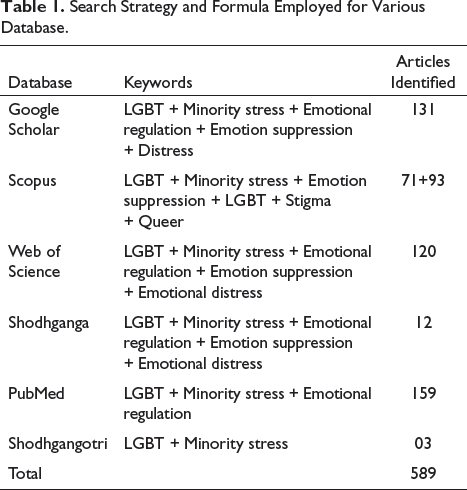
Table 1 depicts the list of various search keywords and formulas that were employed for searching various databases. The initial stage of screening led to the identification and sorting of 589 articles. These articles were further screened in line with exclusion and inclusion criteria.
Search Strategy and Formula Employed for Various Database.
Organization and Screening of Reviews
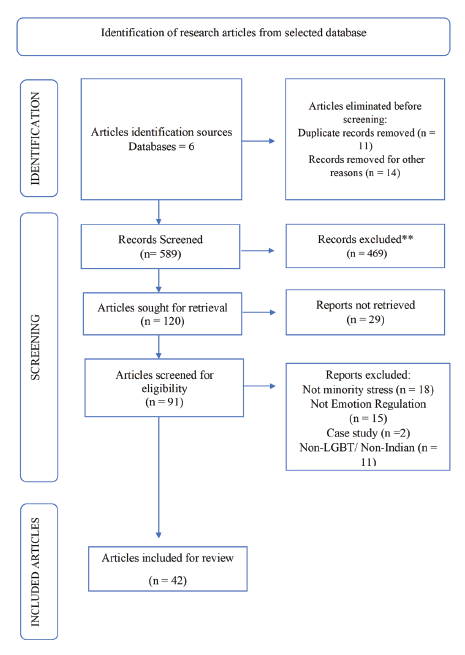
The organizing and screening of the studies were collectively done by all the authors. The screening of the studies was done in two sections as per the posed research questions. The studies reflecting the context of emotional regulation were organized in one Excel Sheet and the other section was utilized for studies on emotion suppression. The studies included theses, dissertations, and research articles on the related context. A total of 589 studies were screened through their relevancy of titles and abstracts. The abstracts for the articles not available in the full text were also included in the study. The studies screened for the potential inclusion were further validated by all the authors to minimize chances of duplication, bias, and errors. The sorted spreadsheet included a total of 120 articles. These articles were further screened independently by the authors for duplicate studies. The duplication screening led to the exclusion of 27 articles. Each of the specific categories of the articles was color-coded for referencing. The final phase of the organization led to the consideration of only 47 articles for inclusion in the study. The articles were finalized in line with the inclusion and exclusion criteria. The PRISMA flow chart for the selection of studies is depicted to highlight the search overview for the studies incorporating three stages: Identification, Screening, and Inclusion. The final inclusion comprised 42 articles for in-depth thematic exploration of the research question. The outline of the search procedure employed in the study is depicted as a flowchart in Figure 1, utilizing the principles of PRISMA guidelines.
Analysis of Reviews
The analysis of the included articles was done through coding of the selected research. The selected articles were coded in reference to—author, year of publication, type of research article, sample size, methodology adopted, domain of emotion regulation, type of minority stress, emotion suppression, distress in relation to emotion regulation, faulty emotion recognition, mediating factors of emotion suppression, and heterosexism in relation to emotion suppression. The identified and selected articles were analyzed by means of interrater coding and dedicated peer-review process. This led to the eradication of any discrepancies in the final database.
Results and Discussion
The final database of articles included 42 studies in the review study. These articles were provided with the adequate scientific evidence to support the research questions posed for the study. The results of the study are presented in two stages. The initial stage provided the description of the articles based on the sample size, year of publication, type of research, and country where the research was conducted. The second stage depicted the findings of the systematic review in accordance with the research questions.
Demographic Description of the Articles Included in Review
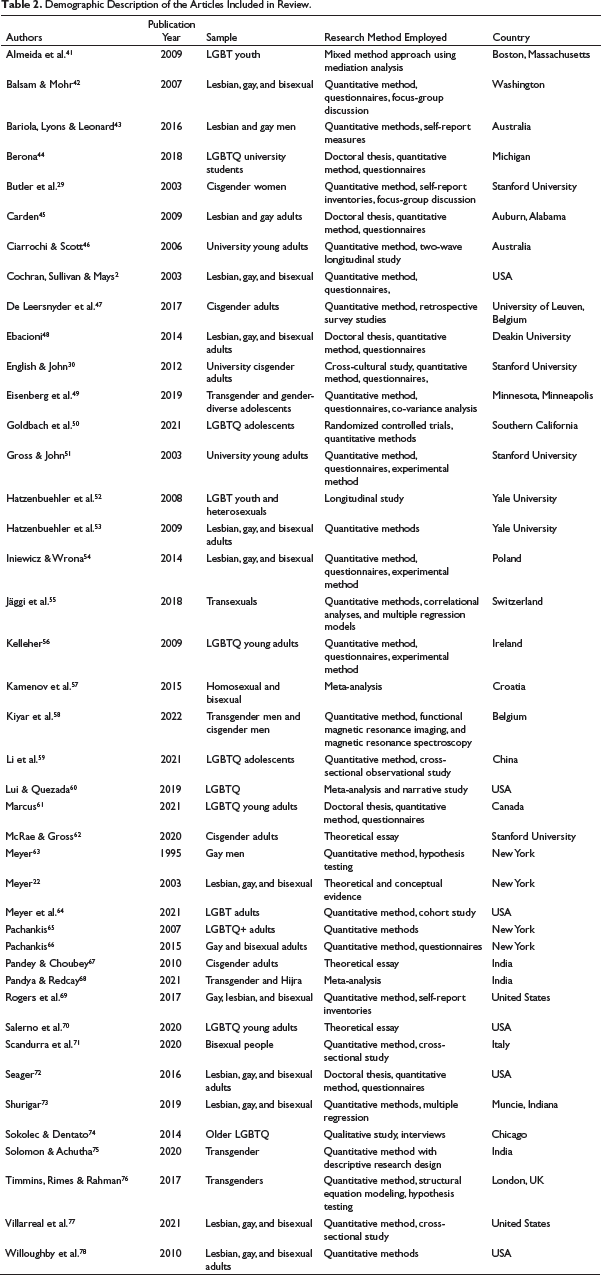
The sociodemographic description of the included studies is depicted in Table 2. The studies provided scientific evidence into the role of emotion regulation and suppressive regulation in reflecting the domain of purpose and well-being among sexual and gender minorities. The final database of articles included empirical studies, qualitative research articles, theses, and dissertations that reported the relationship between minority stress, emotion regulation, and emotion suppression among the sexual minority population.
Demographic Description of the Articles Included in Review.
Scientific Evidence for the Research Questions of the Study
Table 3 depicts the scientific evidence for the posed research questions. The description of research studies included the methodology adopted, scientific tools utilized, and results demonstrated in the context of emotional regulation strategy, mental distress, and emotion suppression experienced.
Scientific Evidence for Role of Minority Stress in Emotional Regulation.

Discussion
Sexual and gender minority individuals experience internalized homophobia, victimization, prejudice, and other forms of oppression from the heteronormative society which hampers their mental health and well-being. The experiences of social environment that place emphasis on heterosexuality predisposes an individual to varied forms of stressors, both Distal and Proximal. Internalization of social nuances, related to gender and sexual expression, burdens an individual with norm-appropriate behavior which suppresses their emotional and other behavioral expressions. 53 An understanding of emotional regulation provides a window into the growth of individual differences in personality and social functioning.
LGBT Minority Stress as a Determinant of Emotion Suppression
RQ1: Whether there would be a role of minority stress in emotional regulation and emotional suppression among sexual and gender minorities?
A range of adverse mental health outcomes including depression, stress, anxiety, and suicidal ideation, due to stigma-related stressors, have been accounted among sexual minorities.2, 22 The persistence of chronic minority stress tends to burden the emotional regulatory processes among sexual minorities on account of victimization, isolation, and discrimination. Petroua and Lemkeb conducted a study in 2016 to report the prevalence of health-risk behaviors among the sexual and gender diverse individuals in response to the extended events of discrimination, violence, stigma, and prejudices. 23 The extension of minority stress theory to the LGBT individuals has highlighted the impact of victimization experiences that are cordially related to the psychological and mental health issues of LGBT individuals. 22 For sexual and gender minority individuals, coping strategies like emotion regulation serve as a mediator between the experiences of victimization or discrimination and the underlying psychopathology.79, 80 It has been documented in the literature that up or down regulation of positive and negative emotions are also involved in emotion regulation processes. 81 Emotion regulation strategies, especially the adoption of emotional suppression of positive emotions have been implicated for the persistence of various psychiatric and psychological repercussions among the LGBT individuals. As a consequence of social dominance, ostracization, isolation, prejudice, and stress, these individuals suppress their emotional expression for a long time. This suppression of emotion is reflected in instances of social inhibition and presence of various psychological distresses including anxiety, depression, stress, and eating disorders.82, 83 There has been considerable focus on the immediate and retarded impact of these suppressive emotional regulation strategies.51, 84, 85 There is a considerable description of sexual minority individuals indulging in alcohol and substance abuse as a coping mechanism for stressors related to victimization and expressive suppression.86, 87 In line with this, emotion suppression has accounted for various negative consequences relevant to interpersonal social transactions and other deteriorating mental health outcomes.
Emotion Suppression Acting as Catalyst for Mental and Emotional Distress
RQ2: Whether there would be the role of emotional suppression as a precursor of mental and emotional distress among sexual and gender minorities?
Emotion suppression or inhibition of expressions for positive and negative emotional responses is related to various social and psychological repercussions. Research has supported the theory that negative experiences resulting from LGBT stigma can lead to chronic stress that contributes to emotional distress among LGBT adolescents and adults.88, 89 Purpose is a stable and generalized intention to accomplish something that is at once personally meaningful and at the same time leads to productive engagement with some aspects of the world beyond the self. A purposeful life is when you are moving towards a goal in life that aligns with your values and passion and tends to make u happy. 90 Sexual minority individuals are projected with discrimination, prejudice, and stigma which suppressed their ability to express emotions. The constant denial and the pressure to conform to the societal norms impose an unseen draconian impact on the mental status and emotional expression of sexual minority individuals. This suppression of emotions has been damaging their self-identity and self-respect. Emotion suppression is associated with several psychological repercussions, and it tends to have negative outcomes for social interactions, 41 cognitive preoccupations, 82 and negative consequences on memory and affect responses.26, 51 Purpose of life among LGBT populations resides largely within the domain of acceptance, dignity, and lack of discrimination by the mainstream society. The barriers to the purposeful life among sexual minorities are largely invested in the immediate social interactions, family reactions, acceptance of their gender incongruence, and emotional dysregulation in response to the daily stressors.91 Emotional suppression is a faulty strategy that impinges on various negative consequences of societal afflictions and emotional responses to those stressors.
Conclusion
The analysis of the identified research articles reported the dominant role of minority stress on emotional suppression and mental distress among the sexual and gender minority population. The interactional relationship between the emotional states and mental distress predisposes an individual to engage in life-threatening and health-risk behaviors such as suicidal ideation and drug abuse. Individuals who self-identify themselves with LGBT identity, which is incongruent with the cultural heteronormative norms, are encumbered and oppressed for greater part of their lives. The instances of oppression and discrimination limit their ability and plausibility for expressing their emotional responses. This subjugation and suppression of emotions lead to negative consequences including psychological distresses. The expressive suppression of emotions impedes the involvement of an individual in social transactions and hampers their interpersonal relationships. The refutation of gender incongruence of an individual by the social environment pressurizes them to adapt alternate coping mechanisms which may have negative impact on their well-being and mental health. The purpose of life for the sexual minority individuals is often determined by the stressors related to their concealed stigma. The concealed stigma poses explicit and implicit strain for individual often limiting their social interactions. The purpose of life is largely defined by the long-term goals that the individual plans. The series of chronic stressors over the lifespan of sexual minority individuals are responsible for compromising their emotional expression and ultimately hampering their mental health and well-being.
Limitations
The present study explored the extant literature for the research on minority stress, emotional regulation, and emotion suppression among the sexual and gender minority population. The study was conducted on the premises of PRISMA guidelines for systematic literature, keeping in view the intricacies of the procedure. Despite rigorous methodology, few limitations exist for the systematic review conducted. The limitations of the study could be capitulated as:
The review was conducted through open-access databases primarily, thus, it limited the domain of other published literature. The impact of suppression basically only the expressive suppression was included in the study. The studies included in the review were in the English language only. Published literature in other languages could also be included in future research.
Future Research
This enquiry was conducted to get the understanding for comprehending the role of minority stress in emotional regulation strategies especially the expressive suppression among the sexual and gender minority individuals. The focus of enquiry was limited to expressive suppression of emotion. Future research could be extended on the lines of incorporating reappraisal and other emotion regulation strategies as a predictor embarking on the purposeful life among LGBT individuals. Also, the impact of suppressing positive emotions could also be explored.
Footnotes
Authors’ Contribution
All authors contributed to the study’s conception and design. Research conceptualization, data sorting, analysis, and duplication checks were performed by AS, AD, VS, and SZ. The first draft of the manuscript was written by AS, and all authors commented on previous versions of the manuscript. All authors read and approved the final manuscript.
Statement of Ethics
Ethical permission was not required for this systematic review research article.
Declaration of Conflicting Interests
The authors declared no potential conflicts of interest with respect to the research, authorship, and/or publication of this article.
Funding
The authors received no financial support for the research, authorship, and/or publication of this article.
