




Abstract
Objective:
To evaluate the impact of interventional “educational module” on knowledge and attitude regarding organ donation amongst resident doctors and nurses in the Institute of National Importance.
Study Design:
Interventional and prospective.
Methods:
We devised an interactive educational module covering various aspects of organ donation through a series of audiovisual lectures and information booklets. Resident doctors and nurses posted in those areas of the 1948-bedded Postgraduate Institute of Medical Education and Research (PGIMER), where head injury patients were treated and were subject to intervention using this module. The pre and postinterventional scores of their knowledge and attitude regarding organ donation were compared to find out impact of the intervention.
Results:
A total of 242 nurses and 87 resident doctors participated in this research. Higher knowledge score was observed preintervention amongst doctors as compared to nurses. Significant improvement was seen in total knowledge scores of both groups postintervention. Doctors had better scores for the “concept of organ donation,” while nurses were more familiar with “procedures and protocols.” Both had low knowledge about “clinical criteria for brain death” and “legal issues” preintervention which improved significantly postintervention. The positive impact of intervention was also observed on attitude in both categories. A significant impact of intervention was observed on overall propensity of doctors and nurses to promote organ donation, for pledging their own organs and for counseling of the patient/attendants on this cause.
Conclusion:
Scientifically designed educational modules have a promising role in improving awareness and attitude of health care professionals regarding organ donation and their propensity to be prospective donors, effective counselors, and advocates of organ donation.
Keywords
Introduction
Organ transplantation, an exemplary achievement of modern health care, has marked a new era of medicine. Dr Francis L Delmonico said, “The work of organ donation is hard, but measures the best of us in humanity….” This trending treatment modality across the globe for end-stage organ failure offers the most cost-effective alternative and ensures tremendous improvement in the quality of life and its span also. 1 Organs and tissues from one donor can save lives of up to eight patients and help up to 50 others.2, 3 Doctors have successfully transplanted kidneys, heart, liver, intestines, pancreas, lungs, thymus, ovaries, uterus, hand, face, penis, windpipe, cornea, skin, ligaments, tendons, bones, cartilages, heart valves, blood vessels, nerves, islet of langerhans cells, bone marrow, etc.4–15 However, a disparity between need and availability of organs persists worldwide. Organs for this purpose need to be made available through donations by living beings and cannot be synthesized artificially in laboratories. For this reason, there is an acute shortage of organs for transplantation globally.16–20
Countries like Spain and USA have strategically achieved cadaveric organ donation rates as high as 48.9 and 36.88 per million population (pmp), respectively, in the year 2019.21, 22 India, on the contrary, even after being second most populous country of the world with about every sixth person on this earth being an Indian, is struggling hard to tap its potential of cadaveric organ donations with a donation rate of meager 0.65 pmp in 2019. It stood at 64th rank amongst 70 countries whose cadaveric organ donation statistics were reported to International Registry in Organ Donation and Transplantation (IRODaT). 21 To quantify the need, an estimated 1,80,000 kidneys, 30,000 livers, 50,000 hearts, and 1,00,000 cornea are required for transplantation annually in India. However, only around 6000 kidneys, 1200 livers, 15 hearts and 40,000 corneas are actually transplanted. 23 Compared to the number of brain deaths, number of donations is abysmally low in the country. Post Graduate Institute of Medical Education and Research (PGIMER) is a tertiary health care and research institute with leading organ donation program amongst public-sector hospitals of the country. Based on “Imminent brain death-Glasgow Coma Score (IBD-GCS)” criteria,24, 25 120 patients were reported as potential organ donors by treating clinicians in the institute in the year 2019. However, consent for organ donation was provided by 41 families, out of which actual donation could be achieved only in 31 cases, thus a donor conversion rate of 25.8% only (hospital data).
Treating doctors and nurses are those health care professionals who are in closest contact with patient and relatives and are considered to influence their thoughts about organ donation the most, and thus are in an advantageous position to motivate relatives of patient for organ donation. Their own awareness, skills, and attitude about organ donation make all the difference in this motivation. Earlier studies in the institute showed overall high level of awareness regarding organ donation amongst these health care professionals. 26 However, information regarding certain practical aspects such as brain death, legislation, and protocols was lacking, which led to confusion and loss of interest to perform. They have expressed the need for more information to be provided regarding the same. Although their attitude was favorable, the reason of avoiding hassles impoverished their intent to get involved in this process.26, 27 An improvement in their awareness level and attitude is supposed to bring about a positive change in their motivating capacity and willingness, thereby increasing donor conversion rate, especially needed in countries like India who practice the “Opt In” system for organ donation. Hence, this study was conceived to assess their awareness level and attitude and then evaluate the impact of educational intervention on awareness and perception regarding organ donation amongst these resident doctors and nurses. We intended to provide scientific evidence in favor of/against such interventional initiatives targeted toward health care professionals for improving their potential of organ tapping from deceased donors.
Methods
This was an interventional study conducted over a period of six months in PGIMER, which is one of the largest tertiary health care and research institutes of the northern part of country and handles a large number of head injury patients in its 100-bedded Advanced Trauma Center (ATC) and parts of 900-bedded Nehru Hospital. Patients with head injury are most prone to brain death and constitute major proportion of potential organ donors. Hence, all areas receiving head injury patients in these centers were included in the study. Staff nurses and resident doctors posted in the study areas constituted study population. All resident doctors (from departments dealing with such patients namely neurosurgery, general surgery, orthopedics, anesthesia, and internal medicine) and all nursing staff posted in the study area were invited, as all of them were expected to come in contact with such patients invariably while being posted in these areas. Approval from the Institutional Ethics Committee and informed consent of each participant were obtained.
Two study tools were used: (a) a semi-structured self-administered “questionnaire,” prepared by referring similar studies,27–31 as “assessment tool” to assess the level of knowledge and attitude regarding organ donation amongst study population pre and postintervention and (b) an “educational module” as the “interventional tool” consisting of an information booklet
An in-house training program of 1 h 45 min duration was devised. Each participant was given a preintervention questionnaire (to be filled in 30 min), followed by an educational lecture (45 min) and an interactive session of 30 min. Information booklets were distributed in the last, and organ pledging forms were also offered. All were given a week’s time to go through the information booklet after which they were subjected to the postintervention questionnaire.
Data from pre and postintervention questionnaires was compiled and analyzed using Microsoft Excel and SPSS 20 software, respectively. Normality of the data was checked using Shipora–Wilk test. Mean values ± standard deviations were used to present measurement data, while categorical data being summarized as counts and percentage. Wilcoxon signed-ranks test and Mann–Whitney U test were used as the test of significance. Chi-square test was used to analyze qualitative data. All the tests were two sided, and the level of α = 0.05 was taken as significant. Results were compiled in a manner to demonstrate the impact of intervention on knowledge and attitudes of these doctors and nurses.
Results
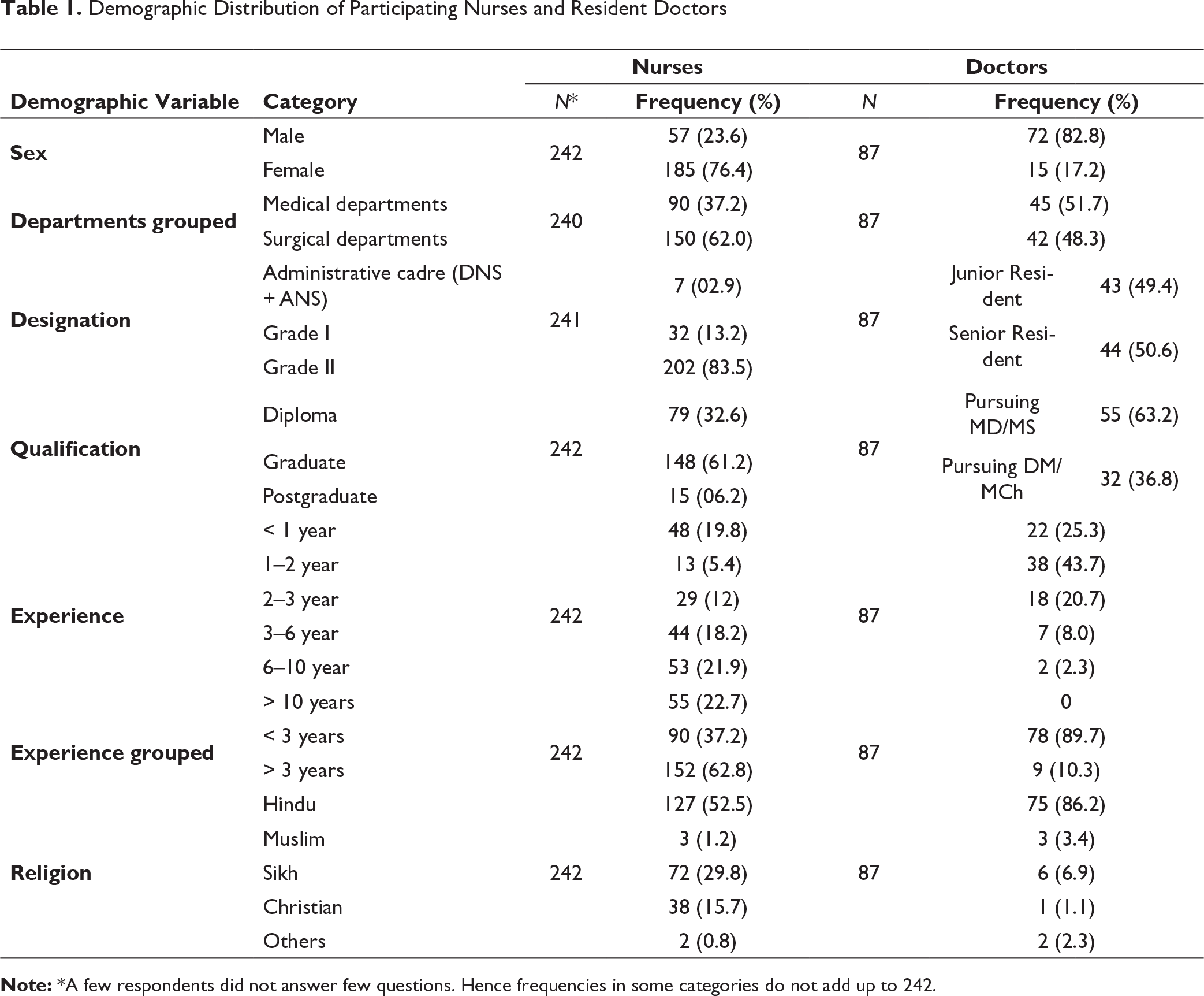
A total of 242 nurses and 87 resident doctors participated in the study. Their demographic details have been depicted in Table 1. Gender representation was converse between the two sections, 76.4% nurses being females, while 82.8% doctors being males. Amongst nurses, about two-third (62.8%) were posted in surgical interventional areas and one-third (37.2%) in medical areas, while doctors were almost equally distributed (51.7% and 48.3%, respectively). Majority of nurses 96.7% were from the nonadministrative cadres (grades I and II) who were responsible for the direct management of patients. There was equal representation of junior and senior resident doctors amongst participants. More than two-third (67.4%) nurses were at least graduate and one-third (36.8%) residents had completed their postgraduation. Two-third nurses (62.8%) had more than three years’ experience of working at PGIMER. Contrary to this, 89.7% doctors had less than three years’ work experience at PGIMER. Hindu religion majority was observed amongst both the participating groups.
Demographic Distribution of Participating Nurses and Resident Doctors
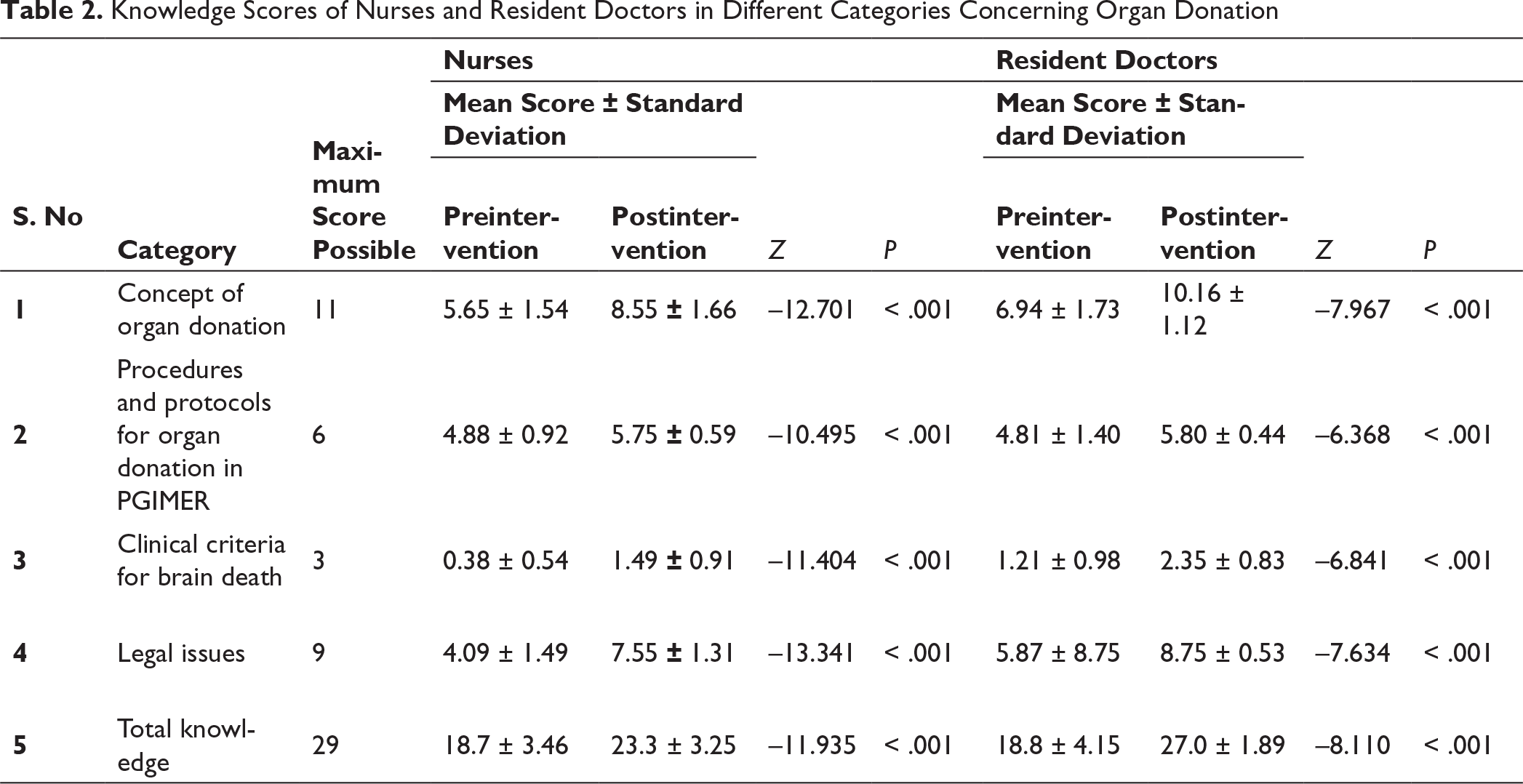
Knowledge Scores of Nurses and Resident Doctors in Different Categories Concerning Organ Donation
The analysis of the “attitude” of nurses and doctors regarding organ donation is shown in Table 3. Regarding “willingness for organ donation” (Q. 35–39), a statistically significant increase was observed in both nurses (Z = –8.686, P < .001) and doctors (Z = –3.125, P = .002) owing to the interventions. There was more than two-fold increase in the number of nurses having pledged their organs postintervention, from 22.9% to 48.3% (P < .001). Only three doctors pledged their organs postintervention, and the increase in pledge rate, i.e., 28.7% to 32.2%, was statistically insignificant (P = .84).
Question Wise Change in Attitude of Nurses and Resident Doctors Pre and Postintervention
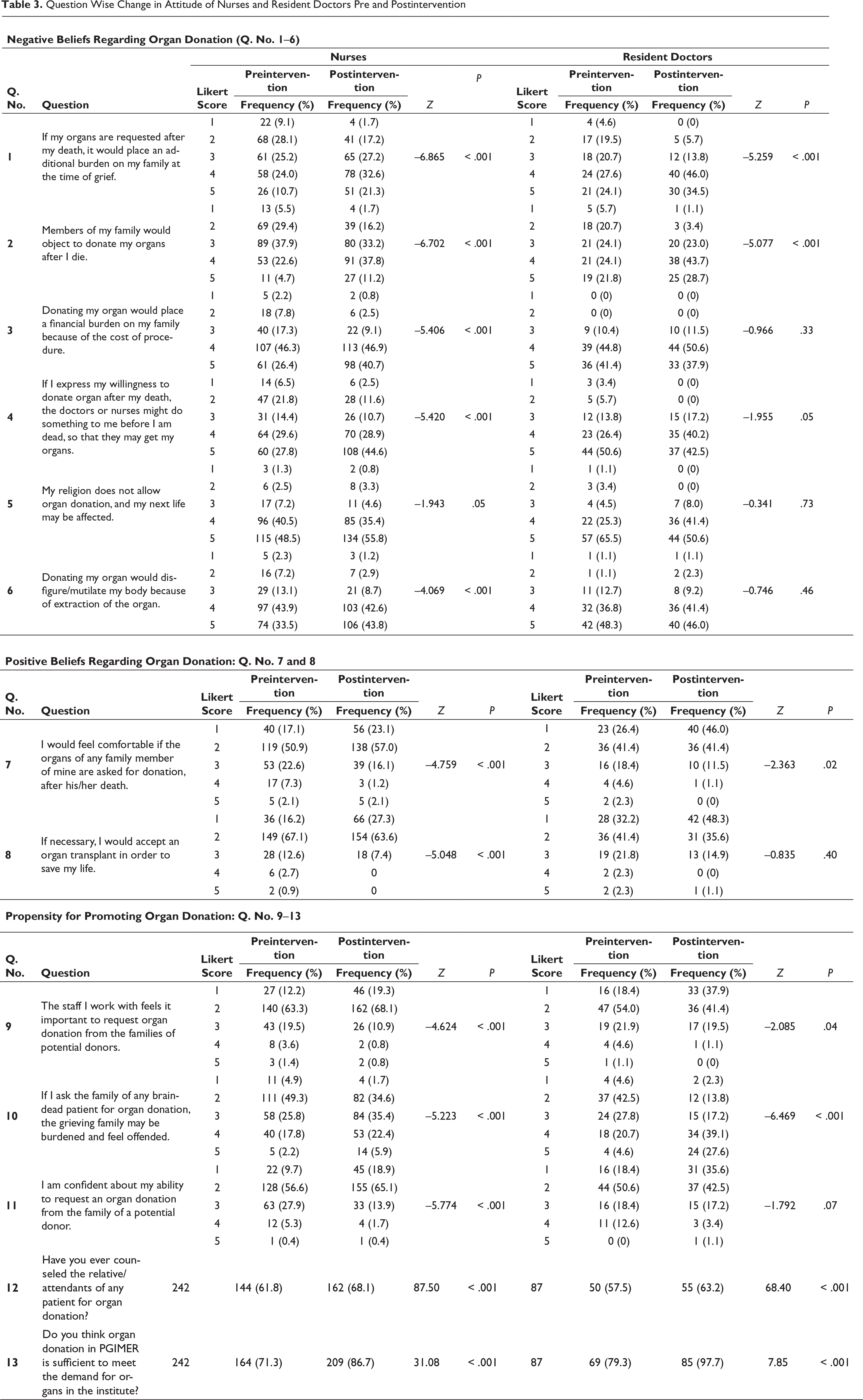
The analysis of impact on the “beliefs” (negative and positive) of participants regarding organ donation has been provided in Table 3. Postintervention, a significant reduction in the prevalent myths and negative beliefs regarding organ donation was observed amongst the nurses (Q. 1–4 and 6). Similar findings were observed amongst the doctors for the myths which were having higher scores preintervention (Q. 1 and 2). A statistically significant improvement was also observed in the positive beliefs having low-score preintervention amongst both the sections (Q. 7 and 8). Both nurses and doctors showed a significant improvement (P < .001) in the propensity to promote organ donation (Q. 9 to 11) postintervention. Also, after being subjected to the teaching module, a significant increase in the number of nurses and doctors who have had counseled patients or their relatives for organ donation was observed (Q. 12 and13).
Discussion
Of the total nurses called for contribution in this study, 83.74% participated. Comparatively, a very low proportion of the resident doctors (30%) posted in the study areas consented to participate. In a survey conducted in the same institute by Ahlawat et al. 27 to assess the knowledge and attitude of health care workers toward deceased organ donation, a very high response rate was observed amongst all categories of participants (99%). However, Flanigan et al. 32 have also observed in their literature review that in general, the response rate of physicians is low in surveys.Higher response rate by nurses in this study may also be attributed to the fact that nurses in the institute are directly under the administrative control of the investigator’s department and were in routine communication with the investigator for other educational activities, whereas most of the participating doctors were not previously in direct association with the investigator. Also, the proportion of doctors posted in the study areas was comparatively very less as compared to the nurses, so most of them could not afford to participate because of their hectic schedule.
The level of knowledge amongst participating health care professionals was higher as compared to that of general population (nonmedical) established in the studies by Mithra et al. 33 in Karnataka and Mishra et al. 34 in New Delhi states. India has been badly suffering from ignorance on this latest modality of transplantation medicine and has a miniscule organ donation rate of 0.65 pmp. The most important factor attributable to this lack of awareness is least efforts being put in for information, education, and communication (IEC) on this topic. However, after the establishment of the national framework consisting of a network of well-coordinated National, Regional, and State Organ and Tissue Transplant Organizations (NOTTO, ROTTOs, and SOTTOs, respectively), the country has witnessed a two-fold increase in its cadaveric organ donation rates over the last five years from 0.36 in 2014 to 0.65 in 2019.21, 22 This is clearly attributable to the increased level of IEC and transplantation activities under the aegis of these organizations and the promising role of media. Compared to the knowledge level of health care professionals observed in the studies by Mithra et al. 33 and Mishra et al., 34 their preintervention knowledge level was found to be even higher in this study. This may be because of the fact that at the time this study was conducted, PGIMER Chandigarh had already achieved the status of being a public-sector institute with the highest incidence of organ donation in the country. Moreover, the ROTTO for eight northern states is also located in this institute.
Similar to the findings of this study, Bener et al., 35 Alsaied et al., 36 Akgun et al., 37 and Jeon et al. 38 also observed higher baseline knowledge scores of doctors as compared to nurses on this topic. A great improvement in total knowledge was observed after intervention amongst both doctors and nurses (28.3% and 16.1% increase, respectively). The positive impact of educational interventions on this topic has also been established amongst the medical and nursing students by Kaiser et al., 39 Farahani et al., 40 McGlade et al., 41 Zahra et al., 42 Kiberd, 43 Rykhoff et al., 44 and Ramadurg et al. 28 There is sufficient evidence that strategies to increase the participation of health care professionals and students on voluntary as well as curricular basis in activities related to awareness regarding organ donation would prove to be highly promising in increasing organ donation.
When compared, the knowledge about the “concept of organ donation” was higher in doctors than nurses in both phases and also improved significantly for both groups postintervention. The findings are consistent with Hu et al. 45 in their study on 400 health care professionals. The impact of intervention on awareness about “procedures and protocols in PGIMER” was statistically significant for both groups. A lower proportion of doctors as compared to nurses knew the procedure to be followed for declaring brain death in the institute, probably because nurses in this setup are supposed to organize and complete the procedures related to brain death declaration and, hence, are more familiar with the procedures. Only 41.4% doctors and 14.9% nurses knew initially which all organs can be transplanted. Significant impact was observed postintervention (85.1% and 82.6%, respectively). Interestingly, fewer doctors than nurses could correctly respond that organ donation was possible at “any age”; however, they took a significant lead from nurses postintervention. More than two-third participants confused “brain death” with other medical terms such as coma, persistent vegetative state, etc. wherein life still persists, similar to the findings of Verma. 46 Cohen et al. 47 concluded in their study that proper understanding and familiarity with the concept of brain death makes health care professionals more comfortable with the situations involving organ donation and facilitates the organ procurement process.
Both groups had poor knowledge regarding “clinical criteria for brain death” prior to the intervention and the scores were least in this knowledge category corresponding with the findings of Bener et al. 35 Knowledge about laws governing organ and tissue donation was also observed to be low in this study as compared to that of Mishra et al. 34 Intervention improved the scores significantly in both these categories, and therefore, continuous education proves to be highly promising.
A more favorable attitude toward organ donation was observed amongst nurses and doctors as compared to general public, similar to the observations of Reddy et al. 48 Much higher willingness has been observed in this study as compared to the study conducted by Ahlawat et al. 27 in the same institute, in a similar setting and on similar population in 2009. This may be attributed to increased activities and awareness regarding organ donation in the institute over the span of time. The positive effect of intervention on attitude as observed in this study has also been established by Ramadurg et al., 28 Farahani et al., 40 McGlade et al., 41 Zahra et al., 42 Kiberd, 43 and others. Strongly positive attitudes were also observed regarding the advocacy for organ donation by different religions, similar to the observation of Bapat et al. 49 Prior to intervention, only one-fifth of the population feared mutilation or disfigurement of body because of organ donation, which improved further to less than one-sixthpostintervention, the observations being in contrast to that of Hu et al. 45
A very low proportion of nurses and doctors (22.9% and 28.7%, respectively) had pledged their organs before intervention. About one-fourth (58) of the nurses pledged their organs immediately after the interactive session. Only 57.5% doctors and 61.8% nurses working in PGIMER had ever counseled a patient or their attendant for organ donation. In this study, a significant impact of intervention was observed on the overall propensity of doctors and nurses to promote organ donation, for pledging their own organs, and for counseling the patient/attendants on this cause.
One limitation of this study was that it was conducted in one locale of the institution receiving only head trauma patients. Thus, findings may not be generalized to the whole population of doctors and nurses in the institute and might not be representative of similar population in other hospitals. Similar studies are required in future to strengthen generalization of the results. Second, the data have been collected purposefully for certain specific variables pertaining to organ donation and many others may not have been included unintentionally. As such, the results may not be a wholesome reflection of the clinico-administrative perspectives of this topic. Further, no follow up for the retention of the gained knowledge and better attitudes was done.
Conclusion
Both nurses and doctors were aware of organ donation, and their attitudes were also favorable, but information regarding some basic and practical aspects of organ donation was relatively lacking. This not only prevented them from being prospective donors, but also acted against them being effective counselors and advocates of organ donation. Besides ensuring a promising role of educational interventions in improving awareness and attitude of health care professionals regarding organ donation, the moot point worth pondering which emerged out of this study was whether the IEC measures being taken by the government and other organizations are sufficient and aptly framed especially observing the lower scores in various categories preintervention amongst the study population, particularly considering the fact that it comprised of the section of society expected to be most informed on this topic. Also, coupling of the promotional activities for organ pledging with scientifically designed educational sessions can greatly enhance the organ pledge rates.
Questionnaire

Footnotes
Acknowledgment
The motivation, guidance, and encouragement received from Professor A. K. Gupta, Head, Department of Hospital Administration and Medical Superintendent, PGIMER, Chandigarh, is sincerely acknowledged and so is the constant support of heads of all participating departments. The quintessential support of Nursing Superintendent and team ROTTO PGIMER, Chandigarh, in accomplishing the study is deeply acknowledged.
Declaration of Conflicting Interests
Ethical Statement
This study was approved by the Institutional Ethics Committee of PGIMER Chandigarh with the Reference Number NK/2088/MHA/5457-58. The written
informed consent was obtained from the participants in the study.
Funding
The authors received no financial support for the research, authorship, and/or publication of this article.
