




Abstract
This study examines the hedging and safe-haven characteristics across the various segments of non-fungible tokens (NFTs). It adopts the case study approach to blend the key study findings on the risk and return aspects of different NFT segments. The study finds that various segments of NFTs have mixed levels of correlations with traditional financial assets. Online games and metaverse segments of NFTs display a link to the crypto assets. Similarly, only the metaverse segment shows an association with the market sentiment. Art, online games, and collectibles segments within the NFTs space show mixed levels of hedging. However, all NFT segments under consideration show ambiguous safe-haven facets. Overall, the present study highlights some of the important aspects to consider while investing in the different segments of NFTs with respect to portfolio optimization, market dynamics, and risk management.
1. Introduction
Non-fungible tokens (NFTs) emerged as an alternative asset class for investment with some unique features to diversify (Dowling, 2022; Umar et al., 2022a, 2023; Xia et al., 2022). Studies show that even though the crypto space has some influence on NFTs, this exhibits minimal variations with respect to the other asset class, and most of the variations are due to its internal shocks (Ante, 2023; Aharon & Demir, 2022). Integrating NFTs into traditional portfolios can serve to safeguard income, as NFT returns remain relatively insulated from external shocks affecting traditional assets. Additionally, NFTs have demonstrated resilience during market downturns, exemplifying their attributes as safe-haven assets, particularly evidenced during the COVID-19 pandemic (Ko & Lee, 2023). However, it is essential to recognize that while NFTs exhibited a temporary increase in correlation with traditional assets during the initial phases of the pandemic, their risk-absorbing capabilities during the COVID-19 crisis are predominantly short term in nature (Umar et al., 2022b). Investing in NFTs presents a spectrum of opportunities and challenges. It opens doors to diverse investment prospects across various sectors (Dowling, 2022; Umar et al., 2022a). The low entry barrier empowers individuals to engage in NFT investments directly, without the necessity of intermediaries such as brokers (Sharma et al., 2022; Wilson et al., 2022). However, liquidity poses a significant challenge for NFT investments, with liquidity levels varying among different assets and days of the week, potentially resulting in tied-up funds due to limited liquidity (Wilkoff & Yildiz, 2023). The studies done on the hedging and safe-haven aspects of NFTs are limited and findings are mixed (Ko & Lee, 2023; Kumar & Padakandla, 2023; Zhang et al., 2024). With this motivation, it is the first study to investigate the hedging and safe-haven features across different segments of NFTs. The value addition of the present study is manifold. First, by exploring various sectors within the NFT realm, it offers a deeper understanding of how different types of NFTs function as hedging or safe-haven assets, addressing a gap in the literature that has predominantly focused on the NFT market as a whole. Second, insights from this study provide valuable information to investors, market participants, and policymakers in developing risk management strategies for operating within different segments of NFTs. Lastly, it offers direction for future studies in the field of NFTs.
2. Insights on Hedging and Safe Havens Across Different NFT Segments
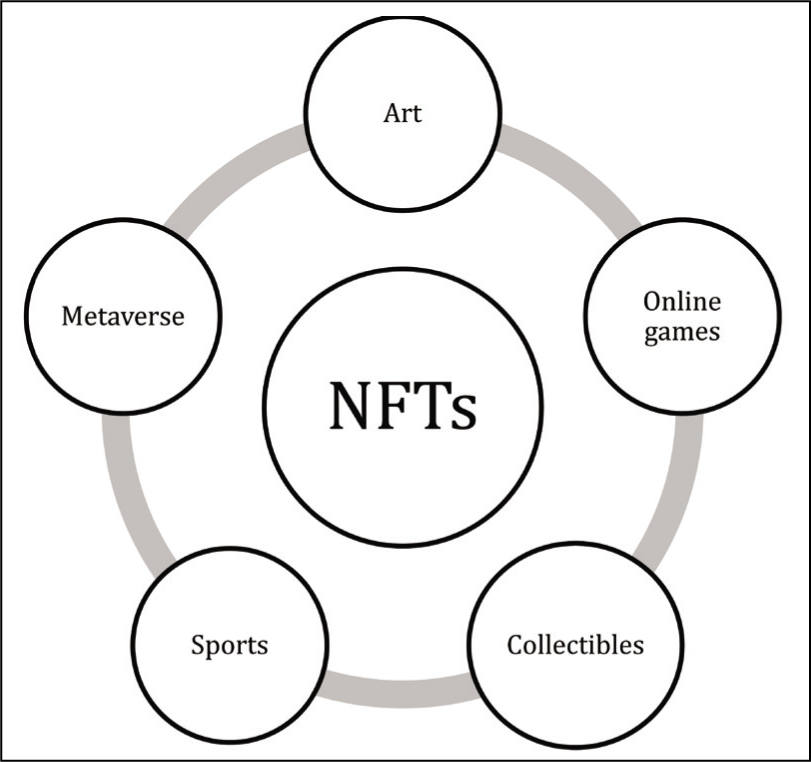
The segmentation of NFTs into five major categories is rooted in their primary use case and market dynamics. Consequently, each segment embodies a distinct category of NFTs with unique characteristics. Analyzing these segments separately offers a comprehensive understanding of the diversifying and hedging properties of NFTs (Figure 1).
NFTs Various Segments.
Investing in NFT art offers a compelling strategy as both a hedge and safe haven against inflation, drawing parallels with traditional art investments. The resilience of NFT art in this regard arises from its detachment from direct influence by monetary policies, akin to tangible assets. Within the cryptocurrency market, NFT art serves as a hedge, particularly for non-stable coins, thereby mitigating overall portfolio risk and enhancing returns (Horky et al., 2022). Despite its efficacy as a hedge in the cryptocurrency realm, the correlation between NFT art and broader market sentiments remains inconclusive. Boido and Aliano (2023) found no significant correlation between NFT art and media attention. Similarly, MP4 files (positive), GIF files (negative), and gas (no effect) show mixed effects on NFT pricing (Chen et al., 2023; Horky et al., 2022).
At the market level, both the value and equal-weighted GameFi Crypto indices demonstrate promise as potential safe havens when compared with most other indices, as revealed by Bo and Shen (2023). Schilperoord (2022) discusses how the returns of Bitcoin can impact investor attention toward prominent NFT games like Decentraland, hinting at a predictive aspect in assessing its returns following Bitcoin market movements. Additionally, the returns of Ethereum and Bitcoin are seen as explanatory factors for the interest garnered by games such as CryptoKitties, Decentraland, and Sandbox. Dowling (2022) found a low volatility transmission between cryptocurrencies and NFT games, though some co-movements between them were observed. However, Vidal-Tomás (2022) offered a contrasting viewpoint, suggesting that cryptocurrencies and NFT games do not move together, supported by indications of low volatility transmissions. This suggests that NFTs could be considered a distinct asset class from cryptocurrencies (Dowling, 2022). These conflicting findings may stem from the nascent nature of the NFT gaming market, warranting further analysis for a more precise understanding of their correlation with different market segments.
Investing in collectibles for financial gain finds its roots in the seventeenth century, notably during the Dutch fascination with tulips, culminating in the infamous Tulip Mania documented by Masset and Weisskopf (2018). Preceding the emergence of digital collectibles, traditional items like cars, coins, wine, and stamps garnered considerable investor interest as alternative assets, not only offering emotional satisfaction but also demonstrating their efficacy as investment vehicles. Contrary to popular belief, stamps exhibit volatility comparable to equities, providing a unique advantage as a hedge against various traditional assets including stocks, bonds, gold, and inflation (Dimson & Spaenjers, 2011). Similarly, coins have been recognized not only as an inflation hedge but also for their portfolio diversification benefits. Wine investments also demonstrate either a negative or low correlation with market risk factors, rendering them an attractive addition to portfolios for potential profits and diversification, regardless of market conditions (Walgreen, 2010). Cumulatively, these studies contribute to the broader understanding that collectibles, as a distinct asset class, tend to display low correlations with traditional asset classes and often retain or appreciate during market turmoil, in contrast to the downturns experienced by stocks and bonds, thereby reflecting their hedging and safe-haven properties. Investors incorporating NFT collectibles into a portfolio containing bitcoin should exercise caution regarding the future movements of the crypto market, as it impacts collectibles too (BenMabrouk et al., 2024). NFT collectibles exhibit a negative correlation with commodities like oil and gold, as well as real estate and interbank rates, thus presenting an opportunity for inclusion as a hedge in portfolios containing these assets (Wang, 2022). Unlike traditional financial assets such as stocks or real estate, NFT collectibles do not generate dividends, interest, or rental income (Walgreen, 2010). Therefore, investors should consider this lack of income generation when evaluating the potential of NFT collectibles as an investment avenue.
The study by Foglia et al. (2024) shows that the NFT fan tokens are not suitable for hedging or safe haven due to long-term association with the financial markets. Studies also show that metaverse segments within the NFTs are affected by market sentiments (Aysan et al., 2023; Pinho, 2022; Yeoh et al., 2023). In addition to its considerable number, studies highlighted that metaverse space is related to the crypto space (Aharon et al., 2024).
3. Discussion
Table 1 summarizes the key findings on the hedging and safe-haven aspects of different NFT segments. All five different segments of NFTs show some level of correlation with traditional financial assets. Art, collectibles, and metaverse segments within the NFT space show mixed levels of associations with the crypto markets. Similarly, the study shows that art, online games, and collectibles segments among NFTs can be used as hedge instruments. Then the present study also highlights that market sentiment can drive the metaverse prices. However, the present study fails to establish any significant relationship to safe-haven characteristics of the different NFT segments.
Summary of Findings.
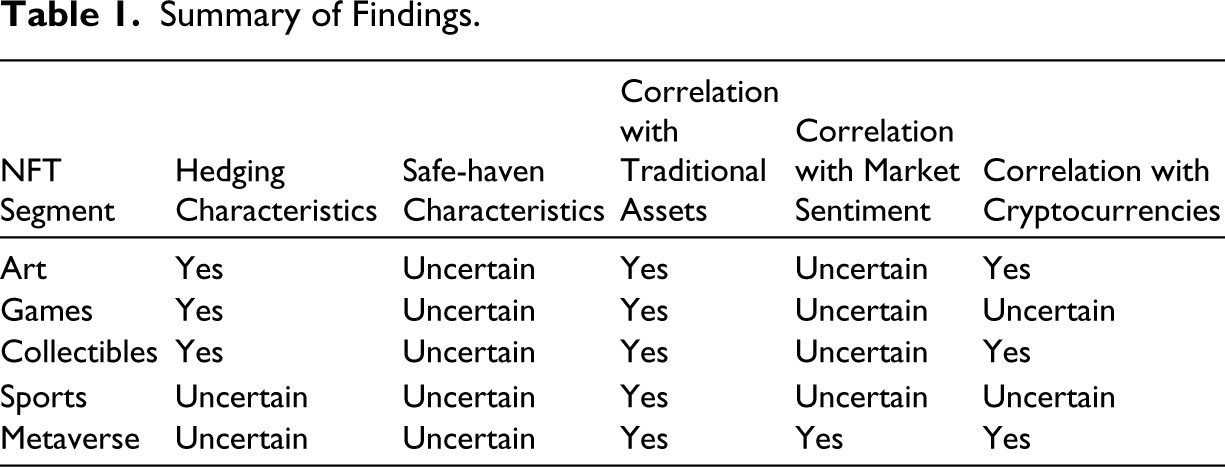
The above findings indicate that including different NFT segments in the investment portfolio could provide diversification benefits to market participants. During high market volatility periods, art, online games, and collectibles segments in the NFT space can be used as hedge instruments. Mixed levels of hedge and safe-haven properties among the different NFT segments also indicate that the NFT space is not fully efficient. Short-term earnings can be made due to these inefficiencies. Lastly, the relationship between the market sentiment and metaverse prices indicates that investor sentiments do affect NFTs, especially in the metaverse segment.
4. Conclusion
The present study highlights that investment into the NFT space presents both opportunities and challenges. It broadly examines the five different segments of NFTs, namely, art, online games, collectibles, sports, and metaverse. The study finds that all these NFT segments have some correlation with the traditional financial assets. It shows that art, collectibles, and metaverse segments in the NFT space are affected by the crypto instruments. Then certain segments among the NFTs, namely, art, games, and collectibles, can be used as hedge instruments during turmoil. However, the present study is unclear on the safe-haven aspects of the various NFT segments under consideration.
Footnotes
Declaration of Conflicting Interests
The authors declared no potential conflicts of interest with respect to the research, authorship and/or publication of this article.
Funding
The authors received no financial support for the research, authorship and/or publication of this article.