



Abstract
The concept of “bali” in Hinduism is traditionally associated with sacrifice, particularly within the context of possession rituals such as teyyam in the Malabar region of South India, where it is often linked to practices of sorcery, magic, and witchcraft aimed at protection and prosperity. This conventional understanding, however, overlooks the multifaceted roles bali rituals play, especially in the mortuary practices of the Māvilan communities in Kasaragod district, northern Kerala. This ethnographic study explores the transformative role of bali rituals in converting the deceased into Aṇaṅṅu teyyam performances among the Māvilans, thereby facilitating communication between the living and the dead and venerating ancestral pasts through Tōṟṟam and Cācitra oral traditions. Employing Victor Turner’s concept of liminality as a theoretical framework, the research examines how these rituals navigate the transitional phases of death, enabling a seamless passage and continued presence of the deceased within the community’s cultural and spiritual landscape. This study underscores the importance of localized ethnographic inquiry in uncovering the complex interplay between ritual, belief, and social structure in shaping communal experiences of death and transformation.
Introduction
This study examines the unique role of bali within the teyyam tradition of the Māvilan community in Kerala, South India. While the term bali is often understood as “sacrifice” in mainstream Hinduism, its interpretation and significance among the Māvilans diverge significantly from this common understanding. The Māvilan, recognized as a Scheduled Tribe community in 2002, primarily inhabit the Kannur and Kasaragod districts of Kerala (Directorate of Printing, 2002). Originally from the former South Canara (Tulunadu) region, apart from Malayalam, they speak distinct dialects including Markodi (Vasudevan, 2016, 2023) and Mavilavu (Mavilan, 2023), which differ from both Tulu and Malayalam.
Contrary to the generalized Hindu concept of bali as sacrifice described by Freeman (1991, 2022) and Prabhu (2014), the Māvilans conceive bali as offerings rather than sacrifice. This fundamental difference underscores the importance of examining cultural practices within their specific community contexts. Through ethnographic observation, this research aims to investigate how these bali offerings serve as a medium of possession in the teyyam tradition, facilitating the transformation of the deceased into the ritualistic performance of Aṇaṅṅu teyyam. To explore this transformation process, this study employs van Gennep’s (1960) concept of “liminality,” later expanded by Turner (1969). Liminality refers to the transitional phase in rites of passage, where individuals exist between their old and new status. Through this theoretical lens, this research examines how the deceased transitions into the Aṇaṅṅu teyyam performance, enabling dialogues between the living and the dead.
This study’s primary objectives are:
How are bali (offering rituals) performed and interpreted in the context of death rituals? What roles do tōṟṟam (ritual ballads or songs) and cācitra (oral history) play in shaping the meanings of bali rituals in the context of death ceremonies? How do bali rituals facilitate the transformation of the deceased into Aṇaṅṅu teyyam and enable dialogue between the living and the dead, and how can this process be understood through the concept of liminality?
By focusing on the Māvilan community’s unique interpretation and application of bali as offerings, this research contributes to a more nuanced understanding of ritual practices in South India, challenging generalized notions of sacrifice and offering in Hindu traditions. This study highlights the importance of community-specific interpretations in understanding cultural and religious practices.
Turner (1969, p. 359) notes that:
Van Gennep has shown that all rites of passage or “transition” are marked by three phases: separation, margin (or limen, signifying “threshold” in Latin), and aggregation. The first phase (of separation) comprises symbolic behavior signifying the detachment of the individual or group either from an earlier fixed point in the social structure, from a set of cultural conditions (a “state”), or from both. During the intervening “liminal” period, the characteristics of the ritual subject (the “passenger”) are ambiguous; he passes through a cultural realm that has few or none of the attributes of the past or coming state. In the third phase (reaggregation or reincorporation), the passage is consummated.
In the context of death among the Māvilan, the separation phase involves the initial detachment from life, marked by rituals that signify the person’s departure from the world of the living. These include mourning, the preparation of the body, and funeral ceremonies. The liminal phase follows as a transitional period where the deceased exists in an intermediate state between separation (from death) and reaggregation (or reincorporation) into Aṇaṅṅu teyyam. During this phase, various rites, such as bali (offering rituals), guide the Aṇaṅṅu 1 of the deceased through this transition. This might involve cremation, food offerings, or other ceremonies intended to assist the deceased in moving on to the next stage. The reaggregation (or reincorporation) phase marks the completion of the transition, where the deceased is transformed into the ritualistic performance of Aṇaṅṅu teyyam. In this context, it is believed that the deceased enters the afterlife, either reincarnated in the māyapramāṇaṃ (realms of māya) or joining the ancestors and returns to the home in the form of teyyam. This symbolic transformation is expressed through the ritualistic dance performance of Aṇaṅṅu teyyam, accompanied by tōṟṟam—ritual ballads sung in a mix of dialect of Malayalam, Markodi (a dialect of Tulu), and Tulu languages, with the rhythmic beats of ceṇṭa 2 and kaimaṇi (cymbals). The Aṇaṅṅu teyyam and tōṟṟam serve to honor and remember the deceased, integrating their memory into the ongoing life of the community.
Thus, observing bali rituals is crucial in this context to deepen our understanding of possession within the framework of teyyam in contemporary culture, religion, and society. This study, therefore, distinguishes itself from previous research on the teyyam tradition in this region by offering a more nuanced exploration of the concept of possession. Unlike earlier works on teyyam that often tie possession to notions of fortune and misfortune (Freeman, 1991, 2022), magico-religious practices (Damodaran, 2008), witchcraft (Tarabout, 2000), and sorcery (Freeman, 2022), as these studies have also examined teyyam’s intersections with artistic expression, its role as a tribute to deities and ancestors, its ecological significance, and its connections to agricultural practices. These perspectives highlight how possession in teyyam rituals often functions as part of broader protection and prosperity rites. Freeman’s examination of bali through the lens of tantric traditions reveals a link between local teyyam practices and Puranic deities. However, such studies often overlook the practices of local teyyam-performing communities that do not incorporate tantric traditions, leaving a gap in understanding their unique interpretations of possession.
Teyyam, also known by various names such as teyyāṭṭam (Freeman, 1991), tiṟayāṭṭaṁ (Ashley, 1979), and tiṟa (Nampoothiri, 2014) in the former Malabar region, and Bhūta kōla (Claus, 1979) in the former South Canara region, has been extensively studied. These studies often explore teyyam as a ritualistic dance performance, sometimes linking it to “art” performance or “folk” dance. While some research suggests that teyyam originates from the “unfortunate death” of an individual, it has not fully examined its connection to funeral rituals or the role of the Māvilan community since the eighteenth century. Additionally, many studies categorize the notion of possession in teyyam through a binary lens of fortune and misfortune, which may oversimplify its ritualistic and religious dimensions.
Turner (1969) contrasts his conceptualization of “ritual” with that of scholars like Richard Schechner (1994) and Erving Goffman (1955, 1961). While Schechner and Goffman view rituals as standardized acts that can be either secular or sacred, Turner perceives them as complex sequences of symbolic acts that reveal deeper cultural processes. He emphasizes the connection between social drama and theater, noting that social interactions often possess a “performed-for-an-audience” aspect, which is fundamentally dramatic (Turner, 1980, 1987). Gennep’s concept of liminality offers a nuanced perspective that social drama, theater, and social interaction are fundamentally ritualistic rather than merely dramatic. Consequently, teyyam performances during rites of passage among the Māvilan should be interpreted as ritualistic manifestations rather than purely artistic forms of expression.
For instance, Brillant-Giroux’s (2020) study on Aṇaṅṅu teyyam among the Māvilan and Malavettuvan provides a clear illustration. He explores how the transformative meaning of Aṇaṅṅu (spirit) possession through various ritual practices enables the living to perceive the deceased in a transformed phase of teyyam (or kōlam), which means “form.” This transformation facilitates both the performance and interaction with the living in a new form—namely, Aṇaṅṅu teyyam or Aṇaṅṅu kōlam. In contrast, Arya (2022) posits that Aṇaṅṅu teyyam is performed in the context of marriage, with the bride assuming the role of “enangathi”—a third person (p. 12). However, ethnographic evidence suggests that Aṇaṅṅu teyyam is not associated with marriage ceremonies but is exclusively performed as part of death rituals. Furthermore, Arya’s study does not delve into the critical role of bali rituals in transforming the deceased into Aṇaṅṅu teyyam, a significant aspect of Māvilan funeral traditions.
The bali (offerings) ritual is crucial in the context of rites of passage, as Turner notes: The passage from one social status to another is often accompanied by a set of cultural performances that enact the change of state and the continuity of social and cultural values (Turner, 1974). In the context of mortuary practices and the Aṇaṅṅu teyyam performance, the bali (offering) ritual exemplifies the tripartite structure of separation, liminality, and reincorporation as theorized by van Gennep (1960) and elaborated by Turner (1969). Unlike conventional teyyam performances, where the transformed entity ultimately reintegrates into everyday life, the deceased in bali rituals is venerated through sustained rites and offerings. This continuity ensures that the ritual’s efficacy extends beyond the immediate performative event, embedding the memory of the deceased into the community’s collective consciousness and daily praxis.
The bali rituals play a pivotal role in commemorating the deceased through the collective participation of community and familial members during the liminal phase. The utterances pronounced during these rituals are subsequently incorporated into the tōṟṟam (ritual ballads) and cācitra (oral histories embedded within tōṟṟam), serving as mechanisms for the ongoing veneration of the deceased. The manifestation of these elements through performance is known as teyyam or kōlam, literally translating to “form.” The Aṇaṅṅu teyyam performance is thus accompanied by the recitation of tōṟṟam and cācitra, which are intoned both prior to and during the performance. These elements are crucial during the transformative phase, establishing a symbolic nexus between the ritual performance, the deceased, and the facilitation of possession, thereby ensuring their continued presence within the community.
Moreover, bali rituals are instrumental in maintaining spiritual equilibrium between the temporal realms of past and present, specifically mediating the ontological boundary between the living and the dead. To fully comprehend the function of bali in sustaining this spiritual balance, it is imperative to examine its primary ritualistic functions and its intricate relationship with the Aṇaṅṅu teyyam performance during the transformative phases. While numerous studies have examined the cultural significance of teyyam, particularly in the context of temple rituals, they frequently emphasize its incarnation as a Hindu deity and its purported origins in the caste system and instances of unfortunate deaths (Dallapiccola, 2001; Freeman, 1991). This predominant focus has inadvertently obscured the significance of localized teyyam performances rooted in mortuary rituals, especially those practiced among the Māvilan and other Tuluva communities.
Research Methodology
This study examines death rituals among the Māvilans, an indigenous community inhabiting the Kasaragod district of Northern Kerala, India. While Brillant-Giroux’s (2020) seminal work on Aṇaṅṅu teyyam among the Māvilans and Malavettuvans of Kasaragod provides a foundational understanding of these death rituals, it does not fully explore the role of bali (offering rituals) within the context of death rituals and teyyam. The present research aims to address this gap in the literature, focusing specifically on the relationship between death rituals, bali, and Aṇaṅṅu teyyam among the Māvilans.
This ethnographic study employed participant observation as the primary research method. Data collection occurred over three periods: February–March 2023, July–September 2023, and July–October 2024. The researcher engaged extensively with Kottan, a renowned teyyam performer and “Karmi” (funeral ritual priest) from the Māvilan community. Kottan performed tōṟṟams (ritual ballads) in response to the researcher’s inquiries about death rituals and their connection to Aṇaṅṅu teyyam, providing a personalized performance crucial to understanding the subject matter.
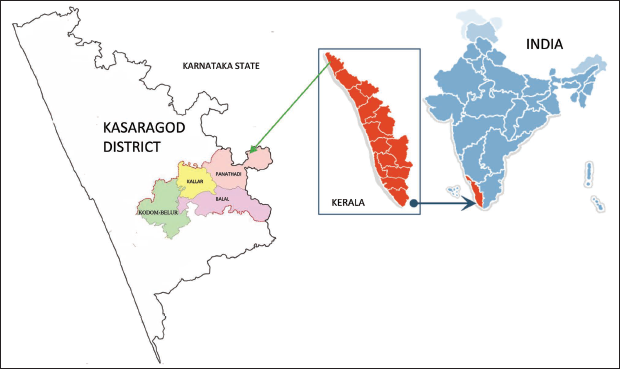
Additionally, the researcher consulted Mohanan, a respected traditional medicine practitioner and “Karmi,” who offered valuable insights into funeral rituals in several areas of the Kasaragod district, including Balal, Kallar, Kodom-Belur, and Panathady (see Figure 1). The study involved observing bali rituals in various contexts, including funerals and non-performative phases of teyyam.
Highlighted Areas on the Map Indicate the Location of the Study in Kasaragod District, Kerala State, India.
While initial efforts were made to locate textual references such as manuscripts and books pertaining to death and bali rituals, it became apparent that much of the relevant information exists within oral traditions. The primary reference for understanding the origin and meaning of these death rituals was the Kāpāḷatti cācitra, which encompasses both tōṟṟam and cācitra (oral history or utterances) performed during the Aṇaṅṅu teyyam.
A significant limitation of this study is its lack of comprehensive analysis of the Aṇaṅṅu teyyam performance itself. The research primarily focused on understanding how Aṇaṅṅu teyyam originates in relation to an individual’s death and the role of bali rituals in facilitating the performance of Aṇaṅṅu teyyam. Consequently, greater emphasis was placed on bali rituals within the funeral context and the non-performative phase. While the observation of bali rituals during the performative phase of Aṇaṅṅu teyyam is crucial, collecting sufficient data on Aṇaṅṅu teyyam performances was challenging due to the monsoon season. These aspects will be addressed in future research. This study contributes to the existing literature by examining the interconnections between death rituals, bali, and Aṇaṅṅu teyyam among the Māvilans, an area previously unexplored in academic research.
The Separation: Origin and Meaning of Death Rituals
The Māvilan community’s funeral rituals, particularly the separation phase, exemplify a profound rite of passage that delineates the transition from life to the posthumous realm. This phase, reflective of a significant symbolic and ritual transformation, is characterized by complex and elaborate practices that demarcate an individual’s death within the Māvilan cultural framework. This process aligns with Turner’s theory of liminality, which emphasizes the transformative nature of rites of passage and the transition between states of being (Turner, 1969).
In Māvilan traditions, death is ascribed a more profound significance than birth, manifesting in symbolic and ritualistic expressions observed at the deceased’s residence. The separation phase is marked by communal gatherings, mourning rituals, and collective actions that collectively underscore the symbolic transition of the deceased from the living community to an altered state, both visible (Aṇaṅṅu teyyam) and invisible (māya). This phase reflects Turner’s concept of liminality, wherein the deceased is symbolically removed from the societal structure and transitioned into a new, albeit intangible, existence (Turner, 1969; van Gennep, 1960).
Historically, the Māvilans, previously known as Mayyans, were predominantly located in the Coorg district and adjacent regions, including parts of Kasaragod, Mangalore, and northern Kannur district. Traditionally, the Māvilans practiced burial rites; however, contemporary practices have shifted toward cremation, paralleling Hindu customs. Despite this shift, comparative analysis reveals that Māvilan death rituals remain distinctly divergent from Hindu practices. Currently, the Māvilans primarily reside in the Kasaragod district of Kerala, a region bordering the southern parts of Karnataka and parts of Kannur district in Kerala.
Marriage practices among the Māvilans reflect historical connections with Tulu-speaking communities such as the Malavettuva, Pala community in Coorg, Koppalans, and other Tulu-speaking families. Intercaste marriages with Malayalam-speaking communities suggest a historical milieu less influenced by the practices of untouchability and rigid caste structures. However, contemporary influences of Hinduism and Hindu nationalism have impacted social dynamics, resulting in a tendency for upper castes to avoid marriages with lower castes. Notably, in areas of the Kasaragod district such as Kallar Panchayath, some Nayar and Tiyya families maintain robust intercaste connections with the Māvilans, evidenced by intercaste marriages, although upper castes frequently avoid such unions.
In Hinduism, death-related rites of passage encompass cremation, the collection of citābhasma (ashes of cremated corpse), and their immersion into a river, symbolizing mōkṣa or liberation from the cycle of death and rebirth. In contrast, Māvilan death rituals incorporate cremation, the practice of bali (offerings), and the transformation of the deceased into the form of Aṇaṅṅu teyyam. This transformation signifies the deceased’s transition into an invisible state or “māya,” enabling continued participation in the household’s spiritual and symbolic life in a novel form. Thus, while both traditions include cremation, the symbolic meanings and ritual processes diverge significantly.
The Māvilan funeral practices, particularly the separation phase, are characterized by an elaborate and protracted process, distinguishing them significantly from Hindu practices. The transition from burial to cremation, precipitated by the tragic death of chitta kāpāḷatti, is venerated through the tōṟṟam and the cācitra, thus it is known as Kāpāḷatti cācitra. The tōṟṟams are ritual ballads or songs sung before and during the ritual enactment of the teyyam. Among Malayalam-speaking teyyāṭṭam and tiṟa performing communities such as the Malayan and Vannan, these ballads are referred to as tōṟṟam pāṭṭu during the teyyāṭṭam performance (Freeman, 1991) and vaḷḷāṭṭu during the tiṟa performance (Nampoothiri, 2014). These terminological variations in the ritual ballads stem from cultural taboos, which are primarily linguistic rather than caste based. However, several scholars (Freeman, 1991; Kurup, 1973) argue that these restrictions are caste based.
The confinement of teyyam, teyyāṭṭam, and tiṟa performances to lower-caste communities presents a paradox that raises questions about the restrictions on performing certain teyyams. This phenomenon necessitates an inquiry into the enforcement of these restrictions and the rationale behind lower castes imposing such limitations on each other. The use of different names to designate the teyyam (e.g., tiṟa, teyyāṭṭam, and tiṟayāṭṭaṁ) and the ritual ballads (e.g., tōṟṟam, tōṟṟam pāṭṭu, and vaḷḷāṭṭu) also warrants examination. Field observations suggest that Malayalam-speaking teyyam performing communities have limited access to the Tulu tōṟṟams used by Māvilan and Koppalan communities. Cultural taboos, primarily linguistic in nature, appear to restrict certain communities from performing specific teyyams of other communities.
Research findings indicate that while Vannan and Malayan perform in Hindu temples as part of prosperity and protection rituals, which are cyclical and associated with festivals such as Kaliyāṭṭam or Perumkaliyāṭṭam (Gopi, 2021; Nampoothiri, 2014), these are not part of funeral rituals. In contrast, the Māvilan perform teyyam in the houses of the deceased and ancestral temples such as pati and paḷḷiyara, typically as part of Aṇaṅṅu teyyam. Exceptions include Viṣṇu Mūrtti and Bhagavati teyyam, which they perform in Hindu temples managed by upper castes. Ethnographic data reveal that AAṇaṅṅu teyyam is exclusively performed by the Māvilan community, while performances of other teyyams such as Cāmuṇḍi and Kuṟatti accompany Aṇaṅṅu teyyam. The study also found that the Kuliyan teyyam 3 is performed in the Kāvu (sacred tree) managed by the Māvilans as part of harvest festivals, notably during the Biṣu (Viṣu) festival in April or May. 4
The conceptualization of teyyam exhibits significant variation among different communities. Ethnographic research reveals that while Malayalam-speaking teyyam performing communities such as the Malayan and Vannan conceive of teyyam as “daiva” or “god,” the Māvilan understand it as “kōlam” or “ritual form.” The cācitra, an integral component of the tōṟṟam, is unique to the Māvilan communities. The Kāpāḷatti cācitra serves as a notable example that differentiates the meaning of tōṟṟam and cācitra. While tōṟṟam represents the ritual ballads, cācitra encapsulates the oral histories embedded within the tōṟṟam. This distinction provides ritual meaning and contextual understanding of funeral practices during the separation phase among the Māvilan, which can be analyzed through the lens of Turner’s concept of liminality (Turner, 1969).
In Turner’s framework, the separation phase marks the initial stage of a rite of passage, where individuals are detached from their previous status and prepared for transition (Turner, 1969). The Māvilan funeral practices, with their complex rituals and deep symbolic meanings, epitomize this phase. Field observations indicate that the transformation from burial to cremation, honored through the Kāpāḷatti cācitra, underscores the community’s adaptation and continuity amid change. The exclusive performance of Aṇaṅṅu teyyam by the Māvilan and the incorporation of oral histories in the cācitra reflect the community’s unique cultural identity and the profound significance of the separation phase in their funeral rituals.
The “Kāpāḷatti cācitra” venerates three women—Chitta Kāpāḷatti, Karichi Kāpāḷatti, and Kumba Kāpāḷatti—as daughters of “Kaveri” from the Coorg region. Ethnographic observations reveal that this tōṟṟam is articulated in Mavilavu, a dialect of Malayalam known exclusively to teyyam performers of Māvilans. The inclusion of these figures in the “Kāpāḷatti cācitra” further underscores the cultural significance of the transformation and the ritualistic process of separation, aligning with Turner’s conceptualization of liminality as a transformative phase bridging the tangible and intangible realms (Turner, 1969). The tōṟṟam and cācitra are crucial for understanding the shifts from burial to cremation practices within the Māvilan community. These rituals serve as cultural repositories, encapsulating the community’s adaptation to changing funerary practices while maintaining distinctive cultural elements. The tōṟṟam and cācitra of Kāpāḷatti are presented below, offering insight into the ritual narratives and oral histories central to the origin of Māvilan funeral practices:
The tōṟṟam raṇḍāṁ kūḷikaḷum kūḷiperumpaṭi kūḷikaḷ vanthu kaḷaṃ polikā
9
mūnnāṁ kūḷikaḷum kūḷiperumpaṭi kūḷikaḷ vanthu kaḷaṃ polikā
10
nālāṁ kūḷikaḷum kūḷiperumpaṭi kūḷikaḷ vanthu kaḷaṃ polikā
11
añcāṁ kūḷikaḷum kūḷiperumpaṭi kūḷikaḷ vanthu kaḷaṃ polikā
12
āṟāṁ kūḷikaḷum kūḷiperumpaṭi kūḷikaḷ vanthu kaḷaṃ polikā
13
ēḷāṁ kūḷikaḷum kūḷiperumpaṭi kūḷikaḷ vanthu kaḷaṃ polikā
14
eṭṭāṁ kūḷikaḷum kūḷiperumpaṭi kūḷikaḷ vanthu kaḷaṃ polikā
15
ompatāṁ kūḷikaḷum kūḷiperumpaṭi kūḷikaḷ vanthu kaḷaṃ polikā
16
Ō… Patthānāṁ vāḷavakatthe okkavanna Kāḷiyēkkuṁ
17
kūḷiyēkkuṁ Ō… kāvēriyammakkū tiruvāyi piṟannē Mūvar makkal tā
20
Ō… munti pratāḷiccu Kumba peṇṇē tā
21
Ō… atinte bayye munti pratāḷiccu Kāricci peṇṇē tā
22
Ā… mūnnānāṁ iḷayōḷallē Chiṟṟa peṇṇē tā
23
Ā… malarakēṭāvāllo mēlappam kaṇṭē tā
24
Ā… kuṅṅikkē kayyimayi kuṟuṅkiri bāḷē tā
25
Ā… rammāṇi kiṅṅiṇi keṭṭiloli vaḷaṟṉē tā
26
Ō… vaṭṭārmaka peṇṇinna māḷāṟu kaṇṇu mayyi tā
27
The tōṟṟam of the Kāpāḷatti cācitra elucidates the narrative of the birth of three Kāpāḷattis and tragic demise of chitta Kāpāḷatti, as well as the evolution of the Māvilan illam.
28
The illam, representing the ancestral home of the Māvilan community, is a site where a matrilineal kinship system is honored. Furthermore, the tōṟṟam provides insight into societal attitudes and behaviors toward women of the Māvilan community, revealing how the dominant society sought to linguistically and sexually demean the three daughters when they appeared in public with their brothers (three kāpāḷans). These incidents are further detailed in the cācitra section, which serves as a continuation of the tōṟṟam.
Annēraṁ para̱yuṉṉuṇḍallō aṟupiri
aṇṇammāṟe kāvēri ammeṟe tiriyiṭṭu puttiri mūṟi pāṟāṭṭaṃ kāmanāyi pōkavēṇallō
30
āṅṅaḷamār pōkum bayyē ñāṅṅaḷum kūṭē baruvallō āṅṅaḷum peṅṅaḷum orubayikk nuṭannāḷuṇḍallō kāṇunnamāḷōr poḷivākku paṟayuvaḷḷō
31
kaṇṇu ceṅkāyappeṭṭu ēvalaṁ pōvōṁ ēvalaṁ baruṁ tiri nōkki koṇṭu!”
32
anneramuṇḍallo karimuṇḍa kuṭakaṇṭe ēriyuṁ pērāyi barinna ārṭā eṇṭe pañcāḷikkoṭi beṟṟal moraṭṭa peṟukki ilakki
33
Njāṅṅaḷu tannẹ Chiṟṟappeṇṇu…!
34
chatta pallukoṇṭaṅṅane tannẹ ariccaṁ kaṭiccuṁ mumpatte ppallukoṇṭaṅṅane mumpāṟaṁ kaṭiccuṁ kallitṭṭu taṭiyyiṭṭu kunnuvilā ceytu koṇṭuvallō ciṭṭapeṇṇine
35
Māvum pilāvum koti kāṇṭiyāṁ kūṭṭi koṇṭuvallo Mūnnaanaam divasamuṇḍallo kariyaṭiccu kūṭṭuvaanaayi pōyi koṇṭuvallo…
36
kariyaṭiccu kūṭṭi vayimaṭakkuṁ uṇḍallō paccaṁuḷḷa mayyaṇṭe kaṇaṅkākku chaṟapaṟā charkkall bāriyeṟiññallō
37
entōru māvilavuṁ kāṇunnivitaṁ bāribaraccu nōkkunnaēraṁ peṟṟāluṁ uṇḍallō iṣṭṭaṁ pōṟuti cattāluṁ uṇḍallō iṣṭṭaṁ pōṟuti kumbappeṇṇin
38
atinē entunnā beṇḍunnippō
39
māṭṭuṁpuṟattu mūnnuviḷakkuṁ mukkaṇṭaṁ kallum kūṭṭiyuṟappiccū dīpaṁ tannālundallo ninṟe cattōṟukāranuṁ māṟukōṭukkuvallo ninṟe kōyipaitaṅṅaḷkkuṁ kūṭe kāvalāyuṁ tuṇayāyuṁ nikkuvallō
40
The cācitra section documents the brutal murder and incineration of chitta Kāpāḷatti by a Kodavan in the Coorg region, ostensibly for collecting betel from his land. Their experiences, enshrined in the Kāpāḷatti cācitra, function as a reciprocal medium for expressing, memorizing, and realizing the past, while underscoring the significance of performing bali. The performance of bali is referenced in the concluding segment of the cācitra. The transition from a burial system to cremation exemplifies this connection, preserving their memory and ensuring the continuity of their narratives within the community’s cultural fabric. The oral traditions of tōṟṟam and cācitra, coupled with the role of bali in funeral rites and teyyam performance, are fundamental to understanding the origin and significance of teyyam performance among the Māvilan.
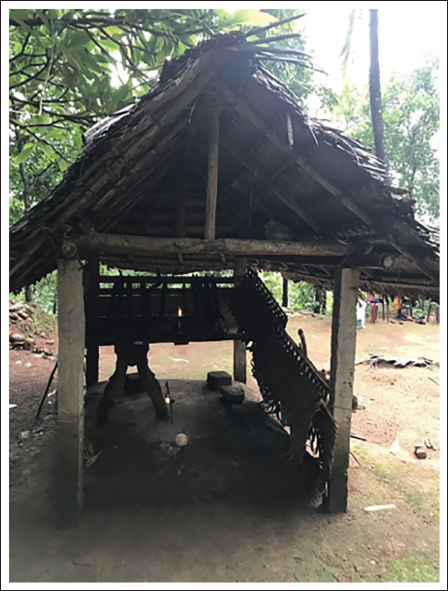
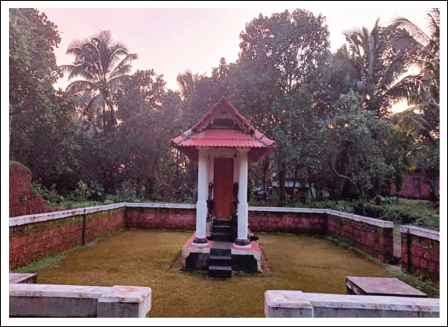
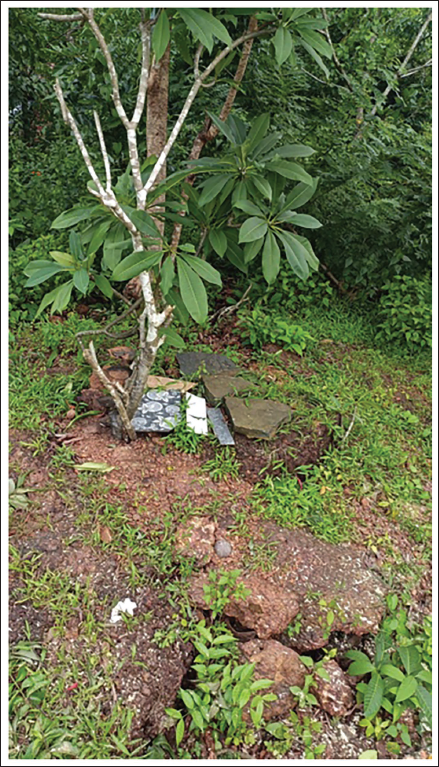
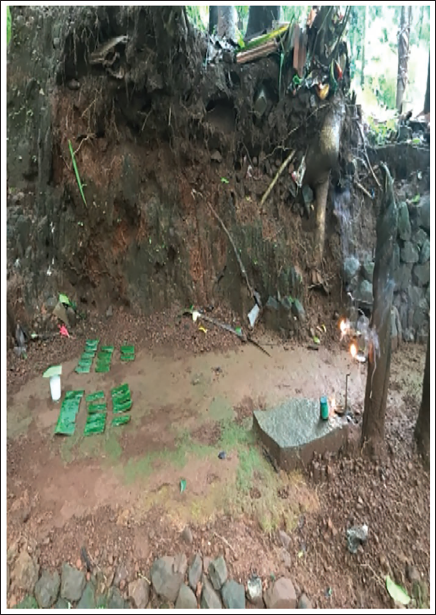
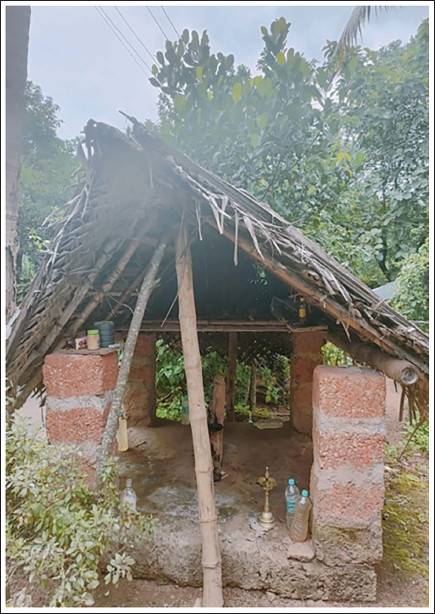
Moreover, the construction of the “pati” an ancestral temple crafted from mud and a lattice of coconut tree leaves (see Figure 2) or “paḷḷiyara” modern temple (see Figure 3) within the illam, holds profound significance. Adjacent to this structure, approximately 30 m away, lies an area featuring three stones (known as Kāpāḷatti Kallu) beneath a Plumeria tree (see Figure 4). This architectural ensemble reflects the deified status of the three women, underscoring that the inception of Māvilan religious ideals is intrinsically linked to funeral rituals. The physical manifestation, embodied by the pati or paḷḷiyara and its surrounding features, serves as a tangible reminder of these women’s sanctity and the religious traditions rooted in the community’s interpretation of death and mourning. This spatial arrangement and its associated rituals provide insight into the Māvilan community’s cosmology, where the boundaries between the living and the deceased are negotiated through carefully constructed sacred spaces and performative practices.
It should be noted that in some Māvilan families, the construction of the pati is done differently. For example, in some areas, Māvilans place a single (rather than three) Kāpāḷatti Kallu outside the pati (see Figure 5); likewise, in other areas, a single Kāpāḷatti Kallu is placed inside the pati (see Figure 6). There are specific reasons for these differences, although the ritual practices remain the same.
The Kāpāḷatti cācitra provides a comprehensive insight into Māvilan kinship structures, funerary practices, bali (ritual offerings), and teyyam rituals. These tōṟṟam and cācitra are vocalized during the tying of the Aṇaṅṅu Kōla or Aṇaṅṅu teyyam. Additionally, specific tōṟṟam and cācitra are associated with the three Kāpāḷatti teyyams that accompany the arrival of the Aṇaṅṅu teyyam, wherein the recently deceased is venerated in the guise of a teyyam, and their lived experiences are commemorated through newly composed tōṟṟam and cācitra. Furthermore, karim Cāmuṇḍi, four variants of Kuṟatti and often Pañcuruḷi teyyams, are performed as a symbolic means of escorting the Aṇaṅṅu teyyam. The performance of these additional teyyams is contingent upon the financial status of the deceased’s family.
The tying of the Aṇaṅṅu Kōla or Aṇaṅṅu teyyam represents a transformative process, wherein the performer’s body undergoes a ritual metamorphosis into the form of Kōla or teyyam. This transformation occurs within a performative phase of the teyyam entity, situated inside a temporary enclosure known as aṇiyara—constructed from coconut leaf mats. This enclosure, whose walls are also adorned with coconut leaf mats, is exclusively designated for the tying of Kōla or teyyam. During the recitation of the Kāpāḷatti cācitra, the performer undergoes this ritual transformation with the aid of their assistants in aṇiyara. This complex of rituals and performances illustrates the intricate relationship between oral tradition, embodied practice, and sacred space in Māvilan culture. The Kāpāḷatti cācitra, in conjunction with the associated teyyam performances, serves not only as a repository of cultural knowledge but also as a dynamic medium through which the community negotiates its relationship with the deceased and reaffirms its cultural identity.
These performative settings underscore the performer’s proficiency in diverse artistic, handicraft, and rhythmic domains. Such skills are exemplified in the crafting of mats from young coconut leaves, the creation of wooden bangles for the teyyam entity, the application of symbolic masks and body paint, and the rhythmic accompaniment of ceṇṭa (drums) and kaimaṇi (cymbal). Upon the conclusion of the ritual song, the performer symbolically assumes the form of the Kōla or teyyam entity.
Accompanied by the rhythmic beats of ceṇṭa and kaimaṇi, the teyyam entity emerges from the aṇiyara and proceeds toward the bali kalam. The bali kalam is a designated space where offerings of various comestibles are arranged on separate banana leaves. These offerings, collectively termed kalaśa bali (see Figure 7), include: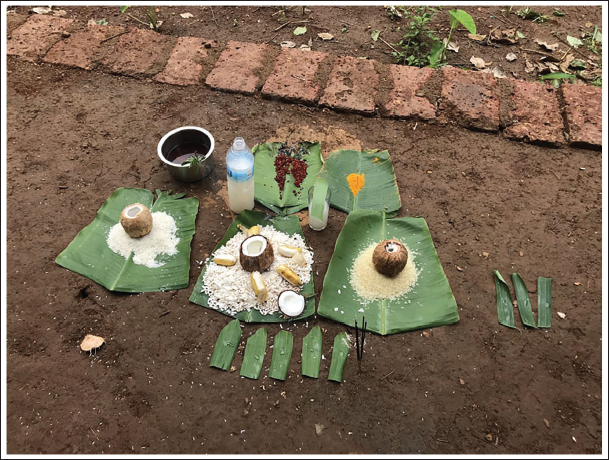
The kalaśa bali is presented in front of the Kāvu (sacred tree), pati or paḷḷiyara (ancestral temple), both in the context of performative and non-performative settings of teyyam. The rituals in the non-performative context (e.g., kalaśa bali) are performed on special occasions or designated days. In the context of performative settings of teyyam, upon emerging from the aṇiyara, the teyyam entity inspects the kalaśa bali, acknowledges the pati or palliyara and the assembled family members, and communicates in the Mavilavu language:
nuḷḷikoṭuttōnuṁ nuḷḷikkoṭuttu bārikoṭuttōnuṁ bārikoṭuttu bānaṁ kaṇḍa ṭaravāṭṭile kuḍaṅṅaṁ veccu kuttaraṁ cheyṭiṭṭuṇṭuṇṭeṅkil vaḷḷipiṭiccu vaḻipāṭu ceyṭiṭṭuṇṭuṇṭeṅkil peṟṟa mātāvu aṟiyāte baḷarilla…
44
This utterance marks the commencement of the teyyam performance and underscores the significance of bali, both during the performative phase of teyyam and in post-performance rituals. In the latter, individuals perform bali in front of the pati or paḷḷiyara on special occasions, such as kaṟutta vāvu (black moon day). On kaṟutta vāvu, offerings typically include pori (toasted rice powder), ari (toasted rice), alcoholic beverages offered in small banana leaves, half a coconut, and a sacrificial hen.
It is noteworthy that in some Māvilan communities, where a kinship system of kuṭummam (nuclear family) exists rather than the traditional illams (joint family), they construct pati with a single kāpāḷatti kallu placed inside. The kuṭummam system often reflects individual ownership of lands and houses, contrasting with the joint ownership in illams. Although contemporary Māvilan society predominantly follows the nuclear family system, in most cases, land ownership belongs to female members, symbolizing a matrilineal family system.
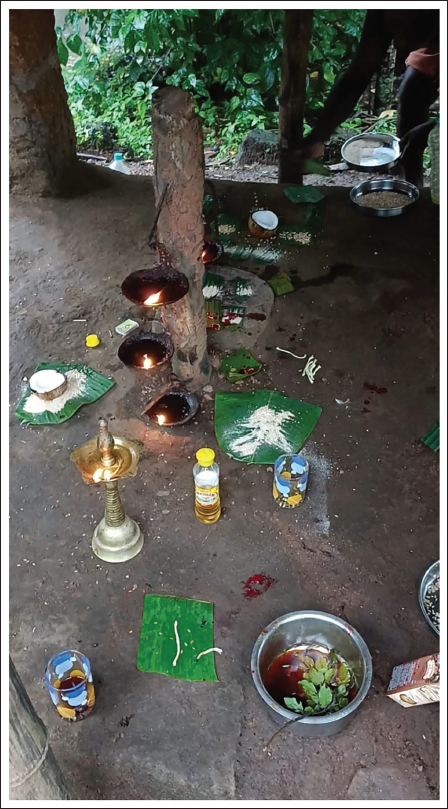
The concept of separation, central to Turner’s notion of liminality, is evident in the coexistence of illam and kuṭummam systems. These kinship structures are in a state of transition, influenced by housing development policies designed by central and state governments, reflecting a movement from traditional to more modern structures. This transitional phase represents a separation from traditional norms, aligning with Turner’s conceptualization of liminality as a period of ambiguity and reformation. Moreover, the offering rituals, which vary among Māvilan communities, exemplify this separation. In some areas, bali rituals are performed outside the pati or paḷḷiyara, while in others, they occur within the pati (see Figure 8), where the kāpāḷatti kallu is placed. This variation highlights the liminal state of the community, transitioning between old and new practices, and reflecting the fluidity and ambiguity characteristic of the liminal phase.
The origin of bali and teyyam is deeply rooted in funeral rituals, where their meaning transforms in the liminal phase. This transformative phase in the funeral context includes bali rituals such as cūṭṭu bali, Aṇaṅṅu bali, and koṭi-Aṇaṅṅu bali, which are distinct from kalaśa bali. These rituals facilitate the deceased’s transformation into a new form, namely the Aṇaṅṅu teyyam or Aṇaṅṅu kōlam, and enable the reincorporation and veneration of the deceased’s lived past into new tōṟṟam and the new Aṇaṅṅu teyyam performance. At this juncture, the deceased becomes part of māya pramāṇam (joining with the ancestral spirits).
This complex interplay of ritual, kinship, and spatial practices demonstrates the dynamic nature of Māvilan cultural traditions. The community’s negotiation of traditional and modern elements, particularly in the context of funeral rites and family structures, provides a rich illustration of Turner’s concept of liminality in action. These practices not only reflect the community’s adaptation to changing social and economic conditions but also serve to maintain cultural continuity through the transformation and reincorporation of ancestral spirits.
The Liminality and Bali
Turner’s concept of liminality describes a phase in rituals and transitions where individuals or groups occupy an ambiguous state between their old and new status. Turner (1969, p. 359) elucidates:
Liminal entities are neither here nor there; they are betwixt and between the positions assigned and arrayed by law, custom, convention, and ceremonial. As such, their ambiguous and indeterminate attributes are expressed by a rich variety of symbols in the many societies that ritualise social and cultural transitions. Thus, liminality is frequently likened to death, to being in the womb, to invisibility, to darkness, to bisexuality, to the wilderness, and to an eclipse of the sun or moon.
This conceptualization of liminality is deeply embedded in death rituals and the symbolic practices of funeral rites. In the Māvilan context, the ritual practice of bali holds significant importance in facilitating the transformation of the deceased from their old form into the form of Aṇaṅṅu teyyam. The bali rituals commence immediately in the post-cremation phase, initially lasting for 3 days and concluding on the 9th or 11th day. This period can be interpreted as the liminal phase, characterized by three forms of bali rituals and the family members’ involvement with unspoken understandings, which dominate during the transformation of the deceased’s Aṇaṅṅu into the form of the kōdi-Aṇaṅṅu. These major bali rituals are:
Cūṭṭu bali Aṇaṅṅu bali Kōdi-Aṇaṅṅu bali
The transformation of the deceased into Aṇaṅṅu kōlam or Aṇaṅṅu teyyam is achieved exclusively through the performance of these bali rituals. The nature and meaning of the bali evolve in each phase of the ritual process until it attains its original significance, which is realized in the final phase when the deceased is perceived in the form of Aṇaṅṅu kōlam or Aṇaṅṅu teyyam.
The bali rituals play a pivotal role in Māvilan funeral practices, not only responding to death but also demonstrating cultural resilience, spiritual beliefs, and communal solidarity. In numerous indigenous cultures, including the Māvilan, funeral rituals transcend the mere act of mourning. They reflect a complex interaction between the living, the dead, and the cosmic elements that are believed to govern life and death. Māvilan funeral rituals, characterized by their complex structure and profound symbolism, offer a unique perspective on the community’s worldview. These rites integrate a multitude of actions and offerings, each designed to secure a safe journey for the deceased, alleviate sorrow among the living, and maintain harmony between the physical and spiritual realms. Central to these practices is the concept of “Aṇaṅṅu,” the successful passage of which relies heavily on the participation of the living through ritual offerings. This engagement serves a dual purpose: honoring the departed and reinforcing community cohesion by reaffirming the connection between the living and the dead.
A key element in this ritualistic framework is the practice of “Bali,” which involves offerings of food and drink, often including the sacrifice of poultry or hen. “Bali” functions on multiple levels: as a tangible expression of respect, a provision of sustenance for the deceased’s journey, and a medium of communication facilitating the transition of the departed into the form of teyyam. This practice underscores a broader theme of reciprocal relationships between the realms of the living and the dead in Māvilan culture, suggesting that death transforms rather than severs interpersonal bonds. The funeral process begins with cremation, followed by a series of private rituals conducted over 3 days, attended exclusively by close kin and relatives. The “bali” ritual commences on the day of cremation and is succeeded by the “Kāpāḷatti cācitra” that serves as a ritual directive for the community.
A crucial figure in this process is the “Karmi,” who oversees the cremation. This time-sensitive ritual must occur within 6–8 h of the body’s placement in the home, contingent on the presence of all blood relatives. The mandatory attendance of all blood relatives highlights the cultural emphasis on communal participation in rites of passage. Notably, the absence of a blood relative is believed to potentially impede the deceased’s transition into the form of “Aṇaṅṅu teyyam,” underscoring the perceived importance of familial unity in facilitating the spiritual journey of the departed. The commencement of the ritual is signaled by a traditional proclamation from the senior family member, the “Kāraṇavar,” delivered in the Markodi (Vasudevan, 2016, 2023) language:
“Karmi” makkall marumakkall māmi māme maththāra parththullā … ṇāṇa cheṇa caṭaṅṅāne chūle…
47
This proclamation by the Kāraṇavar serves multiple functions within the ritual context. First, it officially acknowledges the presence of all necessary participants, encompassing both the ritual officiant (Karmi or priest) and the extended family members. Second, it acts as a formal commencement order for the “caṭaṅṅu” (ritual), specifically the cūṭṭu bali (cremation process). The imperative tone of the statement underscores the Kāraṇavar’s authority in the proceedings and the urgency with which the rituals must be undertaken.
The “Cūṭṭu Bali” Ritual: A Critical Component of the Separation Phase in Māvilan Funerary Practices
The “cūṭṭu bali” ritual, a central element in the cremation process of the Māvilan community, exemplifies the transformative journey from life to death within the theoretical framework of liminality. This ritual encompasses several key components that facilitate the deceased’s transition from the physical to the spiritual realm. A crucial aspect of the ritual involves the application of a turmeric and coconut oil mixture to the corpse by blood relatives. This action, performed thrice from head to feet, serves as a preparatory measure for the body’s initial transition. Following this preparatory phase, the deceased is transported to the pyre for cremation.
The term “cūṭṭu” specifically denotes a fire ignited using bundled dry coconut leaves, which is essential for lighting the pyre. In this context, “bali” refers to the transformative process of cremation, wherein the physical body is metaphysically converted into “Aṇaṅṅu” through the resultant ashes. This transformation represents a significant metaphysical shift, integral to the separation phase, marking the deceased’s transition from the corporeal to the spiritual domain. The concept of “cūṭṭu” also resonates in various teyyam rituals among the Māvilan, such as the “Kuliyan teyyam,” where it holds symbolic significance.
The ritual proceedings are directed by the “Karmi” (ritual specialist), who instructs the family and relatives to transport the body on a wooden stretcher to the pyre, typically situated at a distance from the residence. The “Karmi” prepares specific herbal medicines from the nearby forest, utilizing a “Katti” (a knife commonly used by the Māvilan for wood and bamboo cutting) 48 to initiate the ritual. It is noteworthy that members of non-Māvilan communities often abstain from participating in this “caṭaṅṅu” (ritual), and only male relatives and kin accompany the “Karmi” to the pyre, further delineating the boundary between the living and the dead.
The “Karmi” performs a ritual circumambulation of the pyre three times, during which small pits are dug near the pyre’s head and feet using the “Katti.” Portions of the prepared herbal medicines are placed in these pits and subsequently covered. These herbs are believed to play a crucial role in preventing the deceased’s Aṇaṅṅu (spirit) from transforming into negative energies, known variously as Niṭe (Markodi language), Bādha (Mavilavu), Piśāc (Malayalam), or “ghost” (English). This act marks the initial stage of purification, safeguarding the Aṇaṅṅu’s passage and mitigating the risk of its transformation into a malevolent spirit.
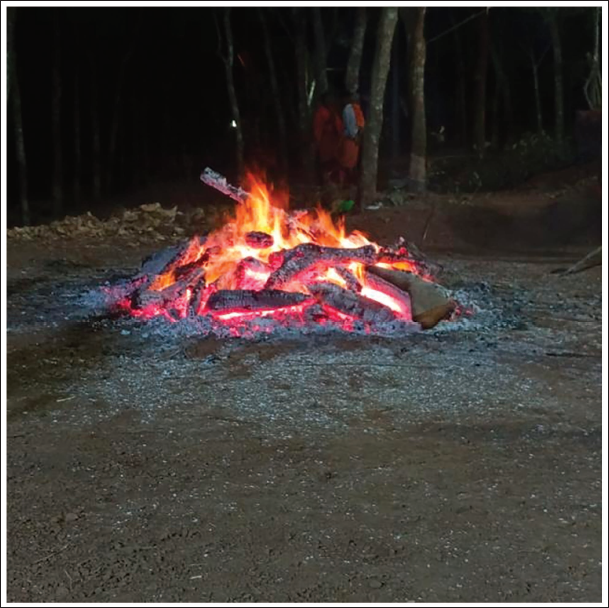
The ritual culminates with the kin igniting the pyre, completing the transformation of the deceased into “Aṇaṅṅu” (see Figure 9), a process central to the separation phase in Māvilan death rituals. This ritual not only demarcates the physical and spiritual separation of the deceased from the dead but also reinforces communal boundaries, embodying the concept of liminality in ritual processes. The “cūṭṭu bali” ritual serves as a complex, multifaceted process that facilitates the deceased’s transition, reinforces community bonds, and maintains spiritual equilibrium. Its various components—from the application of turmeric and coconut oil to the use of specific herbal preparations—underscore the intricate relationship between physical acts and metaphysical beliefs in Māvilan funerary practices.
The “Aṇaṅṅu Bali”: A Critical Ritual in the Separation and Liminal Phases
The concept of Aṇaṅṅu encompasses two distinct aspects: the visible elements of the deceased, referred to as “Aṇaṅṅu,” and the invisible elements, its existence as māya. Brillant-Girox (2020) offers various interpretations of Aṇaṅṅu, drawing parallels between the Aṇaṅṅu-māya relationship and the ātman-brahman (soul-ultimate reality) concept in Hinduism. However, empirical observations of “possession” during the kōdi-Aṇaṅṅu bali and Aṇaṅṅu teyyam performance suggest that it is primarily constituted by the Aṇaṅṅu, diverging from the Hindu analogy. The Aṇaṅṅu teyyam performance materializes through a transformative process: Aṇaṅṅu evolves into kōdi-Aṇaṅṅu, which subsequently transforms into kōlam-Aṇaṅṅu or Aṇaṅṅu kōlam (alternatively known as Aṇaṅṅu teyyam). The Aṇaṅṅu bali ritual serves as the focal point of this transformation.
Karipath (2005) argued that Māvilans perform sañcayanam on the 5th day after death and conduct a pulayūṭṭ or cāvūṭṭ ceremony on the 14th day. However, these observations contain several inaccuracies. Contrary to Karipath’s assertion, Māvilans do not perform sañcayanam; instead, they conduct kariyaṭiccukūṭṭal. The Hindu concept of sañcayanam, involving the collection and disposal of cremated ashes, is absent in Māvilan practices. Furthermore, the pulayūṭṭ or cāvūṭṭ ceremony Karipath describes is not observed. Māvilans actually perform kodi-Aṇaṅṅu bali or aḍiyanthiraṁ on the 9th or 11th day, which is symbolically visible in the context of Aṇaṅṅu bali.
Critically, Karipath’s study overlooks the crucial role of bali rituals in transforming the Aṇaṅṅu into the Aṇaṅṅu teyyam, a key aspect of Māvilan funeral traditions. Furthermore, Arya (2022) equates Māvilan bali rituals with those practiced in Hinduism, which does not fully reflect their contextual significance within Māvilan culture. For example, Arya interprets the clapping at the conclusion of Aṇaṅṅu bali as an invitation to crows. However, ethnographic findings indicate that this action—clapping three times forward and three times backward—symbolically signifies the completion of Aṇaṅṅu bali rather than serving as a gesture to invite crows.
The Aṇaṅṅu bali represents a pivotal offering ritual that plays a crucial role in both the separation and liminal phases of Māvilan funerary practices. This ritual commences simultaneously with the ignition of the pyre, marking a significant moment in the transition of the deceased. The “Karmi” (priest) assumes a pivotal role in orchestrating the Aṇaṅṅu bali ritual, which spans from the first to the third day following the death. This ritual is distinct from conventional bali rituals such as kalaśa bali. The process commences with a collective bath in a nearby river, following the Karmi’s instructions. This bath serves as a ritual purification, encompassing complex practices.
A notable aspect of the ritual involves the assembly of close blood relatives, both male and female, from the deceased’s kuṭummam (family unit) in front of the bali kalam. Bali kalam is a specially designated space outside the deceased’s house that serves as the venue for the Aṇaṅṅu bali over the subsequent 2 days. A temporary stove, constructed from stones, becomes the focal point for the impending ritual. The preparatory phase involves various activities: gathering wood and dry coconut leaves for fuel, fashioning an improvised cooking vessel from a broken piece of pottery or pan, and collecting leaves from a specified herbal tree dedicated to the bali.
A white cloth draped over an erect stick stands prominently before the offerings, symbolically representing the Aṇaṅṅu. The Aṇaṅṅu bali involves the offering of half-cooked rice mixed with turmeric and water. Each participant carefully allocates turmeric-infused rice upon 9 or 11 herbal leaves, with the Karmi partaking last. The Karmi then eulogizes the deceased, emphasizing their significance to the family, illam, and the broader community. Addressing the Aṇaṅṅu in the Markodi language, the Karmi articulates:
paṟōṭukunnavu mattāṟa paṟttulla … nāṇa ēṟāṭṭa paṟiyē uṇṭāvuṭṭa avana sañcāryaṁ akkuntu. aka paṟṟa cūtilēṇṭ pōvōṭu. nikkaṟ imbuḷ ulla jērkkalēniyāna paṟṟa koṇṭu naṭattukunnakḷ akkunu. imbuḷ paṭṭatta kāryaṅṅaḷāne paṟṟa cūtuṇṭu. nāṇa nikkaṟak māyāpramāṇaṭ akkuntu sthānaṁ.
This eulogy, translated as,
For those who are supposed to be here, they are here. If some have left or have not yet arrived, it is due to their situation. Please forgive them. You have taken care of the family and children. You have guided them well. From now, your place is in māya (the invisible realm).
It acknowledges the presence of attendees, recounts the deceased’s role as a guardian and provider, and recognizes their transition into an invisible form (māya) within māyapramānam. This address advocates for a peaceful transition, embodying not merely an act of respect but a communal validation of the deceased’s new state and enduring presence within the collective memory and traditions of the Māvilan community.
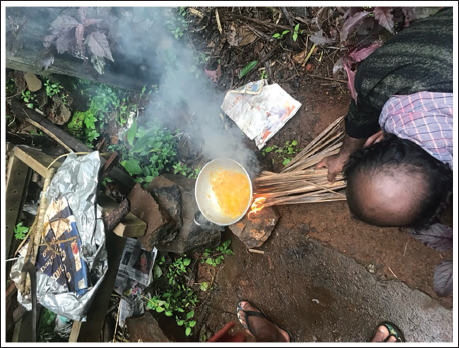
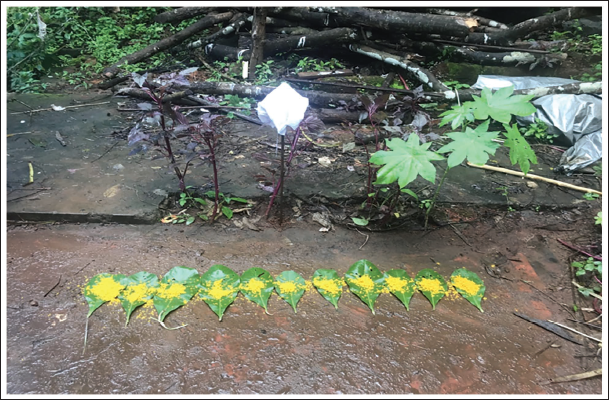
The ceremonial presentation of turmeric rice on herbal leaves is a pivotal element of the Aṇaṅṅu bali. This offering transcends the notion of a communal meal, serving as a profound recognition of the Aṇaṅṅu, the transcended essence of the deceased. The number of leaves used in this offering holds particular significance, reflecting familial hierarchy and generational continuity. Eleven leaves are used if the deceased was an elder, typically a grandparent or parent viewed as the family’s last surviving member. Conversely, nine leaves are used for younger deceased individuals, such as when a son predeceases a parent or grandparent (see Figures 10 and 11).
The Aṇaṅṅu bali rituals culminate on the third day with a practice known as kariyaṭiccukūṭṭal or teḷippu, which involves covering the cremation site. Following this, all members convene at the deceased’s residence for a crucial discussion to determine the date for the kōdi-Aṇaṅṅu bali. This ritual, also referred to as aḍiyanthiraṁ, encompasses the significant practice of “triggering of the possession.” The chosen date is typically either the 9th or 11th day, maintaining symbolic consistency with the leaf offerings made during the Aṇaṅṅu bali.
The “Kōdi-Aṇaṅṅu Bali”: Culmination of Liminal Phase
The “kōdi-Aṇaṅṅu bali” represents the final stage of the liminal phase in Māvilan funerary rites, wherein the Aṇaṅṅu undergoes transformation into the form of kōdi-Aṇaṅṅu. This ritual event is characterized by the temporary possession of a family member (of kuṭummam) and close friend (eṇaṅṅu) by the deceased’s Aṇaṅṅu. In this context, the “Karmi” assumes a dual role: as both friend and guide for the deceased’s Aṇaṅṅu, particularly during its metamorphosis into kōdi-Aṇaṅṅu. Upon possession of the “Karmi” (eṇaṅṅu), family members present offerings of food and drink. This day is alternatively known as “Aḍiyanthiraṁ,” derived from the Malayalam term “pulayūṭṭ.” While various Hindu castes conventionally observe pulayūṭṭ or aḍiyanthiraṁ rituals on the 12th-, 16th-, or 41st-day post-cremation, the Māvilan community performs these rites on the 9th or 11th day.
The “Aḍiyanthiraṁ” ceremony involves the invitation of relatives, neighbors, and friends of the deceased. Notably, individuals outside the Māvilan communities may exhibit reluctance or opt for complete abstention from participation. This abstention primarily stems from the divergence in the timing of the event from their customary 12th-, 16th-, or 41st-day observance. To accommodate these preferences, some Māvilan families in certain areas conduct the kōdi-Aṇaṅṅu Bali on the 9th or 11th day, followed by a feast on the 12th day. However, this duality is atypical among the Māvilans.
The event commences in the morning with a collective bath by blood relatives and the “Karmi” in a nearby river. The “Karmi” applies “kuruti” (a mixture of water with lime and turmeric) to purify the body. Post-ablution, participants assemble inside the deceased’s dwelling before a bali kalam, a ritual space specifically designated within a room for the “kōdi-Aṇaṅṅu bali” ritual. The “Karmi,” seated on a “palaka” (a small wooden stool positioned approximately 30 cm off the ground), leads the ritual. Other attendees, segregated by gender, stand behind him: men on one side and women on the other. Participants focus their gaze upon the bali kalam, attentively observing the unfolding rituals. The room’s atmosphere is hushed, with attendees collectively anticipating the imminent arrival of the Aṇaṅṅu. After approximately 30 min of eager anticipation with no discernible event, expectations mount for the arrival of the Aṇaṅṅu and its subsequent possession of a present individual. In the Markadi language, the kāraṇavar (the elder) articulates an invocation to the bali kalam:
Ceṇaṁ cūla.! Ekkaḷa kor̥e samayāk impuḷ niṇṭippukuṇ … Ekkaḷak pōt pēṭṭe pēlēṇt. Ādyaṁ kuṭummaṭ cūvoṭu. At̥u kaṭit eṇaṅṅuṭṭu pakaroṭu…!
This utterance can be interpreted as: “Hurry up, as we have many tasks to complete and cannot wait indefinitely for you. First, reveal yourself within one of the family members present, and then within your eṇaṅṅu (friend).” In the context of “kōdi-Aṇaṅṅu Bali,” the “Karmi” assumes the role of a “friend” to the deceased’s Aṇaṅṅu, hence the designation “eṇaṅṅu” during the ritual. This interaction suggests an atypical delay in the Aṇaṅṅu’s manifestation through the possession of any assembled individual. Recognizing this delay, the “Karmi” engages with the kāraṇavar regarding potential unfulfilled aspirations of the deceased or the absence of close blood relatives, such as offspring. Upon identification of any such issues, the “Karmi” directs the Aṇaṅṅu to forgive these shortcomings and continue waiting until possession is achieved.
The phrase “Ādyaṁ kuṭummaṭ cūvoṭu. At̥u kaṭit eṇaṅṅuṭṭu pakaroṭu…!” explicitly conveys that the deceased’s Aṇaṅṅu initially manifests in a family (kuṭummam) member before promptly “decanting” into the “Karmi’s” body. The term “pakaroṭu” is analogous to the English “decant,” indicating the temporary nature of the Karmi’s possession. Successful possession signifies and validates the Aṇaṅṅu’s transformation into kōdi-Aṇaṅṅu, which can subsequently evolve into Aṇaṅṅu teyyam or Aṇaṅṅu kōlam. The kōdi-Aṇaṅṅu 49 symbolically represents the performative phase of Aṇaṅṅu teyyam and is integral to kalaśa bali, performed in the context of Aṇaṅṅu teyyam. In some instances, the initiation of possession may require considerable time. Failure to achieve possession leads to the conclusion that the Aṇaṅṅu has transformed into niṭe (malevolent spirit) or bāte (erring spirit), impeding the deceased’s Aṇaṅṅu’s progression toward Aṇaṅṅu teyyam.
It is crucial to note that ritual interaction primarily occurs between the “Karmi” and the kāraṇavar or assembled members, rather than directly with the entity. Their dialogue and participation are instrumental in the ritual proceedings and in understanding the deceased’s unfulfilled desires or familial gaps. This elucidation enhances comprehension of the interpersonal dynamics within the ritual context and underscores the significance of dialogue between the ritual expert and participants in guiding the transformative process.
Within the “Aḍiyanthiraṁ” context, possession involves a state where any family member, regardless of gender, is believed to be temporarily possessed by the Aṇaṅṅu. Unlike teyyam performers, these possessed individuals do not wear costumes or makeup but typically remain silent with a vibrating body. Notably, in these instances, there is generally no dialogue between family members (kuṭummam) or “Karmi” and the entity. This observation contrasts with Brillant-Giroux’s (2020) assertion that the “kōdi-Aṇaṅṅu” ritual includes dialogues between the entity and family members.
In the context of “kōdi-Aṇaṅṅu bali,” the offering ritual commences upon successful possession. As the Aṇaṅṅu decants into the “Karmi’s” body, the latter may exhibit trembling sensations, indicative of the entity’s presence. Upon manifestation of these symptoms in the “Karmi,” who is seated on the “palaka” (small wooden stool), the kāraṇavar promptly places a banana leaf before the “Karmi” and presents vegetarian foods, specifically prepared for the kōdi-Aṇaṅṅu bali. Each family member present then approaches and serves a small portion of rice and curry onto the banana leaf using a spoon, proceeding sequentially until the last member has participated. The “kōdi-Aṇaṅṅu bali” concludes after the “Karmi” distributes a small portion of the served food (offerings) to the members.
Following this, the kāraṇavar concludes the ritual with an utterance in the Markodi language:
Aṇaṅṅu kuṭummaṭṭ cūt̃ilent eṇaṅguṭṭ pakarituntu Nāṇa oñci koḷḷaṁ kaṭit kōlaṭṭ koṭiyākṇ…!
50
Atu nāṇa pāṭṭa nikkaran kuṭummaṭṭa sāmpatthikānē cūt̃ilent pōṭunavu ceyyoḷi…!
51
This proclamation underscores that all family members have witnessed the Aṇaṅṅu’s possession of a family member (kuṭummam) and its subsequent decanting into a third person, in this case, the eṇaṅṅu (“Karmi”). It further stipulates that, contingent upon the family’s financial capacity, they will witness the deceased in the form of Aṇaṅṅu teyyam or Aṇaṅṅu kōlam, an event likely to occur after a year’s interval.
This ritual sequence exemplifies the complex interplay between spiritual beliefs, familial obligations, and economic considerations in Māvilan funerary practices. The structured nature of the offering, with each family member participating sequentially, reinforces communal bonds and emphasizes the collective nature of the transition process. Moreover, the kāraṇavar’s concluding statement highlights the temporal aspect of the ritual cycle, extending beyond the immediate post-mortem period to encompass future observances.
The acknowledgement of financial considerations in determining the nature of future rituals provides insight into the pragmatic aspects of spiritual practices within the Māvilan community. This intersection of spiritual obligations and material realities offers a fruitful area for further anthropological investigation, particularly in understanding how indigenous communities negotiate between traditional practices and contemporary economic constraints.
The Reaggregation or Reincorporation: The Aṇaṅṅu Teyyam Performance
In the context of rites of passage, as elucidated by Turner (1969) in his analysis of liminality, reaggregation (or reincorporation) denotes the final phase of the rite of passage. This phase, succeeding the liminal stage where individuals or groups undergo transition, involves the reintegration of the individual or group into society. During this phase, the subject re-enters society with a new status, role, or identity, and is expected to adhere to the norms and responsibilities associated with this new position.
Within the Māvilan context, the Aṇaṅṅu teyyam or Aṇaṅṅu kōlam can be interpreted as part of the reaggregation phase. This ritual performance symbolizes the deceased’s return in visible form as teyyam or kōlam—a symbolic expression during the performative phase. It signifies the dead’s return home, where they subsequently reside as invisible māya in the ancestral temple. During the performative phase, kalaśa bali is crucial in tying the kōlam or teyyam. These offerings appease the deceased, trigger possession, and Aṇaṅṅu teyyam enables dialogues with family members. Prior to the Aṇaṅṅuteyyam performance, various Bhūta kōla entities such as pañcuruḷi, kuṟatti, and kalluruṭṭi, as well as teyyam entities including Karim Cāmuṇḍi, the three Kāpāḷatti teyyams, and Kuṭummam teyyam, are often performed. The inclusion of these Bhūta kōla and teyyam entities is contingent upon the family’s financial circumstances.
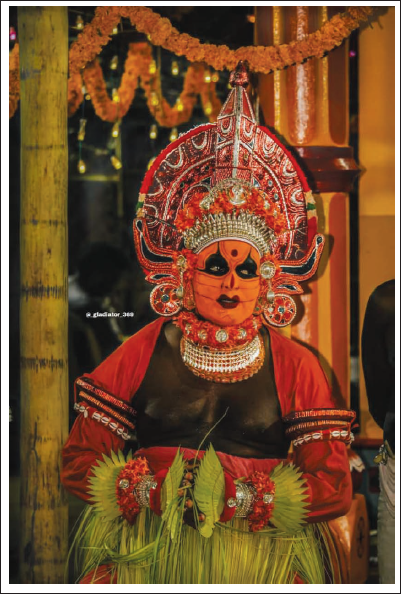
The newly formed Aṇaṅṅu teyyam (see Figure 12) of the deceased is venerated through tōṟṟam and cācitra, wherein the actual name of the deceased and their lived experiences are reincorporated into the tōṟṟam. In the post-performance phase of Aṇaṅṅu teyyam, the deceased is memorialized and appeased through bali (offering) rituals on special occasions or functions. This practice serves to maintain the spiritual equilibrium between the living and the dead. Brillant-Giroux (2020) notes that kōlam-Aṇaṅṅu ritual resembles typical teyyam by invoking a deity through a performer. However, unlike standard teyyam rituals, kōlam-Aṇaṅṅu uses a uniform approach for all deified ancestors, customizing only the tottam song to reflect the specific ancestor.
The Transformed Form of “Aṇaṅṅu” into “Aṇaṅṅu Teyyam.”
Conclusion
In conclusion, this study demonstrates that among the Māvilan community, bali signifies “offerings ritual,” diverging from its conventional interpretation as “sacrifice” in Hinduism. Bali rituals play a crucial role in death ceremonies, facilitating the separation of the deceased and their reincorporation into tōṟṟam and Aṇaṅṅu teyyam. These rituals appease the deceased and ancestral spirits, maintaining spiritual equilibrium between the living and the dead. The liminal phase, as conceptualized by Turner (1969), between separation and reincorporation involves complex ritual processes transforming the deceased into Aṇaṅṅu teyyam.
The Kāpāḷatti cācitra is vital in death rituals, providing foundational understanding and meaning, while also serving as oral tradition in the performative phases of Aṇaṅṅu teyyam. Tōṟṟam (ritual ballads) and cācitra (oral history) venerate the deceased’s lived past, offering important references for understanding each teyyam’s original knowledge. Exploring tōṟṟam and cācitra is crucial in understanding how communities performing teyyam and Bhuta kola conceive these practices. These elements preserve teyyam knowledge and carry significant linguistic elements, employing Tulu, Markodi, Mavilavu, and Malayalam in their oral traditions. These findings contribute to understanding religion, culture, and society, particularly the concept of bali and its relation to funeral rituals and teyyam. While this study focused on bali rituals through the lens of liminality in death rituals, future research could explore tōṟṟam, cācitra, and performative settings of teyyam in greater detail. Overall, this work provides valuable insight into Māvilan society, culture, religious practices, and language, highlighting their relevance in contemporary society and contributing to the broader field of anthropology of religion.
Footnotes
Declaration of Conflicting Interests
The author declared no potential conflicts of interest with respect to the research, authorship, and/or publication of this article.
Funding
The author(s) disclosed receipt of the following financial support for the research, authorship, and/or publication of this article: The author acknowledges financial support from the Doctoral School of Humanities at Jagiellonian University, Poland, in the form of a PhD scholarship.
