



Abstract
In the Anthropocene and on the brink of the Sixth Mass Extinction, we are called upon to reflect on how humans can, do, and should live with other species on Earth. This article uses an interdisciplinary approach, drawing on Bruno Latour’s actor-network theory, to unveil the multifaceted ways that tigers and humans have an impact on each other. The result is an interspecies ethnography of the reality of coexistence between two species recognized as dangerous to the other. The indigenous Mishmi people of the Dibang Valley provide us with a complex example, revealing that humans and tigers have equal roles to play, and the article highlights the flexibility of were-tigers and shamanism as one way to navigate this complex relationship.
Introduction: A Study Model of Interspecies Ethnography in South Asia
“108 people died due to tiger attacks in India between 2019 and 2021,” read the Times of India (2022) headline on April 4, 2022. The state of Maharashtra is identified as having the highest number of recorded deaths ( India News, 2022 ), and there is growing attention toward the plight of the Sundarbans’ tiger widows (see Chowdhury et al., 2016). And yet the state of Arunachal Pradesh in the farthest northeast of India has recorded no deaths from tiger attacks for years (India News, 2022). Officials had not believed that tigers were present in the area (Nijhawan, 2019), which provided a simple explanation for the lack of attacks. But there were several accounts of tigers spotted in unexpected cold and rocky territories, avoiding official detection, cohabiting this mountainous area with the local tribe, the Mishmi (Aiyadurai, 2016, p. 312; Nijhawan, 2019). The Mishmi are not completely isolated or entirely marginalized, despite having large areas of land, and Aiyadurai (2016, p. 6) points out that the subgroup of Idus have ready access to schools; many have government jobs, while some study at a university or are journalists, and yet despite their credentials, their accounts of local tiger sightings were largely ignored in official reports and data collection until 2012.
Everything changed in late 2012, when two tiger cubs were found in an Idu Mishmi village and the Forest Department was contacted (Aiyadurai, 2016, p. 305). Since then, more detailed records have begun to emerge, and the “Status of Tigers 2018” report has officially stated that there is a “persisting low-density tiger population” in the Dibang Valley area (Jhala et al., 2020, p. 135). However, in the same report, there are details of how camera traps were arranged for monitoring, and it is clear that the higher altitude areas were avoided (Jhala et al., 2020, pp. 345–346; see also Qureshi, 2014, pp. 276–281 for a similarly problematic study). If the Idu Mishmis are correct, it is safe to assume that the monitoring efforts have not yet been able to gauge a realistic estimate of the tiger population.
Doubt is cast over the reality of the situation through several different official reports. One acknowledges that the largest population of tigers does not reside in official reserves (Jhala et al., 2020, p. 135). A 2018 report from the region claims that the Mishmi Hill ranges are now believed to have more tigers than any officially designated tiger reserves in Arunachal Pradesh (Adhikarimayum & Gopi, 2018, pp. x–xi). Yet at the same time, other official reports have dedicated very little space to the state of tigers and wildlife in the Dibang Valley areas; for example, while other reserves have several pages explaining their conservation progress, the Dibang Valley has just two pages, including maps, in the official “Status of Tigers” report (Jhala et al., 2020).
These conflicting sources of information highlight a growing problem in a world undergoing accelerated changes and losing focus on a question of how it is that the tigers and humans in the area have been cohabiting the Dibang Valley with so few deaths or attacks on either side. It is probably worth reconsidering how we perceive concepts of coexistence “to capture a sense of heightened jeopardy in an epoch of accelerating extinctions resulting from intensifying human interventions in the natural environment … in which we will be increasingly forced to share space and resources, and acknowledges our shared biological inheritance” (Pooley, 2021, p. 2). In the case discussed here, we need to also recognize that both species are seen as dangerous to each other. This idea of heightened jeopardy due to fewer resources is therefore exacerbated, alongside a growing sense of threat and need for control.
The emerging status of the concept of coexistence implies that there are multiple facets and elements of coexistence that should be taken into consideration and are still being discovered, each of which influences the other. These require contextualization, interdisciplinarity (Pooley et al., 2022, p. 6), and multiple perspectives, including those of indigenous and local groups (Pooley, 2021, p. 1). We therefore hope that by drawing on the examples discussed here, from primary and secondary sources with the Mishmi groups of the Dibang Valley, to expose and contextualize some of the theories of coexistence. Additionally, Pooley (2021, p. 2) points out that we must also consider concepts of care, coadaptation (Hill, 2021, p. 3), co-constitutive communities (Pooley, 2021, p. 5), and, significantly, conflict (Hill, 2021, p. 1; Pooley, 2021, p. 3).
Conflict, evident in the relationship between tigers and humans, may not initially appear to be a part of coexistence as much as its opposite. But this apparent juxtaposition is already somewhat normal in ecological rules, such as predator–prey relations (Berestycki & Zilio, 2019, p. 436), where predator and prey populations keep each other in check, leading to an overall balance between the two species. It is also evident through Galtung’s description of positive and negative peace (Bhatia, 2021, p. 1), and when it comes to people, Hill (2021, p. 2) points out: “conflict is normal in human relationships.” In particular, degrees of conflict are not unheard of within human families and between siblings, a perspective that is particularly relevant to consider in the situation of the Mishmi and their tiger “brothers.” As we will see later, in fact, in the cosmogonic myths of these indigenous communities, a concept of original undifferentiation between human and nonhuman animals is handed down, whereby the first man and his brother-tiger are intrinsically linked by a kinship bond. Whichever the circumstance, conflict constitutes a natural part of coexistence, provided it is held in balance: “negative and positive peace may be separate dimensions but cannot exist without each other” (Bhatia, 2021, p. 1).
The Indian zoologist K. U. Karanth and his colleague R. Gopal, director of several tiger conservation projects in India, have worked intensively on these issues (Karanth & Gopal, 2005, p. 373). Their exploration of human–tiger coexistence in India is predominantly seen from a conflictual perspective, pointing out that tigers are among the most “conflict-prone” of big cats. For them, coexistence is placed at odds with experiences of conflict, so they look for ways “to mitigate human-tiger conflicts” (Karanth & Gopal, 2005, p. 374) and state that “mitigation of such conflicts should be the most important part of any conservation agenda that strives for continued coexistence of carnivores and humans” (Karanth & Gopal, 2005, p. 373). They are not alone in this approach, as others have also adopted conflict mitigation as the path to coexistence (see Nyhus & Tilson, 2010, p. 127). The problem with this approach is that it fails to consider conflict as a natural part of interspecies coexistence. As Bhatia (2021) and Hill (2021) indicate, and as we have already explained, coexistence and conflict go hand in hand. Furthermore, Nair et al. (2021, p. 1) suggest: “to understand what makes it possible for humans and wildlife to share space, we have to look beyond the ecological and socio-economic study of damages caused by human-wildlife conflict and explore the cultural and societal context within which co-existence is embedded.” This combination of diverse perspectives, ranging from the scientific to the anthropological, reveals that conflict is in fact a natural part of what it means to coexist.
Bruno Latour’s (2017) interpretation of actor-network (AN) theory draws attention to the complexity in our world by identifying nodes and highlighting how each node has multidimensional connections to an indefinite number of other nodes, each influencing and being influenced by the others. By applying AN theory to a particular example, such as the Idu Mishmi and surrounding influences, we can begin to understand how inter- and intraspecies relations, including potential points of conflict, translate into a workable, livable form of coexistence that has its roots in a perhaps archaic past and still continues today. But today’s world is also facing modern risks, and we should seek to understand how much of a threat, if any, they pose to the concept of coexistence. This article specifically concentrates on the coexistence and relationships between the two specific species named, but tries to do so from multiple perspectives to reveal their complexity.
Navigating the Complexity: Coexistence Scenarios
The present study is based on extensive anthropological research in the Mishmi Hills, around the town of Tezu and up the Dibang Valley of the Lohit district in Arunachal Pradesh. The ethnographic data are corroborated by a selected and updated bibliography on the theme of coexistence between human settlements and big cats. While many other recent studies on multispecies ethnography would have been helpful at this juncture (e.g., Ingold, 1988; Kohn, 2013; Tsing, 2015), we have found a useful and essential guideline on the concept of coexistence described and considered from multiple perspectives and from an interdisciplinary stance in the collection of works by Pooley et al. (2022). Moreover, we decided to apply Latour’s thinking to the case study to advance a model type of work. Our analysis draws its ontological and epistemological perspective from AN theory, in which nothing exists in isolation, with numerous connections between everything, and each network has “as many dimensions as they have connections” (Latour, 2017, p. 175). AN theory seeks to understand social relations by considering also the “non-human, non individual entities” (Latour, 2017, p. 174), making it well-suited to non-anthropocentric explorations. In fact, it seeks to demonstrate the multitude of influences every element may have in relation to any other and so considers “human, unhuman, nonhuman, inhuman characteristics; the distribution of properties among these entities; the connections established between them” (Latour, 2017, p. 179). This is done by identifying what Latour refers to as nodes within a multidimensional network of connections.
Previous discussions on conflict or coexistence are often framed as “human-wildlife” relationships (Woodroffe et al., 2005, p. 1) or consider the impacts of humans on natural systems (Woodroffe et al., 2005), terms that highlight only a perceived separation of humanity from the natural world. This reduces the complexity of life on Earth to a simplified, anthropocentric, and dichotomic discussion. By considering even a fraction more of the complexity, through AN theory, and avoiding debated terms such as “nature” (as recommended by Aiyadurai, 2016, p. 311), a more realistic, and arguably a more natural, state of affairs is revealed. Perhaps by recognizing the intricacy and extensity of interspecies relations, where humans are within the same network as other forms of life on Earth, we can begin to readdress issues of coexistence, and even of conservation. This article therefore explores ways in which the human–tiger coexistence and conflict discussion can be framed, by considering a variety of perspectives. It will bring together indigenous accounts and ecological understandings of coexistence and conflict by going beyond the simplistic human–nature dichotomy.
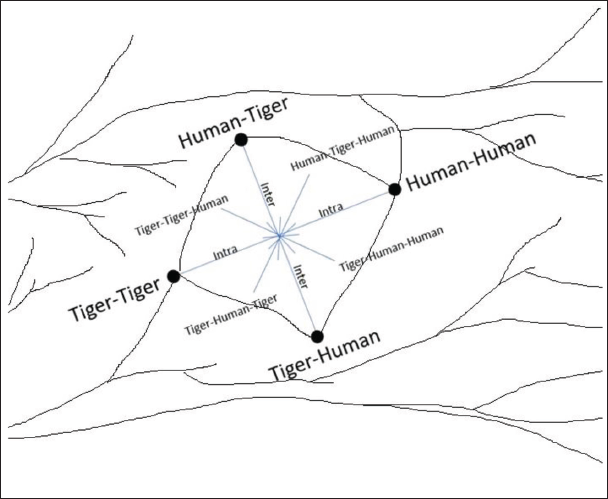
A full exploration of AN theory on this subject would require a much more extensive piece of work, so to keep focus, this article will locate itself in the discussion by utilizing a compass of the cardinal points of human–tiger coexistence (see Figure 1), within the setting of the Dibang Valley and the Mishmi people. Figure 2 demonstrates how this compass could map onto a hypothetical network of AN theory, highlighting a set of most pertinent connections and nodes. There are of course additional influences beyond the four cardinal points, just as there are other directions from a compass, which this article is unable to give full attention to, although some will be mentioned in the discussions to follow.
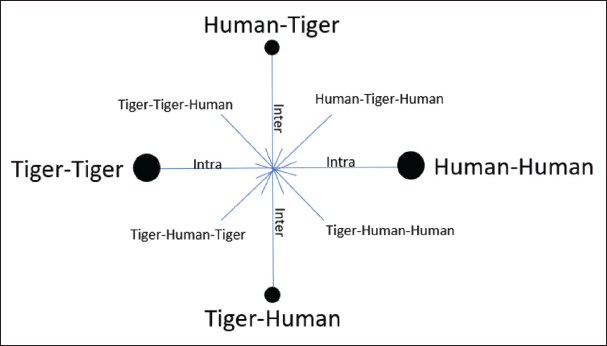
The Compass Mapped onto a Hypothetical Network, Highlighting Tiger and Human Nodes.
It should be noted that although the framing of this article aims to avoid anthropocentrism, the relative abundance of material considering the human perspectives on the subject means that for force majeure, the human perspective and understanding have a stronger foundation and scope of resources. This reflection is made in the hope that this piece of work can contribute to promoting other-than-human perspectives when considering matters of interspecies coexistence, while recognizing that the materials and sources required are not yet readily available.
Coming to the ethnographic detail, the Mishmis are a “Scheduled Tribe,” that is, an indigenous population, recognized by the Indian government, which today live in the northwestern districts of Arunachal Pradesh, essentially in the easternmost area of the entire Indian subcontinent, a short distance from the Burmese border. The Mishmi communities are divided into three subgroups, with a substantial ethnic continuity between them: the Idu, the Miju (or Kaman), and the Digaru (or Taraon); on the whole, they number just over 40,000 units according to the data of the last completed Census of India (2011). 1 With distinctly Asian features, much closer to Southeast Asia than to mainland India, the Mishmis speak a series of dialects belonging to the Tibeto-Burman family. 2 The basic rule of marriage is clan exogamy, and in order to establish a marriage, the persons involved should not have any blood ties from either the patrilineal or matrilineal descendants. The community structure is, however, patrilineal, patrilocal, and patriarchal. Traditional costumes and dresses are very rich; these mainly consist of garments still produced locally, which in the past were a valuable bargaining chip between the tribes. We had the opportunity to observe the women of the Digaru villages at work, weaving cotton on the loom, a handcrafted hand tool, intent on the production of clothes with traditional motifs of remarkable workmanship. We also testify the use, still today, of various intertwined plant fibers, bamboo, and tree bark for some of the attributes of the garments. Also noteworthy is the production of beaded jewelry, silver decorated with tribal motifs, or the ornamental use of out-of-date coins. We were told that belonging to one group or another among the Mishmis can be understood from the patterns given in traditional costumes, but the distinctive feature among the tribes is the styling of the hair, generally kept long, sometimes gathered in a bun.
The shamanic tradition of these areas is articulated, complex, and extremely interesting, even if in the surroundings of Tezu it presents the symptomatic prodromes of decay and contamination due to the impact of modernization, which in these areas certainly takes a few decades to go but is nevertheless incipient. Considering the logistical and infrastructural difficulties of the region, which, due to the monsoon, is practically isolated for half the year, the area has had considerable importance since the past for trade, especially with the Assamese population. (The location’s opportunities and challenges for trade are the same opportunities and challenges it poses for the tiger population, as will be discussed later.) Therefore, the area today presents itself as a multicultural microbalance, in which the Christian-Catholic missions have been very assertive in converting part of the population in recent years. Furthermore, despite the considerable presence of traditional Hindu schools and important pilgrimage destinations (such as the sacred site of Parashuram Kund along the Lohit River), we witness the growing influence of Hinayana Buddhism, near the border with Burma. This influence is based on a missionary action of conversion that openly opposes indigenous cults and the use of blood sacrifices. Alongside a form of reformed animism, here called Donyi-Polo—the cult of the Sun and Moon (Chaudhuri, 2013)—there is still a strong traditional shamanism based on the cult of ancestral deities or natural spirits called khinu. They can be both benevolent and malevolent and can be appeased through the profusion of blood from a multitude of animal sacrifices. These human–spirit relationships are normally conveyed by the shaman of the community through various rituals. There are many names that describe the sacred specialists in these areas. The term nyibu indicates the shaman in the so-called neighboring “Tani” groups, namely, Apatani, Nishi, Hill Miri, and Tagin. These are different communities that boast similar traditions and descendants from the same ancestor (Abo Tani). Although it is a typical expression of central Arunachal Pradesh, the word nyibu has begun to spread beyond their cultural sphere and is considered here a linguistic loan. Among the Mishmis, there are different degrees of religious apprenticeship, from local healers, to the custodians of tradition, up to the most powerful shamans. Our informants told us that among the Digaru, the goak is little more than a local healer and animal sacrificer in honor of spirits. But among the Miju and the Idu, there are the most powerful shamans: powerful sorcerers, proficient in trance control and altered states of consciousness; they are also able to communicate with the deities of the forest and to influence the behavior of tigers and big felines. It seems that, depending on the area, there are at least three shamanic categories whose apex is represented by the igu for the Idu and the kambreng for the Miju, but some authors report more (Chaudhury & Duarah, 2004, p. 29; Mene & Miso, 2022, pp. 25–26). 2 In the next paragraphs, we will demonstrate how cultural, folkloric, and, above all, religious elements and notions are essential to understand the dynamics of intra- and infraspecies coexistence.
Intraspecies Tiger Relationships: Predation, Resources, and Climate Change
Tigers are widespread around Asia and capable of surviving in a range of habitats and environments (Sunquist, 2010, p. 21). In the case of the Dibang Valley, the tiger population has been living at unusually high altitudes and so is relatively understudied (see Jhala et al., 2020, pp. 345–346; Qureshi et al., 2014, pp. 276–281). As such, this article will draw information from tiger relations as identified from observations of other populations within India. Regardless of the population in question, it is no trivial task for humans to attempt an interpretation of intra-tiger relations. No matter how much we study and observe nonhuman animals, we will never be able to entirely remove the human lenses through which we decipher and contextualize what we see. Nevertheless, broaching this subject can be an act of awareness, and this article draws attention to what we can understand about these neighbors and their social world.
Intraspecies coexistence is self-evident among all species on Earth. Whether they live in isolation or in groups, there is a balance and set of rules that allow multiple individuals of a species to live simultaneously, as well as have interactions that allow for reproduction and the continuation of that species. Importantly, these interactions are not without conflict. A degree of conflict can be healthy for a population (Berestycki & Zilio, 2019, p. 436), whether it is at an individual level by dividing access to resources or at a population level by controlling population growth (Berestycki & Zilio, 2019). The same is true in intra-tiger relationships. These interactions, also influenced by their habitat, resource access, and other species and factors in their ecosystems, can trigger temporary or long-term behaviors in individuals or in groups that have a later impact on the coexistence with humans. These behaviors may lead to reproduction, may be copied by other tigers, may create conflict, and so on.
Tigers may seem an unusual example for considering intraspecies coexistence, as they are often perceived as solitary animals. However, interactions between individuals, such as their territorial nature and land tenure habits, are considerably more complex than once thought, and it is important to note that these habits are changeable (Schaller, 1967, p. 240). For example, males were assumed to be constantly in conflict and therefore live separately (Schaller, 1967, p. 244) but were then seen sharing space and resources in acts of tolerance (Schaller, 1967, p. 250), and the same is true of females living in a shared territory (Simcharoen et al., 2014, p. 370; Sunquist, 2010, p. 28). There are also varying degrees of tolerance of transient individuals who may pass through a settled group temporarily (Schaller, 1967, p. 239) or may integrate themselves and establish themselves in the group’s hierarchy (Schaller, 1967, p. 240). It is already clear that tigers and their social systems are hard to pin down; they are not simply solitary, simply settled or nomadic, or simply packs. Sunquist (2010, p. 28) suggests that these differences in tolerance are somewhat dependent on what he labels “periods of social flux.” There is already complexity in the idea of coexistence.
Their varying levels of tolerance are also evident in their eating habits; adults have killed young cubs while fighting over food (Schaller, 1967, p. 234) but have also been seen to contentedly share carcasses (Sunquist, 2010, p. 24). Food access is perhaps one of the most important deliberations when considering coexistence, as many interspecies relationships enter into conflict over limited resources, and diminished prey populations are cited as being one of the most significant barriers to growing and maintaining healthy tiger populations (Karanth & Gopal, 2005, p. 377; Nuwer, 2019; Nyhus & Tilson, 2010, p. 126; Sunquist, 2010, p. 26). A lack of prey has been identified as a crucial point for fraying tolerance between tigers, and this has been identified as one factor that may push them to seek food elsewhere, such as in human settlements (Karanth & Gopal, 2005, p. 379). This behavior may then be passed down through generations (Karanth & Gopal, 2005), adding to the anguish and strain of local human–tiger relations that can last over several years. And yet, also here, there is evidence of differing adaptations in regard to prey availability. Even if there is an abundance of prey, “tigers do not seem to kill them out of proportion to their availability” (Sunquist, 2010, p. 24). This implies an understanding of the availability of food and resources for the tigers, and in fact, Sunquist posits that from a tiger’s perspective, it “becomes uneconomic” (Sunquist, 2010). Perhaps there is more to uncover here about how tigers manage their own resources.
It is very interesting to note that if for rangers, zoologists, as well as local hunters, tigers are a taxonomically distinct category from the others, it is also true that big cats in general tend to be classified all together by the local culture. As for the Hindi, Bengali, and Assamese languages, the word bagh/bagho indicates both the tiger and the big cats; also, in Arunachal Pradesh—although all the subspecies are carefully recognized by the native peoples—the religious and cultural sphere, symbols, and functions attributed to tigers are also often attributed to leopards, which is a much more common and widespread animal. It should thus be considered that often when our interlocutors spoke of large cats and predators, they were more often referring to leopards. The dynamics of coexistence, however, would change very little due to their differing ecological niches: if the tiger needs a home range/hunting area of about 40 square km, the leopard needs on average a slightly smaller area. This balance has recently been broken more and more often due to the ongoing deforestation in the Dibang Valley, forcing additional strain among big cat groups as well as within them. It seems obvious that, in our analysis, human action (such as clear-cutting and the demographic boom of the villages) should be treated for consistency, which is done in the next paragraph. However, there are endogenous causes to the metamorphosis of the territory. The increasingly common scourge of illegal logging here meets the phenomenon of climate change, which alternates periods of unprecedented drought, with violent alluvial phenomena in the monsoon period. The set of these phenomena clearly implies a change in animal behavior and the necessary process of adaptation to survival and also to new dynamics in the coexistence between animal and animal (Kumar, 2022; Sheth, 2020).
For these tigers, coexisting is not merely a case of inhabiting the same space. It is the nuance of the interactions between each combination of individuals, the environment they find themselves in, the social dynamics at play, and of course the complex web of connections beyond their own species. It is the flexibility and changeability of those relations within the concept of coexistence that allows the population to maintain itself. It is not simply harmonious living, solitary lifestyles, or the opposite. It is the fact that they are able to adapt to the changing situations and match their behavior to it. Having seen that, overall, coexistence is not necessarily a challenge between tigers, why then does it appear to be a problem worthy of discussion? The concerns for and around these tigers’ coexistence seem to come, as we have suggested, mostly from their connections and overlap with the human species.
Tiger–Human Relations: Between an Ancient Brotherhood and Multiple Modern Issues
Humankind has been influenced by tigers in a multitude of ways around the world, by capturing the imaginations of many through literature, art, and cinema. These connections influence not only our perceptions but also our sense of identity. In the case of coexistence, it is necessary to also explore ways that tigers have impacted human cultures and communities, and not only the other way around.
In the 1970s, Indira Gandhi’s efforts to promote conservation within India led to the creation of the government-run Project Tiger (Aiyadurai, 2016, p. 310). The new status of the tiger as a national unifier of India meant that tigers influenced a range of human perspectives and discussions, in both positive and negative ways. Many sovereigns and military leaders of Indian history who boasted the name of the big cats, the tiger and the lion above all, embodied the idea of strength, pride, and royalty. But in this case, the figure of the tiger, in oriental shaktism and tantrism, inherently embodied the creative and destructive power of the great goddess of Hinduism (Durga in particular, as well as her innumerable forms and local variants). Through her form of nature alive and incarnated, principle of manifestation, her cult embraces and merges with the cultures of the native peoples of the forests, which have often coexisted with her earthly expression (nonhuman animal), through a process of inculturation from below and from above. In the northeast regions of India, the modern discourse on the tiger and its preservation inspired political movements and rebel group identities, such as the All-Tripura Tiger Force (Bhaumik, 2004, p. 237), the Bodoland Liberation Tigers Force (Bhaumik, 2004, p. 238), and the Muslim United Liberation Tigers of Assam (Bhaumik, 2004, p. 242), to name just a few. It would be difficult to say how the political landscape could be different without the influence of the unifying tiger, and its associated characteristics, leading these movements. In this case, the connection between tigers and humans is made up of additional nodes in our network, such as the world of politics, communications, and media, and these further complicate the directness of tigers’ influence on humans.
Aside from these entangled and intricate connections that are evidence of our shared coexistence, there are also more direct examples. The Mishmis, living on the edge and within tiger territories, see themselves in a network of relationships with tiger and tiger figures, who are highly influential to their identity and daily lives (Nijhawan, 2019). Tigers define the Mishmi’s wider family ties with other-than-humans (Aiyadurai, 2016, p. 306; Nijhawan, 2019) and also help to build their social mechanisms; the shaman, which has a spirit-tiger, is among the most important members of the community (Nijhawan, 2019).
Even if tigers are perceived positively, there is no denying the impacts that they can have on local livestock and therefore on livelihoods and food sources, putting strain on their relationship with humans. Different responses to livestock attacks portray alternative modes of coexistence. Idu Mishmis have been known to participate in retaliatory killings (Aiyadurai, 2016, p. 20), which is also a common approach in other communities around India (see Jhala et al., 2020, for examples). But generally, their taboos mean that they avoid this as a response, believing that there are alternative, more supernatural motivations for a tiger’s attack, which therefore demand non-retaliatory behavior (Nijhawan, 2019). Instead of being a provocation, these attacks become a reaffirmation of a belief system, their identity, and the reasoning for their rituals.
In many parts of India, there are common attack stories, through individual problem tigers who stalk and hunt humans (Karanth & Gopal, 2005, p. 381). In the Sundarbans, tigers also attack and kill humans directly, creating tiger widows (Chowdhury et al., 2016, p. 12), causing further tension to the idea of harmonious coexistence. The people, and families of people, who come under attack become redefined in the eyes of their communities, and tiger widows often suffer additional hardship, such as social exclusion, because of the actions of these tigers (Chowdhury et al., 2016, p. 12). But this is not the case in the Dibang Valley, where there have been no reported tiger attacks or deaths in recent years (India News, 2022). Arguably this could be one reason why issues of coexistence seem more straightforward between tigers and the Mishmis, but this kind of thinking becomes cyclical; is the lack of attacks because of how the tigers are perceived by the Mishmis, or are they perceived in a different way because of the lack of attacks?
While these assaults are troubling and dangerous, it should be noted that they are not the norm (Seidensticker & McDougal, 1993, p. 105). In fact, Sunquist has witnessed instances of tigers being within a few feet of humans bathing or washing in a river, which do not attack, and for him, it is this very behavior that he says makes him “viscerally aware of the tiger’s amazing ability to coexist with humans” (Sunquist, 2010, p. 20).
So, the nature of tiger–human relations, in terms of coexistence, cannot and should not be viewed only as violent acts, but also for the lack of them and their influence on identity. Perhaps there are ulterior nodes within this section of the network, which we have not yet been able to fully understand. For now, it is clear that there are a multitude of ways in which tigers have influence on humans in the Dibang Valley area and beyond, through politics, identity, and social structure, by dictating behavior and affecting access to food and livelihoods. Tigers are not a species defined and managed by us, which is precisely why we need to further explore the complexity and nuance of what coexistence means in practice.
In fact, tigers, as we saw in the previous section, cannot be truly known through human perspectives, but philosopher Hannah Arendt’s Nature suggested that humans can seek to understand nature better through processes. Coexistence is a natural process and one that we share with the tigers. In this way, we have before us a rare chance to be a part of Arendt’s Nature, if only we can seek to be actively aware of our actions and the processes we are co-creating (Arendt, 1961, p. 60).
In this regard, and as a challenge to the human ability to know nature, this article will highlight the particular connection that tigers seem to have with shamans. Since this animal is at the apex of the great predators, it is a kind of embodiment of the essence of the forest or of the deities presiding over it and is the guiding animal of the shaman. Upon entering a trance state, the guiding spirit of the ritual specialist manifests itself to him and protects him in all his subtle or psychic battles against demons and evil entities. Even in the initiatory apprenticeship, it is common for the shaman to be kidnapped, literally grabbed, and carried into the depths of the forest by a guiding spirit for preparatory purposes. It is intriguing to note that this natural spirit is frequently revealed to be a tiger or a leopard (or have its semblance). As for our experience in detail, this phenomenon was reported to us by shamans of the Butpa and Monpa communities of the West Kameng districts, by the Niyshi in central Arunachal Pradesh and by the Idu and Miju shamans in the Mishmi Hills. This sort of interaction is explicitly shown in the most disparate ways, such as the fact that the shaman moves like a tiger during the trance or that to induce himself in a state of possession, he pours the blood of sacrificed animals on some relics and ritual objects built precisely with tiger jaws and tusks. It is clear that by doing this, the shaman ritually feeds the tiger to call it to himself and be pervaded by its power (Beggiora, 2017). Among the Mijus, we were told of the possibility that the soul of the shaman, which came out of the body during a ritual session, could merge with that of an ancestral tiger, becoming in turn a psychic tiger or a tiger spirit. It is important to note that in all these cases, which we only briefly mention here for reasons of space, the fact that the shaman is “chosen” is justified a priori by the presence or link with the sublimated, deified form of a tiger. For everyone else, that nonhuman animal remains a fierce, dangerous, beautiful, and mysterious expression of nature.
Human–Tiger Relations: Dynamics of a Not-so-easy Coexistence
Just as tiger behavior toward humans can be passive or violent, so can human behavior toward tigers. This creates a somewhat symmetrical set of connections, but the reality of these behaviors varies greatly, both in method and in impact. In this section, we try to explore the human role in coexistence—and conflict—between our two key species.
Humans mirror tigers’ attacking behavior through retaliatory killings (see Adhikarimayum & Gopi, 2018, p. 98), when humans purposefully hunt and kill individual tigers for having attacked members of their community or their livestock. Trying to reveal the positive elements of coexistence in this behavior is challenging, although it is interesting to consider an ecological perspective: two top-level predators who keep the population of the other in check through balanced competition. One broader theory for the justification of retaliation killings may be how, according to Bird-David, “people see nature in the form of reciprocity” (Bird-David, 1990, in Aiyadurai, 2016, p. 29). This view of reciprocity is not exclusive to the discussion on tigers. For example, the IUCN utilizes the concept of ecosystem services to explain how if human societies look after nature, they can expect to make use of various services in return, but by threatening the health of natural systems by habitat destruction and pollution, these services will be damaged and humans will suffer as a result (IUCN, 2022). While they may not believe in receiving “services” from nature, the understanding that damaging nature can affect humans is evident with the Idu Mishmi. Although there have been some instances of retaliation (Aiyadurai, 2016, p. 20), official reports have noted the relative lack of retaliation killings and attributed it to the traditional beliefs and stories of the local community (Jhala et al., 2020, p. 132).
In order to demonstrate the kinds of beliefs referred to, a couple of relevant sections of traditional stories involving tigers are described here. The first is that at the origin of the world, it was burnt down and only one woman survived; one of her grandchildren was Amrazee, a “unique admixture of man and tiger,” who was a sibling of thunder, lightning, cobra, sun, moon, stars, spirits, disease, and humans (Mene & Chaudhuri, 2010, p. 36). From this, we can see how tigers are one of the original creatures on Earth, as important as the sun and moon, and created at the same time, and so equally, as humans. Another pertinent tale recounts the kinship between Mishmis and tigers: A woman gave birth to two children; the older brother, Apiya, was a tiger, and the younger brother, Mishmi, was a human. One day, Mishmi saw his older brother eating raw meat, which scared him, and to encourage her younger son, their mother suggested they compete to see who was the strongest by crossing a river. Mishmi ended up killing Apiya, and his body was washed away. Eventually, the bones washed ashore, and the local tigers and big cat species emerged from these bones (Aiyadurai, 2016, pp. 308–309). For this reason, Idu Mishmis continue to see tigers as their brothers, and as summarized by Nijhawan (2019), “for the Idu, the tiger has many meanings. It is an animal that lives in the forest, is feared, and kills mithun and it is the mythical brother who must not be killed, yet again.”
With these tales as part of their upbringing, it is easier to understand the complex but respectful relationship between the two parties. The kaleidoscopic reality of the myths of the indigenous peoples of Arunachal Pradesh proposes a constant affinity of themes, converging in their attention not to expose themselves to risk of repercussions from the ancestral and spirit world. The story of the two mythical hunting brothers is also widespread among the Miji, the Adi Gallong, and the Bori (Elwin, 1993, pp. 458ff). Unbeknownst to the other, one of the two, unable to resist the temptation of blood, devoured half of the prey on the spot. Finally discovered by his brother, he revealed his feline nature as a predator, retiring to live in the forest. The Miji and Gallong groups tell a technique of hunting with traps, where the brother-tiger used to inspect them alone at dawn, devouring half of the animals captured. In the Bori version, on the other hand, a deer hunt is described, at the end of which the tiger-man drives his brother away on the pretext of sending him in search of firewood. By doing so, he has time to devour half the prey on his own. It is interesting to note that the setting and the distinct hunting techniques change according to the habits and customs of the different tribes. However, in all versions—and especially in the last one—attention is paid to the fact that one of the brothers devours raw meat, considering cooking a waste of time. There is a constant theme according to which the human brother, following the discovery of this, considers the devourer of raw meat as nonhuman. As such, the man-tiger retires to live in the forest; in the Miji and Gallong version, moreover, there is still a pact of alliance and collaboration between the two. In fact, they will continue to meet and hunt together in secret, as long as the first does not reveal the true nature of the other to the village (or to the family).
The theme of brotherhood between men and tigers is also found widely in the traditional cycles of the Nocte and in Minyong legends. Returning to the Mishmi story, we have been told a version according to which it is said how the two brothers were conceived at the same time and grew up together in the womb of the same mother. During pregnancy, the woman is said to have felt constant jolts and blows on her left side, the gestational side of the tiger baby, while her right side, the gestational side of the human baby, was absolutely quiet. Even among the neighboring Tagins, in the order of the cosmogonic manifestation, men and tigers would be born in the same time frame from the same ancestor Abo Tani, mythical progenitor of the tribes settled in central Arunachal Pradesh. They were therefore twin brothers and were in turn the ancestors of humankind and felines (see also Ghosh & Ghosh, 1998, p. 15).
It is interesting to note that the theme of kinship/friendship or of original alliance between humans and beast evokes in a quite discernible way a mythical state of primordial undifferentiation between humans and nonhumans. The breaking of the ancient pact and the inevitable clash between the parties develops in a nutshell the theme of the differentiation between the wild and the domesticated: that is, between the reality of the villages and a nature that here is pristine, uncontaminated, sublime, as well as hostile and merciless. The theme is well known in anthropology (Descola, 2013, pp. 32–52; Lévi-Strauss, 1963). The mediation between the contenders and the re-establishment of a certain balance is clearly a metaphor for communication and coexistence strategies.
In the saga of Mishmi and Apiya (which boasts countless variants), the human cannot beat the nonhuman in strength and agility in a head-on collision; for this reason, the test of crossing the river by swimming is proposed. As soon as the tiger reaches high water, awkward in his movements, he will be treacherously hit with a poisoned arrow shot by his brother: this is a gimmick, worthy of a trickster, who is also a shamanic figure in these cultures. 4 Moreover, in the traditions of the indigenous peoples of these areas, the theme of the superiority of the feral brother over the human in physical strength and by reason of the weapons possessed is recurrent. According to some versions of the Adi groups, the claws, but especially the fangs, are a gift from the divinity after, for the first time, the man-tiger has fed on fresh blood (Elwin, 1993, pp. 467–470; Ghosh & Ghosh, 1998, p. 71). According to an ancient legend of the Angami Naga group, reported at his time by Hutton (1920, p. 42) and relating to a territory not too far from here, there is a source of blood (or in other versions, of reddish water) in the forest, which gives men who go there to quench their thirst the ability to transform into a tiger. As we shall see, this type of fluidity between human and nonhuman animals would seem to evoke the figure of the shape-shifter. Therianthropy is also considered a shamanic faculty here. Intriguing are the Wancho versions of the far-southern offshoot of the region, telling of how in ancient times tigers were armed with rifles or how men carried sharp fangs in their mouths. Through a cunning trick, the men were able to exchange these weapons with the tiger brothers, thus becoming superior to them in hunting and warfare (Elwin, 1993, pp. 474–475; Ghosh & Ghosh, 1998, p. 58). Cunning and magical weapons—traps, poisoned arrows, enchanted bows, or the most disparate divine tools—seem to be the only way for man to defeat the ferocity of his feline brother after his transformation or after breaking the covenant pact. Or at least, it is an attempt to excel over the other forces of nature in search of a certain balance. But the case of the actual killing of the tiger, if it happens or is unavoidable, is interpreted among the Mishmi and neighboring communities as truly a murder or a serious breach of a taboo. Therefore rituals of atonement and the celebration of a memorial are recommended; our informants stated that they are similar to the funeral rite for men, but in honor of the feline and in memory of the ancient blood bond between the groups.
And so, we can see that in addition to retaliation and reciprocity, tigers have been targeted for a number of other reasons. Karanth and Gopal (2005, p. 375) point out that they have been “targeted both as dangerous vermin and desirable trophies.” It was during the colonial period in India that tigers got hunted to their lowest population levels (Karanth & Gopal, 2005), and this is where we see the shift from a balanced and reciprocal relationship into our first clear example of failed coexistence. New human emotions were beginning to define the relationship; jealousy, fear, desire, and greed combined, but the concept of mutual, brotherly respect of the traditional perspectives was lost. These introduced attitudes and their accompanying behaviors caused substantial damage to one side of the tiger–human coexistence, directly inflicted by the other. Local communities alone had never threatened the very existence of the whole Panthera tigris species, and now the scales were tipped. The human species, conversely, has still never faced the threat of extinction because of tigers.
One of these new attitudes meant the reframing of dead tigers—instead of being evidence of a broken taboo and its spiritual consequences, they instead became prizes. Poaching rose and is still a very current issue. The Idu Mishmis have a tale, reflecting their awareness and rejection of such behavior, thanks to the same reasons described above. The story is that a slave once found a diamond inside of a cobra’s body and smuggled it back to his village, where he proceeded to hide it in a variety of places. Everywhere the diamond was hidden, it left behind a little bit of itself. This meant that every place and animal the diamond touched, including the skins of the tigers, became highly valuable and were then sold to other people (Mene & Chaudhuri, 2010, p. 44). As Nijhawan (2019) points out: “Most Idus I spoke with were well aware of the value of tiger parts in illegal markets, but they would not kill tigers for the fear that it might invoke the ancestral curse of death and destruction. Perhaps many other human societies would be tempted to sell the tiger skins, and yet the Mishmi see the killing of a tiger as a far more serious crime. In fact, as they are brothers, killing one is equivalent to homicide (Aiyadurai, 2016, p. 309), and the consequence entails a ritual as complex as that of a human funeral (Aiyadurai, 2016). Additionally, they are apprehensive to contradict the spiritual world and would not wish to “invoke the ancestral curse of death and destruction” of the tiger spirits (Nijhawan, 2019). It is clear that the Mishmi have emerged as informal conservators of their local tiger population, and in fact, they consider themselves as the most prominent and efficient protectors (Aiyadurai, 2016, p. 311). They attribute this to their kinship ties and strong taboo system (Aiyadurai, 2016).
Conservation efforts, whether active or passive, are clear examples of ways in which humans have tried to have a directly positive impact on tiger populations, a new version of the meaning of coexistence and perhaps an unusual one from an interspecies perspective. In general, conservation efforts in India have been declared as great successes, and the tiger population grew from 1,411 in 2006 to 2,967 in 2018 (Jhala et al., 2020, p. 30). It has been said that “in the Anthropocene it is unlikely that tigers will survive without targeted conservation investments” (Jhala et al., 2021, p. 282). However, other accounts suggest that the declaration of official reserves and conservation regulations will not necessarily have the positive impacts they are supposed to (Fanari, 2020). And in the case of the Dibang Valley, the tiger population had hardly been recognized in the past, let alone actively protected by official status and intervention, and the valley now has more tigers than in official tiger reserves in other parts of Arunachal Pradesh (Adhikarimayum & Gopi, 2018, pp. x–xi; Nandi, 2020).
For all of the positive work that conservationists are trying to achieve, there are also barriers that negatively affect the tiger populations. Obvious examples include construction of buildings and infrastructure works, like the Trans-Arunachal Highway plan, which would pass through the Dibang Valley and has already been flagged as a threat to tiger mobility and that of other wildlife including their prey (Adhikarimayum & Gopi, 2018, p. 103; Jhala et al., 2020, p. 135). Similarly, new village and town constructions, built outside or around the perimeters of wildlife reserves, can be seen as creating a semipermeable fence for tiger populations within, restricting their movements as well as the freedom of their prey and health of the local ecosystem and creating territorial overlaps between the two species.
In all of this, tigers have been labeled by humans as prizes, brothers, spirits, dangerous, and vulnerable. The clearest message that has emerged is that most interventions are likely to continue to risk knocking tiger–human coexistence off-balance, just as the introduction of colonialist perspectives did. Perhaps the best approach for a healthy coexistence, as Nijhawan (2019) suggests, “is to not meddle.”
Conflicts Among Humans: The Nonhuman as a Pretext or as a Means?
Undeniably, there are commonalities between different human perspectives when it comes to the future of the world’s tigers. Conservationists from NGOs, government actors, and enthusiasts hope for the continued revival of tiger populations in India, as do indigenous groups like the Mishmi. Nevertheless, many of these groups face internal conflicts as they try to prioritize human safety. As stated previously, it is normal for humans to face conflict with each other (Hill, 2021, p. 2). Differences of opinion are common in our species, including when it comes to human and tiger coexistence. These differences emerge from the complex network of nodes and connections of intra-human relations and extend from clashes of scale (see Eriksen, 2016, p. x), differing belief systems, and access to various resources and their utilization, among so many other factors.
There are many accounts of legal conflicts, for example, between the Forest Rights Act and Core Tiger Habitats; both seek to improve biocultural diversity and peaceful living but are often in conflict with each other as to which species has the priority (Agarwal & Shrivastava, 2017; Fanari, 2020). In the case of the Idu Mishmi, this particular conflict is further complicated by their unusual context: in 2013, a government official declared that the Forest Rights Act is not applicable in Arunachal Pradesh, as the state only consists of minority groups (ANI, 2013). While it may have appeared that there would be no need for such protection if all groups were minorities, it is more difficult to protect their rights in the future if core tiger habitats are recognized by external and official actors.
And still, on the occasions when villagers, including Idu Mishmis, have been known to trap or kill problem tigers, it causes a “direct conflict with the law” (Aiyadurai, 2016, p. 311). This is a common point of tension and dispute, as those who live in the proximity of tigers often feel that the government departments do not understand the challenges or severity of their situation and are believed to prioritize tiger well-being over their own safety (Nuwer, 2019). Conflicts with the Forest Department are also evident through poaching issues. Besides putting humans in conflict with the tigers, poaching stems from a human–human problem. Nijhawan (2019) explains how “poaching gangs took advantage of people’s antagonism towards the Forest Department, not the forest or tigers.” This is a prime example of how the intra-human relationships are crucial when considering coexistence with other species; distrust and hatred between different actor groups have allowed the persecution of local tigers, even between groups who are supposed to be united in their protection.
This is especially evident upon inspection of anti-poaching and conservation interventions from government and NGO actors regarding the ongoing plans to create a new official tiger reserve in the Dibang Valley, which is still being discussed (Aiyadurai, 2016, p. 312). International actors are now involved in watching India’s progress regarding its celebrated national animal, and this has created additional pressure for government intervention, which in turn creates additional pressures at the state and local levels. These top-down conservation efforts have created movements of militarization and local resistance (Aiyadurai, 2016, p. 308; Fanari, 2020) and have therefore led to fracturing relationships between local human and tiger populations, as communities seek to protect themselves from external control and violence (Nijhawan, 2019; Oommen, 2021, p. 4); these conservation projects have therefore been labeled as creating “spaces of conflict” (Fanari,2020). And Oommen (2021, p. 4) suggests that still today, much conservation work is done through the creation of “exclusionary spaces,” a phenomenon also compared to “colonial style ‘green grabbing’ … with its already known undesirable outcomes: agrarian distress, migration, exclusion, and alienation and loss of ties with land, and rights of local communities” (Oommen, 2021). It is pertinent to consider how, in our current era, with our knowledge of historical events, emerging interdisciplinary approaches, and international discourse, we are unable to stop recommitting conflicts of the past.
For now, officials have suggested that “incentive driven persuasion of local forest communities” (Jhala et al., 2020, p. 620) would be the best approach for tiger conservation in the area, an idea that appears not to recognize the cultural significance of the land and familial ties that most Mishmis hold by reducing it to monetary motivations. And there are suggestions that “instead of Idu culture and shamans mediating temporary episodes of conflict between people and tigers, the Forest Department will be held responsible” (Nijhawan, 2019), again undermining their local knowledge and perspectives that have maintained a healthier coexistence with their tiger brothers. It prompts the question of whether the successful protection of local tigers can endure, if the taboos and ancestral ties of the Idu Mishmi are no longer the main forms of mediation and management, especially as the new methods and organizers appear to lack local trust.
There is no doubt that the area needs protection from harmful construction and poaching activity, for the benefit of all local species. But given the evidence that official tiger reserves might not be the most effective form of intervention, it is possible that the motivation for creating new ones is more political than it may first seem. Again, the focus on intra-human connections and political debate can cause us to forget the other species being affected by our decision-making. It is also evident that this park would have significant consequences for local human communities and for other local species who would be affected by the creation of such a project, as well as the health and natural (unmaintained, untouched) biodiversity of the area: how would it affect the tigers’ prey and niche-companion species? Would the natural balance of coexistence still be able to fight through the human activity, even if it is well intentioned?
Regarding the difficult human relationships indirectly involving also the world of big cats, we would like to conclude with an intriguing ethnographic case. Near Tezu, there is a large community of Tibetan refugees called “Lama Camp,” which formed here after the Chinese invasion. Paradoxically, the Tibetan diaspora is someway frowned upon in many areas of Arunachal Pradesh. This happens because especially among the indigenous peoples, who have often entered into conflict with each other on the territory, the Tibetans are probably the last immigrants of the contemporary era. Furthermore, the native communities feel stigmatized and marginalized by the Indian government: the Tibetan diaspora is perceived as a sort of a side effect of international politics that spilled over and has become a burden on communities already afflicted by backwardness and lack of infrastructure and development. This is the basis of a certain xenophobia toward foreigners. Some Tibetans and lamas have told us that the tensions are constant and that the tribes in the area do not fail to target their community even with evil and black magic (jadu) that would hypothetically be practiced by shamans. Therefore, many rites that take place at the local monastery were said to be aimed at pacifying evil spirits and purifying the place. When we asked for feedback on this scenario outside the Tibetan community, many confirmed a sort of a tug of war, or psychic battle, between the Buddhist lamas and the ritualists of the local communities. Members of the Mishmi communities claimed that some of their shamans are able to send tigers against their enemies and that the practice is true and terrifying. It is not clear if these tigers are to be considered metaphorically as a kind of animal-spirit-warriors or if these claims allude to the concrete ability to remotely control the behavior of big cats. However, this dynamic is locally widespread: we have had the opportunity to observe it in the past (Beggiora, 2013), and the phenomenon falls into the case study of terianthropy, or the so-called were-tigers. We are faced with a truly paradoxical case, however, since this particular landscape is not at all overcrowded, and in the midst of an extensive and wonderful sacred nature, a war is being fought with no holds barred, implying the involvement of the different species and entities living in the territory. Moreover, we have had the opportunity to verify that this dynamic of interaction with nonhuman or other-than-human entities is a serious issue in social relationships and not a mere rumor or simplistic superstition. In fact, we met one of these tiger-shamans among the Mijus, and the thing that struck us the most was the network of reverential terror that hovered around him. No one among the people of the city, or among the local politicians, or even among the Christians had the courage to accompany us to the man who knew how to talk to tigers, despite his hut being a few kilometers from Tezu in the forest. When we managed to reach him, he sat completely naked by the fire, inside his house-stilts, isolated from the rest of the village. While all those present lay prostrate and no one had the courage to meet his gaze, he confirmed to us his ability of metamorphosis and also the possibility of manifesting himself in the dreams of others, under the guise of a tiger. He showed us a kind of dried tuber that, sliced and chewed during the liturgy, 5 would lead the shaman into a trance, allowing the transfiguration process. We are forced to omit further details considering this as a highly sensitive matter and respecting the anonymity of our informants.
It is undoubtedly a complex debate, with a shared desire for tiger protection at its heart, that should be dedicated plenty of time and consideration, and it appears that debates are still ongoing as to the best approaches for how to proceed. If compromise could be reached, in all its complexity, it would surely be a strong step in the direction of what coexistence could look like. By starting to resolve conflicts between groups of people, their relationships with the tiger population could also be brought back into balance.
Conclusions upon Closer Inspection
We have witnessed lots of points of conflict in this article, and yet the underlying point of consistency is that coexistence is happening; tigers are living on our planet, humans too, and for now, they are able to do so simultaneously. Nonetheless, we know that if our current coexistence were to fail, it is not that tigers will have eliminated the human species, but the opposite. And that is what is perhaps prompting the passion and quantity of conflicting interventions that we have discussed. What is crucial to consider is the health and nature of our coexistence and to be aware of when it becomes threatened or unbalanced, just as it was during the colonial hunting craze. Each of the perspectives highlighted has provided us with an expansion of our understanding of the intricate nature of what coexistence means and how it has been shifting and changing, constantly adding nodes and connections to the network map between two species.
Latour clearly states that any research using the AN theory should seek to add nodes and connections, further complicating the map, rather than trying to reduce and clarify them, as this is the only way to truly deepen our understanding (Latour, 2017, p. 181). Mishmi accounts help us to do that through their real-life examples of balance, combining animist perspectives and admissions of points of conflict with the tigers. Just as within any family, conflict and coexistence are seen as two constants that do not exclude the other. The balance between the two is so delicate and complicated, and has so many actor relationships involved, that we must endeavor to reveal all of the influences, impediments, and hidden connections, in order to understand the whole relationship better. When it comes to the question of tiger conservation and cultural conservation in the Dibang Valley, many actors appear to be saying that the best approach going forward is to talk with local communities (Jhala et al., 2020, p. 132; Pooley, 2021, p. 3), especially with the local communities that have thus far been, as they claim, the main protectors of their tiger brothers (Aiyadurai, 2016, p. 306). However, when it comes to issues of humans and their environment in today’s Anthropocene, Eriksen (2016, p. 155) suggests not talking, but developing a better “ability to listen.”
The first place to start is to listen and learn from each other and notice the ways that our human–human interactions impact tiger populations (through politics, construction, development, economic and financial gain, and so on). If we can listen to other human voices and take them seriously, we could try to follow the example of the Mishmis and see other-than-humans as an extended family. We may treat them with similar expectations of conflict and harmony as we do our own families and even find ourselves learning something about how to live more sustainably with the planet from our adopted siblings. The then environment minister Anil Madhav Dave said, “forests, tribal forest dwellers and life forms living in forests complement one another and are not rivals” (Ganesan, 2016). When we are able to change how we see ourselves in the relationship, coexistence becomes easier. However, if we let the coexistence bonds between humans become unbalanced, our efforts will be focused on our own conflict and its resolution, preventing us from addressing the greater problems at hand. If we are to aim for true coexistence, we should first seek to understand what that means, in all its forms, and remember that no single interaction happens in isolation.
In conclusion, the four cardinal points of the compass are, in reality, rarely precise enough for navigation. Further consideration is due to the important role of the shaman in Mishmi–tiger relations. He acts as a go-between, a communicator, a spiritual and physical healer, and even a shape-shifter. In this last role, he blurs the lines between a human and tiger and therefore blurs the neat division between human life and wildlife. In fact, in each of his roles, he reveals another level of complexity for the ways in which both tigers and humans influence and define each other.
We see that the closer we look upon the tiger and human nodes, the ever more complex are their intertwining relationships. As Latour (2017, p. 174) points out, actor-networks “may have no compulsory paths, no strategically positioned nodes.” Moreover, “one is asked to think in terms of nodes that have as many dimensions as they have connections”—their character “is never captured by the notions of levels, layers, territories, spheres, categories, structure, systems” (Latour, 2017, p. 175). In this way, our compass seems to fail, as it cannot capture the new spiritual and material aspects of the shaman and his role. Or perhaps it would be better to think of an ad libitum multiplication of nodes and relations, as in a series of fractals replicating different levels of multiple worlds in this sort of network. And the shaman is a fluid entity who is able to move across them by participating in their nature. In this sense, the shaman is not filling in a gap; he is his own network, formed by and forming the nodes between which he travels. This explains, through the research we have presented here, how he as a human may influence other humans’ perceptions of tigers, becomes a tiger, manages human–human relations using the tiger as a tool, is defined by the tiger, and so forth. Moreover, following our assumptions of reflection and reciprocity between the human and animal worlds, it seems legitimate to hypothesize that tigers are also capable of shamanic agency and of transcending the planes of existence.
What does this actually mean for conflict and coexistence? The shaman would appear to be truly capable of embodying both sides simultaneously, the conflict within the coexistence, as he navigates relationships externally to himself, as well as internally. His perspective shows the epitome of what coexistence can mean. He has to decide or control when to use the tiger as a channel for communication, and he has to know when to do so as a human. Inside of him are both species, but through the perspectives set out in this article, this concept can be extended to every human being, but maybe the shaman reveals it in a more evident way. Perhaps it is for this reason that he is able to help and guide others in managing and balancing their lives and the nuances of mutual coexistence.
Footnotes
Acknowledgment
In this article, the pages from 1 to 10 and 50% of the bibliographic entries are attributable to V. M. Exley and pages from 11 to 21 and 50% of the remaining bibliographic entries are attributable to S. Beggiora.
Declaration of Conflicting Interests
The author declared no potential conflicts of interest with respect to the research, authorship, and/or publication of this article.
Funding
The author received no financial support for the research, authorship, and/or publication of this article.
