




Abstract
On the February 11, 2020, the World Health Organization (WHO) gave the name of COVID-19 to a new coronavirus that had not been previously identified in humans. Although the virus began in Wuhan, China, in December 2019, within weeks it spread worldwide to almost every continent. This virus is part of an ongoing pandemic that causes severe acute respiratory symptoms. Many countries went into complete lockdown in order to contain the proliferation of this virus. This lockdown due to the widespread pandemic experienced for the first time in a century worldwide, triggered concern, fear, anxiety and stress, all of which are expected and normal reactions to the altering and uncertain state that people found themselves undergoing. Some of the main concerns facing many was how to manage and react to the stressful situation of coronavirus, how to remain confined at home, and how to handle the unfolding narrative so rapidly unfolding in the lives within communities-lives that had been “turned upside down” in a matter of a few weeks. This research looks at the state of mind of citizens in four continents: Africa, Australia, Europe, and India, of the world during lockdown. It also explores whether a novel illness such as COVID-19 can cause mental health issues, widespread fear, and anxiety, among people and the manner in which they deal with this. As the world deals with the physical health, financial, and social consequences of the pandemic, which has claimed many lives, the mental health impact and implications cannot to be ignored.
Introduction
The past year and a half have certainly brought unforeseen changes that may have turned “worlds” upside down. Almost every aspect such as work-life and how we balance it with family responsibilities, the time we spend with those we love, physical health, financial stability, or even how we express love for each other. These simple things we may have taken for granted have now come into sharp focus.
Mental well-being, like physical health, is an important component of all living beings. The World Health Organization (WHO, 2018) constitution states:
Health is a state of complete physical, mental and social well-being and not merely the absence of disease or infirmity. Mental health is a state of well-being in which an individual realizes his or her own abilities, can cope with the normal stresses of life, can work productively and is able to make a contribution to his or her community.
An important implication of this definition is that mental health is more than just the absence of mental disorders or disabilities. The COVID-19 virus, which emanated in December 2019 in China, has since affected most countries worldwide. In a media briefing on March 11, 2020, WHO (2020) Director General Dr Tedros Adhanom Ghebreyesus said that the agency had “made the assessment that was a public health catastrophe and can be characterised as a pandemic. He further stated that this was a first pandemic caused by a coronavirus.” In South Africa as well as internationally, COVID-19 is part of an ongoing pandemic which causes severe acute respiratory symptoms. On March 15, 2020, the President of South Africa, Cyril Ramaphosa, declared a national state of disaster, and declared measures such as instant travel restrictions and the closure of schools from March 18, 2020. On March 17, 2020, the National Coronavirus Command Council was established, “to lead the nation’s plan to contain the spread and mitigate the negative impact of the novel virus.” On March 23, a national lockdown was announced, starting on March 26, 2020. This lockdown was one of the strictest lockdowns in the world, with almost all outdoor movement regulated and a strong prohibition placed on the sale of cigarettes and alcohol. The lives of South African citizens came to a standstill with lockdown to prevent the spread of corona, and this situation was more than enough to induce a state of uncertainty and anxiety to many. This research explores the state of mind of citizens in four continents of the world, that is, Africa, Australia, Europe, and India during lockdown. It also looks at whether a novel illness such as COVID-19 and lockdown can cause mental health issues that includes widespread fear, anxiety, among people and the manner in which they dealt with this. As the world addresses the physical health, financial, and social consequences of the pandemic, which has claimed many lives, the mental health impact and implications, cannot to be ignored.
Contextualisation of Pandemics over the Past Century
Many pandemics occurred at intervals of several decades during the 20th century, the most severe of which was the so-called “Spanish Flu” (caused by an A [H1N1] virus), estimated to have caused 20–50 million deaths in 1918–1919. Milder pandemics occurred subsequently in 1957–1958 (the “Asian Flu” caused by an A [H2N2] virus) and in 1968 (the “Hong Kong Flu” caused by an A [H3N2] virus), which were estimated to have caused 1–4 million deaths each (WHO, 2009). The 2009 swine flu pandemic that took thousands of lives, different strains of the influenza viruses have caused some of the deadliest outbreaks of the past century. This group of pathogens is one of the most closely watched due to its enormous pandemic threat. In its seasonal epidemics, the virus infects up to 15% of the population it hits. Annual epidemics are thought to result in between 3 and 5 million cases of severe illness and between 250,000 and 500,000 deaths every year around the world, according to the WHO (Gholipour, 2013). Noteworthy outbreaks caused by the influenza virus include the Asian flu in 1957 and the Hong Kong flu in 1968, which each caused several million deaths worldwide and the swine flu in 2009. Furthermore, Gholipour (2013) attest that the severe acute respiratory syndrome is caused by the SARS coronavirus. It first infected people in the late 2002 in China, and within weeks, spread to 37 countries through air travel. The virus infected 8,000 people worldwide, about 800 of whom died.
In the mid-20th century, the human immunodeficiency virus (HIV), if left untreated will progress and eventually breaks down the immune system, resulting in a condition called AIDS (acquired immune deficiency syndrome). Without a properly working immune system, people with AIDS are left vulnerable to other, often deadly, infections. A weakened immune system makes it harder for the body to fight off other diseases, such as cancer, liver disease, cardiovascular disease, and kidney disease, according to the Centers for Disease Control and Prevention (CDC) (Salamon, 2019). This virus spreads through blood, semen, and other bodily fluids. Most people currently get the virus by having sex with or sharing drug-injection equipment with someone who is infected.
The COVID-19 crisis, which began in December 2020 undoubtedly, feels extraordinary, and in many ways, it is. Never has the world faced a health crisis that has moved so quickly across continents, overpowering multifaceted health care systems, and putting entire economies on hold. However, this is not the first pandemic the globe has faced, and it likely will not be the last. Together, humanity has stood on the precipice of many uncertainties caused by different unrelenting viruses. But no matter what the challenge—the Spanish flu in 1918, the flu pandemic in 1957, the HIV/AIDS crisis, West Nile, SARS, swine flu, Ebola—there has been a light at the other side and lessons to be learned (Scimecca & Goodkind, 2020).
Although lessons have been learnt from the previous pandemics, COVID-19 has been seen to be a great equaliser-it is not discriminatory in its victims, contradicting concepts of socio-economic status, gender, class, and racial superiority. It is affecting people all across the world. With the lessons learnt from epidemics and pandemics about the physical conditions of the disease, the mental state of citizens also, transmit fear and anxiety long after people have recovered and remain entrenched within the global psyche, often in the form of folk tale and literary or historical accounts. Naturally, logically, and unsurprisingly, the larger the scale of an outbreak, the larger the impact and magnitude of its sequelae (Moukaddam, 2019). Furthermore, Moukaddam (2019) states that in recent years, media attention has shaped outbreak coverage in various ways, heightening alarm while serving as a useful tool for encouraging precautions and prevention. However, pandemic spread of infectious diseases has also been a cause of concern because of increased air travel and an overall increase in global connectedness that is clearly seen with COVID-19. Mental well-being includes emotional, psychological, and social well-being. It affects how people think, feel, and act. It also helps determine how we handle stress, relate to others, and make choices.
Research Methodology of This Study
Research methodology fundamentally can be understood as the process of reviewing how research is done in a systematic way pertaining to the question under study. This research adopts the phenomenological approach that is intended to understand the subjective, lived experiences and perspectives of participants in this study. Phenomenology is based on the principle that a single experience can be interpreted in multiple ways and that reality consists of each participant’s interpretation of the said experience. Thus, phenomenology provides information about unique individual experiences, offering a rich and complete description of human experiences and meanings from the first-person point of view. This method allows for explanation of unforeseen results. When an event, activity, or phenomenon is described, the phenomenological study is an appropriate qualitative method. In phenomenological study, a combination of methods, such as conducting interviews, administering questionnaires, reading documents, watching videos, or visiting places and events to understand the meaning participants place on whatever’s being examined can be used (Sauro, 2015). The quantitative data within the study are collected and analyzed. As indicated, in March 2020, the WHO declared COVID-19 a pandemic, caused by the novel SARS-CoV-2 virus. Many countries internationally went into lockdown or semi-lockdown. This research examines the experiences and the state of mind of citizens in four continents of the world, that is, Africa, Australia, Europe, and India during the lockdown of the COVID-19 pandemic. It also looks at whether a novel illness such as COVID-19 and lockdown can cause mental health issues that includes widespread fear, anxiety, among people and the manner in which people dealt with this pandemic-what it was like to experience an unprecedented situation, that is, this pandemic.
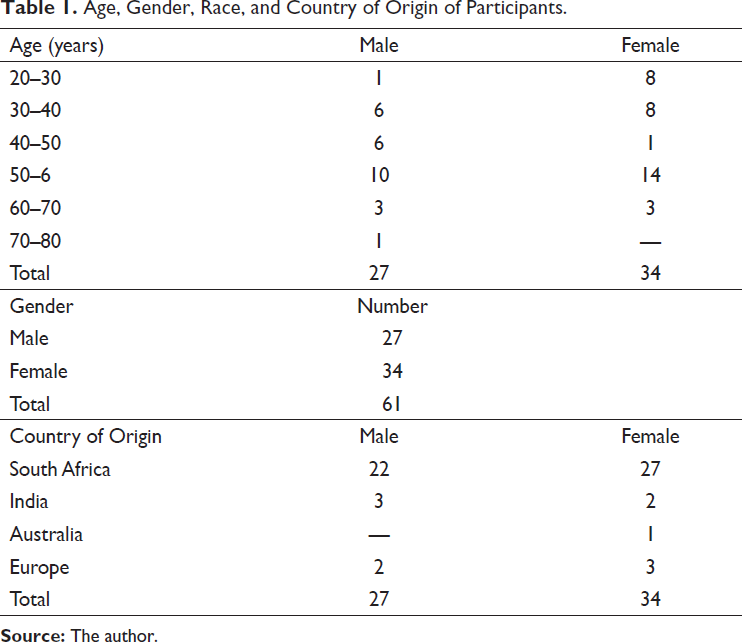
The researcher used the purposive sampling technique in which the researcher relied on her own judgment when choosing members of the population to participate in the study. Furthermore, snowball sampling was used in which the researcher nominated participants of the primary data sources nominated another potential primary data source to be used in this research. This was based on referrals from initial subjects to generate additional subjects. Questionnaires were initially sent to 40 participants known by the researcher via email. These participants were asked to recruit other individuals via email for the study. The researcher received a total of 61 completed questionnaires. Content and thematic analysis was applied to examine the data.
Analysis of Data and Research Findings
Age, Gender, Race, and Country of Origin of Participants.
Analysis of Questions
Fifteen different questions were asked ranging from how they were coping with the COVID-19 virus, how they managed stress, what their fears were (if any), whether they were afraid of contracting COVID-19, their state of mind during this period, whether there were family members who were depressed, and their experience about the pandemic. Of the fifteen questions asked, a few relating specifically to mental health will be discussed in the following text. Also, the differentiation between gender and geographical location will not be made because there were many similarities in the answers of interviewers across the different countries.
The concerns experienced by interviewees were various. Among which were: the uncertainty as to when everything was going to get back to normal; themselves and family contracting the COVID-19 virus (especially those with co-morbidities); job loss; repercussions and strain on the economy; academic studies and losing loved ones. One participant indicated:
My fear about the safety of my children and family; contracting the disease itself; the effect on my financial well-being. It is something totally novel which the world itself has not experienced; I am unaware of the extent of the discomfort I will endure. I do not know how my family will be affected; my income will be further adversely affected (as it already is) and I will be pushed into further economic disaster which I already find myself; I do not know quite what the full impact will be and the uncertainty that accompanies such feelings.
Another participant indicated that:
I feel restricted and unable to do the things that one is used. It is frustrating to be grounded in one environment. My biggest worry is the economy of the country as there is widespread unemployment, poverty and illicit trade as a result of the COVID-19. My retirement investment has taken a major setback and the value of it has reduced significantly. My most fear is that I don’t get infected as I have multiple health issues.
Another interviewee said:
It was not actually contracting the virus but I feared for the safety of my children. We have scheduled my son’s wedding for November and my biggest fear was that it would not take place because of the lockdown worldwide. I was afraid that airlines would not be travelling and that if they did—there would be a period of quarantining. As above, my biggest worry during this period was the wedding of my son. All kinds of thoughts went through my mind. I finally reconciled myself that whatever is to happen will do so. Worrying won’t change anything-we have to just wait. Another of my worry was my aging mum, 82-was worried about her contracting the virus. I was worried that my children who stayed in Amsterdam would not be able to travel to South Africa.
In keeping with what was reported in the media the following respondent said:
That I and my family would get it. My mum lives in an old aged home and was also concerned about her health. You are afraid that you may contract the virus and not sure how it will affect you. What the health implications are … these fears sometime play on your mind. It would be as stated above fear of getting the virus… Social media and TV reports etc have only ONE thing to report i.e. the virus. There are is no other news. Hence this can raise anxiety levels about the virus if you contract it. Also, there are so many different theories of the virus that you do not know what is true and not true… Then there are conspiracy theories, which just adds to anxiety and fear. Furthermore, my biggest fear is that COVID-19 might not end this year, and we will have to live like this the whole of 2020. And that my loved ones might get infected with COVID-19. I am worried about my academic progress. I am not used to working in one space. Changing working spaces helps me avoid being stressed due to work. So, since home has turned to my work office, I find procrastinating very easy, because I am not used to working at home for the longest of time. Home is for relaxation.
The following interviewee was very vocal about the impact that lockdown had on his mental health:
I am an extrovert who loves being around people and outside, therefore being forced to stay at home was quite nerve wrecking. I literally felt as if I was a prisoner. I will say here that I leave alone in a very small apartment. I must admit that whereas we were allowed 2h max outside the house I did not obey that rule. It was just too much pressure on my mental health and I was going out few times a day for a regular walk just to see the outside world and other people. I tried few times to remain indoors but I just missed connection to other human beings too much. That my family member i.e. my mum will get sick and since I am far away and no flights are allowed I will not be able to go and see her. Uncertainty when this is over and I will be able to fly out to see my family. I am not scared of COVID-19 itself and do not fear being sick at all. It is the frustration that I cannot be close with my family in these weird times that is bothering me.
In keeping with the above sentiment, the following interviewee felt similarly:
I felt very suffocated because I felt that a lot of my freedom was taken away and I couldn’t see my friends or family that made me incredibly sad and as much as I kept in communication with my friends and family it wasn’t enough I felt very isolated as well as I couldn’t do some of the activities I use to enjoy. My biggest fear is getting infected or knowing someone in my family becoming infected with the virus. My biggest concern during this time would be whether or not I will be able to go on pilgrimage between now and next year as it is extremely important to me because if there is one thing I have come to realise is that in all of this I need to put my faith and trust in God.
Internationally some of the feelings and fears were similar. Two respondents from India indicated:
Transmission from another person. To keep my sons safe from COVID-19 because they are staying at New York, USA and Toronto Canada which are high risk zones. I stayed for 2 months at Kathmandu, Nepal and in this period, people were seriously ill. For the past month, I have been at a village in Haripurwa, India. Generally, people in the village are not serious about the result of COVID-19. Another respondent in India stated: Due to my health conditions I have to visit the Physiotherapy centre daily and the fear of becoming a carrier of the virus is always on my mind. The biggest worry of mine is that if something happens to me then what will happen to my family members. Because here in India it is very difficult to convince others about the severity of the transmission of the COVID-19 virus.
Majority of the respondents were afraid of losing their jobs, retrenchments, some were worried that their pension package would probably be worth half of its original value and others were concerned that they were losing business and income had been adversely affected. Many were breadwinners within the household. This added stress to their family life especially when there were dependants whom they were responsible for.
Respondents said:
Yes, as there may be restructuring due to the poor economy. Many new digital technologies have been introduced at work and the ability to settle down to use these forms of technology is a major challenge which may affect productivity and meet the organisational goal. Since most things are operating remotely. This period proved that the fourth industrial revolution has taken over and this might result in fewer employees needed in most industries thus, retrenchments will be on the rise. This period also proved to me that no sector is completely safe from retrenchment as we are all experiencing an economic crisis during this pandemic. This is where the fear of losing my job emanated from.
Another said:
Many people are being affected. In my small business we were closed during the lockdown and could not pay full rent and salaries. If there is no employment then there is no money.
A further comment was:
Right now, my job relies on working online and I worry that if the online learning does not pen out as anticipated, what will happen to our jobs? Will are jobs still be safe? Now these are questions that I constantly ask myself. Although I never considered that aspect as a government employee, my biggest concern is the possibility of recurrence of the virus which may bring the economy to its knees thus creating huge job losses across the board. Although we are in Government sector, the government was not able to even give the salaries to their employees. One day salary of all the employees deducted and the increment and other allowances have been deferred for next 2 years which will cost a lot of loss to us.
The answer to this question ranged from the spectrum of being frustrated, having cabin fever, anxious and angry to being calm, content, happy to be home, and relaxed was not surprising, given the extent of the virus. While some respondents were despondent and riddled with fear and anxiety, others were calm and accepting of the situation. One respondent said:
It was greatly affected to such an extent that my anxiety levels were increased. I was also worried about the future and the ability to get back to normality. Another said: My state of mind is no stable because those are a lot of questions coming to mind what next and what life will look like after the pandemic has been eradicated. I have had 2 meltdowns where I became very angry. But for most of the lockdown I have been able to keep my calm. I went through various stages, fear, depression, anxiety, worry and restlessness. Anxious, about the future, fear for my safety and the safety of my loved ones. A sense of hopelessness, as there are so many uncertainties about COVID-19. Frustration about being locked down for such a long period. It’s quite challenging. Unable to go out and do the things you want without any restrictions. It has made me more sensitive towards everything happening around me. I am not as motivated and happy as I usually am due to not seeing my family and not being able to plan for the rest of the year. In between heightened enlightenment and severe depression. Fear always bothering me while I have to be strong for my family. Trying to be strong while you are also not is exhausting and draining. The state of deep anxiety, frenzy and despair with a little glimmer of light at the end of the tunnel for everything in the world is transient.
Some had the following to say:
Things are fine. But only the fear of contracting the virus. However, because of the lockdown at times, you become oblivious of days and time. It is like each day is the same… Sharp spikes of focus in my work, scattered alongside indolence and boredom with my domestic activities. I would say it is uncertain and days are not the same. Some days I feel like I can’t continue doing this, I need to go out with friends and family, and some days I can cope. But small activities such as exercising and listening to music help my mind stay stable. I would say my mental health is normal presently; I am no longer panicking as I used to and I have managed to find my balance in all the chaos. My state of mind is actually good because I have found coping mechanisms such as reading and baking and cooking and cleaning The state of mind is not good even after the lockdown too. As the numbers are increasing and India is now at number 4 among the top COVID-19 affected countries we are very much fearful about the life of ours and our family members and secondly regarding the livelihood options.
In keeping with the answers given to the questions above, the mental state of family was also affected due to the virus and the lockdown. Some found that the lockdown brought their families closer together.
Thus far we have managed to keep mentally balanced, I suppose more so because we are resigned to the necessity of the lockdown and accordingly accepting the measures imposed There were a few, information overload can result in fear mongering and that can play a part in making people feel down. However, over the course of the lockdown and as the new normal has become a reality, I have noticed people are more at peace with the situation. Perhaps the word “down” is not suited to what they felt. I would say they were shocked and have now accepted the situation. When the lockdown started most of us were feeling depressed some even had trouble sleeping at night. We have family members all over the world and their feelings are just depression and frustration as a response to the pandemic. My son’s wedding had to be postponed indefinitely. This has left us very disappointed, and the inability to confirm a future date is very depressing. Conversations with friend and family indicated that the situation was very depressing. They wanted this lockdown to end. The constant visuals of migrant workers—their plight and suffering, India, South Africa, etc was depressing to members of my family. My wife and my two children have been in therapy before lockdown and still is. One family member is feeling down about it. Frustrated from a professional point of view and has a very strong sense of empathy thus copes poorly with overwhelming negativity/suffering in the world. My old parents were extremely stressed and spoke about death and the wills etc. My mum was very depressed for several weeks and it was difficult to talk to her. She was scared she will never be able to see us again and often close to tears. It took a lot of conversations to get her out of this state. As the lockdown now is being relaxed in many jurisdictions she is getting better now. My family members were unhappy and frustrated and experienced a lot of stress and anxiety with regard to the lockdown. Because of lookdown regulations and its levels, the extension of my house was left incomplete and the project is now behind the schedule with more financial implications that were not budgeted for and inconvenience. My brother, he thought he would be fired from his job as he is in event management, so during the early stages he was beyond frustrated. My mum as she had to undergo an operation during level 4 lockdown. This put added stress on the family. At the beginning thinking that we will never be able to see our relatives and friends. But we keep in touch every Friday every family member gets an invitation to Zoom meeting. It becomes an online party. We bonded better as a family and spend quality time together. As a family we tried our utmost best to emotionally support each other during this period. We united in high spirits, praying for panaceas to the global scourge COVID-19.
Answers to this question was various and provided a deep insight into perceptions of the COVID-19 virus and its impact on lives.
This is a totally novel experience not only me but the world at large. I am concerned about the impact and repercussion of the “fallout” that will follow the advent of this scourge. I may be mistaken but a serious concern also is that many people appear not to be taking the matter seriously enough. Corruption will always remain among human and I fear that many resources will be adversely affected by unscrupulous people during this crisis as is the norm. One variant can change the construct of the world. It’s a scary time, uncharted territory. Not much is known about this virus, not sure when an antivirus would be found, for how long are we supposed to go on living in this fashion, will we have to do this for the rest of our lives? It has changed my entire way of thinking about life in general and make appreciate things that I took for granted. The COVID-19 has raised many concerns and consciousness about the state of the world. Although there may be many explanations about it, what comes out clear is that as human beings we need to do things differently if this planet is going to sustain itself. There needs to be lifestyle changes, greater awareness about the environment so that nature can sustain itself for future generations to come. The experience is not good, but also a lot of positive insights can be generated from the experience of the pandemic. Because of the COVID-19 people have improved their virtual communication through technology and it has facilitated the way people look at the world by shaping a different perspective on world expectations. The economy has been affected by many families and countries worldwide. I believe we underestimate the relationships or the amount kids miss their friends during this time and/how many companies are not equipped for digital transformation. This experience has made me realise how little we need, to appreciate things we took for granted, and recognise the true value of human connection. It has also made me thankful for what we have and for the blessings of good health, peace and happiness. I have also learned never to take anything for granted. I have come to realise that while the world is so vast and varied we are all one and the same. I think it is a gift to humanity and our environment—we have all had to slow down, reassess what matters, work together as a team, love ourselves because we are all we have & that if we do not look after our planet, we will have more turmoil going forward. Its mother earth’s way of cleansing the planet—bitter-sweet because some of us will perish but for the first time ever, the hole in the ozone layer has closed. The President started with a bang but soon lost credibility. The leadership of the government is poor creating more opportunities for corruption during this Pandemic. Illiterate South Africans see this pandemic as a hoax. The economy has collapsed and COVID-19 is the miracle the ANC was waiting for a new lifeline. It could not have happened at a better time which will allow them reset their base. I’m also off the opinion they will use this pandemic to ride their political agenda and exploit the situation. Well we all hope and pray that a vaccine is developed soon and that everything turns to normal, worldwide. Had a nasty experience with a burglar, 2 weeks ago, fortunately it was handled without anything serious. Crime has certainly increased. Experience with a burglar, 2 weeks ago, fortunately it was handled without anything serious. Crime has certainly increased. COVID-19 is a great equaliser-no race, status or sector of the world is spared. Unfortunately, as usual the poor, migrants, refugees will suffer the most- many are without water, food and sanitation. One of the most pathetic sights on tv is to see migrant workers with children walking home (without shoes about 250 km) due to buses and trains being stopped during this period. Although many refugees were given shelter, the conditions were so pathetic. The question arises-would the world leaders and mankind ever learn anything from this pandemic. In 1918 when the Spanish flu wreaked havoc on the world approximately 30–50 million people died. It was caused by an H1N1 virus with genes of avian origin. Although there is not universal consensus regarding where the virus originated, it spread worldwide during 1918–1919. In the United States, it was first identified in military personnel in spring 1918. It is estimated that about 500 million people or one-third of the world’s population became infected with this virus. The number of deaths was estimated to be at least 50 million worldwide with about 675,000 occurring in the United States. South Africa was one of the five worst-hit parts of the world. About 300,000 South Africans died within six weeks. That represented 6% of the entire population. Certainly, the world is a very different place in 2020, not least in the speed of international travel compared to that in the steamship-era of 1918. Yet, the ways in which viruses behave and humans respond have not changed so much. That’s why there are still important lessons to be learnt from the catastrophe of 1918. This is particularly true when it comes to quarantining people infected with the virus, and their contacts. Our daily lives have changed dramatically and not sure when if ever things will be normal again … that’s something we all will probably only feel the impact of after a few more weeks when things we used to take for granted are not the same anymore. Hopefully most people in the world especially our loved ones survive this crisis amid the world will be a better place. Anxiety and worry about what’s going to happen-the uncertainty caused a bit of depression. For me and us as a family, it has made us reach back to the comforts of the past and forward to a radically changed future. I am of the opinion that this entire chronicle of our life will inordinately impact every facet of our existence, immediate and future. The manner in which we go about our daily lives, interactions with our immediate family, work colleagues and our clients. I think learning spaces and their operations will be greatly impacted and will have to re-configure and re-design their teaching and learning strategies. I think environmentalists will become more vociferous in their advocacy for a cleaner society urging people to become more conscious of the environment. I think people will perhaps become more circumspect about how they spend, save and perhaps consider living more conservatively. This entire situation has created a new dawn in how governments will start to govern. The pandemic has revealed the very many inadequacies of government and how this has played out in the pandemics impact on the most vulnerable people of our communities. The experience of global lockdown is unprecedented. As unexpected, there were those who were altruistic; those who were opportunistic; those who turned inwards for self-preservation; and those who just did not care, because they did not understand the seriousness of the pandemic. The latter group presented themselves as the most dangerous members of our communities, many who are convinced by false confidences, information, claims, and superstitious. Culture and race took a higher place in the scheme of public health. I suppose the worst impacts will be on the poor, self-employed, day-wage earners, small businesses and private sector workers. Public sector and other workers are uniquely protected from not losing their salaries under the guise of working from home. Nobody understands the psycho-medical effects of sudden confinement. Would prisoners perhaps experience this phenomenon. Even when I go out I come back feeling sick and exhausted-people are struggling to keep it together psychologically. I have mixed emotions and feelings regarding the opening of certain businesses and activities. I am torn between the concept of savings lives and earning a living. They are not mutually exclusive things. This has been a time of unprecedent upheaval and life has changed dramatically for all. Life will not be the same and there is a lock of control over the outside life therefore work needs to focus of one’s inner self. Much easier said than done. I am worrying about everyone that has lost their jobs. There are neighbours whom I’ve noticed to be struggling. This pandemic has hit everyone hard especially those who lived on bare minimum before the pandemic. People who living hand to mouth were seriously affected. People are starving with no food and this may lead to food roots. Poor people had no choice but to go to work even though they were Risking their lives. Life VS death. Small informal traders are one example of a group that left them with no income. 13 million school children did not go to school due to lockdown. We must let all grades pass this year except the grade 12s. The matriculants need to finish school so that they can get entrance to university. People taking public transport are Risking their lives in overcrowded taxis and busses. The government banned cigarettes and alcohol but the people are still buying the imported illegal brands. This virus is still growing. Especially old, Black and poor people with no medical aid. The virus will be here for a long time so we have to learn with it. I learned that I spend excessively much money on unnecessary things and have identified areas where I can cut down on spending; in essence, lockdown has taught me how to maximise my savings. I think we prematurely followed what other countries were doing by implementing the lockdown restrictions, at the time the restrictions were introduced. As a result, there is a lot of confusion about how to protect people’s livelihoods and protecting their health. I personally feel that there is a lot of grey areas in the understanding of the virus even in medical fraternity the world over. Some explanations of area are unproven theories and perceptions. I believe that the pandemic has illustrated how difficult it is in SA to enforce the law. It has demonstrated political differences and polarisation of SA communities along socio economic status as well. Shown how impossible and difficult for the poor who live from hand to mouth on piece jobs to be locked into their houses. How difficult for communities to comply because of non-existence of services like water, sanitation and other remote services. It has exposed our country of its deep shortcomings which require expedient attention like triple challenges (Poverty, inequalities and unemployment). It has given our family to love each other more. We have much respect for each other. It has taught us that “no human being is an Island.” We have learnt that I’m because we are and there is greater power Devine power GOD.
Discussion
An outbreak of a pandemic which in no time engulfs the whole world into its grasp can generate fear and anxiety in many individuals who remain within their houses during the lockdown. As the coronavirus (COVID-19) pandemic sweeps across the world, it is causing widespread concern, fear, and stress, all of which are natural and normal reactions to the changing and uncertain situation that everyone finds themselves in. Anxiety is a mental health disorder characterized by feelings of worry, anxiety, or fear that are strong enough to interfere with a person’s daily activities. The different stages or phases of lockdown has placed many people in a state of uncertainty. The impact of COVID-19 not only impacted healthcare professionals but also the psychological and social impact of the COVID-19 pandemic affected the general population. The pandemic and subsequent lockdown globally and its associated challenges generated deep anxieties, nervousness, and insomnia. As indicated from the responses, there is an increase in the number of symptoms connected to general bouts of stress and a feeling of vulnerability. People are unsure as to how many days this lockdown would continue for, or if this step will be able to control the virus. From the sentiments expressed by respondents, there is a clear indication that the COVID-19 pandemic has made people realise that life is fragile and that all human beings are interdependent. Mental health is fundamental to our collective and individual ability as humans to think, interact with each other, earn a living, and enjoy life. Mental health is about how one feels about oneself, how one relate to others, and how to deal with opportunities, difficulties, and challenges of everyday life. Fear and anxiety are common psychological response during disastrous situations like COVID-19 (Dong & Bouey, 2020).
The fear of COVID-19 is also related to its novelty and the uncertainties about how the outbreak might worsen. Epidemiologists, virologists, and public health experts have warned governments all over for an advanced preparedness. It needs to be at every level of health-service, policy making, and their implementation. Mental health and psycho-social health are integral part of this preparedness, as pandemics affect the society at a large, more than just individuals. Emotional health at all tiers needs to be integrated into the public health infrastructure. Fear of the unknown, in this case, the spread of the disease and the impact on people, health, hospitals, and economies, for example, raises anxiety in healthy individuals as well as those with pre-existing mental health conditions (Rubin & Wessely, 2020). Individuals, families, and communities experience feelings of hopelessness, despair, grief, bereavement, and a profound loss of purpose because of pandemics (Levin, 2019). Feelings of loss of control drive fear and uncertainty as the trajectory of the pandemics is constantly evolving, so is the advice on the action to take to stop the spread of a pandemic. Similarly, Han et al. (2018) indicated that perceived mixed messaging from government or health officials can also lead to public confusion, uncertainty, and fear.
One way of trying to mitigate these challenges faced by people is to set up regular phone calls or video conferences with family, friends, and colleagues can bridge the gaps brought on by social distancing. As social beings, people need each other. As society is being asked to act in an increasingly unsocial way in order to overcome the challenges of this pandemic, one should remember that society as a whole is in this together and should act accordingly.
Conclusion
The disastrous consequences of the coronavirus pandemic remain persistent. As the coronavirus pandemic rapidly sweeps across the world, it is inducing a considerable degree of fear, worry, and concern in every sector of the population, especially people with underlying health conditions. The pandemic lockdown has created drastic changes in external circumstances which have a significant impact on us internally. Many economies struggle, millions have lost their lives, and furthermore, the very livelihoods of millions are threatened. The indefinable levels of stress and uncertainty undermining safety has now resulted in an alarming rise in mental illness. On this basis, the promotion, fortification, and restoration of mental health can be viewed as a vital concern of individuals, communities, and societies throughout the world. As novel ways of doing things like working from home, zoom conferencing, home schooling becomes the norm, in public mental health terms, the main psychological impact to date is elevated rates of stress or anxiety. But as new measures and impacts are introduced—especially quarantine and its effects on many people’s usual activities, routines or livelihoods—levels of loneliness, depression, harmful alcohol and drug use, and self-harm or suicidal behaviour are also expected to rise. While research for biological prevention and cure continues, the focus on psychological and social impacts, and their interventions should not be neglected. Things that were supposedly important before lockdown are seemingly irrelevant now. Everyone reacts differently to stressful situations. The emotional impact of an emergency on a person can depend on the person’s characteristics and experiences, the social and economic circumstances of an individual and their community and the availability of local resources.
Footnotes
Declaration of Conflicting Interests
The author declared no potential conflicts of interest with respect to the research, authorship, and/or publication of this article.
Funding
The author received no financial support for the research, authorship, and/or publication of this article.
