




Abstract
Enforcing online classes during the lockdown due to the outbreak of the COVID-19 pandemic worsened the living and learning conditions of students from the most marginalised sections in India. Against this backdrop, this study seeks to shed light on the risk of the rapid adaptation of online teaching methods under extremely unfavourable educational conditions and poor educational infrastructure in India. The evolved system was entrenched in the existing social and educational inequalities that were exacerbated by ever-growing private educational providers. This almost limited the vulnerable group in finding choices of learning through the online mode necessitated by the lockdown. Traditional teaching and learning practices were implicated not only due to the existing social arrangements but also due to the shift to the online mode of learning with the adaptation of digital technology during the pandemic crisis, which has deeply disrupted the current educational scenario as well. Critical lessons learned from the recent catastrophic events will provide a political vision to outline an inclusive approach to designing sustainable educational planning and programmes targeting the most vulnerable sections of the population. This also reminds us that hasty and cosmetic solutions would do more harm to the poor than to the rich, thereby leading to everlasting damage to educational and social systems.
Introduction
The governing crisis triggered by a series of disruptive policies 1 laid down by the ruling regime during the pandemic intensified the texture and structures of inequality in India and further complicated the marginalised and poor sections (The India Forum, 2021). As the second wave of the pandemic was widespread and resulted in the loss of a huge number of human lives, primarily due to the lack of proper healthcare provisions, public outrage against it was quite loud and clear. Many considered the failure of the regime during the COVID-19 pandemic more as a crime against humanity (Roy, 2021) than as a sheer governance failure. This article delineates the structural problems embedded in social inequality that were exacerbated by the public policies implemented during the pandemic and explores how these policies reinforced unequal educational opportunities. The education system suffered throughout India during the pandemic. There were numerous sad stories in this phase of the abrupt imposition of arbitrary rules to continue education through the online mode amid lockdown, which worsened the living and learning conditions across various population groups (Babu, 2020, 2022). These unfavourable conditions with pre-existing differences magnified the problems that arose due to the type, means and mode of education being enforced upon students. Apart from dealing with educational inequality (Nambissan & Rao, 2013; Shah et al., 2020), this article explores how the rapid adaptation of the online teaching mode posed new challenges to the fundamental issues of access to education for the poor.
The existing social stratification and educational inequality are attributable to the ever-growing private school education, which has intensified unequal opportunities (Choudhury, 2020; Chudkar & Creed, 2016; Jain et al., 2018; Nambissan, 2012; Sahoo, 2017). With the expansion of the education market, the overrepresentation of poor students in government schools has changed the institutional culture (Hill et al., 2011). Teachers’ attitudes towards the new generation of learners have invariably resulted in poor-quality teaching and thus poor outcomes (Sardana, 2022). Moreover, primary issues such as ensuring access to minimum facilities and affordability and feasibility of education to the most marginalised sections have been neglected by the authorities (Bera, 2020). These factors became stumbling blocks to the online learning methods necessitated by the lockdown. Even regional disparities were not taken into consideration when online teaching became mandatory across India. Similarly, administrative protocols that were rolled out during the pandemic were technical solutions that proved to be less useful in creating a learning environment on the ground. This study attempts to propose the possibilities for rebuilding the trust by protecting the public interest in school education plans and practices with full state funding, in accordance with that promised in the Constitution of our democratic system. Instead of admitting the market volatility of the education system, post-pandemic predicaments should be a critical lesson to strengthen our collective political will. Providing hasty solutions without acknowledging the structural impediments of problems will not only worsen the living conditions of the poor but also intensify educational and social inequalities.
Education in the Pandemic Context
Schools were on the cusp of the pandemic and the subsequent lockdown and they struggled to quickly overcome the crisis. The impact of the massive closedown of schools, effectiveness of remote learning, provision of equal opportunities in online classes, strategies to mitigate the loss of learning and reopening of schools became topics of debate in the public sphere. This invited wider public attention for consideration that education is the only possibility to establish an egalitarian society in future. The unprecedented disruption in education indeed affected the lives of students and their learning. To contain the spread of the pandemic, most of the countries closed down their educational institutions. Depending upon the intensity of the virus infection, this localised closure of schools affected either directly or indirectly about 60% of the world’s student population. The consequences of this closure invited social and economic hardship, which was extremely harsh on the lives of the most vulnerable sections of the population. It is in this context that the UNESCO declared the COVID-19 outbreak as a major educational crisis. With the closure of educational institutions, teaching and learning were disrupted since the middle of February 2020, which further widened the socio-economic disparities affecting educational institutions. It also intensified learning inequality among students invariably. In developing countries, apart from educational resources available at school, poor students were deprived of basic facilities at home that could supplement their learning during the lockdown. Though teachers played a critical role during the crisis, many were sceptical about their respective work obligations. Learning from the impact of past disasters on human conditions and their strain on the socio-economic system, one cannot presume that technological adaptations will bring fixed solutions to every problem (Burgess & Connell, 2020). Replacing regular classes with online classes through remote learning disrupted intimacy and human relations. Irregularity in meetings and the lack of face-to-face interaction led to frustration among teachers and students. Parents too were concerned with the online mode of learning regarding whether their children were getting the best technical aids. As long as schools remained closed, students were left in isolation because they lost the minimum level of social interaction received from their peer groups in schools. However, the tremendous pressure from the authorities to conduct online classes and examinations made educational institutions fall into disarray once they remained closed for months (UNESCO, 2020a).
The UNESCO initiated an educational coalition at the global scale to find alternative strategies for creating inclusive learning opportunities during the pandemic. It developed a series of educational applications, platforms and resources in the digital mode with multisector partnership and collaboration to provide appropriate aids for distance learning, which aimed to help teachers, students, parents and administrators facilitate learning, social care and interaction during the closure of schools. Apart from providing resources for psychosocial support, the digital methods of distance learning such as massive open online courses, self-directed learning content, live-video communication, tools for digital learning content, external repositories of distance learning and digital learning management systems were developed to provide appropriate solutions (UNESCO, 2020b). However, the less educated population found the emerging relationship between educational inequality and access to digital platforms for education and other services complicated, thereby restricting the choices for their future work prosperities (Artero et al., 2020). The social conditioning of developing societies and unequal provision of educational services across diverse populations under the extreme crisis were hardly taken into consideration in the new learning regime and the kind of coalition being debated at the global scale.
When the population was confronted with multiple crises in addition to the outbreak of the COVID-19 pandemic, the government announced numerous promises to resume socio-economic activities after a series of lockdowns. This out-of-the-box thinking, though appreciated, invited serious intellectual attention for long-term development. In India, the unintended effects of the pandemic upon different groups and communities vary depending on the social and economic security measures available, as the country is characterised by deep-seated structural inequality. Apart from the alarming rates of deaths due to the pandemic, the risk brought about by migrant labourers, as circulated in the media, shook the livelihood of India’s poor. It is the vulnerable groups in India who suffered the highest level of misery due to the unprecedented lockdown that was implemented as a strategy for containing the spread of the virus (Ray et al., 2021). The government faced severe criticism after it failed to deal with the complications of the lockdown, which was widely reported in the mass media. In the education sphere, during the first phase of the lockdown, 320 million learners and 1.5 million schools were affected by the transition to the online mode (Modi & Postaria, 2020).
In a frightening incident, on the opening day of online classes in a new academic session in Kerala, a 14-year-old Dalit girl set herself ablaze for missing the online class as she could not access digital devices at her home in Wayanad, one of the backward districts in the state (Press Trust of India, 2020). Kerala, one of the most progressive states in India, showed its resilience in this crisis (Banaji, 2021) and started conducting online classes throughout the state on the first of June 2020 even though 2.7 lakh students did not have access to electronic devices in their homes to attend them. In another gruesome incident, a 17-year-old Dalit girl in the Mansa district of Punjab allegedly committed suicide owing to the unavailability of a smartphone at home to attend online classes (Ghazali, 2020). It was estimated that more than 12,500 students committed suicide during the pandemic, counting at least one case per day in every state of India (Adhikari, 2021). Students committing suicide raised the fundamental question of whether students from poor backgrounds had access to an adequate learning environment in their homes with sufficient digital technological apparatuses for attending online classes. Such tragic events are not new as they have been noticed and studied in the past. The number of suicide cases reported in premier educational institutions shows the exclusionary practices embodied in our educational system (Sarveswar & Thomas, 2022). Due to media focus, some of these cases received public attention as they were believed to be institutional murders rather than suicide acts. Such cases provoked activists for political campaigns, challenged academic integrity and were interpreted as institutional murders (Sukumar, 2023). Students from extremely poor backgrounds are often suffocated by institutional discrimination, leaving them with little hope of completing their studies. This discrimination works against meaningful education experiences for the poor in the so-called modern and enlightened spaces of educational institutions that follow subtle forms of exclusionary practices. These compounding factors are entrenched in unequal opportunities and discrimination culture on the one hand and the lack of cultural and material resources on the other to withstand new challenges such as the pandemic.
Before the pandemic, educational inequality in developing societies is faced with a new array of problems. It was estimated that even before the outbreak of the pandemic, 258 million students were dropped out of school. However, with unprecedented school closures due to the pandemic, 10 million students suffered. As India witnessed the longest period of school closures, which continued for 69 weeks, students were virtually unable to access their school and interact with their teachers and peer groups. The government’s imposition of adopting online classes to deal with the pandemic met with backlash due to poor infrastructure, technological glitches and digital illiteracy. As a result, teaching and learning became packaged delivery services provided by ed-tech companies for harnessing the digital education market (Wood, 2020). As the access to and the usage and effectiveness of online services varied across social categories and regions, studies showed that students belonging to affluent families in cities adapted faster to the new system than their poor counterparts (Anand & Lall, 2022; Sharma & Syiem, 2023). The complete disruption to the conventional mode of face-to-face learning subsequently led to the loss of learning in the online education mode, which affected 70% of students (Annual Status of Educational Report [ASER], 2022). Teaching the same content multiple times (46%), low attendance (30%), unable to catch up with the curriculum (64%), technical glitches (22%), mismanagement of COVID-19 guidelines (22%) and the lack of parental support (24%) (ASER, 2021) accelerated the loss of learning. Adapting to remote learning in a hierarchal society with the precarity of unequal opportunities and discrimination in education, young learners in the vulnerable sections of rural and urban areas suffered the most under the new mode of learning.
Lack of access to education, alarming rates of dropout, the growing trend of loss of learning and widening learning gap made learning unaffordable for the new generation of learners from the marginalised groups. Given the severity of this social phenomenon, political initiatives were needed to ensure continuity, inclusion and equity in education (Government of India [GoI], 2020). However, arbitrary decisions on the online learning mode were focused on mitigating the immediate interruption caused by the lockdown. This left little room for thinking about a more inclusive, affordable and flexible system. Instead, young learners were made to fit into the new-normal techno-centric regime. The revolutionary change brought about by the introduction of e-learning platforms did not affect how we as human beings can creatively engage with our painful experiences and sustain the spaces for dialogue and interactions as a pedagogy of care. In these uncertain times, the government indeed continued to incorporate information and communication technology (ICT) in every sector of development. However, it could not succeed in overcoming harsh realities, unlike its counterparts in developing nations, owing to institutional malfunctions, sharpening inequalities and governance failure (Ghosh, 2022).
Unequal Provisions and the Risk of Adopting Online Education
A critical examination of the educational policy framework and its practices and results shows the failure of the education system. This framework widened educational inequalities across genders, castes, tribes and religious groups to access education amenities (Nambissan & Rao, 2013). This calls for educational inclusiveness as a new paradigm of development that outlines inclusive policies for a sustainable future. Unsurprisingly, among policymakers and analysts, the discourses on access to equity and quality in education became a new political language to make education inclusive. However, the ground reality was quite different because no attention was given to analysing structural inequalities, particularly educational inequality. Imposing rules to transform the conventional mode of teaching to online teaching severely changed the minimum requirements for learning. Consequently, this sudden shift in the learning environment produced disastrous outcomes.
The pandemic led to an extraordinary circumstance that threatened the very existence of human lives. Public discourses surrounded by the unprecedented disaster alerted humanity to high risk. At this stage of crisis, the authorities could not shy away from the existing structural impediments embedded in the system for the convenience of governance. Certainly, the crisis would not have stopped us from undermining our capacity to find alternative possibilities for seeking better feedback from these impediments. To overcome the crisis, institutional systems of democracy should have been proactive to evaluate the existing pattern and critical functions and seek desirable results as vital elements of education. Finding new areas of educational inequality and eliminating them from society contextualises the relevance and purpose of education. This will enable us to achieve the social context of the learning and learning process and to develop education programmes that are practically feasible (Velaskar, 2016). So far, the introduction of various modes of teaching during the pandemic has not gone well with the existing social conditions. This suggests that the successful execution of any new reforms in the educational system depends on the prevailing social conditions.
The ever-expanding nature of educational avenues, new education opportunities and resultant enrolment rate in both schools and higher education institutions is well known. According to the educational statistics of 2018, there are 15,22,346 schools in India (from primary to senior secondary) and the growth enrolment ratio is reasonably good with 25 crores of students attending the school regardless of their social backgrounds. Contradictory to the low dropout rate in primary education (4%), a high dropout rate was observed in upper primary education (17%). Moreover, against the overall rate of 24% of GRE in higher education, poor sections such as scheduled castes (19.9%) and scheduled tribes (14.2%) recorded a low GRE. Paradoxically, the real expansion of educational institutions can be well observed in the private sector. The reason for the exponential growth of the private sector in education since 1990 was the government policy towards the privatisation of education. Of a total of 1.7 million schools, 38% are in the private sector, which registered a 20% increase in the last decade. Every year, the enrolment pattern in the private sector varies by age and gender; the proportion of boys enrolled is higher than girls, and the data indicate that the difference in the gender gap continues to exist (Banerji & Wadhwa, 2013).
Of late, the private sector in India has become the largest market for school education in the world (Jain et al., 2018), which has resulted in declining student enrolment in public-funded schools. In 2016, for instance, 4,464 (0.6%) primary and 2,702 (0.7%) upper primary schools recorded zero enrolments. In addition, 55,996 (7.1%) primary and 22,312 (6.1%) upper primary schools recorded an enrolment of less than 15 students. Similarly, 187,006 (26.5%) primary and 62,988 (17.3%) upper primary schools were with less than 30 students. The unavailability of teachers and the low quality of education in these schools resulted in a low enrolment rate (Table 2). Furthermore, 81,459 (11.5%) primary and 14,786 (4%) upper primary schools had only one teacher. The shortfall of teachers was observed in elementary schools as well, where only 9.08 lakh teachers were available against the requirement of 51.8 lakh in 2016. The establishment of the Ekalavya Model Residential School affected the learning opportunities of tribal students because of the shortage of regular teachers and the undue delay in releasing the sanctioned funds on time. The National Education Society for Tribal Students appointed 4,000 teachers against 36,000 sanctioned vacancies and inaugurated 378 schools against the 740 proposed (Garai, 2020). Adopting the school merger policy to rationalise the allocation of resources, especially teachers, the government permanently closed 72,157 schools between 2017 and 2022.
At different stages of the reopening of schools after the pandemic, unlike earlier scenarios, the preference for private schools declined, whereas that for government schools increased (Table 1). In rural areas, for instance, a large number of students left private schools and joined government schools. As a result, the enrolment rate in government schools increased from 64.3% in 2018 to 70.3% in 2021. On the contrary, in private schools, the enrolment rate reduced from 33.5% in 2018 to 24.4% in 2021. Moreover, non-enrolment of students increased from 2.5% to 4.6% at the primary level, whereas in high schools, this rate decreased from 12% to 7%. The expenditure for the mid-day meal scheme in schools was the lowest in 2020 (GoI, 2020). The reduction in public funding for education further burdened poor sections because of the loss of employment and economic slowdown during the pandemic.
Students Enrolled in Schools by Age Group in Rural Areas (%).
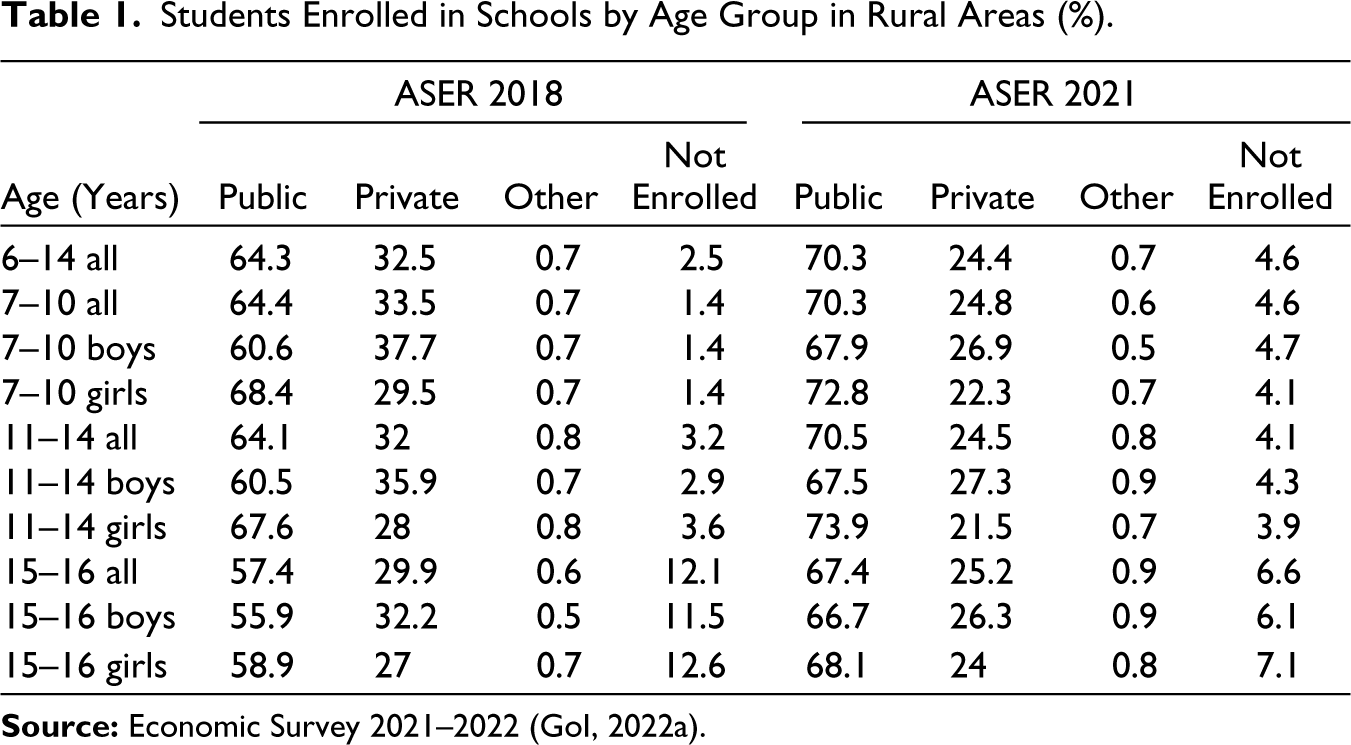
Interestingly, new private schools secured a high enrolment rate, which was attributable to the low pace of enrolment rates in government schools. Behind this structural shift, a myth started circulating among the public, especially among poor sections: that only private schools can guarantee quality education. Teaching the English language and making their students learn English became an important tool in determining the quality of education in private schools. The ideology of the quality of education being determined by the English language in the private sector weakened the case of government schools being inferior with poor quality. This changed the public perception of the quality of education, which led to an increase in the demand for private schools regardless of urban and rural divides. To ameliorate the possible distress among poor households to access education in the private sector, the state implemented a special policy. Under the purview of the RTE Act 2009, 25% of seats need to be reserved in private schools for backward sections. However, the flexibility and ambiguities of rules and regulations under this policy could only help private management as rich parents were willing to pay heftily for the personal benefits of their wards. The lack of enforcement of rules and the absence of critical voices made this policy less effective for students from poor sections. Even if private schools accommodated students from low-income groups, their parents may not understand the improvements in the learning level of their children, unlike their high-income counterparts.
The voices of the poor parents were hardly heard by school managements as they were provided free admission for their children under the quota system earmarked for low-income families. Moreover, the lack of parental education and poor infrastructure of the family hardly created a learning environment in the home for their children. Other than seasonal announcements of regulation and incentives, state agencies seemed to be less interested in creating favourable conditions of equality in private schools. Data reveal unequal distribution across regions, variations in the social composition due to gender and caste, and a higher rate of enrolment by male students from affluent families. Similarly, students from minority communities formed the lowest proportion in private schools. These findings show that the root cause of educational inequality is complex not merely due to the structural inequality and insensitivity towards diversity but also conditioned by policy discourses in favour of the market economy, weak regulatory mechanisms and narrow ideological positioning that has gripped today’s educational system. The compounding structural effect invariably affected poor students who struggled with their survival issues, let alone spending on technology to attend online classes (Grover, 2021). Although adaptation is human nature, the coercive adaptation of online learning after the lockdown adversely affected poor students since their basic living conditions were shaken during the pandemic crisis.
Challenges of Technological Adaptation in Education
Adaptation and integration of the ICT in the field of education were revolutionary, as evidenced by the transition from traditional printing through storage of data to the complex world of electronic communication. Although reforms in education signify the importance of information science, they are not focused on the critical areas of the changing mode of information, changing boundaries of who speaks to whom and changing social relations and personal identities (Marshall, 1999). This discourse should also explore the discursive power relations and ideologies of the ruling regime, policymakers and policy thinktanks, whose interest in the ICT revolution in the field of education can be a new blueprint for reforms. These are the new forces that seize the autonomous spaces required for the education system to sustain and enforce new structures in the form of reforms, as they appear to be necessary conditions for radical transformation. These forces consider that ICT in education appears to be a viable tool for maintaining transparency, efficiency and inclusiveness. In addition, the academic logic of technology makes the field of education forecast the skill requirements in the labour market and design academic programmes according to the market logic. One needs to look into the macrodynamic of technology in education, which forces the private sector to evolve faster than publicly funded schools in attracting parents regardless of their background to capitalise on the education market. Apart from the conventional mode of teaching, the adaptation of ICT-based education and teaching the English language have become the determinants of quality education. In addition to determining quality teaching, these two parameters constitute what we consider the meritorious good in education. The ideological push for ICT in education drives the state to minimise public financing in education and invite private sector investment to expand new avenues in the education market.
Technologies are integral to the development and progress in the education market. Adaptation of technology in education has contributed in terms of geographical outreach to expand our mental and social horizons and advancement in knowledge generation, storage and dissemination. This is especially true considering that innovations in communication technologies such as print technology, radio broadcasting, television, computers and online networks become operational tools to effectively access online educational resources for teaching and learning. This advancement is also beneficial to those living in remote areas in accessing educational resources. This shows that a higher level of cooperation is needed as we begin to depend on and value information science as vital for appropriate choice-making, innovative decision-making and knowledge production on a wider scale (Buckland, 2023). However, a myriad of sources and information asymmetry are quite intense, which restricts the choice and support of any crucial decisions during crisis situations. While transforming the education system under new circumstances, educational processes get entangled with the flood of information about curricula framework and pedagogical practices, which affects individual learners and teachers.
India framed the national policy on ICT in 2012, which underlined its significance in the field of education, especially regarding the challenging issues of accessibility, quality and efficiency. Integrating ICT with school education has been part of educational policy reforms to realise the idea of taking advantage of information science to learn, adapt and disseminate new skills in electronic and advanced digital media technologies. This policy aims to establish and sustain the ICT infrastructure in schools and educational institutions by encompassing institutional processes and restructuring training methods and pedagogical resources. While visualising advanced technological integration in the field of education, the Central Institute of Educational Technology developed apps such as DIKSHA and ePathshala. The integrated e-learning platform ‘Study Webs of Active Learning for Young Aspiring Minds’ (SWAYAM) designed many online courses for students, teachers and teacher educators, in addition to telecasting e-content through 32 national television channels called SWAYAM Prabha DTH TV. The aim of this platform was to cultivate new capabilities among students and teachers in ICT skills through computer-aided learning. However, these initiatives were designed only to supplement regular teaching and learning processes within the given institutional logistics. Therefore, it is clear from the inception of policy deliberations that such initiatives are not meant to replace the physical mode with the online mode of teaching and learning. Moreover, an open-school system was also designed with a specific set of objectives for targeted groups. These new evolving systems could not develop up to the threshold level to face the new challenges in the education sector during the pandemic crisis and the resulting massive lockdown. It is true that with all its pitfalls the government could not prepare well for institutional arrangements with respect to the ICT architecture, the required skilled manpower and their distribution and availability across regions.
When it comes to the distribution of media and its access across India, new forms of inequality arise. Studies show that all young learners, especially those from marginalised communities in remote areas, were affected by the unavailability of electronic media and inaccessibility to Internet facilities for attending online classes. Television continues to remain a prominent medium of access as it has penetrated about 210 million households in 2020 (70%). In contrast, the number of Internet users is 480 million (31%), and one can imagine how many could afford and access smartphones for attending online classes. A study reported that only 15% of rural households had access to the Internet as compared to 42% in urban households (Bhusari, 2022). Because of the school closure, it was estimated that the regular learning of almost 80% of rural students was adversely affected as most of them were deprived of accessing electronic devices and network facilities. This shows India’s digital divide and its exclusionary practices in the field of education. Therefore, the rhetoric of online classes as an alternative to the conventional means of education resulted in the loss of learning, especially among the poor sections of our society.
The uneven distribution of the basic infrastructure questions the claims of the government and the online learning catastrophe during the pandemic (Table 2). Even basic facilities such as electricity supply were unevenly distributed in schools across the states, which was especially poor in the North-eastern and Himalayan states. It is no secret that digital devices cannot function without electricity. This makes us wonder how the entire education system switched to the online mode with modest Internet access (33.9%) and fewer computer gadgets (10%). Schools in Uttar Pradesh had the lowest rate of computer facilities (2.9%) and secured the highest number of enrolments during the pandemic (13.2%).
Basic Infrastructure Facilities in Schools for Digital Learning, 2021–2022.
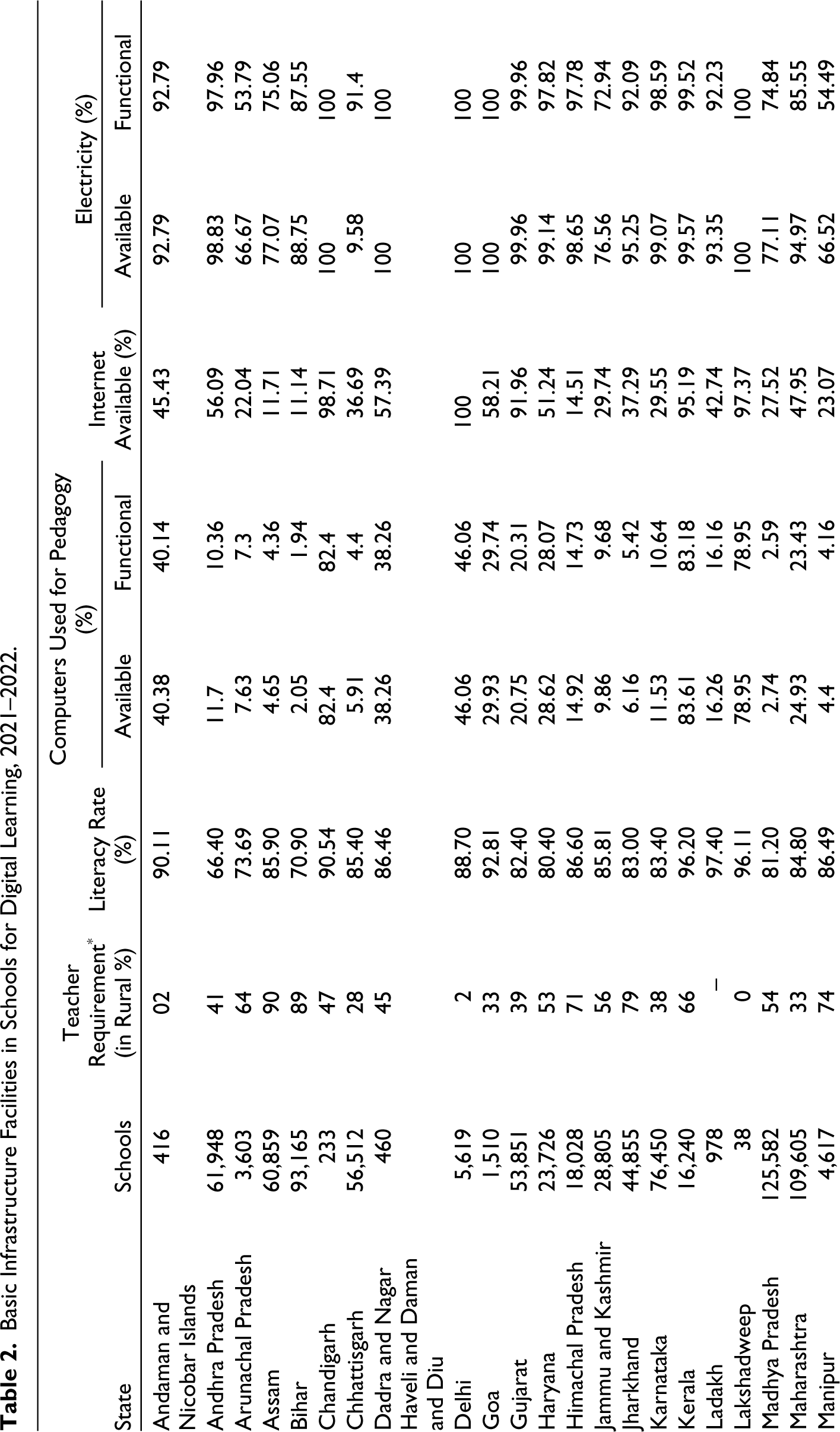
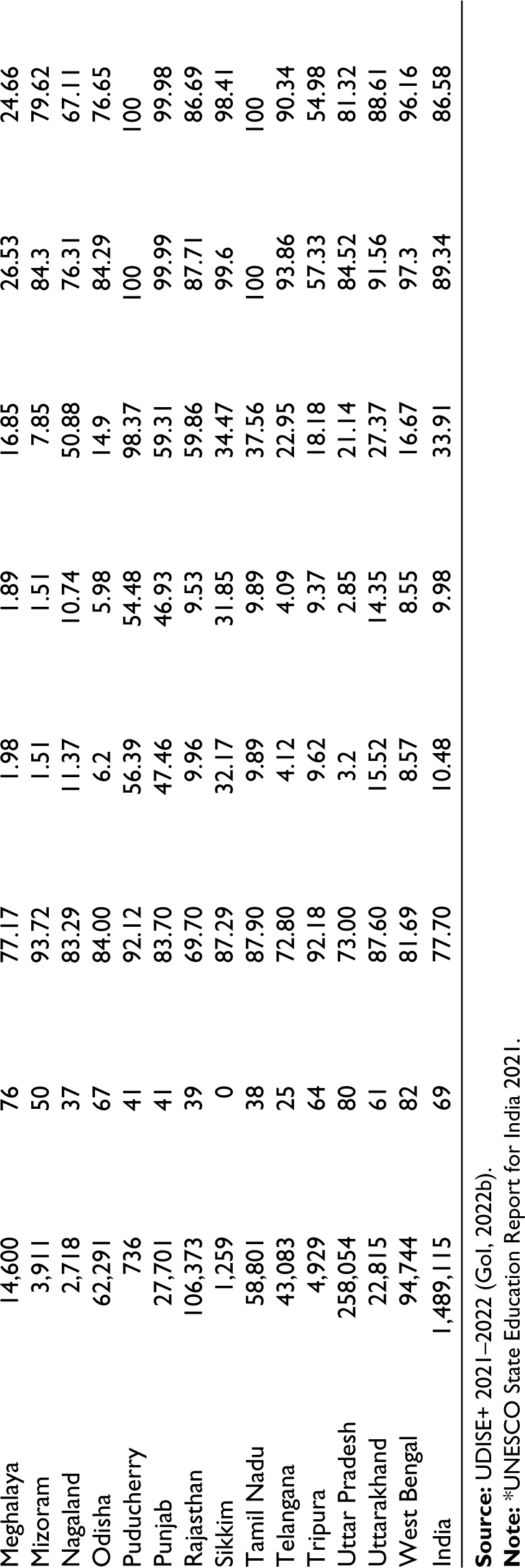
The effective use of electronic and digital devices not only is due to their wider acceptance but also depends on the availability and accessibility of associated infrastructure such as electricity, network connectivity and operating mechanisms in the region. Although access to the Internet is fast growing, it remains poor in rural areas, especially for women and marginalised groups (Keelery, 2020). Since several tribal hamlets did not have access to digital devices, power supply, communication networks and electronic and digital devices, students from these areas could not use any e-learning platforms in their homesteads (Sivakumar, 2020). It was reported that 46% of households in India had only one dwelling room and 31% had two dwelling rooms (GoI, 2011). Such circumstances hindered the creation of a learning environment for poor students in their homes. Students were also deprived of attention from their parents, who lost their jobs and income during the lockdown. As a consequence, there was a stark social and digital divide between various socio-economic groups across the country.
From School Learning to Home Learning
The government pushed hard its agenda to normalise online classes as a mechanism of studying at home. The schooling system cannot be replaced by the online mode although the government deliberately remained unattended about this shift during the pandemic, which particularly affected the reflexive mind of young learners. Family and kinship networks have always been the primary sites of socialisation for the young generation. The closure of schools and the sudden termination of the learning environment, which was replaced by home learning, were not as easy as seen in the context of the pandemic crisis. In the first three months after the commencement of online classes during the lockdown, 66 school students committed suicide in Kerala, indicating that mental health issues and anxiety began to affect students and parents (Harjule et al., 2021). Various reasons for mental health issues were reported: from mothers scolding students for attending online classes, to not allowing them to play games, to scolding them for watching obscene clips on mobile phones. Invariably, some students took the extreme step of suicide because of problems within the family and substance/parental abuse (The New Indian Express, 2020). Remote learning came with many complications for poor families, who struggled to balance their work outside the home with managing children inside the home.
The uneven distribution of teaching materials and online access, and the lack of technical support and socialisation resulted in a less-than-ideal learning experience for students. In remote areas, teachers did their best to educate students, who preferred screens for games, not for studies. Such observations made clear that teachers were far away from the context of teaching. Though teachers need to acquire specialised skills for online teaching, remote learning is inconvenient for students and parents. Indian teachers were caught in a trap set by the decisive and conflicting sectors of failed leadership that did not consider the challenges faced by students and parents. There is a trust deficit between the government and the teaching community at large. The government often dictates what to, how to and what not to teach and how to evaluate. Constrained by these rules, teachers hardly hold the power to command their spaces of preparation for the class, devoting their time and energy to the new generation of learners. As reported in a study, the role of a teacher is fundamentally to teach, not to die performing election duties during the pandemic (Sharma, 2021). The system should have supported teachers and protected them in the extreme phase of the crisis. Without the active involvement of teachers, we cannot instil creative imagination, ideals and skills in the minds of young learners to take up new challenges.
Being a student, every young learner is reminded of active learning in the formal educational ecosystem such as school. In the absence of school, the termination of regular classroom teaching forced students to stay at home and switch to online classes. Studentship of school-going students resulted in a setback on account of treating them as children, considering them immature, playful, being attached to the adult members of the family and seldom driven by sentiments. Spatial dispossession on a regular interval between school and home environments is useful for the self-formation and cognitive development of students. Breaking the temporary detachments from home makes learning processes more static than making them dynamic. It is also true that for millions of poor students in India, especially in the slums of Indian cities, there is no viable place for serious learning engagements.
It is evident by now that the lockdown imposed on 24 March 2020 not only failed to achieve its goal but also invited more misery to millions of ordinary people. Curiously, liquor shops in India were kept open during the lockdown and witnessed large crowds, but there was no public outcry for reopening educational institutions, whose regular functioning was affected due to the strict instruction to follow physical distance. Prestigious educational institutions and campuses should have shown their resilience to the crisis by setting an example to withstand as a community. Due to the poor institutional support and trust deficit, parents and schools were left unprepared, which resulted in the loss of formal learning.
Conclusion
By understanding the challenges of education in India caused by the pandemic, critical lessons can be learned from the institutional and organisational crisis that ensued. No doubt, our future predictability as a theory of change should drive our sincere efforts to gather credible facts and the right information and knowledge about the effect of the pandemic on the educational system. Being resilient by its nature and design, the educational system has tremendous potential to change the course of a given phenomenon. However, in light of the existing studies and reports, it faced backlash due to the governance crisis, economic slowdown and an unprecedented job loss of employment during the pandemic. In the wake of alarming rates of public health risk, it was assumed that even though schools were closed during the lockdown to prevent the spread of virus infection, learning would continue. The coercive adaptation of online classes by the government forced school administrations to implement online teaching as the best solution to overcome the crisis, without providing adequate financial, material and technical aid needed for the new arrangements. The actual cost of online classes burdened poor households as they were unable to bear the expenses that the new setup demanded.
As we continue to face unprecedented threats such as climate change, diseases and extreme forms of violence, terrorism and war, it is important to redefine the future of education towards building peace, resilience and sustainability. Adapting to changes is the innate capacity of human beings, which determines the extent of their resilience during crisis times. Adaptation is inevitable, yet the question of integrating it with the actual needs for learning across various populations and support for educational institutions remains critical. This integration and the invention of digital technology will not create a sustained learning ecosystem unless they are sensitive to the existing cultural and institutional constraints and human and social vulnerabilities. The current approaches and practices lack the capacity to integrate ICT into the field of education to realise an inclusive ecosystem for experiencing actual learning. As the purpose of education is significant in shaping the future of our society, we should strive to cultivate democratic values in the everyday practices of teaching and learning. This calls for an inclusive, quality and affordable educational system for all with equal participation of its stakeholders.
Footnotes
Declaration of Conflicting Interests
The author declared no potential conflicts of interest with respect to the research, authorship and/or publication of this article.
Funding
The author received no financial support for the research, authorship and/or publication of this article.