




Abstract
This research aims to understand the different success factors of a savings and credit cooperative (SACCO) through the study of the managerial dimensions and its style of governance. Semi-directed interviews were conducted with three directors who are founding members of the Haitian ‘MEN ALE MEN VINI (MAMEV)’ cooperative. NVIVO version 11 software was used as a tool for coding and data analysis. The interviews concluded that the success of the cooperative is linked to the personal attributes of the various directors, effective management, good governance and an efficient decision-making system. This research also showed that the success of cooperatives is partly related to the notoriety, leadership, willingness and level of commitment of its directors. It is also related to the good governance manifested in the participatory management and decision-making, the transparency of the organization and the quality of the work of the cooperatives. Also, the research has shown that anchoring the cooperative in the community, bringing the population closer to the cooperative and offering services adapted to the community’s needs have a positive influence on the membership and make the cooperative more sustainable. Finally, the research showed that the adoption of an effective governance mode helped to ensure the sustainability, viability, modernity, efficiency and social, financial and economic soundness of the cooperative. The experience of this SACCO not only helped the members to counteract the myth of incapacity that prevailed in Haitian community at the time but also improved the living conditions of the members as well as those of community members. The research provides a novel contribution to the resilient and sustainable model of governing and managing SACCOs. It also presents a new model of the Success Keys of SACCOs.
Introduction
Like banks, cooperatives, are financial institutions that offer financial services to users. They both play the same roles in financial systems around the world. Jacquier (1999, p. 62) defines savings and credit cooperatives (SACCOs) as democratic non-profit financial institutions that are controlled and organized by their members who associate with a view to putting together their savings and making loans to each other at reasonable interest rates. In this sense, they are a form of financial innovation (Gandré, 2012). They exist for reasons that are in equal measure economic and social (Mathuva & Kiweu, 2016).
However, there are many distinctive features that distinguish banks and SACCO’S. For Gandré (2012), local control is one of the elements of the cooperative distinctiveness. Cooperatives are distinguished from banks by their respect for cooperative principles, their promotion of self-development, their reliance on volunteer work and the social ties that exist within their membership (Périlleux, 2008). In the philosophy of the cooperative movement, profit maximization is not the finality, and since value creation is shared among members, the remuneration of shares becomes partly incidental (Mathuva & Kiweu, 2016). Moreover, they differ from commercial banks in their participatory governance mode and in the use of dividends to redistribute wealth among members.
In Haiti, the creation of the ‘Small Savings’ in the Jacmel Valley in 1946 marked the beginning of this economic movement to meet the financing needs of the economically disadvantaged persons living in the most remote areas. In these zones, as well as in urban areas, they provide financial services to the most underprivileged populations. However, it was not until 1950 that SACCOs emerged with the support of the Développement International Desjardins (DID) and the Canadian International Development Agency (CIDA). Since then, the number of SACCOs has continued to grow in the different regions of the country. In 2002, many went bankrupt while others achieved success. For these reasons, SACCO’s have proliferated to the point where the Economic Commission for Latin America and the Caribbean (ECLAC) has qualified this as a phenomenon of our time and as an unprecedented shift for the Haitian financial sector. Over the years, many SACCO’s have developed rapidly, while others have failed to keep a prominent position in the financial sector. This is attributable to their characteristics. That said, the status and mode of operation of SACCO’s are entirely different from those of traditional banks.
Despite all the complexities faced by the organizations, there are elements that give these SACCO’s competitive advantages. These could be considered as success factors of financial cooperatives.
Success factors are elements that contribute to the development of cooperatives and facilitate the achievement of results (Regional Council of Environment [CRE], 2014). They also include various organizational structures that promote and facilitate stakeholder participation while ensuring appropriate sharing of roles and responsibilities. The factors can be economic or territorial in nature.
Cooperative development is to a large extent contingent on experiences of collective management (Gandré, 2012) which proceeds from the intensification of relationships between cooperatives and communities (Richez-Battesti et al., 2006). Generally, these relationships breed partnership along with a renewed commitment to supporting cooperative growth. In fact, the importance of cooperation is such that the designers of this model have included it in the movement’s fundamental principles (Gandré, 2012). The CRE (2014) considers that partnership with the public sector contributes financially to cooperatives’ development. It can be streamlined to either helping them master new techniques with a view to reaching out to the most underprivileged users or helping them implement good practices and rigorous standards (CGAP, 2005). This relationship allows governments to implement economic development (Yadav & Ghosh, 2019), industrialization of agriculture and housing policies.
The economic factors that contribute to the development of cooperatives are essentially related to their capacity to ensure sustainability and financial independence (Abdulaziz-al-Humaidan et al., 2021). According to Kooli (2019), financial success is the outcome consisting of the implementation of a strategic plan, the bringing together competent human resources and the offering of pleasant working conditions. Financial success is also conditioned upon the implementation of a good strategy in matters of innovation and the cooperative’s firm willingness to build on the competitive advantages associated with cooperative distinctiveness (Muteke et al., 2015). Other recognized distinctive elements are the dual status of members enabling the achievement of financial returns and therefore meeting member needs (Mavimbela et al., 2010). This is generally the result of improved control of access to information costs and the owner interest adjustment (Richez-Battesti et al., 2006). A good capacity to draw member deposits and to ensure the financial viability of cooperatives is also conducive to ensuring sustainable financial independence (CGAP, 2005). Fournier et al. (1996) stress the importance for cooperatives to establish a close relationship between savings and credit collection, an improved match between supply and demand for financial services, and social and physical proximity.
Huppi and Feder (1990) contend that savings and credit play an important role, and they contribute to economic and social development. Governments, NGO, and support bodies must direct their effort toward institutional reinforcement, training and management (Helmi et al., 2021; Kooli & Abadli, 2021) at all levels of the cooperative system rather than on the provision of cheap loans. These authors argue that SACCO’s success requires ascending institutional development, and local- and management-level training. They also underscore the importance of supporting member deposits rather than outside funding sources. Finally, they believe that SACCO’s success is contingent on limiting the activities offered to financial intermediation. All the aforementioned elements are required in order to create a relationship of trust and hence achieve positive results in cooperatives’ activities.
From his side, Périlleux (2008) has identified governance-related success factors that can be summarized in participatory and representative democracy. This mode of governance is seen as a mechanism that facilitates the gradual integration of the category of the population excluded from traditional forms of governance. At this level, the members play a central role in the life of a cooperative and contribute to decision-making, approval (Brullebaut, 2010) and finally to control (Ory et al., 2012). For Périlleux (2008), any govern-ance system must therefore aim to resolve conflicts between stakeholders.
Several studies were conducted in order to explore the utility, effectiveness and efficiency of the SACCOs. However, few of them explored the impact of governance style on the cooperative’s sustainability and social, financial and economic success. The objective of this research is to study a success model of a SACCO (COOPEC) in Haiti. Essentially, it is a question of understanding the various success factors through the study of the managerial dimensions and its style of governance. The experience of ‘MEN ALE MEN VINI (MAMEV)’ could serve as a role model to be followed by similar cooperatives in developing countries. After the literature review, we will present the methodology and data collection. The following sections will explore the challenges that need overcoming to achieve success for cooperatives. This research will finish by discussing the main results and presenting the main conclusions.
Literature Review
The Complexity of the Cooperative Model
Complexity Due to Limited product Offerings
Cooperatives are created to generally meet the needs of excluded or marginalized populations. They help to alleviate the financing problem by linking the collection of savings and the distribution of credit to members (Fournier et al., 1996). However, these credit offers are not sufficiently flexible and diversified to meet the various credit needs (Khlif et al., 2015 Tesfamariam, 2015). The development of new products and increased membership make the management of cooperative activities more complex (CERISE-IRAM, 2005).
Complexity Due to the Dual Role of the Members
The various literatures on cooperatives mention that members are an important element in the functioning of cooperatives (Slimane et al., 2017). Their implications bear witness to this at both the start-up and the development stages. At the same time, members play the role of co-owners and that of users or suppliers, the role of capital provider(s) and the holder(s) of voting rights. In terms of activity and the obligation to contribute, they make commitments independently (Khlif et al., 2015). In fact, they are considered a ubiquitous stakeholder (Slimane et al., 2017). This reality in the dual role of members makes the governance of cooperatives very complex. As service users, they are in direct contact with cooperatives, and as co-owners they expect performance at the managerial level (Université de Lausanne [UNIL], 2014). This leads to a dilemma. In the functioning of the members, they are at the same time saving members and borrowing members. Such a situation creates conflicts of interest linked to moral randomness (Branch et al., 1998; Marwa, 2015; Ping, 2003). As ‘member-savers’, they want to benefit from an interest-bearing, profitable investment with less risk and, at the same time, they are more attentive to the solvency and liquidity levels of their cooperatives. Moreover, as ‘borrowing members’, they push cooperatives towards policies that are riskier in terms of financial viability (CGAP, 2005). Gandré (2012), admits that this dual quality leads to a limitation of capital. In order to address this constraint, Gandré (2012) encourages members to invest more in the purchase of membership shares or to increase reserves through surplus earnings in order to optimize the capitalization of cooperatives.
Complexity Due to Governance Issues
Governance is ‘an internal decision-making process, both institutional and behavioural, affecting relations between leaders and stakeholders’ (Saïsset, 2016 p. 22). With this idea in mind, most cooperatives make use of member volunteers in their choice of administrators and employees (Bridault et al., 1998). They also resort to a developmental approach to support their growth. Also, in order to meet the challenges of complex operations, cooperatives recruit professional managers. This last recruitment strategy generally generates a conflict of visions between the administrators and the new executives recruited (CERISE, 2005). These manifestations of conflicting visions arise as volunteer administrators, rather than remaining in their oversight roles, continue to make operational decisions (CGAP, 2005). In addition, there are also problems associated with the lack of technical skills of members to ensure effective oversight (Branch et al., 1998; Tesfamariam, 2015). Périlleux (2008), meanwhile, refers to the significant discretionary power of managers due to the lack of technical skills of the members to fully carry out their supervisory functions.
Other complexities persist in cooperatives. They need to develop while remaining faithful to their initial mission and the fundamental principles that guarantee their cooperative nature (Fournier et al., 1996).
For Tesfamariam (2015) and the UNIL (2014), participatory governance is a source of complexity whenever members do not always understand the issues surrounding their status as members. Branch et al. (1998), Tesfamariam (2015) and Marwa (2015) point to the inability of cooperatives to attract qualified human resources in the face of the level of competition observed on the job market. These authors argue that such a situation exposes cooperatives to the risks of finding qualified human resources to maintain their performance.
Governance as a Success Factor for Cooperatives
Success factors include the elements that contribute to the development of cooperatives and facilitate the achievement of results (CRE, 2014). They can also encompass the different organizational structures that encourage and facilitate stakeholder participation while ensuring an adequate sharing of roles and responsibilities as success factors. Marwa (2015) acknowledges that the success of SACCOs depends on good agency management, managerial skills and good governance. Governance plays an important role in the success of cooperatives (Gandré, 2012).
Participatory and Representative Democracy
Participatory and representative democracy is a success factor for cooperatives. It promotes social inclusion and strengthens social equity (Nigussie et al., 2018). It encourages the involvement of members in collective decision-making and gives members the opportunity to act as administrators (IFA, 2013). This mode of governance plays an important role in the success of cooperatives. It increases the resilience of cooperatives in the face of the current economic and financial crises (UNIL, 2014). In general, the creation of participatory governance structures promotes the sharing of ideas and debates, leading to the development of cohesion and coherence in cooperatives (CRE, 2014).
Governance and Stakeholders
Many researchers in governance and organizational management argue that stakeholders create tensions within the cooperative model. These stakeholders are employees and managers (Bouchon et al., 2012). For Desroche (1976). There are also tensions between the main players in cooperative governance, including administrators, employees and members. According to Freeman (1984), shareholders should not be neglected as they have considerable influence on the various activities of the cooperatives. Some research suggests that shareholders have an important influence on the governance and performance of cooperatives. In this sense, Bouchon et al. (2012) have shown that the cooperative model gives stakeholders an important place in the cooperative model insofar as they hold the mission of ownership and control. The members also have the power to speak out and ensure that cooperatives continue to function properly, and that social justice is maintained in the distribution of profits to its owner-users (Faure-Ferlet et al., 2014). In fact, participatory and representative democracy encourages the participation of a variety of stakeholders in the management and governance of cooperatives. It brings together diverse interests, skills and experiences. Some authors refer to ‘extended governance structures’ (Rijpens, 2011) to characterize a governance system that encourages the involvement of members in the management of the cooperatives.
Governance and Financial Performance
The characteristics of cooperatives represent variables that explain their resistance during the various financial and economic crises (UNIL, 2014). During different periods of financial crises, they have recovered from an exceptional performance compared to commercial banks. These results stem from their mode of governance, which favours financial performance (Al-ahdal et al., 2021). This performance depends largely on the importance given to volunteering to reduce costs, the strong participation of members in the daily life of cooperatives and the assumption of many tasks by volunteers. The involvement of members and volunteering makes it possible to ensure financial performance and to guarantee the security and sustainability of the financial services (CERISE, 2002). For this reason, Slimane et al. (2017), referring to the cooperative members, say that they represent a contributing resource in the process of value creation within cooperatives. For this reason, the cooperative governance model is based on the desire to make members resource generators. This particularity strengthens their financial systems to become a tool at the service of development strategies and reinforces social equity in the territories served by the cooperatives. Despite the implications for members, in order to facilitate access and financial inclusion, and enhance the usefulness of the service for profitability (Richez-Battesti et al., 2006), financial cooperatives must ensure their financial health (CGAP, 2005).
Role of Shareholders in Governance
The International Cooperative Alliance (1995), through its principles, grants great responsibilities to its members. This responsibility consists in choosing the leaders of their cooperative and making decisions by exercising their democratic controls. In the governing of cooperatives, members are a central figure (Slimane et al., 2017), a centrepiece (Richez-Battesti et al., 2006) and an influential stakeholder (Kochan & Rubenstein, 2000). Their roles consist of taking decisions at general assemblies, sanctioning the management of board members (Richez-Battesti, 2006) and controlling the various activities (Marsal, 2012).
Methodology and Data Collection
The observation of the premature decline of some Haitian SACCOs and the counter-observation of the great success of other cooperatives are giving rise to great research interest. It becomes important to understand the managerial factors that are likely to trigger the success of a cooperative. To carry out this study, the qualitative interpretive approach was prioritized. A qualitative exploratory study allows one to become familiar with people and their concerns. It can also be used to identify impasses and blockages that may hinder a large-scale research project. Descriptive research helped us to explore the mechanisms and actors (the how and who of phenomena) and, through the precision of details, provided contextual information that was used as the basis for further explanatory research. The study and analysis of the experience of the selected cooperative helped us to present a better understanding of the success of SACCOs based on the discourse of the administrators of the studied SACCO. Thus, data collection was carried out through the conduct of semi-structured interviews with three founding members of a Haitian SACCO called MAMEV. This method was chosen because of its suitability to the research project and the characteristics of the Haitian context.
The choice of performing only three interviews is generated by the nature of the research. As we talk about qualitative/interpretive research, the question is no longer about how the results would be generalized but rather about the transferability of knowledge. Savoie-Zajc (2019) assumes that in discussing rigor in qualitative/interpretive research, researchers do not allow themselves to be locked into a specific framework for judging the rigor of their research according to a set of criteria that would be the same for all and for all research approaches. These forms of research are part of a particular context and are based on intense, evolving, long-term researcher-participant relationships.
Researchers, rather, emphasize the importance of understanding the context of their research and thus retain strategies related to its rigor that are consistent with its cultural, disciplinary and thematic environment.
Kemp (2012), in discussing qualitative/interpretive research, emphasizes the importance of the notion of transferability, which is related to the traditional concept of external validity and which refers to the applicability of data and results in other situations. For him, decisions about the transferability of these results to other contexts can be more easily made by the reader (2012, p. 120).
Proulx, J. (2019) admits that the issue of transferability is important in the field of research. This notion of transferability elides the fact that research work and its results are anchored in a particular context, which precisely allows them to make sense and grasp their contributions and relevance. For Proulx, J. (2019), thinking in terms of transferability implies an intention (explicit or not) to disregard the context from which the results are derived. In qualitative research, contextual noise accompanies the data, participates in the research results, gives them meaning and offers them contextual strength; and this is either lost during the illusion of transfer or is impossible to purge (Proulx, 2019). Beyond their context of emergence, which gives them life and meaning, the results are contingent to the following context: they emerge from the interaction between the researcher and the object of study in a continuous and reciprocal movement of mutual influence (Anadòn, 2001; Bednarz, 2013).
The analysis of the collected data was carried out using NVIVO version 11 software. The analysis of the success factors focused on the governance dimensions, and it intentionally excluded the social and community dimensions that will be the subject of further research.
Results
Overcoming Challenges to Achieve Success
To achieve the observed success, the cooperative has developed certain strategies to overcome challenges related to the sociology of the community, integration into the community, mobilization of new members, and search for cohesion among the members of the governing team.
Proximity Governance
One of the biggest challenges for the cooperative was psycho-sociological. It concerns a community perception that no business could be carried out in this locality or even be sustainable in order to respond to the population’s financial difficulties. This perception constituted a sort of psychological obstacle not only to the start-up but also to the development of the cooperative. According to the JHC respondent, ‘It was difficult to find members because of the existence of a myth suggesting that nothing could be sustained in Gressier’. The JHC respondent admits that ‘To deal with this sociological reality, the founding pioneers were obliged to move from house to house to raise awareness of the founding assets of a co-operative and to earn their trust’. This challenge has had a serious impact on the founders’ ability to mobilize new members. Membership was essential to mobilize savings in order to provide credit. However, this sociological aspect was seen as a major obstacle to overcome from the outset, and the founders were aware of this reality. This awareness strengthened their determination through a word-of-mouth strategy put in place to publicize the cooperative. In fact, the mitigation of this challenge did not come about by pure chance, but rather through the will and personal attributes of the founders, not to mention the considerable contributions of representatives of DID. Thus, it is concluded that the success of the MAMEV cooperative is partly dependent on the adoption of a mode of local governance that is characterized by its sensitivity to the issues of its living environment. MAMEV’s status as a local cooperative has thus helped it to involve itself as a leader in its territory. MAMEV’s support for a mode of proximity management and local governance has strengthened the relationship and mutual trust between the cooperative and community members.
Financial Accessibility through the Sustained Commitment of the Founders
In order to make financial services easily accessible, the members were involved in the creation of this financial cooperative. The start-up was not easy, but it was supported by the DID as part of a project to revitalize the Haitian cooperative sector. Despite this commitment, MAMEV faced various challenges in increasing membership, mobilizing savings and dealing with the sociological aspects of the community. The founders were committed and involved in overcoming these challenges. The JHC respondent states that ‘The founders decided to provide economic and financial means to meet the costs of the first establishment. They decided to work as volunteers to make the co-operative run. The members were also concerned with the difficulties of the population to access credit through traditional banks’. Inaccessibility to financial services was one of the major handicaps that negatively influenced the quality of life of the population. Whenever community members wanted to save, they had to go to the big cities to find a commercial bank. Hence the importance of citizen involvement in the fight against financial exclusion. Thus, the interviews led to the conclusion that the founders mobilized together by going door-to-door in order to obtain the support of community members and to provide the material, economic and financial means necessary for the development of the financial cooperative. The word-of-mouth strategy also played an important role in popularizing the idea of the cooperative and explaining its raison d’être. This mobilization made it possible to generate financial and material resources. It made it possible to pay for the office and employees for a period. This level of commitment was a strong testament to the founders’ firm commitment to ensure the growth of their cooperative through the generation of collective leadership. This form of involvement even influenced the personal leadership of some founding members and generated significant personal success for some members.
Engagement to Increase Membership and Savings
At the start, the cooperative benefited in some way from the support of DID. This support was integrated into a programme called the Program for the Creation, Development and Strengthening of Cooperatives. It was used to support cooperatives in difficult financial situations but was also conditional on maintaining certain levels of savings and membership. The [A]fter the different training sessions held every Sunday on the cooperative movement, the team members were distributed in different areas to mobilize other people. Each one according to his or her means makes contributions in nature or in cash in order to make our dream come true. A car that belonged to a founding member was made available to the team to mobilize people. The first office space was donated by a member of the team.
In her research on Tanzanian SACCOs, Marwa (2015) concluded that the success of these institutions is linked to their ability to attract new members and contributors. She thus suggested the strategy of scaling-up efficiency through the adoption of improvements aimed at increasing membership. She also suggested a strategic growth model using a mix of aggressive marketing campaigns to attract and retain more net savers and attract external capital. The research showed that founding members took the most difficult and least expensive path. As a result, the founders and administrators all committed themselves by mobilizing their personal resources to meet these requirements. As a result of these efforts, the cooperative has benefited from this indirect financing. The mentioned conditionalities were seen as a catalyst for the vast mobilization triggered to increase membership and savings. It was launched not only to counteract the myth of incapacity that prevailed at the time but also to improve the living conditions of the members as well as of community members.
Team Cohesion to Achieve Performance
The cooperative was initiated by dynamic and dedicated founding members. They have developed great cohesion among the members of the management team through the maintenance of regular meetings of the various boards. They have also demonstrated the benefits of collective leadership in the mobilization of resources. According to the JHC respondent,
The meeting of the three bodies is mandated by the 2002 Act and requires all co-ops to hold such a meeting at least every three months. Prior to my arrival on the board, it was not held regularly. However, under my chairmanship, it does take place regularly to facilitate harmony among the board administrators.
The complementarity and involvement of team members is a considerable asset in the development of the cooperative. This cohesion has reassured the local population and strengthened the commitment of all members. Financial performance and social involvement have thus depended greatly on the cohesion of the management team. The management team has developed a certain capacity to manage internal conflicts. It has also helped in the creation of effective consensus-based problem-solving processes. Thus, a spirit of harmony was created to safeguard the interests of the cooperative. Without this ability, the cooperative would not have been able to achieve this high level of financial performance on a continuous basis in a country where political unrest, economic difficulties and uncertainty in the local currency remain constant. Thanks to collective leadership, MAMEV has been able to overcome human, social, economic and financial constraints, and generate positive surpluses throughout the years of its existence.
Success Factors Related to the Governance Approach
Several elements have been identified in the governance of the cooperative to explain its performance. The right decisions to ensure its sustainability, the use of effective communication to maintain harmony across the various boards and the daily practice of good governance are all factors that have contributed to the success of the cooperative.
Efficient Decision-making Process
The administrators of the various boards have an internal structure to make useful and timely decisions. Onboard bonuses were made in a transparent and consultative manner following cooperative principles as confirmed by the JHC respondent: ‘Decisions are made in a transparent manner. They are collegial decisions, shared by the various members who make up the councils’.
The interviews also helped us to conclude that the monthly meetings of the various bodies (Board of Directors, Credit Board and Supervisory Board) are held in a structured and regular manner. These arrangements have been implemented in order to materialize participatory governance, take decisions capable of sustaining the cooperative and define strategic implementation plans. The interviewees also admit that this type of meeting is an appointment that allows the administrators of the different boards to get together to take the necessary decisions. The acceptance or rejection of a decision must be made democratically by most of the members present. Whether strategic, tactical or operational, decisions must be adopted in the meeting of the three bodies. This type of decision-making governance does not exclude the independence of the boards but has been maintained in order to sustain harmonious relations between the bodies and to ensure that decisions are taken in a collegial manner. Participatory decision-making has also proven to strengthen the cohesion between the different boards and to ensure the smooth running of the cooperative.
Developed Communication Synergy
In order to convey appropriate messages to members and non-members alike, both internally and externally, the cooperative has developed its own communication system. Thus, the JHC interviewee admits that: ‘MAMEV’s managers have developed a synergy between all the boards through the maintenance of effective communication’. Internally, communication synergy has developed through the meetings of the three bodies. The exchange of ideas and discussions initiated before decisions were made have largely contributed to the creation of this harmony. This synergy has also facilitated communication between the regulatory bodies and has optimized the level of harmony between the administrators of the various boards. It has also facilitated the flow of communication and the reciprocal sharing of relevant information between the various boards.
The communication synergy was also present at the annual general meetings, which served to share information on the management of the cooperative with the various members. The interviewees mentioned that at each general meeting, the members present were given an annual newsletter outlining the various activities and achievements. These meetings were organized on a regular basis in order to share information on the financial statements, establish a dialogue with the members, and collect proposals and suggestions. Externally, this communicational synergy was developed through the cooperative’s community roots. In relations with community agents and small community organizations, a vast communication network has been developed. This form of community involvement made it possible to strengthen the population’s sense of belonging to the cooperative. It has also allowed the cooperative to expand its influence both within and outside the territory it serves and has facilitated the promotion of the various services.
Applying Democracy to Maintain Good Governance
In the view of the administrators, democratic management is a hallmark of good governance. The JHC candidate thus affirms that ‘the MAMEV cooperative applies the principle of open governance. In the meetings, the proposals have been exposed to the other members and after debates, a vote is taken, and the decision is the one accepted by most of the members present’. In the general assemblies, as in the different councils, democracy remains predominant in all decision-making mechanisms. The decisions taken in the meetings of the three bodies were proposed and accepted by most of the members present. Moreover, they are all collegial, concerted and transparent decisions adopted according to the democratic principle of the cooperative movement and the applicable law.
In the general assemblies, the members have been well informed of the financial realities, have been heard, have been consulted and have expressed themselves through their votes. Each board presented its different activities carried out in a document, and the different members of the boards were always available to answer the questions of the member-policyholders. Also, each member present at the general assembly had the document that summarized all the financial activities of the cooperative. This helps to remove any doubt about the management of the cooperative. Again, the members have the same rights and can all become administrators as long as they have a majority to support them in the elections. Credit services are available to them as long as they meet the eligibility requirements. Rigor in the respect of principles and non-favouritism occupy an important place in the management of the cooperative.
Accountability for Transparency
Accountability serves not only to comply with existing laws but also to demonstrate financial transparency. The candidate The seriousness and notoriety of the team members, the transparency in the decisions adopted and the democracy in governance also played an important role. Moreover, in the general assemblies each board presented the different activities carried out in a document and the different members of the boards were available to answer the questions of the members. Each member present at the general assembly had the document. In fact, the strategy was the transparency of the cooperative to remove any doubt.
Accountability is one of the strategies adopted in order to gain the trust of the population. It also helped to show the members the commitment and willingness of the administrators to make the cooperative a modern, strong, viable, and sustainable enterprise. The publication of information through annual reports is a way to express the satisfaction of the administrators after the number of years of existence in an uncertain environment. Through the publication of annual reports in which financial information is disseminated, the cooperative wanted to demonstrate that it is committed to good governance in order to be competitive in the Haitian cooperative movement. Through the disclosure of financial statements, the administrators want to demonstrate that the success of a SACCO in Haiti requires the efforts of all team members. Its financial robustness has been achieved through the dynamism of the members of the various boards and the application of the principles of good governance.
Thus, we conclude that good governance serves as a backdrop in the cooperative’s management culture. The success of the MAMEV cooperative has been achieved through the application of governance based on a collaborative, participatory and transparent approach.
Governance Through Effective Management
Training to Improve Service Offerings
The success of the cooperative did not come about by chance. It is the result of a series of administrative measures. For example, the JHC applicant states that: ‘The implementation of a staff training programme to improve the effectiveness and efficiency of services to members is just one of a series of decisions. Training of staff and administrators has been a priority to improve the quality of services offered’. Financial and cooperative training is not only for employees and directors but is also an obligation for all members. Regular training sessions have been organized for members and directors. They have focused on the cooperative movement and the importance of SACCOs in improving members’ living conditions. These sessions aimed to instil the vision of cooperatives in the mindset of new members. Directors and employees had the opportunity to visit international cooperatives. This allowed them to experience the astonishment, excitement and commitment to the development of the cooperative. The cooperative has also established an internship programme that is open to young university graduates. Each year, several people receive training to work in the cooperative. This programme has allowed the cooperative to have a bank of qualified and available candidates. Whenever a need has arisen, the cooperative has given hiring priority to people registered in its database who are already qualified.
Affordable Services to Attract New Members
The cooperative’s involvement in the community is mainly aimed at improving the living conditions of its members. Certainly, it also seeks profitability in order to better meet the needs of members. Despite this, profitability has never been at the core of MAMEV’s priority objectives. Thus, according to the JHC respondent,; In opposition to commercial banks, cooperatives are more flexible in the conditions for granting credit’. The display of flexibility and accessibility of conditions has created a viable response to community problems. Compared to competing businesses, their service fees are very affordable, and the granting of credit does not require too much collateral to cover risks. Non-members use the cooperative to find affordable credits due to the high demands of competitors and the proximity of services offered. Given the involvement of members as volunteers, operating costs have become lower compared to the other financial institutions. Hence the justification for the flexibility and easily accessible conditions for granting credits.
Role of Physical Appearance in Sustaining Trust
The physical aspect of the head office has great importance in the development of a sense of pride, the belonging of the members and the confidence of the population towards the cooperative. This is confirmed by the words of the JHC candidate, who mentions:
[T]he quality of the welcome and the impact of its imposing building also play an important role. You know in Haiti that the population is attracted by beautiful objects. In the eyes of all, MAMEV has the most magnificent building than any other cooperative in the country. Such a building inspires the confidence of the population and makes it a prestigious institution.
In Haiti, the way MAMEV has established itself as a cooperative business makes a positive impression. From a sociological point of view, Haitians are always attracted by everything that is beautiful. It is in this sense that MAMEV’s gigantic building contributes to making it a great first in the Haitian cooperative sector. Also, through the interviews we conducted, we concluded that in the various general assemblies, representatives of the federations and the association of SACCOs have repeatedly said that the building of the cooperative is attractive, it arouses the confidence of the population and makes it one of the most prestigious cooperatives in Haiti. Implicitly, this physical aspect has positively affected the perception of the cooperative and contributed in large part to the attraction of other members.
Effective Strategy to Increase Membership and Mobilize Savings
The JHC interviewee states:
Initially, for DID to give us financial support that consisted of paying rent and some staff until the cooperative had the means to do so, it required us to have a sufficient number of members and a considerable level of savings. Members and savings did not come without effort. To achieve this, the founders had developed a strategy to attract members. This strategy consisted of being present to speak out to mobilize people in gathering places such as in the different churches every Sunday and in cultural centers. It is a word-of-mouth strategy.
That said, the cooperative has adopted a simple, effective and above all economical communication strategy. The ‘word-of-mouth strategy’ has led to a massive mobilization of savings and an increase in the number of members. Combined with the notoriety of the founders, the expected objectives in terms of savings and number of members were achieved. The founders, who were mostly volunteer administrators, gave generously of their time and energy in mobilizing members. From house to house, they were there in the different zones to explain to people the need to become members and the pride they felt in seeing the locality become a large-scale cooperative. Thus, word-of-mouth strategy and community anchoring were two of the many elements that enabled the cooperative to meet this great challenge amid a very challenging community.
Offer of Services Adapted to the Needs of the Community
The MAMEV cooperative was set up to meet the needs of its members and the community in general. The offer of adapted services (Matharu & Juneja, 2021) to the community needs has allowed the cooperative to ensure its viability, growth and sustainability. The financial results obtained over the past several years have been used as a source of motivation in order to redouble its efforts and better provide adapted services to its members. MAMEV has thus offered a variety of savings and credit services in several forms (consumer loans, commercial loans, production loans and mortgage loans). According to the JHC interviewee, ‘in addition to savings services, the cooperative provides credit to consumers, businesses and farmers’. For example, in order to start poultry production in the community after the 2010 earthquake, MAMEV created a fund called ‘chicken coop loans’ that was set up to provide credit for chicken and egg production. With this fund, credits were granted to members at a very low rate.
Also, in order to give access to credit to the least favoured members, a category of credit called ‘credit to small merchants’ was also introduced as a souvenir for the first members who were all small merchants. In this category, people borrow small amounts of money for a short period of time at a very low interest rate. It is a programme that facilitates the financial inclusion of the most disadvantaged in the community. Beneficiaries of the small merchant credit programme will later become members.
Again, MAMEV was the first Haitian financial institution to finance start-ups in the community it serves. Traditional financial institutions refuse to finance them because of the high level of risk they represent. The presentation of a business plan and the establishment of the business in the cooperative’s territory are the only conditions required by the cooperative to finance this category of business, provided that the promoters are members. Finally, MAMEV offers schools and community hospitals a service for preparing and processing salaries. The cooperative tries to put the means at its disposal at the service of its community.
MAMEV wants to make itself useful in the daily life of the population. The service offers have been perceived as bringing the cooperative closer to the community. They have also created a mutual bond of belonging and trust. With the help of these services, the cooperative becomes more involved and more prosperous in order to improve the well-being of its members and to finance comm-unity projects. Research conducted by consultative group to assist poor (CGAP) (2005), Tesfamariam (2015), and Khlif et al. (2015) concluded that the limited supply of products is one of the factors leading to the failure of SACCOs. In this research, it was found that the MAMEV cooperative was able to develop and vary its product and service offer, which contributed to its success and prosperity.
Discussion
In general, the literature review found that the success of credit unions is related to several factors. Gandré (2012), Richez-Battesti et al. (2006), CGAP (2005) and Fournier et al. (1996) found that the success of COOPECs is essentially linked to their ability to ensure their long-term financial autonomy. In this respect, the present research was able to reinforce previous findings but also made new contributions. Thus, it was found that the assurance of financial autonomy was achieved through the integration, sustained commitment and awareness of the cooperants. This last observation related to the consciousness of MAMEV members could be justified through the basics of the virtue ethical theory (Zetzsche, 2007) of corporate governance. In fact, the latter theory concluded that the agents and shareholders’ good conduct, awareness and adherence to the mission, role, principles and values of the SACCOs movement generally leads to its success. The application of an integrative and democratic style of governance has optimized the voluntary engagement of members and therefore helped to reduce the cost of operations. The cooperative has also focused on increasing membership in order to optimize the level of savings necessary to grant productive credits. Again, this financial success could be explained through the stewardship theory (Donaldson, 1990) that focuses on the optimization of the financial performance of the SACCO’s.
Once again, the governance system is based on open communication, democracy and participation in decision making, which has made it possible to achieve this last objective. UNIL (2014), CRE (2014) and IFA (2013) have recognized that the creation of participatory and representative democracy optimizes the conditions for the success of COOPECs. That said, MAMEV has been very successful in applying the principles of participatory and representative democracy. It has thus carried out its activities and made its decisions through the creation of regular meetings of the three management bodies. It has also strongly encouraged its members to take part in the various general assemblies. MAMEV has also ensured that there is a good involvement of the members in the life of the cooperative. Finally, elections are organized on a regular basis in order to renew the administrators.
For their part, IFA (2013) and Rijpens et al. (2011) mentioned that the style of governance and stockholders are key to the success of SACCOs. This research has been able to demonstrate the effectiveness of the governance style that relies on encouraging volunteerism and member involvement in the day-to-day life of the co-operative (virtue ethical theory). In fact, MAMEV has adopted a proximity governance style that is characterized by its sensitivity to the challenges of its institutional environment. The choice of a strategic management approach (Oliver, 1997) that takes into consideration the sensitivities and needs of its environment contributed to the success of the studied SACCO.
Although, the financial profitability of the cooperative was a guarantee of MAMEV’s good functioning, the cooperants relied on inclusive governance that serves to improve the living conditions of its members. This last strategy generated an optimization of the involvement of the members in the activities of the cooperative and, consequently, it positively influenced the financial results. This strategy has been supported by an operational mode based on trust, transparent accountability (Ping, 2003) and the adoption of rational financial decisions based on the principle of consultation. Thus, and indirectly, by focusing on meeting the needs of its members, the MAMEV cooperative has been able to achieve financial sustainability. Again, the latest observation could be explained through the transaction cost theory (Williamson, 1975) that explains a SACCO’s profitability through the performance of its organization and structure. Other researchers such as Slimane et al. (2017), UNIL (2014), Marsal (2012), Richez-Battesti (2006), and Kochan and Rubenstein (2000) have pointed out the importance of participatory governance, which assigns an important role to the cooperative members. This has been seen as a major condition that can optimize the success of COOPECs. Through this research, we have observed that the members have been involved in the decision-making process through various general assemblies. The cooperative members also participate in the election of the board members and have a controlling role.
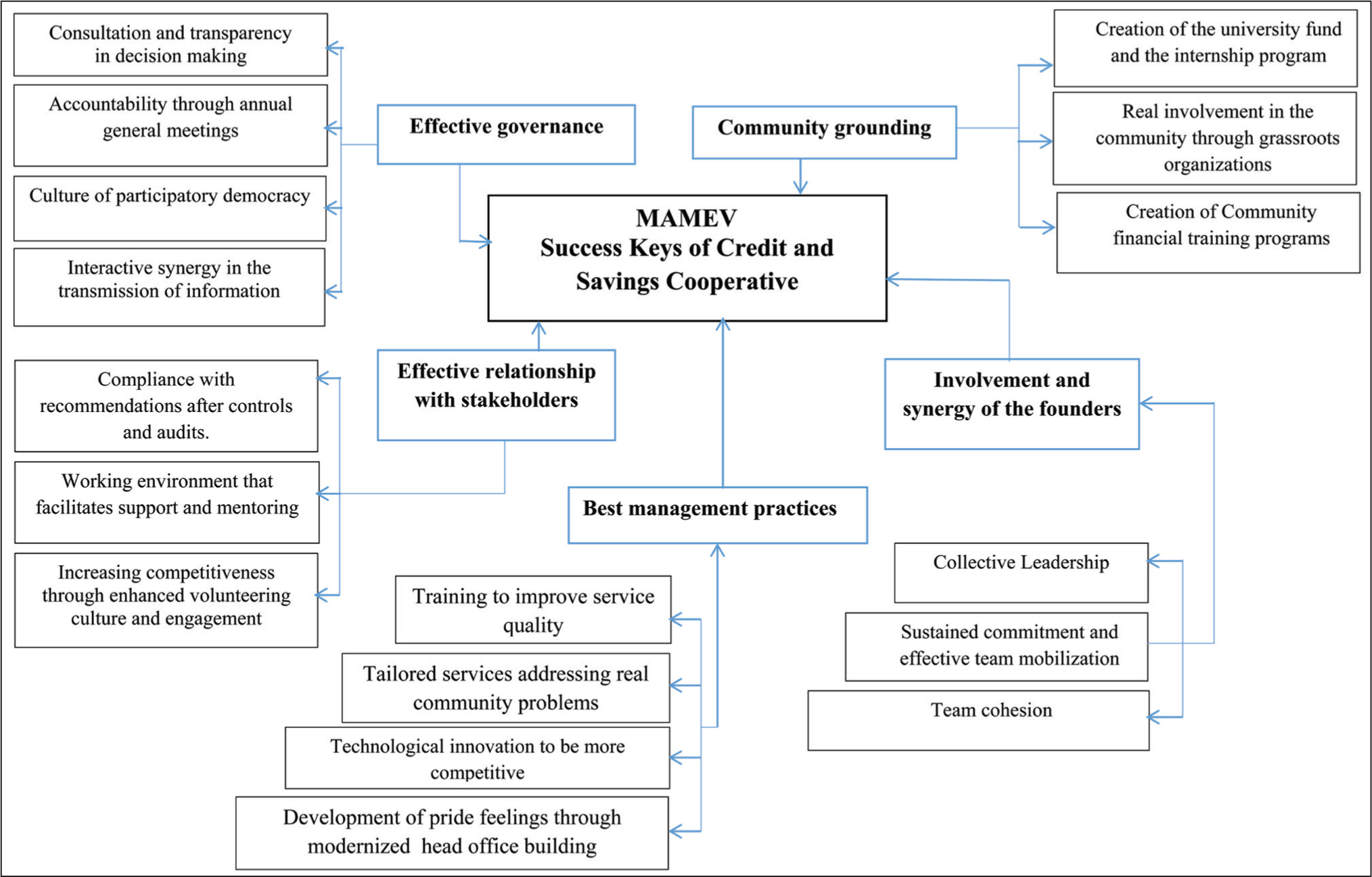
As indicated in Figure 1, this research also allowed us to identify certain success factors that are directly related to its management style. Indeed, the cooperative’s performance has been optimized through the adoption of high value-added managerial decisions. For example, employee training has improved the services offered. Also, offering services at affordable conditions has made it possible to attract new members and generate more resources. Improving the physical appearance of the head office has helped to strengthen and maintain a trust relationship amid a fragile community. The cooperative has focused on innovation in order to be more competitive. The cooperative also offered adapted services to meet the needs of its community.
Conclusion
The research demonstrated that the success of the MAMEV cooperative stems essentially from its governance style that is characterized by the collaborative, participatory and transparent management of the administrators. This managerial effectiveness at the governance level has strengthened the bonds of belonging between stakeholders and their cooperative. The style of governance adopted also helped to ensure the sustainability, viability, modernity, and financial and economic soundness of the cooperative. Other factors related to the management style have also positively influenced the cooperative’s level of success. Thus, the decisions taken at the level of human, financial and economic resource management have generated an improvement in the services offered and the creation of effective strategies to increase membership and has ensured the financial viability of the cooperative.
The success of a SACCO in Haiti is also multidimensional. The leadership and notoriety of the administrators, the daily practice of good governance, the respect of cooperative principles, the regular inspection and control of regulatory bodies, the anchorage in the community, and the involvement and sustained commitment of members are some of the success factors.
Limitations and Further Recommendations
The success story of Haitian MAMEV cooperative helped the members not only to counteract the myth of incapacity that prevailed in Haitian community at the time but also to improve the living conditions of the members as well as of community members. The research provides a novel contribution to the resilient and sustainable model of governing and managing SACCOs that could serve as a model to be followed by other cooperatives and communities. This research showed several implications, lessons and experiences on the theoretical and managerial levels. It also presents a new model of the Success Keys of SACCO’s. However, like others, this research has some limitations that must be highlighted. The research relays on the outcomes of only three interviews. However, as we performed qualitative/interpretive research, the question is no longer how the results would be generalized but rather the question of transferability of knowledge. The experience of this cooperative would serve as a role model for other co- operators and communities.
Footnotes
Declaration of Conflicting Interests
The authors declared no potential conflicts of interest with respect to the research, authorship and/or publication of this article.
Funding
The authors received no financial support for the research, authorship and/or publication of this article.