



Abstract
The aim of this study is to better understand the effect of flexible working arrangements (FWAs) on three academics’ outcomes, which are work pressure, work–life conflict and satisfaction during the ongoing COVID-19 pandemic. A quantitative approach using probability-sampling technique was performed to collect the data. A total of 132 responses were considered in this study. The sample includes academics from Middle East and North Africa region. This research used the method of partial least squares to test the research hypotheses. The findings showed that there are significant effects between flexible working-time arrangements, work pressure, work–life conflict with academics’ satisfaction. Yet, both work pressure and work–life conflict do not have moderator roles on the relationship between FWAs and academics’ satisfaction. The research results could be applied by university human resources’ managers seeking to introduce flexible schedules in the workplace in the context of uncertainty. The study makes a novel contribution to the effect of flexible schedules on the attitude of academics during a health crisis (COVID-19).
Keywords
Introduction
Nowadays, there is a growing number of workplaces, which adopt flexible working arrangements (FWAs) as the demand for employee-oriented and individualized work arrangements continues to increase (Amritha et al., 2017; Al-Kasasbeh, 2016; Uglanova & Dettmers, 2017; Wheatley, 2016). On the one hand, organizations profit from flexible work schedules through coping with variations in demand, minimizing expenses and becoming more attractive to potential employees (Bohle, 2016). On the other hand, employees prefer this approach as it is sensitive to their changing personal needs and circumstances (Goudswaard et al., 2013; Inayat & Khan, 2021). In higher education, the flexible schedules are almost practiced since academics could choose them according to their expectations and availability (Butcher & Rose-Adams, 2015; Du Plessis, 2019; Goudswaard et al., 2013; Ukwoma & Ngulube, 2021). During the ongoing COVID-19 pandemic, the FWAs become critical in distance education in order to overcome several challenges, which aimed to complete the programs on time and prepare for final exams (Kohnke & Moorhouse, 2021). However, the e-teaching depends on several variables such as student attendance or Internet accessibility. Moreover, teaching from home needs itself a working climate in order to maintain the same level of effectiveness compared to conventional teaching in classroom (Katoua et al., 2016; Nguyen, 2017; Yawson & Yamoah, 2020). Consequently, the sudden passage to e-teaching imposed by the last circumstances may affect the wellbeing and the productivity of many academics who have to manage their work and home requirements at the same time (Kohnke & Moorhouse, 2021). Besides, the fact that those academics are not well familiarized with new techniques of e-teaching, and the stress related to the confinement may be influential on academic mental health as well. The repercussions of this situation on the academic attitudes remain probable since they have not been distinctly identified in previous researches with varied results being reported. Hence, there is a need of direct further efforts into investigating the impact of flexible hours on the academics’ attitudes towards their work during the COVID-19 pandemic era. This study is developed in the context of this research gap. More precisely, it aims to study how the flexible working-time arrangements could improve the academic’s satisfaction during the restrictions imposed by the COVID-19 pandemic.
To meet the different research objectives discussed above, we structured this research work as following: the second section discusses the literature review on the concepts of FWAs, academic satisfaction, and work–life conflict (WLC). The arguments that sustain the research hypothesizes are also presented in this section. The third section describes the research approach, design as well as data collection. The fourth section deals with data analysis, and the last section discusses the main conclusions, implications and limitations of the study.
Literature Review
The ‘New’ Challenge of Academics During the COVID-19 Pandemics
Since the emergence of the Corona pandemic, which has upset the human life in the whole world, universities across the world have adopted various restrictions and measures in order to limit the spread of this dangerous virus. General breakdown, self-isolation, remote working and social distancing are only some examples. However, these procedures were considered by several authors as predictors of mental illness and cause severe damage to human wellbeing (Godinic et al., 2020). Other researchers note that academics are already facing stress and burn-out because they have several responsibilities to undertake (Bell et al., 2012; Du Plessis, 2019). Under normal conditions, they are dealing to fulfil multiple roles’ demands such as activities of teaching, supervision, coordination and consultation. While during the health crisis of COVID-19, they are also requested to deal with pressures caused by the requirement to balance between traditional workload and virtual duties, as well as the balance between teaching and research activities. It seems important to note that the e-teaching, which is brusquely introduced, requires specific abilities to assume those new responsibilities (Guri-Rosenblit, 2018). Owing the time pressure during the COVID-19, it was difficult to re-train effectively the academic staff. Consequently, most university teachers are not well prepared and equipped to teaching on-line which may foster their anxiety. These pressures could also come from the fact that distance teaching cannot involve in an inappropriate environment. ‘Working from home’ during the COVID-19 pandemic can be a source of frustration particularly for those having spouses and children who are learning or working in distance at the same time and in the same place. This is the reason why a question should be asked whether these conditions demote a high work–life balance (WLB) and the wellbeing of academics as well.
Conceptual Model and Research Hypotheses
Although several researchers have studied the impact of implementing a flexible work schedule (Al-Kasasbeh, 2016; Russel et al., 2009; Shagvaliyeva & Yazdanifard, 2014; Wheatley, 2016), little effort has been directed towards analysing the effect of this arrangements in the academic field. In the following paragraphs, the impact of FWA on work pressure, WLC, and academics’ satisfaction are investigated.
FWAs and Academics’ Satisfaction
In response to various environmental issues related to COVID-19, a flexible hour programme was currently enhanced by universities that allows academics to report early or late and teach and leave at a different time. In previous studies, flexible work hours have been associated with the increase in worker satisfaction levels (Al-Kasasbeh, 2016; De Menezes & Kelliher, 2016; Dousin et al., 2019; Goudswaard et al., 2013; Wheatley, 2016). The practice has evolved from working early and leaving earlier to a point where the workweek is customized to the unique needs of the employee. Studies such as the ones conducted by Wheatley (2016) conclude that there is a positive correlation between flexible work schedules and worker satisfaction levels. Similarly, Al-Kasasbeh (2016) notes that the introduction of flexible work hours is linked to an increased level of job-satisfaction amongst faculty members. Murtaza and Rafique (2018) also look at the relationship between flexible work schedules and job satisfaction. The research focuses on female faculty members in a business school in Karachi. The results indicate that an increase in the number of work hours was associated with lower levels of job satisfaction among the respondents. There is a disparity in how flexible work benefits are perceived by male and female workers.
For instance, Uglanova and Dettmers (2017) explored the long-term impact that flexible workweeks had on employees by analysing three aspects of subjective wellbeing: stability, recovery and chronic improvement. The results show that women followed a chronic strain pattern while their male counterparts took the adaptation pattern as they take up a more flexible work hour pattern. Women, therefore, profit from flexible work hours in the long term while men experience a deterioration of leisure time, which is then followed by adaptation. This finding contradicted Wheatley’s (2016) assertion which stated that flexible work arrangements harmed female employees’ job, leisure and level of satisfaction compared to men. The study had pointed to the fact that male workers often enjoyed the more benefits of flexible work schedules than their female counterparts. In another perspective, De Menezes and Kelliher (2016) look at the impact of both the formal and informal flexible working arrangements on job satisfaction and performance. Their results indicate that the formal flexible work arrangements had a negative association with company performance but were a great source of personal job satisfaction. While informal flexible work arrangements were associated with better company performance but a lower level of employee satisfaction. We believe that both formal and informal schedules may have a positive effect since all participants will be satisfied by a ‘controlled flex-schedule’. Consisting with previous ideas, this leads to the following hypothesis:
FWAs and Work–Life Conflict
A customizable and flexible work schedule has been linked to reduced WLC. The WLC is the lack of opposition between obligations at the workplace and in other aspects of life (Bohle, 2016). Working from home and having a customizable work week affords the employee enough time to effectively handle life issues. Previous studies noted that among the advantages of FWAs is that they allow employees to balance between their social and professional lives (Glass & Estes, 1997; Goudswaard et al., 2013). In other words, FWAs are likely to reduce WLC. Hill et al. (2010) have led a global survey on workers from four nations. They found that working from home and perceived schedule flexibility are linked to low WLC. Studies such as the ones carried out by Shagvaliyeva and Yazdanifard (2014) support this assertion. Other authors underline that compressed working weeks as could help a university teacher from one hand to meet the professional objectives when working fewer days and from the other hand to manage their familiar responsibilities during the remaining days (Agha et al., 2017; Al-Kasasbeh, 2016). In contradicting studies, flexible working hours have been linked to reduced control at work and a more hectic WLC. Bohle (2016) explores the relationship between different forms of ‘flexible work’ and the impact it had on the organization and WLC. The author notes that in the case of precarious jobs, the working hours are unpredictable and lead, therefore, to a feeling of loss of control for the employee and an increase in WLC. In contrary, a regular schedule is associated with increased job security compared to flexible work options (Bohle, 2016). Russel et al. (2009) argued that working from home is strongly correlated with high level of WLC. Since the e-teaching was introduced unexpectedly and unpredictably with COVID-19, this situation could make academics uncomfortable at the expense of their wellbeing. Maybe because the on-line regular schedule does not correspond perfectly to their personnel needs. Therefore, flexible working hours may reduce the WLB thereby fostering the stress among academics. This debate leads to the following hypothesis:
FWAs and Work Pressure
Work pressure refers to ‘intensity of work demands, both physical and mental, experienced by workers, and the degree of work effort demanded in employment’ (Russel et al., 2009). In higher education, work pressure has risen considerably in the last years because of the quick digitalization of learning tools. Academics are pressured to deliver more results while they are not necessarily familiarized with those digital tools. This ‘technophobia’ (Poalses & Bezuidenhout, 2018) could hamper their mental and physical health (Lopes et al., 2014). However, there is a limited investigations about the association between flexible working times and work pressure. As stated above, FWAs could reduce the family–life conflict whether they are adapted to academic’s requirements. Following the same reasoning, FWAs may be considered as source of pressure if they are not accommodated with the normal lifestyle of academics. In parallel, although flexitime is reinforced during the lockdown procedures, academics are already exposed to the pressure of teaching on-line pushing them to work extra-hours in order to fulfil their ‘new’ responsibilities. As a result of the lack of previous studies linking between flexible hours and work pressure (Russel et al., 2009), we can expect that the FWAs could be an additional source of pressure for academics and, therefore, we draw the following hypothesis:
The Moderating Effects of FWAs, Work–Life Conflict and Work Pressure on Academics’ Satisfaction
Work–Life Conflict and Academics’ Satisfaction: WLB is the lack of opposition between obligations at the workplace and in other aspects of life (Bohle, 2016). As stated above, WLC is associated with unhealthier work environments where employees can have more stress and have many cases of burnout. Islam and Alam (2014) affirm that WLB constitutes an important factor to remain in the company and promotes employee’s wellbeing. According to Amritha et al. (2017), WLB, which conducts to overall life satisfaction, is mainly stimulated from successful achievement of inside and outside the work responsibilities. There is a disparity in how WLB is perceived by male and female. For instance, woman could hardly find this balance especially who have dependent child in the household and are more exposed to WLC (Shen & Jiang, 2015). Other studies suggest the women are less motivated to work from home because it constitutes an additional burden (Erogul & Rahman, 2017; Faizan & Zehra, 2016) This means that stress or strain experienced at work by academic women influences the level of stress of the spouse or children and vice versa. Some authors point out that high WLB helps in reducing absenteeism and improve the wellbeing of academics (Agha et al., 2017). The same finding is observed in Shantha’s (2019) study. Consisting with these ideas, the following hypothesis is proposed:
Work-Pressure and Academics’ Satisfaction: Work pressure expresses negative health outcomes and somatic complaints such as headache, upset stomach, sleep difficulties (Lopes et al., 2014; Russel et al., 2009). In the context of steady growth of e-teaching, academics are called to work for long time and to deal with psychological, physical, and behavioural disorders (Barkhuizen & Rothmann, 2005; Du Plessis, 2019; Poalses & Bezuidenhout, 2018). Consequently, academics feel that they are working under pressure to meet the requirements, respect deadlines and perform their tasks. Moreover, the pressure may come from the using of digital tools such as Blackboard and Zoom platforms, which consume more time than what is desirable for adaptation. Poalses and Bezuidenhout (2018) stated that among the crucial source of stress in higher education is the continuous effort to keep up with information technology developments. This technophobia could hamper their mental and physical health (Lopes et al., 2014). In the same vein, Tagurum et al. (2017) focused on the case of academics who have overexposure and involvement with computer technology. They called it ‘technostress’ to characterize the anxiety or mental pressure felt while using technology. During the COVID-19, it seems important to mention that academics are called to be available any time to respond to both student and administrative staff requests. In support of this fact, reported higher stress levels among e-teachers, and attribute this mainly to the ‘24/7 phenomenon’ which could considerably disturb their wellbeing. In the same perspective, a study of reports alarming rate of health problems amongst academics due to work-related stressors. The author precises that academics find that teaching online is time consuming, more isolator and requires specialized skills. Therefore, pressures accentuated by COVID-19 would predict the ill-being of academic staff (Bell et al., 2012). However, there is not a common conclusion regarding the negative association between working from home and the level of stress. According to Russel et al. (2009), working online is not a source of stress but a motive for balance between health and work. In other perspective, Malik (2015) points out the fact that work pressure affects differently depending on nature of task. Indeed, in any case, work pressure is stressful, but there are positive and negative stresses. Positive stress can be felt when executing interesting tasks, while negative stress leads to burnout and depression. Based on research, Malik (2015) explains further that when people are immensely interested in a job, they enjoy working. In such a situation, the work is not a burden but a pleasure making the fatigue negligible. While Podsakoff et al. (2007) distinguish between two types of stressors: hindrance stressors which affect negatively on job satisfaction and challenge stressors which impact positively on job satisfaction. According to this debate, the work pressure may have both positive and negative impact on the academic satisfaction depending on whether the task is interesting and how academics perceive the pressure. Therefore, we draw the following hypothesis:
Moderating Role of Work–Life Conflict and Work Pressure
In the organizational literature, WLC is identified to be related to negative individual outcomes such as burnout (Buonomo et al., 2020), turnover intention (Lu et al., 2017) and work disengagement (Yang et al., 2021). Although limited attention is paid to relationship between FWAs, WLC and job satisfaction, some attempts were developed in this perspective showing that employees who have flexible work and experienced less conflict between work and family tend to carry positive aspects from daily life to their job (Obrenovic et al., 2020). In other words, the more individuals feel balanced the more they enjoy their daily life and their work (Qu & Zhao, 2012; Rahman et al., 2018).Additional research studies Du Plessiss (2019) and Poalses and Bezuidenhout (2018) argued that the incompatibility between familiar and professional roles has negative influence on the employees' satisfaction. This negative association between WLC and job satisfaction is also supported by the meta-analysis of Michel et al. (2009), and Rahman et al. (2018). The following hypothesis is drawn:
Several negative emotions (anxiety, stress, danger, etc.) and health outcomes (headache, upset stomach, sleep difficulties) can be associated with job pressure (Chao et al., 2015; Lopes et al., 2014; Ngirande, 2021; Padmanabhan, 2021; Russel et al., 2009). Several negative emotions (anxiety, stress, danger, etc.) and health outcomes (headache, upset stomach, sleep difficulties) are positively associated with job pressure (Chao et al., 2015; Lopes et al., 2014; Ngirande, 2021; Padmanabhan, 2021; Russel et al., 2009), which leads to low level of job satisfaction and performance (Hsu et al., 2019; Kim et al., 2019; Padmanabhan, 2021). During COVID-19 pandemic era, academics are called to be available at any time to respond to both student’s and administrative staff’s requests. Furthermore, in the case of precarious jobs, the working hours are unpredictable and leads, therefore, to a feeling of loss of control for the employee and decrease of job satisfaction. In the context of over work and unpredictable demands caused by ‘flexible work’ (Bohle, 2016) from the one hand, and work pressure caused by teaching online, which is time consuming, more isolator and requires specialized skills, from the other hand, academics feel in uncomfortable and anxious situation. Accordingly, the benefits of introducing flexible arrangements could decrease the job satisfaction among those who have difficulty to balance their family and job demands and exposed to high work pressure. Hence, it can be said that flexible work, when it is associated with pressure, leads to work dissatisfaction (Russel et al., 2009). Therefore, the following hypothesis is proposed:
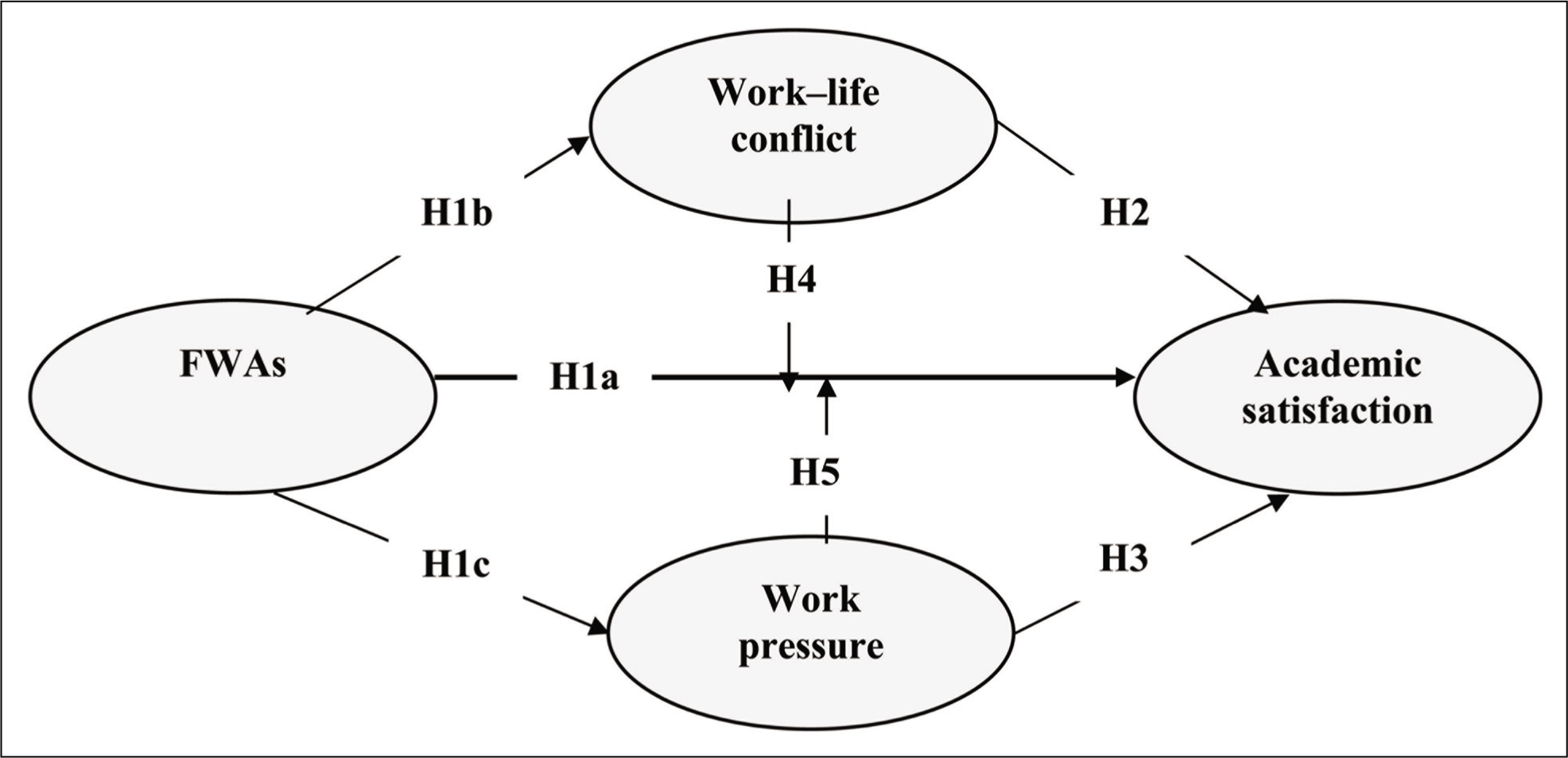
These different research hypotheses are presented in the conceptual model of Figure 1.
Methodology
Data Collection
To test the research hypotheses, web survey data were used from 3 February to 16 April 2021. The target was the Middle East and North African (MENA) academics working at Imam University in Riyadh (Saudi Arabia). The reason for the choice of this target is that they are exposed to high stress related to their expatriation, which could ultimately alter their wellbeing. In addition, it should be noted that academics of this university had been working online since March 2020 according to the health restrictions imposed by the Saudi government due to the COVID-19 pandemic. A probability sampling technique was used, approximately 300 questionnaires were distributed and 132 effective copies were returned with a valid response rate of 44%.
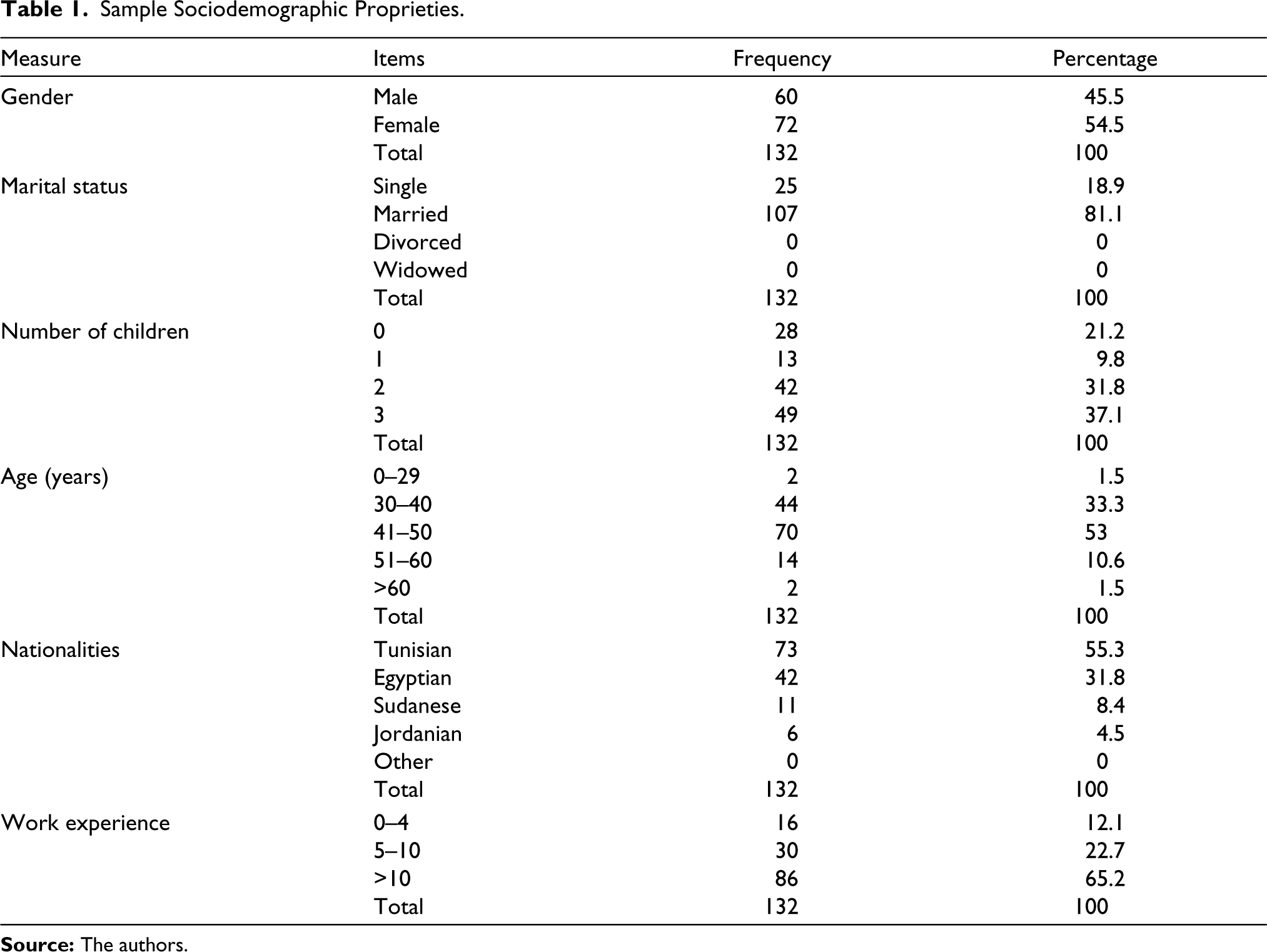
The respondents were asked about their gender. The results showed that 45.5% of respondents were male and others (54.5%) were female. The majority of respondents were married (81.1%). Moreover, the majority of respondents were aged from 30 to 50 years old (86.3%). The target of the survey was the faculties, colleagues, from MENA region working in Imam University in Saudi Araba. Around 55.3% of the respondents were Tunisian, 31.8% were Egyptian, 8.4% were Sudanese and 4.5% were Jordanian. Regarding the work experience, almost 88% of respondents had more than 5 years. The sample profile is summarized in the Table 1.
Sample Sociodemographic Proprieties
Measurements
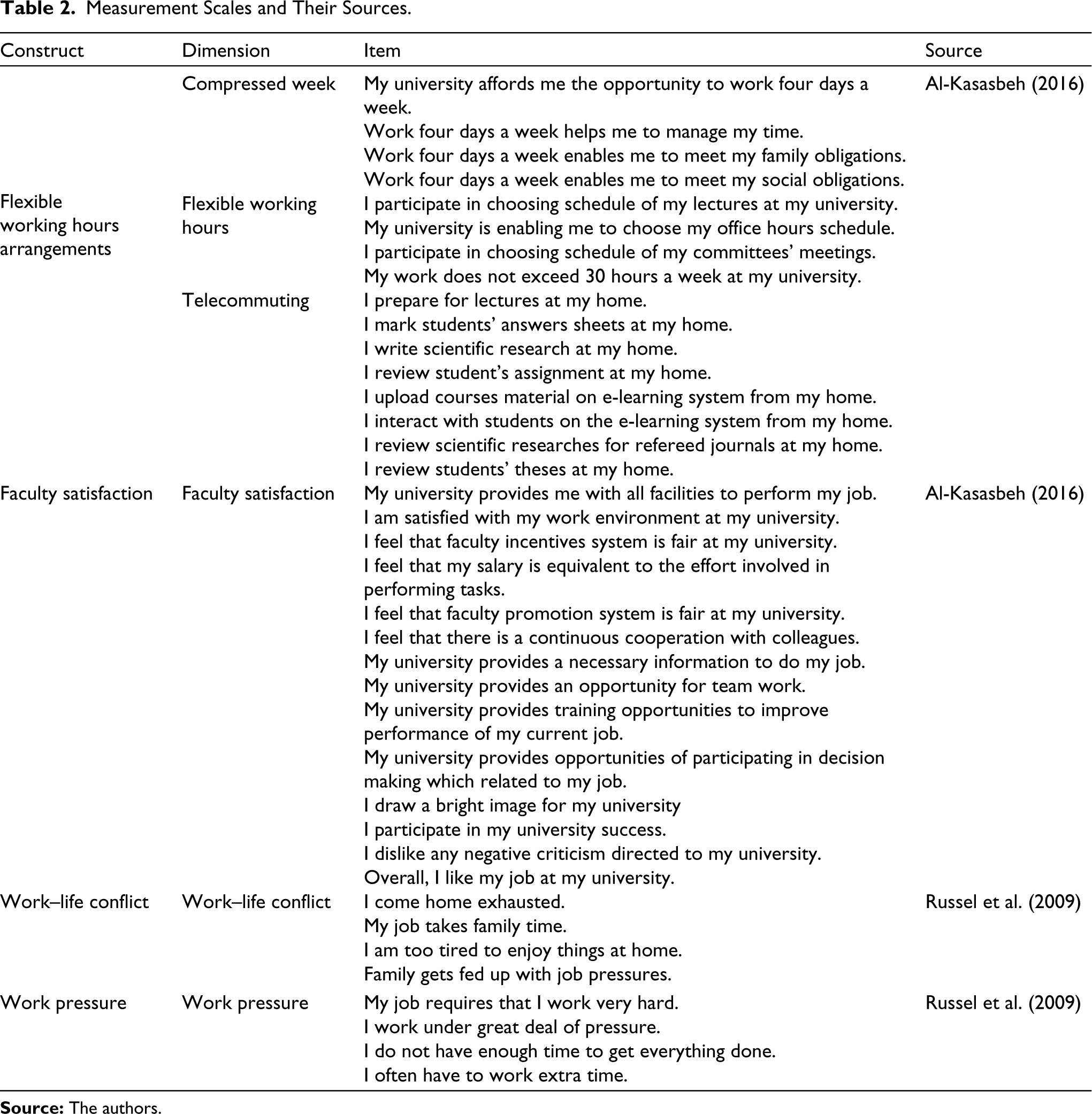
The different variables of the conceptual model were measured through measurement scales from the existent literature with some adaptation to the context of this study. Flexible working hour’s arrangements were assessed using the scale developed by Al-Kasasbeh (2016). This scale includes three dimensions (composed work, flexible work hours and telecommuting) which include 16 items. Academic satisfaction was assessed using a unidimensional scale developed by Al-Kasasbeh (2016). This scale includes 14 items. COVID-19 work pressure was assessed using the scale by Russel et al. (2009), which includes four items. We had adapted the original scale to the COVID-19 context. The WLC is also measured using the scale of Russel et al. (2009), which includes four items. To adapt this measurement scale to the context of the coronavirus pandemic, the prefix ₹during the COVID-19 pandemic' was added to the different items. The items of the different constructs of the conceptual model are available in Table 2.
A five-point Likert scale was used, ranging from ‘totally disagree’ (i.e., 1) to ‘totally agree’ (i.e., 5) for all measurements. Table 2 shows different items for every construct.
Measurement Scales and Their Sources
Results
This study uses both exploratory and confirmatory approaches. The SPSS 20.0 software was used to conduct the exploratory analyses. The principal component method with varimax rotation was adopted. Confirmatory analyses were conducted through AMOS 20.0. The test of reliability, validity (convergent and discriminant) as well as the structural equation modelling were used to test the hypothesized conceptual model.
Measurement Model
Based on the statistics presented in Table 3, academic satisfaction attained highest mean scores of 4.20, while WLC, work pressure and flexible working hours arrangements demonstrated lower scores of 2.42, 2.35 and 2.29, respectively.
Correlation Tests
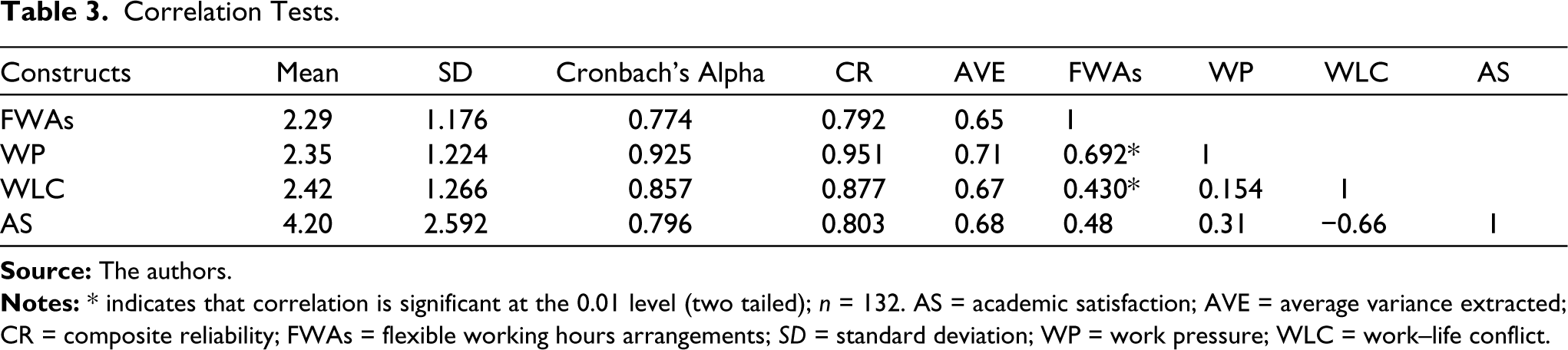
First, the internal consistency (reliability) was assessed using Cronbach's alpha and composite reliability following the approach of Fornell and Larker (1981). The findings in Table 3 showed that Cronbach’s alpha of all scales was greater than 0.7, that indicated internal consistency of scales (Hair et al., 2016). Second, the convergent validity was assessed through the average variance extracted (AVE) values and factor loadings of measurement items. The high convergent validity was confirmed since AVE values for each construct exceeded the threshold of 0.5 (Anderson & Gerbing, 1988; Naim & Lenka, 2017). Third, the discriminant validity was assessed by comparing the square root value of the AVE for each construct with the other correlation values in the correlation matrix (Fornell & Larcker, 1981). Furthermore, the measurement items’ loading values on their assigned constructs were larger than the cross-loading values on other constructs by more than 0.10 according to Gefen et al. (2000). Consequently, the discriminant validity is conformed for all constructs.
Structural Model
Model Fit
Several indicators were used to check the model fit. They are χ2 normed, goodness of fit (GFI), adjusted GFI (AGFI), root mean square error of approximation (RMSEA), root mean residual (RMR), normed fit index (NFI) and comparative fit index (CFI) (Kline, 2005; Marcoulides & Schumacker, 1996). The output of the software provided the following values: χ2 = 60.7, df = 15; χ2/df = 4.05, p < 0.001; GFI = 0.92 > 0.9; AGFI = 0.87 > 0.8; RMSEA = 0.011 < 0.08; RMR = 0.076 nearest to 0; NFI = 0.96 > 0.9 and CFI = 0.98 > 0.9. Hence, the results showed that the structural model provided a satisfactory fit to the empirical data.
Hypothesis Testing
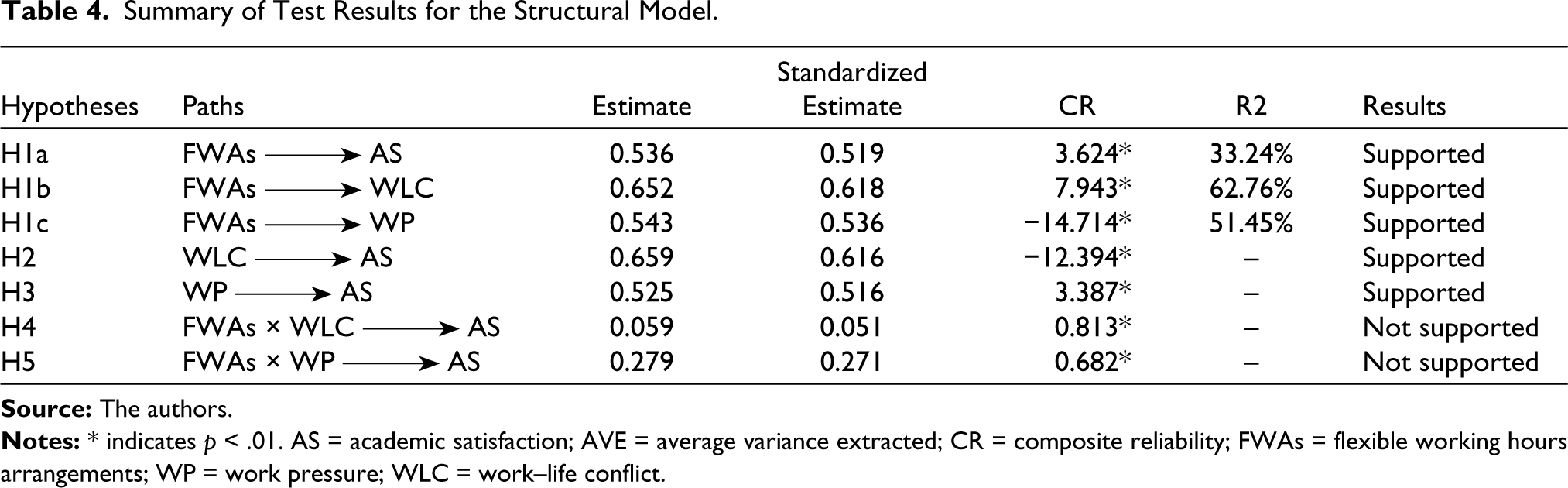
For the different variables of the conceptual model, the following values of variance were found: 33.24% of the variance of the variable academic satisfaction, 51.45% of the variance of the variable work pressure and 62.76% of the variance of the variable WLC (Table 4). So, we decide to accept the model in its original form. These results are summarized in Table 4.
As shown in Table 4, the results indicated that five hypotheses were confirmed (H1a, H1b, H1c, H2 and H3) and two hypotheses related to the moderating effect were rejected (H4 and H5). First, FWAs, WLC and work pressure had a significant effect on academic satisfaction (βH1a = 0.519, t = 3.624, p < 0.001; βH2 = 0.616, t = −12.394, p < 0.001; βH3 = 0.516, t = 3.387, p < 0.001). Thus, H1a, H2 and H3 were supported. Second, the results indicated that FWAs had a significant effect respectively on work pressure (βH1b = 0.536, t = −14.714, p < 0.001) and WLC (βH1c = 0.618, t = 7.943, p < 0.001), supporting H1b and H1c. Third, the products (FWAs × WLC) and (FWAs × WP) had no effect on academic satisfaction (βH4 = 0.271, t = 0.682, p < 0.001; βH5 = 0.051, t = 0.813, p < 0.001). Thus, H4 and H5 were not supported.
Summary of Test Results for the Structural Model
Discussion, Implications, Limits and Future Research Pathways
Discussion
This study investigates the influence of flexible working arrangements on work pressure, WLC and academic satisfaction. Flexible working-time arrangements seemed an influential means of disturbing the balance between work and other life interests, especially in a COVID-19 context where it is difficult to look for alternative solutions. Therefore, it is anticipated that FWAs would increase pressure and WLC. First of all, the study results’ main contribution lies in the support of Al-Kasasbeh’s (2016) findings, who concluded that FWAs positively impact academic satisfaction (H1a supported). The findings of this study converge with those of Wheatley (2016), Al-Kasasbeh (2016), De Menezes and Kelliher (2016), Murtaza and Rafique (2018) and Dousin et al. (2019). Furthermore, the findings of this study also support the hypothesis during the COVID-19, FWAs impact positively on work–life conflict (H1b supported) and confirm the ideas of Bohle (2016) and Russel et al. (2009), which stated that FWAs may disturb the WLB. Thus, despite the FWAs, academics can hardly manage between their personnel and professional interests. This result can be explained by the fact that more than half of the respondents are married females with dependent children. As stated by many authors, this category is less willing to work from home (Faizan & Zehra, 2016) and therefore, most exposed to WLC (Shen & Jiang, 2015).
Concerning the relationship between FWAs and work pressure, results reveal that there is a significant and positive link between these two factors (H1c supported). In spite of FWAs, e-teaching is a source of work pressure which affects both mental and physical health among academics. This is in line with the ideas upheld by many authors such as Lopes et al. (2014), Tagurum et al. (2017) and Poalses and Bezuidenhout (2018).
In addition, this study found out that the WLC negatively impacts academic satisfaction (H2 supported), a hypothesis which converges with Agha’s et al. (2017) and Shantha’s (2019) findings. It might even be stated that the use of flexible working practices negatively influences the WLB of university professors. Universities should allow academics to choose flexible timing, giving them the possibility to spend more time with their families. Based on the findings of previous studies, such as the ones of Du Plessiss (2019) and Poalses and Bezuidenhout (2018), we have assumed that there is a negative relationship between work pressure and academic satisfaction. Indeed, a heavy workload accompanied by increased administrative duties and students’ demands, especially in COVID-19 context, make academics more exposed to stress and psychological and behavioural disorders. However, the results show a positive relationship between work pressure and academic satisfaction, thus rebutting the preliminary assumption (H3): work pressure impacts negatively on academic satisfaction. This interesting finding highlights that work pressure has, therefore, a paradoxical impact on job satisfaction. This result is in accordance with Russel et al. (2009) whose research concluded that working online is associated significantly with reduced levels of job stress, because working from home allows academics to manage their workload more flexibly. Malik (2015) pointed out the fact that work pressure impacts differently depending on the nature of the task: the more academics perceive their tasks interesting, the less the effect of work pressure will be. This means that academics are immensely interested in their job, despite the fatigue it can cause. Following the reasoning of Podsakoff et al. (2007), work pressure appears as a ‘challenge stressors’ which positively impacts on job satisfaction. It can be deduced that if job satisfaction is enhanced, it is due to work pressure being perceived as a challenge rather than a hindrance. Eventually, one of the contributions of this study is to investigate the moderating role of both WLC and work pressure. However, the results indicate that neither WLC nor work pressure have a moderator effect on the relationship between FWAs and academic satisfaction (H4 and H5 not supported). This outcome can have two explanations. The first one is related to the fact that statistically, the relationship between FWAs and academic satisfaction (H1a) is so strong that it can attenuate the moderator effect of both WLC and work pressure. The second explanation is related to the nature of those stressors themselves. In other words, if the WLC and work pressure, as intrinsic stressors, have a neutralized effect as moderators, it is because academics are rather focusing their cognitive resources towards their tasks more than the stressors themselves. Consequently, academics perceive the WLC and work pressure as occupational risks that they have to deal with even in COVID-19 context.
Theoretical and Practical Implications
Theoretical Implication
The main contribution of this study is to shed light on how FWAs affect intrinsic aspects of work, namely WLC and work pressure, and their effects on academic satisfaction during the COVID-19 pandemic. This study is the first to investigate the moderating effects of both WLC and work pressure, even if those effects are not in the anticipated direction. However, the findings of this study put forward that, although the COVID-19 context, academics show their high resiliency towards their responsibilities and any work-related stressors are perceived as challenges to overcome.
Practical Implication
In order to cope with the work pressure, universities should improve the wellbeing of their academics’ staff by seeking human resource policies, which give priority to FWAs. Higher education institutions could consider implementing psychological assistance and health programmes (Du Plessis, 2019). Under the current circumstances, universities management should encourage material rewards to compensate for the fatigue of academics, particularly since we know that academics are relatively low paid in universities. Although there are several benefits of FWAs on academic satisfaction, the high workload accompanied by unfeasible extra administrative duties caused by remote work have been considered as pressure elements that place these university professors at risk of experiencing negative occupational stress and decreasing their satisfaction level when teaching on-line (Agha et al., 2017). The stakes are higher if academics are exposed to additional stressors related to COVID-19 pandemic. This is one more reason why further research must focus on how we can improve the on-line environment for academics with adequate tools (Guri-Rosenblit, 2018). Hence, the use of flexible working practices positively influences the overall job satisfaction of university professors. In return, universities should allow academics to choose flexible timing to spend more time with their families.
Limitations and Further Recommendations
Although this study presents several implications on both theoretical and managerial levels, some limitations should be underlined. First, the sample taken into consideration was heterogeneous in terms of experience, age, gender, number of children and consequently, FWAs may impact differently on the wellbeing of individuals. Future studies should explore those control variables, in order to give more clarifications about how FWAs could affect academic satisfaction. A gendered-differentiated analysis would be ideal, in particular on women, who are more exposed to WLC (Faizan & Zehra 2016; Shen & Jiang, 2015). Second, the cross-sectional nature of this study did not look at how the attitudes of our respondents could be evaluated. It might be fruitful to perform a longitudinal study in order to compare the before and after COVID-19, and explore if the studied factors change with time. Third, the small sample size of the studied population is considered a vital limit, mainly because of academic impediments at the end of the academic year.
Footnotes
Declaration of Conflicting Interests
The authors declared no potential conflicts of interest with respect to the research, authorship and/or publication of this article.
Funding
The authors received no financial support for the research, authorship and/or publication of this article.