



Abstract
The novel coronavirus, COVID-19 has affected the advertising industry in India. This study tries to gauge the purchase intention towards hygiene products during the ongoing pandemic with reference to smartphone advertising. The purpose of the study is to explore the features of smartphone advertisements like advertising value perception, context awareness value and brand attitude, pertaining to COVID-19 hygiene-related advertisement narratives. To serve the purpose, two-wave shortitudinal study was conducted at time T1, that is, lockdown period and T2, that is, unlock period in India with the help of non-probability snowball sampling. The total numbers of respondents at T1 were 311, while for T2 the total 160 respondents were contacted through online mode. At T1, the relationship between perceived advertising value and purchase intention was not established, which depicts the pandemic effect. At T2, the relationship between context awareness value, brand attitude and purchase intention was established. Further, at T1, the brand attitude did not show a mediating effect on purchase intention, but at T2, it was found to have a mediation effect on purchase intention. The study has important implications as ongoing pandemic has altered the way of living. This also has significantly impacted the advertising industry especially the hygiene products.
Keywords
Executive Summary
This study examines the impact of brand attitude on purchase intention in the context of COVID-19 pandemic. Divided in two phases, this shortitudinal research was carried out to identify the variables affecting the purchase intention of sanitary products during the spread of the pandemic. The study began in the month of June for Phase I and was further conducted in the month of September for Phase II.
The study begins with a brief overview of the situation globally during the COVID-19 pandemic. The usage of smartphones grew multifold during that period. The study also reflects the effect on the consumption of video ads. This helped the authors develop a proposed model to carry the study forward. Followed by that is the detailed literature review to identify the gaps. Based on the literature the hypotheses were mentioned. This research tries to investigate the variables forming advertising value and context awareness value which lead to formation of attitude towards a brand which finally leads to purchase intention. Later in the study, the detailed methodology is mentioned. The study then goes on to the data analysis, where structural equation modelling was used to analyse the data. Further, the results are discussed. We have finally concluded the study with limitations of our study and the future scope.
Introduction
Classified as a black swan event, the novel coronavirus, that is, COVID-19 outbreak that originated from Wuhan, China in the late 2019, has affected healthcare systems globally with a multiplied impact on each facet of an individual’s life (Coccia, 2020; Nicola et al., 2020). World Health Organization declared the outbreak of COVID-19 as a global medical emergency on 30 January 2020 (Sohrabi et al., 2020). The spread of the novel coronavirus has highly affected the global advertising industry. Past few months have seen a steep downturn in the advertising expenditures globally (Taylor, 2020). These times have poised great challenge globally as well as for the Indian advertising industry. There is no certainty as to how long the pandemic and its impact will stay, but according to various reports and articles, it is evident that recovery will be quite difficult. According to Taylor (2020), the recovery will be slower than that following the ‘Great Recession’ of 2008. The novel coronavirus has posed several changes in the lifestyles of consumers. The pandemic has transformed major aspects of their daily lives, including how consumers engage with media and retail landscapes predominantly (Nielsen Company, 2020). Consumers are increasingly adapting to media and shopping habits to manage their lives through the pandemic. These changes in the consumption pattern are supposedly becoming embedded as a part of their daily lives, and it is unlikely that these habits and patterns will return to normal in the near future.
Due to the pandemic, a sudden spike was observed in the consumption and sale of personal and home hygiene products such as detergents, washing powders, sanitizers, floor and toilet cleaners (Kohli, 2021). The hygiene product sector is concerned with the production of items that are used to keep one’s personal hygiene and protect one from communicable diseases. Hygiene product manufacturers have started using all their resources to meet the unprecedented demand for their products. Since the outbreak of the pandemic, consumer spending preferences have been driven by personal and home hygiene. According to a Global Data consumer survey of 11 countries, 37% of consumers have purchased more household cleaning products and 77% have purchased more personal hygiene products since the epidemic began. As the coronavirus was new, governments around the world issued instructions encouraging people to use hand sanitizer and soap more frequently, resulting in a large gap between supply and demand for hygiene products such as hand sanitizer and toilet paper. However, fast-moving consumer good (FMCG) giants saw great opportunity in terms of revenue generation which could be leveraged due to the pandemic. Owing to this, there was a spike in advertising related to personal hygiene products from well-known brands. Thus, this study focuses on understanding the advertising value perception underlying the advertisement narratives of hygiene products on social networking sites (SNS). During a situation like this pandemic, advertising budgets have shrunk while the consumption of media has increased many folds due to lockdown. Social media serves as the best platform to leverage effective advertising in this situation where traditional advertising media like out of home advertising have become redundant due to the imposed lockdown. Brands are also seeing it as a low-cost model, which enables them to derive results in the minimum time possible for the targeted ‘Facebook generation’ (Saxena & Khanna, 2013). Millennials contribute as the largest user base when we use the term Facebook generation. Group of individuals born in or after 1980 forms the millennial generation. Numerous authors have named millennial generation as Gen Y, or the Nexters and the Nexus generation, owing to the characteristics and the events that outlined their lives including globalization, increasing demographic diversity, swift technological advancement (Barnard et al. 1998; Burke & Ng, 2006; Zemke et al., 2000).
Millennials grew up with the internet and mobile phones, and are therefore referred to as the Net/Wired generation sometimes (Rai, 2012). Thus, millennials are well-known as Digital Natives (Prensky, 2001). Mobile technology has changed our ways of interacting and communicating (Balasubraman et al., 2002; Dickinger et al., 2003). Thus, it gave birth to smartphone advertising. Smartphone advertising offers similar properties as the traditional advertising but additionally allows its users to access the internet anywhere they want. Internet information transmitted without location and time barriers, which leads to applications that are easily accessible from web-enabled smartphones (Venkatesh et al., 2003). These applications also include platforms like YouTube. Moreover, according to Leppäniemi and Karjaluoto (2005), smartphone enables marketing campaigns to reach ten thousand of the audience in a comparatively low cost than direct marketing platforms. Thus, consumers perceived the value based on entertainment and informativeness (Ducoffe, 1995) and credibility (Pavlou & Stewart, 2000). In the current era, many studies have highlighted the growth of smartphone advertising, focusing on smartphone features (Lee et al., 2017; Saadeghvaziri & Hosseini, 2011; Xu et al., 2009). Most of the research on smartphone advertising has emphasized on factors related to context awareness during the usage of smartphone, such as personalization (Al Khasawneh and Shuhaiber, 2013; Gasparetti, 2017; Kim & Han, 2014; Lee, 2010), location (Lee, 2010; Xu et al., 2009) and timing (Tsang et al., 2004). There are various formats of smartphone advertising, out of which, video advertising demonstrated a growth of 46% globally in the first half of the year 2017 and is growing at an increased pace (Goodfellow, 2017). The speed at which video-based advertising is gaining popularity catches the attention of researchers towards this interesting area of study. According to Tewari (2018), Indian advertisers consider video advertisement as a great branding tool. Major FMCG brands are highly spending on video ads over SNS. YouTube is a powerful contributing platform in the video-sharing business. It offers numerous kinds of advertising formats, attracting advertisers. According to Zhang and Yuan (2018), video advertising is the best for drawing users’ attention while enhancing decision-making. According to Abramovich (2018) globally, consumers are spending 83 minutes daily consuming videos, and it is expected to reach 92 minutes per day in 2020. Indian consumers spend 70 minutes daily on watching videos (KPMG, 2019). This number has increased manifolds due to the lockdown scenario.
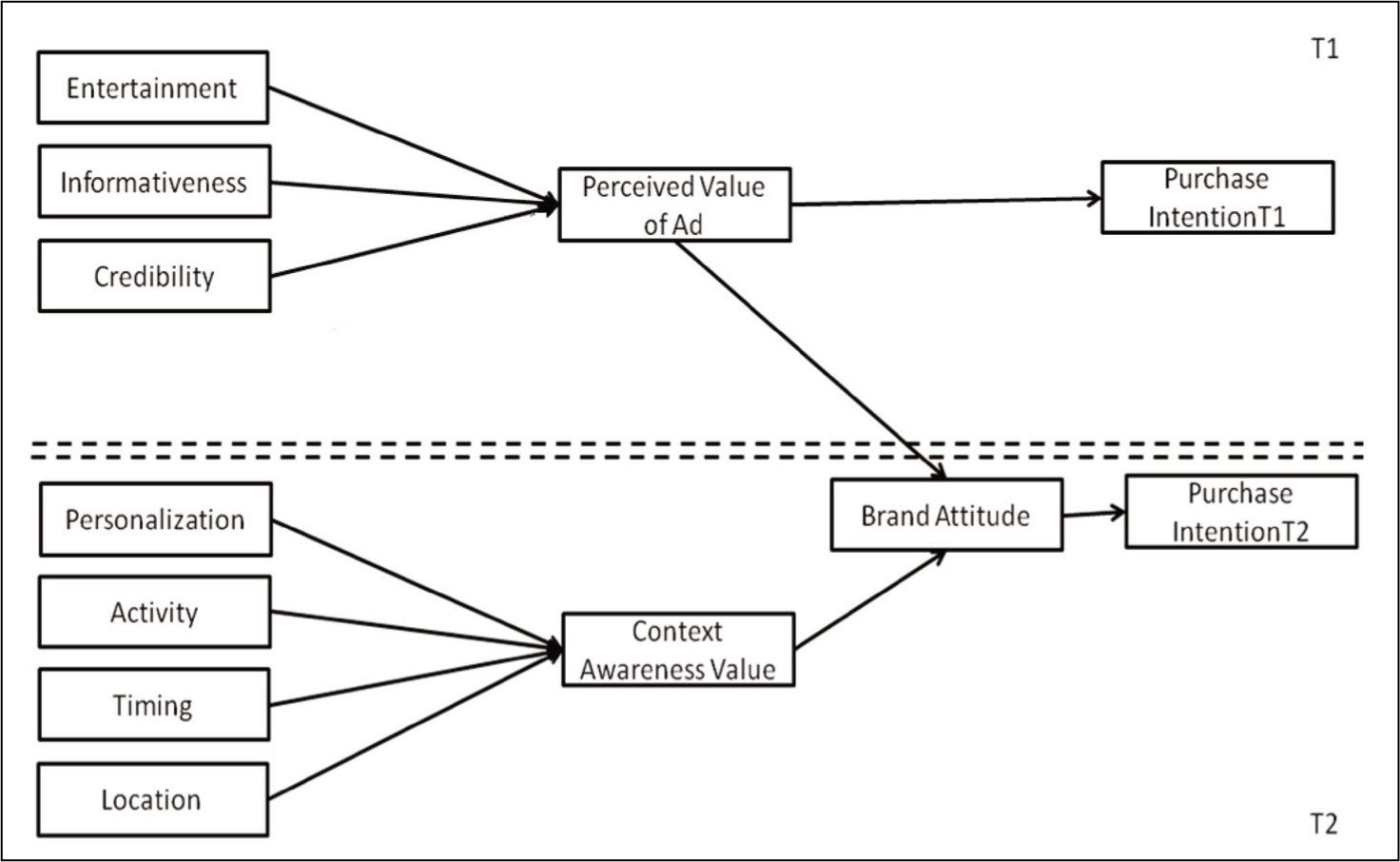
Therefore, this research tried to investigate the antecedents that create advertising value and context awareness value at T1, that is, during lockdown and T2, that is, during the unlock phase for the hygiene products during COVID-19 pandemic. Further, the study aimed to understand that how advertising value and context awareness value influence the brand attitude along with purchase intention for hygiene products. To serve the purpose, at T1, the respondents ware shown the video and based on that they were requested to fill the online questionnaire. There was a time lag of 3 months for the second survey. At T2, the respondents of T1 were contacted again through online mode. The data were collected with the help of non-probability snowball sampling. The primary aim of advertising comprises branding and sales (Laudon & Traver, 2013). Hence, it becomes imperative to interpret the process of customer’s purchase behaviour and not only advertising. To achieve the purpose, the descriptive cross-sectional research design was followed with snowball sampling. Thus, we propose the model shown in Figure 1.
Literature Review
Ducoffe (1995, 1996) created a model based on three antecedents of perceived value: informativeness, entertainment and irritation, based on a series of research. The advertising model proposed by Ducoffe has been used in numerous contexts such as the Web (Choi & Rifon, 2002; Wang & Sun, 2010) and feature phone advertisements (Blanco et al., 2010; Chowdhury et al., 2006; Liu et al., 2012; Tsang et al., 2004; Ünal et al., 2011; Yang, 2007). In the face of prior research findings, very few studies have adopted an advertising model in the smartphone advertising context. The pervasiveness and convenience of the smartphone are major contributing factors in the importance of smartphone advertising (Kim & Han, 2014). Further, the pandemic situation has led to reduction in the advertising revenues. Brands are indulging in value-based marketing campaigns that will help them create a strong bond with the consumers. This study considers that smartphones can adopt features of the web as well as smartphone advertisements and therefore making it most popular advertising medium in the times of adversity.
Factors Influencing the Perceived Value of Advertising
Ducoffe (1995) defined advertising value as the subjective evaluation of the utility or relative worth of advertising to consumers. Advertising value can assess the effectiveness of advertising because of its ability to integrate the media experience with the advertising experience (Logan et al., 2012). The value of advertising is considered from the advertiser’s perspective as based on its capacity to achieve marketing and communication goals. According to Houston and Gassenheimer (1987), the core essence of marketing lies in transaction between two parties. Taking this into consideration, consumers’ perspective should also be examined. This research on advertising value is based on how factors like entertainment, information and credibility influenced the perceived value of smartphone advertising for hygiene products.
Entertainment refers to enjoyment and delight obtained from advertisements (Ducoffe, 1996). According to McQuail (2010), advertisements, which are entertaining, allow the audience to experience an aesthetic enjoyment. The feeling of enjoyment highly contributes in accounting for overall attitude towards advertisements (Liu et al., 2012; Xu et al., 2009). As per the usage and gratifications theory, consumers derive benefits from entertaining advertising (Schlinger, 1979). According to Shimp (1981) and Shavitt et al. (1998) entertaining advertising increase the effectiveness of the message. Unlike advertising through traditional media, smartphone advertising entertains the consumers more thoroughly owing to its utilization of various features in a smartphone (Kim & Han, 2014; Oulasvirta et al., 2012; Yang et al., 2013). Advertisers strive to offer entertaining advertising because they believe it improves the efficacy of the message. Thus, we contend that in case of hygiene products, entertainment also helps in forming the perception towards advertising value. Hence, we propose the following hypothesis:
H1: Entertainment positively affects perceived advertising value of hygiene products.
Ducoffe (1996) has defined information as the extent of awareness in which consumers feel that information regarding product/service is being advertised. One of the primary reasons for using a smartphone is to look for information. Consumers have immediate access to smartphones through which advertisements are transmitted. This enables them to validate the correctness of the information in the advertisements (Shepard et al., 2011). The primary reason for consumers’ approval of advertising is its ability to provide information (Bauer and Greyser, 1968). In case of hygiene products, informativeness in advertisement is an essential antecedent of advertising value. Various studies have proven its importance in the effectiveness of web advertising (Ducoffe, 1996; Wang & Sun, 2010). This impact of informativeness can be applied to smartphone advertising messages (Kim & Han, 2014). Hence, the following is hypothesized:
H2: Informativeness positively affects the perceived advertising value of hygiene products.
Credibility is defined by Pavlou and Stewart (2000) as ‘the consumer’s believability for the advertising message’. It measures the amount of belief that consumers exhibit towards a claim in the advertisement. Advertising credibility can be termed as the perceived believability, truthfulness and honesty of content in an advertisement (MacKenzie & Lutz, 1989). In other words, credibility helps in measuring the quantum of trust exhibited by consumers in an advertisement claim (Trivedi et al., 2020). According to Erkan and Evans (2016), credibility is an important variable in forming advertising value. Consumers are known to have a low tolerance for ambiguity and uncertainty. They avoid risk-taking at large (Erdem et al., 2006), especially in case of personal hygiene products. Amid the pandemic, when many unfortunates losing their lives, people tend to be risk averse and consume the products which they perceive credible. This may be true for smartphone advertising. Hence, we hypothesized that:
H3: Credibility positively affects the perceived advertising value of hygiene products.
Factors Influencing Context Awareness Value
Context is explained as ‘any information which can be used to characterize the situation of any entity’ and context awareness value is interpreted as a system that ‘uses context to provide relevant information and/or services to the user, where relevancy is dependent on the task of the user’ (Abowd et al., 1999). In other terms, context awareness value is regarded as identifying the situations which involve contextual information used for communication among the individuals. Factors such as activity, timing, location and personalization played a crucial role in contributing context awareness value.
Personalization is an essential antecedent for analysing an individual’s conditions (Al Khaswneh & Shuhaiber, 2013; Kim & Han, 2014; Lee, 2010). Personalization has been considered an important variable when it comes to smartphone advertising (Kim & Han, 2014). Smartphone advertisements enable extreme personalization when consumers are presented to customized advertisements. According to Park and Chen (2007), the unique features of smartphone advertising make personalization of advertising contents possible and enables unique consumer-by-consumer messaging. Consumers show a positive attitude towards authorized messages in smartphone advertising (Tsang et al., 2004). DeZoysa (2002) found that personalization makes consumers more receptive to advertising, and consumer’s receptiveness is important in hygiene products as well. Moreover, certain customers targeted by personalized advertising according to their habits and preferences tend to respond positively and this pandemic makes everyone habituated to hygiene products. Thus, the following hypothesis is proposed:
H4: Personalization is positively associated with the context awareness value of hygiene products.
As per Partridge and Begole (2011) and Kaplan (2012), a user’s search history plays an important role and helps in recognizing past behaviours. Activity can be defined as a reaction of an individual under specific circumstances (Lee et al., 2017). Smartphone advertising takes into consideration the past activities of consumers. While transmitting of smartphone advertisements, the belief that past activities tend to impact future activities is considered (Partridge & Begole, 2011). An internet search, use of SNS and gaming are major activities via smartphone. In this exercise, the individual’s log data are gathered, unlike the desktop operated non-smartphone advertisements. Amid pandemic, when the consumers were ordering online and majorly people were searching for household, hygiene and personal care products. Thus, in case of hygiene products, to deliver high context awareness value, advertisement maximizes the use of consumers’ past activity. Therefore, it is hypothesized:
H5: Activity is positively associated with the context awareness value of hygiene products.
It is a known fact that timing affects the behaviour of an individual at large. The pandemic effect is also a timing effect which changes the consumer behaviour. The heavy usage of hygiene products is also pandemic time effect. Hence, timing is an important aspect of context awareness (Megehee, 2009; Tsang et al., 2004). According to Kaplan (2012), advertisement, including necessary information transmitted to the consumer at a desirable time, leads to an addition in its value. Wireless internet technology has enabled the high portability of smartphones. Smartphone advertising can reach consumers at favourable times through smartphones. Portability feature of smartphones helps in transmitting these messages, unlike non-smartphone advertisements (Chon & Cha, 2011; Liao, 2012). Increasing use of smartphone applications has significantly improved the timing of smartphone advertisement. For instance, discount coupons or offers sent through advertisements at a time desirable to the consumer will lead to high context awareness value, and this is also true in case of hygiene products during pandemic. The subsequent hypothesis is proposed:
H6: Timing is positively associated with the context awareness value of hygiene products.
Many research papers have established the impact of location on smartphone advertising (Al Khasawneh & Shuhaiber, 2013; Kaplan, 2012; Yang et al., 2013). New big data processing technology has enabled the implementation of location-based data collected with the help of wireless internet services. Technological disability did not allow location features in non-smartphone advertising, whereas it plays a significant role in new smartphone advertising by employing Global Positioning System information (Lee et al., 2017). The popularization of smartphones has given rise to location tracking services. To further investigate the impact of the location on hygiene products, we hypothesize:
H7: location is positively associated with the context awareness value of hygiene products.
Advertisement Value, Context Value and Consumer’s Brand Attitude
As per Laudon and Traver (2013), branding of products and sales are two major purposes of advertising. Individuals attribute attitudes to a brand by connecting positive or negative images transmitted through advertising. MacKenzie and Lutz (1989) found that cognitive changes are induced in consumers through advertising messages. Further, these cognitive changes alter brand attitude (Lee et al., 2017). Advertisement messages persuade consumers and induce emotional changes as well as make them recognize enjoyment. Studies have confirmed the impact of advertisement value on brand attitude. Therefore, it can be said that high advertisement value positively affects consumers’ attitudes towards the product/service brand.
H8: Advertisement value positively impacts brand attitude of hygiene products.
Context awareness value is unique to smartphone advertisements, which is affected by characteristics like personalization, location, activity and timing (Kim & Han, 2014). Features of smartphone advertising lead to context awareness value. It is distinguished from advertising value that is common for smartphone advertisements as well as non-mobile advertisements. According to Lee et al. (2017), context awareness value is a construct that affects consumers’ attitudes towards product/services in smartphone advertisement. Consumers prefer advertising that matches their personal circumstances. In addition, consumers are more familiar with the personalization of advertisement. Thus, messages being approached with personal circumstances get easy acceptance. Context awareness value is a new value that can have an impact on the brand attitude of consumers. It, therefore, becomes necessary to examine the hypothesis:
H9: Context awareness value positively impacts brand attitude of hygiene products.
The Perceived Value of Advertising, Brand Attitude and Purchase Intention
Purchase intention is regarded as a key variable in various studies. A consumer’s online purchase intention is conceptualized as online purchase intention (Schlosser et al., 2006). According to Hausman and Siekpe (2009), successful e-tailing operation is measured by purchase intention, and it is the most frequently used online behavioural intention. Value of advertising plays an important role in forming positive attitudes towards advertisements (Ducoffe, 1996). Goldsmith et al. (2000) concluded the relationship between positive attitude towards advertisement and a positive attitude towards the advertised brand. According to Choi and Rifon (2002), a positive attitude towards the brand and its advertising generates consumers’ overall purchase intention. Choi et al. (2008) and Zeng et al. (2009) concluded that advertising value is an antecedent that positively relates to purchase intention in smartphone advertisements. Thus, we propose the hypothesis:
H10: Advertising value perception positively impacts purchase intention of hygiene products.
Research done previously has established that brand attitude affects purchase intention. Brand attitude impacts the purchase intention of consumers directly for products/ services (Mackenzie & Spreng, 1992). Further, brand attitude is an affective reaction of an individual to a brand being advertised (Mackenzie & Lutz, 1989). In other words, purchase intention can be considered as the perceived likelihood of purchasing the product/service being advertised (Trivedi, 2020). Many studies have established the relationship of attitude towards the brand and perceived purchase intention (Ferreira & Barbosa, 2017). These studies were done in the context of other products and services and established the relationship between brand attitude and purchase intension. During this crisis time, when all the companies were advertising for hygiene products and creating brand attitude which ultimately impacts purchase intension. Thus, against this backdrop, we proposed that:
H11: Brand attitude positively impacts purchase intention of hygiene products.
The Mediating Role of Brand Attitude
Brand attitude refers to the propensity to the brand of the advertised company and an individual’s awareness for it. The utilization of natural value of advertising along with its distinctive features will lead to purchases of products/services (Lee et al., 2017). Hence, brand attitude is formed by the amalgamation of advertising value that is generated by perception formed by consumption of advertisement and context awareness value, which considers individual situations. Brand attitude is a pivotal construct in connecting advertising value and context awareness value with purchase intention, which is the main purpose of advertising. Many research studies have established the positive effect of strong brand attitude on purchase intention (MacKenzie & Lutz, 1989). Thus, to check this claim in case of smartphone advertising and hygiene products amid pandemic, we proposed that:
H12: Brand attitude mediates the relationship between the perceived value of advertisement, context awareness value and purchase intention of hygiene products.
Methodology
Overview of the Studies
To address the questions surrounding the advertising value perception and advertising context value, and their effect on brand attitude and finally purchase intention, we conducted two complementary studies at time T1 (during lockdown) and T2 (unlock phase). The time lag between both the studies was three months.
Participants and Procedure
Study 1
This research designated YouTube as the video consumption platform widely used on smartphones. The criterion for selection was the traction gained by platform and the ease in identifying an ample number of respondents. For this research, we selected India as the location for the field study. India has 1 approximately 564.5 million internet users as of date, representing an internet penetration of 36%. 2 YouTube ranks as one of the most admired SNS in India. 3 Smartphone users in India are projected to be 696.07 million in 2020. Respondents were shown three different ads from the FMCG industry with special focus on COVID-19 advertisement narratives. Specifically, ads by ITC Savlon, HUL Lifebuoy and Dabur were shown to participants so that results can be generalized. These brands were successful in launching video advertising campaigns on YouTube recently, and therefore, were selected for this research. True View ads were selected for this study. The goal of True View ads on YouTube is brand awareness and ad recall which is closet fit to the purpose of our study. The respondents reported the average time on YouTube as 30 minutes.
We have used descriptive research design in this research. By adapting existing scales drawn from literature, a structured questionnaire was created. This questionnaire was administered to individuals born after 1980 (Gen Y) by adopting non-probability snowball sampling for collecting responses. According to Chapekar (2017), generation Y (millennials) is the highest contributor to the total viewer traffic on YouTube. As per a report, millennials are the generation that is most inclined to follow brands online in order to learn more and be amused. They are also twice as likely as Gen X and Boomers to communicate with brands via social media rather than calling or email. Further, the respondents were assured that their responses would be kept confidential and would be used only for study purposes, to overcome non-response bias. We have collected data from major urban cities in India, considering that the internet and smartphone access is easy and affordable to the respondents in large cities.
Study 2
In Study T2, we have included general questions comprising of demographic details and scale items on seven variables: activity, personalization, location, timing, context awareness value, brand attitude and purchase intention. We have adopted validated scales from previous studies. Before the T2 survey, smartphone-enabled app advertising was briefly explained to the respondents. Next, we prompted them to answer the questions referring to smartphone advertisements. The initial questions about the time and frequency of use were asked to the respondents. Average time of the smartphone usage was reported 3 hours daily by respondents.
Total responses consisted of 311 participants at T1. The responses were checked for duplications and criteria qualifications, and 302 were considered fit for the study T1. For T2, an invitation email was sent to 302 participants who had responded to the online questionnaire for T1 study. Around 160 responded to the questionnaire for the second survey. Out of which we found 151 responses eligible. Out of 151 participants 59% were male and 41% were female. Average age of the respondents was 32 years. Around 65% respondents were having post-graduation degree and 31% were having graduation degree. Average experience of the respondents was 9 years. The participants completed two surveys: Time 1 (T1) occurred during the lockdown period or the designated quarantine period, where we assessed the variables affecting advertising value and its effect of purchase intention. Time 2 (T2) was considered at the beginning of the unlock period (i.e., three months after the first survey that was administered in June 2020). The same respondents were approached for time T1 and T2 to avoid bias.
Measures and Tools
The language of an instrument used for data collection was English. We have derived the scales for all variables from the existing literature. We have measured all the variables on a seven-point Likert scale ranging from strongly disagree to strongly agree.
Entertainment
We measured entertainment using Ducoffe (1995) and Pollay and Mittal (1993), a four-item scale. The sample item was, ‘When I see advertisements of hygiene products on smartphone, I think advertisements are amusing and entertaining’.
Informativeness
Informativeness was measured on a three-item scale developed by Ducoffe (1995) and Pollay and Mittal (1993). The sample item was, ‘When I see advertisements of hygiene products on smartphone, I think advertisements are valuable sources of information about products’.
Credibility
To measure credibility, we have used scale developed by Pavlou and Stewart (2000). The sample item was, ‘When I see advertisements of hygiene products on smartphone, I think advertisements are credible’.
Advertising Value Perception
We used Ducoffe (1995) three item scale to measure advertising value perception. The sample item was, ‘When I see advertisements of hygiene products on smartphone, I think advertisements are useful’.
Personalization
We measured personalization using three-item scale from Lee et al. (2017). The sample item was ‘I feel that smartphone advertising displays personalized messages tome’.
Activity
In our study, we measured activity using three-item scale from Lee et al. (2017). The sample item was, ‘Smartphone advertising is provided based on previous behaviours’.
Timing
Timing was measure using three-item scale derived from Lee et al. (2017). The sample item was, ‘Smartphone advertising is provided when information on products is necessary’.
Location
We measured location on three-item scale from Lee et al. (2017). The sample item was, ‘Smartphone advertising is provided at a place where products can be purchased conveniently’.
Context Awareness Value
To measure context awareness value, we used three-item scale from Lee et al. (2017) and the sample item was, ‘Smartphone advertising’s context awareness is valuable’.
Brand Attitude
Brand attitude was measured on a four-item scale derived from Lee et al. (2017) and the sample item was, ‘When I see advertisements of hygiene products on smartphone, I think I have a pleasant idea of the brand, which I see in the ad’.
Purchase Intention
The scale to measure purchase intention was adopted from Yoo and Donthu (2001) and the sample item was, ‘When I pay attention to advertisements of hygiene products on smartphone, I think I would buy this product’.
Results
Reliability
To assess the reliability of the used scales, Cronbach’s alpha values were derived. Nunnally (1978) indicated an admissible value above 0.7 for all variables that were studied. Identification of the need for factor analysis as a necessity was done by performing Kaiser Meyer-Olkin (KMO) and Bartlett’s test for sphericity. Significance was established by values 0.861 (T1) and 0.842 (T2) for KMO and p = .000 by Bartlett’s test Adequacy was indicated by a KMO value between 0.8 and 1. A significant Bartlett’s test indicated equal variances across sample populations, and factor loadings above 0.6 were accepted. Multi-collinearity among variables was detected by observation of variance inflated factor values. Multi-collinearity was deemed absent by obtained maximum variance inflated factor value of 5.21 (Pan & Jackson, 2008).
Common Method Bias
For this study, data have been collected through a structured questionnaire only; therefore, it became imperative to check whether the data were free from common method bias or not. In order to achieve this, we have conducted Harman’s single factor test, and a single factor was showing 18.82% of the variance. This concluded that the results were free from common method bias (Podsakoff et al., 2003).
Measurement Model
Next, we performed the confirmatory factor analysis by using maximum likelihood estimation, and the model demonstrated an acceptable fit. Purchase Intention at T1 (PIT1) was removed due to lower loadings. The recommended fit indices (χ2 = 970.259; df = 624; CMIN/DF = 1.55; CFI = 0.910; GFI = 0.900; TLI = 0.893; NFI = 0.894; RMSEA = 0.061 and P close = 0.00) were significant and within acceptable limits (Hair et al, 2009).
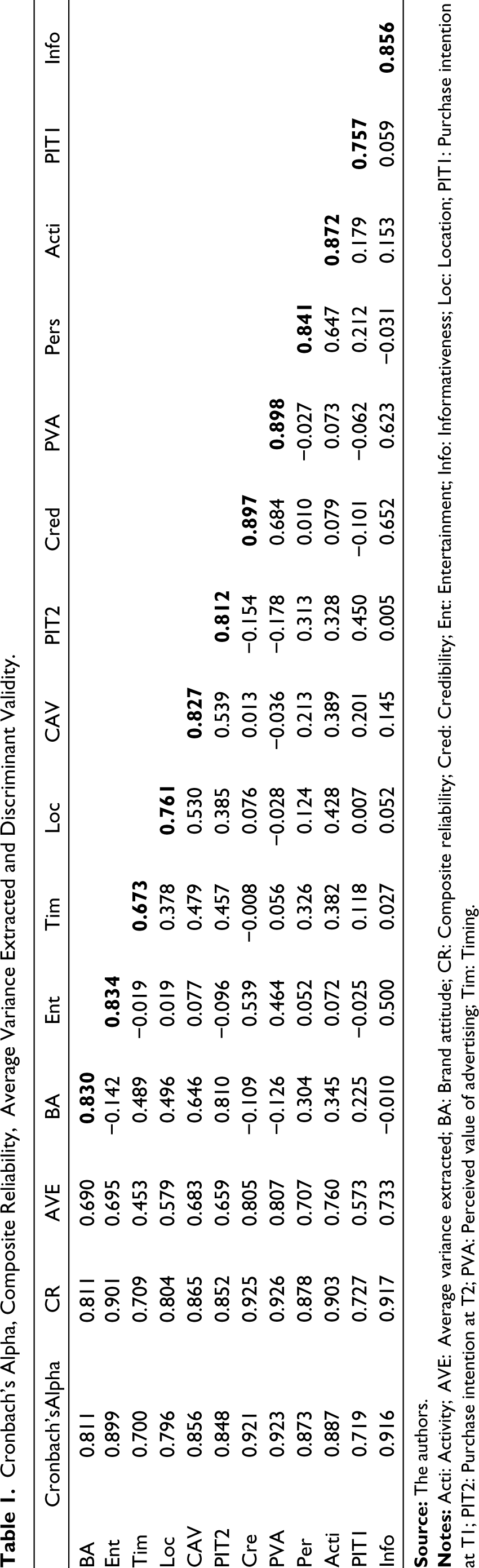
The next, we have examined convergent and discriminant validity. The values obtained for average variance extracted (AVE) and composite reliability were above 0.5 and 0.7, respectively and were thus appropriate. For timing, the value of AVE was 0.453, and Fornell and Larcker (1981) advised that if AVE is less than 0.5, but the composite durability is greater than 0.6, the converging validity of the system is still sufficient. We also conclude that our constructs display satisfactory discriminant validity, square root of AVE for each construct was greater than the association amongst the constructs and the other constructs (Bhattacherjee & Premkumar, 2004).
Structural Model
We have tested our developed hypotheses using structural equation modelling (SEM) in step-wise fashion leading to a model with all major constructs, as SEM can measure the direct effect of observed and latent variables (Hair et al., 1998). The obtained values of the recommended fit indices were χ2 = 1379.680, df = 691, CMIN/DF = 1.99, CFI = 0.921, GFI = 0.893, TLI = 0.808, NFI = 0.899, RMSEA = 0.08 and P close = 0.00. The results helped establish a good fit between data and the model. SEM was used to test the proposed hypotheses (Table 1).
Cronbach’s Alpha, Composite Reliability, Average Variance Extracted and Discriminant Validity
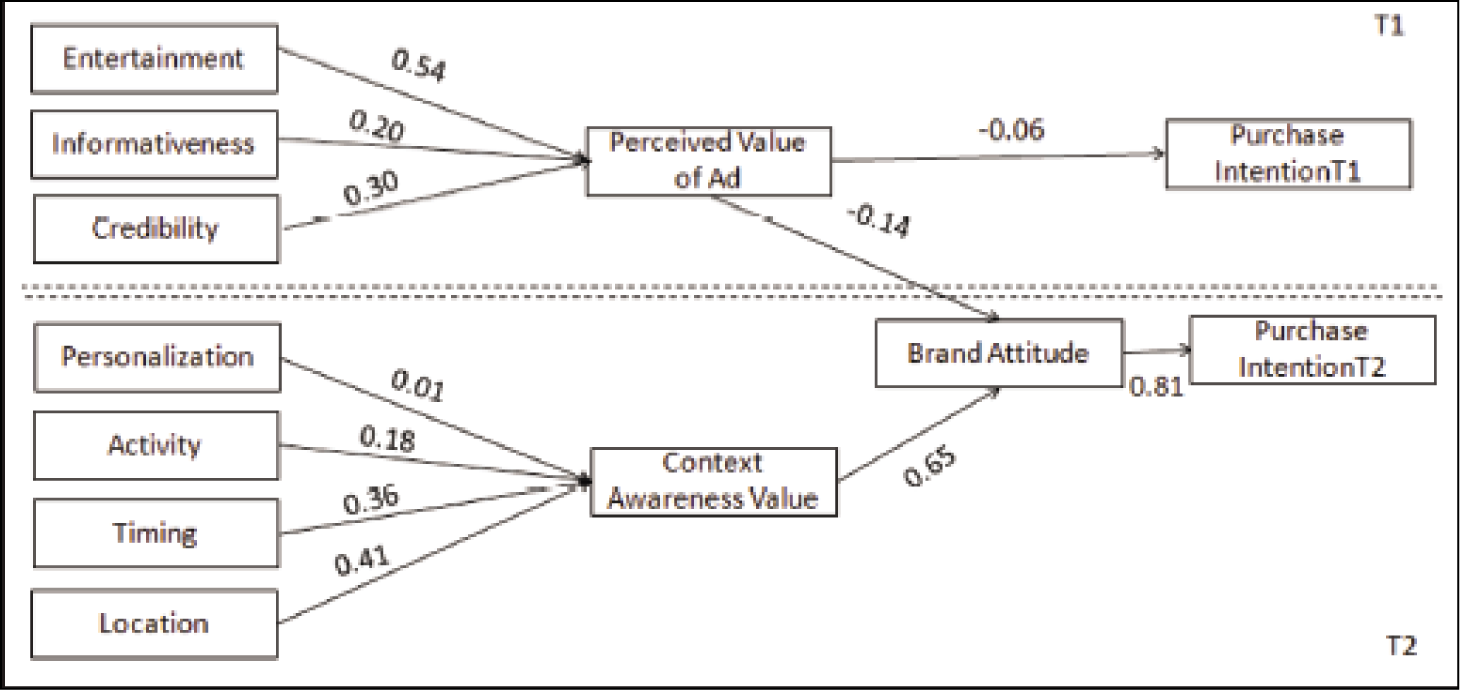
It was found that at T1: entertainment (β = 0.54; p < .05), informativeness (β = 0.20; p < .05) and credibility (β = 0.30; p < .05) were contributing positively to the perceived value of advertisement. Further the relationship between perceived value and purchase intention was insignificant (β = −0.06; p > .05). At T2 three variables activity (β = 0.18; p < .05), timing (β = 0.36; p < .05) and location (β = 0.41; p < .05) were contributing positively to the context awareness value. Further context awareness value was contributing positively to the brand attitude (β = 0.65; p < .05); whereas, perceived value of advertisement was contributing negatively to the brand attitude (β = −0.14; p < .05). Further, at T2 brand attitude was positively contributing to purchase intention (β = 0.81; p < .05) (see Figure 2).
Mediation Analysis
The mediation effect was verified by the bootstrapping process. The bootstrapping approach is recognized as a relatively better way of mediating impact monitoring (Shrout & Bolger, 2002).
First, we have checked brand attitude as mediator between the perceived value of advertisement and purchase intention at T1. It was found that at T1, brand attitude was not confirmed as mediating variables between and purchase intention as the range of values examined were between the bootstrapped lower-level confidence interval (LLCI; −0.631) and upper-level confidence interval (ULCI; 0.0109) were including zero. At T2, the brand attitude was confirming the full mediation between context awareness value and purchase intention. Here, the absence of a zero value verified the mediation effect of brand attitude. The range of values was examined between the LLCI and ULCI (0.0420, 0.1913) respectively.
Overall, at T1, the brand attitude did not have a mediating effect, but at T2, it had a mediation effect on purchase intention.
Discussion and Implications
The onset of the COVID-19 pandemic led to an unexpected change in the buying behaviour of consumers. Various reasons support this statement. One, the consumption of personal hygiene products like sanitizers, soaps and disinfectants increased. According to Statista report (2021), hand sanitizers witnessed a 144% increase in sales in India in 2020 compared to 2019. Liquid hand wash came in second, with a 42% increase. Second, due to government-imposed lockdown and necessary quarantines, consumers looked forward to online purchase. Third, many players selling personal hygiene products started competing in the market. This led to more and more advertisements in the context of FMCG products, specifically personal hygiene products. Moreover, while businesses are currently attempting to set the correct tone during a global health emergency, the future foreshadows market change, more competition and a requirement for innovative and aggressive marketing strategies. This study was conducted to understand the effect of various smartphone advertisement factors affecting consumers’ brand attitude and purchase intention for products of the brand. It was found that for web advertisements, entertainment, informativeness and credibility have a positive impact on perceived advertising value. The results are similar to Brackett and Carr (2001) and Ducoffe (1996). The result also implied that web-based online advertising can be replicated to smartphone-based advertising.
In addition, smartphone advertising can utilize various additional features and hence have an advantage that differentiates smartphone advertising from non-smartphone advertising. Advertisers are prioritizing digital advertising because online environment is favourable for quick response campaigns. These campaigns encourage one-click purchases by consumers which can drive sales. It was found that out of four antecedents, only personalization was not contributing to the context awareness value for the hygiene products during the unlock phase, that is, T2. Many past studies have supported that personalization is an important antecedent contributing the context awareness value (Aguirre et al., 2015 Gasparetti, 2017; Kim & Han, 2014; Lee et al., 2017). However, all these studies were carried out during pre-COVID circumstances. This study is carried out during a pandemic situation. Therefore, in such a situation, personalization is immaterial considering the product being advertised as new. The results show that all cognitive and affective factors including informativeness, entertainment and credibility significantly and positively affect advertising value perception. At T1, it was found that entertainment and informativeness are the strongest determinants, followed by credibility in shaping the advertising value, which contradicts with the results of Haghirian and Inoue (2007). During the lockdown phase, people were at home and entertainment was one of the important factors while spending their entire time in quarantine. Another reason could be the information bombard due to increased media consumption which leads to a preference of entertaining advertisements over informative ones.
Another challenge that brands faced was the heightened focus on brand perception. Consumers were paying attention to how brands are responding to COVID crisis. Empathy and mindfulness through advertising was observed in advertisement narratives across major FMCG brands. The results clearly exhibit that customers have a positive perception about smartphone advertisements when it is pleasing, trustworthy and believable. This result is consistent with the past studies (Ducoffe, 1995; Lee et al., 2017; Trivedi et al., 2020). This study found that the perceived value of advertising did not affect purchase intention at T1. The study was contradicting with past studies (Dao et al., 2014; Martins et al., 2019). Activity, timing and location contributed positively to context awareness value. The advent of artificial intelligence-driven technology has enabled this feature where the customer search data and location are tracked. This helps advertisers in sending communication at the required time to enhance the context awareness value towards the brand. The beta values in this study indicate that the location is the most significant variable, followed by timing and activity. It is evident from the results that context awareness value contributed positively to brand attitude, while the perceived value of advertisement negatively contributed to the brand attitude, which was contradictory to our expectations. Finally, brand attitude positively contributes to purchase intention. These results are in line with the results of Kim and Han (2014) and MacKenzie and Lutz (1986).
Limitations and Future Scope of the Study
Like other empirical studies, there are certain limitations in generalizing the results of this study. First, the population of the survey is limited to India. Further exploration is suggested to generalize the research to other geographical regions considering the varying effect of the pandemic in different countries. The study has considered only Gen Y respondents. In future research, the other generations can be added and comparison can be done to understand the difference in among the generations. Second, a limited number of predictors were investigated for advertising value and context value. Future studies need to consider the mood of an individual as a moderating factor as well the platform of advertisement. Third, perceived advertising value and context value, including social values, emotional and functional perspective may be considered as a second-order factor. Fourth, this research is done in two different time intervals. Although, the respondents were same and we do not believe that the time interval caused any differences in the results, we insist future research to look into the implications if any, of different time frames in the psychological aspects of literature. Fifth, privacy concerns due to personalization and location should be taken into considerations. Sixth, the type of smartphone advertising like text and app has different influences due to varying features. An empirical survey into the effect of privacy concerns on personalization and location should be investigated. Finally, studies in the past have suggested that prior purchase experience influence online purchase intention (Brown et al., 2003). Future research could investigate this factor in detail.
Conclusion
Our study provides contributions to industry as well as academia. It is evident that advertising value alters brand attitude and therefore, it is important to carry out timely measurements of brand image. Purchase intention is the result of positive brand image. This research provides insights on factors that are favourable for effective advertising in terms of content as well as context. Major studies on advertising have considered content as an important factor in shaping the brand image; however, it has become rather necessary to consider context also. The comprehensive model lays foundation for studies on how advertising value perception and context awareness value affect brand image, which is important, in accessing a brand’s prestige and goodwill. In apprehensive situations like the COVID-19 pandemic, it becomes important for marketers to consider these factors.
Footnotes
Declaration of Conflicting Interests
The authors declared no potential conflicts of interest with respect to the research, authorship and/or publication of this article.
Funding
The authors received no financial support for the research, authorship and/or publication of this article.