



Abstract
Value creation, customer engagement and employee engagement have emerged as important organizational outcomes for continued success. At the turn of the new decade, it is imperative to identify new research directions for these outcomes to improve the marketing effectiveness of organizations while keeping people at the centre of this pursuit. The present study is propelled by this motivation. The study started with the exploration of the relationship of customer and employee engagement in value creation, while limiting the scope to services. The extant literature has not studied the three together. The second phase of the study dwelled on identifying common links among the three to develop a conceptual model that brought the concepts of customer engagement, employee engagement and value creation together. Perceived risk was identified as the underlying phenomenon that connected all three to be part of a social system. A conceptual framework has been proposed for connecting perceived risk to customer engagement and employee engagement that would create value in service organizations. The study identifies future research directions for theory building and practice.
Executive Summary
Value creation, customer engagement and employee engagement have emerged as important organizational processes for continued success. In the context of services it is important to understand how value is created through employee and customer engagement. The study addresses this particular research gap. A conceptual model that brought the concepts of customer engagement, employee engagement and value creation in services together has been proposed in the study. The study also identifies the future research propositions that have implications both for theory and practice.
The conceptual framework details how service organizations that want to build on customer and employee engagement absorb the perceived risk for both customers and employees by various means of branding (customer as well as employer branding), employee compensation plans and service guarantees. In such a situation, satisfied employees work towards solving customer’s problems by building solutions that ultimately leads to customer satisfaction. In the process, VCS is created through CE and EE. This is the first study to propose such a framework.
Introduction
Engagement, both customer engagement (CE) and employee engagement (EE), have received abundant attention in the last two decades from academic as well as practitioner communities especially in the service sectors (Lee et al., 2017; Ng et al., 2020). Through ‘engagement’ service organizations make effort to build associations with their stakeholders (Verčič & Vokić, 2017). In a market with highly competitive intensity, sophisticated customer and technology advancements CE and EE provide a sustainable competitive advantage to firms (Kumar & Pansari, 2016; Qin et al., 2014; Van Doorn et al., 2010).
CE has been associated with positive outcomes such as customer satisfaction, increased affinity and relationship quality (Hollebeek, 2011), wellbeing (Van Doorn et al., 2010), along with an enhancement in the firm’s performance (Benn et al., 2015; Kumar & Pansari, 2016; Van Doorn et al., 2010). Similarly EE has been related to improved financial and operational performance of the firms (Hughes & Rog, 2008), increased affective organizational commitment (Lee & Ok, 2016) and lesser burnout (Hakanen et al., 2018; Van Beek et al., 2011).
This study aligns with the objective of finding new research directions in the context of CE and EE with reference to value creation in services (VCS). In service organizations, people play an important role in the marketing mix. People comprise both of employees and customers, where employees are treated as internal customers. Thus engagement is an important organizational construct for both. However despite increased scholarly attention on CE and EE, their remains a gap in understanding their relationship with each other (Chandni & Rahman, 2020; Kumar & Pansari, 2016) and how they could together contribute to value creation in service organizations. Thus we developed the following research question.
Literature Review
The construct CE has been conceptualized and operationalized in several ways in different contexts (Chandni & Rahman, 2020) which depicts that it is an ongoing area for scholarly research as also highlighted by being listed as a research priority by Marketing Science Institute (MSI, 2020) 2020–2022. CE operationalization includes, ‘customer engagement with mobile apps’ (Thakur, 2016, 2018), ‘brand community engagement’ (Kumar & Nayak, 2018), ‘global customer engagement’ (Gupta et al., 2018) ‘customer engagement in tourism brands’ (Harrigan et al., 2017), ‘social media customer engagement’(Rehnen et al., 2017), ‘company engagement’ and ‘loyalty program engagement’ (Bruneau et al., 2018), ‘customer engagement framework’ (Kumar & Pansari, 2016), ‘customer engagement with social issues’ (O’Brien et al., 2015), ‘customer brand engagement’ (Hollebeek, 2011) and ‘customer engagement behaviour’ (Van Doorn et al., 2010). Additionally scholars have used theories that lead to CE in specific contexts such as food delivery apps; user gratification theory (Kaur et al., 2021), innovation resistance theory (Kaur et al., 2021) and dual factor theory (Talwar et al., 2020). The household size as a moderator for brand love in natural products has also been studied (Kumar et al., 2021) and an instrument developed to measure the user’s flow experience on SNS-based brand communities (Kaur et al., 2018).
The research on EE has broadly covered three themes starting with, ‘personal engagement’ (Kahn, 1990), ‘burn out at work place situations’ (Maslach et al., 2001) and a fulfilling state of mind (Schaufeli et al., 2002). Based on Kahn’s (1990) work Saks (2011) also identified and worked on two kinds of EE, one as related to job and second as related to organization. In 2014, Kumar and Pansari have conceptualized EE from the marketing perspective.
There has been a difference in the way dimensionality of CE and EE have been looked at. Several authors suggest them to be unidimensional (Carter & Baghurst, 2014; Chang, 2016; Jarvis et al., 2017; Rehnen et al., 2017) while a large proportion believes them to be multidimensional (Ahuja & Modi, 2015; Hollebeek, 2011; Vivek et al., 2014).
Coming to VCS, the most popular and pioneering work on employee and customer creating value for the organizations in term of profitability was the service profit chain (Heskett et al., 1994). Their work emphasized on the relationship between internal and external service quality that led to increased productivity of employees and improved profitability of firms along with positive outcomes such as customer satisfaction and loyalty. Their conceptual model has been statistically tested and found significant in 2016 by Hogreve et al. (2017). But there are only a few studies on this concept and there is no study that is done from CE and EE perspective taken together (Chandni & Rahman, 2020).
It has also been observed that scholars have emphasized that organizations should concentrate more on engaging not only customers but also employees in order to harvest double benefits of revenue generation through CE and cost-saving through EE (Kumar & Pansari, 2016). Thus CE and EE have received increased attention from both academicians and practitioners (Barnes et al., 2014; Thakur, 2016) and there are now a number of articles being published in both these domains. Despite that there is a continued call to study them together (Islam & Rahman, 2016; Kumar & Pansari, 2016). It is important to mention here that CE has a clear and direct positive association with firm performance and EE also has been shown to be related (Mittal et al., 2018), but there has been no work with reference to EE and CE together contributing to VCS. The Fortune 500 companies host the best places to work and the highest sales revenues; thus, value creating organizations have higher CE and EE but the linkage between them has not been explored. This is the first study that proposes a conceptual model that links EE, CE and VCS and opens up new avenues for firms to formulate strategies and scholars to build theories.
Highlighting the Gap
As discussed in the previous section, the contemporary literature connects VCS with EE bidirectional (Path A), EE with CE (Path B) and CE with VCS (Path C) as shown in Figure 1.
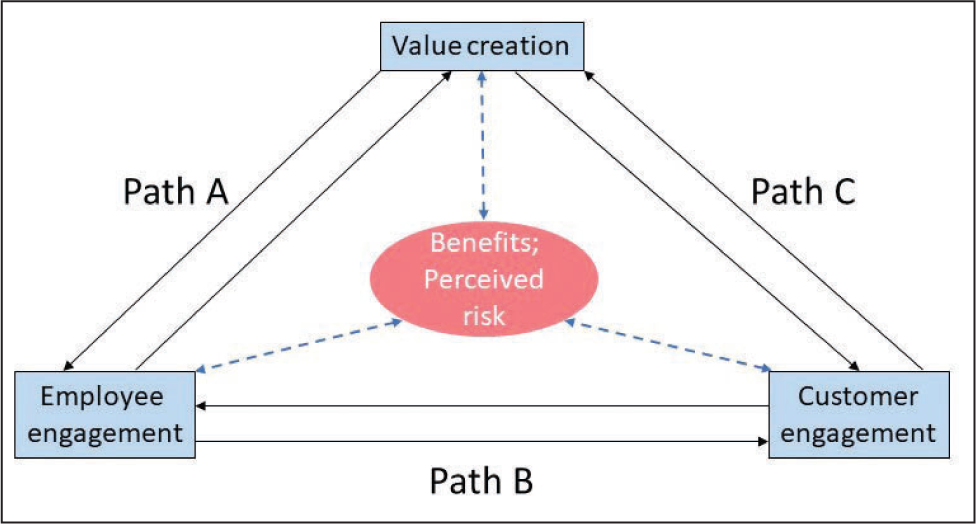
To illustrate, referring to Path A, it is possible that VCS influences EE and EE influences VCS as well. Similarly CE and EE would influence each other and so would CE and VCS. This triangular network, that is, the collection of nodes and links, represents a social system (Lind et al., 2007). One of the basic tenets of a triangular social system with bidirectional connected links is that there is an underlying phenomenon that connects all three nodes (Deri et al., 2018). While extant research has investigated each link (i.e., Paths A, B & C), the phenomenon that underlies VCS, CE and EE has not been explored in the extant literature. Understanding this underlying phenomenon is critical, especially from a services point-of-view. By working on that common link, it is possible for service providers to focus on value creation through CE and EE and also remove the bounds of intangibility. Thus it becomes important to identify the common connections between how companies support value-creating employees and customer relationships.
Extant literature reveals one common aspect that both employees and customers look for from a company—the benefits they seek. While employees seek benefits in the form of job roles, authority and incentives (Armstrong, 2006; Mahaney & Lederer, 2006; Mottaz, 1985), customers look for benefits such as assurance of a high-quality offering, satisfaction with usage and painless post-purchase service, to name a few (Kotler et al., 2009). When both employees and customers receive the benefits they seek, they are likely to become engaged and enter into long-lasting relationships with the company. These relationships are, in turn, likely to be value-creating for the firm as well. Thus, one of the underlying phenomena acting as a tying thread across the notions of VCS, CE and EE are the benefits that customers and employees seek.
Benefits are one dimension of CPV seen as a common link between CE and EE. Another dimension comprises costs that serve as a common link between the two. Costs are the sacrifices a customer has to make in order to acquire an offering. Costs include not only monetary value but also all efforts, risks and insecurities connected to the acquisition and use of a product (Zeithaml et al., 2018). One such cost or sacrifice is perceived risk (PR), which has been identified by Peter and Ryan (1976) as a function of two dimensions that, in its simplest form, can be represented as,
Risk = Probability of consequences occurring x Negative consequences of poor brand choice.
It is also understood that intrinsically human being strive to achieve certainty and reduce the chances of negative consequences through their actions as by the law of nature. Customer’s PR exerts a high influence in the early stage of the consumer buying process in VCS that service organizations absorb to translate into benefits by using the skill and knowledge of their employees. In the process, they also absorb the PR of employees. PR is also important at later stages of building customer relationships, thus making it a central component of CE, EE and VCS). However, the lowering of perceived risk— which is also a common link between VCS, CE and EE—has not been studied. In fact PR is one of the least studied elements in the marketing and workplace literature (Liu & Wnag, 2013; Snoj et al., 2004). Further the role of psychological capital in EE has been highlighted by Karatepe and Karadas (2015). Hence, it would be interesting and worthwhile to look at how and why the lowering of PR may be important for customers and employees of firms at different stages of decision making with reference to CE, EE and VCS. PR has a role to play in all kinds of buying decisions—complex, habitual, dissonance reducing and variety seeking—at all stages in the buying decision—problem recognition, information search, evaluation of alternatives, purchase and post purchase (Mitchell, 1992).
In order to better understand the interrelationships between;
A firm and its customers and A firm and its employees in terms of the
Benefits and the costs involved, and What these employees and customers are willing to give to the company in exchange, an integrative, yet parsimonious framework that incorporates all of these elements is proposed in this study.
Conceptual Framework
Our conceptual framework visualizes the different flows that take place between the entities mentioned above based on what has been researched in the extant literature.
If we consider the flows between a firm and its customers, we see that a customer seeks tangible and/or intangible benefits from a firm (e.g., the assurance of a high-quality offering that lowers the customer’s PR and creates satisfaction with usage) and pays certain costs (e.g., time, efforts— tangible or intangible) to obtain those benefits. Notably, only when the benefits outweigh the costs (e.g., a trusted brand lowers the PR that a customer feels, especially in a services context), customer value is created. Further, according to the service-dominant logic perspective, customers engage in a co-creation process with the firm through the usage of their specialized competencies, that is, knowledge and skills. Vargo and Lusch (2004) note that, ‘The customer is a co-producer of service. Marketing is a process of doing things through interaction with the customer’. Thus, the firm’s role is to deliver a value proposition—rather than value itself—which is co-created when the customer uses the firm’s offerings (Lemke et al., 2011). Hence, the customer is said to be playing a resource-integrating role (Lusch & Vargo, 2006). When benefits consistently exceed the costs and the customer feels better off as a result of this co-creation process (Grönroos & Voima, 2013), the customer’s perceived value (CPV) is high, leading to high customer satisfaction and customer engagement levels (Venkatesan, 2017). The theory of consumption values (Sheth et al., 1991) explains the benefits side of value. The theory has been further extended to give important insights in the context of food delivery apps (Kaur et al., 2021), online travel agencies (Kaur et al., 2021), social media brand communities (Talwar et al., 2020) and mobile instant messaging (Dhir et al., 2020). While the literature has investigated other benefits in detail, the reduction in PR has received scant attention for VCS.
On a similar note, employees seek certain benefits from firms (e.g., job roles, incentives, recognition and social security) and are willing to pay costs (such as their time and effort) for same. These benefits also provide a lowering of an employee’s PR. In exchange, employees also utilize their competencies (i.e., knowledge and skills) to further the cause of the firm for which they work in order to maintain a constant flow of the benefits accruing to them. Thus, service employees create value for the organization and customers by offering their skills and knowledge to generate unique solutions. Again, when employee benefits consistently outgrow their costs, that is when employee value is created, employees feel happy working for a firm. This leads to a high level of employee satisfaction, which ultimately leads to increased employee engagement.
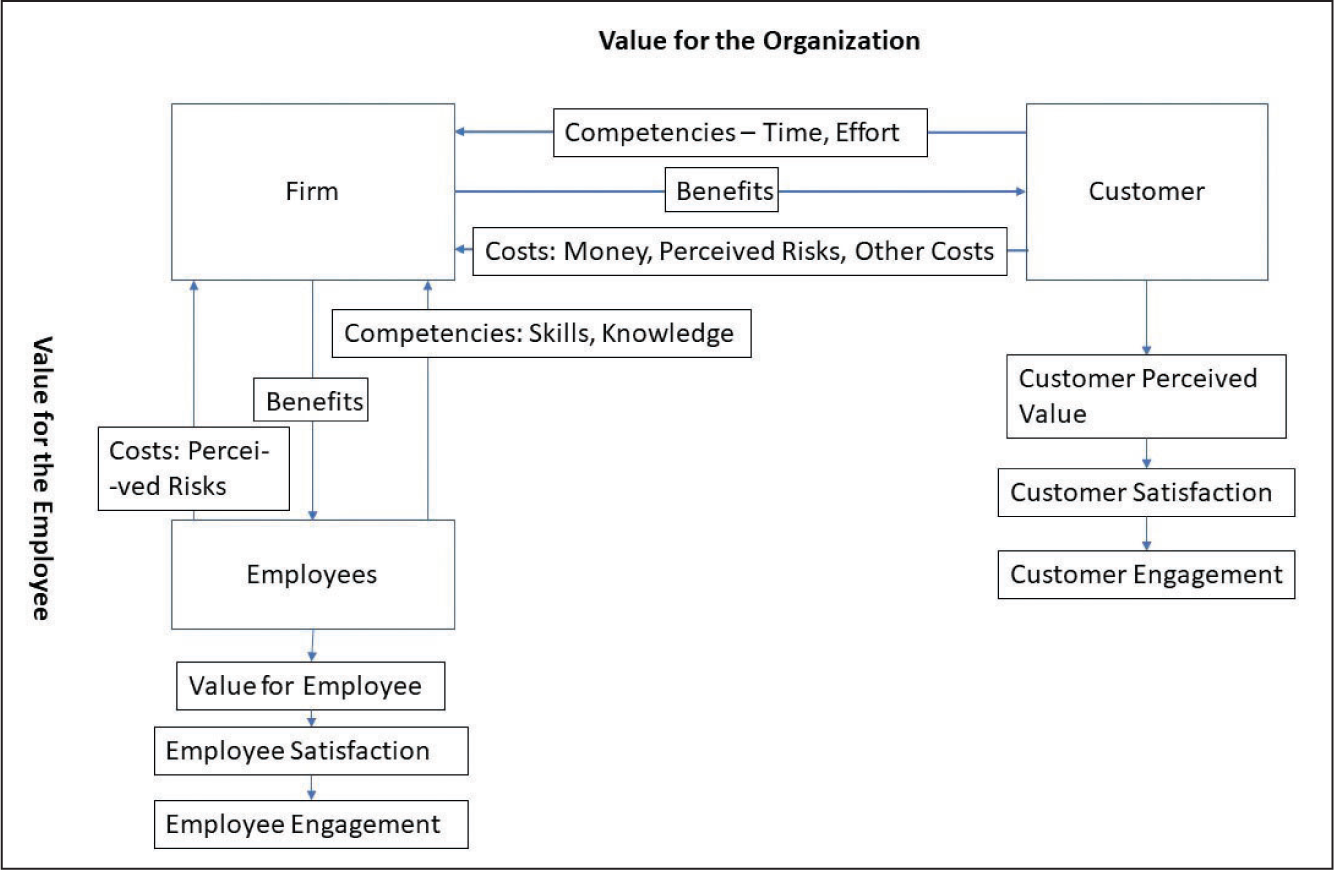
Figure 2 illustrates the interrelationships between:
a firm and its customers; a firm and its employees in terms of the—(a) benefits and the costs involved; and (b) what these employees and customers are willing to give to the company in exchange.
The picture that emerges when we combine the flows shows that service organizations that want to build on CE and EE absorb the PR for both customers and employees by various means of branding (customer as well as employer branding), employee compensation plans and service guarantees. In such a situation, satisfied employees work toward solving customers’ problems by building solutions that ultimately lead to customer satisfaction. The process engenders both employee and customer value, which further leads to CE, EE and, thus, VCS.
It is also important to highlight that while PR may have an antecedent role to satisfaction and engagement at the customer and employee acquisition stage; it may continue to have a moderating role in the onward journey. Profitable loyalty and satisfaction need to be understood and taken to a higher level as the customer moves from the acquisition to the retention stage (Pansari & Kumar, 2017). Thus, factors such as trust and commitment that come into play for building relationships and engagement are also related to the lowering of PR. The extant literature on EE and CE that starts with satisfaction of employees and customers needs to pull backward to understand it even better. Here it emerges that PR may have an important anchor role in CE, EE and VCS.
Bridging the Gap: Proposed Research Directions for Theory Building
As highlighted in Section 4 regarding VCS it emerges that PR is an important psychological dimension for both customers and employees in a service organization. The organization absorbs the PR of both these parties to create and deliver value for them as well as itself. Future research must be guided in terms of the following theory-building propositions with reference to perceived risk versus VCS, CE and EE;
Customer PR as an antecedent of CE in the first time purchase decision with reference to VCS; Employee PR as an antecedent of EE at the time of hire; The themes of trust, purchase intention and technology adoption have been studied extensively in services with reference to perceived risk; however, there is a need to study these themes along with PR for their association with VCS along with CE and EE; PR is important even in a repeat purchase context and thus its linkage with VCS, CE and EE in that context needs to be studied. The role may change from being an antecedent—as in the first time purchase decision—to a moderator/mediator role; The interrelationship between the constructs of VCS, CE and EE may explore many new directions; for example, job security—revenue—customer loyalty. In fact, each is a multi-dimensional concept, and the dimensions may be interlinked and interrelated.
The anchoring of service organizations on VCS, CE and EE through PR is aligned with the co-creation of value with stakeholders and could open possibilities for innovations that can be used both in practice and theory.
Implications for Marketing Practitioners
To remain successful in business and continued growth, organizations need sustainable competitive advantage. Already companies such as Google have created workplaces which engage employees and products that engage customers while creating value for the company. Yet there is a constant look out for what next can be done. The next step would be how to continue and evolve in their CE and EE practices. Lowering of PR of both employees and customers opens up a new avenue to start building such practices in these organizations for new and existing customers.
Conclusion
This study provides a detailed conceptual overview of the role of PR in VCS through CE and EE. It is the goal of all organizations to sustain themselves and remain successful while continuously creating and/or providing value for all its stakeholders, which includes customers, employees, investors, society and itself. VCS, CE and EE are constructs that would enable this and have been addressed in the literature. However, it is sometimes important to change a viewpoint and look at the same concepts with a fresh perspective in order to see new dimensions involved that could be productive. We have attempted to do this in this study in which we identify PR as a new lens through which the concepts of VCS, CE and EE may be examined by marketing researchers and practitioners. This fresh perspective would enable extending these concepts, singularly, dually and triangularly, as well. The conceptual part, where the three concepts need to be studied together is yet to be addressed in the literature, but as the field of marketing, the individuals and the organizations evolve, the new decade must start with exploring this dimension as well.
Footnotes
Declaration of Conflicting Interests
The authors declared no potential conflicts of interest with respect to the research, authorship and/or publication of this article.
Funding
The authors received no financial support for the research, authorship and/or publication of this article.