



Abstract
The purpose of this study was to examine the influence of brand personality and brand loyalty on repurchase intention of Pakistani mobile phone users. The population for this study comprised master’s students at large public sector universities of Pakistan. Results of 318 responses indicate that sincerity, competence, ruggedness and sophistication significantly predicted brand loyalty, while the excitement dimension of brand personality failed to predict brand loyalty. It was also found that brand loyalty positively predicted the repurchase intentions among mobile phone users of Pakistan. The study also tested the moderating role of relative brand identification in the relationship between brand loyalty and brand repurchase intentions. By making overall significant contributions to the existing body of literature, the test of moderated regression analysis indicates the presence of a moderating role of relative brand identification. With remarkable contributions, this research presents valuable insights to marketers and stakeholders, helping them to understand brand personality, rebuild marketing strategies, boost brand loyalty, grasp relative brand identification, gain a competitive edge, make informed decisions and stay relevant in the market.
Highlights
Mobile phones have become the main way people communicate globally, especially in developing regions with over 8 billion users.
Brands’ behaviours normally associated with the behaviour of human traits by the companies to identify the actual reaction of their respective brands.
Over 90% of mobile phone users in Pakistan are using social networks, which is a smooth way to collect data to get desired results.
Customer who has a tendency and attitude of repeatedly purchasing a product from the same brand with more involvement in the attributes and status of the brand is considered as the loyal customer of brand.
Introduction
Mobile phones have become the main way people communicate globally, especially in developing regions, with over 8 billion users, including in rural areas, for economic and social development (Bhavnani et al., 2008; Nikolopoulou et al., 2023). The mobile phone is recognized for its positive impact on users with a particular focus on rural and underserved areas, revolutionizing development, and huge contributions in human development (Khan et al., 2022; Kreutzer 2009; Shaffril et al., 2009; UNESCO, 2015). With this growth, cell phone manufacturers have continually launched new features to mobile phones over the years to enhance their functionality and appeal to consumers. For buying behaviour, previous research has explored mobile phone feature preferences (Economides & Grousopoulou, 2009; Haverila, 2011), significant relationships between service quality, customer satisfaction and purchase intentions within Pakistan’s cellular industry, offering valuable insights for both businesses and future research in this area (Ali et al., 2010; Javed & Khan, 2022), but did not examine the statistical relation of brand personality and brand loyalty on repurchase intention in Pakistani context, leaving a gap in understanding this relationship. The main objective of this study is to investigate the influence of brand personality and brand loyalty on the repurchase intention of Pakistani mobile phone users.
In the age of digitalization where authenticity is a main concern for individuals, brand behaviours matter more than ever. In this era, it is quite crucial to explore how companies are aligning their actions with their values by creating a meaningful impact for stakeholders. Brands’ behaviours are normally associated with the behaviour of human traits by the companies to identify the actual reaction of their respective brands (Aaker, 1997; Jiménez-Castillo & Sánchez-Fernández, 2019; Leonard & Prevel Katsanis, 2013). Apple is an example of brand personification to elaborate the personality of its brand/s. It is important to realize the fact that brand recognition plays a pivotal role in a product’s market positioning, which constitutes a fundamental imperative for sellers who are seeking to establish their presence within a competitive marketplace.
Over the years, the mobile phone industry in Pakistan is getting rapid growth due to improving lifestyles and communication methods in the digital era, with significant potential to boost the country’s economy (Imtiaz et al., 2015; Jamshed et al., 2022) and people are much aware about the use of the product and available brand options in Pakistan (Iqbal et al., 2017; Majeed et al., 2022; Nawaz et al., 2019). According to the statistics issued by the Pakistan Telecommunication Authority (PTA), there were 165 million registered users of mobile phones in Pakistan by December 2019 and 194 million in 2022, respectively. According to the information from the Pakistan Advertisers’ Society, a significant portion of 60% of the users carry more than two mobile phones/brands while 7% are those users who carry more than three mobile phones/brands. Additionally, nearly 90% of the users are in the age range of 21–40, who are our target respondents in this research. Furthermore, over 90% of the mobile phone users in Pakistan are using social networks, which is a smooth way to collect data to get desired results. Based on the awareness, usage and knowledge about this industry, mobile phone users have been selected for this study to collect data for branding, brand personality and brand loyalty. This study will provide an overview by examining how brand personality and loyalty are influencing repurchase intentions among mobile phone users in Pakistan by highlighting the importance of aligning company actions with values in today’s authenticity and competitive-driven market. It will provide the perspective on how brand behaviours relate to human traits by impacting consumer choices and emphasizing the emotional aspect of buying decisions. With a substantial mobile phone user base in Pakistan, this research holds relevance for this key market segment.
Nowadays, brand concept has emerged as an important note while examining the aligned concept such as Ramaseshan and Tsao (2007) research found that Colgate toothpaste, which has brand competence, can be linked with Pantene shampoo, which has excitement in its brand personality. This research is significant as it sheds light on the dynamics of brand personality, loyalty and repurchase intentions within the context of Pakistan’s rapidly growing mobile phone industry, providing valuable insights for marketers, businesses and stakeholders. It also addresses the need for aligning company actions with values in the era of digitalization, where brand behaviours play a pivotal role in consumer choices and emotional buying decisions.
It means that distinctive brand personality of a specific brand enhances and improves the brand equity of that brand based on the image and personality given by the consumer (Keller, 1993; Mohd Johan et al., 2022; Vahdati & Mousavi Nejad, 2016). Following this perception, companies try to give different dimensions to the same product categories so that they may achieve maximum brand personality image in the minds of consumers to gain and attain brand equity in the market. Asti et al. (2021) emphasize that repurchase intention of a customer depends on trust in the brand, while also indicating that buying behaviour theory facilitates a connection between trust, brand recognition and purchasing decisions. For small businesses, the internet’s affordable advancements offer new opportunities, particularly in financial technology services. It is important to realize that mobile payment providers should prioritize perceived usefulness and ease of use over concerns about perceived technology risk for small businesses (Wiradinata, 2018). For mobile payment services adoption, behavioural beliefs, social influences and personal traits are crucial factors in adoption, with varying impacts on behavioural intention at different stages (Yang et al., 2012). This will happen only in the case that the buyer is fully independent to examine the traits of the brand. In sum, the main aim of current research is to examine the influence of five dimensions of brand personality and brand loyalty on repurchase intention, and the moderating role of relative brand identification on the said impact in the context of Pakistan. This research provides insights for future managers and businesses to understand how brand personality affects brand loyalty and repurchase intentions, enabling them to develop effective marketing strategies, build emotional connections with consumers and stay competitive in the evolving Pakistani mobile phone market.
This research focuses on the statistical relationship between brand personality, brand loyalty and repurchase intention within Pakistan’s expanding mobile phone industry. Existing studies have explored multiple aspects but still lack specific attention to how brand personality and loyalty influence repurchase intentions among mobile phone users in Pakistan. The research aims to fulfil the research gap by providing valuable insights into consumer choices in the dynamic Pakistani mobile phone market. This article is structured as follows by providing the literature review in the first section, including a discussion on defined variables. The second section presents the study’s methodology, results, as well as the contribution. The final section concludes along with a discussion on future directions with managerial implications, study limitations as well as conclusion.
Literature Review and Hypothesis Development
Brand Personality
Personality is a set of different traits that shape a person’s overall image and sketch (Allport, 1937; McAdams & Pals, 2006). It is a kind of some values and ideas about the people, product and/or place that people have in their minds and have sketched (Church & Burke, 1994; Perey et al., 2018). It is basically a set of habitual behaviours that collectively create the image of that person, thing and/or place (Mischel, 2013; Murray, 1938), including some biological and environmental factors that shape the personality of a person/thing (Corr & Matthews, 2009; Lee, 2019). Commonly, there is no general rule or specific definition of personality, while most theories focus on the interaction between motivation and the environment of the individuals. There are many approaches used to study personality that may include biological, trait-based, cognitive, learning and humanistic approaches (Biesanz et al., 2003; Przybył & Pawlak, 2023). So, different traits have been used in the psychology of personality that may include five-factor models (Goldberg, 1993), Eysenck Personality Questionnaire (Eysenck & Eysenck, 1975), Sixteen Personality Factor Questionnaire (Karson & O’Dell, 1976) and Temperament and Character Inventory (Cloninger, 1994). Brand personality helps in the positioning of the brand that causes in differentiating the brand from others in the market (Sung et al., 2010). Every brand has its own personality, that goes beyond its colour and logo (Browne, 2017). Brand personality is the voice of the company that seeks to establish a personal connection with the customers and have them identify with that personality (Hvam, 2022; Litvin et al., 2016). Therefore, while developing brand strategies, it is necessary to identify human personality traits that are related to the personality of the brand. So, the profile of brand personality provides guidance to brand managers in a wide variety of fields like marketing, advertising or designing. Although there is a considerable amount of research on different attributes and features of the brands (Jacoby et al., 1974; Martins, 2015), Aaker (1997) elaborated the brand personality through a proper and conceptual framework (Su & Reynolds, 2017). The defined brand personality scales of Aaker (1997) have not been challenged, and regular research is being conducted using these scales as a standard for brand personality. From all the above definitions of brand personality, we will try to find out whether these commonly used brand personality scales actually measure brand personality in its true spirit according to the market demand or not (Azoulay & Kapferer, 2003; Ghodeswar, 2008).
Brand Personality and Brand Loyalty
When a company wants to launch a new product, it tries to launch the product with unique and differentiated features that may distinguish it in the market. Based on these differentiated qualities, the customers recall those qualities to find that product in the market (Netemeyer et al., 2004; Pina & Dias, 2021). A customer who has a tendency and attitude towards purchasing of a product from the same brand repeatedly with more personal involvement in the attributes and status of the brand is considered as the customer is loyal to that brand (Bloemer & Kasper, 1995; Tucker, 1964). Now, categorizing the brand personality traits, it is necessary to find out the brand personality construct that may influence consumer behaviour. Since there is a lack of consensus of brand personality traits; therefore, it is difficult to apply the entire brand personality traits as a standard on all the product categories (Keller, 2016; Radler, 2018). Since these differences in choices, Aaker (1997) categorized brand personality dimensions by standardizing them. It is important to understand that consumer perceptions and emotions linked to the brand personality are crucial, as emotional connections drive brand loyalty. In this regard, implementation of effective communication strategies across various touchpoints, creating positive consumer experiences and fostering trust and credibility are key components (Raeisi et al., 2023). Additionally, capitalizing social influence and continuously adapting new strategies based on consumer feedback contribute to building long-lasting connections.
Sincerity
The first dimension of brand personality described by Aaker (1997) is sincerity. When we think about sincerity, some kind of words like honest, genuine, wholesome and cheerful come to mind that are associated with this dimension. Consumers are overwhelmed with brand messaging throughout the day, which creates very little impact on the consumers (Coursaris et al., 2013; Gutierrez et al., 2023). The more impact comes through the native and cultural use of a product. When an individual feels relatedness regarding a product or service and relates it to their culture and nativity, the sincerity towards the product/service will increase as compared to the product that is presented in standard format (Puzakova et al., 2015). Sincerity of brand is that a customer may consider it a personal thing and more related to their personal and social life (Aaker et al., 2004). Therefore, where the customers are more anxious towards their self-concept, the brand sincerity is more appealing and attractive to them (Tuan et al., 2012). Consequently, the sincere brands build a very good long-term relationship, and people have greater trust in these brands because people feel the self-relatedness to these brands (Heding et al., 2015; Lee et al., 2022), which will ultimately lead to more customers’ attraction through word-of-mouth (WOM) from those satisfied customers. Aker et al. (2004) also mention that customers always prefer those brands on which they have trust and sincere relatedness of their characteristics, and that will ultimately increase the chance of a stronger relationship with the brand and preference of the brand also increases. Deriving from the above discussion in literature review, it has been found that brand personality is a significant predictor of brand loyalty. Therefore, the dimension of brand personality (i.e., sincerity) is also expected to influence brand loyalty. Hence, we posit:
H1: There is a positive relationship between sincerity and brand loyalty.
Competence
The second dimension of brand personality mentioned in (Aaker, 1997) a study is brand competence. The attributes represented in this dimension of brand personality are intelligence, achievement, consistency, capability and proficiency (Eisend & Stokburger-Sauer, 2013), that is to say, how much competencies a brand has that are positively related to the personality of the brand (Ramaseshan & Stein, 2014). Following the establishment of sincerity in the branding process with customer perspective, the next phase involves assessing the product’s competence and evaluating its ability to fulfil the promises made by the brand to its customers (Ogbuji et al., 2016). When the personality of a brand is strong enough to attract customers and retain them, it will lead to the condition of favourability, uniqueness and strength in the minds of the customers (Aaker, 1997). Based on these integrity and strength, the organization must align itself to retain the same position of the brand so that more and more strong image can be attained and retained in the minds of the customers (Godsey et al., 2020; Ogbuji et al., 2016). The strength of the brand and support of the organization to the strength of that brand increases the attraction of customers (Aaker, 1999) through the WOM of existing loyal customers (Raab et al., 2016). Brand competence also plays a major role in the service industry through brand distinction in the market (Ogbuji et al., 2016; Ren et al., 2023). So, brand competence is a very important trait of brand personality that creates distinction in the market (Aaker, 1999). Deriving from the above discussion in literature review, it has been found that brand personality is a significant predictor of brand loyalty. Therefore, the dimension of brand personality (i.e., competence) is also expected to have a positive influence on brand loyalty. Hence, we posit:
H2: There is a positive relationship between competence and brand loyalty.
Excitement
The dimension of brand personality in the third step is excitement (Aaker, 1997). It consists of traits like playful, daring, spirited and imaginative; competence and excitement have been considered as related to the inner part of human emotions (Furnham, 2022; Stenros, 2015; Toldos-Romero & Orozco-Gómez, 2015). So, Aaker (1997) found that these dimensions are positively related to the human attributes of competence, excitement and sincerity. Due to these relationships, the customer will be very excitedly involved in interactions with the brands to whom they are loyal (Russell-Bennett et al., 2007). Deriving from the above discussion in literature review, it has been found that brand personality is a significant predictor of brand loyalty. Therefore, the dimension of brand personality (i.e., excitement) is also expected to positively influence brand loyalty. Hence, we posit:
H3: There is a positive relationship between excitement and brand loyalty.
Sophistication
The fourth dimension of brand personality that has been identified and presented by Aaker (1997) is brand sophistication. Charming, well-refined, elegant and intricate personality of a brand (Aaker, 1997). Ultra-premium position, the toughest personality in the market is sophistication (Aaker, 1997). Armani, Versace and iPhone are sophisticated brands in the market. There is a lot of patience required to achieve that place in the market. Despite decades of struggling in the market, brands remain unsuccessful to achieve such a position of sophistication (Martin Ruiz & Rosa, 2017; Van Loggerenberg et al., 2021). According to Litvin et al. (2016), competence and sophistication are very important dimensions of brand personality in the field of hospitality and tourism. Sophistication plays an important mediating role between brand personality and brand loyalty (Litvin et al., 2016). From the work of Litvin et al. (2016) on tourism industry, they found that customers can differentiate between two places based on the brand personality identified by them. From all these studies, sophistication is a very critical and technical trait of brand personality that plays a very crucial role between brand personality and brand loyalty. Brand sophistication is a very significant predictor between brand personality and brand loyalty (Ramaseshan & Stein, 2014). Therefore, the sophistication dimension of brand personality is also expected to influence brand loyalty. Hence, we posit:
H4: There is a positive relationship between sophistication and brand loyalty.
Ruggedness
The fifth dimension of brand personality is brand ruggedness/toughness (Aaker, 1997). More powerful, tough, forceful and potent come to mind when we think about the dimension of ruggedness. There is a long history of relationship between brand and the people. This relationship is a hotspot for the marketers as well as for the academicians (Fennis et al., 2005). Marketers are interested to find out the key to strike at the right time by targeting the right customer from the targeted group (Ewing & West, 2000; Putri, 2021). On the other hand, academicians are interested to find out why customers are more interested in some specific brands than others and what role symbol and social interaction play in the process of this likeness (Belk, 1988). To find out these questions, they have largely focused on the role of brand attributes that are causing the main source of attraction for a customer in the market (Fishbein & Ajzen, 1977). It has been studied whether the trait of ruggedness of brand personality matches the human personality traits and whether the assessment is the same as the assessment of human personality traits (Balabanis & Karpova, 2022; Fennis et al., 2005). So, the ruggedness in brand personality traits of Aaker (1997) has been taken from the Malhotra (1981) scales that have been developed on self-concept, person concept and the brand concept. Fennis et al. (2005) found that ruggedness is very effective and positive if it is exposed intensively through a strong brand for a long period. Deriving from the above discussion in literature review, it has been found that brand personality is a significant predictor of brand loyalty. Therefore, the ruggedness dimension of brand personality is also expected to influence brand loyalty. Hence, we posit:
H5: There is a positive relationship between ruggedness and brand loyalty.
Brand Loyalty and Repurchase Intention
From all the above reviews, whether the buying decision is conscious or unconscious, it is based on trust that comes from the performance of the brand and its value (Guo et al., 2017). The main identity of brand loyalty is that loyal customers do not purchase alternatives in case the required brand is not available (Alnawas & Altarifi, 2016; Ozuem et al., 2021). Brand loyalty and repurchase intension are positively supported by online WOM, which leads to the response of customer to not switch to different products of competitors, as well as preference of use that specific brand (Imtiaz et al., 2015; Khan et al., 2012). Repurchase intention is widely affected by marketplace convenience, place and time, availability of product convince and money, intention of the customer, accessibility to the product, etc. So, from the research of Seiders et al. (2012), it is found that the moderating effect of repurchase intention is not much effective towards the satisfaction of customer. Similarly, we cannot predict repurchase intention from the repurchase behaviour of the customer from convenience products like daily life use products (Ananda et al., 2023; Chandon et al., 2005). It is because the switching cost in convenience products category is very low as compared to costly goods and products. On the other hand, customer satisfaction has an impact positively on the repurchase behaviour as well as on the repurchase intention (Ramamoorthy et al., 2018; Seiders et al., 2012). Many researchers have found that normally managers rely on the sale outcomes by using different techniques to find out the repurchase intention of the customers (Chiu et al., 2014). It is perceived that a customer with high brand loyalty who repeatedly purchases a brand and shows strong commitment is considered as having more repurchase intention (Shin et al., 2017). Furthermore, attitudes, subjective norms and perceived behavioural control collectively impacted the intention to repurchase (Hongyan & Zhankui, 2017). Similarly, a familiar brand has great impact on the choice of the customer to select a brand that will lead to repurchase intention (Laroche et al., 1996; Jeng, 2017). People are also becoming status conscious in the use of mobile phones (Katz & Sugiyama, 2005; Wallis, 2015), therefore, it is considered as luxury item and customers are more concerned with social comparison in the purchase of luxurious items (Eom & Seock, 2017; Pillai & Nair, 2021) like mobile phones, luxury houses, luxury cars, etc. Because of this review and analysis, customers who are loyal to a specific brand and those who are conscious of a specific brand based on luxury and social status lead to repurchase intention. Based on all this discussion, practically, there is a difference between experience and the expectations regarding customer satisfaction for repurchase intention (Hill & Alexander, 2017).
H6: There is a positive relationship between brand loyalty and repurchase intention.
Relative Brand Identification as a Moderator
The concept of identification came from social identity theory (Stets & Burke, 2000). Individuals go beyond self-identification and try to match the concepts to the society by comparing themselves and their thoughts and moods. Based on that comparison, the individuals try to find out the possible match based on self-classification about the society (Mael & Ashforth, 1992). Some marketing literature suggest that trust comes from the experience of the customer with the brand (Delgado-Ballester et al., 2003; Joshi & Garg, 2021; Ravald & Grönroos, 1996). Since the organizational research has identified that identification-based trust, therefore, is more favourable as compared to the experience as mentioned in marketing literature (He & Li, 2011). Based on consumer identification, the next step is the consumer’s commitment after establishing the trust in brand (Tuškej et al., 2013; Tanoglu, 2018). So, the main point of this notion is to find out how much a consumer is psychologically and emotionally committed to that brand (Tuškej et al., 2013; Valette-Florence & Valette-Florence, 2020). The evidence from previous research has identified that the identifying behaviour of the consumers in relative brands may have a moderating impact on brand personality and brand loyalty. Thus, in the current market where there are few brands (iPhone, Samsung, Oppo, Huawei, Qmobile, etc.) having strong competition in the market, it becomes difficult for the brands to find out the position in the market; therefore, relative brand identification is very suitable and the customer is the best source to find out the relative brand identification where they compare the same product category in the market and give position to different brands based on the brand personality traits. Further, we propose that relative brand identification better predicts brand loyalty than single brand identification. So, we have extended the previous research (wherein consumers’ identification was based on a single brand) (Kuenzel & Halliday, 2010; Vincken, 2020) by examining the positive role of relative brand identification on brand loyalty in the Pakistani mobile phone market, which is hypothesized as follows:
H7: Relative brand identification moderates the relationship between brand loyalty and repurchase intentions such that greater the relative brand identification stronger the relationship between brand loyalty and repurchase intention.
As shown in Figure 1, the conceptual framework depicts five dimensions of brand personality (sincerity, excitement, competence, sophistication and ruggedness). These five dimensions will influence brand loyalty, which in turn leads to the repurchase intention among the consumers.
Research Framework.
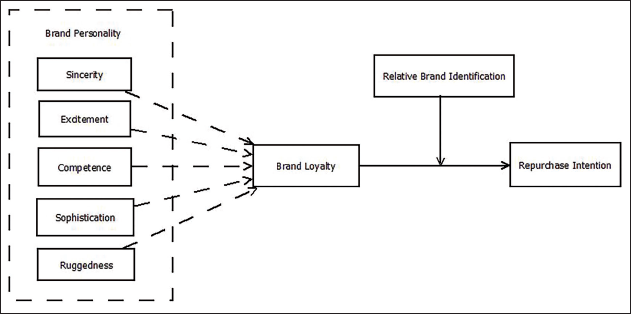
Research Framework.
Sample and Data Collection Procedure
The main aim of this study is to find out the influence of brand personality and brand loyalty on repurchase intention based on the case of mobile phone users from Pakistan. This study was carried out on master’s students from large public and private sector universities from Rawalpindi/Islamabad and Lahore. Majority of them were male (76.5%), average age of respondents was 37.25 years and most of them were private sector employees (53.75%). Almost all of them were bearing smartphone with them. Considering the guidelines of Ruane (2005), this study considered 50% of the population as a suitable size as sample. Before this, we conducted a pilot study on master’s students in a university and confirmed the research design to carry on this methodology. Thus, sample size of the study covered 310 responses. The size was also considered suitable, as Pituch and Stevens (2016); Steven (2002) commented that a researcher should distribute at least 10 questionnaires against each item. Thus, the sample size was well above the said value (27 items × 10). For data collection, random sampling technique was used, where every targeted person from the population has an equal chance to be selected. Self-administrated questionnaires were sent to the targeted population in the form of Google Form as a soft copy using different social media (WhatsApp, Facebook, Google+, email links, etc.) in April 2023. During the first four weeks, 229 responses were received. After further follow-up (two more weeks), 81 more responses were received. Thus, collectively 310 responses were received. Table 1 represents the results of demographics.
Results of Demographics.
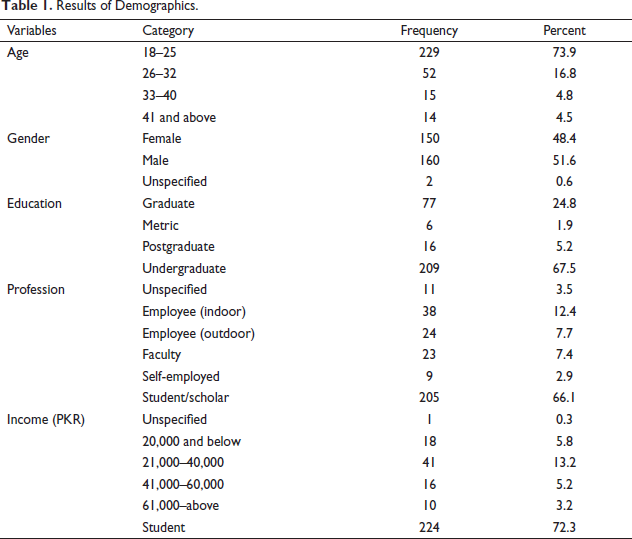
Results of Demographics.
Conducting a pilot study is instrumental in assessing the questionnaire’s relevance and reliability. The primary aim of a pilot study is to identify and rectify errors in the research design before the final testing phase. This preliminary testing of the questionnaire is considered crucial for all types of research endeavours. It facilitates the identification and elimination of biased questions, ensuring that only well-constructed and meaningful questions are included in the final research instrument. According to Cooper and Schindler (2003), the recommended size for a pretesting questionnaire ranges from 25 to 100. In the current research, 55 questionnaires were collected for the pilot study to check the reliability of the data. The research instrument’s reliability was assessed using Cronbach’s alpha, and Table 2 illustrates the reliability of the variables utilized in the current pilot study involving 55 questionnaires.
Reliability Table for Pilot Study.
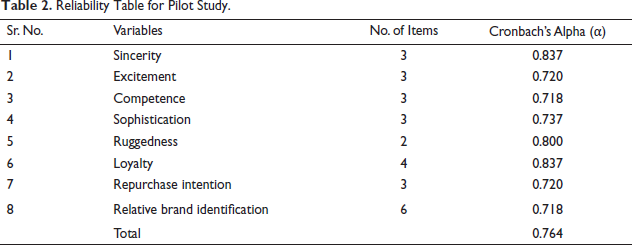
Reliability Table for Pilot Study.
The Cronbach’s alpha values mentioned in Table 2 indicate the internal consistency and reliability of each item in the questionnaire. The established standard for assessing reliability acceptability is ≥0.70. In the context of this research on supply chain resilience, the reliability for the five items is approximately 0.905. The total overall reliability of the research instrument, consisting of 47 items, is 0.930 (93.00%), signifying a commendable overall reliability of the collected data.
Demographics
Most of the population of Pakistan is very young age people (Asif & Pervaiz, 2019). In the survey, 73.9% of respondents belong to the 18–25 age group while 16.8% belong to the 26–32 age group. So, from the survey, it has been confirmed that most respondents are young with age below 32. Since the Pakistani society is male dominant (Khan et al., 2012), therefore 51.6% of respondents were male and the rest of 47.7% were females. The targeted population is young age individuals who are representing most of the population of Pakistan. The said population mostly exists in universities and colleges who are using social media through mobile phones, therefore the most suitable place for collection of data is the universities.
Most of the respondents were university students. It is necessary for better understanding of the questionnaire; therefore, university students are well-targeted respondents for our research. In this survey, 67.5% of respondents were undergraduate (based on majority representation of young age individuals), 24.8% of respondents were graduates and 5.2% were postgraduates.
If we categorize the respondents based on nature of employment, 12.4% of respondents were indoor employee, 7.7% were outdoor employee and 7.4% were faculty members. Since the taste of every employee differs based on the employment status (Sharma & Warkentin, 2019), therefore the data have been collected accordingly.
Since the data have been collected from the universities, therefore 72.3% of respondents belong to student groups. From the employed students, majority (13.2%) have their income between 21,000–40,000 while 5.2% belong to the 41,000–60,000 group. During the data collection, it has been found that 3.2% of students (employed) had their income above 61,000.
Mobile phone product has been selected for data collection. All the available brands have been studied but, during the study, it has been found that major portion of the market (85.1%) has been captured by five big mobile phone brands (iPhone, Samsung, Huawei, Qmobile and Oppo). Following previous research, the questionnaire has been divided into four parts. All the parts have been selected from different questionnaires. These four parts consist of brand personality, brand loyalty, repurchase intention and relative brand identification. Brand personality consists of 5 items and 14 questions (Aaker, 1997), brand loyalty has 4 items (Chung & Park, 2017), repurchase intention has 3 items (Jalilvand & Samiei, 2012) and relative brand identification has 6 items (Mael & Ashforth, 1992). The generalizability and validity have been confirmed and tested.
Non-response Bias and Common Method Bias
To address the potential non-response bias, we conducted a comparative analysis using a paired t-test in SPSS software, specifically focusing on the responses of early and late responders. For this evaluation, we selected the initial 50 and the final 50 responses from the dataset. The results revealed no significant difference between the first 50 early responders and the last 50 late responders, suggesting the absence of this particular bias.
In our investigation of common method bias, we employed the calculation of total variance explained, following the approach suggested by MacKenzie and Podsakoff (2012). An indication of the absence of this bias is a total variance explained value below 50%. Applying this method to our research, the total variance explained value is 23.91%, falling below 50%, thus conclusively eliminating the possibility of common method bias.
Model Fit
Fit indices for the model are computed using various criteria, including the chi-square divided by degrees of freedom (χ2/df = 2.687), the comparative fit index (CFI = 0.913), the incremental fit index (IFI = 0.924), the normed fit index (NFI = 0.914), and the root mean square error of approximation (RMSEA = 0.071). According to a rule of thumb for a model with a high df, the acceptable range for the χ2/df ratio ensuring a well-fitting model falls between 2 and 5. For fit indices like CFI, IFI and NFI, a value greater than 0.9 is suggested as indicative of a reasonable model fit. The proposed acceptable value for RMSEA, ensuring a well-fitting model, is less than 0.08. Consequently, the results of the fit indices indicate a robust fit for the model. Table 3 represents the results correlation matrix, mean and standard deviation.
Results Correlation Matrix, Mean and Standard Deviation.
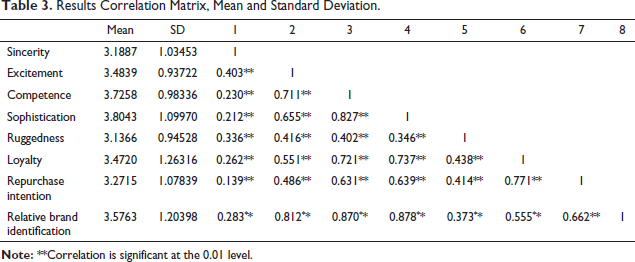
Results Correlation Matrix, Mean and Standard Deviation.
Pearson correlation was performed. According to the rule, a low correlation exists among variables when r value is between 0.10 and 0.29 or –0.10 and –0.29. A moderate correlation exists when r value is between 0.30 and 0.49 or –0.30 and –0.4.9 while a strong correlation exists when r value is between 0.50 and 1.0 or –0.50 and –1.0. Analysis shows that there is a strong correlation between excitement and competence (0.711), sophistication (0.655), brand loyalty (0.551) and relative brand identification (0.812). Similarly, competence has a strong correlation with sophistication (0.827), brand loyalty (0.721), relative brand identification (0.870) and repurchase intention (0.631). Sophistication has a strong correlation with three other variables like brand loyalty (0.737), repurchase intention (0.639) and relative brand identification (0.878). From these results, it has been found that there is also a strong relationship between brand loyalty and repurchase intention and consequently relative brand identification. On the other hand, it has been found from the results that there is a low or weak correlation of sincerity with competence (0.230), sophistication (0.212), brand loyalty (0.262), repurchase intention (0.139) and relative brand identification (0.283).
Regression analysis was performed to test the overall brand personality relationship with brand loyalty. The r value of 0.581 indicates a strong positive correlation between the two variables. r square value is 0.338. It indicates the total variance explained by the independent variables into the dependent variable. There is a significant relationship between brand loyalty and repurchase intention. The significant level of brand loyalty and repurchase intention is 0.000 which is less than 0.05 which shows the significance relationship. Results are presented in Tables 4 to 6.
Direct Effect of Five Dimensions of Brand Personality on Brand Loyalty.
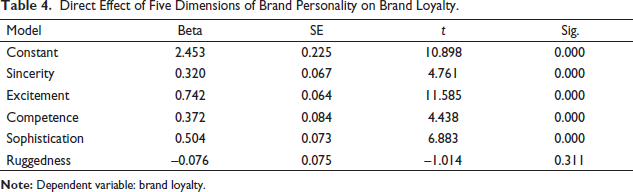
Direct Effect of Five Dimensions of Brand Personality on Brand Loyalty.
Direct Effect Brand Loyalty on Repurchase Intention.

Moderation Effect of Relative Brand Identification Between Brand Loyalty and Repurchase Intention.

All the hypotheses have been tested by using hierarchical moderated regression analysis. Relative brand identification has been used as a moderator in the research. In previous studies, relative brand identification has been tested on brand personality and brand loyalty as a moderator (Chung & Park, 2017), while we tested it as a moderator between brand loyalty and repurchase intention. Five dimensions of brand personality (Aaker, 1997) have been tested for brand loyalty to find out the impact of every dimension on the repurchase intention. The strong positive relationship between brand personality and brand loyalty has been found from the research.
H1 predicted that there is a positive relationship between sincerity and brand loyalty (t = 4.761, p < .01). This result shows that sincerity is positively and significantly related to brand loyalty. H2 predicted that there is a positive relationship between competence and brand loyalty. From the results (t = 4.438, p < .01), there is a strong positive relationship between competence and brand loyalty. H3 predicted that there is a positive relationship between excitement and brand loyalty. The results (t = 11.585, p < .01) show that there is also a significant and positive relationship between excitement and brand loyalty. H4 predicted that there is a positive relationship between sophistication and brand loyalty. From the research, it has been justified as a significant and strong relationship (t = 6.883, p < .01). H5 predicted that there is a positive relationship between ruggedness and brand loyalty. From the results (t = –0.1.011, p > .05), it has been found that the relationship between ruggedness and brand loyalty is negative and not significant, thus the relationship has not been established from this research.
H6 predicted that there is a positive relationship between brand loyalty and repurchase intention. From this research (t = 27.707, p < .01), it has been justified that there is a positive relationship between brand loyalty and repurchase intention. In this continuous sequence, it has been found that there is a positive relationship between brand loyalty and repurchase intention by testing dimensions (Aaker, 1997) of brand personality.
H7 predicted that relative brand identification moderates the relationship between brand loyalty and repurchase intention such that greater the relative brand identification stronger the relationship between brand loyalty and repurchase intention. The results (t = 9.876, p < .01) show that relative brand identification has a positive and significant effect on the relationship of brand loyalty and repurchase intention.
Discussion and Conclusions
From the results, it has been found that there is a significant and positive relationship between brand personality and brand loyalty. It was found that indeed, brand personality significantly and positively predicted brand loyalty. These results are also aligned with the past studies of Chung and Park (2017), who also found that these two variables are related. Hypothesis H1 to H5 have been confirmed, as there is a positive relationship between brand personality and brand loyalty. All the components of brand personality (Aaker, 1997) have been tested separately with Brand Loyalty and it has been found that there is a positive relationship between those components and brand loyalty. The positive results of hypotheses of components (sincerity, competence, sophistication and excitement) of brand personality show that mobile phone users are more attentive towards the long life of the mobile (sincerity). The brand must be renowned (competence) in the market, and they may feel pleasure and be proud of carrying and handling their mobile phone brands (sophistication and excitement). After buying the mobile phone of their choice, they use protective and precautionary measures during the use of the mobile phones. Therefore, from the results, it has been found that the dimension of ruggedness does not play such a prominent role between brand loyalty and repurchase intension.
H6 proposed that there is a positive relationship between brand loyalty and repurchase intention. The results were in line with the proposed hypotheses. It was found that indeed, brand loyalty significantly and positively predicted repurchase intention. These results are also aligned with the past studies of Liao et al. (2017) and Yi and La (2004), who also found that these two variables are related. H7 proposed that relative brand identification moderates the relationship between brand loyalty and repurchase intention. This study detected the contextual role of brand identification between brand loyalty and repurchase intention.
First, five dimensions of brand personality have been considered to have an influence on brand loyalty, and this process has been empirically tested based on the Pakistani mobile phone market. Although past research has suggested organizations to build a unique and distinct brand personality (Keller, 1993; Phau & Lau, 2000), some empirical research has directly tested whether consumers are influenced by different dimensions or not. Consequently, from previous research (Bairrada et al., 2019; Keller, 1993; Kim et al., 2001), it has been found that there is a positive impact of brand personality on brand loyalty. It was also found that all the brand personality dimensions were not equal in influence to create brand loyalty. Apart from ruggedness, which failed to be a predictor, the other four dimensions had different beta values showing their different influence on brand loyalty.
Besides the impact of brand personality on brand loyalty, repurchase intention has been found from these two constructs based on the Pakistani mobile phone market. Although previous studies on brand personality and brand loyalty have mostly focused on the bilateral relationship between a consumer and a brand isolated from other brands (Curlo & Chamblee, 2018; Kuenzel & Halliday, 2010) and repurchase intention; therefore, this study investigates the role of brand personality and brand loyalty to inculcate repurchase intention once loyalty has been established. Previous research found out that the impact of brand personality on consumer behaviour is very limited due to lack of consensus about real brand personality. A framework has been developed by Aaker (1997) to address this issue. This framework consists of five dimensions of the brand personality and those dimensions are sincerity, excitement, competence, sophistication and ruggedness. Apart from ruggedness dimension, all other dimensions significantly and positively regressed upon the brand loyalty construct.
Extending upon the existing studies in the area of brand personality and brand loyalty, this study also tests whether these two variables (brand personality and brand loyalty) ultimately lead to consumer repurchase intention. Since the literature suggests that it is 5–25 times more expensive to acquire a new customer than to keep an existing customer (Griffin & Herres, 2002; Hill & Alexander, 2017). Taking a leaf out of this investigation, repurchase intention of the consumers has also been tapped. In this regard, it has been found that brand personality does indeed develop brand loyalty among the consumers, which in turn leads to repurchase intention among the consumers. Studies on brand loyalty usually view purchase intention as an outcome variable. However, as suggested by previous research, it is more expensive to build new customers than to keep the old ones (Jenneboer et al., 2022). Therefore, just developing an intention to purchase is not enough, customers must purchase repeatedly. Therefore, this study proposed that brand loyalty should lead to repurchase intention among the customers, and this is what should be the focus of attention for managers and practitioners.
Managerial Implications
The findings of this study are also important for managerial perspective. Every dimension of brand personality has been tested separately to find out their respective impact on brand loyalty that will lead to repurchase intention. Based on the response of a dimension of brand personality, the manager can decide how to focus on which aspect of the brand so that customers may repurchase it. The existing research has been conducted to find out the impact of brand personality dimensions on brand loyalty (Chung & Park, 2017). This research has been conducted to find out the impact of every dimension of brand personality (Aaker, 1997) on brand loyalty that will lead to repurchase intention. Marketers can focus on the dimensions of the brand to find out which is more suitable for their product and which is not much supportive for the consumer in the process of repurchase. From our study, the dimension of ruggedness is not supportive for brand loyalty and consequently for repurchase intention. From the findings, consumers want that mobile phone brands should be stylish (sophistication), good looking (competence), personality booster (excitement) and user friendly (sincerity) performance of the mobile. Consumers are not much interested in the solidness (ruggedness) of the mobile because they mostly buy other accessories to protect their mobile phones. Therefore, it is important for the manager to focus on their products/brand to be designed in such a way so that customers may repurchase it based on sincerity, competence, excitement and sophistication.
The findings of this study contribute to brand personality, brand loyalty and consequently repurchase intention by finding the moderating effect of relative brand identification. First, the five dimensions of brand personality (Aaker, 1997) have been tested separately on brand loyalty to find out the impact of every dimension so that we may find out the impact of every dimension on brand loyalty that may lead to repurchase intention. So, the current study finds out that every dimension of brand personality has distinct qualities that influence the behaviour of consumers during purchasing mobile phone of any brand. In continuation of previous research (Chung & Park, 2017; Keller, 1993; Kim et al., 2001), we found that most dimensions of brand personality are positively related to brand loyalty. The most important is that every dimension of brand personality has a different impact based on its characteristics and understanding of the customer. The results of our research show that from the dimensions of brand personality sincerity, excitement and sophistication are more influential factors that affect brand loyalty in the Pakistani market. These aspects are very important and useful in consumer behaviour perspective (Bairrada et al., 2019).
Limitations and Future Research
Although the findings provide meaningful implications, this study has some limitations and offers several directions for future research. For researchers, the findings of this study contribute to the literature on brand personality, brand loyalty and repurchase intention. This study focused on only one type of product, that is, mobile phones. According to Chung and Park (2017), mobile phones are the type of product for which consumers have direct as well as indirect experience, so these are appropriate for studies on brand personalities and brand loyalty. They further proposed that findings from studies on mobile phones could be generalized across several other products. However, the model proposed here should be tested across other studies to further authenticate its validity across different product categories.
Only cross-sectional data were used for the study. It is known that cross-sectional studies are weak in generalizability and to confidently establish the causality among variables. However, given the time and cost considerations, a single-shot study was considered more appropriate for the time being. Future studies could test the model using either experimental designs or go a step further to carry out a longitudinal study. Data were collected from a specific segment of the population only, that is, people of twin cities universities (Rawalpindi/Islamabad) and from the University of Punjab, Lahore. Although they represent the major cities of the country, yet the phenomenon of brand loyalty and brand personality may vary across different cities of the country. The study proposed one moderating variable only, that is, relative brand identification. The relationship has been developed as a moderator between brand loyalty and repurchase intention. It can be tested as a mediation moderator variable that may have different results and some different outcomes that can be used and implemented in the market accordingly.
Conclusion
This study has examined the different traits of brand personality that have an impact on brand loyalty and consequently the impact of brand loyalty on repurchase intention. Through data collected from university students in Pakistan, the study has revealed that certain brand personality traits, such as sincerity, excitement and sophistication, have a positive impact on brand loyalty in the mobile phone market. It was also proposed and tested that relative brand identification acts as a moderator in the relationship between brand loyalty and repurchase intention. It has also been found that relative brand identification has a positive impact on brand loyalty and repurchase intention, and it does moderate the relationship between brand loyalty and consumer repurchase intention. These findings have practical implications for marketers aiming to enhance brand loyalty and repurchase rates in competitive markets.
Footnotes
Authors Contribution Statement
Assad Rahman: Idea and study design, collection of relevant data, development of research approach and initial manuscript drafting.
Amjad Ur Rehman: Analysis and interpretation, review and integration of relevant literature, creation of visual aids and manuscript review and editing.
Mazhar Iqbal: Oversight throughout, journal correspondence and manuscript review and coordination.
Adeel Ahmed: Study design contribution, participation in data collection, assisted in interpreting findings and manuscript review and feedback.
Declaration of Conflicting Interests
The authors declared no potential conflicts of interest with respect to the research, authorship and/or publication of this article.
Ethical Declaration
The authors abide by all the ethics involved in this academic work and have not submitted it to any other journal.
Funding
The authors received no financial support for the research, authorship and/or publication of this article.
