



Abstract
Many digitalization programmes fail in the implementation phase due to unforeseen obstacles. This study examines the barriers that affect the successful implementation of digitalization using the interpretive structural model and also evaluates the interrelationships among the barriers in the implementation of digitalization. Previous articles in the discipline of digitalization were used in the literature to mainly draw barriers found during the implementation phase of digitalization. Interpretive Structural Modelling results helped to find different levels of barriers and their influence on the system. The high cost of digital technologies and political instability were identified as the leading barriers affecting the successful implementation of digital systems in South Africa. The findings will aid in decision-making for problem-solving to eliminate the most critical barriers to improve the implementation process.
Keywords
Introduction
Digitalization is the process of incorporating technology into regular business operations and connecting businesses to digital platforms as a priority for competitive advantage (Meskic et al., 2022). Another source defined digitalization as the process of converting anything from its physical condition to one that allows for connection and interaction (Noussan & Tagliapietra, 2020).
The basic principles of digitization lay the foundation for understanding its meaning in the South African context. Digitalization is about the integration of digital technologies into various aspects of the economy and society, revolutionizing traditional processes and systems. At a global level, digitalization is recognized not only as a technological adoption but also as a strategic manoeuvre that is critical to gaining a competitive advantage (Dohale et al., 2023; Gaglio et al., 2022).
It is crucial to recognize the complex link between digitalization and competitive advantage. Digitization enables companies to increase efficiency, drive innovation and improve the customer experience. Industries around the world have experienced the profound impact of digitalization, which enables companies to quickly adapt to market changes, reduce operating costs and secure a competitive advantage. Emphasizing this link between digitalization and competitiveness is key, especially when it comes to removing the barriers to successful implementation in South Africa (Manda & Backhouse, 2017).
Digitization is not a mere luxury but a necessity for South African industries. The adoption of digital technologies is perceived as a pathway to economic and social development. Anticipated benefits include new job creation, economic growth and heightened global competitiveness. Neglecting digitization may lead industries to lag behind, grappling with challenges in adapting to swiftly changing markets and forfeiting potential long-term advantages (Gaffley & Pelser, 2021).
Digitalization is the future of the environment, as it enables the automation of numerous processes and makes them more efficient and cost-effective (Kalymbek et al., 2021). Because of digitalization, time can be saved by putting in less effort on repetitive tasks, freeing up time for creative endeavours and expansion. Additionally, the study has outlined several benefits and drawbacks of digitalizing labour (Abdrakhmanov et al., 2022).
Digitalization is bringing about a fundamental change for companies and its effects are complex (Buck & Eder, 2018). Parviainen et al. (2017) highlighted three points that contribute in the impact of digitalization as follows: ‘Internal efficiency; i.e., improved way of working via digital means and re-planning internal processes, external opportunities; i.e., new business opportunities in existing business domain, and disruptive change; digitalization causes changes business roles completely (Parviainen et al., 2017)’. Computational innovation can reduce fossil byproducts in a roundabout way by driving environmentally friendly mechanical development and reducing energy consumption, and it plays a crucial role in reducing fossil byproducts through fossil byproduct replacement strategies and full public large-scale information pilot zones (Shen et al., 2023). Digitalization is the fate of the environment of the entire world since it permits computerizing many cycles, which makes them more proficient and less expensive (Kalymbek et al., 2021). In any design, migration or development of a system, there may be obstacles that affect the success of the system implementation. Assessing the barriers encountered during system development or implementation is essential to avoid project failure. The goal of this research is to analyze the barriers that affect the successful implementation of digitalization using the Interpretive Structural Model.
African economies’ structural transformation will proceed more quickly through digitalization, which will also dramatically lower CO2 emissions, the primary cause of climate change (Ali & Gniniguè, 2022). Legislators continue to lag behind developments in this area despite the fact that digitalization presents new threats in the form of cybercrimes and privacy breaches (Meskic et al., 2022). Bahn et al. (2021) discussed the point that the adoption of digital technology may be hindered by high purchasing, operating and/or maintenance expenses. The author also highlighted that adoption of digital technologies (or the data generated by them) may be limited by a lack of technical expertise (Bahn et al., 2021). Long-term strategies for adopting innovations in business models and applications and making sure society accepts them are lacking (Albach et al., 2015). The author highlighted that the process of putting sustainable digital transformation into action is complicated and requires overcoming numerous obstacles and resource constraints (Rupeika-Apoga & Petrovska, 2022). Digitalization has become an essential aspect of modern businesses and organizations. However, the successful implementation of digitalization is often hindered by various barriers. To overcome these barriers, several studies have used Interpretive Structural Modelling (ISM) to identify and analyze the barriers to the successful implementation of digitalization (Agrawal et al., 2020; Goel et al., 2022; Kandasamy et al., 2023; Majumdar et al., 2021). These studies reveal common barriers to digitalization implementation, such as lack of trained staff, lack of top management commitment, insufficient research and development, resistance to change, high costs, data security and privacy concerns, and lack of infrastructure like high-speed internet and reliable power supply. These factors contribute to the challenges in implementing digitalization.
The need for targeted research is underscored by the gaps in the literature review, particularly the paucity of material on South Africa’s digitization barriers. Research in this area is essential to obtain a detailed picture of the national difficulties and to recommend targeted measures and strategies to address these barriers. Such studies could improve competitiveness, rationalize resource allocation, promote information sharing and advance the overall goals of South Africa’s socio-economic growth (Van Dyk & Van Belle, 2019). Hence, we propose below research questions (RQs):
RQ1: What are the barriers affecting the successful implementation of digitalization using the Interpretive Structural Model?
RQ2: What is the interrelationship between barriers to the implementation of digitalization?
This research will use a qualitative approach through the application of ISM technique to identify and define barriers and their relationship under the scope of digitalization in South Africa.
The use of ISM to analyze the barriers to the successful implementation of digitalization provides organizations with a thorough understanding of the obstacles they need to overcome and effective strategies to address them.
The subsequent sections are structured as follows: The next section provides an overview of the literature related to digitalization; the following section outlines the ISM methodology; the subsequent section details the ISM data analysis, showcasing the level attained by each barrier and their interrelationships. The second last section discusses theoretical and practical implications. The final section offers concluding remarks, discusses limitations and suggests directions for future research.
Literature Review
This research our literature review took a different approach by looking into different topics covered in the past within the scope of digitalization, its application, what to look into during and after the implications, etc. Digitalization could be seen as the next big application within different trades, and it may also assist in widening our thoughts as a new tool to be used. Digitalization permits you to save time, diminishing how much work on customary assignments, and along these lines opens up open doors for new drives and advancement (Abdrakhmanov et al., 2022). Digitalization is still unable to effectively separate economic expansion from environmental harm (Pérez-Martínez et al., 2023). Mondejar et al. (2021) highlighted barriers to be taken into account to have a successful implementation of digital technologies, namely: cost, patients, age, level of education and computer literacy. Access to technology is frequently difficult due to a lack of knowledge concerning the current state of technological capabilities, a lack of necessary expertise and excessive investment prices (Garske et al., 2021). Bekezhanov et al. (2022) mentioned two limitations that need to be observed during the implementation of digital systems, namely: lack of resources and inaccessibility of rural internet. Another author found additional limitations that affect the implementation of digitalization as: insufficient state support, small scale of production and the low starting level of application of digital technologies (Starykh et al., 2022). The legal regulation of digitalization-related activities and products has been challenging; additionally, society advancement and clearer and more stringent legal regulation are required (Meskic et al., 2022). A breakdown analysis of Industrial Revolutions and their significance could be a great source to enlightening which legal regulations align with digitalization activities and also it could aid in building interrelationships among barriers identified.
Industrial Revolution is ‘the structural shift of the large proportion of the population from agricultural to manufacturing and mining sector, which caused a growth in the manufacturing sector, and ultimately increasing the national income’ (Agarwal & Agarwal, 2017).
The First Industrial Revolution marked the shift from manual labour to machine-driven processes and spanned several decades. The Second Industrial Revolution, occurring in the twentieth century, was characterized by electrification and the organization of conveyor production, initially in the automobile industry and later extending to other sectors. The Third Industrial Revolution involved profound transformations in systems, structures, institutions, relationships and technologies, reshaping how people organize production, exchange, consumption, education, communication and leisure. The Fourth Industrial Revolution represents leveraging digital technologies called ‘Industry 4.0 technologies’ (Dohale et al., 2022; Popkova et al., 2019).
It is essential to identify what is and is not working in order to address these barriers more effectively. Management will invariably be able to determine where gaps exist, how to address issues and where to find change agents by measuring engagement levels. The examination of interrelationship between barriers may assist in providing hidden connections, support prioritization and minimizing the unintended consequences which helps in developing a more effective strategy that will aid in achieving desired outcomes.
Methodology
ISM-based Model
This research used ISM technique to identify and define barriers and their relationship under the scope of digitalization. ISM provides a realistic picture of the issues to decision-makers and the factors involved by providing an orderly, guiding framework for complex challenges (Attri et al., 2013). The goal of ISM is to efficiently provide a network representation, or directed graph, of the intricate patterns of relationship between the pieces by a systematic application of graph theory to theoretical, conceptual and computational problems (Prasanna & Ramanna, 2014).
The selection of ISM over the DEMATEL method for assessing interlinkages between barriers to digitalization was guided by specific considerations. ISM was deemed more appropriate for our study due to its capacity to uncover hierarchical relationships and dependencies among the identified barriers (Sushil, 2012). It offers a structured and visual representation that facilitates a comprehensive understanding of how these barriers influence one another (Sushil, 2012). While DEMATEL is proficient in determining relationship strength and direction, ISM was chosen for its clarity in illustrating a hierarchical structure, aiding in the identification of crucial elements for overcoming top-level barriers. The decision to use ISM was also influenced by its ability to spotlight core barriers crucial for addressing overarching challenges within the digitalization context. Several researchers have used ISM earlier to understand the interrelationships among elements (Bag, 2019; Kumar et al., 2021).
Findings of Barriers from Literature Review
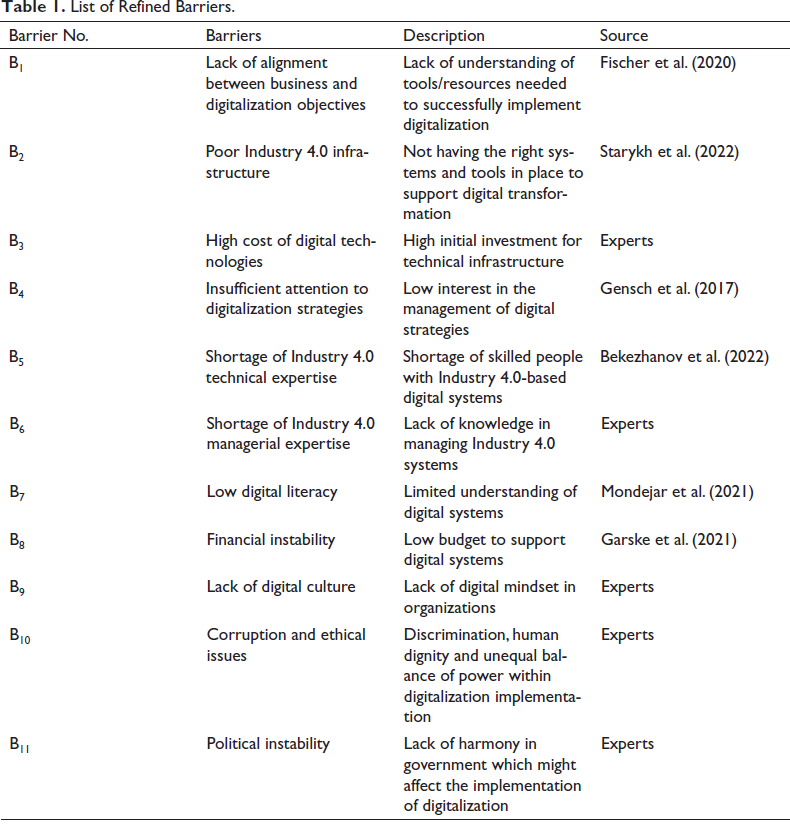
Digitalization-related literatures were reviewed thoroughly and 15 barriers affecting the implementation of digitalization were discovered. A focus group was formed to criticize the relevance, validating their practicality by referencing the current challenges faced in introducing new systems. With the help of experts joining, the number of barriers was filtered to 11 by removing repeating barriers and the least relevant, and then the barriers were rearranged to the level of importance as shown in Table 1.
Data Analysis and Findings
In this step, the relationship between the barriers chosen is to be validated by using specific variables to identify the link between the barriers, and how they function together using interchanging leading positions between the barriers. It offers useful insights for decision-making and aids in understanding the interdependencies and impacts between them.
Development of Structural Self-interaction Matrix
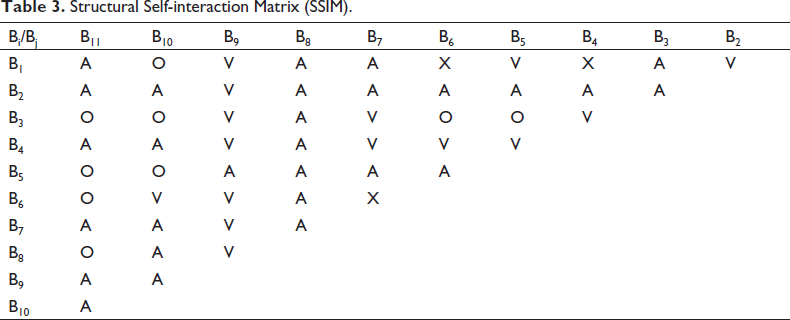
Four symbols—V, A, X and O—were utilized to create a structural self-interaction matrix (SSIM). See VAXO rule in Table 2. The symbols were determined using two variables (i and j) relationship, the results were then used to develop SSIM matrix (refer to Table 3).
Develop Reachability Matrix
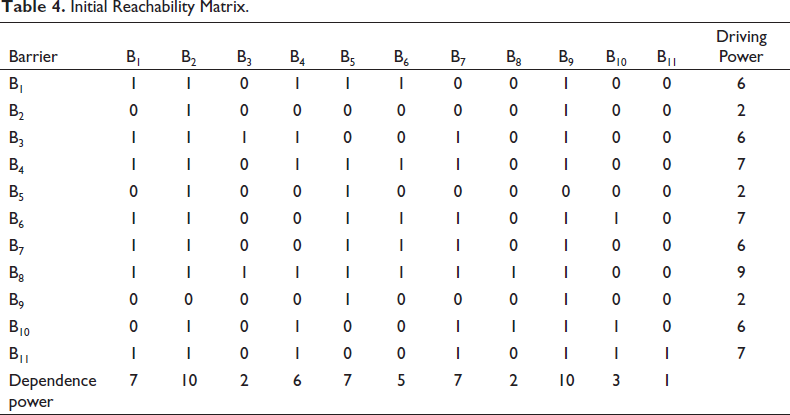
In this step, we developed an initial reachability matrix from the SSIM by converting SSIM results into a binary matrix. The driving power on the reachability matrix is calculated as the sum of all horizontal barriers and the dependence power is then calculated as the sum of all vertical barriers. Sushil (2012) stated that the SSIM symbols conversion is done through the below interpretation to reach the initial binary matrix (initial reachability matrix) in Table 4.
If the (i,j) entry in the SSIM is V, then the (i,j) entry in the reachability matrix is ‘1’ and the (j,i) entry becomes ‘0’.
If the (i,j) entry in the SSIM is A, then the (i,j) entry in the reachability matrix becomes ‘0’ and the (j,i) entry becomes ‘1’.
If the (i,j) entry in the SSIM is X, then the (i,j) entry in the reachability matrix becomes b‘1’ and the (j,i) entry also becomes ‘1’.
If the (i,j) entry in the SSIM is O, then the (i,j) entry in the reachability matrix will be ‘0’ and the (j,i) entry also becomes ‘0’.
Transitivity Principle Checking and Final Reachability Matrix
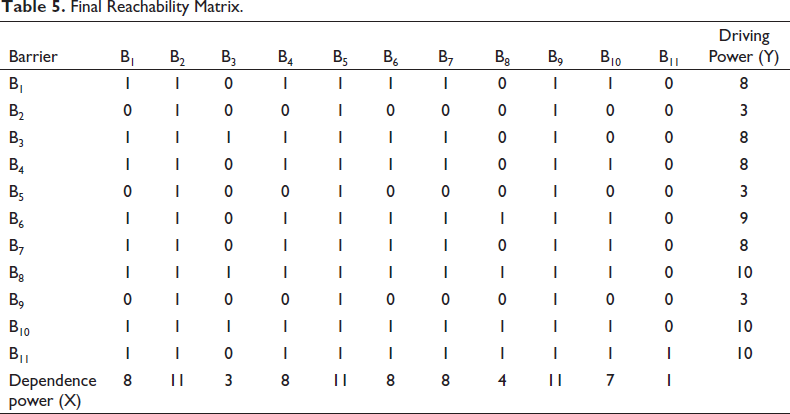
One of the basic assumptions of ISM is that the contextual relation is transitive. It states that if A has a connection to B and B has a connection to C, then A must have a connection to C (Dube & Gawande, 2016). Based on the definition above, there is an assumed indirect relationship between two variables in a matrix if there is a bath of ‘1’ value between them. For the final reachability matrix, there is a use of the ‘Max’ function which consists of the sum of a barrier of x-axis by the transpose function to the sum of y-axis calculated from the initial reachability matrix. See the formula below:
Final reachability (i,j) = MAX($B1:$B114*TRANSPOSE(B$1:B$11))
By iteratively applying the max formula, you capture transitive reachability and ensure that all indirect linkages are taken into account in the final reachability matrix obtained in Table 5.
Level Partitioning
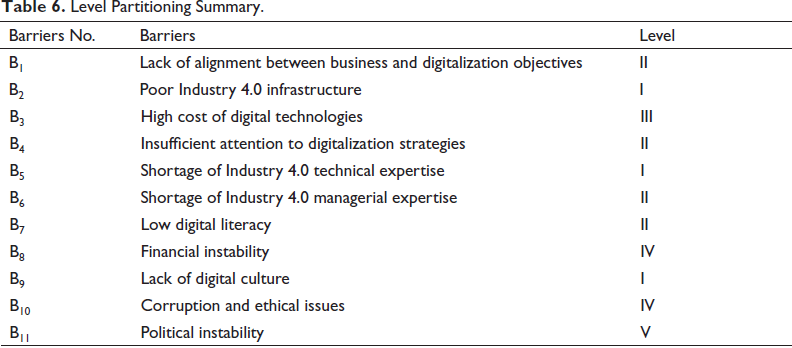
Upon completion of the final reachability matrix, the same data produced is used to obtain level partitioning. Level partitioning is obtained by considering the value ‘1’, the value will be converted into the variable/barrier number. The conversion will then be populated in a table under the Reachability Set (RS) and Antecedent Set (AS). The RS looks at the horizontal values under each variable and the AS looks at the vertical values under each variable respectively. When all the analysis of RS and AS is complete, there is a final analysis Intersection Set (IS) which looks at the common conversion on both sets (RS and AS) to help reach a level partitioning. If RS and IS obtain the same variables, then a level is reached. If a variable reaches a level, it then needs to be removed from the partition to analyze the second partition and the same analysis structure is followed till all variables reach a level. See Table 6 for summary of level partitioning.
Diagraph
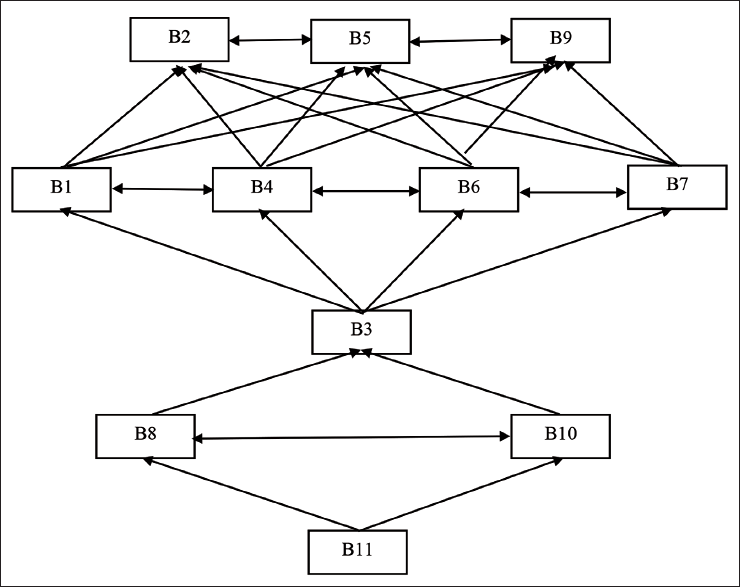
Upon completion of the final reachability matrix and level partitioning, the information is visually represented to depict the structural relationships and dependencies among different variables. The structural model consists of nodes and connectors. Nodes represent variables and connectors represent the relationship and, most importantly, dependencies between the variables. The ISM diagraph is shown in Figure 1.
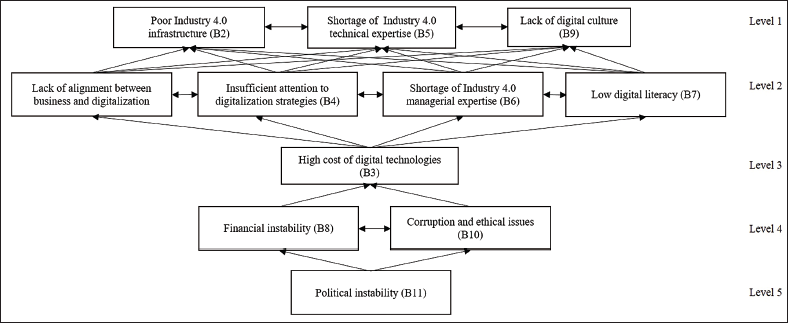
Diagraph. The diagraph is converted into Interpretive Structural Modelling (ISM) (see Figure 2).
Interpretive Structural Modelling (ISM) Model.
MICMAC Analysis
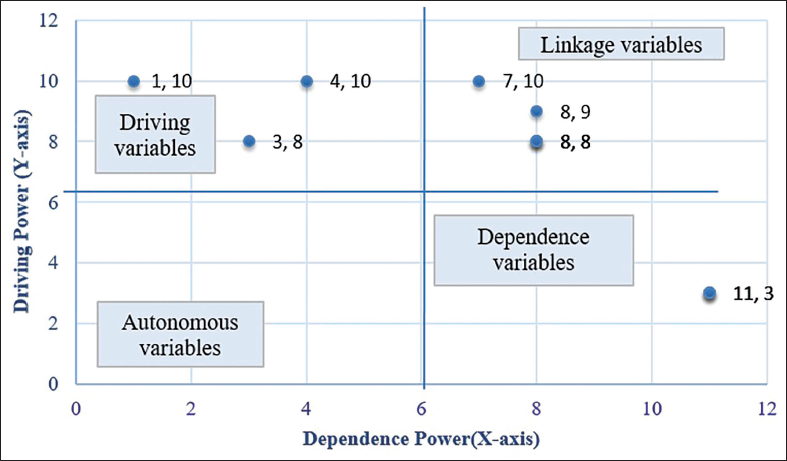
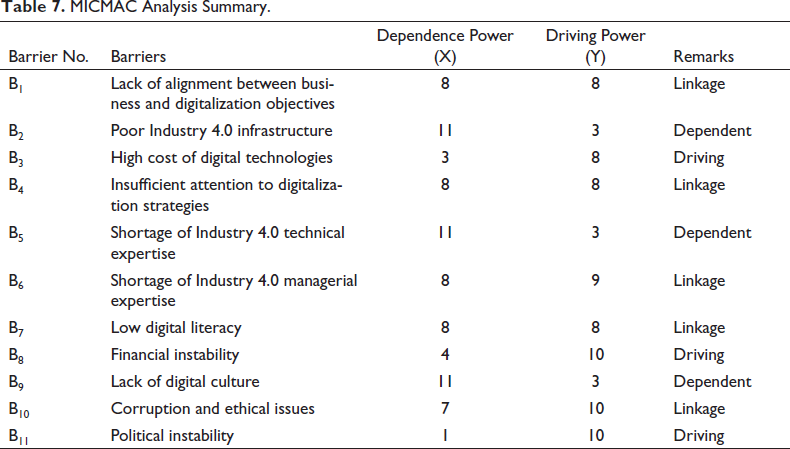
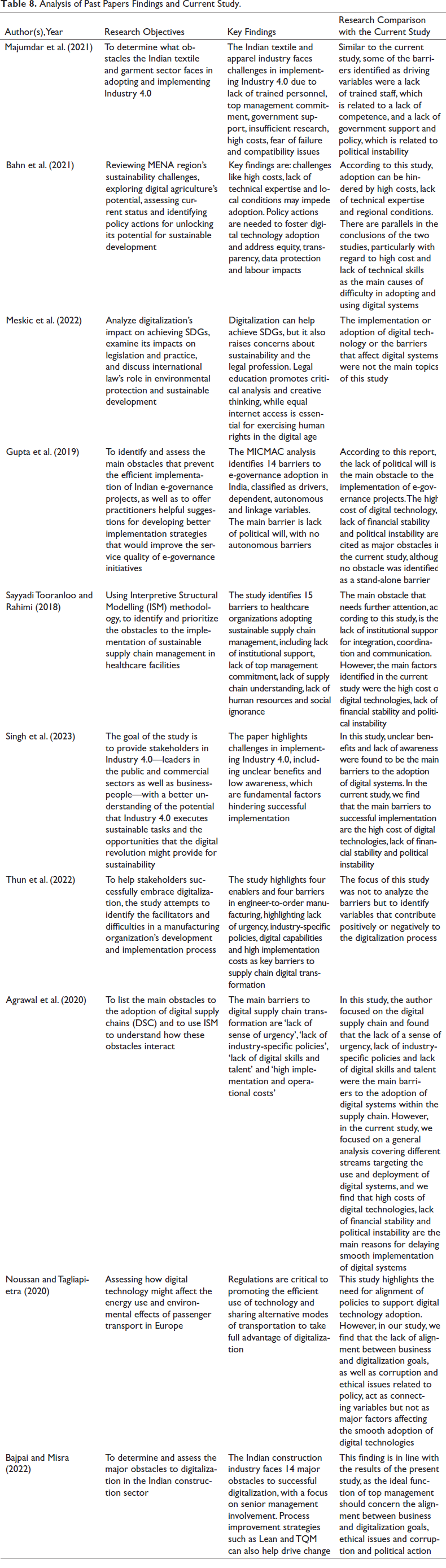
MICMAC analysis, also known as Matrice d’Impacts Croisés Multiplication Appliquée à un Classement, aids in understanding the relationships and influence among the variables provided. The intent of MICMAC analysis in this study is to understand and analyze the interdependencies and influences among the variables provided. It aims to identify the key factors that have a significant impact on digitalization and categorize them based on their power and dependence using four different factors namely: autonomous variables, linkage variables, dependent and independent variables. See variable criteria and relationship in Figure 3 and MICMAC analysis summary in Table 7. The discussion of findings is presented in Table 8.
MICMAC Plotting of Coordinates.
Discussion
Theoretical Implications
The study aims to address the ‘what’ and ‘how’ questions to build theory, following Whetten’s (1989) framework. Initially, we answered the ‘what’ question by identifying 11 elements that function as barriers to digitalization in South Africa. These barriers include a lack of alignment between business and digitalization objectives, poor Industry 4.0 infrastructure, high costs of digital technologies, insufficient attention to digitalization strategies, a shortage of Industry 4.0 technical, shortage of managerial expertise, low digital literacy, financial instability, a lack of digital culture, corruption and ethical issues, and political instability. Subsequently, we addressed the ‘how’ question by examining the interrelationships among these barriers using the ISM approach. The ISM model reveals that bottom-level elements, such as political instability are critical and must be addressed to overcome top-level barriers, such as poor Industry 4.0 infrastructure, a lack of Industry 4.0 technical expertise, and an absence of digital culture.
This methodological contribution connects theory and practice, enhancing the theoretical landscape of digitalization problems in the particular context of South Africa, together with practical insights for resolving the hurdles.
Practical Implications
We found that the ongoing Fourth Industrial Revolution places significant value on the use of digital technologies. With advancing digital technology, gaps are surfacing in various industries in South Africa where personnel are unprepared to adapt to industrial changes and keep pace with evolving digital technologies. These findings underscore the importance for managers to stay well-informed about technological developments in the industry to support employees’ skills development programmes. It is crucial for managers to introduce skills gap analysis and utilize the results to craft targeted skills development programmes.
ISM analysis proves invaluable for managers to identify the interrelationships between the elements. One of the interesting findings in this study is political instability acting as a fundamental and highly critical barrier to digitalization in South Africa. Managers addressing political instability as a barrier to digitalization in South Africa should adopt proactive strategies. This involves thorough scenario planning, engaging with policymakers, and diversifying partnerships to mitigate risks associated with political uncertainties. Additionally, allocating resources to robust risk management, enhancing public relations and supporting advocacy groups for stability can contribute to a conducive environment. Embracing agile project management, investing in ongoing education for employees, and continuously monitoring the political landscape are crucial for adapting digitalization efforts to evolving conditions. Ultimately, a multifaceted approach that combines advocacy, strategic planning and adaptability is essential to navigate the impact of political instability on successful digitalization initiatives in South Africa.
Conclusion
In conclusion, this study addresses two crucial research questions pertaining to the barriers affecting the successful implementation of digitalization in South Africa and their interrelationships. By utilizing the ISM, the research makes substantial contributions to theoretical boundaries. It comprehensively identifies 11 barriers specific to South Africa, and through ISM, elucidates the intricate interplay among these obstacles, establishing a hierarchical structure that pinpoints critical elements for overcoming top-level barriers. This methodological advancement, coupled with practical insights, effectively bridges the gap between theory and practice, enhancing the understanding of digitalization challenges in the South African context.
However, it is acknowledged that ISM has limitations, and future research endeavours could overcome them by exploring alternative methodologies such as neutrosophic ISM or M-TISM.
This calls for continued research efforts to refine theoretical frameworks and methodologies for a more nuanced understanding of digitalization dynamics, paving the way for improved strategies in the ever-evolving landscape of technological implementation in South Africa.
Future researchers can expand the scope of the study by carrying out comparison analyses with other nations dealing with comparable issues or even with various locations within South Africa. This would make it easier to pinpoint regional variations in digitalization obstacles and the efficacy of different tactics. Furthermore, to follow the development of digitalization hurdles over time, future researchers can conduct longitudinal research. This strategy would enable a proactive rather than reactive response to implementation difficulties by offering insights on how the nature and impact of these obstacles change.
Lastly, future studies can incorporate models like TAM, Augmented TAM, UTAUT and AIDUA to expand on the current study on South African barriers to digitalization. In particular, investigating the combination of TAM and Augmented TAM can illuminate acceptability and utility elements at the human level, and expanding UTAUT to include organizational contexts can offer perceptions into getting beyond organizational obstacles. Understanding user adoption patterns and attitudes can be aided by the application of the AIDUA model. It is imperative to take into account cultural modifications in order to improve the models’ applicability within the South African setting. Furthermore, important variables impacting technology adoption can be found by comparing UTAUT with UTAUT2. The validity of the models can be evaluated over time by longitudinal research.
Appendix
List of Refined Barriers.
Symbols and Variable Relationships.

Structural Self-interaction Matrix (SSIM).
Initial Reachability Matrix.
Final Reachability Matrix.
Level Partitioning Summary.
MICMAC Analysis Summary.
Analysis of Past Papers Findings and Current Study.
Footnotes
Acknowledgements
The authors are grateful to the journal’s anonymous referees for their beneficial suggestions to improve the quality of the article. Usual disclaimers apply.
Declaration of Conflicting Interests
The authors declared no potential conflicts of interest with respect to the research, authorship and/or publication of this article.
Funding
The authors received no financial support for the research, authorship and/or publication of this article.
