



Abstract
Using annual data from 1980 to 2019, we explore the impact of remittance inflows (remittances) on renewable and non-renewable energy consumption in Jamaica. We apply statistically adequate vector error correction and vector autoregression models. There are two primary findings. First, we find that an increase in remittances is associated with a decrease in renewable energy consumption within an error correction model, which suggests a long-run negative relationship between remittances and renewable energy consumption. Second, an increase in remittances is associated with an increase in non-renewable energy consumption in the short run; no cointegrating relationship is detected. One implication of our finding is that Jamaica could strengthen policies that encourage the consumption of renewables while discouraging the consumption of non-renewables. These policies should apply to not only remittance-receiving households but also energy consumers in general to enhance the uptake of renewable energy.
Introduction
Since the seminal study by Kraft and Kraft (1978), scholars have extensively examined the Granger causal nexus between energy consumption and macroeconomic variables from various perspectives. In this study, we examine the causal impact of remittance inflows (remittances) on renewable energy (RE) and non-renewable energy (NRE) in Jamaica. The justification for the study of this topic is two-fold. First, Jamaica holds the unenviable position of having the second city in the world to experience climate departure (Scott, 2023). Climate departure of a location is the first year after 2005 when the average temperature of its coolest year is projected to exceed the historic average temperature of its hottest year between 1960 and 2005 (Mora et al., 2013). Second, Jamaica has an energy-intensive economy with heavy reliance on imported NRE. However, using NRE will increase energy expenses and exacerbate climate departure and its attendant negative environmental consequences. Against this backdrop, our study aims to further the understanding of one of the factors, remittances, that influences the energy mix of RE and NRE in Jamaica. This is done to support environmental policies in this Small Island Developing State as it strives to achieve its sustainable development goals.
Numerous research papers have explored which factors might impact the consumption of RE and NRE. Among the diverse macroeconomic, socioeconomic, and institutional factors identified by prior studies, several researchers found GDP per capita to be a key factor (Apergis & Payne, 2011; Rahman & Velayutham, 2020). Credit and financial development are also beneficial for the consumption and production of RE. These effects are prominent when considering non-hydropower RE (Anton & Nucu, 2020; Wu & Broadstock, 2015). A consumer’s income, employment, or general purchasing power at the household level influences their transition to cleaner energy sources (Ma et al., 2019; Twumasi et al., 2020).
Other determinants of RE identified by researchers include technological innovation (Khan et al., 2020; Murshed & Alam, 2021), institutional circumstances (Cadoret & Padovano, 2016), human capital (Akintande et al., 2020; Khan et al., 2020), oil prices (Murshed & Tanha, 2021; Omri & Nguyen, 2014), pollution emissions (Sadorsky, 2009), trade openness (Omri & Nguyen, 2014; Murshed, 2018), foreign capital inflows (Paramati et al., 2016; Qin & Ozturk, 2021), poverty and income inequality (Démurger & Fournier, 2011; Uzar, 2020), informational and socio-cultural awareness (Karanja & Gasparatos, 2019; Kesari et al., 2021), and remittances (Das et al., 2021; Mills, 2023).
Based on the preceding, our study contributes towards filling gaps in the literature in the following three respects. First, there is a dearth of studies on the effects of remittances on RE consumption, and this examination is relatively recent (Das & McFarlane, 2020; Das et al., 2021). Second, none of these studies focused on the Jamaican economy. Third, the existing literature is completely missing a focused examination of the impact of remittances on RE and NRE. The closest study examining the interplay of remittances with RE and NRE is Zhang et al. (2022). However, their work primarily focused on how remittances, alongside foreign direct investment, economic growth, RE, and NRE, impact the ecological footprint. Our study focuses on the Jamaican economy and analyses the effects of remittances on the consumption of RE and NRE while disentangling the short-run and long-run dynamics. Importantly, we also provide the attendant policy implications of our findings considering the interplay between RE and NRE.
In the Jamaican context, the earliest attempt at disaggregating total energy demand was performed by Ramcharran (1990). However, Ramcharran used a sectoral decomposition of total consumption, considering electricity demand from two categories of consumers: residential users and commercial users. Analyzing aggregate electricity demand for Jamaica from 1970 to 2014 for diverse categories of consumers, Campbell (2018) found that commercial and industrial consumers are responsive to changes in income. While there has not been a consensus among researchers about the existence and dynamics of the relationship between remittances and financial development (Chowdhury, 2016), in the Jamaican context, some scholars have found evidence of a significant relationship between these two variables (for example, Das & McFarlane, 2022b; Deonanan et al., 2020). Das and McFarlane (2022a) found that remittance could curtail electricity theft and positively impact economic growth. While this finding suggests yet another positive aspect of remittances in the Jamaican economy, a disaggregated analysis is necessary to determine whether remittances increase RE’s share in the energy mix.
Using annual data from 1980 to 2019, we examine the impact of remittances on RE and NRE consumption in Jamaica. We employ vector autoregression and error correction models to RE and NRE consumption, respectively. There are two key findings. One, we find that an increase in remittances is associated with a decrease in RE consumption, suggesting a long-run negative relationship between remittances and RE consumption. Two, NRE consumption increases in response to increased remittances in the short run. There is no long-run cointegrating relationship. One implication of our findings is that Jamaica might intensify policies promoting RE use and discourage NRE consumption. Such policies should target households receiving remittances and all energy consumers to boost the adoption of RE sources.
The rest of this article is organized as follows. The next section reviews the related literature and situates our contribution to it, which is followed by the section that further discusses the objectives. Then the rationale is presented, followed by the section that explains methods. The subsequent section presents the analysis, while the section following that discusses the findings. The last section concludes the article.
Literature and Contribution
Related Literature
We compare and contrast representative studies from the following areas: energy consumption and growth, RE and NRE consumption and growth, and remittances and energy consumption. The following section elaborates on how our study contributes to this literature.
Studies analysing the dynamics between energy consumption and economic growth tend to do so from a Granger causal perspective. The findings from these studies typically support one of the following four hypotheses: growth, feedback, conservation, or neutrality. According to the growth hypothesis, higher energy consumption Granger causes GDP growth, captured by observing unidirectional causality (see Tran et al., 2022 for a review). The feedback hypothesis argues that the relation between energy consumption and GDP growth is bidirectional. Often acting through a feedback loop, economic growth spurs higher energy demand, further stimulating GDP through enhanced economic activity (for example, Dedeoğlu & Kaya, 2013; Jin et al., 2022).
The conservation hypothesis argues that greater growth leads to higher energy consumption (Kraft & Kraft, 1978; Odhiambo, 2009). Finally, studies have found evidence of no causal relationship between energy consumption and growth (see Menegaki, 2021, for a summary), supporting the neutrality hypothesis. Most of the early papers on the growth-energy nexus analysed energy consumption at the aggregate level without disaggregating it into renewable and non-renewable parts. Moreover, growth was generally captured as GDP per capita in these papers, and the concept of sustainable growth was missing. Newer studies on growth and energy incorporate the concept of energy conservation and sustainable growth (Bhuiyan et al., 2022; Menegaki, 2021). Higher RE consumption allows for energy conversation concerning NRE consumption while promoting sustainable growth, so our work contributes to building on these newer studies.
Among papers that studied RE consumption and economic growth nexus, support for the positive impact of RE on growth was found by Kasperowicz et al. (2020) for 29 European countries, Shahbaz et al. (2020) for 38 RE-consuming countries; Tiwari (2011) for India; and Wang et al. (2022) for 34 Organisation for Economic Co-operation and Development (OECD) countries. Sadorsky (2009) observed the validity of the conservation hypothesis from the significant long-run positive effect of per capita income on RE consumption in 18 emerging economies from 1994 to 2003. Observing 16 emerging market economies within a multivariate panel framework from 1990 to 2007, Apergis and Payne (2011) found a unidirectional causality from economic growth to renewable electricity consumption in the short-run and bidirectional causality in the long-run. A unidirectional causality from economic growth to RE was also found by Rahman and Velayutham (2020) for 5 South Asian countries and Alam and Murad (2020) for 25 OECD countries.
Evidence of bidirectional (feedback) relationship between RE consumption and GDP growth was found by Al-Mulali et al. (2013) and Kahia et al. (2017), among several other researchers. Al-Mulali et al. (2013) examined 108 countries and found that 79% had a positive bidirectional long-run relationship between RE consumption and GDP growth. However, Jamaica is among the few countries showing evidence of the neutrality hypothesis. This is not unlikely for a country if the RE consumption is still a small percentage of the total energy consumption and RE is still not extensively used for activities that can contribute to economic growth or wealth accumulation.
Increased energy consumption comes with increased pollution emissions. This led several researchers to explore the validity of the environmental Kuznets curve (EKC) hypothesis. The original EKC hypothesis suggests an inverted U-shaped relationship between pollution emissions and economic growth, implying emissions increase with growth, followed by an eventual decline. Research on EKC patterns in developed and developing countries has provided mixed evidence. Following some of the recent studies, economic growth was found to increase the rate of carbon emissions in G20 countries (Li et al., 2021), and an asymmetric effect of NRE consumption on growth and carbon emissions per capita was found for Africa (Awodumi & Adewuyi, 2020). We may not observe a clear EKC pattern for developing countries in general either because they are still at an early stage of development. Alternatively, factors contributing to higher CO2 emissions, such as rapid industrialization, urbanization, international trade, and foreign direct investment (Koengkan & Fuinhas, 2022; Li et al., 2022; Musah et al., 2021a, 2021b, 2021c), may persist even at higher income levels.
Studies focusing on the EKC hypothesis might have generated the misleading hope that environmental degradation would eventually decline with higher growth. However, economic development does not seem sufficient to solve the problem of depleting NRE sources and emitting pollution unless deliberate actions are taken (Alvarado et al., 2021). This further highlights the need to explore whether activities contributing to GDP growth are tied to NRE consumption. Because if economic activities promote NRE consumption, it will lead to increased emissions. Against this backdrop, our study contributes toward understanding the role of remittances in Jamaica’s energy mix to inform policy in line with energy conservation with sustainable economic growth.
Following the trend of a growth-oriented focus on development, initial research on remittances primarily focused on growth, income, investment, and poverty alleviation-related aspects. Researching the dynamics regarding remittance, energy consumption, and environmental concerns is a relatively newer trend. Remittance income may increase energy demand directly by increasing a household’s disposable income, leading them to purchase energy-intensive consumer durables such as automobiles, refrigerators, and heating and cooling devices (Ahmad et al., 2019; Chami et al., 2008). Moreover, remittances can indirectly impact energy consumption by boosting national income, leading to greater urbanization, construction, and real estate expansion, which in turn increases energy usage.
Remittances may positively affect financial development after a threshold level (Das & McFarlane, 2022b) by creating better access to credit and loans. This, in turn, could have a positive impact on growth and energy consumption and a positive or negative effect on the environment. On the other hand, remittances may facilitate educational attainment (Adams & Cuecuecha, 2013; Arif et al., 2019; Askarov & Doucouliagos, 2020), resulting in greater usage of eco-friendly and energy-saving appliances in households.
Among the pioneering studies that explored the effect of remittances on energy consumption, Akçay and Demirtaş (2015) found evidence of a direct positive impact of remittances on energy consumption and an indirect impact of remittances through growth and industrialization in Morocco. Using a five-stage interaction mechanism, Ahmad et al. (2019) proposed that remittances increase consumption and savings. Higher consumption stimulates industrial production, higher savings encourages financial development, and both eventually lead to higher usage of fossil fuels. Rahman et al. (2021) also found long-run causality from remittance, GDP, and urbanization to energy consumption in Bangladesh, India, Pakistan, and Sri Lanka. Das et al. (2021) found evidence of a long-run relationship between remittances per capita, RE consumption, and GDP per capita in Bangladesh. They also observed evidence of short-run bidirectional causality between remittances to RE consumption, suggesting remittances and RE consumption likely reinforce each other. Das and McFarlane (2020) found a bidirectional long-run cointegrating relationship between remittances and electricity and between remittances and natural gas in Bangladesh. By presenting a unique synthesis of the existing literature, Mills (2023) highlighted the need for more focus on proactively directing remittances toward environment-friendly development. For Jamaica, analyzing data from 1976 to 2014, Das and McFarlane (2022a) found bidirectional causality between the energy variables and remittances and unidirectional causality running from the energy variables to negative movements in remittances.
Some authors found that remittances reduced environmental degradation in their sample (Saliba et al., 2022; Wang et al., 2021; Yakubu et al., 2022; Zafar et al., 2022). However, several others found that remittances are increasing environmental degradation. Analyzing a global sample of 97 countries from 1990 to 2016, Yang et al. (2020) found that remittances and energy usage increases CO2 emissions. Similar adverse environmental effects of remittances were found by Ahmad et al. (2022) for Pakistan; Akinlo (2022) for Nigeria; Kibria (2022) for Bangladesh; Nwani et al. (2022) for Sub-Saharan Africa, and Rani et al. (2022) for South Asian Association for Regional Cooperation economies. In the Jamaican context, Brown et al. (2020) found a long-run cointegrating relationship running from remittances to CO2 during 1976–2014, supporting an inverted U-shaped pattern. They also found a significant asymmetric response of CO2 to remittances in the short run. While the heterogeneity of environmental impacts could be attributed to differences in country-specific locations and time, along with the author’s choice of methods and variables, it is widely accepted that without energy conservation and transition to clean energy sources, pollution will increase (Hossain, 2011).
Situating Our Contribution to the Literature
Some recent publications have suggested analyzing remittances as a potential influencer of energy transition (Wan et al., 2022), and some have critically examined its role in enhancing energy transition (Uche, 2022) and reducing energy poverty (Agradi, 2023). However, to our knowledge, prior studies have not examined the impact of remittances on disaggregated energy consumption with respect to RE and NRE for Jamaica. This is an important question given Jamaica’s pressing environmental and sustainable development initiatives. By analyzing the impact of remittances on RE and NRE separately, our article will help to identify whether remittances are helping or deterring Jamaica’s transition towards a greener economy through its impact on the energy mix. It should also be noted that remittances are a stable and growing source of foreign inflow for the Jamaican economy. Given the urgency to diversify the country’s energy mix and reduce vulnerability relating to fossil fuel dependency, our study sheds light on whether such an important source of funds is being channelled to consume more RE. Understanding the role of such a potential influencer is a crucial step for the transition to cleaner energy. At the same time, by inspecting whether remittances encourage or discourage the consumption of NRE, our study contributes to the growing debate on adverse environmental concerns of remittances.
Objectives
Several research papers have attempted to explain which factors might increase the consumption of RE and decrease the consumption of NRE. However, they are yet to specifically focus on the Jamaican economy and consider the interplay between different energy sources and remittances. Therefore, this study aims to examine the impact of remittances on the consumption of RE and NRE in Jamaica, particularly within the framework of long-run and short-run relationships.
Rationale of the Study
Remittances provide direct economic benefits by enhancing the recipient household’s income, creating ripple effects on the economy through household spending and investment. These actions contribute to growth and development in many developing economies (Cooray, 2012; Ratha, 2013; Meyer & Shera, 2017). Although debates persist on the extent of remittances spent on investment expenditures versus consumption, it is widely agreed that additional remittance income boosts household purchasing power. Moreover, remittances can positively affect the recipient’s capabilities in several other ways, such as improving health (Lu, 2013), bolstering food security (Abebaw et al., 2020; McFarlane et al., 2022; Thomas–Hope, 2017), reducing poverty and income inequality (Azizi, 2021; Bang et al., 2016), augmenting capital or stimulating labour demand (Mallett, 2018), and fostering entrepreneurial initiative (Nzima et al., 2017). Therefore, our first rationale is that remittances can potentially support RE consumption by increasing household purchasing power and actualizing other attendant benefits. The energy ladder framework suggests that economic improvements significantly drive a household’s transition from low-efficiency to high-efficiency energy (Hiemstra-Van der Horst & Hovorka, 2008).
In Jamaica, the energy sector is the largest foreign exchange user, and developing RE infrastructure requires substantial funding. While foreign aid remains crucial for financing large infrastructure projects, dependency on aid is increasingly viewed ‘unfavourably’ due to its shortcomings. Critics also argue that stringent aid conditions imposed by donors may sometimes be overly odious. On the other hand, remittances are growing in importance as a stable and counter-cyclical source of foreign capital in Jamaica with no questions asked or conditionalities imposed (Acosta et al., 2007; Ramocan, 2010). Hence, our study rationalizes that investigating how this significant source of foreign capital affects Jamaican energy consumption concerning RE and NRE is worth investigating.
Transitioning from the current NRE-based system necessitates extensive investments at the national and household levels. Remittances could support the deployment of RE by influencing financial development. For example, the Jamaica Public Service Company Limited, the country’s sole electricity distributor, has implemented billing policies such as the ‘Net Metering’ system to encourage RE consumption. Under this system, any surplus electricity RE generates is credited to the customer’s account for future use. Given the positive role of remittances in financial development, remittances could impact RE consumption through its indirect channel. This is the third rationale for this study.
It is essential to acknowledge the potential adverse effects of remittances, as discussed in the ‘Literature and Contribution’ section, concerning environmental degradation. Most previous studies examined the effect of total energy consumption on emissions, which may be too narrowly defined as it does not account for RE consumption dynamics. This lack of specificity could lead to inconsistent and inconclusive empirical findings. If we can determine whether remittances encourage NRE consumption or discourage RE consumption, we can identify the root cause and guide remittances toward RE consumption through policy measures. This provides the fourth rationale for our study.
Our final rationale rest on the fact that the potential of remittances for sustainable development has not been fully explored. Drawing from the concept of ‘Green Finance,’ which encompasses a broad range of mitigation activities (Lindenberg, 2014), we propose that remittances hold significant potential for green finance. Our article assesses if Jamaica is moving in the right direction regarding this issue.
Methodology
Sample Frame and Data Source
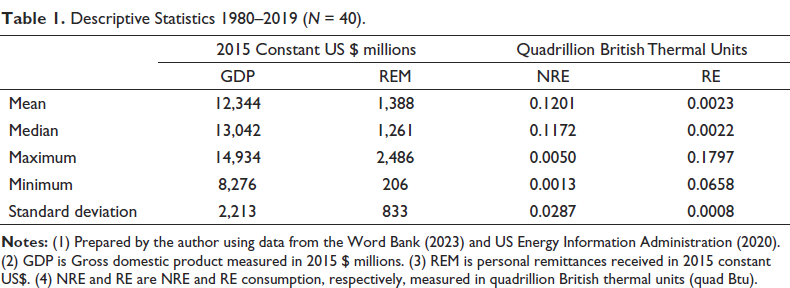
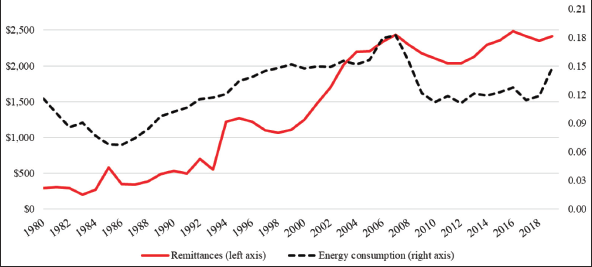
Figure 1 charts the evolution of energy consumption and remittances in Jamaica. The data are annual, spanning 1980–2019, and from the Word Bank (2023) and US Energy Information Administration (2023). Energy consumption is measured in quadrillion British thermal units (Btu), covering the two main constituents, NRE and RE. NRE includes energy sources like coal, natural gas, petroleum, and other liquids. Conversely, RE involves consumption from non-fossil sources such as hydropower, wind, solar, geothermal, wave, tidal, and biomass. Remittances (REM) are the inflows of personal transfers and employee compensation given to residents by non-residents, measured in 2015 US dollar terms. GDP is also measured in 2015 US dollar terms. Table 1 provides key descriptive statistics for these variables. Notably, Jamaica received an average of $ 1,388 million in personal remittances over our sample period.
Descriptive Statistics 1980–2019 (N = 40).
Empirical Model
Initially, we apply the natural logarithms to GDP, REM, NRE, and RE. Henceforth they are referred to as LNGDP, LNREM, LNNRE, and LNRE, respectively. We then establish the order of integration of the variables using the Augmented Dickey-Fuller (ADF) unit root test. Next, we check for evidence of cointegration among the variables, specifically for renewables and then for non-renewables. Our functional relationship is represented by Equations (1) and (2).


We determine cointegration using the Johansen cointegration test (Johansen, 1991), considering both the trace test and the maximum eigenvalue test statistics. Both tests are sequential, with the null hypothesis of r cointegrating vectors. The alternative hypothesis for the trace test is that
If the variables exhibit cointegration, we estimate a VECM incorporating the level and first difference of the variables. Otherwise, we estimate a VAR using the first differences of the variables. In either case, we ensure each model is statistically adequate by checking for the serial correlation of the residuals and dynamic stability. We check for the serial correlation of the residuals by reporting the Likelihood Ratio test and the Rao F-test statistics for up to 5 lags. For stability, we report the inverse roots of the autoregressive characteristic polynomial. Whether a VECM or VAR is used, we employ impulse response functions to elucidate the empirical causal relations on how (a) remittances affect RE consumption, and (b) remittances impact NRE consumption.
Our study’s implications and findings hinge on the strengths and weaknesses of our econometric methods, which merit discussion. Unit root tests are notable for their limitations: they have a lower power to reject a false null hypothesis and have an observational equivalence between trend stationary and difference stationary processes in finite samples (Hamilton, 2012). These issues mean there is uncertainty around whether a time series is genuinely difference or trend stationary. Nevertheless, adjusting the data to circumvent the effects of spurious regressions is crucial, hence the extensive application of unit root tests in the literature. Like unit root tests, cointegration tests have a lower power to reject a false null hypothesis, especially in the system equation setup. Still, these tests are instrumental in deciding whether to estimate VECM or VAR models.
VECMs can incorporate time series variables’ long-run (levels) and short-run (first differences) dynamics. This results in super-consistent estimators, a particularly beneficial feature when analyzing data with small sample sizes like ours. VAR and VECM models offer a flexible yet structured approach to capture the complex dynamics among variables without needing a theoretical foundation (Sims, 1980). However, when using these models, it is important to be mindful of the loss of degrees of freedom, which leads to decreased statistical testing power. Consequently, estimates could have large standard errors unless the number of endogenous variables and their lags are small. Furthermore, discerning the interactions between variables based on their parameters, including both sign and significance, can be challenging (Lütkepohl, 2010). VAR and VECM models attempt to counteract this weakness through impulse response functions. However, these should be viewed as indicative rather than definitive regarding the expected dynamics among variables. This is partly because, in the real world, holding all variables constant is rarely, if ever, feasible, and the true data-generating process underlying each variable is seldom, if ever, known.
Analysis
Unit Root Testing
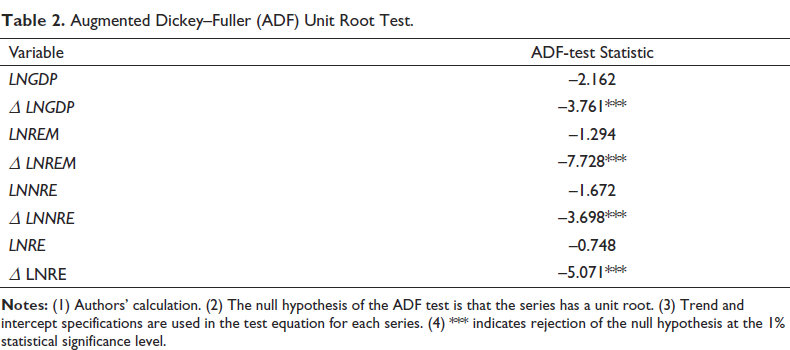
Table 2 presents the results of the ADF unit root test on our variables. The test results indicate that all variables are non-stationary at levels. The ADF test statistics for
Augmented Dickey–Fuller (ADF) Unit Root Test.
RE Consumption
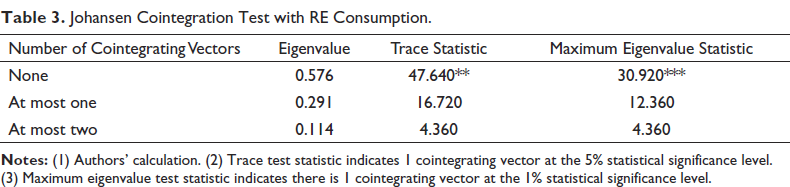
Table 3 reports the Johansen test results for cointegration among
Johansen Cointegration Test with RE Consumption.
VECM with RE, Serial Correlation Residuals.
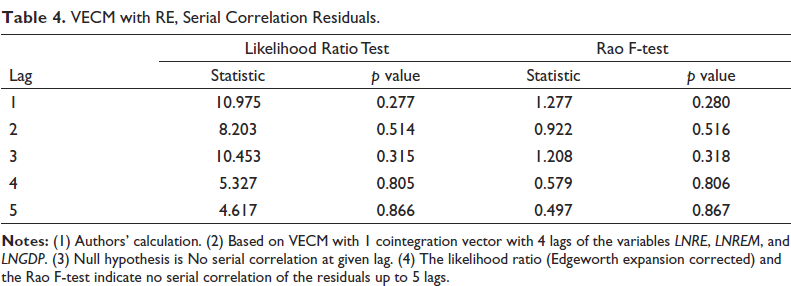
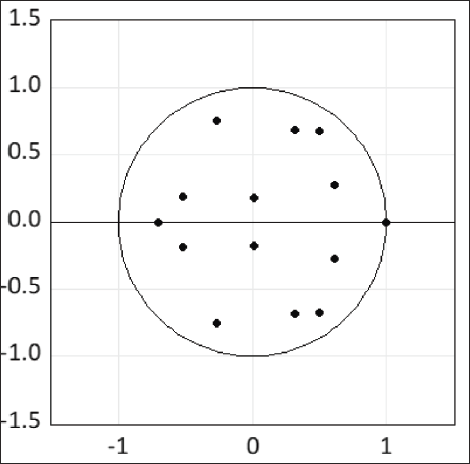
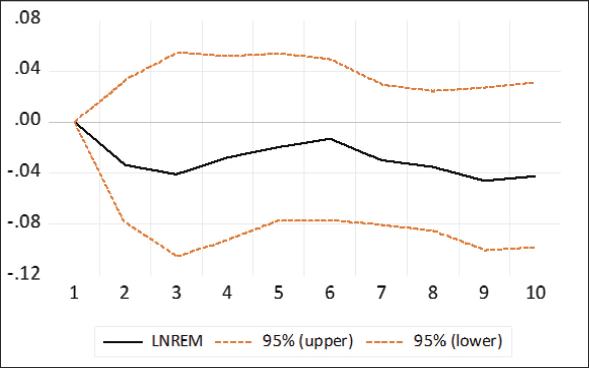
With the statistical adequacy of the VECM established, we conduct impulse response analysis to assess the impact of remittance changes on RE consumption. The outcome of this analysis is reported in Figure 3. In this figure, we show the impact of a non-factorized one standard deviation shock to the innovations of
It is important to note how our findings compare to recent studies. Subramaniam et al. (2022) studied the top five remittance-receiving countries, and Das et al. (2021) focused on Bangladesh. Both studies found that remittance inflows increased RE consumption, contrasting our findings. However, Chen et al. (2023) reported a negative impact of remittances on energy consumption in developing countries, including Jamaica, aligning with our results. However, they did not differentiate between the effects on RE and NRE consumption.
NRE Consumption
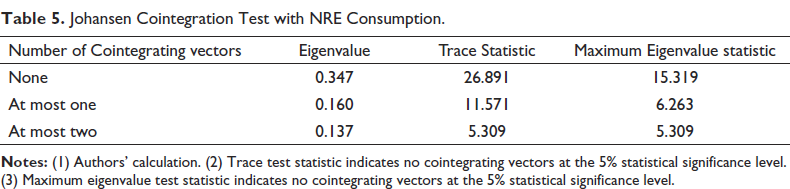
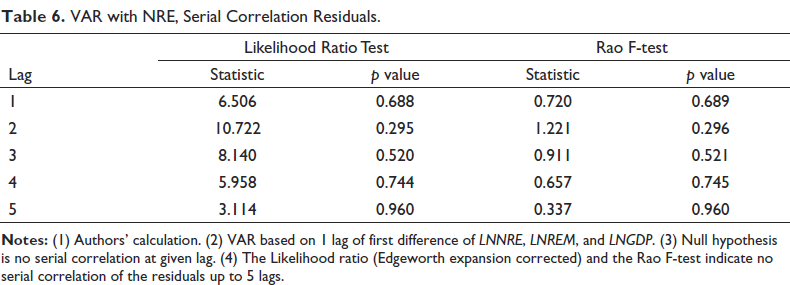
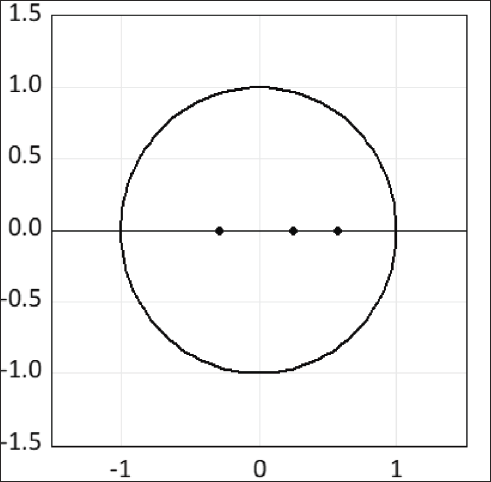
We begin by evaluating the dynamics of NRE consumption and remittances through cointegration testing. Table 5 reports the results of the Johansen test for LNGDP, LNREM, and LNNRE. The trace and maximum eigenvalue test statistics reveal no cointegration relationship between the variables. With no cointegration, we analyse the joint causal dynamics using a VAR in its first difference. For this purpose, we estimate a VAR with ∇ LNGDP, ∇ LNREM, and ∇ LNRE using one-year lagged values of the variables. The absence of serial correlation in the residuals and the stability of the VAR ensure the adequacy of our VAR model. Table 6 confirms that there is no serial correlation in the residuals of the VAR model. Figure 4 demonstrates that the VAR model is stable, as none of its roots are outside the unit circle.
Johansen Cointegration Test with NRE Consumption.
VAR with NRE, Serial Correlation Residuals.
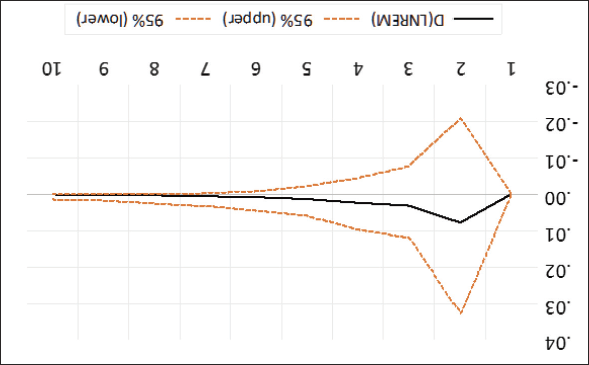
With the statistical adequacy of the VAR model, we analyse the impulse response of the impact of remittances on NRE consumption. Figure 5 reports this analysis. In this figure, we report the results of the impact of a non-factorized one standard deviation shock to the innovations of Δ LNREM on the time path of Δ LNNRE. These results indicate that increased remittances are associated with an increase in NRE consumption.
Regarding how these results compare to recent studies, none directly examined the impact of remittances on NRE consumption. However, we can infer the potential impact from studies examining remittances’ effect on environmental outcomes such as CO2 emissions, generally attributed to NRE consumption. For instance, Islam (2022) found that increasing remittances are associated with decreasing CO2 emissions across eight top remittance-receiving countries, implying a negative impact of remittances on NRE consumption. By contrast, Yang et al. (2021) examined Brazil, India, China, and South Africa from 1990 to 2016 and found that increased remittances correlate with rising CO2 emissions. This implies a positive impact of remittances on NRE consumption, which aligns with our findings.
Discussion and Policy Implications
To attain a higher proportion of RE consumption in its energy mix, Jamaica has started pursuing energy policies aggressively. Aligning the consumption behaviour of end-users with RE, ensuring RE’s economic affordability, and establishing market rationale will be vital to Jamaica’s RE strategy. Remittances play a significant role in many Jamaican households’ purchasing power and are the country’s primary source of capital inflows. Considering the impact of these inflows on energy consumption is crucial. Otherwise, energy policies may not achieve the desired increase in RE consumption. Our findings suggest a long-term negative relationship between remittances and RE consumption, with an increase in remittances associated with a decrease in RE consumption. Simultaneously, we found that NRE consumption increases with remittances in the short term. We now draw several observations from existing literature, which offer potential explanations for our study’s observed effects and form the basis for our policy recommendations. Consequently, we propose short-term, medium-term, and long-term policies.
To begin, remittances might affect energy consumption differently across income groups. Research indicates that remittances can significantly alleviate energy poverty by increasing energy access and consumption (Agradi, 2023). Without the incentive or an opportunity to use RE, it is unlikely that low-income households would automatically increase their consumption of RE upon receiving remittances unless the cost of RE is significantly cheaper and more accessible than NRE. Some rural, off-grid consumers in Jamaica lack clean energy access due to the difficulty of extending the energy grid to remote areas. Moreover, urban, high-demand, densely populated areas often receive priority for grid extension due to budget constraints. As a result, many poor rural households mainly rely on kerosene lamps, charcoal, or candles (Jamaica Information Service, 2018), despite the efficiency of solar home lanterns for low-income communities. Managing the up-front costs of RE devices can pose a problem for poor households, with research indicating that high initial prices of clean energy, such as photovoltaic systems, remain a barrier for some low-income households (UNDP, 2021).
We recommend subsidizing the initial RE consumption cost in the short term for impoverished remittance-receiving households. Over the long term, a consolidated strategy could reduce remittance costs, popularize mobile banking, and incentivize remittance-induced expenditure on RE equipment. Adopting digital technologies, particularly mobile money transfers, could be highly advantageous. These technologies could form a part of medium to long-term energy policies. Mobile transfer for remittances is still in its early stage in Jamaica. In this respect, approximately 40% of the population remains unbanked or underbanked (CAPRI, 2022). The efficacy of earlier Demand Side Management (DSM) incentives supports our recommendation. These DSM incentives reduced consumers’ electric load cost and increased electric savings by supplying energy-efficient residential gadgets in the short term. However, consumers could not finance energy reduction schemes in the long term (Binger, 2011). This observation leads us to propose additional medium-term and long-term policies.
Supply-side policies can reduce energy costs for all households, whether they receive remittances or not. Such policies include the broader availability of hybrid options (integrating RE into the national energy grid). Pilo’ (2022) notes that consumers will be less inclined to use NRE with this option. However, some low-income residential consumers still tend to be less formally connected to a grid. The irony is that these small customers may face even higher prices for energy as upper middle-income residential consumers and large commercial customers are leaving the grid. In this regard, shifting from net-metering to a net-billing scheme could support higher RE consumption (IRENA, 2015) and customer benefits (Pilo’, 2022). However, initial concerns against this system include its size limitations, administrative issues, system costs, interconnection fees, lengthy interconnection wait times, problems with the licensing and approval protocol, and an upfront deposit requirement, which may not be affordable for many households (Kersey et al., 2021; Timilsina & Shah, 2016). In a recent news report, the Jamaica Renewable Energy Association also raised concerns about the net billing system’s transparency and regulatory structure, indicating that these issues impede the adoption of RE (The Gleaner, 2022).
Thus, we recommend popularizing net billing, removing bottlenecks, restructuring outdated policies, and making the system more transparent in the medium term. For the long term, we suggest examining legislative reforms more closely. A utility monopoly on electricity distribution can help or hinder RE deployment, depending on a country’s political structure, corruption level, and other key socio-economic factors. While we agree with Kersey et al. (2021) that legislative reforms alone will not increase the share of RE, energy pricing raises strategic concerns for traditional distributors’ business models. We suggest including the welfare impact for consumers from all income groups in the policy framework.
At the household level, affordability aside, awareness and perception barriers present significant challenges. Because some households need more knowledge and adequate education about the various forms of RE, transaction costs, risk management, and the best options, people cannot make optimally informed decisions on energy-related products and services (UNDP, 2021). In the long run, targeted educational and human capital development programs for remittance recipients could prove highly beneficial. Negative social and cultural perceptions can also discourage users from choosing green technology. For instance, solar cooking methods fail to gain traction in many households due to their reliance on sunlight availability, insufficient energy storage options, inefficient and lengthy cooking times, and the need for extensive infrastructure (Topriska et al., 2016).
Moreover, solar cookers are often considered inferior alternatives for low-income households. Therefore, whether they receive remittances or not, middle- and upper-income households may prefer more sophisticated NRE-intensive technologies. Many Jamaicans are also unaware of their country’s comparatively significant carbon footprint and mistakenly believe that environmental degradation issues in Jamaica are less severe than in other high-emitting countries (UNFCC, 2011). We strongly recommend promoting green transition and RE as a long-term strategy.
Finally, given the existence of the EKC hypothesis in the Jamaican economy (Brown et al., 2020), it seems that Jamaica is still in a stage where growth, industrialization, urbanization, and energy demand are prioritized. As a result, remittances are channelled to meet these priorities with NRE. According to the World Energy Council (2022), Jamaica has consistently improved its ability to meet current and future energy demands (energy security). This progress is primarily due to greater diversification in energy production and supply and improvements to storage facilities and resilience. However, Jamaica has yet to make notable progress regarding energy affordability. A just and fair energy transition must concurrently ensure a secure, equitable (affordable), and sustainable future (World Energy Council, 2022). While Jamaica shows a notable improvement in providing energy security, it requires help with affordability and sustainability. Prior supply-side studies highlighted several regulatory, policy, legal, technical, capacity, knowledge, and financial barriers preventing RE scaling up in Jamaica in general and solar photovoltaic in particular. Jamaica needs to overcome these barriers to improve affordability in the long term. Taxing higher income brackets and redistributing the benefits to lower-income consumers seems promising. However, we hesitate to generalize this recommendation because energy is already quite expensive in Jamaica, and hiking prices further through taxes could be problematic. Moreover, while environmental taxes could help reduce emissions, there is scope to encourage energy independence through remittances. Therefore, our final recommendation is to incentivize RE consumption through alternate measures (such as cost reduction incentives) by targeting the energy requirements of remittance recipient households.
Conclusion, Limitations, and Future Research
Jamaica struggles with supply-side and demand-side constraints for the deployment of RE. While there are quite a few papers on the supply-side constraints of the economy, only a few studies discussed the demand-side constraints. By analyzing the impact of remittances on disaggregated energy demand, we contribute to the literature in this regard. Examining the relationship between remittances and RE consumption and NRE consumption in Jamaica from 1980 to 2019 using VAR and VECM models, we find that increased remittances are associated with decreased RE consumption in the long run. However, from the non-cointegrating relationship (that is, short run), our findings reveal that NRE consumption increases in response to increased remittances.
Our findings offer valuable policy recommendations for Jamaican policymakers, as summarized earlier. However, our study has two main limitations. First, we focused solely on the causal impact of remittances on disaggregated energy consumption. As RE consumption is still in its early development stage in Jamaica—as evident from the share of RE in the energy mix—it is likely that the energy transition will take a longer and more complicated route in Jamaica than what we currently observe. There may also be non-linear effects of remittances on RE consumption. Future studies could explore a more detailed framework. Second, while our study emphasizes the need for policy research that addresses the varying energy needs of different income groups, it was beyond our scope to include the welfare impact on these groups.
For future research, we also suggest analyzing the marginal effect of remittances on RE and NRE consumption conditioned on the household income level. Some limitations for RE deployment are structural and specific to the Jamaican economy. For instance, the main RE sources in Jamaica are solar and wind, which are associated with higher variability than other RE sources like hydro or geothermal energy. Therefore, we need more studies explicitly focused on Jamaica in this area. Lastly, we need future studies focused on understanding how to enhance energy security and green transition in Jamaica, possibly by evaluating case studies at the household level. These studies could also focus on raising awareness and enhancing human capital development regarding the use of green technologies. For instance, if engineers require better education and training to install solar panels in households, and households need proper education to maintain these panels, the economy might need help to utilize the clean energy that is already generated effectively.
Footnotes
Acknowledgment
The authors are grateful to the journal’s anonymous referees for their extremely useful suggestions to improve the quality of the paper.
Declaration of Conflicting Interests
The authors declared no potential conflicts of interest with respect to the research, authorship and/or publication of this article.
Funding
The authors received no financial support for the research, authorship and/or publication of this article.
