



Abstract
This article assesses how the ‘Public Interest’ was used to (de)legitimize the acquisition of a national airline. It does this by adopting a case study approach that analyses the acquisition of Aer Lingus by International Consolidated Airlines Group (IAG). This acquisition is part of a broader trend of international consolidation that the aviation industry has experienced in recent years. The article also critiques whether the ‘Public Interest’ was constructed on valid grounds. Its analysis found that the public interest was constructed as the continuance of routes between Irish airports and London Heathrow as a means for Ireland to maintain international connectivity. However, this article questions the validity of how the ‘Public Interest’ was constructed, suggesting that although the Public Interest does appear to be served by maintaining international connectivity, it is less clear whether connectivity with London Heathrow serves the interests of the public. Notwithstanding this critique, IAG was able to successfully use the maintenance of the Public Interest to successfully execute its acquisition of Aer Lingus.
Introduction
Acting in the public interest is usually understood as a desirable and ethical end goal of public policy (Cassinelli, 1958, p .48) and is often evoked in regulatory discussions of global entities (Plantin et al., 2018, p. 307). Successfully fulfilled, a policy enacted in the public interest should mirror a policy that the public would enact if they could, assuming they did so with rationality, disinterest and benevolence (Lewis, 2006, p. 694). This extends into the commercial world when regulatory institutes consider the public interest when determining if a major acquisition should be approved (Choi, 2018). However, understanding the public interest in this manner is problematic given that the public are not homogeneous and do not have identical policy preferences (Downs, 1962, p. 3). Consequently, the above description illustrates some of its core criticisms; it is too broad and diffuse a concept (Lewis, 2006, p.694) and largely nebulous in how it is defined (Sorauf, 1957, p. 618). This definitional ambiguity is problematic when analysing public discourse as it can often lead to the ‘public interest’ being used as a legitimacy device, when it may be questionable if the policy is actually in the public interest. Thus, given the unlikelihood of a universal definition being attainable (Long, 1991), alternative typologies are needed as a next best alternative. This article utilizes a prominent typology advocated by Mitnick (1976), to assess the use of the Public Interest in the (de)legitimacy of this acquisition. This is detailed in Table 1.
Application of Mitnick’s Typology.
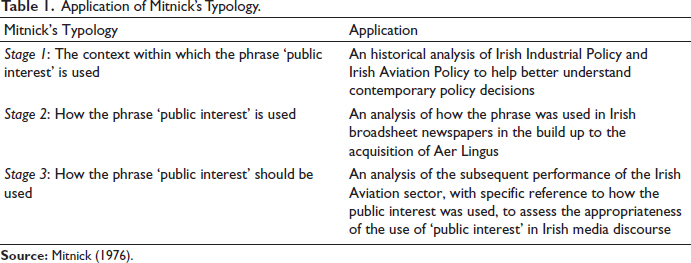
This article focuses on Irish aviation policy and the strategic decision by the International Consolidated Airlines Group (IAG) to acquire Aer Lingus, the former national airline of Ireland. Like many countries, Ireland’s aviation sector was long dominated by a national airline, which was initially established as a state-run enterprise. This active presence of the state meant that by default aviation policy had a public service obligation. Thus, the acquisition of Aer Lingus by IAG provides an interesting case given the conflicts it may present between a general industrial policy that is highly receptive and welcoming of foreign direct investment (FDI) (Lane & Ruane, 2006, p. 4), and an aviation policy that, given its history, may still possess legacies of a public service obligation. This presents a particularly challenging context for an acquisition.
Aer Lingus and Irish Aviation Policy
Given its island status, Irish transport policy has long had international connectivity at its heart (O’Grady, 1997, p. 80). This connectivity has traditionally focused on transit between Ireland and European hub airports (O’Connell & Connolly, 2017, p. 1297), and between Ireland and North America (O’Grady, 1997). The more recent rise of the low-cost airline model, and Ryanair as one of its chief proponents, has seen air passenger numbers grow significantly (Barrett, 1997) and seen direct connectivity also become an important consideration (Fan, 2006).
Aer Lingus was established as a national carrier in 1936 to provide initial connectivity with Europe (O’Connell & Connolly, 2017). Given its status as a national carrier, it is not surprising that Aer Lingus dominated air routes in and out of Ireland, a feature that would persist until the deregulation of the aviation sector in Ireland in 1984 (Barrett, 1997). This move to deregulate was spurred on by a public dissatisfaction with high fares and poor service (Barrett, 1997). Based on these measures, deregulation had the anticipated transformative effective (Putatunda, 2005, p. 15) and was successful, with passenger number growing significantly through the 1990s and prices falling due to increased competition and greater efficiency (McLay & Reynolds-Feighan, 2006). However, the fortunes of Aer Lingus were not buoyed by this deregulatory move. Its near bankruptcy in 1993 and again in 2001 (O’Connell & Connolly, 2017, p.1297) showed not only how it struggled to compete without its state granted monopoly but also the burden it bore on the state for subsistence.
The success of deregulation in improving international connectivity versus the continued struggles of Aer Lingus may have influenced government to consider privatizing Aer Lingus. This privatization began in 2006, at the end of a fruitful 20-year period for privatizations globally (Palcic & Reeves, 2004, p. 1), when the Irish government opted for a partial divestment IPO, which resulted in the state maintaining a 25% stake in Aer Lingus (Oliver, 2006). This allowed the state to maintain some influence on the decision making within Aer Lingus. Though this would clearly be limited, one area that the government did note as an area of concern was international connectivity, which was seen as integral (Sunday Business Post, 2005).
Constructing the Public Interest
This section focuses on how the Public Interest was used to (de)legitimize the IAG acquisition of Aer Lingus. The state’s retention of 25% of Aer Lingus meant that IAG needed its approval to acquire a majority stake in Aer Lingus. The decision of IAG to attempt to acquire Aer Lingus is unsurprising given the global consolidation of airline groups in recent years (Ciliberto et al., 2019). After its initial approach in December 2014, there was a growing concern of the impact that this acquisition may have on the connectivity from Cork and Shannon airports, both regional airports in Ireland. This concern for connectivity specifically focused on the London Heathrow routes from these airports that were operated by Aer Lingus. Throughout January 2015, speculation was mounting that in the event of IAG acquiring Aer Lingus that these routes may be reduced or discontinued.
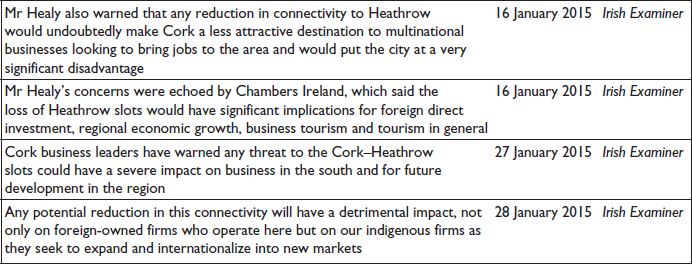
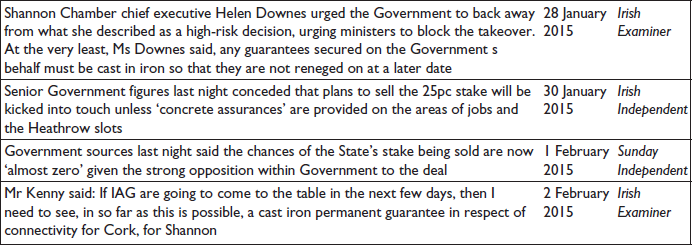
Data was collected from the archives of the five national broadsheet newspapers in Ireland: The Irish Times, The Irish Independent, The Sunday Independent, The Irish Examiner and The Sunday Business Post. This data collection focused on identifying articles that contained discourse on the public interest. This assessment was inclusive of any article that discussed this acquisition as providing a discernible benefit, or not, to Irish society. This inclusive approach was deemed appropriate given the lack of definitional certainty on what the public interest actually entails (Long, 1991), and resulted in 46 articles being identified. A discourse analysis of these articles was carried out to analyse how the public interest was constructed to (de)legitimize this acquisition. The central theme in this construction was ‘connectivity’ in various guises. Figure 1 focuses on national connectivity, Figure 2 on regional connectivity and Figure 3 on the protection of connectivity to/from Ireland.
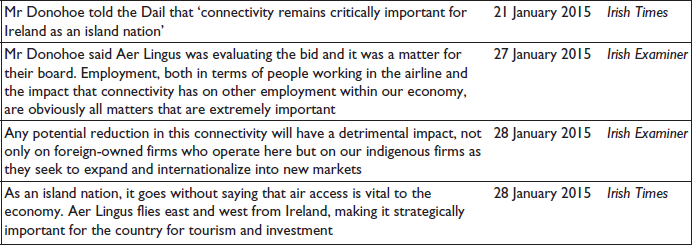
Central to how the ‘Public Interest’ was used was the importance of international connectivity to Ireland. Why was connectivity so central to this construction? As has been previously discussed, international connectivity has long been central to Irish industry policy. If Ireland wants to have an ‘open-economy’ (McCann, 2013, p .111), where FDI is seen as integral to economic growth, then ensuring and maintaining international connectivity is key. The longevity of this industrial policy, and its association with economic growth in Ireland (Kneafsey & Regan, 2020), lend credence to the strength of connectivity as being important for the Irish economy. Thus, in Figure 1, above, connectivity is described as being ‘critically important’ (21 January) to Ireland, and ‘vital to the economy’ (28 January). This echoes the long-term focus on Irish industrial policy towards internationalism, and also the even greater emphasis placed on internationalism, through exports, as a means for the Irish economy to recover after the Great Recession (Ruane, 2016, p. 245). Figure 1 alludes to this with Ireland described as an ‘island nation’ (28 January), whose relied on connectivity to maintain ‘employment within our economy’ (27 January).
Figure 1 also sees the media texts refer to international companies in Ireland and internationalizing indigenous firms, and the implies how important it is to ensure a hospitable business environment for them. The connectivity that Ireland possesses is seen as ‘vital’ for the country to attract ‘tourism and investment’ (28 January), and any reduction on this connectivity would be detrimental for ‘foreign-owned firms who operate here’ and on ‘indigenous firms as they seek to expand and internationalize’ (28 January). Ireland has an above average presence of MNCs (Barry, 2019, p. 94), which is viewed with pride by the Irish public. Indeed, Irish public opinion is so positively disposed to MNCs that it was strongly supportive of its government’s decision not to collect the €13 billion awarded to it by the European Commission in unpaid corporate tax by Apple (Kneafsey & Regan, 2020, p .8). Thus, reference to foreign-owned companies and their investment, help legitimize the importance of connectivity to the Irish economy, given its associated importance to these companies.
The importance of maintaining international connectivity was often articulated through the consequences of a reduction or loss of connectivity. After an initial concern for connectivity internationally, the consequence of a loss in connectivity coalesced around concern for the regional airports in Cork and Shannon, in the Irish south and midlands. In contrast, Dublin airport was viewed to possibly benefit from this acquisition as it was viewed as an alternative airport to London Heathrow for transatlantic flights. The impact to these regional airports would have ‘significant implications’ (16 January) and ‘a severe impact’ (27 January) on these regions. This impact was described through economic means and often included the impact on the wider localities where the airports were situated, with the discourse used constructing such an impact as having very negative economic consequences. The regions would become ‘a less attractive destination to multinational business’ (16 January) and would have ‘significant implications for foreign direct investment, regional economic growth…’ (16 January). It would also impact on firms already operating in Ireland, causing a detrimental impact ‘not only on foreign-owned firms who operate here but on our indigenous firms’ (28 January). The focus on ‘multinational business’ and ‘foreign direct investment’ are useful contributors to the effort to de-legitimize the acquisition of Aer Lingus, given how fundamental these have been to Irish industrial policy and its success (Barry, 2019). This has led to Ireland being positively disposed to both the presence of multinationals and attracting FDI and has sought to provide a hospitable environment for such international activities through its industrial policy (Cotter, 2004). Thus, any disruption to this can be used to imply such activities go against the success of Irish Industrial policy, which has been central to Ireland’s economic growth.
On the face of it, this concern is not without merit. Though investment in aviation is an important contributor to economic development, the magnitude of this effect is greater in large airports as opposed to regional, smaller airports (Redondi et al., 2013). Whereas the connectivity from larger, hub airports can have a multiplier effect on economic development, the economic impact of closing smaller, regional airports is argued to be negligible in most instances of such airports in Europe, a trend that is particularly prominent in Ireland (Redondi et al., 2013, p. 89).
Thus, whether the reduction in connectivity at Cork and Shannon airport would have the negative consequences that were suggested in Figure 2 is at best debatable. Whether the concerns expressed have bona fides is not the pressing concern. Rather, what the discourse in Figure 2 helps achieve is a de-legitimacy of the Aer Lingus acquisition by associating a potential loss in connectivity as the antithesis of the long established Irish industrial policy of internationalism (Barry, 2004). Within the Irish context, this is a powerful discursive tool given the centrality of internationalism to Irish industrial policy and how that internationalism is positively received in Ireland.
By the end of January, the public discourse about the vitality of international connectivity for Ireland, and the potentially negative consequences of any disruption to this, was so effective that the likelihood of a successful acquisition were rapidly diminishing. Government sources were leaking that the chances of a sale were ‘almost zero’ (1 February). However, there were suggestions as to how the public interest of maintaining international connectivity could be protected whilst also facilitating the acquisition. The need to secure ‘guarantees’ (28 January) and ‘concrete assurances’ (30 January) were being presented as the requirement for the government acquiescing to the acquisition. The concessions amounted to a maintenance of the status quo of international connectivity were ‘the very least’ (28 January) necessary to ensure the deal was not ‘kicked into touch’ (30 January). Furthermore, the state demanded that these concessions amounted to ‘a cast iron permanent guarantee’ (2 February).
The use of the cast iron guarantees as a discursive device was useful for the state as it allowed it to turn the public discourse away from de-legitimizing the acquisition due to connectivity concerns, and move it to legitimizing the acquisition if guarantees could be attained on future connectivity. It also allowed the state to present itself as the defender of the public interest, in how it was trying to maintain international connectivity, whilst simultaneously supporting the internationalism that was at the heart of its industrial policy. An outright rejection of IAG’s acquisition offer may have been damaging to Ireland’s reputation as a welcoming country for FDI, but a full acceptance of IAG’s offer would have questioned the commitment of the state to protecting the public interest. Demanding cast iron guarantees allowed the state to support the acquisition whilst protecting the public interest. IAG appeared to recognize this and was quick to offer the necessary guarantees to the Irish government to allow it to move to accept its acquisition bid.
Assessing the Public Interest
This section will consider how the Pubic Interest should be used by assessing the claim that connectivity with London Heathrow was in the public interest and whether the ‘cast iron guarantee’ that the government attained from IAG as a concession for approving the acquisition did protect ‘the public interest’. This involved the collection of public data of aviation statistics in Ireland from the Central Statistics Office (CSO) to examine the validity of the claim made.
Figure 4, above, shows the actual performance of all routes from Irish airports to London Heathrow subsequent to the IAG acquisition of Aer Lingus. As shows, Cork–Heathrow was the worst performing route, experienced passenger number decline that contrasts to the growth on the two other routes to Heathrow. The contrasting fortunes of Cork and Shannon airports are notable given how much of the connectivity concern raised during the IAG acquisition of Aer Lingus focused on these two airports. The significant increase in passenger numbers on the Shannon–Heathrow route can principally be attributed to the decision by Aer Lingus to increase capacity on this route by 35,000 seats from summer 2016 (Shannon Airport, 2015). This capacity increase contributed to a 12.88% growth in passenger numbers in 2016 to a level that remained quite constant through to 2019. Aer Lingus also increased its capacity on the Cork–Heathrow route in 2017, moving from four to five daily flights during the summer period (Irish Times, 16 December 2016). This resulted in a less impressive 2.83% growth in passenger numbers. This increased capacity was maintained in 2018, but the extra daily flight was not offered in 2019. Though the reason for this was never publicly confirmed, the relatively low growth in passenger numbers that resulted from the extra daily flight would seem to have been a contributed factor.

Thus, the connectivity concerns raised prior to the IAG acquisition of Aer Lingus did not materialize. Up until the eve of the COVID-19 pandemic, which decimated air passenger numbers internationally, IAG had at least maintained, and in some instances increased, flight capacity on the Cork–Heathrow and Shannon–Heathrow routes, despite the reduction/cancellation of similar routes by competitor airlines. For example, CityJet axed its route from Cork to London City Airport in June 2016 after just eight months of operation, citing a lack of demand (Irish Examiner, 13 May 2016). As this was still within the seven year ‘cast iron guarantee’ period, the maintenance of its schedule is unsurprising. However, the expansion of capacity was not required of them.
Based on the criterion of global connectivity, how pressing was the need to maintain connectivity with London Heathrow to protect the public interest. To assess this, we must consider the concept of connectivity within air travel and how it applied to Irish airports. The IATA (2020, p. 16) distinguish between direct connectivity, the number of destinations that can be reached with a non-stop flight, and indirect connectivity, number of destinations accessible with a connecting flight. Though direct connectivity is typically preferred by travellers, the dominance of the hub-and-spoke system within international air travel means that connections to hubs is important to ensure indirect, global connectivity. This would lend credence to the public interest argument, given London Heathrow’s position as an international hub airport. However, Irish airports were not solely reliant on Heathrow as a hub airport. In recent years, other major European hubs, such as Paris, Amsterdam and Frankfurt, have outperformed London Heathrow in terms of international connectivity due to expansions in these airports versus capacity limitations at London Heathrow (IATA, 2020, p. 11). Only Cork and Dublin Airports had established routes with the other major European hub airports during the 2015–2019 period.
Figure 5 shows the Cork–Amsterdam route has experienced a decline in passenger numbers between 2015 and 2019 of 9.16% due to a reduction in capacity from Aer Lingus. During this period, Aer Lingus was the sole operator on this route. In contrast to this, the Cork–Paris route saw a sharp increase with passenger numbers up 50.86%, due principally to Air France commencing a daily service on this route in 2018 (International Airport Review, 2018), which it then doubled in 2019 (Cork Airport, 2019). The expansion of this route is significant as it more than makes up for the decline in passenger numbers on the Cork–Heathrow and Cork–Amsterdam routes. If travel to these hub airports is primarily for the purpose of international connectivity, then the location of the hub may be less important for the traveller.
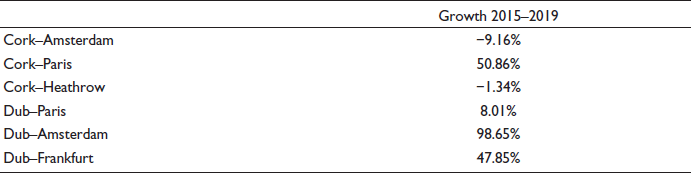
Thus, the public interest of international connectivity has not suffered in the aftermath of the IAG acquisition of Aer Lingus. In fact, this has increased in terms of passenger numbers, but not through an expansion of passengers to London Heathrow or because of a mandated ‘cast iron guarantee’ on air routes. Instead, other providers, principally Air France and KLM, have provided a route based on their perception of greater demand between Cork–Paris and Cork–Amsterdam. If it is assumed that these routes are a competitor of the Cork–Heathrow route, given each airports status as a European hub, then the need for ‘cast iron guarantees’ in the public interest appears tentative. Indeed, the available evidence suggests that there was little appetite from IAG to reduce or discontinue this service. Passenger numbers were relatively stable in the years after the acquisition (up to the eve of the COVID-19 pandemic at least), passenger numbers grew substantially on the Shannon–Heathrow route, and IAG even put on an additional daily service on the Cork–Heathrow route during the 2017 summer season. Figure 5 shows that Ireland has good international connections to both London specifically and to major European hub airports, some of which have seen substantial connectivity expansion between 2015 and 2019.
Conclusions
In this article the Public Interest was constructed as maintaining international connectivity, for which routes to London Heathrow were deemed as vital. This Public Interest was then used to first de-legitimize the acquisition of Aer Lingus and then to legitimize the acquisition. The de-legitimacy was achieved by constructing the acquisition as a threat to the Public Interest should IAG reduce connectivity between Irish regional airports and London Heathrow in favour of more profitable routes. The Irish government then legitimized its position in favour of the acquisition on the condition that this Public Interest was protected through a ‘cast iron guarantee’. Thus, the Public Interest was vital for both the de-legitimacy and legitimacy of the acquisition.
The use of the Public Interest for (de)legitimacy comes from the internationalism that is at the heart of Irish industrial policy and the nationalism at the heart of aviation policy. The connectivity that needed protecting was international, which was seen as vital to Ireland’s competitiveness and ability to attract inward investment. This ‘international nationalism’ is a consequence of Irish industrial policy, which has long heavily promoted FDI as a means of achieving economic growth (Tomaney, 1995), and the strong support for MNEs evident in Irish public discourse (Kneafsey & Regan, 2020). It is a useful discursive device as it allows Irish public discourse to be critical of an international company and protectionist around its own parochial interests, but also still a destination for internationalism. The ‘cast iron guarantee’ that the Irish government sought, and ultimately got, as a concession for supporting this acquisition demonstrated this international nationalism. It evoked a nationalist rhetoric in how it supported parochial interests about connectivity, but also set out the means with which the FDI would be welcomed.
Within aviation policy, cross-border acquisitions have long been difficult due to foreign ownership restrictions and nationality rules (Rijke, 2012). Lufthansa had to undertake a prolonged procedure to complete its acquisition of SWISS, eventually prevailing after guaranteeing jobs and the continued existence of SWISS as an international airline (Vermooten, 2020, pp. 10–11). In addition to such external hurdles, cross-border acquisitions present increased challenges of risk for the acquirer (Paula et al., 2020), necessitating that acquirer to be cautious in their acquisition strategy. Thus, the prolonged acquisition of Aer Lingus is unsurprising given the risk involved for IAG and the anticipated scrutiny and challenges its acquisition faced.
The subsequent performance of the routes from Ireland to London Heathrow, which were central to how the Public Interest was constructed, was mixed. The Shannon–Heathrow route grew in terms of passenger numbers, which it achieved with the support of Aer Lingus. The Cork–Heathrow route declined, though the increased competition to other major European hub airports helps explain this decline. The significant expansion of the Cork–Paris route, which came as a result of this increased competition, questions whether the Cork–Heathrow route equated to the ‘Public Interest’ if it is assumed, as this article argues, that the Cork–Heathrow route principally serviced international connectivity rather than direct connectivity with London. This questions whether the Public Interest should be used in this manner and echoes previous research in questioning whether the state is necessary to provide this Public Interest (Goodman & Loveman, 1991).
This article has used Mitnick’s (1976) typology to assess how the Public Interest was constructed during the acquisition of Aer Lingus by IAG, to evaluate this construction, and to provide some context for its construction. Mitnick’s typology allows us to see how the Public Interest is actually used, and then to evaluate this construction. Though this does not allow for a universal definition to be attained, it does allow for a critique of the term at a local level. For the acquisition of Aer Lingus, this article has shown how the Public Interest was constructed, provided context as to why it was constructed in this way, but is critical of this construction. Given the definitional ambiguity that has long plagued the Public Interest, this article argues that this more modest approach may be of benefit to many research areas.
Footnotes
Acknowledgement
The author is grateful to the anonymous referees of the journal for their extremely useful suggestions to improve the quality of the article. Usual disclaimers apply.
Declaration of Conflicting Interests
The author declared no potential conflicts of interest with respect to the research, authorship and/or publication of this article.
Funding
The author received no financial support for the research, authorship and/or publication of this article.
