



Abstract
The general idea of this article is to analyse the interrelation between the dynamic capabilities of knowledge management, learning, adaptation, with innovation in medium and large companies in an emerging Latin American economy. This is because innovation is a key strategy for dealing with crises such as the one caused by the COVID-19 pandemic. A Likert scale survey of 106 executives from the same number of firms in the pharmaceuticals, information and communication technologies and processed food sectors was applied to obtain data. The general findings show that there is a significant inter-relationship between the different dynamic capabilities of the firms above described. However, when analyzing the interrelationship between the dynamic capability of innovation with the other three capabilities, the strongest interrelationship is with adaptive capability. These findings, positively draw attention, given that a literature review on the subject indicates that in emerging economies the companies developing these capabilities are unusual. These encouraging findings suggest that companies in these economies have the capacity to effectively address the issues posed by the COVID-19 epidemic.
Keywords
Introduction
In an environment as complex, dynamic and uncertain as the current one, particularly considering the crisis caused by the COVID-19 pandemic (Suyanto, 2021), any company’s long-term viability requires the implementation of dynamic capabilities (DC) ecosystem (Bocken & Geradts, 2020). From the negative consequences of the pandemic, many organizations developed capabilities to learn quickly to respond to the demands of their stakeholders (Nayal et al., 2022), and to counter the challenges of a changing environment (Chakrabarti & Mukherjee, 2022). Thus, by their relevance in organizational activity, DC play an important role in improving organizational performance (Supriharyanti & Sukoco, 2022), and in the exploitation of internal capabilities in turbulent circumstances (Salim et al., 2019). In this respect, for Zeng (2022) and Gölgeci et al. (2019), DC is a key strategy that enables companies to respond to the demands of the environment with a competitive advantage.
The resources and capabilities that generate value for a company in its home country may generate more or less value in different countries (Chen et al., 2019). This is particularly true for emerging market firms that do not operate within fully developed national innovation systems that support capabilities (Moreno et al., 2020). Alongside this is the fact that some emerging market companies do not invest in R&D to the same extent as their competitors in developed countries, therefore, developing technological and knowledge capabilities is difficult (Lynch, 2019).
In line with the above, Mohammed et al. (2021) emphasize the need for DC analysis in companies in emerging economies as a strategy to overcome the consequences of pandemic crises. This is because companies, regardless of their size, have had to face unprecedented challenges in terms of declining sales, employee layoffs, payment of obligations, among others. Consequently, the need to explore the links between DC and corporate sustainability is driving organizations to reconsider their operations and strategies (Chen et al., 2019).
As a result, responding to, anticipating, or generating changes depends on the company’s DCs, in order to take advantage of the encompassing opportunities (Tasheva & Nielsen, 2022) and to build a competitive advantage in emerging economies (Kaya et al., 2020). In this regard, Gölgeci et al. (2019) when referring to emerging economies, highlights the need for companies-friendly, long-term oriented, flexible, equitable, and human capital development policies. As well as physical and cognitive infrastructure, to foster a socioeconomic and institutional environment that encourages the development of DC, and the need to create policies to help firms apply their capabilities and thus enhance their competitiveness.
Also, the literature review indicates that, in the context of emerging economies, it is unusual for companies to develop these capabilities. In fact, scholars and practitioners have become increasingly interested in the analysis of DCs in emerging economies (Akhtar et al., 2017; Lynch, 2019).
For Ponta et al. (2022) and Raj and Athaide (2022), one of the most important capabilities to be developed by firms, especially in times of crisis, is innovation capability (IC), which enables firms to create and maintain a competitive advantage. In this direction, Kucharska and Rebelo (2022) consider that an effective innovation capability must be supported by knowledge sharing, learning, and adapting to change.
In view of the above, this research aims to analyze the interrelationship between the dynamic capabilities of knowledge management, learning and adaptation to the environment, with innovation in medium and large companies in an emerging economy. This is because innovation is a key strategy for dealing with crises such as the one caused by the COVID-19 pandemic.
The article’s content is structured as follows. After the introduction, a section on the literature review is presented. Subsequently, there is a section on the methodology that covers data collecting and processing. The analysis of results collected through field work with the managers of the companies who participated in the study, as well as their respective discussions, follows. The conclusions and recommendations are finally presented.
Literature Review
The health crisis caused by the COVID-19 pandemic produced the most severe economic and social upheaval in decades, particularly in Latin American economies (Hossain, 2021). The confinement created chaotic conditions that forced businesses to develop new strategies to meet the basic needs of society (Goyal & Dangwal, 2022). Many companies had to implement innovations schemes that helped counteract the negative effects of COVID-19. These firms had to offer improved products, lowering costs, or establish new distribution channels. In addition, they faced shipping delays, price increases and product shortages (Yahya et al., 2021).
Overall, companies had to transform themselves by adopting digital technologies and developing dynamic capabilities to respond to the consequences of the pandemic (Khurana et al., 2022). In this regard, Warner and Wäger (2019) and Kokshagina (2021) argue that digitization capabilities helped firms to develop dynamic capabilities and improve their corporate performance. Also, knowledge management as a strategic resource helped develop other organizational capabilities that boosted firms’ performance to respond to the COVID-19 pandemic (Li et al., 2022).
In general, the response of firms to the different consequences of COVID-19 depended on their ability to learn new techniques and forms of management (Fasth et al., 2022). Therefore, the role of adaptive capabilities and temporal aspects became very important for firms in responding to the crisis (Eggers, 2020).
Dynamic Capabilities (DC)
According to Albort-Morant et al. (2018), there is no specific definition on the meaning of dynamic capabilities. Some authors agree that DC are organizational processes or routines that enable an organization or corporation to integrate, build, reconfigure, and renew internal and external resources to achieve a long-term competitive advantage (Nayal et al., 2022). As a result, actions aimed at the building of DC of innovation, knowledge management, learning and adaptation have an impact on organizational effectiveness (Cyfert et al., 2021).
This has caught academics’ curiosity, resulting in significant advances in its conceptualization and relationship with other concepts (Zahra et al., 2022). This has made it possible to identify some central elements that define DC, such as the level of change in the environment, organizational processes or routines, the configuration of resources, and managerial decision-making (Dyduch et al., 2021). Thus, DC refers to the company’s ability to integrate, grow and reconfigure internal competences in order to respond to, or in some cases generate, changes in its environment characterized by being complex and uncertain (Cyfert et al., 2021; Teece, 2018). The study of DC guides how a company’s capabilities are developed, augmented, and combined, and includes competencies such as identifying and assessing opportunities and threats. This creates value in the process and reconfigures the tangible and intangible assets that contribute to its competitiveness.
The development of DC depends on the perceptions and behaviours of managers who must be aware of the impact of their actions in the field of seeking opportunities for their companies (Nabi et al., 2022). These actions should include analyzing trends to create value for customers, generating changes in the attitudes of their employees, identifying changes in the environment, and enhancing the organization’s competitive capacity (Cyfert et al., 2021). Therefore, to respond to internal and external conditions, companies require knowledge management, learning, adaptation, and innovation capabilities (Otengei & Ahebwa, 2021).
Knowledge Management Capability (KMC)
KMC is a process that includes identifying, acquiring, recording, creating, transferring, integrating, sharing, and applying knowledge-related resources and activities to contribute to the achievement of competitive advantages (Lei et al., 2021; Sun et al., 2020). This efficient and effective creation of knowledge is carried out from various intra- and inter-organizational sources (Adamides & Karacapilidis, 2020). Therefore, the ability to manage knowledge is not only limited to accessing technological systems to store, transform or distribute knowledge, but also increases the capability for learning, with a focus on the goal of developing social capital (Ode & Ayavoo, 2020).
Organizations, according to Pellegrini et al. (2020), are institutions that integrate knowledge. The KMC involves the use of several learning mechanisms and processes of multiple combinations of knowledge possessed by heterogeneous individuals who are part of the organization. Because knowledge happens in people, it must be disseminated to teams or at the organizational level to support this recombination process (Alpenberg & Scarbrough, 2021). Considering that knowledge is created through the social activities and efforts of an organization’s members, it is critical to combine knowledge management processes with coordinating activities (Cyfert et al., 2021). KMC, therefore, leads companies to realign their structure, culture, and routines to contribute to value creation (Khodaei & Ortt, 2019).
KMC and innovation capability (IC) are closely linked because of the central role of knowledge in innovation (Lei et al., 2021). As Le and Lei (2019) point out, the organizational capability for innovation is significantly conditioned by the transformation and application of the firm’s knowledge. As a result, knowledge transfer is a critical activity for businesses since it leads to the establishment of a competitive advantage, which can include technology or managerial competencies that encourage the firm to innovate more (Ode & Ayavoo, 2020). However, Malik et al. (2020) and Oliva et al. (2019) recommend further studies in the framework of exploring the integration of knowledge with other capabilities, especially with innovation in dynamic environments.
To tackle the challenges of the contemporary environment, KMC helps firms to innovate by identifying, capturing, and modifying the dominant rationale to which they are used (Bocken & Geradts, 2020; Yuan et al., 2021). KMC as a DC enables companies to analyze the context quickly and effectively in order to identify trends, threats, and opportunities to invest resources, adapt, and/or create value for their stakeholders in ways that are more effective than their competitors (Heider et al., 2021). As a result, KMC is regarded as crucial for innovation and, as a result, for a company’s competitive advantage (Ouyang et al., 2019). Based on these arguments, the following hypothesis is proposed.
Learning Capability (LC)
Learning refers to an organization’s ability to sustain or increase performance by using knowledge gained (García-Morales et al., 2007). And, because the new information must be contrasted with previously acquired knowledge for continued development, there is an iterative process of knowledge production and application in this knowledge management process (Linden et al., 2019). Following Ashkenas et al. (2002), LC is defined as the ability of a company to learn from past experiences and to transmit these experiences over time. In this sense, the experience curve acquires great importance for the activity of companies (Jabeen & Al Dari, 2020). Organizations that are better adapted to the environment are characterized by making decisions based on learning acquired through experience and openness to new experiences (Cyfert et al., 2021).
The importance of building experience is linked to one of the three fundamental characteristics of LC proposed by Zollo and Winter (2002): accumulated experience (collecting experiences from everyday events), knowledge articulation (processing implicit knowledge and articulating it with collective discussions and evaluation processes) and knowledge codification (understanding codification through routine operational activities). Likewise, it contributes to the construction of competitive advantages, given that it is a source of internal capability for the company (Loureiro et al., 2019).
Studies on the LC of people and companies show that, especially in cases like multinationals, learning processes resulting from experimentation are required within a dynamic global network of meso (sector) and macro (region) character (Rodríguez et al., 2020). In this regard, Organizational learning research has made significant contributions to innovation for two reasons. To begin with, the ability to learn and innovate allows a company to grow in value. Second, organizational learning is one of the most important sources of innovation in businesses (Lloréns-Montes et al., 2005). Firms require a more complex learning mechanism to generate more drastic changes when the level of uncertainty in the environment increases (Fernandes & Panjaitan, 2019).
As a result, it’s critical to encourage businesses to improve their learning and innovation capabilities (Zia, 2020). And companies are encouraged to innovate in volatile contexts, and in order to innovate, they must learn (Hermawati, 2020). In this sense, several research highlight organizational learning as a source of innovation, since ideas and practices that are characterized by being different are essential in the design of new products and services (Makhloufi et al., 2021). This implies that companies need to define adequate processes to identify, store and reconfigure their resources like expertise (Lynch, 2019). Hence the need to obtain a holistic view of how DC influence firm performance in emerging economies (Akhtar et al., 2017). Based on these arguments, the following hypothesis is formulated.
Adaptability Capability (AC)
AC can be understood as the ability to cope with conditions generated by constant changes in the environment (De Groot et al., 2020). The capability for change and adaptation on the part of companies to respond to changing environmental conditions is emphasized from an organizational standpoint (Burnard et al., 2018). To Fraga (2014), organizations in a dynamic environment with high levels of AC need to develop the ability to reconfigure themselves rapidly by applying new knowledge in a sustainable manner, and this AC must allow them to improve and increase the availability of resources in order to counteract changes.
For Wang et al. (2020), the AC refers to the adoption of R&D strategies and investments, as well as organizational structures and management processes, to generate technological advances in the context of innovation processes. In this process, the organization makes decisions that include a significant relationship between AC and innovation, reflecting that the decision-making for its operation seeks to differentiate itself with innovative products, services, or processes (Rodríguez et al., 2020). Although indeed, it is recognized that the innovative capability of firms is developed through organizational adaptability, this is a challenge for managers due to their limited resources (Chan et al., 2019). In this way, managers learn by forming assumptions about new scenarios based on prior experiences, judgments, and knowledge (Lewin et al., 2020). As a result, AC is critical for businesses that need to understand and assimilate information about their surroundings, such as local culture, consumer preferences and behaviour, competitive environment, institutional and regulatory norms, and limits (Lewin et al., 2020).
In this scenario, DCs became more attractive due to their potential to improve the performance of companies, like the AC and innovation in efforts to achieve sustainability (Purnomo et al., 2021). In most cases, companies had to adopt and develop technologies to survive the pandemic (Chakrabarti & Mukherjee, 2022) and overcome the severe consequences caused by it (Konstantinou et al., 2021). This is the case of creating new routines for remote work collaboration, reorganization of work teams and implementation or better utilization of cloud computing.
Innovation Capability (IC)
The concept of IC is commonly defined as the ability of organizations to develop new products, services, processes, and the identification of new markets (Wang & Ahmed, 2007). Therefore, it entails the ability to change organizational procedures and skills in order to deal with competitive pressures (Oliveira et al., 2019). Innovation is a concept that does not reside only at the micro level of companies but extends to the macro level and through a multitude of associations called innovation ecosystems (Zeng, 2022). This refers to a group of interacting companies and institutions that depend on each other’s activities (Jacobides et al., 2018).
This interactive process involves multiple actors, making IC a holistic concept, comprising a series of central aspects, which act together to produce great results in performance (Zia, 2020). Some of these aspects are management support, organizational structure, use of technology, collaboration with external entities, and employee training (Mendoza-Silva, 2021).
Few studies have analyzed DCs in the context of an ecosystem and, therefore, there are several gaps that need to be addressed (Parida et al., 2019). For instance, organizations must understand the micro level of how they might establish routines to produce and deliver new value propositions in partnership with multiple ecosystem stakeholders (Linde et al., 2021).
IC can then be considered as a multidimensional construct, where an innovative product as an output is not sufficient to represent the innovation potential of firms, it is necessary to recognize that firms’ processes are essential and cannot be separated from IC (Mendoza-Silva, 2021). In this regard, Bocken and Geradts (2020) emphasize the importance of collaborative creativity in the development of DC. The multidisciplinary and cross-sector partnerships that companies can form can encourage them to develop their IC (Zahra et al., 2022). Studies on innovation indicate the necessity for firms to build networks that allow them to study and understand an industry’s dynamics, support planning, and expand their long-term vision in order to establish adaptation and business innovation processes (De Aro & Perez, 2021).
Thus, innovation is the result of a continuous and dynamic process related to LC (Hermawati, 2020), therefore, companies must embrace learning to develop IC over time. And they must also be able to convert the information obtained into knowledge and, subsequently, apply it to generate innovation in production systems, processes, or techniques (Hermawati, 2020) of a sustainable nature (Rey-Garcia et al., 2021). As a result, innovation is closely linked to various DCs of organizations and individuals and is supported by a territorial strategic planning process (Hameed et al., 2021).
To Lynch (2019), there are not enough academic studies that combine DCs with strategies for sustainability, especially, on the factors that impact IC (Zhang & Merchant, 2020). And although there is a significant gap in linking DCs with corporate sustainability in emerging economies, linkage mechanisms can be identified through knowledge, learning and innovation (Lynch, 2019). Because there is a scarcity of research on the drivers of innovation in emerging markets, it is difficult to determine the extent to which national or local institutions influence the development of organizational skills (Child et al., 2017).
Methodology
The data for this study was obtained from an invitation to participate in a survey sent to a total of 210 medium and large businesses from pharmaceuticals, information and communication technologies and processed food sectors of the economy in the city of Bogota, Colombia. Only 154 of the total number of companies invited expressed an interest in participating, and 128 filled out the survey form. The data from 106 surveys were considered valid for data processing after filtering the information gathered. In this regard, it is important to mention that, although the sample seems small, it is significant because there are few large and medium-sized companies in the pharmaceutical, information and communications technology sector and processed food sectors in the country (ANDI, 2020; Colombia Productiva, 2019; Ministerio de las Tecnologías de la Información y las Comunicaciones [MinTIC], 2021) and because those responsible for responding to the survey were senior managers (one per company) and it was difficult to obtain the information due to their limited time availability.
In the Colombian economy, pharmaceutical companies contribute to the productivity and economic development of the country (Limas, 2018). It is characterized by being one of the sectors most influenced by regulation and the dominance of multinational pharmaceutical laboratories (Vásquez et al., 2010). It is estimated that by 2032, the growth of exports of the Colombian pharmaceutical industry will be close to 1,719 million dollars, generating 98,000 jobs (Ministerio de Comercio, 2019). The communication technologies sector is characterized by its rapid growth compared to other countries in the Latin American region (CPA Practice Advisor, 2017). In 2020, this sector contributed around 0.45% of Colombia’s total exports (MinTIC, 2021) and contributed 7.5% of Colombian GDP in 2021.
The Likert scale survey (with values from 1 to 7) was designed specifically for this research. The survey was conducted directly to the firm’s managers by the researchers with the support of a group of students from the International School of Economic and Administrative Sciences of the Universidad de La Sabana. The survey format used consists of 13 items (1–13) aimed at evaluating knowledge management capability (KMC), 6 items (14–19) aimed at evaluating learning capability (LC), 6 items (20–25) aimed at evaluating adaptability capability (AC), 6 items (26–31) aimed at evaluating innovation capability (IC). The survey was first submitted to a panel of three experts and then to a pilot sample of 12 business managers. The final survey structure was determined based on these two steps.
The data was processed to identify the principal components of each evaluated variable and the relationship between the capabilities of managing knowledge, learning experience, and adaptation with the capability for innovation. The structural equation model (SEM) with the SPSS version 25 statistical software was used. For the confirmatory factor analysis (CFA), the following fit indices were considered.
Results
The following are the results of the study starting with the reliability of the questionnaire, then the descriptive analysis of the data, the principal components analysis for each ability assessed, and finally the multivariate correlation analysis evaluated by structural equation modelling.
Reliability of the Questionnaire
The reliability of the survey format assessed by Cronbach’s Alpha coefficient for the data set obtained a value of α = 0.941.
For the knowledge management capability (KMC) items α = 0.883, for the learning capability (LC) α = 0.893, for the adaptability capability (AC) α = 0.792 and, for the innovation capability (IC) α = 0.867. With these results, it was evident that the questionnaire has a high level of reliability.
Descriptive Analysis
The data in Table 1 show that the knowledge management capability was scored with an average of 5.63 (on a scale of 1–7) and that the most important actions in this capability are the concern of the companies to facilitate access to knowledge by the people who work there (6.0), to encourage communication between people (5.9) and motivate teamwork; while the least frequent actions are those related to the recording of knowledge in maps and guides to lessons learned (5.2).
Mean and Standard Deviation of Items Assessing Knowledge Management Capabilities, Learning, Adaptability, and Innovation in Companies.
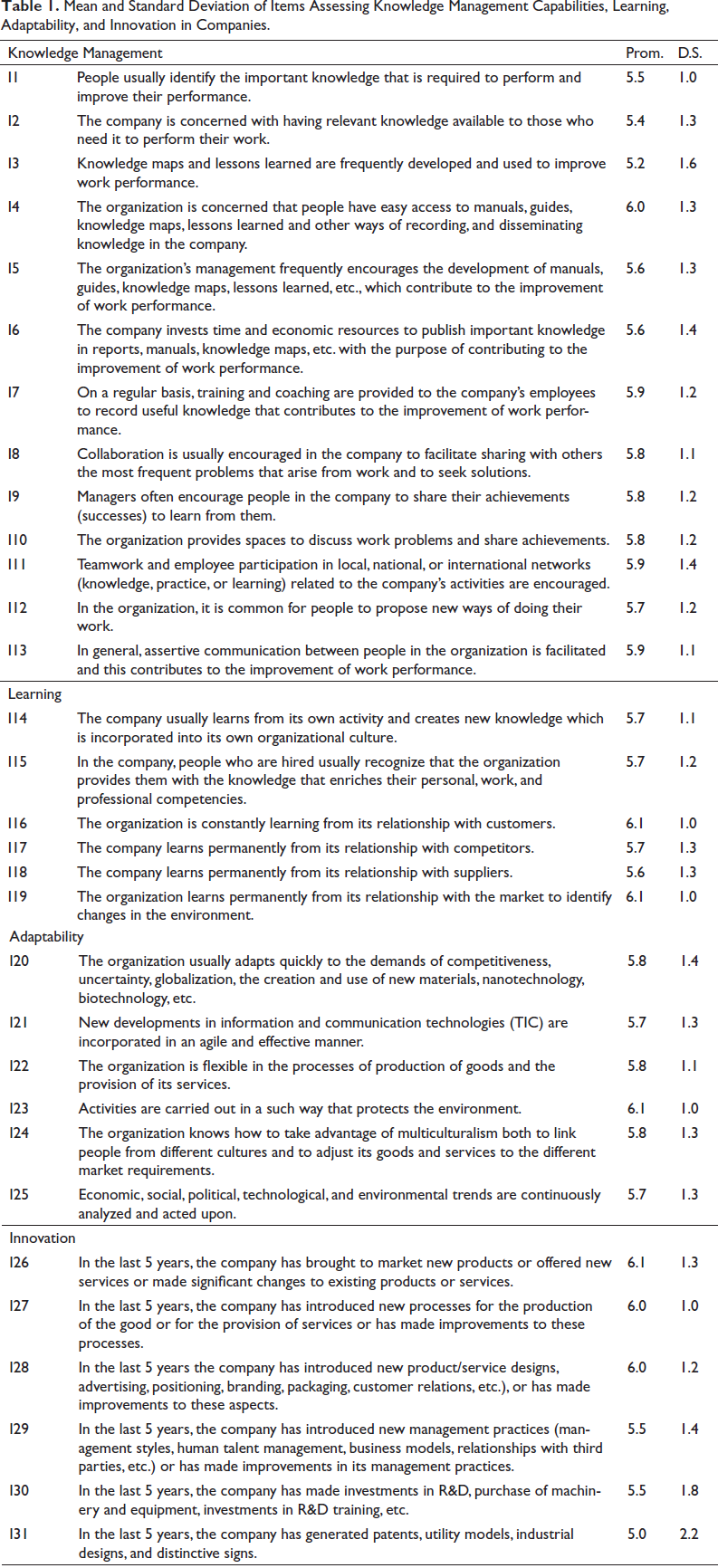
As for the capability to learn or build experience, the average score was 5.87, and the most outstanding actions were continuous learning through relationships with clients (6.1) and by analyzing the market and changing environment (6.1).
The capability to respond to the environment or capability for adaptability was scored with an average of 5.8, with environmental protection actions being the most important.
The capability to innovate was scored at 5.68 and the most outstanding actions were those related to product, process, and marketing innovation.
Exploratory Factor Analysis (EFA)
For the EFA of the survey data, Bartlett’s test of sphericity and the Kaiser–Meyer–Olkin adequacy test (KMO) was used to evaluate the validity of the statistical analysis and to determine the number of factors that compose it. The AFE of the data was performed to verify the dimensionality of each capability that makes up the dynamic capabilities questionnaire (knowledge management, learning-learning-building experience, adaptation to the environment and innovation).
Knowledge Management Capability (KMC)
The results obtained for Bartlett’s sphericity indicate that, as p-value = 0.000 < 0.05, there is sufficient evidence to affirm that the KMC items are sufficiently correlated with each other to perform factor analysis. In addition, to test the degree of joint relationship, the Kaiser–Meyer–Olkin adequacy test (KMO) was performed. This statistic indicates a number between 0 and 1, if the value of that test is higher than 0.7 the factor analysis can be considered to be good. Table 2 shows as the value of the overall KMO is 0.85, it is considered feasible to perform the AFE.
Bartlett’s Test of Sphericity and KMO Test.

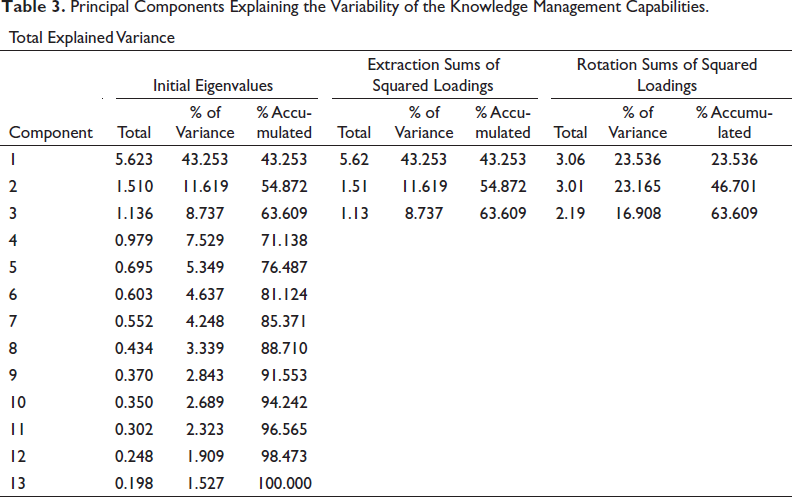
The data in Table 3 show that the set of KMC items within companies can be grouped into 3 main components that explain 63.61% of the variability of this capability. Component 1 explains 43.3% of this variability, component 2 11.6% and component 3 8.73%.
Principal Components Explaining the Variability of the Knowledge Management Capabilities.
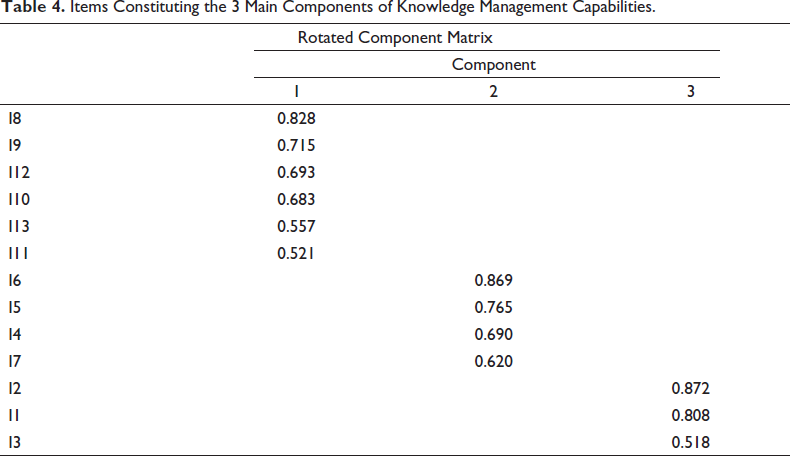
The data in Table 4 describe that component 1 emphasizes the items related to sharing and using knowledge—SUK (I8–I13), where the stimulus collaboration to facilitate sharing with others the most frequent problems that arise from work and to seek solutions (0.828) and the frequent encouragement of managers to share their achievements (successes) with other people of the company to learn from them (0.715). Component 2 emphasizes the items related to the recording of knowledge—RK (I4–I7), where the importance of investing time and financial resources to record knowledge (0.869) and encourage the development of manuals, guides, knowledge maps, and lessons learned is highlighted. Component 3 emphasizes items related to knowledge identification—KI (I1–I3) where the identification of relevant knowledge to be used to improve work performance stands out (0.872). In summary, these results indicate that companies are concerned about developing KMC to become more efficient and competitive, which is unusual for companies in emerging economies.
Items Constituting the 3 Main Components of Knowledge Management Capabilities.
Learning Capability (LC)
Table 5 shows that the results obtained for Bartlett’s sphericity indicate that, as p-value = 0.000 < 0.05, there is sufficient evidence to affirm that the LC items are sufficiently correlated with each other to perform a factor analysis, and as the value of the overall KMO is 0.88, it is also considered pertinent to perform the AFE.
Bartlett’s Test of Sphericity and KMO Test.

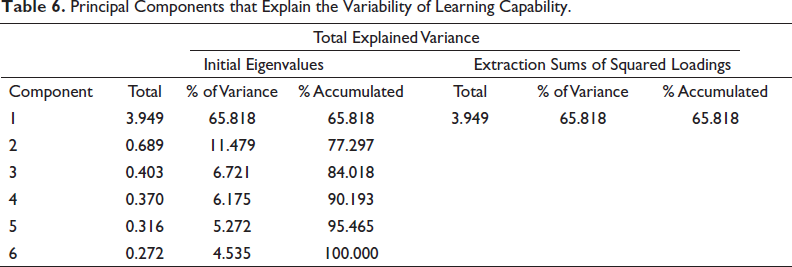
The data in Table 6 shows that component 1 is sufficient (optimal) to explain the variability of LC in the companies, explaining 65.8% of the variability of this capability.
Principal Components that Explain the Variability of Learning Capability.
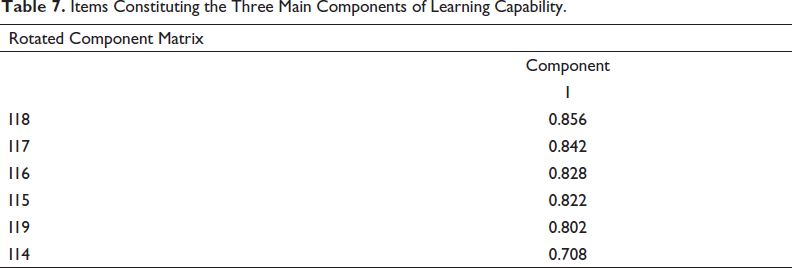
The data in Table 7 indicate that, in the companies, the different items (I14–I18) related to learning have a similar impact in explaining the variability of their LC.
Items Constituting the Three Main Components of Learning Capability.
Adaptability Capability (AC)
The data in Table 8 show that the results obtained for Bartlett’s sphericity indicate that, as p-value = 0.000 < 0.05, there is sufficient evidence to affirm that the AC items are sufficiently correlated with each other to perform factor analysis. Furthermore, as the overall KMO value is 0.77, it is considered pertinent to perform the PFA.
Bartlett’s Sphericity Test and KMO Test.

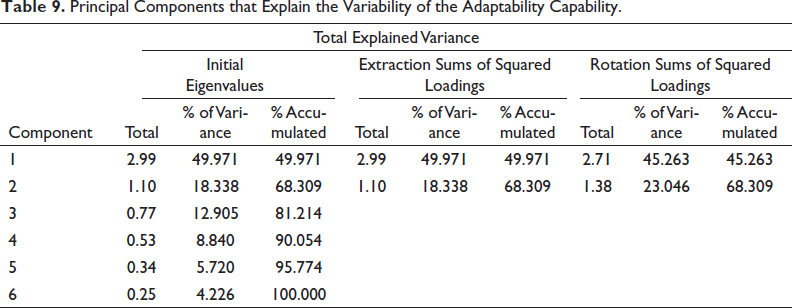
The data in Table 9 show that, with two components, the variability of the AC by companies can be explained. Component 1 explains 49.9% of this variability and component 2 18.3%, with a cumulative between the two components of 68.31% of the variability explained.
Principal Components that Explain the Variability of the Adaptability Capability.
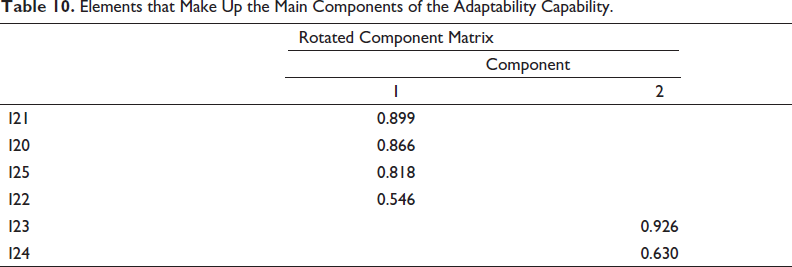
The data in Table 10 describe that in component 1 items I21, I20, I25 and I22 stand out; where the incorporation of information and communication technology developments—ICT (0.899), the rapid adaptation of companies to the demands of competitiveness, uncertainty, globalization, the creation and use of new materials, nanotechnology and biotechnology, etc. (0.866), and the analysis of economic, sociodemographic, technological trends, etc. (0.866). And component 2 with items related to environmental care—EC (I23 and I24). These results are consistent with the approaches of Konlechner et al. (2018) who state that the absorption and management of technologies facilitate technological change and the adaptation of companies to the environment. They also agree with Burnard et al. (2018), who states that organizations with AC are characterized by interpreting and assimilating environmental signals to achieve competitive advantages in unpredictable and complex contexts such as the current ones.
Elements that Make Up the Main Components of the Adaptability Capability.
Innovation Capability (IC)
The data in Table 11 show that the results obtained for Bartlett’s sphericity show that, as p-value = 0.000 < 0.05, there is sufficient evidence to affirm that the IC items are sufficiently correlated with each other to perform factor analysis. Furthermore, since the value of the overall KMO is 0.881, it is considered pertinent to perform the AFE.
Bartlett’s Test of Sphericity and KMO Test.

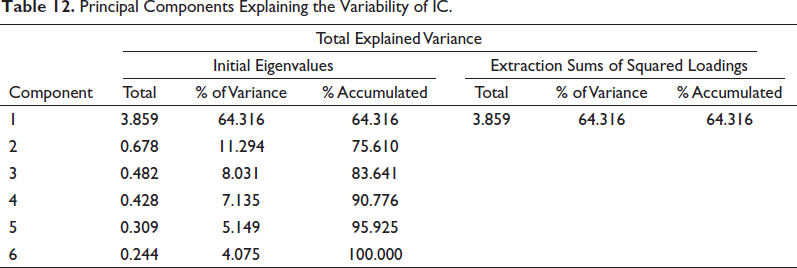
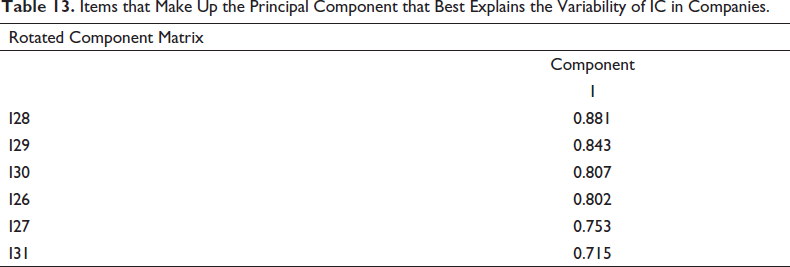
The data in Table 12 show that the variability of IC by companies can be explained by a component that accounts for 64.31% of that variability.
Principal Components Explaining the Variability of IC.
The data in Table 13 describe that component 1 is made up of all the items used to evaluate innovation in companies, but mainly those related to innovation capabilities in marketing (0.88) and organizational (0.84).
Items that Make Up the Principal Component that Best Explains the Variability of IC in Companies.
Confirmatory Factor Analysis (CFA)
The CFA was performed for the KMC and the AC because these are two skills in which variability is explained by more than one principal component. In the case of the knowledge management capabilities, the CFA goodness-of-fit index led to the deletion of item I12, while for the AC the validity of all the items evaluated was confirmed.
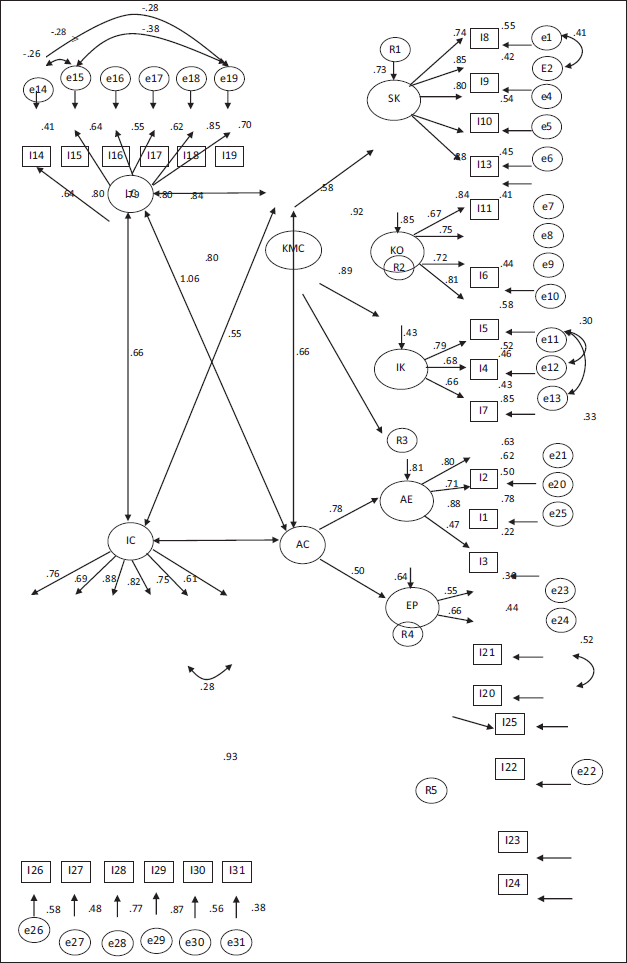
Confirmatory Factor Analysis (CFA) for the Interrelation Between the Abilities Assessed
According to the result of the goodness of fit, an improvement in the indexes is evidenced, so that the proposed model can be considered acceptable. The results are as follows. A chi-square of 773.17 with 386 degrees of freedom and a p-value of 0.00, rejects the null hypothesis of a good fit. However, we obtained a CFI = 0.806 and TLI = 0.781. The RMSEA = 0.09 value shows that the proposed model is appropriate.
It should be noted that the correlation values between the latent variables (knowledge management, learning, adaptability, and innovation) have a good value. But for the innovation variable, the variables that contribute the most are learning and adaptability to the environment with a value of 0.66–0.93 respectively, while knowledge management contributes 0.55. These results show that the three-hypothesis proposed by the research were approved:
The data in Figure 1 indicate that, in general, there is an interdependent relationship between the different capabilities evaluated.
Relation of Interdependence Between the Different Capabilities Evaluated.
Discussion
In the framework of the studies by Kaya et al. (2020), DC contribute to building competitive advantages in organizations. Along these lines, the results of this study indicate that there is an interrelationship between the dynamic capabilities of adaptability, knowledge management and learning with innovation dynamic capability and that this contributes to improving the competitive capacity of companies. This confirms the objective of this work to understand the influence and development of DC in companies in emerging countries (Gölgeci et al., 2019).
In terms of knowledge management capabilities, the results of the study show that firms in the sectors analysed have a good propensity to share and use knowledge as a competitive strategy with significant positive correlations with innovation capabilities. This confirms hypothesis 1 of the study and this is consistent with the approaches of Amaya et al. (2022), Lei et al. (2021) and Sun et al. (2020). Thus, these authors affirm that sharing and using knowledge are critical aspects of knowledge management which add value to the competitive capacity of companies. These results also show that companies are using these strategies with their collaborators to share knowledge about the most frequent problems that arise in their daily work and to seek possible solutions. In this type of company, knowledge is the key resource for their performance, as demonstrated by the studies of Bocken and Geradts (2020) and Yuan et al. (2021).
Regarding hypothesis 2 about learning capability, the results of the study highlighted the contribution of the organization to employees in terms of the generation of competencies and learning generated from the relationship with customers, suppliers and competitors. This contributes to identifying changes in the environment, a key aspect in such dynamic and uncertain environments as the current ones, an aspect that is highlighted by Teece (2018) when he refers to DCs as the company’s ability to integrate, grow and reconfigure internal competences in order to respond or generate, changes in the business environment.
Similarly, the results show evidence of learning generated from organizational activities and their incorporation into the firm’s culture. This is in line with Cyfert et al. (2021), who emphasize the importance of combining knowledge management processes with organization processes, and Khodaei and Ortt (2019) who proves that companies need to realign their structure, culture, and routines to contribute to value creation. Hypothesis 2 shows that the organization provides their employees with knowledge that enriches their personal, work, and professional competencies. This confirms the relevance of a flexible organizational structure and organizational change management in creating positive employee attitudes towards learning (Gelard, 2021).
With regard to the third hypothesis about the capability to adapt, the results of the study highlight the adoption by the companies of new technological developments, rapid adaptation to the demands of the environment and uncertainty. This response of companies to the environment is coherent with the approaches of Burnard et al. (2018), who states that organizations with adaptability capability are characterized by interpreting and assimilating environmental dynamics to achieve competitive advantages in unpredictable and complex contexts like the current ones. These results confirm hypothesis 3 and are supported by the studies of Warner and Wäger (2019) and Kokshagina (2021) who state that building digitization capabilities support the development of dynamic capabilities and improves the corporate performance of firms in crisis situations like the COVID-19 pandemic.
Additionally, the results are consistent with the approaches of Konlechner et al. (2018) who state that the absorption and management of technologies facilitate technological change and the adaptation of companies to the environment through their capabilities (Dobelin & Galina, 2019). This agrees with Khurana et al. (2022) in terms of dimensioning the limits of the organization as an opportunity to transform through the adoption of technologies.
In terms of innovation capability, the results of the study indicate that there is interest among firms in generating a value-added. And that several of these activities can be achieved through relationships with customers, suppliers, and competitors themselves, as pointed out by Bocken and Geradts (2020) who emphasize the importance of collaborative creativity in the development of DC. From this perspective, innovation capability is an alternative to gaining competitive advantages to identify new opportunities and develop new markets (De Aro & Perez, 2021). Especially, organizations in emerging markets succeed in building competitive advantages, when they strengthen and exploit in an efficient way their capability to innovate (Mathew et al., 2021).
Regarding the interrelationship between the different capabilities, the results of the analysis show an interrelationship between learning capability and environmental adaptation capability, which is since these two capabilities are part of the so-called higher-order managerial capabilities that include organizational culture, transformational leadership, and strategy. Likewise, the interrelationship between the adaptability capability and innovation is because the greater the capability to constantly scan the external environment, the greater the capability for innovation (Hermawati, 2020) and the greater the capability of innovation, the greater the capability of companies to adapt to the environment (Fernandes & Panjaitan, 2019).
This demonstrates that organizations with knowledge management capability develop adaptability capability better than those that do not manage knowledge (Fraga, 2014). Additionally, is worth mentioning the interrelationship between knowledge management and innovation capabilities because firms leverage knowledge management to generate innovation in production systems, processes, or techniques of a sustainable nature, they also leverage innovation for new knowledge management (Rey-Garcia et al., 2021).
These companies practice the virtuous cycle that the more they learn, the more they manage knowledge and vice versa, which is positive for building organizational competitive advantage and is a key factor for the competitiveness of the companies in the sectors analysed (Linden et al., 2019; Wang et al., 2020). Learning allows firms to incorporate innovative routines that also contribute to building competitive advantages (Loureiro et al., 2019), in addition, the ability to learn and its result in organizational learning are the main sources for generating innovation in firms (Hermawati, 2020). On the other hand, innovation capability allows firms to dynamize their learning capability (Oliveira et al., 2019). This shows the interrelationship between learning and knowledge management and learning and innovation capabilities.
Conclusion
In general, the results of the study indicate that the companies that participated in the study reported having good practice of dynamic capabilities for managing co-knowledge, learning, adapting to the environment and innovation. Companies showed an interest in developing innovation capabilities that allow them to be competitive, this is a feature that should characterize firms regardless of the environment in which they operate. This is very positive, because the literature review confirms the importance of these capabilities for companies as a strategy to respond to the challenges of the current organizational environment characterized by rapid and uncertain changes, and because the development of these capabilities has been more frequent in companies in developed countries than in those in emerging countries. This confirms the need to explore the links between DC and corporate sustainability in emerging market companies.
The results of the study also indicate that there is a significant interrelation between the different capabilities evaluated (knowledge management, learning, adaptation to the environment and innovation), which shows that companies are concerned about promoting integral activities that allow them to develop sustainable dynamic capabilities that enable them to build equally sustainable competitive capabilities. This shows that, although not many companies in emerging markets invest in R&D compared to their competitors in developed countries, for those that do, the acquisition and development of technology and knowledge capabilities have been more manageable.
On the other hand, face to the principles of knowledge management, these companies dedicate time and resources to the recording of knowledge as a key activity of their dynamic capabilities, which is a relevant aspect for companies in emerging economies. Faced with the effect of the pandemic, this is consistent with the need to implement new and different ways of doing things, new organizational routines, or new logic in the operation of an organization to achieve better adaptation to its stakeholders through decisions based on learning acquired through experience.
One of the limitations of the study is considered to be the size of the sample, which, because it includes different sizes of companies and subsectors, makes it difficult to generalize the results, but it is a good indication of what is happening in terms of dynamic capabilities in the companies studied.
Footnotes
Acknowledgement
The authors are grateful to the anonymous referees of the journal for their extremely useful suggestions to improve the quality of the article. Usual disclaimers apply. We also thank Universidad de La Sabana for the resources provided to the EICEA-101-2016 project from which this article is derived.
Data Availability Statement
The data will be made available on request from the corresponding author.
Declaration of Conflicting Interests
The authors declared no potential conflicts of interest with respect to the research, authorship and/or publication of this article.
Funding
The authors received financial support from the Universidad de La Sabana for the research, authorship, and publication of this article through the EICEA-101-2016 project.
