



Abstract
The present study aims at adapting and validating the Bergen Facebook Addiction Scale (BFAS) for mobile social networking site (MSNS) addiction in the context of a developing country. The study further examines the role of social overload and religiosity in MSNS addiction. A cross-sectional survey was used to obtain data from a sample of 557 MSNS users in South Africa. The psychometric properties of the adaptation of the BFAS for MSNS addiction were robustly assessed using the structural equation modelling technique. The results suggest a five-factor addiction component model for MSNS addiction with excellent psychometric properties. Given that much of the existing literature suggests a six-factor behavioural addiction component model for SNS addiction, the findings of the present study contribute new insights into the literature and reinforce the need for far-reaching cross-cultural validation scales beyond their original contexts. Furthermore, the findings of the study make an original contribution to the literature by explaining how social overload mediates the impact of religiosity on users who are addicted to MSNS.
Keywords
Introduction
To suggest that social media are a global sensation is an understatement, given that the number of social media users globally is projected to increase from 3.6 billion in 2020 to 4.4 billion in 2025 (Statista, 2021a). The use of the mobile phone to access social networking sites (SNSs) is emerging as one of the important services that are increasingly redefining consumers’ personal attachment to their mobile devices (Kim et al., 2019; Sensis, 2017). Many internet SNS providers, such as Facebook, YouTube, Twitter and LinkedIn, have turned to mobile devices and have developed and introduced mobile applications that can be downloaded and installed on smartphones for quick and ready access to their SNSs. The use of the mobile phone to access SNSs is denoted by the term ‘mobile SNSs’ (MSNSs). Most MSNS users are able to create their own profiles, make friends, create and participate in chat rooms, have private interpersonal conservations, make calls, share photos and blogs and play games on the SNSs using their smart mobile devices. Estimates from Statista (2021a) showed that, as of January 2019, the global MSNS penetration rate was 42%. It was further noted that East Asia tops the list of MSNS users, with 70% of its active social media population accessing the services through mobile phones. This is followed by North America and South America, with 61% apiece. Southern Africa sits in the 13th position, with 36% of its social media population using the service via their mobile phones. In Australia, it was reported that 81% of the SNS user population preferred using their mobile devices to access SNSs, in contrast to the 30% and 28% showing a preference for laptop and desktop access, respectively (Sensis, 2017).
Fostered by the portability of mobile devices and affordable mobile internet, research on usage patterns suggests that the regular use of MSNSs has increased over the past few years (Sensis, 2017) in a way that may contribute to the possibly problematic use of the media (Gökçearslan et al., 2016). Although research suggests that the judicious use of SNSs could be beneficial to users (Jozani et al., 2020), empirical evidence has shown that some users appear to exhibit addiction-related symptoms such as conflict in their relationships and/or jobs, withdrawal, mood modification and salience (Pontes et al., 2016; Ryan et al., 2014). Consequently, researchers (Griffiths et al., 2014; Salehan & Negahban, 2013) have advocated for research into SNS addiction.
Although there is burgeoning research on internet and social media addiction (Carbonell & Panova, 2017; Pontes et al., 2016; Sondhi & Joshi, 2021; Suresh & Biswas, 2020), the existing research has not really addressed the issue of MSNS addiction—particularly from the perspective of developing countries, which have witnessed explosive growth in mobile penetration rates.
Motivated by this research opportunity, this study aims at conducting a psychometric validation of the Bergen Facebook Addiction Scale (BFAS) (Andreassen et al., 2012) in the context of mobile social networking addictions and examining the association of religiosity and social overload in a nomological framework of MSNS addiction in a South African sample. Addictive SNS use has been robustly and consistently associated with a number of dysfunctional behaviours and deficiencies in social skills (Caplan, 2006; Whang et al., 2003). For this reason, the need to examine potentially problematic MSNS use in a South African sample may be of clinical relevance (Pontes et al., 2016). Moreover, it is argued that research into SNS addiction is plagued by methodological inefficiencies, and therefore requires more validating studies in different contexts to enhance the validity of SNS addiction scales. The present study makes a number of important contributions. First, it is the first to validate a scale for MSNS addiction in a South African MSNS sample. Second, although the issue of taking care of others’ needs (social overload) could contribute to the excessive use of MSNS, the literature has not yet documented this relationship. The present study contributes to the literature by showing how social overload fosters MSNS addiction. Third, to the best of the researcher’s knowledge, the present study is the first to demonstrate the mediating effect of social overload in the relationship between religiosity and MSNS addiction, thus explicating the nature of the relationship between religiosity, social overload and MSNS addiction. Finally, the findings of the present study have important managerial implications that are especially important for strategies that aim to overcome MSNS addiction.
Literature Review
Bergen Facebook Addiction Scale
The BFAS, developed by Andreassen et al. (2012), was rooted in the six components of behavioural addiction (salience, mood modification, tolerance, withdrawal, conflict and relapse) developed by Griffiths (2005). The BFAS comprised 18 items, with three items measuring each of the six dimensions of behavioural addiction identified above. The items were measured in a 5-point Likert response format, with 1 = ‘very rarely,’ 2 = ‘rarely,’ 3 = ‘sometimes,’ 4 = ‘often,’ and 5 = ‘very often.’ The self-reporting BFAS, along with the measures of other constructs (i.e., NEO–Five Factor Inventory, Facebook Attitude Scale, Online Sociability Scale, Addictive Tendencies Scale, BIS/BAS scales and Sleep questions) was administered to 423 students in two institutions of higher education in Bergen, Norway. The results showed that the psychometric properties of the scale were RMSEA = 0.046 and CFI = 0.99, and the coefficient of alpha was 0.83. The results further showed that neuroticism and extraversion are positively associated with the BFAS, while conscientiousness is negatively associated with the BFAS. Finally, high scores on the BFAS were related to delayed bed times and rising times.
Given that the BFAS is premised on the components model of addiction, Griffiths et al. (2014) contend that the BFAS is arguably the most psychometrically robust scale. The cross-cultural validity of the BFAS was confirmed in samples drawn from Portugal (Pontes et al., 2016), Poland (Błachnio et al., 2016), Italy (Monacis et al., 2017) and Turkey (Akin et al., 2013). A South African validation of the scale would therefore contribute to ascertaining the validity of the scale beyond a European cultural setting. A critical limitation of the BFAS, however, is that it is related to one specific commercial SNS (i.e., Facebook) instead of the activity of social networking itself (Griffiths, 2012; Griffiths et al., 2014); thus, a more reliable SNS-specific scale is required (Griffiths, 2013).
In line with the recommendations of Griffiths et al. (2014), this study examines the validity of the BFAS for general SNS use instead of only for Facebook. This study preferred the 18-item second-order BFAS over the six-item single-factor Bergen Social Networking Addiction Scale (BSNAS) (Andreassen et al., 2016), which is an abridged adaption of the BFAS for general SNSs. This is because the one-item-per-addiction component of the BSNAS may not reflect the broader psychological problem espoused by the addiction components.
Social Support Theory and Social Overload
In our social systems, friends are said to be good medicine. This means, literally, that social relationships are fundamental to personal health and happiness through the social support that people receive from social relationships (Sarason, 2013). Social support is thus argued to be one of the most important forms of social relationship (Uchino et al., 1996). People receive support from the community and social networks, and from confiding in partners who act as coping assistants (Zimet et al., 1988). Social support is thus defined as an ‘individual’s perception that he or she is loved, valued and able to count on others should the need arise’ (Turner, 1983, p. 110). The social support that individuals receive in the social system could range from advice to reassurance and the provision of tangible assistance (Weiss, 1974). These forms of support could either cushion people from the harmful effects of stressful life events or assist them to recover more readily from the effects of such events (Wang et al., 2014). Shumaker and Brownell (1984) contend that social support usually manifests between people who are members of the same network. Social networks are thus closely associated with social support (Glanz et al., 2002). People in a social network often feel a sense of indebtedness to provide support to members in their social network. Thus, Uehara (1990) contends that the provision of social support to the members of a social network could be ‘costly’ to those who provide it.
It has been established that users of SNSs often feel a high social demand to take care of friends, to empathize or help them address their problems, or to entertain them (Maier et al., 2012; Maier et al., 2015). Therefore, SNS users who have friends in their social network and who feel obliged to take care of the social needs of other users in their network may be using SNSs frequently and for prolonged periods, and consequently may develop a ‘stickiness’ to the platform that potentially results in addiction. Although social overload could play a role in the addictive use of MSNS, prior research has not examined this relationship. This study addresses this research avenue by examining the association of social overload and MSNS addiction.
Religiosity
‘Religiosity’ refers to the strength of an individual’s religious observances, as shown by their adherence to a religion’s practices, and the extent to which their life is influenced by the principles of the religion to which they belong (Charlton et al., 2013). Religiosity is a broad concept with two important dimensions: extrinsic and intrinsic. According to Chang et al. (2019), intrinsic religiosity manifests itself in the tendency to observe the teachings and practices of a religion in order to fulfil internal religious goals. To these people, religion is the ultimate means to their fulfilment. Extrinsic religiosity, on the other hand, is when people ride on the back on religion to achieve a goal—usually a non-religious one (Raggiotto et al., 2018). These categories notwithstanding, religiosity in its broadest sense is inherently linked with many aspects of an individual’s socio-cultural life and have an observable influence on the values, belief systems and behaviours of individuals (Choi, 2010).
Prior literature has identified religion as a powerful force that drives an individual’s behaviour. Research by Singh et al. (2021) shows that both intrinsic and extrinsic religiosity are salient factors influencing the attitude to environmental sustainability in family-owned businesses in Fiji. A study by Minton and Liu (2021) revealed that religiosity influences not only consumers’ sense of belonging, but also their product evaluation; whereas, research by Novis-Deutsch et al. (2021) shows that religiosity plays a significant role in deterring individuals from engaging in a range of socially problematic or antisocial activities. The findings of a study by Lewczuk et al. (2021) show that religiosity is positively associated with a self-perceived addiction to pornography among Polish adults aged between 18 and 69 years. In the area of internet addiction, prior studies (Agbaria & Bdier, 2019; Nadeem et al., 2019) found that respondents who reported high on intrinsic religiosity showed a significant decrease in internet use.
Thus, in the face of increasing concerns about SNS addiction, examining the role of religiosity could have useful implications for strategies that aim to reduce users’ susceptibility to SNS addiction. However, studies on the influence of religiosity, internet use and SNSs addiction are significantly limited (Campbell, 2006; Charlton et al., 2013). The current study also addresses this research opportunity by investigating the role of religiosity in MSNS addiction.
Objectives
Motivated by this research opportunity, this study aims at conducting a psychometric validation of the BFAS (Andreassen et al., 2012) in the context of mobile social networking addictions, and to examine the association of religiosity and social overload in a nomological framework of MSNS addiction in a South African sample.
Rationale for the Study
Social Overload and Mobile Social Networking Site Addiction
MSNSs have emerged as important social linkage systems, in which members of the MSNS provide and receive support from other members of the network. Indeed, research (Li et al., 2015; Kim et al., 2011) has shown that one of the basic motives for joining an SNS is to obtain social support. Users of MSNSs tend to develop a sense of belonging, commitment and responsibility to other members in the MSNSs over time. This leads to the situation where members of MSNSs often feel a sense of responsibility to provide social support to friends in the network in the form of comforting and empathizing with them during moments of distress, and to entertain them, compliment them and provide them with advice, suggestions and useful information to address their problems (Maier et al., 2015). These perceived demands of social support may create a burden for the givers of the support, and lead to social overload. The term ‘social overload in virtual networks’ denotes members’ perception of excessive demands to provide social support for members in their virtual communities (Maier et al., 2015). Members who succumb to high demands to render social support to other members in the MSNS may inadvertently be using the MSNS for extended periods, and will invariably develop MSNS addictive tendencies. This study proposes that social overload will be significantly and positively related to MSNS addiction.
Religiosity, Social Overload and Mobile Social Networking Site Addiction
The importance of taking care of the needs of others (social support) is found in many religious beliefs (Brudek et al., 2021). Research shows that people receive the religious ideas and values of helping others from their religious organisations, and internalize them into their own perception of identity, consequently relying on these ideas to engage in social behaviours (Einolf, 2011; Piotrowski & Żemojtel-Piotrowska, 2020). Research (e.g., Guo et al., 2020) has thus found a significant positive association between religiosity and helping others. Given that people who are religious are likely to provide social support, it is argued that religiosity will predispose users of mobile social media to yield to the excessive demands for social support from people in their MSNSs. Based on that, the current study argues that religiosity will have a significant and positive association with perceived social overload from MSNSs.
Prior research indicates that religiosity fosters positive health behaviours (Svensson et al., 2020) and reduces the risk of stressful events and other health conditions (Thomas & Barbato, 2020). Others have found a significant relationship between religiosity and lower levels of addictive behaviour from gambling and substance use (Feigelman et al., 1998). In studies of the role of religiosity in internet addiction, researchers (e.g., Agbaria & Bdier, 2021; Nadeem et al., 2019) found that religiosity is significantly and negatively associated with internet addiction among females. Given this evidence, the present study posits that religiosity will have a significant and negative association with MSNS addiction.
Methods
Context of the Study
The context of the study is MSNS use in a South African sample. South Africa is home to a population of 57.73 million people, with an urbanisation rate of 66% (StatsSA, 2018). Statistics of the Independent Communications Authority of South Africa (2021) estimated that, as of December 2020, South Africa had 60 million smartphone subscriptions. In 2021, there were an estimated 38.13 million active internet users in South Africa. Of this number, it was estimated that over 36 million used mobile internet. In the same period, it also emerged that almost 99% of those using social media networking sites accessed their account through the mobile phones (Statista, 2021b).
A potential contribution to the increasing MSNS use among South Africans is a marketing strategy implemented by the major mobile network operators in the country, which offers substantially discounted data bundle packages for social media platforms. The rates of these ‘social data bundles’ are much cheaper than standard data packages, are used by consumers for MSNS activities, and thus may be contributing to the increasing MSNS use among South Africans.
In spite of the increasing pervasiveness of MSNSs in South Africa, MSNS addiction research is significantly sparse. This is against the backdrop that research into internet addiction began in the West in the mid-1990s (Griffiths, 1996; Young, 1996). Given the rising trend of MSNS use, it could be argued that South African MSNS users are vulnerable to addiction. Despite this, the possible addictive tendencies of MSNS use among South Africans have not been empirically examined.
Participants
A total of 557 South African SNS users participated in the study. Of this total, 236 (42.4%) were male and 321 (57.6%) were female. Most of the respondents—182, or 32.7%—were aged from 20 to 25, followed by those in the age group from 26 to 30, of whom 76 (17.2%) were in the sample. Of the 557 participants, 235 (42.2%) indicated that they use SNSs very frequently, and 213 (38.2%) indicated that they use them frequently. Slightly more than a quarter of the participants—142, or 25.5%—specified that they spend more than 120 minutes per day on SNSs.
Procedure
The population of the study was defined as South Africans who are 18 years or older, who have at least one active social media account and who access social media networking sites, including through a mobile device. Given that there was no readily available sampling frame, a non-probability convenience sampling technique was implemented to select the participants in the study. A small group of trained survey research assistants approached potential participants in various places, including homes, campuses and shopping malls. After introducing themselves, they explained the purpose of the study and the ethical measures adopted for the study—including voluntary participation, anonymity and confidentiality and the measures to handle the data. Potential participants who consented to participate in the study were given a copy of a paper-based questionnaire to complete. The participants had the option of completing the questionnaire straightaway or of completing it later and arranging with the research assistant to collect the completed questionnaire on an agreed date. The participants were free to terminate their participation in the study at any moment without any negative consequences for themselves. No incentive was offered to people to participate in the study; thus, voluntary and intentional participation was their main motive for taking part. Of the total of 840 printed questionnaires issued to participants, 557 usable responses were realised, translating to an effective response rate of 66.31%.
Measures
The internal consistency of the scale (α = 0.859) showed that it was a highly reliable measure of the construct. Participants’ withdrawal (M = 2.39, SD = 1.238) was measured with the three-item, 5-point scale as they responded to questions like ‘How often during the past twelve (12) months would you have become restless or troubled if you were prohibited from using SNSs on your mobile device?’ The internal consistency of reliability for this measure (α = 0.897) denoted high reliability. At last, participants’ conflict (M = 1.89, SD = 1.028) was also measured with the three-item, 5-point scale. Participants responded to questions like ‘How often over the past twelve months have you used mobile SNSs so much that it has a negative impact on your job/studies?’ The measurement scale exhibited a high internal measure of reliability (α = 0.845).
The final questionnaire developed for this study was pretested using personal interviews with a sample of 30 conveniently selected participants. The aim of pretesting was to ascertain each participant’s perception of the clarity of the instructions and the wording of the items, and the time the questionnaire took to complete. The results of the pretesting suggested that the instructions for the instrument and the wording of the measures were generally clear. With this generally positive feedback, the instrument was rolled out without any modifications.
Data Analysis and Results
Common Method Variance
Given that the data were perceptual in nature and were collected at one point in time using a survey method only, the data could be affected by common method variance (CMV). To control for CMV in the data, the unmeasured common latent factor (CLF) method recommended by Podsakoff et al. (2003) was implemented. Following the recommendation of Lowry et al. (2012) in applying CLF technique, two models were created. In model 1, all of the items were allowed to load freely onto their theoretical construct, and in model 2, all of the items were constrained to load onto an unmeasured latent factor. The results of a Chi-square difference test showed that there was no statistical difference between the unconstrained and constrained models (∇χ2 = 1, ∇df = 0, p < 0.100), suggesting that the models were the same or were invariant (Gaskin & Lim, 2017). This finding suggested that the CLF test did not detect any specific response bias affecting the model, thus implying the absence of common method bias in the dataset.
Scale Validation
Validation of the BFAS for MSNSs
The original BFAS was built on a strong a priori theoretical and empirical basis, and therefore, a confirmatory factor analysis (CFA) was an appropriate technique to use (Bagozzi & Phillips, 1982; Fabrigar et al., 1999). Consequently, a CFA with a maximum likelihood estimation technique, using AMOS 25.0 software, was used to confirm the validity of the BFAS in the South African sample of MSNS users. The scale validation for this study unfolded in three stages of analysis: goodness-of-fit, convergent validity and discriminant validity. To ascertain how well the measurement model demonstrated fit with the data obtained, the Chi-square (χ2), the χ2 ratio to degrees of freedom (χ2/df), the comparative fit index (CFI), the standardized root mean square residual (SRMR) and the root mean square error of approximation (RMSEA) were used. To obtain goodness-of-fit, it is recommended that χ2/df should be less than 3, the CFI should be greater than 0.90 and the SRMR and the RMSEA should not exceed 0.08 (Bagozzi & Yi, 1988). The CFA results for goodness-of-fit (χ2 = 432.866; df = 120; p < 0.05; χ2/df = 3.532; CFI = 0.959; SRMR = 0.036; RMSEA: 0.066) suggested that the BFAS measurement model demonstrated a reasonably good fit with the data.
Following the assessment of goodness-of-fit, the convergent validity of the measurement model was examined using item factor loadings, composite reliability (CR) and average variance extracted (AVE). To achieve convergent validity, it is suggested that standardized loading estimates of each item should ideally be 0.7 or higher, the composite reliability for each construct should exceed 0.8, and the AVE for each construct should be greater than 0.50—or, put differently, that the square root of the AVE should exceed 0.71 (Fornell & Larcker, 1981; Hair et al., 2019). The results of the measurement model analysis are presented in Figure 1.
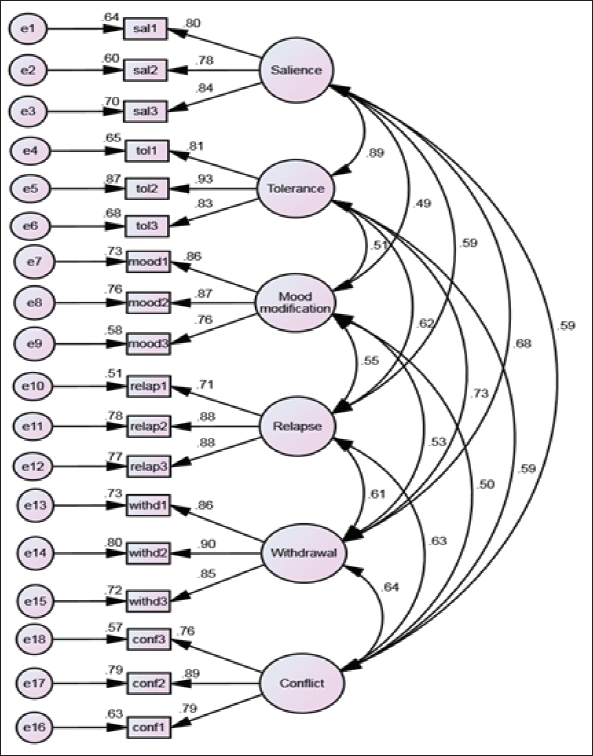
From Figure 1, it can be seen that the item factor loadings for all of the BFAS dimensions exceeded the 0.7 threshold, with 0.71 (relap1) being the lowest. The CR for all of the dimensions was above 0.8, with 0.846 (salience) as the lowest estimate. The AVEs for all the dimensions were above the 0.5 threshold, with 0.634 (salience) as the lowest. These results generally suggested that the BFAS had good convergent validity in the South African sample of MSNS users.
Psychometric Properties of the BFAS Model.
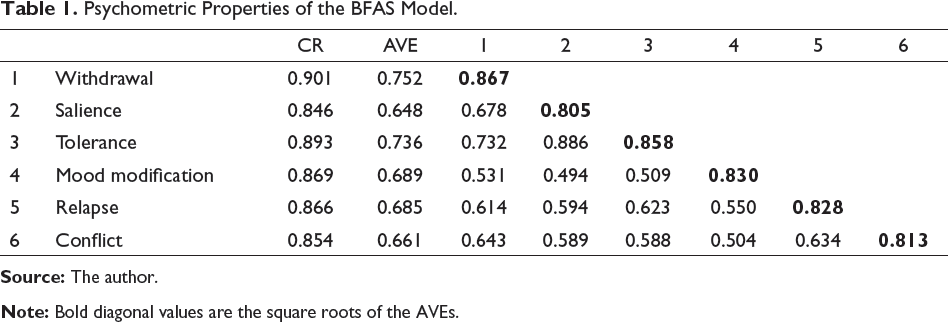
From Table 1, it can be seen that the highest bivariate correlation between any pairs of the construct CFA model was 0.886 for that between salience and tolerance. This estimate was higher than the square root of the AVEs of salience (0.805) and tolerance (0.858). Moreover, the bivariate correlation estimate (0.886) for salience and tolerance was higher than the lowest square root of AVE, that is, 0.813 for conflict. Thus, these results generally suggested that the BFAS did not achieve discriminant validity in the South African sample of MSNS users.
Post-hoc Analysis
Pattern Matrix.
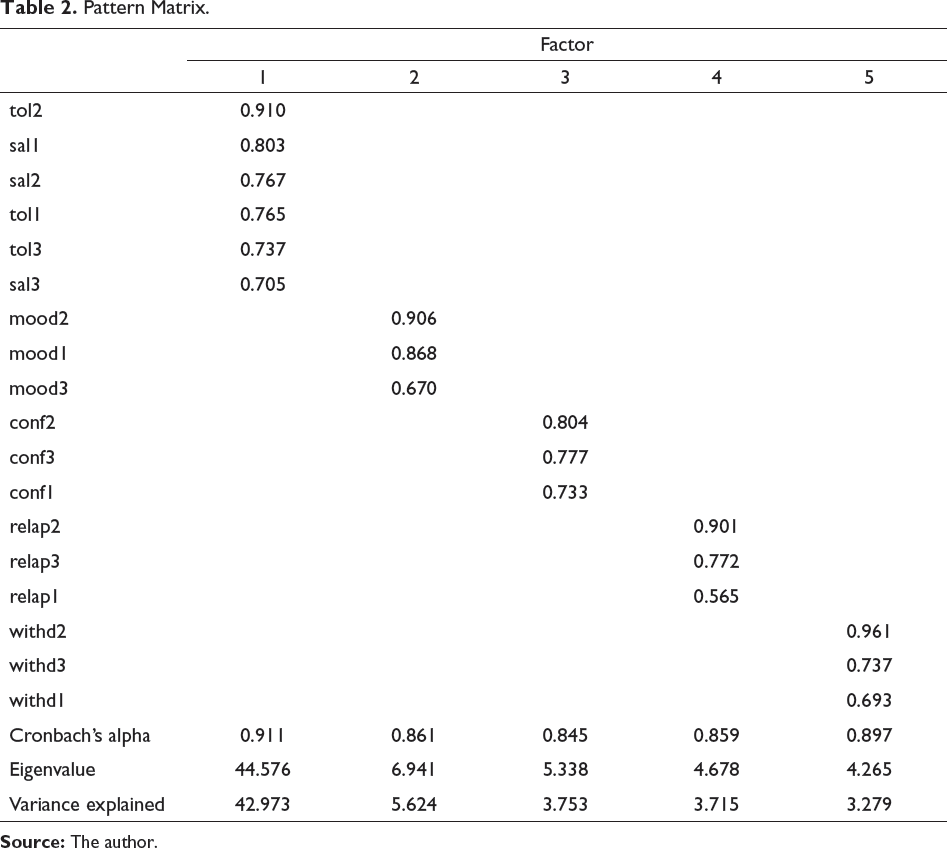
From the pattern matrix, it can be seen that the items for salience and tolerance loaded together on a common factor. This suggested that their factors were highly associated with each other, and thus that the factor might have represented a single concept (Hair et al., 2019). For this reason, these were lumped together as one factor and termed ‘problematic use.’ This is in line with the recommendation of Rutland et al. (2007).
Validation of the Revised Five-factor BFAS for MSNSs
The revised five-dimension BFAS was assessed for its goodness-of-fit with the sampled data. It was also assessed for its convergent and discriminant validities. The results of the goodness-of-fit indices (χ2 = 434.739, df = 124, p < 0.05, χ2/df = 3.506; CFI = 0.954, SRMR = 0.0375; RMSEA = 0.067) showed that the revised measurement model demonstrated a good fit with the data.
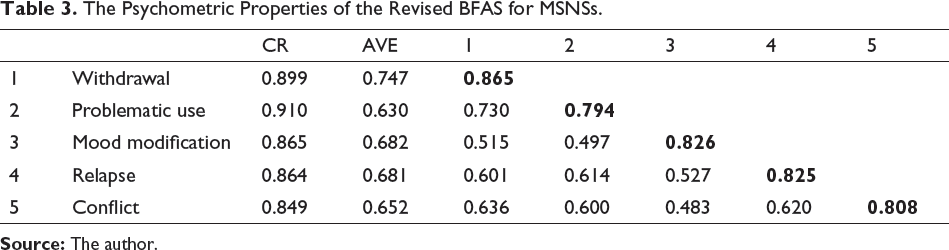
For convergent validity, the results of the analysis presented in Figure 2 shows that all of the item factor loadings were significant at p < 0.001, and were higher than the 0.70 threshold, with 0.72 (relap1) being the lowest. The CR for all of the constructs ranged between 0.864 (relapse) and 0.910 (problematic use). These estimates were well above the 0.8 recommended threshold.
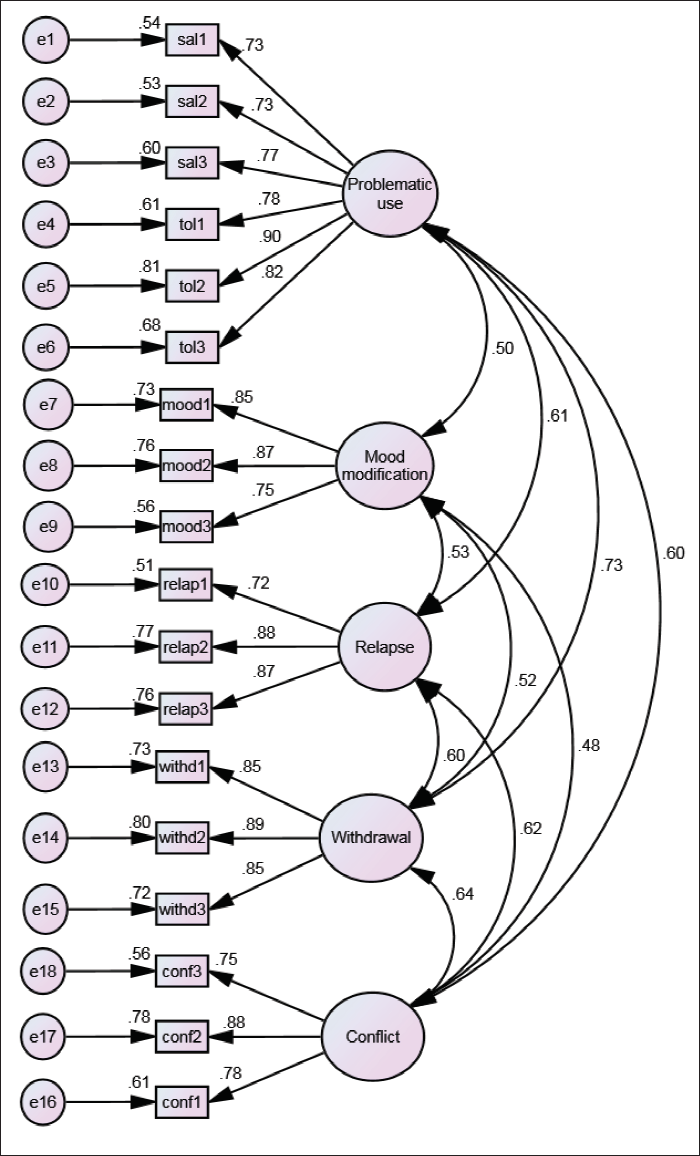
Finally, the AVEs for all of the constructs ranged between 0.630 (problematic use) and 0.747 (mood modification), exceeding the 0.5 threshold. These results therefore confirmed the convergent validity of the revised BFAS model.
The Psychometric Properties of the Revised BFAS for MSNSs.
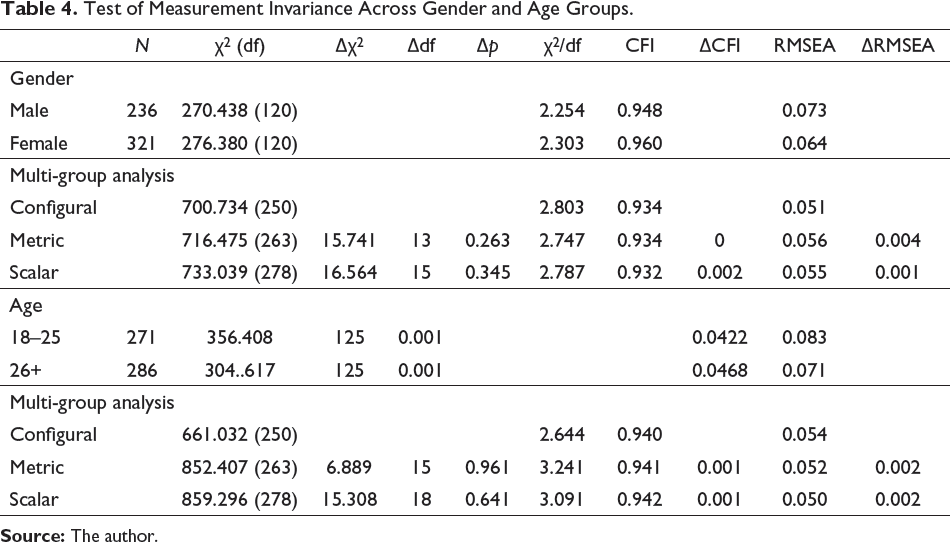
Measurement Invariance
Test of Measurement Invariance Across Gender and Age Groups.
Second-order MSNS Addiction Model Validation
A second-order CFA was conducted to examine the structural relationship between MSNS addiction and the five dimensions of the modified BFAS. The results of the fit indices (χ2 = 510.185, df = 130, p < 0.05, χ2/df = 3.0925, CFI = 0.944, SRMR = 0.044, RMSEA = 0.073) showed that the second-order CFA demonstrated a good fit with the data. Moreover, the results of the second-order CFA showed that all of the dimensions were significant at p < 0.001, with good factor loadings for problematic use (β = 0.83; p < 0.001), mood modification (β = 0.63; p < 0.001), relapse (β = 0.76; p < 0.001), withdrawal (β = 0.84; p < 0.001) and conflict (β = 0.76; p < 0.001). Put together, these results generally suggested that the five first-order constructs were a good representation of the underlying second-order construct, MSNS addiction.
Nomological Validity
Establishing nomological validity is argued to be an important step in the scale development and validation processes (Straub et al., 2004). Nomological validity ascertains the ‘degree to which predictions from a formal theoretical network containing the concept under scrutiny are confirmed’ (Straub et al., 2004, p. 5). Based on a review of the literature, the nomological validity of the revised scale was ascertained by including social overload and religiosity as antecedents of MSNS addiction in the structural model analysis.
The results of the structural model suggested an acceptable fit with the data: χ2 = 1433.015, df = 456, p < 0.001, χ2/df = 3.143, CFI = 0.921, SRMR = 0.0427, RMSEA = 0.062. The results for the structural path analysis are presented in Figure 3.
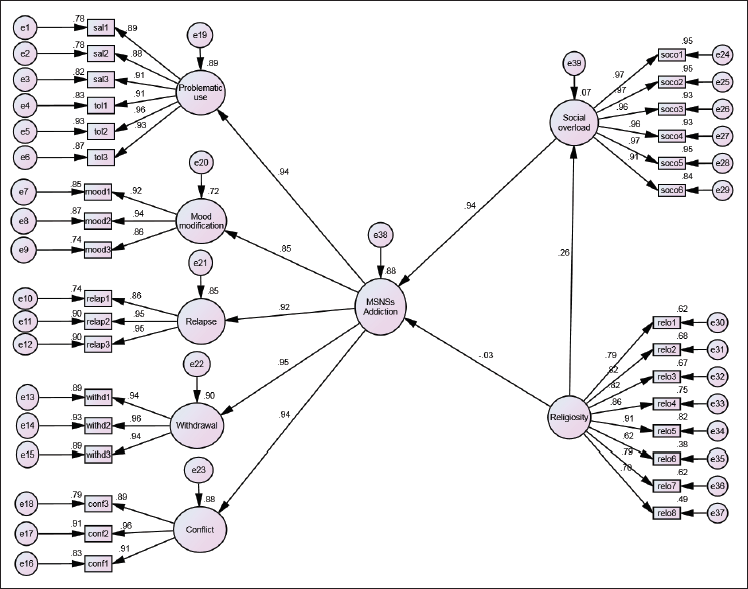
The results showed that social overload was significant and positively associated with MSNS addiction (β = 0.94; p < 0.001). Similarly, the results of the analysis suggested that MSNS users’ religiosity was significant and positively associated with their perception of social overload (β = 0.26; p < 0.001). By contrast, the results of the analysis suggested that MSNS users’ religiosity was not significantly associated with their MSNS addiction (β = −0.03; p > 0.05). However, the results showed that the indirect effect of religiosity on MSNS addiction through social overload was significant (β = 0.390; p < 0.001), thus providing statistical evidence of full mediation. The results further showed that, together, the factors explained a very significant (88%) variance in MSNS addiction.
Discussion
The overriding aim of the current study was to ascertain the validity of the BFAS in a South African sample of mobile SNS users. The BFAS underwent rigorous scrutiny to establish its construct reliability, construct validity and nomological validity in a South African sample of MSNS users. The results of this study produced interesting findings.
First, the results of the study confirmed the usefulness of a five-factor model instead of the six-factor model espoused by the BFAS. Although all of the items for mood modification, conflict, relapse and withdrawal loaded significantly on to their hypothesized factors, the items for salience and tolerance loaded together, suggesting that they shared a significant amount of variance, and thus that there could be theoretical overlaps in the underlying conceptualisation of the constructs. This finding was supported by those of an earlier related study by Monacis et al. (2017) that validated the Bergen Social Media Addiction Scale in an Italian sample. They too found a high variance between the measurements of salience and tolerance, and concluded that salience (which highlights the obsession that dominates that behaviour) could be theoretically linked to tolerance (which refers to the increased levels of the activity that are needed to obtain the required level of satisfaction). Similarly, Rutland et al. (2007) found significant overlaps between salience and tolerance on the one hand, and mood modification, withdrawal, relapse and conflict on the other hand, and concluded that, while the former might be related to problematic use, the latter could be attributed to pathological use.
Given the statistical evidence provided by the current study, and the findings of earlier related studies that suggested theoretical overlaps between salience and tolerance, the current study followed the approach of Rutland et al. (2007) by lumping salience and tolerance together into a single factor denoting problematic use. Consequently, this study has validated five factors (problematic use, mood modification, relapse, withdrawal and conflict) as unidimensional measures of MSNS addiction. Further psychometric evaluation of the scale was conducted to validate measurement invariance (i.e., configural, metric and scalar) of the MSNS addiction scale among different gender and age groups. This reinforced the validity of the scale across different groups, which represents a significant step in SNS addiction scale development, as previous studies (Andreassen et al., 2012; Kuss et al., 2013; Pontes et al., 2016) had not ascertained the measurement invariance of the SNS addiction scales.
Similar to the BFAS is the compulsive internet use scale (CIUS) (Meerkerk et al., 2009). However, unlike the six addiction components espoused by the BFAS, the CIUS consists of only five—it has no ‘tolerance.’ Meerkerk et al. (2009) noted that the results of an earlier qualitative study did not provide ample support for the inclusion of tolerance as an integral component of compulsive internet use. For this reason, Kuss et al. (2014) advocated that future research look into the role of tolerance as a component of internet addiction. Based on the evidence, the role of tolerance as a component of internet addiction is called into question. And, given the conceptual overlaps between salience and tolerance produced by the empirical findings of this study, dropping tolerance altogether as a component of MSNS addiction, instead of lumping it together with salience, could have been an alternate approach to achieving discriminant validity. This study therefore supports the call of Kuss et al. (2014) for a careful investigation into the role of tolerance as a component of MSNS addiction.
The findings of the study also suggested that MSNS addiction provided good predictive power to explain problematic use, mood modification, relapse, withdrawal and conflict, as it explained 89%, 72%, 85%, 90% and 88% of the variance in the five addiction components, respectively. The five-factor model thus contributes significantly to explaining MSNS addiction. Once this five-factor model has been validated in clinical samples and evaluated for specificity and sensitivity, it may be used as an alternative approach to identifying users who are at risk of developing addictive MSNS use behaviours. This is given that the current study confirmed a five-factor MSNS addictive component model, as opposed to the six-component model that has been widely confirmed in non-African samples. A replication study may therefore be necessary in other African countries, using the same component structure, to ascertain whether the five-factor component identified in the present study holds true in other African samples, or whether an alternative theoretically driven model could explain MSNS addictive tendencies better.
This study also contextualises perceived social overload as a situational, individual-level factor that influences MSNS users’ ‘stickiness’ to the system. The findings of the current study have provided the first evidence to suggest that social overload is strongly associated with MSNS addiction. Although an earlier study by Maier et al. (2015) examined the antecedents and consequences of SNS users’ perceived social overload, their study stopped short of examining the association between users’ perception of social overload and addiction to SNSs. Similarly, other earlier studies (Chaouali, 2016; Maier et al., 2012) that examined users’ perceived social overload in the SNS use context addressed the issue of how giving too much support to others over SNSs potentially contributes to SNS addictive behaviours. The findings of this study explicate this relationship, and so contribute to the initial literature on the role of perceived social overload in fostering MSNS addictive behaviours.
The findings of the study suggest that MSNS users’ religiosity is not significantly associated with their MSNS addiction. This finding thus suggests that earlier findings on the relationship between religiosity and online addictive behaviours are inconsistent. In a study of internet addiction among Malaysian youth, Charlton et al. (2013) found that, while religiosity has a negative association with internet addiction in the female sample, the relationship in the male sample is not significant. Grubbs et al. (2015), on the other hand, found a strong positive association between religiosity and perceived addiction to internet pornography in a student sample drawn from the United States. Similarly, a recent study by Lewczuk et al. (2021) also found that religiosity is related to internet pornography addiction among Polish adults. The non-significant relationship between religiosity and addiction to MSNSs obtained in the present study may be attributed to the generally declining levels of religiosity among the participants. Indeed, a study among South Africans by Kotzé and Loubser (2017) found that, for most of the participants, the importance of God in their lives had declined.
In spite of the non-significant relationship between religiosity and MSNS addiction, the findings of the present study suggested that religiosity has a strong positive association with perceived social overload. This result suggests that religiosity predisposes users to a perceived social responsibility to provide too much social support to other MSNS users. Although the direct association between religiosity and MSNSs is not statistically significant, it has an indirect relationship through social overload, suggesting that social overload mediates the impact of religiosity on MSNS addiction. Given that studies on the impact of religiosity on general internet use and its addictive behaviours are few, the findings of the present study make an initial contribution to the literature by clarifying the role of religiosity in priming users’ susceptibility to perceived social overload and MSNS addiction from the perspective of a developing country.
Conclusion
The present study adapted and tested the validity of the six-factor BFAS in a South African MSNS sample. Moreover, the study ascertained the impact of perceived social overload and religiosity on MSNS addiction. The results of the psychometric evaluation suggested a five-factor addiction component model for MSNS addiction with excellent psychometric properties. Moreover, while it seems plausible that taking care of others, leading to social overload, could be related to social networking addiction, previous research has not documented this relationship. The findings of the present study in this regard make an initial contribution to the literature. Furthermore, while its findings indicate that perceived social overload is directly related to MSNS addiction, the impact of religiosity on MSNS addition is indirect, and can only be observed through social overload. This suggests that social overload mediates the impact of religiosity on users’ addition to MSNS. This mediation result also contributes to the literature, as it serves to clarify the nature of the relationship between religiosity and MSNS addiction. In conclusion, although there is burgeoning research on social media addiction, the existing research has not really addressed the issue of MSNS addiction—particularly from the perspective of developing countries, which have witnessed explosive growth in mobile penetration rates. The findings of the present study contribute to addressing this research opportunity.
Practical Implications
In clinical practice, given that the MSNS addiction components are modelled on substance-related addiction components, the findings of the study imply that therapeutic remedies for behavioural disorders—like MSNS addiction—may benefit from the extensive knowledge and evidence-based treatment approaches to substance-related addictions (Glasner-Edwards & Rawson, 2010). Specifically, government agencies and others interested in reducing MSNS addiction should design promotional programmes that promote people’s self-determination to limit their mobile MSNS sessions considerably. Programmes should also be designed that build MSNS users’ capacity to make rules about not using MSNS after a given time every day. This would help to foster MSNS users’ self-control.
Moreover, as a way to discourage MSNS addiction, people could be encouraged to turn away from SNSs and to share real-life experiences. Practitioners interested in reducing MSNS addiction should encourage people to invite friends over to share enjoyable activities with them. Refocusing people’s interest in maintaining real-life relationships more than social media relationships is a strategy that management could consider in efforts to curb MSNS addiction.
Practitioners who are interested in reducing MSNS addiction should be attentive to the role that perceived social overload plays in fostering MSNS addiction. Given that the findings of this study identified respondents’ religiosity to be a salient driver of their perceived social overload, practitioners could work with religious organisations to re-channel people’s perceived responsiveness in taking care of others on SNSs towards activities like volunteering in orphanages and old-age homes and joining civic groups that promote social well-being. These activities would address their need to care for people and help to make them feel worthy.
Future Research
The present study has a number of noteworthy limitations. Self-reported measures were used to assess the possibility of MSNS addiction. This might have implications for the validity of the measures, as self-reported measurements are often susceptible to deception and social desirability biases (Fisher & Katz, 2000). Researchers (Beard, 2005; Kuss et al., 2014) have emphasized that, in internet psychopathology results, reported measures are never adequate in describing possible addictive behaviours. In spite of this limitation, there is some underlying merit in using self-reported measures (including cost effectiveness, ease of administration and information richness) that supports the choice to use them for the current study.
The study was conducted in the Gauteng Province of South Africa—the financial hub of the country, and highly urbanized, and largely cosmopolitan. Thus, the pattern of MSNS usage among the population of this province might not reflect the less urbanized areas of the country. The use of a non-probability sampling technique, and the relatively small sample size in comparison with other validation studies, also have implications for the generalisability of the findings of the study. Future studies could increase the sample size and expand it to include users in less urbanized areas and use probability techniques to select the sample in order to increase the generalisability of the findings.
The current study makes several noteworthy contributions to MSNS addiction research from the perspective of developing countries. The findings of this study could serve as a point of departure and, one hopes, inspire further research in this research domain from the perspective of developing countries.
Footnotes
Declaration of Conflicting Interests
The author declared no potential conflicts of interest with respect to the research, authorship and/or publication of this article.
Funding
The author received no financial support for the research, authorship and/or publication of this article.
