



Abstract
Telework has become a very popular arrangement that has grown rapidly worldwide, most recently due to the COVID-19 pandemic. It is important to deepen our knowledge about the performance of companies and employees in the context of telework because the results of previous studies are contradictory. The present study examines the relationship among telework, job performance, work–life balance (WLB) and family supportive supervisor behaviour (FSSB) in the context of COVID-19. The data (N = 519), which are collected from large private service companies in Colombia during the COVID-19 pandemic, are analysed using partial least squares structural equation modelling (PLS-SEM). The results do not indicate a correlation between telework and job performance or WLB in the context of the pandemic. However, positive relationships are found between job performance and both FSSB and WLB, and between FSSB and WLB. The findings help us to understand both the importance of WLB and FSSB for teleworkers and the way these factors impact job performance. The present results could help companies design strategies for the implementation of telework after COVID-19.
Keywords
Introduction
On 30 January 2020, the World Health Organization declared the COVID-19 outbreak a global health emergency, and on 11 March 2020, they classified it as a pandemic. At this time, millions of people around the world were forced to work from home when governments implemented measures to contain the spread of the novel coronavirus, like mandatory quarantines. Under these circumstances, organizations had to adapt drastically, thus, shifting to telework (Chang et al., 2021). One of the surprising impacts of the pandemic was the speed and efficiency with which companies made this shift (Williams, 2021). Although it was initially thought to be transitory, by early 2021, most people continued to work from home, as 93% of them resided in countries where some form of workplace closure was still in place (International Labour Organization, 2021). In addition, organizations have realized that the shift to telework may be a long-term or permanent change, and they are analysing the best way to implement it as a standard work modality after the pandemic.
In 2019, 69% of the US companies offered some form of telework, and 27% did so full-time (Society for Human Resource Management, 2019). The impact of teleworking on job performance has been the subject of significant debate due to the implications of this work mode for the performance of the human factor, about which CEOs have raised important concerns (Golden & Gajendran, 2019). In recent years, researchers have become interested in understanding the benefits of telework, but no consensus has been found. The literature has been focused on studying the relationship between telework and some variables, such as job performance, job satisfaction, work–life balance (WLB) and family supportive supervisor behaviour (FSSB).
In terms of the relationship between teleworking and job performance, some studies have found that telework increases productivity since it is possible to work away from the office, thus avoiding co-workers’ interruptions (Thulin et al., 2019). However, other studies identified that telework does not necessarily improve productivity or job satisfaction because of family disruptions and social isolation (Jackson & Fransman, 2018). Regarding the impact of telework on WLB, previous studies found a positive relationship. Similarly, telework has become an attractive arrangement for those who want to attain better WLB, which is one of the reasons for the very rapid growth of this work mode in recent times (Ko & Kim, 2018; Thulin et al., 2019; Vilhelmson & Thulin, 2016). Since telework generates autonomy and flexibility, workers can also devote time to personal matters, thus coordinating these two important facets of life without one imposing on the other (Gálvez et al., 2020). This, in turn, generates commitment, which is positively related to job performance (Iddagoda & Opatha, 2020). These findings notwithstanding, telework can also lead to blurring the boundaries between work and family life, resulting in imbalance and increased conflict between them (Sarbu, 2018). Previous studies identified supervisors’ behaviours as a key factor in achieving WLB, as supervisors facilitate employees’ ability to manage work and personal demands (Crain & Stevens, 2018). When supervisors expect teleworkers to be connected all the time, without respecting their work schedule limits, autonomy and flexibility are reduced. This, in turn, affects WLB, which results in a lack of commitment and, as a consequence, decreased job performance. Therefore, to the extent that the employee perceives support from their supervisor in achieving this balance, job performance is likely to improve. However, it is still necessary to elucidate the direct relationship between telework and WLB, and between FSSB and job performance, and therefore the mediating role of WLB in those relationships. In summary, understanding the relationships among telework, job performance, WLB and FSSB becomes important because the findings are contradictory.
In this context, the present study analyses the impact of telework on WLB and job performance, the relationship between WLB and FSSB with job performance, and the impact of FSSB on WLB. This research study is relevant because it fills a gap in the literature on the effects of telework on both WLB and job performance and on the relationship among WLB, FSSB and job performance. The study was carried out in Colombia, with middle-management teleworkers in large service companies from the private sector, under the special circumstances created by the COVID-19 pandemic.
The structure of the article is as follows. The next section presents a literature review of each of the research variables and their relationships. The next two sections, respectively, introduce the research objectives, the rationale of the study and the methodology. Next, we present the analysis. Then, the sixth and seventh sections discuss the results and draw conclusions, respectively. The eighth section presents managerial implications, and the final section addresses limitations and future research possibilities.
Literature Review
Telework and Job Performance
Telework is an alternative work arrangement in which employees perform tasks at a different location from the primary or central workplace for at least part of their workday (Gajendran & Harrison, 2007). This allows workers to access their work activities through the use of information and communications technologies (Nakrošienė et al., 2019). On the other hand, workers’ productive performance in the tasks entrusted to them, which can be measured in terms of its outcomes, seemingly results from some combination of skills, effort and opportunity (Salolomo & Agbaeze, 2019).
There are numerous studies on the relationship between telework and job performance, but the findings are somewhat contradictory (Kuruzovich et al., 2021). According to the social exchange theory, which has been used to explain the connection between these two parameters (Blau, 1964), if telework is perceived as beneficial to the employees, they tend to feel indebted to the organization and make stronger efforts to deliver better results (Bae & Kim, 2016; Golden & Gajendran, 2019; Vayre, 2019). Similarly, employees have reported the perception that telework increases productivity (Akbari & Hopkins, 2019; Felstead & Henseke, 2017; Hopkins & McKay, 2019; Houghton et al., 2018), as commuting times and distractions with colleagues are reduced. Along these lines, Vega et al. (2015) found that teleworkers perceive that they can attain higher job performance levels because this modality provides more opportunities to concentrate on work tasks. Precisely, in this respect, the necessary characteristics for telework to generate better job performance have been identified: reduced distractions from co-workers, a quiet workplace at home, and the possibility to divide time between home responsibilities and work more productively and satisfactorily (Nakrošienė et al., 2019). However, Jackson and Fransman (2018) stated that telework does not necessarily improve productivity, which is negatively affected by family interruptions, social isolation and reduced interaction with workmates. Studies conducted during the pandemic have yielded similar results. Abdel Hadi et al. (2021) found that the daily home demands associated with telework during the pandemic positively correlate with emotional exhaustion, which is, in turn, negatively correlated with job performance. On the contrary, Ipsen et al. (2021) have observed improved work efficiency as one of the advantages of telework during the pandemic.
Telework and Work–Life Balance
WLB refers to ‘the ability to experience a sense of control and stay productive and competitive at work while maintaining a happy, healthy home life with sufficient leisure’ (Bharathi & Mala, 2016, p. 666). This parameter is also defined as ‘the relation between work and non work aspects of individuals’ lives, where achieving a satisfactory work–life balance is normally understood as restricting one side (usually work), to have more time for the other’ (Kelliher et al., 2018, p. 2). Satisfaction with WLB is also understood as the result of assessing the degree to which a person succeeds in meeting work and family demands (Valcour, 2007). Accordingly, time is seen as a scarce resource that employees need to allocate between work and family to achieve a harmonious goal (Lu et al., 2019).
Along these lines, according to the boundary theory, the limits between work and family are becoming increasingly blurred (Kossek & Lautsch, 2012), making it difficult to transition between roles (work and personal/family life). Hence, integration rather than segmentation is suggested to minimize burnout, maintain higher job performance levels (Smit et al., 2016) and avoid conflict. Such conflict occurs when one of the two roles (work or personal life) requires a greater amount of resources than the person is willing or able to allocate to it at the time (Barber et al., 2015). Consequently, telework contributes to better WLB because it increases autonomy, decreases stress (Dima et al., 2019) and increases availability to tend to personal and family matters (Gálvez et al., 2020; Thulin et al., 2019). In this sense, Bharathi and Mala (2016) identified that working from home has a great impact as a professional enhancer of women’s WLB. Similarly, in a qualitative study by Akbari and Hopkins (2019), many respondents stated that telework contributes to WLB. In an exploratory study, Hopkins and McKay (2019) found that many believe that telework contributes to better WLB, which is one of the reasons to participate in it (Thulin et al., 2019). But it is not only the issue of family responsibilities that leads to requesting telework. Cortés-Pérez et al. (2020) found that being able to dedicate time to playing sports is another reason to prefer telework.
At the same time, some scholars have found that telework is negatively correlated with WLB either because of the difficulties that workers face in disconnecting from work issues (Felstead & Henseke, 2017) or because of the conflict generated by expecting work-related things to be carried out outside of the usual schedule (Sarbu, 2018). Since this type of conflict is more intense for teleworkers who have children (Zhang et al., 2020), mothers tend to experience a negative impact on WLB as a result of telework (Kurowska, 2020).
Work–Life Balance, Family Supportive Supervisor Behaviour and Job Performance
Studies claim that WLB has a significant positive relationship with employee attitudes and engagement, which, in turn, positively correlates with job performance (Iddagoda & Opatha, 2020; Talukder et al., 2018). Along these lines, WLB has been observed to improve job performance by positively influencing the psychological well-being of employees (Haider et al., 2018) and by decreasing their turnover intention (Kerdpitak & Jermsittiparsert, 2020). This is consistent with related findings in the sense that greater autonomy and flexibility motivate employee performance (Wong et al., 2020).
FSSB has been defined as ‘those behaviours exhibited by supervisors that are supportive of families and consist of the following four dimensions—emotional support, instrumental support, role modelling behaviours, and creative work–family management (i.e., managerial-initiated actions to restructure work to facilitate employee effectiveness on and off the job)’ (Hammer et al., 2009, p. 839). In other words, FSSB is understood as an employee’s perception that their supervisor is supportive (Clark et al., 2017).
Supervisors who help their employees find a way to balance work and life domains also help to generate positive workplace attitudes among their co-workers (Talukder et al., 2018). Based on the reciprocity argument of the social exchange theory, employees who perceive that their supervisor cares about their well-being and personal/family life also feel the need to reciprocate and help the supervisor achieve their goals through improved performance (Rofcanin et al., 2018). Similarly, FSSB is positively associated with work engagement (Rofcanin et al., 2017) and lower turnover intention (Bagger & Li, 2014). Along these lines, work–family support predicts job-to-family enrichment and vice versa, all of which favours job performance (Jain & Nair, 2017).
Family Supportive Supervisor Behaviour and Work–Life Balance
Helping employees manage work and family responsibilities is critical at a time when the boundaries between work and family life are being increasingly blurred. Therefore, supervisors who contribute to the satisfaction of this need are benefit both employees and organizations (Marescaux et al., 2020). As mentioned before, FSSB is the subordinates’ perception of family-supportive behaviours on the part of the supervisor (Hammer et al., 2009), such that they enable them to achieve WLB (Bagger & Li, 2014). In organizations that offer benefits for their employees to improve WLB, supervisor support is very important, as it promotes their employees’ perception that the supervisor recognizes their efforts and cares about their well-being (Talukder et al., 2018). Recent research reaffirms that there is a positive relationship between FSSB and satisfaction with work–family balance (Idrovo & Bosch, 2019; Rofcanin et al., 2020). FSSB increases employees’ energy, enthusiasm and positive mood at work (Straub et al., 2019). Therefore, these behaviours are a relevant and useful resource for employees to achieve an ideal WLB (Bosch et al., 2018). In fact, work–family support from the supervisor is positively related to work-to-family enrichment and vice versa (Jain & Nair, 2017).
Research Objectives and Rationale of the Study
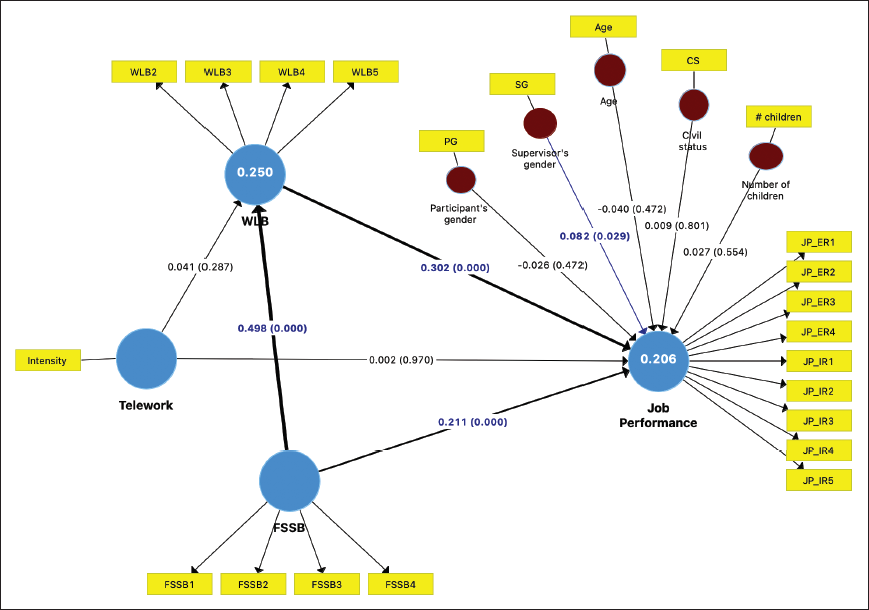
As mentioned earlier, certain discordance persists about the way telework and FSSB (as independent variables) affect job performance and WLB (as dependent variables), and about the likely relationship between the latter two parameters. Therefore, this study examined precisely those relations (Figure 1). The first step was to identify whether or not telework influences job performance in the context of COVID-19. This is particularly important because teleworkers who had been using this work modality were forced to increase its intensity from 2 to 3 days per week to every weekday, without having any face-to-face interaction with co-workers. Therefore, the current study deepens our knowledge of that relation, which is particularly important, considering that the results of previous research are ambiguous, and that the conditions under which telework is being carried out during the COVID-19 pandemic are different from those experienced until then. The relationship is complex as there are different factors that influence whether the balance is positive or negative. On the one hand, telework increases flexibility (Hopkins & McKay, 2019), decreases distractions and promotes concentration (Gálvez et al., 2020), thus improving job performance. However, it can also generate professional isolation and aggravate work–family conflict (Jackson & Fransman, 2018), thus negatively affecting job performance. Therefore, the question that arises is: what happens when, due to public health circumstances, workers have to undertake full-time telework?
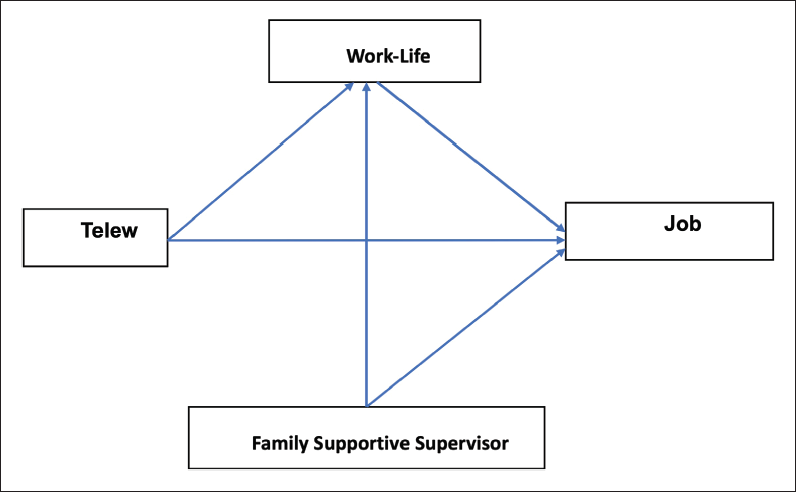
The second step was to examine the type of relationship that may have arisen between telework and WLB in the context of the pandemic, wherein some people had to work while supporting their children in virtual-school tasks or taking care of older adults, plus doing household chores. Thus framed, the connection between these two parameters is particularly important since no conclusive results have been reached so far. Like the interaction between telework and job performance, the relationship between telework and WLB depends on several factors: telework intensity, the people for whom the worker cares at home and the ability to manage the boundaries between work and personal life, which are the two most important domains in life. Along these lines, telework is known to improve WLB (Gálvez et al., 2020), as employees have flexibility to attend to personal and family matters (Akbari & Hopkins, 2019). However, according to Kurowska (2020), in the case of women with dependent children, the impact of telework on WLB is negative and significant. This can be explained by the fact that, to the extent that companies require a permanent connection from employees (expecting them to respond to work issues outside of regular working hours), work–family conflict increases, thus affecting workers’ WLB. These circumstances were aggravated during the pandemic, thus making it necessary to deepen our knowledge of the relationship between telework and WLB in order to delimit the mechanisms that keep it positive.
Inasmuch as employees perceive WLB as a benefit and receive support from the supervisor (FSSB) to achieve it, job performance is expected to improve. The confirmation of this prediction would contribute to the validation of the purported relationships among these three parameters in the context of COVID-19. Based on studies of FSSB, the role of supervisors has been found to be fundamental in the successful implementation of policies, like telework, since they are the ones who promote or constrain the ability of their employees to manage their work and personal demands (Crain & Stevens, 2018; Marescaux et al., 2020; Zhang & Tu, 2018). However, Lu et al. (2019) identified that FSSB is not helpful in alleviating work–family conflict. Along these lines, Crain and Stevens (2018) have stated the need to conduct further research on the effects of FSSB on the employee, the organization and society. In this context, the present research contributes empirical evidence of the effects of FSSB and WLB on job performance. Just as well, it explores whether or not there is a relationship between FSSB and WLB. Finally, the last step was to examine whether or not WLB mediates the relationships between telework and job performance and between FSSB and job performance. Framed in the context of COVID-19, the study was aimed at teleworkers who were already using this modality before the quarantine and held mid-level positions in large private companies of the Colombian service sector.
Due to the pandemic, telework will likely be applied with growing intensity in most companies. In this context, and considering the points made earlier, the present research is an opportunity to identify not only the conditions under which telework impacts job performance but also the role that WLB satisfaction and FSSB plays in job performance. The results will allow companies to make decisions about telework implementation once the pandemic is over, and new working modes are consolidated.
Methodology
Data Collection and Sampling
Demographic Characteristics of the Participants.
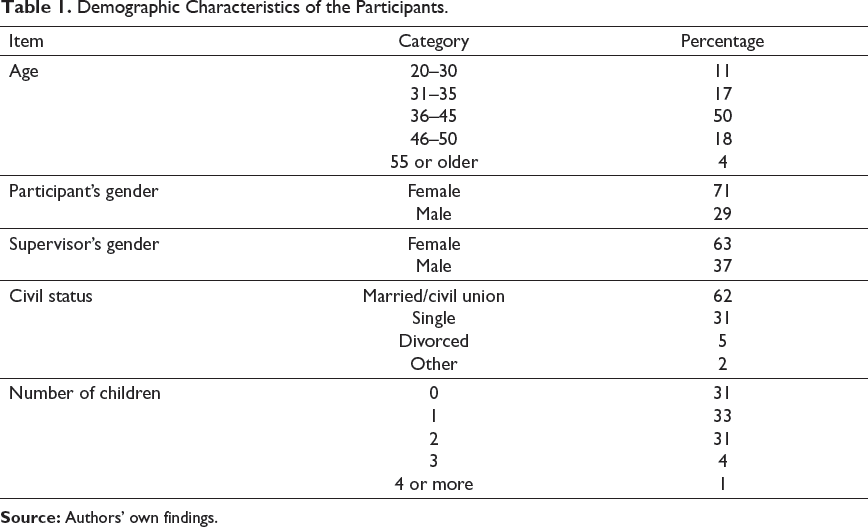
The minimum sample size requirement was 74, which was calculated a priori by means of a statistical power analysis performed using the G*Power 3.1.9.2 software package. Following recommendations by Lakens et al. (2018), a one-tailed test was applied, with an expected effect size of 0.15, a conventional significance level of 0.05, an expected statistical power of 0.95 and the definition of three predictors, which are detailed as follows:
Measures
For the development of the proposed research, instruments from previous studies reported in the literature were used. To measure job performance, we used the questionnaire from Talukder et al. (2018) composed of 10 items (one of which was eliminated since its outer loading registered below 0.5, for example, ‘I meet formal performance requirements of the job’, ‘I can make constructive suggestions to the overall functioning of my work group’). For the WLB construct, we used the questionnaire employed by Valcour (2007) that is composed of five items (one was eliminated due to multicollinearity, e.g., ‘how well your work life and your personal or family life fit together’, ‘your ability to balance the needs of your job with those of your personal or family life’). For the FSSB construct, we used the four-item questionnaire applied by Hammer et al. (2014; e.g., ‘your supervisor makes you feel comfortable talking to him/her about your conflicts between work and non- work’, ‘your supervisor demonstrates effective behaviours in how to juggle work and non-work issues’). Telework was measured according to intensity, using the number of days per week dedicated to this modality (2–5 days per week). Finally, we have used five control variables in the current study, which are the same as the demographic characteristics of the participants that are presented in Table 1.
Analysis
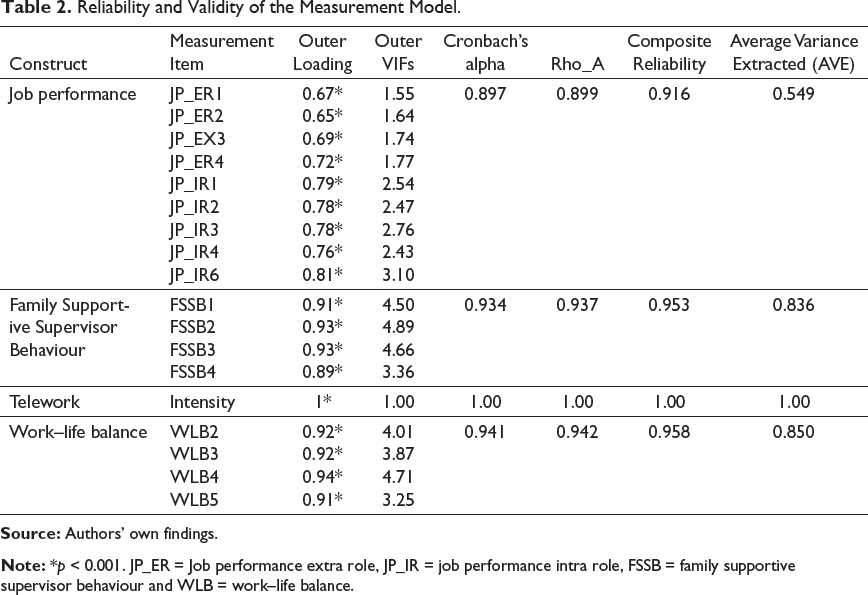
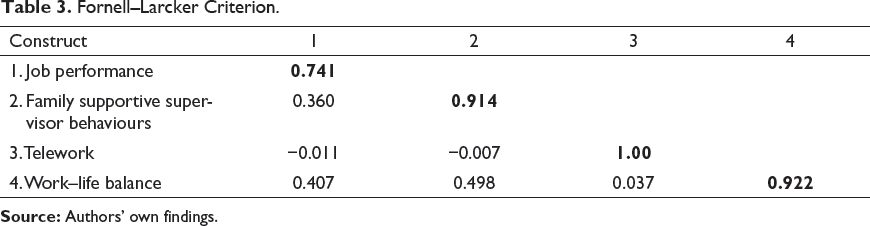
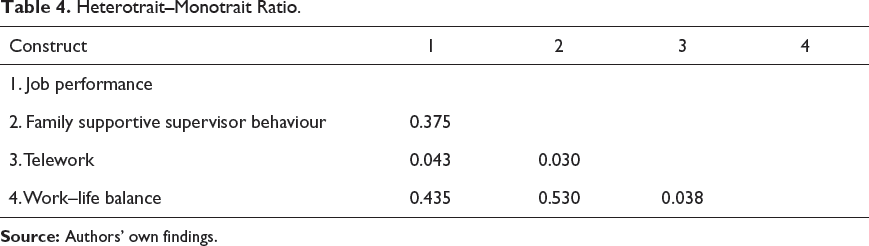
The statistical analyses applied a partial least squares structural equation model (PLS-SEM), evaluated by means of two elements: the measurement model and the structural model. The former evaluates the relationships between the indicators and their constructs (validity and reliability), whereas the latter analyses the predictive capacity of the relationships between the constructs themselves (Hair et al., 2017). The measurement model was evaluated through internal consistency as estimated by Cronbach’s alpha and the Rho_A, and composite reliability (CR) coefficients. Convergent validity was estimated through outer loadings and the average variance extracted (AVE). Collinearity between indicators was analysed using the variance inflation factor (VIF). Finally, discriminant validity was estimated through the Fornell and Larcker index and the heterotrait–monotrait (HTMT) ratio. The evaluation of the structural model was carried out using the (R2) coefficient of determination; path coefficients’ magnitude of total direct effect and total indirect effect; and statistical significance, T-statistic, f2 size effect and predictive relevance (Q2).
Reliability and Validity of the Measurement Model.
Fornell–Larcker Criterion.
Heterotrait–Monotrait Ratio.
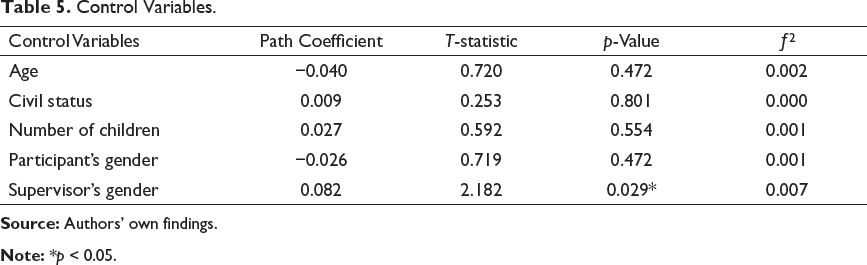
The results of the evaluation of the structural model are presented in Figure 2 with five control variables, where R2 values of 0.206 for job performance and 0.250 for WLB are observed. This means that 20.6% of job performance variance and 25% of WLB variance are explained by the model. Values of 0.75, 0.50 and 0.25 for this parameter are, respectively, considered substantial, moderate and weak (Hair et al., 2011). Table 5 presents the results, including the control variables; only supervisor’s gender has a significant effect; however, the value of ƒ2 is very low (0.007), and the R2 values change from 0.199 without the control variables to 0.206 with those variables. This means that the supervisor’s gender increases the R2 values by only 0.7.
Control Variables.
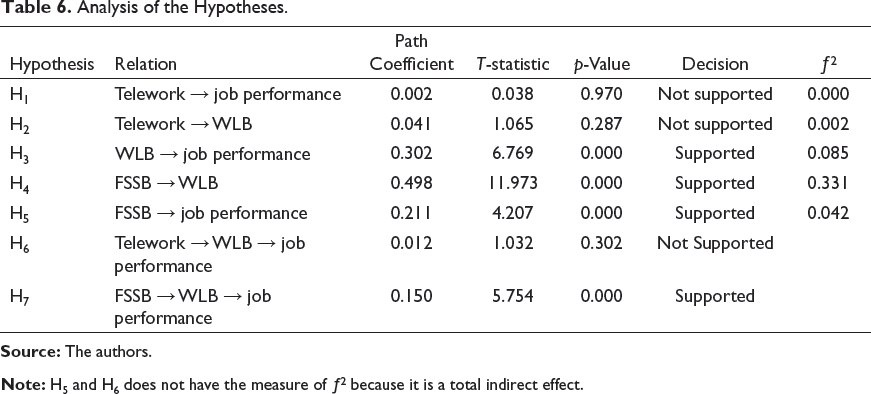
Analysis of the Hypotheses.
Predictive Relevance Q2.

Discussion
The COVID-19 pandemic forced companies to change the way they worked in less than a week, after which many had implemented full-time home-based activity for most employees. The purpose of this study was to examine the relationship between telework, job performance, WLB and FSSB, and the mediating role of WLB in those relationships, in the context of COVID-19. The research data set was generated from the responses of 519 mid-level teleworkers who had been performing under this modality in large Colombian companies of the private service sector prior to the pandemic.
The results of the data analysis did not show any effect of telework on job performance in this context. One of the likely reasons for this result was the change in work-at-home conditions faced by the employees, in the sense of an increased number of interruptions from family members. Therefore, the findings are consistent with previous literature, where it is stated that telework does not necessarily improve productivity because the latter is negatively affected by family disruptions (Jackson & Fransman, 2018). Additionally, due to the pandemic, teleworkers had to increase the intensity of their activity from 2 days to 3 days days a week to every weekday. This meant that all the work they had been doing at the office now had to be done remotely under extraordinary home conditions, a situation that has been recognized to generate professional stress, overwork and, sometimes, burnout, as employees tend to work without limits (Vayre, 2019). Likewise, Abdel Hadi et al. (2021) confirmed that the daily demands of both telework and home in the context of COVID-19 were related to emotional exhaustion, while Kazekami (2020) identified that, although a certain number of telework hours increase work productivity, longer times decrease this parameter. On the other hand, as stated by Ipsen et al. (2021), the experience of working at home during COVID-19 is not conclusive, since 55% of the respondents reported it as a favourable experience and 45% of them stated the opposite. The three greatest telework advantages reported by these authors were greater flexibility, savings in commuting time and reduced risk of catching the disease. In turn, three reported disadvantages were lack of interaction with colleagues, not leaving home and poor workplace conditions.
Similarly, telework was found to be unrelated to WLB in the context of COVID-19, wherein all family members were at home because children were not going to school, and, in some cases, single workers had to move to their parents’ homes to take care of them. This made home a very different environment than the one existing prior to the pandemic. Along these lines, Xiao et al. (2020) found that, during the pandemic, telework decreased physical and mental well-being, and increased the risk of depression, and Zhang et al. (2020) observed that work–family conflicts increased for teleworkers who have children. Thus, although several studies have found that WLB is one of the benefits of telework (Akbari & Hopkins, 2019), since it facilitates the coordination of daily life commitments (Thulin et al., 2019), it is evident that, in the context of COVID-19, this work mode is no longer seen as a means to achieve WLB. Therefore, the data analysis did not show any effect of telework on job performance or on WLB, and it also did not show any effect of the mediating role of WLB in the relationship between telework and job performance.
While the current research found no relationship between telework and WLB, satisfaction with the latter was observed to positively affect job performance. This is consistent with previous reports by Pradhan et al. (2016), who found a profound influence of WLB on employee engagement and productivity, and by Iddagoda and Opatha (2020), who observed a positive correlation between WLB and engagement, which, in turn, had a positive effect on job performance. These results could be explained by psychological well-being, which has been found to mediate the relationship between WLB and job performance (Haider et al., 2018).
The present results also indicate a positive correlation between FSSB and job performance in the COVID-19 context. This corroborates prior reports by Bagger and Li (2014) and Bosch et al. (2018), who observed that, in return for family support from supervisors, employees perform at a higher level. Hence, FSSB seemingly increases employee work engagement and, therefore, performance (Rofcanin et al., 2017). Similarly, Cogin et al. (2018) found that supporting employees to balance work and family influenced employee outcomes. Supervisor support has also been linked to WLB and organizational commitment (Talukder et al., 2018) and to decreased employee turnover intention (Choi, 2020). Additionally, with the control variables, only supervisor’s gender had a significant effect on job performance; however, the value of the effect size is very low; thus, it cannot be concluded that supervisor’s gender greatly affects job performance.
Finally, a positive relationship was found between FSSB and WLB, which is consistent with a similar account by Zhang and Tu (2018), who argue that strong FSSB brings about an enriched work–family interface and, therefore, improved WLB. FSSB constitutes a key factor for employees to achieve WLB and thus impacts organizational and individual outcomes (Idrovo & Bosch, 2019). Therefore, FSSB makes it easier for workers to cultivate a better work–family interface and, consequently, an adequate WLB (Rofcanin et al., 2020). Consequently, with the findings of the relationships between FSSB and WLB, on the one hand, and job performance, it was also found that WLB exerts a mediating effect on the relationship between FSSB and job performance. This is consistent with prior reports by Talukder and Galang (2021), who found that the relationship between supervisor support and employee performance is mediated by WLB.
Conclusion
According to this discussion, the current study has identified a positive effect of both FSSB and WLB on teleworkers’ job performance. Just as well, FSSB is found to positively impact WLB. Therefore, WLB mediates the relationship between FSSB and job performance. However, telework was not observed to have a significant effect on job performance or WLB in the context of COVID-19; thus, the mediating role of WLB was not found in the relationship for telework and job performance. A possible explanation lies in the circumstances in which employees were forced to conduct their work: teleworking every day with little logistical help and the entire family staying at home, in addition to the fear and uncertainty that the pandemic may have generated. However, the observed relationships are relevant to the implementation of telework in companies after the pandemic. The role of the supervisor is fundamental for teleworkers to achieve a better WLB, which, in turn, is likely to facilitate better job performance. This is explained by the social exchange theory, according to which, when employees receive support from their supervisor to achieve WLB, they will feel obliged to reciprocate with better performance.
Managerial Implications
According to the present discussion and the conclusions stated earlier, the vital role played by supervisors in enabling employees to balance work and life—thus achieving better job performance—cannot be denied. Hence, companies should focus on training supervisors so that they develop the necessary competencies to support their collaborators in the management of work and life. In many cases, this will imply a change in the way work is organized and evaluated, and will always require strengthening trust between supervisors and collaborators. This training need implies aligning demands and resources in such a way that, by combining human talent and management, productivity improvements are obtained. This is so because, according to the social exchange theory, the worker feels inclined to give back to the company for their managerial support, thus improving their labour performance.
As to the implementation of telework in post-pandemic times, it should be borne in mind that not everyone has the skills to perform well under this modality. For this reason, it is important that managers understand the need for voluntariness, so that anyone who wants to telework may see it as a benefit to improve their WLB. Thus, as corroborated by the results of the present study, when employees perceive WLB improvements, job performance will improve as well.
Finally, it cannot be forgotten that each employee presents different WLB challenges, so companies must realize that standardized policies may not be applicable to everyone. Therefore, and given the importance of WLB satisfaction with regard to job performance, the policies and practices driving WLB should be reviewed so that they are flexible and address the needs of all employees.
Limitations and Future Research
The present research does have certain limitations. Job performance, WLB and FSSB were self-reported by the participants as mere perceptions about their work. This clearly affects a more realistic appraisal of job performance, since it does not take into account the information that the supervisor would provide. A similar observation can be made about WLB, since the actual proportion between the hours dedicated for work and those dedicated for personal life were not considered either. Last but not least, FSSB is similarly affected.
Additionally, the participant teleworkers were initially hired under different circumstances than those they have lived through during the pandemic. For example, at the time of the current research, participants were with their partner and children at home, so their situation had changed. Likewise, it must be acknowledged that the characteristics of the situation in the midst of the pandemic (fear and uncertainty, to name a few) certainly impact people’s responses. In this sense, future research should conduct a longitudinal study to understand how the current outcomes vary after the COVID-19 pandemic.
Finally, considering that the job performance of the teleworker could vary according to their job role and the industry in which they work, future research could include the job role and the teleworker’s industry as control variables to identify whether or not these factors influence the results. Another future research perspective could be addressed with a multi-group study of telework intensity (high or low) in relation to WLB and job performance.
Footnotes
Acknowledgement
The authors are grateful to the anonymous referees of the journal for their extremely useful suggestions to improve the quality of the article. Usual disclaimers apply.
Declaration of Conflicting Interests
Funding
The authors received no financial support for the research, authorship and/or publication of this article.
