




Abstract
This study assessed the effect of non-tariff barriers (NTBs) on the production and marketing of maize for smallholder farmers in Mbozi and Momba Districts located in Songwe region in Tanzania. A cross-sectional design was employed in gathering primary data. A two-stage stratified sampling procedure was used in the selection of 400 smallholder farmers, who were surveyed using standardized questionnaires. In estimating the effect of NTBs on maize production and supply, the duality model was employed. The results indicate that NTBs have a depressive effect on the quantity of maize produced and marketed. The findings further show that a unit increase in transaction costs attributed to NTBs could reduce the quantity of maize produced by 16 per cent in the two districts. Based on these findings, it is concluded that the quantity of maize produced and supplied by farmers in the two districts decreases with an increase in the NTB costs. The study recommends the reduction and/or removal of the NTBs, which impede maize production and marketing among smallholder farmers. This would help the government to achieve its goals of creating high prices in the surplus districts and attain low consumer prices in the deficit urban centers, thus reducing poverty.
Introduction
In the last few decades, staple food crops, especially maize, have emerged as crucial in guaranteeing food security in most sub-Saharan African (SSA) countries (Friedrich & Kassam, 2016). This is because food security is linked to staple food production and marketing (ACT, 2010; KI, 2011; Mbise et al., 2010). In 2017, global maize produce added up to 1.04 billion tons, of which about 15 per cent was traded on international markets (Liu et al., 2019). For example, in the eastern and southern parts of Africa, agricultural households receive up to 20 per cent of their income from maize production and spend more than 15 per cent of their total household expenditure on maize alone (Chauvin et al., 2017). In most of these countries, maize is the widely grown staple food crop, occupying more than 33 million hectare for each year, and is considered as a major tradeable crop, both locally and internationally (Moctar et al., 2015; World Bank, 2012). However, in these countries, the maize sector exhibits very low productivity, with an average yield of about 1.1 tons per hectare even with improved seeds (Friedrich & Kassam, 2016). The decrease in maize production from these countries had increased the gap of food deficit in which the food requirements has increased for about 100 million tons of cereal food crops in 2014 (FAO, 2013; Minot, 2014). The decrease in maize production from these countries had increased the gap of food deficit in which the food requirements has increased for about 100 million tons of cereal food crops in 2014 (FAO, 2013; Minot, 2014). Similar to other countries in SSA, maize in Tanzania is considered as the most important staple food crop, covering 45 per cent of the total arable land and generating nearly 50 per cent of the cash income for rural smallholder farmers (FAO, 2013; UNESCO, 2011; URT, 2013). Moreover, in Tanzania maize is consumed by the majority of the population (about 90%), followed by rice (17%), which is the preferred staple food more for medium- and high-income earners (KI, 2011; Minot, 2014; National Bureau of Statistics [NBS], 2008). Thus, increasing maize production and marketing has the potential for raising the income and welfare of poor small-household farmers in Tanzania.
However, over the past 10 years, maize production in Tanzania has varied considerably year to year, ranging from 3.3 metric tons (MT) in 2005–2006 to 5.4 MT in 2013–2014 (ASARECA, 2009; NBS, 2014; UNESCO, 2011). It declined from 4.7 MT to 4.3 MT between 2010–2011 and 2011–2012 and further continued to fluctuate, going from 5.4 MT to 5.0 MT between 2012–2013 and 2013–2014 (Indeximundi, 2015; NBS, 2014). This amount has remained below the annual staple food demand of 11 MT for both maize and rice in which maize demand constitutes for about 5.9 MT on the total demand (11 MT) (BMI, 2016; Haug & Hella, 2013; Minot, 2010). The decline in production and supply of maize can be linked to the impact of climatic change, inefficient use of improved farm technologies and excessive marketing transaction costs emanating from government interventions in the marketing of staple food crops through food security policies (FAO, 2016; WEMA, 2010). This situation was reported to discourage maize famers, especially in the major producing regions (Mbeya, Songwe, Iringa, Njombe, Ruvuma, Rukwa and Katavi) from allocating more productive resources (land, capital and labour) to maize production.
Most of the previous studies conducted in Tanzania (including IFPRI, 2013; KI, 2011; Porteous, 2012) on the effects of non-tariff barriers (NTBs) were focused only on cross-border trade, and very little is empirically known as regards to what extent the NTB costs affect the production and marketing of maize in the local trade context, in terms of producer prices and supply, especially in surplus areas such as Mbozi and Momba districts in Songwe region. Thus, there is a dearth of empirical information regarding the extent of NTB costs’ effects on maize production and marketing. Unlike the previous studies cited above, which focused more on the cross-border trade and welfare effects of NTBs, the current study has gone one step further down the maize supply chain in the local trade context to assess the effects of NTB strategies on farmers’ production and decisions to participate in the maize markets in Mbozi and Momba districts in Tanzania.
Review of Literature
NTBs elsewhere in the world have constrained cereal production and marketing, especially in major cereal (rice and maize)–producing countries such as India and the USA. The study by Kornher et al. (2017) reported the application of NTBs such as import restriction and quotas as means of promoting food production and security. Despite the application of these measures, findings from this study indicated low domestic production and prices among maize smallholder farmers. On the other hand, Pernechele et al. (2018) argued that the implementation of price incentive strategies, including NTBs, on maize production had resulted in maize farmers being penalized by low prices and high costs of production. This implies that NTBs, if not carefully implemented, could cause diminishing production and marketing. The study of the Food and Agriculture Organization (FAO) (2020) in the USA on export prices of maize indicated that the prices of maize in some months, particularly in January, increase due to the delay in harvest in some areas and uptick in export sales. This implies that the maize price increase in the USA is caused by factors other than NTBs, which is a departure from this study.
In the context of SSA, findings from the study by Chauvin et al. (2017) indicated that NTBs such as export ban and import restrictions have been commonly implemented with the objective of protecting farmers from the growing external competition and encouraging domestic production. The study by Liu et al. (2019) reported that the adoption and implementation of these protective strategies had had negative effects on maize production and marketing through raised trading costs and reduction in export profits. This situation has discouraged the domestic production by smallholder farmers and increased the food shortage gap. However, these studies have given more attention to technical barriers to trade (TBT) and sanitary and phytosanitary (SPS) measures and less attention to non-technical NTBs such as corruption, road blocks and weighbridges, which this study concentrates on.
Moreover, Porteous (2017) and Kornher (2018) reported that governments in the eastern and southern African region have been regularly limiting export quantities by imposing bans and quotas. For example, Ethiopia imposed an export ban in 2008, 2010 and 2011, Zambia introduced short-term export bans on maize in 2013 and 2016, and Kenya, in 2008 and 2017, introduced the same bans. The outcome from all these bans was the negatively affected domestic maize prices and householders’ income, despite maize being the most consumed and major source of calories and income.
In the context of the East African Community (EAC), findings from studies by Mbaya (2019) and Kornher (2018) indicated that most EAC member countries had implemented less similar price incentive policies, such as input subsidy programmes via the Customs Union Protocol, on staple food crops, including maize and rice. However, the results from these studies showed that the adopted policies had increased food availability and accessibility only in the short run and, in the long run, had encouraged more inefficiency in production and lower prices, which conflicted with the goal of sustainable intensification of agricultural production. Moreover, Makombe and Kropp (2016) are in support of the argument that the introduced NTBs diminish the potential benefits that could be derived from the trade preferences offered through regional trading arrangements in EAC.
In Tanzania, famine early warning systems network (FEWS NET) (2018) reported that maize export bans, which are used yearly as a policy instrument for regulating maize prices and availability whenever the maize production is poor, have tended to negatively affect maize production and marketing. For instance, Tanzania introduced different export bans, such as those in 2008, 2010, 2013 and the recent one in 2017, that were intended to promote food availability among rural areas and low prices for urban consumers. Moreover, the findings by Diao and Kennedy (2016) indicated that the bans on cross-border maize exports implemented by Tanzania lowered the national food price index by only 62.4 per cent compared to the free-export scenario. Though the findings from the above studies show the effects of maize export bans, they concentrate more on maize export across borders and ignore the effects of NTBs within the country, which created an area of interest to be investigated.
Objectives
The contribution of maize smallholder farmers to food security, livelihoods and the country’s economy is crucial; however, the contribution of the sector to the economy has been limited due to the fact that its exploitation has been under-realized. In this regard, this study aims to assess the effect of NTBs on the production and marketing of maize by smallholder farmers in Mbozi and Momba districts in Songwe region in Tanzania. In this view, the study will be a corner stone to inform policymakers, maize traders and smallholder farmers on how to mitigate challenges emanating from NTBs, thus be an important source of food security, employment, improved livelihood and country’s economic growth.
Theoretical Framework
The theory of agricultural household (AHT) was developed by Strauss in 1986 and expanded by Taylor and Adelman in 2003 through the latter’s explanation of its evolution and extension. AHT argues that smallholder farmers in developing countries, especially in the rural areas, perform dual roles as producer and consumer of their own produce. In this way, food-producing households exhibit the dual character of being producers and consumers at the same time (Key et al., 2000; Onono et al., 2013). In order to capture this dual behaviour of such households, the duality model was employed in analysing the effects of NTBs on maize production and marketing. This was done because under the dual (or reduced-form) model, the profit function can be used to describe the production technology set indirectly (Wall & Fisher, 1988). Through this approach, the profit function can be estimated either from cross-sectional data or from time series data that show variation in prices and fixed factors (McFadden, 1978). Moreover, using the duality model, output supply and input demand functions can be easily indirectly derived from the profit function, which satisfies the properties of convexity and monotonicity (Wall & Fisher, 1988). The relevance of this theory to this study is based on the fact that smallholder farmers in Mbozi and Momba districts demonstrate a dual behaviour in making decisions about maize production, that is, as simultaneous producers and consumers of maize.
Methodology
Data
The study was conducted in the Southern Highlands zone of Tanzania covering two major surplus-maize-producing districts, namely Mbozi and Momba in Songwe region. These districts were selected because of their agricultural potential of being surplus-producing areas for maize in the region. The two districts produce about 50 percent of the total maize produced in Songwe region and 40 percent of total maize in Songwe and Mbeya regions (KI, 2011; NBS, 2008). Furthermore, the two districts are also located far from major domestic consumer markets such as Dar es Salaam and Arusha cities. Therefore, involving them in the study was considered useful in obtaining more information related to the spatial effects of NTBs on the prices for and market participation of surplus farmers. A cross-sectional design was used in carrying out the survey of this study. A two-stage stratified sampling technique was used in the selection of the sample size, whereby, in the first stage, wards from the list available at the two districts’ offices were stratified into two strata—the first stratum for wards close to district markets and the second for those located far from district markets. Then, four wards were randomly selected, two from each district, namely Igamba and Ihanda from Mbozi district and Nkangamo and Chiwenzi from Momba district. The selection of wards was also based on the production potential, existence of NTBs and quantity of maize produced. In the second stage, two villages from each ward were randomly selected, forming a total of eight villages, namely Igamba, Itepula, Shiwinga, Ihanda, Malonji, Mpemba, Chiwanda and Isanga. A total of 400 smallholder farmers were randomly selected from the eight villages and interviewed—240 and 160 farmers from Mbozi and Momba districts, respectively. Data on average costs of various NTBs, quantity of maize produced, land cultivated, transport costs and prices for inputs and outputs for the famers in Mbozi and Momba districts were collected through structured and semi-structured questionnaires. Also, a focus group discussion (FGD) was conducted at the village level with smallholder framers. Moreover, individual interviews were held with key informants—village officers, transporters, district officers, custom officials and extension officers—to supplement the information collected from the questionnaires.
Analytical Model
Qualitative data collected from the FGD and individual interviews with key informants were analysed using content analysis, whereby they were first transcribed and then relevant themes were developed from them. Further content analysis led to building arguments and interpreting the findings, which were compared and/or contrasted with the existing literature (Kumburu & Kessy, 2018; Mashenene & Kumburu, 2020; Yin, 2014).
Quantitative data collected from the questionnaires were edited, coded and analysed using the Stata computer software, and the empirical coefficient estimates were estimated through the duality model (under reduced supply function) using ordinary least square (OLS) regression analysis. Then, the derived output supply and input demand functions were treated, as they come from the origin production function. Thus, the optimum levels of outputs and factors that yield maximum profit function were expressed as:


where P = P1, …, Pm + 1 = vector of output prices;
R = Rm + 1, …, Rn = vector of variable inputs prices; and
Z = quantities of quasi-fixed factors of production, which include area planted with maize, total cultivated area (acre) and distance to district markets (km). This profit function depicts the maximum profit a farmer could obtain with the given prices, availability of fixed factors and production technology.
Using Hotelling’s lemma property, output supply and input demand equations were derived by differentiating the profit function with respect to prices, given that the function satisfies convexity and monotonic conditions (Ihle & von Cramon-Taubadel, 2010; Key et al., 2000). Then, the derived output supply and input demand equations can be expressed as:

and

where m and n index the outputs and variable inputs, Y = outputs and X=inputs, respectively.
Since the profit function was assumed to be continuous in both output and variable-input prices (Key et al., 2000; Wall & Fisher, 1988), the two supply and input demand functions derived from Equations (3) and (4) in the reduced form, can be expressed in the linear-relations form as:


Thus, the supply function is positive, and the demand function is negative and sloping downwards, because the π function is a convex function.
According to Makhura et al. (2001), farmers incur normal transaction costs out of that inherited from traders when they search for a good buyer of their produces. These costs are considered before a farmer decides on how much to produce and supply to markets. The inclusion of these costs could even worsen much the effective prices received by farmers. Therefore, if these effects are included in the supply function of a producer, the supply function with transaction costs related to the selling of outputs and purchasing of inputs in a linear form can be expressed as:

Since the transaction costs (including those attributed to NTBs) incurred by traders in moving maize from the production point to urban markets, in the actual sense, are paid by farmers in the form of high and low prices offered by traders for input and output, it is therefore imperative to include them in the supply function (Equation [7]) of a producer as an explanatory variable. Then, the inclusion of NTB costs (R) would enable the study to estimate their effects on the quantity of maize that farmers would be ready to produce and supply to markets. The new supply function with NTBs’ inclusion will be expressed as:

where
PI = the price of inputs as fertilizer and labour;
Z = quantities of quasi-fixed factors of production, which include total cultivated area (acre) and distance to district markets (km); and
R = NTBs costs (TZS).
To estimate the effects of NTBs on the production of maize by smallholder framers in the study area, the derived supply function, using the duality model in the logarithm form, was used. Equation (8) above was expanded, in order to include all factors that influence the supply of maize, and the relationship, in the natural logarithm form, was expressed in the following equation:

where
Ym = total quantity of maize produced (kg); β0 = constant; Pm = market price of maize (TZS/kg); Pf = rate of fertilizer application (TZS/acre); Pv = price of improved seeds (TZS/kg); F = family size (number of people in the household); Zm = total land size allocated for maize cultivation (acre); Pw = labour wage rate (TZS/day); Wc = weather conditions (good = 1, and poor = 2); Ri = NTBs’ equivalent (TZS/kg); and εi = random error term.
Findings and Discussion
Effects of NTBs on the Supply of Maize in Mbozi and Momba Districts
Regression Results on the Effects of NTBs on the Production and Supply of Maize in Mbozi and Momba Districts
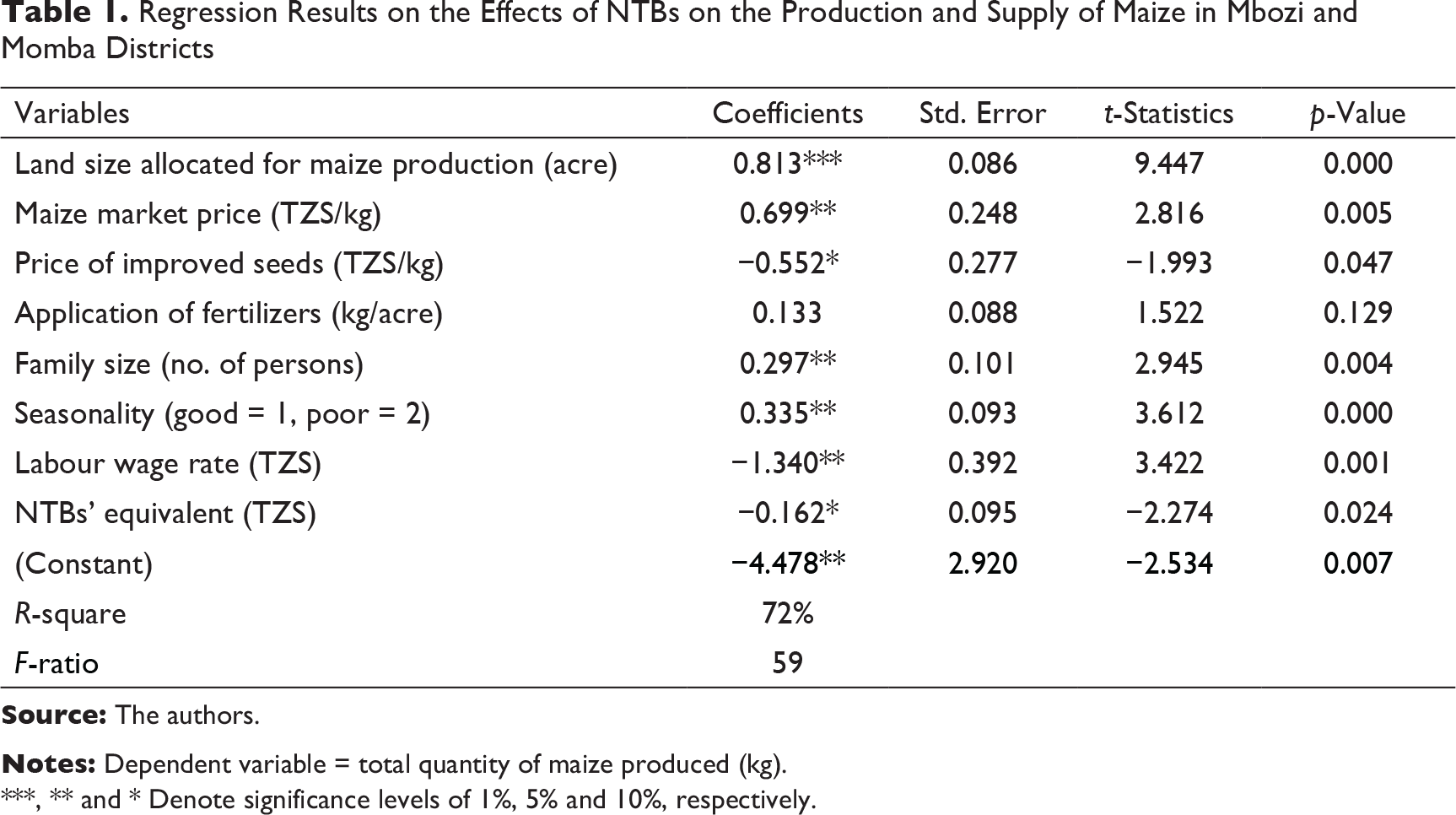
***, ** and * Denote significance levels of 1%, 5% and 10%, respectively.
These findings also concur with the arguments by Minot (2010) and KI (2011) that any additional costs incurred by a trader, due to NTBs in most cases, were shifted to farmers through lower prices offered. Moreover, these results carry a policy implication that the implementation of protective food policy strategies such as road blocks and weighbridges in Tanzania will hurt more smallholder farmers, especially those who live in surplus regions like Songwe. This is because, during the study, it was found that farm gate prices in Mbozi district were averaged at TZS 250/kg, while the cost of producing maize was TZS 345/kg. Therefore, a farmer has to incur a loss of TZS 95/kg, which is equivalent to 16 per cent. Similar to these findings, Gabagambi (2013) argued that maize farmers in Kiteto and Kongwa districts were incurring a loss of TZS 53/kg of maize due to the existence of many NTBs along the way to urban markets at Kibaigwa town. This loss was caused by the lower producer price (TZS 220/kg) that was offered by traders to farmers, while the production cost incurred by farmers for maize was TZS 273/kg. This situation further indicates that market access for smallholder farmers in Tanzania is still constrained by the cumbersome trade barriers, including various types of NTBs such as road blocks, weighbridges, police checkpoints and customer clearance procedures. These deny farmers access to markets and the opportunity to secure the right price for their maize.
In addition, these results are also in line with the descriptive findings of this study in the two districts, which showed about 57 per cent of farmers complaining about receiving low prices from local traders. Furthermore, the findings also are consistent with those of Haug and Hella (2013), who found that producers’ prices in Sumbawanga and Mbozi were lower when the government banned the export of maize in 2008 and 2011, as compared to those before the bans. Likewise, EAC (2012) claimed that maize prices dropped from TZS 45,000 to TZS 30,000 for a bag of 100 kg because of the July 2011 export ban in the major producing regions (Rukwa, Katavi, Ruvuma, Mbeya, Iringa, Njombe and Songwe) in Tanzania.
The findings from this study further indicated that the quantity of maize produced by farmers seems to increase with a rise in the market prices. The price elasticity coefficient for market price was valued at 0.699 and found significant at 5 per cent, implying that a unit increase in maize prices could raise the supply of maize by 70 per cent ceteris paribus. This response of supply to price can be explained by the fact that price, in spatial farming agriculture, is a key motivational factor for farmers’ decision on the quantity of maize to produce and supply to markets. These findings correspond with those of Olwande et al. (2009), Onono et al. (2013) and Haug and Hella (2013), who found similar results in Kenya, Nigeria and Tanzania, respectively.
The size of land owned by a farmer was also found to be an important fixed input factor influencing maize output response in the two districts, with an elasticity of 0.81 and significance at 1 per cent. This implies that a unit increase in the size of land allocated for maize production by a household could increase its outputs by 81 per cent. This is because, land being an important factor in crop production, land size significantly determines the decision of households to engage in production and supply of produce to the market. This aspect was revealed by the differences in the quantity of maize outputs produced in Mbozi and Momba districts, whereby farmers who owned more arable land were producing more maize than those with less arable land.
These findings are consistent with those of Msuya et al. (2008) in Tanzania, who found that land was the most important factor for maize production, with an elasticity of 0.6988. This implies that an increase in land size under maize production would lead to a significant increase in maize output—by 70 per cent. Similarly, Mbise et al. (2010) found that the size of land had an influence on bean and maize production in Burundi, with an elasticity of 0.33, implying that a 10 per cent increase in land size could increase maize and bean production by 3.3 per cent. Moreover, studies by Olwande et al. (2009) and Onono et al. (2013) in Kenya also indicated that, allocating more land for maize could raise maize production among small-scale farmers in rural areas. Increased outputs from the allocation of more arable land for maize production could reduce the impacts experienced by farmers from the imposed NTBs (Olwande et al., 2009).
Furthermore, the price of improved seeds has been shown to have a negative effect on maize output, with a coefficient of −0.55 and significance at 10 per cent (p ≤ 0.05). These results imply that a 10 per cent increase in the price of improved seeds could reduce maize output by 6 per cent, keeping other factors constant. Also, during the FGD, farmers reported that prices for improved seeds in the two districts were very high (about TZS 4,000/kg), to the extent that poor farmers were not able to acquire the seeds and, therefore, relied on seeds selected from their own previous harvests. Moreover, the World Bank (2012) claimed that, the higher prices of seeds were associated with high costs of seeds' production caused by bureaucratic certification and licensing for improved maize seeds by the government. These arguments concur with the findings by Aloyce et al. (2014) that poor farmers are unable and ineligible to receive improved seeds because of the lack of top-up funds in the voucher system in Mbozi and Sumbawanga districts. This situation makes only rich households with more resources more eligible for receiving input voucher in the two districts, contrary to the targeted group of poor farmers.
Further, the coefficient of wage showed a negative relationship with the quantity of maize produced, implying that maize production could decline by 13 per cent with an increase in the wages offered at the labour market (Table 1). This is due to the fact that the increased wage rates reduce the ability of poor farmers to employ more paid labourers in maize production, thus contributing to the reduction of the quantity of maize produced. These findings were contrary to those by Onono et al. (2013), who found that in Kenya, wage rate was statistically insignificantly related to supply of maize. However, the adverse effect of wage rate on quantity of maize supplied is less than that of land and seeds, implying that maize production responds more to the size of land allocated for its production. These findings are also in line with the arguments of the theory of rural households under imperfect markets in developing countries, which argues that households, in response to policy change or market change, can demand more labour and, at the same time, sell their own labour at a given market wage (Taylor & Adelman, 2003). Therefore, the recent inputs subsidy programme is important to induce supply response in the short run, but its impact would not last long without a reduction in marketing costs.
In addition, the influence of changes in weather on maize production was captured by the dummy variables of weather (1 = good weather and 0 = poor weather). The results in Table 1 indicate that maize production and supply were positively related with changes in weather conditions in the two districts studied—they could increase during periods of good weather by 33 per cent. This is because most maize production systems in Tanzania are rain-fed. Therefore, during periods of high rainfall, farmers produce more maize and therefore supply more to the markets.
Conclusion, Managerial Implications and Recommendations
Production and supply of maize were found to decline with the increase in NTB costs and were found to increase with the increase in the size of lands located for maize production and in market price. This implies, among other things, that land and market price are the important determinants of increased production and marketing of maize in Mbozi and Momba districts. Therefore, to improve maize production and marketing, the study recommends, policies that emphasize the reduction of transaction costs attributed to NTBs should be developed. This could be done through the establishment of time-bound programmes that would involve both the private and public sectors in eliminating or reducing the number of unnecessary NTBs on food crop trade, such as weighbridges, road blocks and council permits at the district and region levels. Also, improvement in land productivity and access to market information is recommended. This could be achieved by the government through the Ministry of Agriculture increasing the production capacity of farmers by setting lower prices for fertilizers and providing improved seeds to poor rural farm households. This would enable the majority of farmers in the rural areas, who are constrained by their income, to purchase more inputs and therefore use the right quantity of fertilizer on a particular land size, which could lead to increased maize production. Generally, policies that are aimed at lowering transaction costs would help in promoting maize production, and hence agricultural growth, as well as reducing poverty among rural households in the country.
Footnotes
Acknowledgements
The authors are grateful to the anonymous referees of the journal for their extremely useful suggestions to improve the quality of the article. Usual disclaimers apply.
Declaration of Conflicting Interests
The authors declared no potential conflicts of interest with respect to the research, authorship and/or publication of this article.
Funding
The authors received financial support from the management of the College of Business Education during data collection, but no financial support was received during the authorship and/or publication of this article.
