



Abstract
Our study provides a comprehensive view of innovations in the management of healthcare facilities (HCF). It fills the research gap and contributes to discussions on the need to introduce new innovative management tools into the curricula of healthcare managers and professionals. The design of the study is based on answering research questions (RQ) by statistical processing of data from 181 managers of various types of HCF in Slovakia, obtained by questionnaire. We evaluate the use of innovative approaches in the management of healthcare organisations in the application of hard and soft management tools and their relationship to the economic results of these organisations. RQs are aimed at differentiating the application of innovative approaches in management depending on the characteristics of HCF and their managers and depending on the economic results. There is a positive relationship between the use of innovative approaches in management and the economic results of HCF. There are significant differences in the degree of application of innovative approaches between different types of facilities, the leaders in their implementation are university hospitals. The medical education of managers with the additional completed specialised management study has a significant relation to the application of innovative approaches in management.
Keywords
Introduction
Due to the COVID-19 pandemic, the term of citizens’ health and its protection is frequently discussed not only in media but also in professional and scientific circles. A local epidemic developed into a pandemic and forced everyone involved to think and act responsibly. Management teams of healthcare organisations (HCO), which are in the centre of attention in this context, need not only to address the current emergency reactively but also to adapt sustainable management tools and proactivity in their implementation. Healthcare is very sensitively perceived and evaluated by society. Only viable medical facilities, managed by a quality team of managers, can be a support in resolving the current emergency situation and, in the future, others that are related to globalisation and may occur once again unexpectedly.
The healthcare sector employs a large number of highly educated healthcare professionals. Many of them are getting into managerial positions and have to manage activities for which they were not prepared in the first place. They rely on their experience, occasional additional education and specialisation studies with a focus on management in healthcare. Such a situation is a logical consequence given the complexity of the medical study, essentially lifelong in its nature. Expertise in the medical field is essential but might be not sufficient for managing healthcare facilities (HCF). These managers often lack basic managerial skills. Therefore, we assume that the knowledge and implementation of innovative approaches to management is not their strength. Our intention is to examine this situation and verify the extent to which the management of HCF can benefit from current trends and innovations in management.
Moreover, we strive to offer a comprehensive view of the possibilities of innovating management approaches in the performance of management in healthcare. Not only in the relatively small Slovakia, in the region of Central and Eastern Europe, but also global, this research is original. In a comprehensive form, there are no similar studies transferring the issue of innovative approaches to management into the practice of managing HCO. Existing studies are only partial ones concerning individually selected management tools and their contribution in relation to the outputs of organisations. A systemic view of innovative approaches in management in the context of hard and soft management factors in conditions of HCF is absent. This creates a large research gap. In other sectors, especially the for-profit ones and in public administration, there are many studies on the positive relationship between the implementation of innovative management approaches and the specific outputs of these organisations, towards either external interest groups or employees.
Innovative Approaches in Management According to Management Functions
Management theory offers many recommendations on how to innovatively manage organisations. However, many of them remain unknown to healthcare managers. Several studies have shown that the application of innovative management tools is significantly related to the specific outputs of organisations and supports them in positive direction.
The theory and practice of management are based on the years-tested and widely used system framework dividing the management structure into basic functions (Fells, 2000; McLean, 2011; Parker & Ritson, 2005). Fayol’s classic division is very useful in offering a solid structure to effectively incorporate new knowledge (Carroll & Gillen, 1984). Therefore, the individual innovative approaches in the management of HCF are divided this way. Due to its importance, separate attention is paid to innovation at the strategic management level.
The starting point for the implementation of any activities in the organisation is strategic management (Bouhali et al., 2015; Suarez et al., 2016). Demir and Ugurluoglu (2019) point out its importance in the conditions of HCF management. They examined the use and satisfaction with the implementation of 16 strategic management tools in all types of hospitals. Compared to public hospital managers, private hospital managers use strategic management tools to a greater extent and are more satisfied with them. Additionally, executives who have received strategic management training typically use the vast majority of examined tools.
An important element of the innovative understanding of strategic management is the application of the Balanced Scorecard concept (Banabakova & Georgiev 2018; Chow et al., 1998; Gurd & Gao, 2007; Inamdar & Kaplan, 2002). Behrouzi et al. (2014) provided insight into the prevalence of the application of this tool in Australian HCF. Their research can help managers to change their thinking about performance assessment and provide a structured approach to measuring performance in relation to strategic management in healthcare.
In the context of societal change, the basis of the strategic development of organisations is the application of innovative business models (Breuer et al., 2018; Hwang & Christensen, 2008; Umar et al., 2018; Wirtz et al., 2016). Sharan et al. (2016) argue that HCOs are undergoing a transformation to a supplier approach based on value and point out the importance of business models in HCOs. Understanding the theory of business models can help these organisations in the redesign process. Cicellin et al. (2019) analyse new business models in the provision of healthcare recently been introduced in Italy, as well as their individual components. They introduce a low-cost model of healthcare services enabling to respond to the demand for affordable healthcare while integrating and leveraging social innovation.
Agarwal et al. (2018) as well as Angeli and Jaiswal (2016) examined business model innovations in pyramid-based healthcare delivery. They point to inevitable links between patients’ needs, community involvement, continued customer involvement, innovative healthcare technologies, focus on human resources, strategic partnerships, economies of scale and cross-subsidies at providing inclusive healthcare services.
In the planning function of management, innovations focus mainly on data collection and processing in the form of Big Data (McAfee et al., 2012; Mullainathan & Spiess, 2017). Models are beginning to be used, linking and consolidating the individual plans of the organisation (Osterwalder & Pigneur, 2010). The application of methodologies used in the Information Technology (IT) field is also an innovation in project plans (Fernandez & Fernandez, 2008). Strategic planning is considered a key value-added function of management in healthcare (Begun et al., 2005).
Innovations also significantly affect the organisational structures of HCF—their flexibility and agility, accompanied by team management (Kleinknecht et al., 2019; Sindhwani et al., 2019; Shirey, 2015), reducing the number of management levels and the implementation of Lean SixSigma (Vaishnavi & Suresh, 2020). Agility is essential for HCOs because it helps them cope faster with fluctuating client needs and feedback from competitors. Team management is a highly active mediator of organisational agility. Talib and Rahman (2015) point to the importance of optimal organisational structure for the dimensions of sustainable quality of healthcare in hospital services.
Staffing, a separate function in the European approach to management, has been undergoing rapid development in the recent period. Its importance in increasing the quality of healthcare is growing. The most important challenges of staffing in current healthcare are (a) application of a strategic approach to human resource management (HRM), emphasising not only the expert role of personnel departments but especially the role of strategic partner (Jankelová et al., 2017); (b) HRM focused on the competency of management and defining models of competency (Pihlainen et al., 2016; Walsh et al., 2020); (c) the issue of organisational culture formation (Schaffer, 2019); (d) concepts of talent management (Baraias, 2015; Collings et al., 2015; Sparrow & Makram, 2015). To reduce costs and the need for high-quality services in the healthcare and care services for seniors sectors, effective HRM in organisations from these sectors is crucial (Cook & Bartram, 2015). Baraias (2015) discusses ways, how to use diversity in HRM for improving patient care in HCO. These are various innovative ways of attracting talent across generations, targeted efforts to recruit employees of different generations, the use of social media to reach them, diversity leadership. In particular, diversity leadership should make it possible to contribute fully to the performance of an organisation by facilitating the communication of unique ideas and reducing stereotypical ideas (Moldogaziev and Silvia, 2015). Hussain et al. (2020), however, point out how an impoverished and one-dimensional conceptualisation and operationalisation of ‘culture’ in organisations likely limits the effectiveness of HRM initiatives designed to address diversity.
In the function of leading, many new approaches emerged in the last period. These might be interesting also for HCO. Examples include the organic implementation of ethics into leadership styles (Stouten et al., 2013; Zhu et al., 2015), the incorporation and use of leadership character (Wright & Quick, 2011). Due to the diversity of the workforce in terms of not only age, gender, race, but also experience, priorities, attitudes, communication styles, work approaches, diversity leadership gains importance. It enables team and organisational inclusion (Ashikali et al., 2020). A study by Aij and Rapsaniotis (2017) monitored organisational results after the implementation of lean management. The most frequently recorded tangible outputs were a reduction in the error rate and a reduction in waiting times, which in turn led to a reduction in costs and productivity growth. Fewer errors resulted in reduced morbidity and mortality and thus higher patient safety. Positive effects were also recorded in intangible outputs, for example in increased motivation and employee satisfaction and consequently increased patient satisfaction. Abuhejleh et al. (2016) found that the lean philosophy significantly and permanently optimises the approach to patients, improves their safety and satisfaction and increases employee satisfaction. Successful implementation of lean leadership depends on the degree of adhesion of leaders and their followers on the principle of this philosophy and their willingness to change culture. de Zulueta (2016) introduced the so-called ‘Compassionate leadership’ in the environment of HCF, which he considers a social and moral good.
Controlling has gained in importance in the last period. Many managers see controlling as a way to streamline processes but also to maintain or increase market value in a highly competitive environment (Mišún et al., 2019). Cogin et al. (2016) point out that the excessive use of behavioural control in Australian hospitals has helped to achieve short-term cost reduction goals, but has often led to operational inefficiencies. The above-mentioned Balance Scorecard (Kaplan & Norton, 2001) has significantly contributed to the development of controlling as well. Senior and middle-level management use comparable controlling methods, mostly various online reporting forms (Özen-Bekar & Baykal, 2020). Vainieri et al. (2019) identified that, due to their size (3,000–6,000 employees); Italian public health organisations are primarily governed by regulatory mechanisms and rules with less use of management tools and tasks. Petit and Lux (2019) provided a new perspective on the specifics of the use of control tools in the public health sector, as well as information for the creators of these tools, based on the practice of private sector organisations.
From the point of view of the good functioning of the management of HCO, based on the above-mentioned, it can be concluded that the following aspects are important: (a) orientation on hard management tools that can be designed, formally defined and implemented in the organisation; and in addition (b) application of soft management tools, concerning mainly the human factor and social relations in the organisation, which are mostly informal and often ambiguous (Jankelová et al., 2017). The authors differ in their views on the preferred approaches about managing organisations. Increasingly, theoretical and practical views are dominated by views on the growing influence and importance of soft management tools. However, the challenges of today’s management are to connect the two levels in terms of achieving synergies in their simultaneous use.
Methodology and Results of Empirical Research
Our main objective is to evaluate the application of innovative approaches in the management of organisations providing healthcare in the conditions of Slovakia with regard to the application of hard and soft management tools. In order to fulfil the main objective, the following RQ were set:
Our interest was to map the application of innovative approaches in management compressively, not to deal with the examination of selected methods in depth. The research was based on a quantitative research strategy. Data collection was carried out by a questionnaire in order to obtain as much data as possible. The questionnaire is divided into four main areas and contains 33 items. The first part contains the identification data of respondents, the second part deals with soft and hard tools of healthcare management, the third part focuses on innovative approaches in the management of HCO according to management functions and the fourth part focuses on obtaining information on specific innovative methods and techniques. The questions in the individual parts are mainly scaled, but also dichotomous.
The questionnaire was distributed in a combined manner. It was sent electronically to representatives of selected HCOs. We addressed their top management, on the knowledge and skills of which the application of research tools in the practice of a particular organisation is depending. The second way of distributing the questionnaires was a personal meeting with representatives of HCO, either at their workplace or as part of their participation in specialised studies focused on healthcare management and financing, organised by the Slovak Medical University in Bratislava, Slovakia.
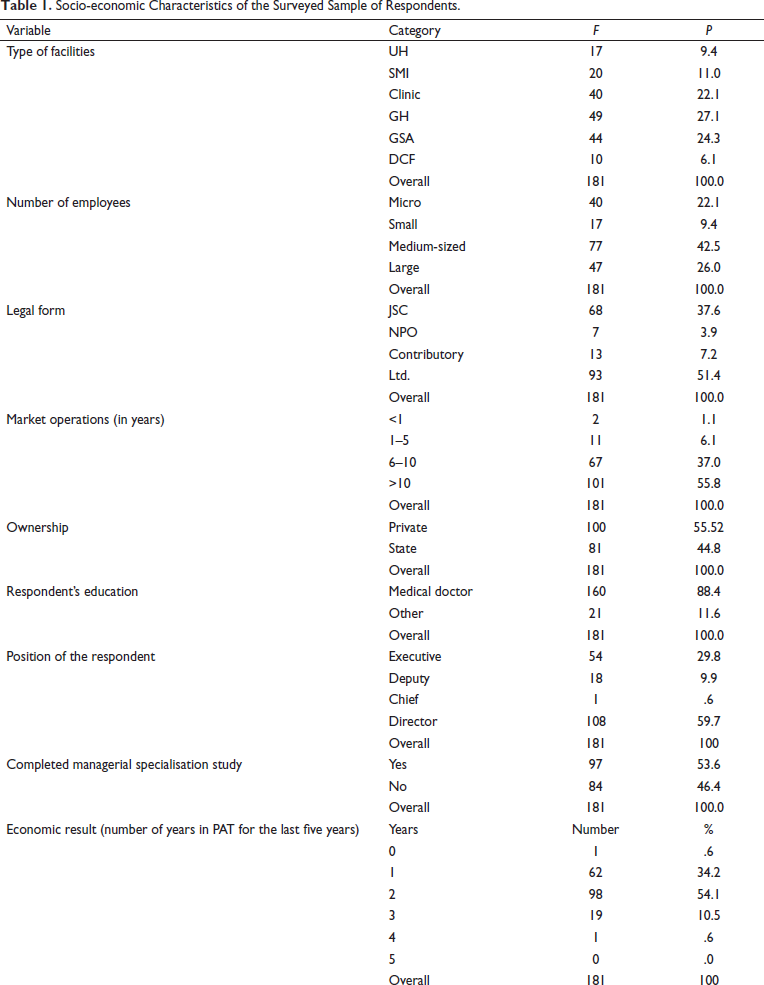
After processing the questionnaires, verifying their completeness and accuracy, we managed to obtain a total of 181 full-featured questionnaires, filled in by representatives of various types of HCO (in institutional care—university hospital [UH], specialised medical institute [SMI], general hospital [GH]; in outpatient care—clinic, general specialised ambulance [GSA], daycare facility [DCF]). The organisations varied in size (number of employees), the legal form, the length of operation on the market, the type of ownership and the economic result for the last five years (profit/loss after tax). Managers who were respondents differed in managerial position, completed education (medical and other) and completion of specialised studies with a focus on management (Table 1).
Socio-economic Characteristics of the Surveyed Sample of Respondents.
SPSS v.23 software was used to process the outputs. To solve the RQ, we used the following statistical tools: ANOVA scattering decomposition with Bonferroni correction for pairwise comparisons, paired t-test, unpaired t-test. The significance level of all tests was 5%. We worked with the innovation variable, which we compiled based on the data in the third part of the questionnaire. We calculated it as the number of innovative methods used collectively by a given HCF within individual areas, specifically in the framework of strategic management, organising, leading, staffing, controlling and quality management. The overall score within the ‘innovation’ category is shown in the following Table 2.
Variable Innovative Approaches—Total Point Score and Percentage Share of Used Approaches.

As part of the research, we worked with the following variables:
innovations—the degree of implementation of innovative approaches through the number of methods applied by the organisation—in absolute numbers and percentages; type of organisation—nominal variable; economic result—number of years in profit in the observed period; scores achieved in hard tools—average score of the rate of use of hard management factors (scale 1–5; 1—very important factor, 5—not important at all); scores achieved in soft tools—average score of the rate of use of soft management factors (scale 1–5, 1—very important factor, 5—not important at all); medical education of the manager—yes/no; completed managerial specialisation study—yes/no.
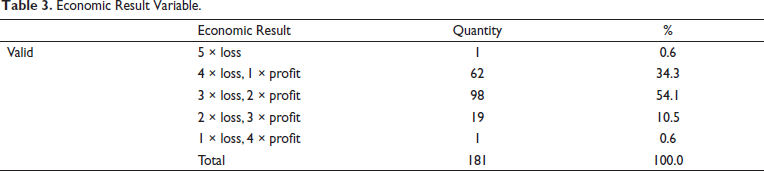
We compiled the variable economic result (Table 3) based on data from respondents on the number of years in which their HCO achieved a positive profit after tax (PAT) for the period 2014–2018. Due to the use of this numerical variable, we performed the quantification in the following way: for each profitable year, we assigned the organisation the value of +1 point, for each year with a loss the value of −1 point. Subsequently, we added the obtained point values for all years and thus gained the final value of the variable economic result for further processing.
Economic Result Variable.
In the results, we illustrate the most important findings and answers to our RQ (Table 4).
Tests of Significance of Variables—Dependent Variable Innovation.
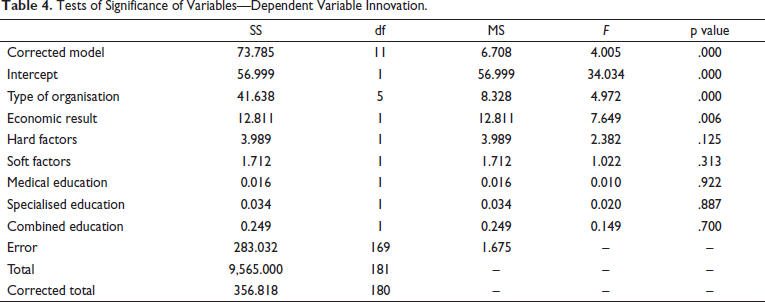
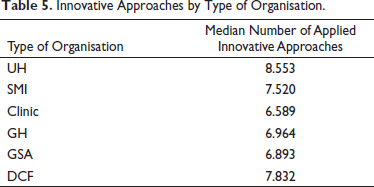
It is obvious that the type of organisation and its economic result significantly affect the innovative management of HCF. Those HCFs that achieve better economic results are innovating their management approaches to a greater extent. In terms of the type of HCF, innovative approaches are mostly applied in teaching hospitals, on the contrary, the least active in this direction are clinics (see Tables 5 and 6). Together, the independent variables explain 15.5% of the variability in the use of innovation. The impact of the other variables examined on the implementation of innovation in management has not been confirmed.
Innovative Approaches by Type of Organisation.
Pairwise Comparisons Using Bonferroni Correction.
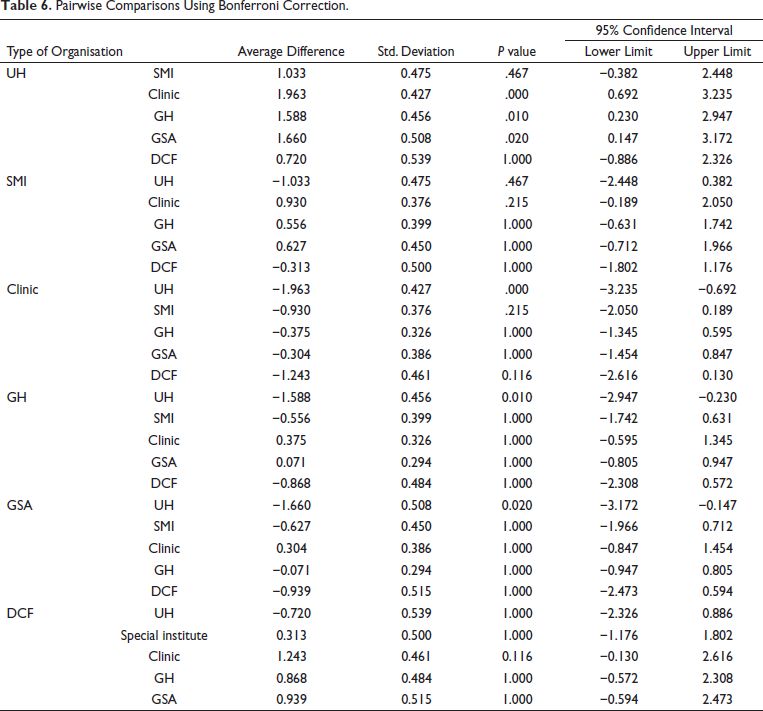
In order to find out which types of organisations have significant differences in terms of innovative management approaches, we subsequently used the method of pairwise comparisons with the use of Bonferroni correction. The results (Table 6) show that UHs differ significantly in comparison with GHs, GSA and clinics. The differences between UHs and SMIs as well as DCFs are not significant.
Our intention was also to examine the impact of innovative management approaches on the performance of HCO. Based on the results presented in Tables 7 and 8, we can state that in terms of economic results, the use of innovative approaches (F = 7.649; P = .006) and the type of organisation are significant variables. Together, they explain 8.1% of the variability in the economic result of organisations. The correlation between economic results and innovation is positive (B = 0.204; P = .006), which means that the application of innovative approaches in management affects the economic result of HCF in a positive direction. The correlation of economic result with soft and hard factors are not significant (P > .05). The results confirm that innovative approaches to management positively affect the economic result, so their implementation in managerial practice is desirable.
Tests of Significance of Variables—Dependent Variable Economic Result.
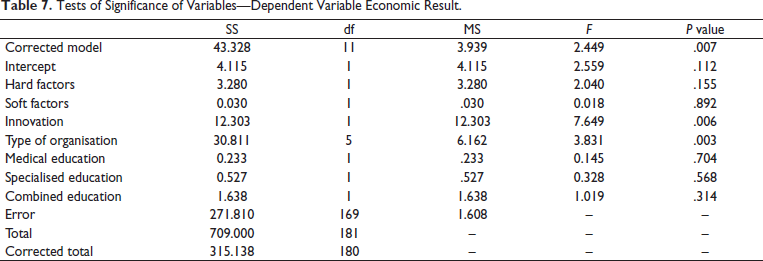
Table of Parameter Estimates—Effect of Economic Result (Dependent Variable) and Innovation in Management.

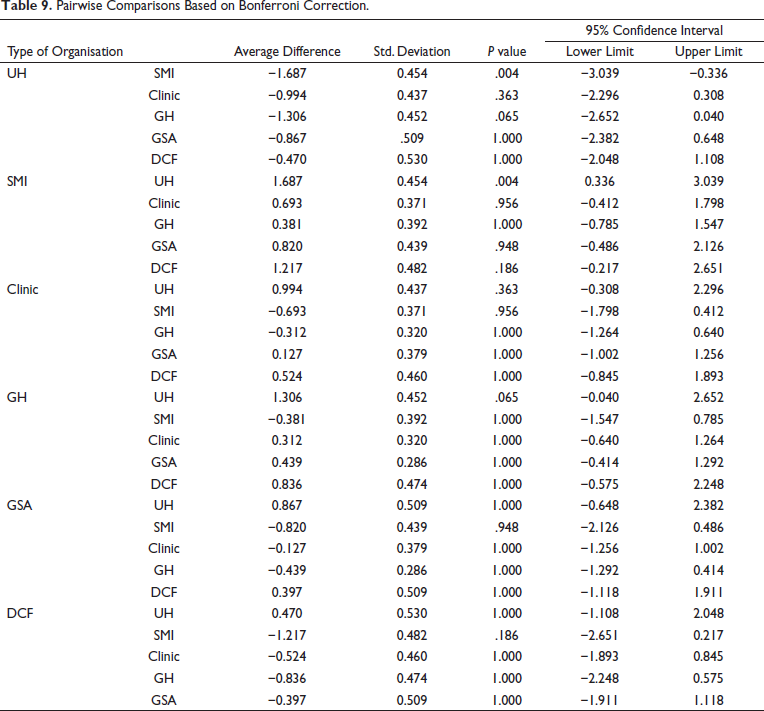
For further examination of the relationship, we subsequently compared the differences in the application of innovative management approaches in terms of their impact on economic results. Table 9 shows the results of pairwise comparisons using the Bonferroni correction. Significant differences in this respect were recorded only in UHs in comparison with SMIs; no significant differences were demonstrated between other types of facilities.
Pairwise Comparisons Based on Bonferroni Correction.
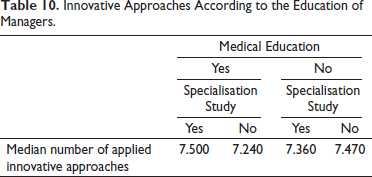
We further explored the use of innovative approaches depending on the education of managers (Table 10). When comparing the groups of respondents, two classification criteria were applied. Managers were divided into those with medical education and managers with other education. Both of these groups were further compared according to the completed specialised management education. The highest number of innovative approaches in management is implemented by those managers, which have both, a medical education and completed specialisation studies. The differences between the individual groups of managers proved to be significant.
Innovative Approaches According to the Education of Managers.
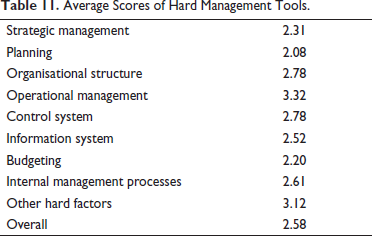
We solve the RQ concerning the use of hard and soft management tools in the implementation of innovative approaches to management by comparing the total score of individual tools using a paired t-test. The significance level is 5%. The average scores of the hard and soft management tools and the total scores are shown in the following Tables 11 and 12.
Average Scores of Hard Management Tools.
Average Scores of Soft Management Tools.
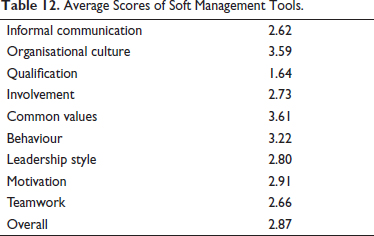
The results showed that managers of HCF rely more on hard tools (Table 13), of which they most often apply innovative operational management, they also rely on the control system and organisational structures. The weak point is the planning process. Among the soft tools, the most important from the point of view of managers appear to be the promotion of common values of the organisation and the building of organisational culture.
Comparison of the Total Score of Hard and Soft Management Tools.
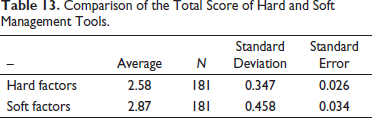
By using paired t-test (Table 14), we found that the difference in the use of hard and soft management tools in the management of HCF is significant in favour of hard factors (t = −7.291; P = .000). We further verified whether the application of hard and soft management tools is significantly related to the intensity of innovative approaches to management. We used the test of agreement of regression coefficients from the relationship of innovations with respect to hard and soft factors (significance level 5% bilaterally). P value of .492 indicates that the examined relationship is not significant. This means innovative approaches are not significantly supported by any group of management tools.
Paired t-Test.

Discussion and Conclusions
When examining the use of individual innovative approaches in management, we found that managers use these approaches on average at the level of 40% (of the possible innovative methods and techniques we have identified). This result is partly in line with previous findings. Rigby and Bilodeau (2013) report that the use of innovative tools among healthcare managers ranges from 61% to 83%, so the level is higher, while Demir and Ugurluoglu (2019) report rates of 11% and 69% and point to very low level of knowledge, especially in strategic management. However, our value of 40% may be distorted by the high representation of currently common methods such as benchmarking, quality management tools, time management and tools for risk or knowledge management, while many innovative methods are almost unknown to respondents. In fact, the real level of current innovative approaches may be even lower.
In order to meet the main objective, we formulated four RQ devoted to examining the relationship between the application of innovative approaches and selected variables such as type of organisation, economic result and the use of hard and soft management tools. We can conclude that there is a significant interdependence between the application of innovative approaches in the management of HCF and the type of organisation, in favour of UHs, which apply the largest number of innovative approaches in management tools. UHs are followed by DCFs and SMIs. We explain this by the fact that UHs create an optimal environment for the cooperation of clinicians and academics, which can lead to the support of the use of innovative management tools in practice. This was also documented by Bowen et al. (2019) on the need to link research and practice and their effective cooperation. A significant relationship was not confirmed between the use of innovative approaches and the type of ownership. However, some studies point to the opposite effect, namely the higher application of innovative approaches in private facilities and justify the fact that private hospitals operate in a more competitive environment than public hospitals (Demir & Ugurluoglu, 2019).
There is a mutual interdependence between the application of innovative approaches in the management of HCF and the economic result. Implementation of innovative management approaches improves economic results; on the other hand, organisations with better economic results apply innovative approaches to a greater extent. These findings are in line with the findings of Agarwal and Ganesh (2017), who validated the positive relationship between innovative management approaches and service delivery outcomes (readmission rate, infection rate, average mortality rate, length of hospital stay, time spent serving clients, level of client satisfaction with health services and average waiting time for patients in private hospitals).
We further found that there is no significant correlation between the intensity of applying innovative approaches in the management of HCF and the use of hard or soft management tools. The correlations of innovations with hard and soft factors are not significant. We expected an opposite result, as the use of hard factors proved to be more significant in HCO and we assumed that it would also lead to higher innovation activity.
Our research confirmed the difference in the intensity of the use of hard and soft management tools. We evaluated the use of both types of tools using the average score of each factor within each group of tools and subsequently through the total score for each group. By using pair test, we found that the difference is significant in favour of hard factors. HCF managers rely more on operational management and control systems, while soft factors like new leadership styles are at a low level of knowledge. In addition, the principles of collective learning, knowledge sharing, and employee engagement are used to a lesser extent. However, there are many studies on their significance. Majernik and Patrchnak (2014) examined the impact of employee engagement and patient satisfaction with the result of a significant effect. Singer et al. (2017) introduced an innovative approach in the form of collective learning as a tool to improve quality and safety in healthcare. Several studies address new trends in healthcare leadership and point to the significant effects of using new leadership styles to improve the quality of services provided (Abuhejleh et al., 2016; Aij & Rapsaniotis, 2017; de Zulueta, 2016). Positive correlations were found for such indicators as reduced error rates, shorter waiting times and increased productivity. Reducing waiting times and errors have led to lower costs; fewer errors resulted in reduced morbidity and mortality and thus higher patient safety. Results were also recorded in intangible outputs, including increased employee motivation and satisfaction and increased patient satisfaction. Although managers consider the sharing of common values and the building of an organisational culture to be beneficial and pay attention to them, our research in the management of HCO has identified gaps that represent development potential for the future.
At the beginning of the article, we stated that many healthcare managers run their organisations without managerial education, drawing on their experience and practice. Therefore, we verified whether the application of innovative approaches in the management of HCF is determined by the managerial education of healthcare managers. We divided the managers into groups—based on medical education and completion of specialised managerial studies. The significant impact of education on management innovation has been confirmed. Those managers who have a medical education and at the same time completed managerial specialisation study apply innovative approaches to a greater extent. This finding corresponds with the results of studies, which point to the need to introduce new innovative management tools into the curricula of healthcare managers and professionals. That should become a mandatory requirement in HCO (Agarwal & Ganesh, 2017). HCFs, which have a more complex structure than organisations operating in other sectors, show a particular need for strategic management tools. These will allow them not to be paralysed by change or high competition in their environment and to effectively manage their own limited resources through effective strategies. Therefore, top healthcare managers should be trained in the effective use of innovative management tools, as it has been proven that managers who completed specialised management education or training have used these tools more than those who have not complete such education (Demir & Ugurluoglu, 2019).
Based on the results, we can conclude that managers of HCF still do not make full use of innovative approaches in management as an effective management tool for achieving the goals of their facilities. However, the dynamic and turbulent environment places high demands and requires organisations to be prepared to handle unexpected situations. Knowledge of adequate management tools and the ability to implement them can help healthcare managers address such challenges. Many available studies confirm that quality innovative management is still insufficient in this sector. Pihlainen et al. (2016), Ackerly et al., (2011), Enterkin et al. (2013) and Yoder-Wise (2014) state that the need for management and leadership skills in healthcare is the current challenge. Approaches to the development of healthcare managers have been identified as inadequate and contradictory (Ackerly et al., 2011; McCallin & Frankson, 2010; Townsend et al., 2012). Management and leadership go beyond the scope of the physician’s role; management and leadership competence have proven insufficient in many studies (Dickinson et al., 2013; Kuhlmann & von Knorring, 2014).
The main obstacles mentioned by the representatives of the surveyed HCF are insufficient expertise on trends, low motivation, insufficient staffing, bureaucracy and legislative obstacles. At the same time, we expect that the risks also lie in the inactivity of the leaders of the organisation in developing a vision as a certain idea of the direction of the organisation and its subsequent implementation. Communication, acquaintance with ideas and reconciling the interests of all stakeholders play an important role in this area. On the other hand, the employees themselves, their low motivation and commitment to improving quality through new methods can also be an obstacle. The current period of the COVID-19 pandemic provides an unprecedented period for observing the readiness as well as the unpreparedness, ability, as well, inability of healthcare managers to cope with a crisis. In crisis times, healthcare managers should be able to implement optimal hard and soft tools based on knowledge and disposal of managerial skills in order to set effective measures. The coronavirus crisis clearly points to the need to link the medical, economic and managerial aspects of the healthcare system.
Implications and Limitations of Research
The practical implications of our research are on several levels. The first is the existence of a relationship between the implementation of innovative management approaches and the performance of HCF. This finding should be an important stimulus for healthcare management and encourage them to take an interest in studying and subsequently applying innovation in management. UHs excel in the application, which may be related to the connection between clinics and academia, where management becomes domesticated even in a highly professional environment.
Related to this is another level of implications, namely a contribution to the discussion on the need and development of managerial education of healthcare leaders. Healthcare management necessarily requires new innovative approaches that will enable today’s healthcare managers to handle extremely challenging situations related to the constant changes in the social environment and in addition to achieve excellent performance within these situations. Our results point to the fact that a significant variable is entering into the relationship of high quality versus limited resources. It is the qualification of healthcare managers, where optimal results are achieved by facilities whose managers have not only medical but also managerial education. This result confirms the importance of management education in HCO.
We hope that our results will help to arouse interest in a deeper examination of the relationship between innovation in management and performance and the identification of the variables that contribute to this relationship. Moreover, due to the general trend of overestimating innovations in soft management factors, we found that innovative approaches in the management of HCF are not significantly supported by a group of hard or soft management tools.
Our research has its limitations. First, the research sample, which consisted of HCF operating in Slovakia exclusively. However, it covered facilities of different types, allowing mutual comparison. The second limitation may be the method of evaluating the performance of HCF. From the analysed period, we assessed the performance by the number of years in which the facilities achieved a PAT. For a more objective assessment, the results for a longer evaluation period were taken into account. However, it would be more appropriate to use a more comprehensive evaluation indicator, including other categories of performance.
Footnotes
Acknowledgement
This article is a partial output of the solution of the VEGA project of the Ministry of Education of the Slovak Republic no. 1/0328/21 Post-pandemic business management: identifying temporary and sustainable changes in sequential and parallel management functions in the context of the COVID-19 pandemic; and no. 1/0010/23 Adaptability of Corporate Culture – a Factor Supporting Resilience and Sustainability of Enterprises in Slovakia in the Post-covid period.
Declaration of Conflicting Interests
The authors declared no potential conflicts of interest with respect to the research, authorship and/or publication of this article.
Funding
This research was funded by Scientific Grant Agency VEGA of the Ministry of Education, Science, Research and Sport of the Slovak Republic, grant numbers 1/0328/21 and 1/0010/23.