




Abstract
A critical situation pushes human behaviour towards different directions with some aspects of behaviour being irrevocable. COVID-19 pandemic is not a normal crisis, and to control the spread of disease various measures were taken including complete and then partial lockdown. Since all elements of the economy are intricately interrelated with public health measures and lockdown, this resulted in economic instabilities of the nations hinting towards change in market dynamics. In every market, consumers are the drivers of the market competitiveness, growth and economic integration. With economic instability, consumers are also experiencing a transformation in behaviour, though how much of transformation experienced during the crisis will sustain is a question. This article looks at the consumer behaviour during COVID-19 crisis and in the subsequent lockdown period when the world stood still for more than a quarter of a year. Further, the article attempts to weave through the maze of literature available about consumer behaviour in normal times and in crisis times, strengthens it with the rapid assessment reports culled out by the different consulting organisations during lockdown phase, substantiates the same with first-hand telling and retelling of experiences by consumers and professionals with marketing background to bring up a hypothesis of the pandemic affecting a paradigm shift from consumer materialism to consumer spiritualism. The proposition offers further testable hypotheses for future research to understand consumer sentiments or requirement in buying ‘what is enough’ within the marketing context and how it can be reinforced post-COVID crisis for ensuring sustainability of business models. It would also be interesting to explore the correlates of this forced consumer behaviour with other variables such as learning from crisis, changing needs, personality, nationality, culture, new market segment and age to develop new models of consumer behaviour.
Introduction
In the start of the last decade, Gates Notes (Gates, 2020) released an article emphasising that beyond the immediate danger posited by the 2009 H1N1 pandemic that claimed the lives of 18,036 people, there were larger implications in highlighting the fact that health systems were unprepared for inevitable outbreaks in the future. The article urged for a ‘wake-up call’ for investments in capabilities, infrastructure and human resources for health, surveillance and management of deadly epidemic outbreaks. In 2018, following the Ebola outbreak, the Global Preparedness Monitoring Board—an organisation consisting of notable global health officials created by the World Health Organization and World Bank—in their first annual report examined airborne diseases such as influenza and suggested that a disease such as the Spanish flu had the potential to spread around the globe in less than 36 hours, killing more than 50 million people. The report highlighted how the existing gaps in global preparedness would compound the implications of a prospective pandemic extending beyond increased levels of mortality and morbidity to destabilising national security, detrimentally impacting global economy and trade due to changing consumption behaviour. As recently as October 2019, the World Economic Forum (WEF) in collaboration with the Johns Hopkins Center for Health Security and the Bill & Melinda Gates Foundation hosted a high-level simulation exercise that brought together governments, security, businesses and public health leaders to address a hypothetical global pandemic scenario. Learning from the exercise showcased the glaring vulnerabilities in pandemic preparedness and response across the system, and while participating stakeholders began to incorporate the learning from the simulation, the inevitable COVID-19 occurred and witnessed an exponential increase in the number of cases across countries (ReliefWeb, 2020).
Consumer Behaviour Approaches in Times of Crisis
A consumer is a person who identifies a need or desire, makes a purchase and then disposes of the product in the consumption process. A typical consumer’s utility is dependent on the consumption of agricultural and industrial goods, services, housing and wealth (Grundey, 2009). No two of them are the same, as everyone is influenced by different internal and external factors which form the consumer behaviour. Consumer behaviour is an important and constant decision-making process of searching, purchasing, using, evaluating, and disposing of products and services (Valaskova et al., 2015). The macro consumer behaviour is created by social issues, but to reach the factors of micro consumer behaviour, individual factors (Solomon, 2016) are researched. Flatters and Willmott (2009) claim consumers try to maximise their utility, satisfaction, or joy by purchasing consumer goods.
The approaches explaining consumer behaviour are divided into the three groups (Valaskova et al., 2015): psychical-based on the relation between the psyche and behaviour of the consumer; sociological approach—which is devoted to the reactions of consumers in different situations or how the behaviour is influenced by various social occasions, social leaders; and economic approach—grounded on basic knowledge of micro economy in which consumers define their requirements. Subsequently, the consumer interests are confronted and traded on the market. After liberalisation in India, consumer behavioural pattern has been explained by such approaches in the borderless globalised world, while defeating individual identity and giving rise to collective identity through brand culture. The intermittent waves of ‘Swadeshi’ and ‘back to basics’ propagated by social leaders like Baba Ramdev or Gandhian minimalistic lifestyle also emerged as a behavioural approach. The sociological approach of behaviour is also harvested which is adopted by the affluent class as a natural wholeness to self-actualisation. Many lower socio-economic rung consumers too yielded to elitist appeals of material symbols to showcase themselves in higher rungs under economic approach to consumer behaviour. Amalia et al. (2012) in their study explained that people are not the same and not all the people have the same perception about a situation with negative effects like economic or any other crisis. In crisis times, new trends in consumer behaviour emerge. The most important factors which model the consumer’s behaviour in crisis are risk attitude and risk perception. Risk attitude reflects consumer’s interpretation concerning to the risk content and how much he or she dislikes the content of that risk. Risk perception reflects the interpretation of the consumer of the chance of being exposed to the risk content. Hoon Ang et al. (2001) in his work discussed that these changes in consumption behaviour arising from an economic crisis may be moderated by personality characteristics too. These characteristics of personality include dimensions like the degree to which consumers are risk averse, value conscious and materialistic. Earlier studies were indicative of behavioural changes among consumer in times of crises with significant change in utility pattern. A study conducted by Flatters and Willmott (2009) identified few new trends during crisis which include simplification of demand because of limited offers during crisis which tends to continue post-crisis where people buy simpler offering with great value. The study also reported that even the rich people, post-crisis expressed dissatisfaction with excess consumption and focused on recycle and teach their children simple and traditional values. Flatters and Willmott (2009) in their study proved that the impact of the recession on consumer attitudes and trends is critical. Some trends are advanced by the recession, while others are slowed or completely arrested. The most central trends in crisis include the demand for simplicity, which indicates that consumers seek uncomplicated, value-oriented products and services that simplify their lives and focus on the enactment of a company where consumers are outraged by the unlawful conduct and unethical company behaviour. The change in consumer behaviour during crisis times led authors’ interest to explore consumer behaviour during COVID-19.
Method of Research
Through an analysis of relevant published surveys during COVID-19 and an in-depth discussion with few marketing professionals and consumers, this article has analysed main changes in consumer behaviour caused by the COVID-19 and subsequent lockdown period. Further literature was also explored to find out the reasons of these behavioural changes in consumer decision-making process in times of crisis.
Market Dynamics During COVID-19
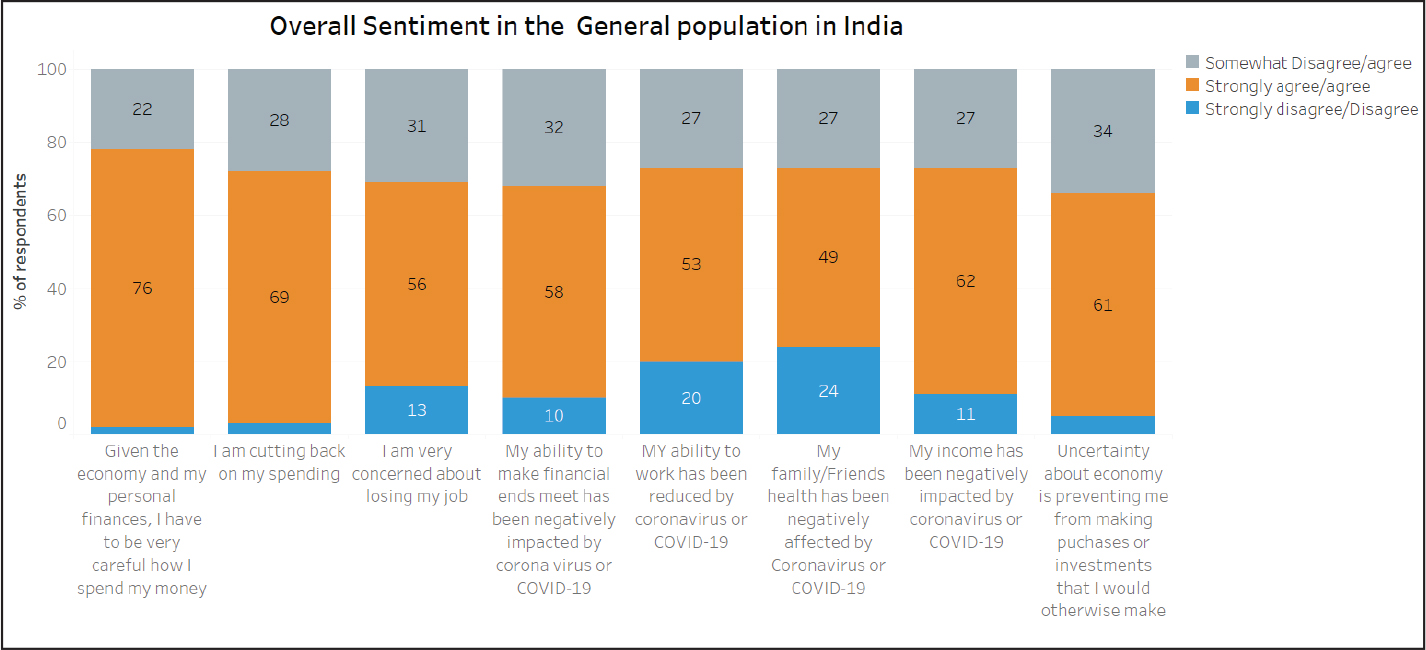
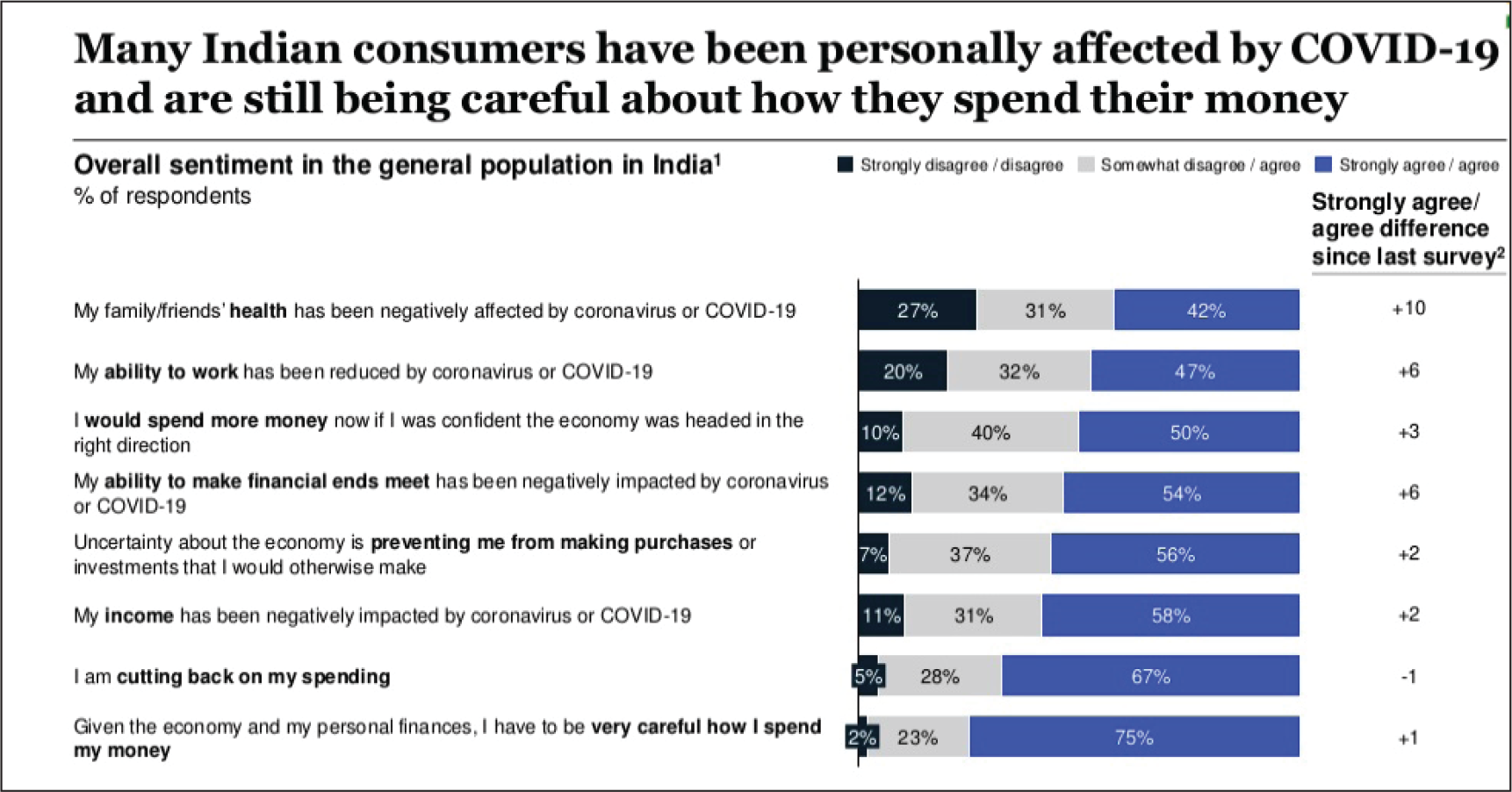
This pandemic has a serious impact on the economies of the nation hinting towards change in market dynamics. Abe (2020) in her report on ‘Market Trends and D2C Opportunities in the COVID-19’ observed trends such as from people raiding grocery store walkways to the cancellation of the world’s most significant events and mandates for ‘non-essential’ businesses to be temporarily closed to prevent spread of infection. During the pandemic, people are spending less of their income on items perceived as nice-to-have or non-essential (such as clothing, shoes, make-up, jewellery, games and electronics). Globally too, during COVID-19, the developed nations are shifting towards steady state purchasing post-stock piling as per iRi POS data (2020). The report also stated edible products are expected to have an increased demand and non-edible products shall have a moderate need globally, thereby decreased demand which includes homecare, cosmetics and personal care products. A survey on Indian consumer sentiments during corona virus crisis was carried out by Mckinsey from 1–4 May 2020. The result indicated that 76 per cent of consumer out of the sample strongly agreed to spend their money carefully and cut back on their purchase (Figure 1).
Mckinseyconsumer-sentiment-during-the-coronavirus-crisis).
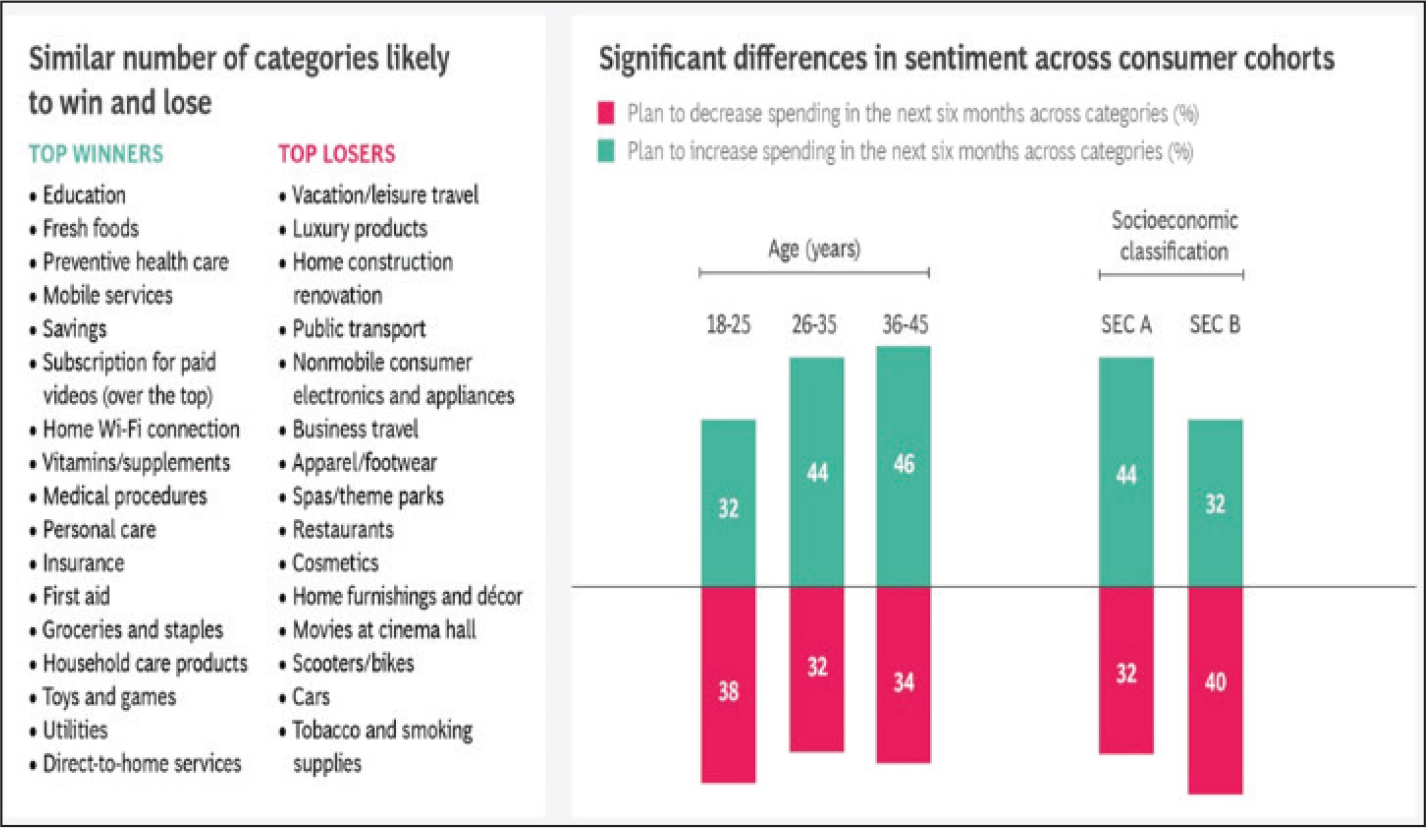
Beside change in spending pattern, substantial fall in sales of different sectors in India has been noticed during COVID-19 as per Boston Consulting Group report (2020) on market dynamics. Figure 2 indicates meaningful differences in spending specifically. Lower-income and younger consumers show a higher propensity to plan to reduce their spending, while older and higher-income groups exhibit more resilience and are more likely to expect to maintain or increase their spending.
Percentage of People Planning to Defer Purchases due to Coronavirus Outbreak in Different Sector
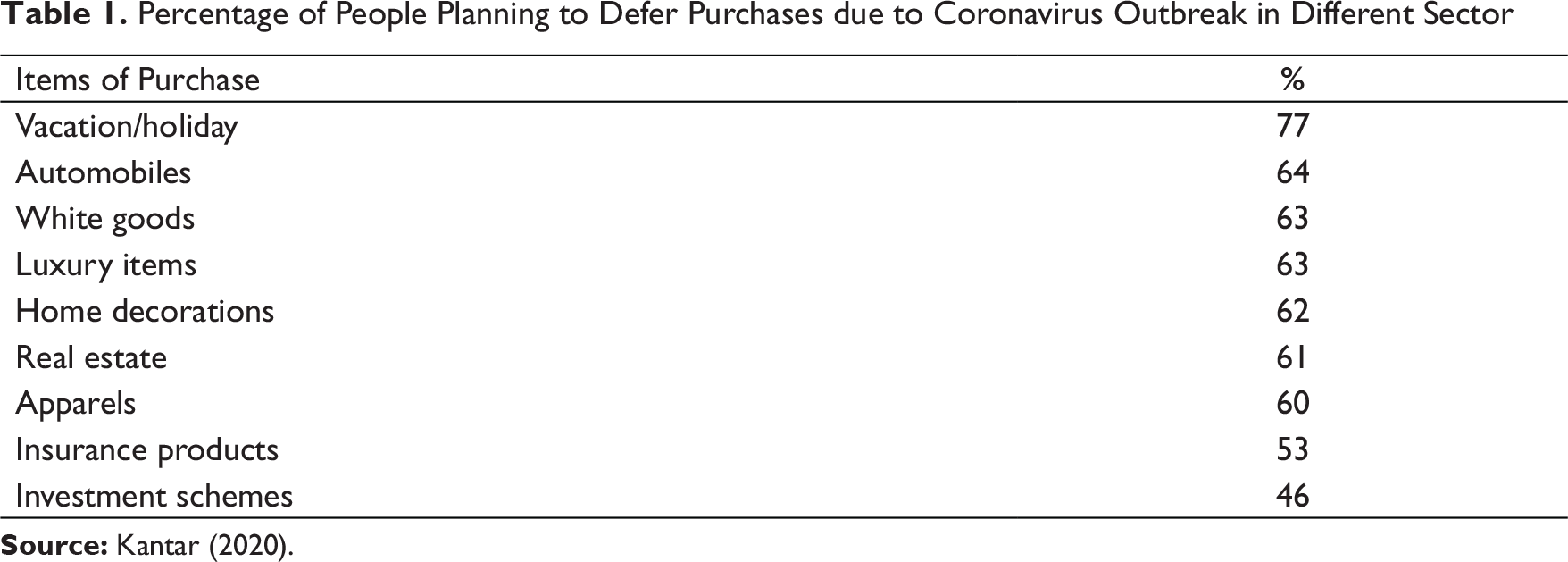
A noticeable change in consumer’s attitudes, behaviours and expectations has also been conveyed by research agency Kantar in their report on ‘Market Dynamics During COVID- 19: Indian Consumer Sentiments Analysis’ (2020). This survey was carried out with 18+ years of consumers, covering a sample of 11,000 household, 19 cities and 15 states across India. Consumers conveyed heavy concern about pandemic and observed that disruption (45% of respondent) bothers them more than health concerns (31%). The survey also reported significantly reduced spends across physical as well as online formats. Survey also reported about planned purchases being deferred and a new learning to live with less. The survey points out the consumers’ interest in saving through investments, insurance, health and hygiene product (Table 1).
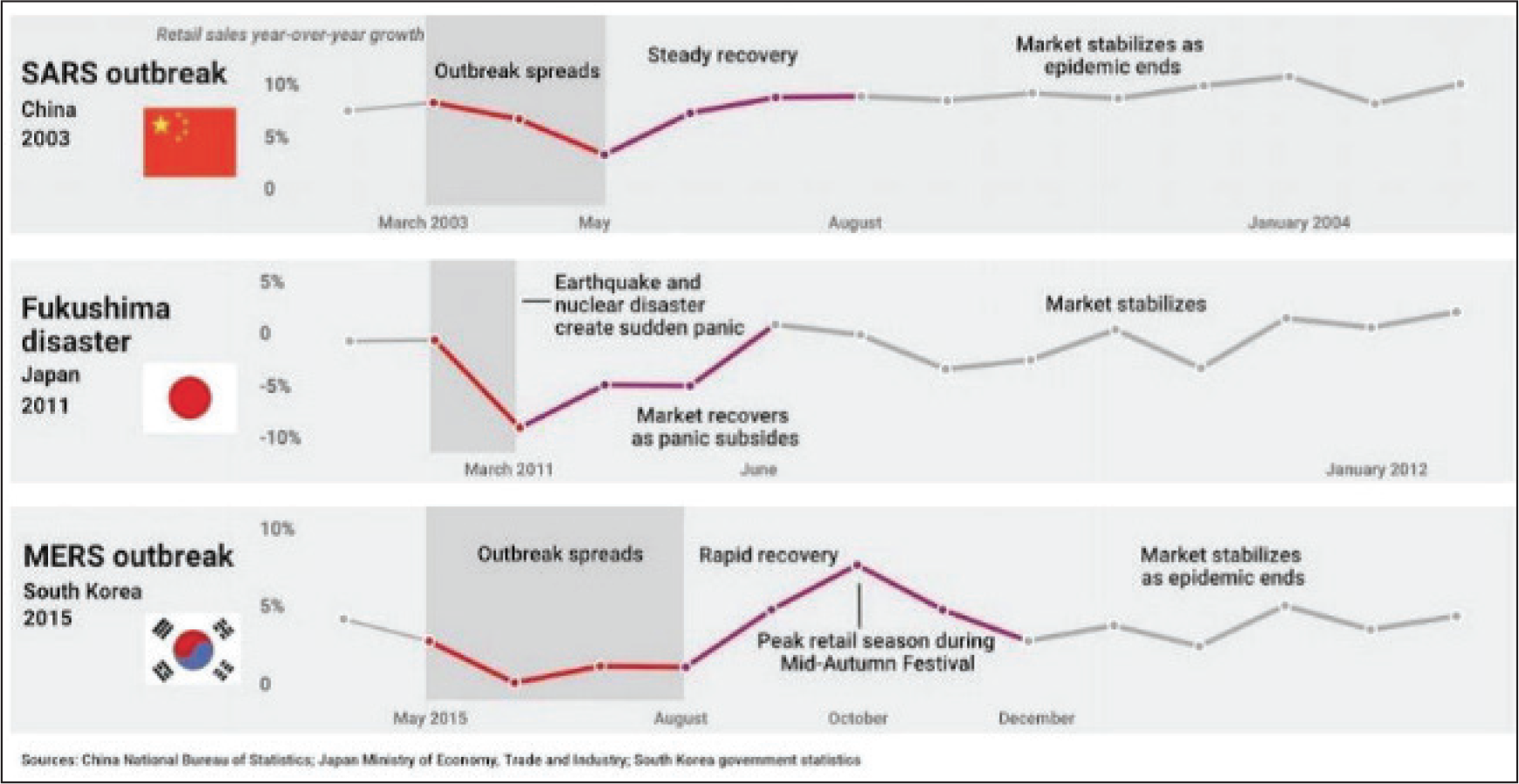
While writing on potential impact of COVID-19 on Indian economy, a report of KPMG (2020a) stated that this economic elastic behaviour with reference to spending was also shown during previous epidemics with increased attention of consumers on price, origin of the products and utility-based consumption or curtailed consumption. During the previous outbreaks such as SARS, MERS and other natural disasters, consumers displayed economic elastic behaviour (Figure 3), in form of rapid, steady or slow recovery of market. A part of this behaviour is permanent and brings in structural changes in the way we live, work and take buying decisions. Accenture consumer research (2020), conducted between 2–6 April also reported that during this COVID-19 outbreak, a rise in consumer’s concern has led to change in priorities of consumers which is now centred around most basic needs, sending demand only for hygiene, cleaning and staples products, while non-essential categories slump. The desire to shop local is also reflected in the products which consumer buy and the way they buy to support local stores as they consider them more sustainable option.
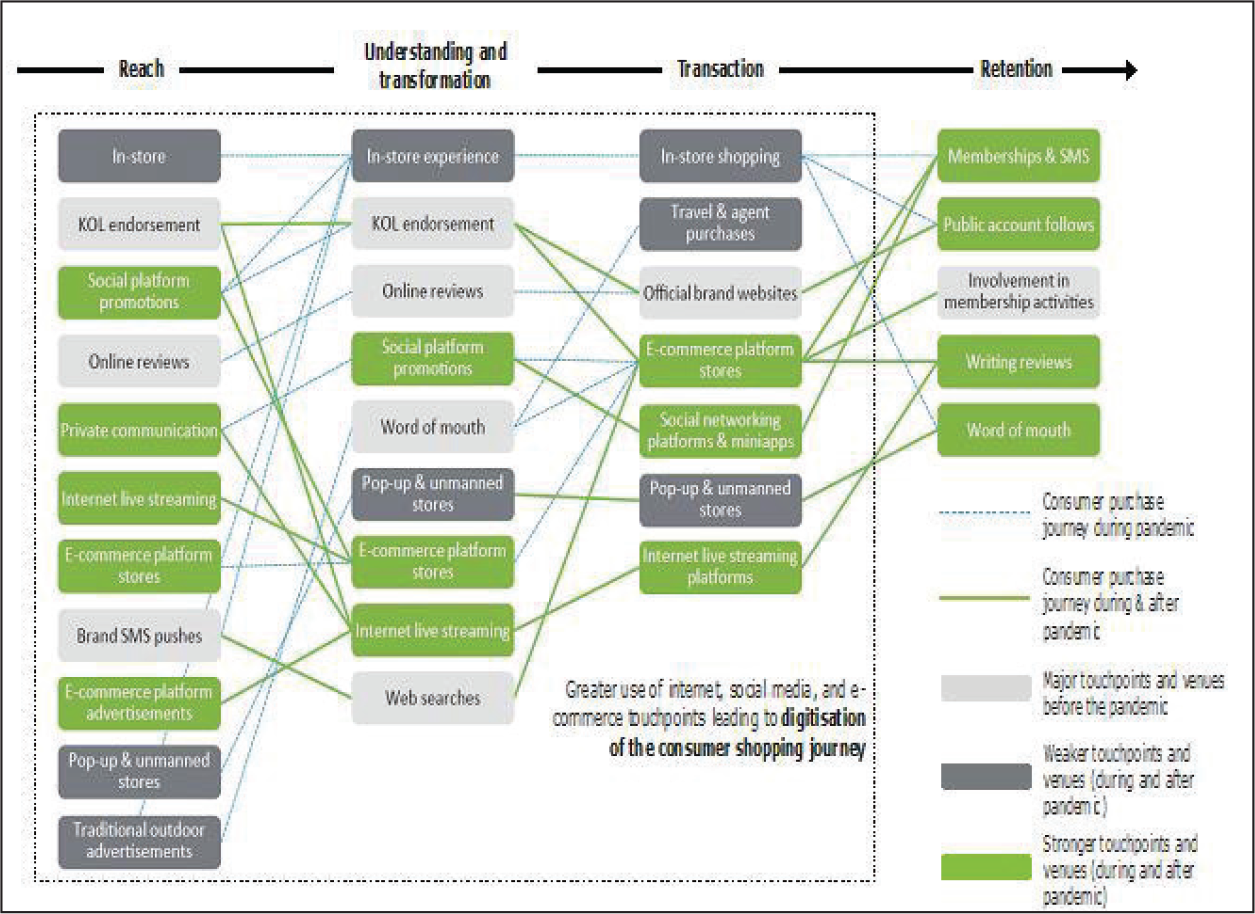
As the community will move beyond the survival mode, some of these changes in spending behaviour will not be retained, while some others could be permanent as reported by few research agencies. For example, besides a change in spending pattern, greater use of ecommerce touch points for shopping as various digital platforms—namely official site of products, social media and mobile platforms—has been used by consumers during the pandemic which had led to the digitalisation in buying, and this digitalisation of consumer shopping journey will increase with weaker presence of traditional outdoor advertisement and shopping malls visit due to physical distancing rules. These technology platforms are expected to play a strong role in terms of reaching, creating awareness, transaction and retention of consumers post-COVID along with word of mouth (Deloitte, 2020; Figure 4). This trend is reflected in the types of apps that consumers are downloading, related to entertainment, news, healthcare and education as reported by (Accenture, 2020).
In times like these, our need for the necessities of life takes precedence indicating few major shifts in customer behaviour. For instance, markets are experiencing shifting of consumers’ priorities as they deprioritise buying nice-to-have items and curtailing consumption except for groceries and at-home entertainment (‘McKinsey Survey Data Second Week of Lockdown: Indian Consumer Sentiment During the Coronavirus Crisis’ 2020). Consumers also expect advertising to help navigate the new normal with a positive perspective (Kantar, 2020; Figure 5). Indian consumers too have adopted new behaviours with a comparatively higher level of optimism in comparison to European nations. It is also important to notice that top concerns of Indian consumers were personal, family safety and overall public health (McKinsey, 2020).
As mentioned above, a cluster of surveys has tracked consumer sentiments during COVID-19 and reported about the transformation in consumer behaviour and indicated towards consumer behaviour models taking a different shape. Understanding of new models will have a great role to play in successes and failures of dozens of firms, post-COVID-19 scenario. The nature of this crisis has brought to the surface the disadvantage of trade dependencies for essential items, market complexity and has ruthlessly exposed the materialistic culture of buying behaviour which was not necessarily need-induced. Consumer behaviour has taken on a new definition during the inevitable challenge of the COVID-19 pandemic. This, in turn, is posing a challenge to the businesses for bringing strategic changes for sustainability and to rethink about the existing consumer behaviour models and their usefulness for businesses and marketing strategies to remain viable across consumer segments.
Spiritual Approach of Consumerism: The ‘Next Normal’ of Consumer Behaviour
Aforementioned behavioural approaches have ruled the market dynamics in the last three decades till COVID-19 knocked at homes and locked us all in. Kotler and Keller (2012) stated that a good understanding of customers’ lives is crucial to ensuring that the most appropriate products and services are being marketed to the right people in the most effective way possible. During these lockdown phases with no mobility and only digital media to connect, authors’ in-depth discussion with marketing professionals of different sectors has led to an understanding that suddenness and universality of lockdown has changed the behavioural dynamics of consumers and has redefined the social spheres and individual orientation. Marketing professionals also viewed their opinion about new order of demand and supply coupled with uncertainty forcing consumption rolled back to Maslow’s primary level needs, that is, need for ‘food’, ‘clothes’, ‘shelter’, safe indoors, social love and belongingness for all socio-economic classes alike, irrespective of segment type. The socio-economic pyramid crumpled and flattened pushing everyone to survive based on essential requirements, inflected by a behavioural driver ‘health and healthy choices’ as rightly said in Vedas, that is, ‘health is wealth’. During Vedic period also ‘health as wealth’ played a very significant role at individual as well as at national level. Health, well-being and food were recognised as the chief essentials for the happiness of family and society in those times. The economic policies were also framed and adjusted according to social conditions, ethical values, health and spiritual views (Dwivedi, 2016). The discussion with professionals indicated that external and internal drivers of consumer behaviour such as personality type, brand image, status, self and self-concept which earlier used to be prominent drivers have become inconspicuous during lockdown days. Further, discussion with consumers specified that economic order quantity of only essential products is the new driver in behaviour followed by recycle and reuse of products, as the households have become small consumer unit of production, consumption, co-creation and cooperation. The consumers also opined about a shift from patronising bigger organised brands to smaller near-home retail kirana (retail) stores, who showed solidarity in times of need, going beyond the call of duty to ensure essentials are delivered in safe and hygienic ways. The consumers submitted that COVID-19 shock has created a new or revived a behavioural understanding of buying, indicating a conscious shift towards spiritual consumption. In view of the loss of work and shortage of regular income, the age-old principle of spending within limits was recalled. The mythological wisdom ingrained in sayings and proverbs like jitni chaadar ho ootne paanv pasaro (live within your means or capacity) is revived with a supposition that this will be the next practice and will certainly breed new fertile grounds for new life order. The palatial infrastructure of corporate offices, universities, schools shrunk to 8-inch screens and the importance of farming, supply chain and effective governance has re-featured as heroes of consumption. As reported above, consumers expressed a sentiment about optimism and current possessions not only enough but more than what could be consumed reinforcing the old philosophy of ‘santosh is param dharam (what we have is enough).
According to marketing professionals, the traces of new marketing models started emerging, for example, online ready-to-eat food-delivery companies immediately switching overnight to delivering essentials such as fruits, vegetables and groceries. Companies are banding together in multilateral collaborations, some formal and some informal, to advance innovation. For example, more than 15 pharma companies are collaborating in a COVID-19 R&D forum to advance, individually and collectively, the most promising drugs and vaccines; and decades-long competitors Sanofi and GSK are partnering on COVID-19 vaccine development. To maximise economic recovery while protecting public health, decisions about which measures to deploy, when and where, are made locally at district-by-district indicating a shift from globalisation to localised models with a boost to local retailers and new ways of communication such as mobile messaging to local stores.
These dimensions of behaviour in times of crisis have also been reported in literature. Kelemen and Peltonen (2005) have named it as consumer spirituality and defined it as the interrelated practices and processes that people engage in when consuming market offerings (products, services, places) that yield ‘spiritual utility’ (Kale, 2004, 2006, p. 109). Consumer spirituality is the intrinsic motivation to seek and express autonomy, inner satisfaction and self-actualisation, maintain harmonious and sacred relationship with others, and desire sacredness in products, services and experiences. The concept of spiritual consumption and its relationship with consumer behaviour in time of crisis has been introduced in the literature of marketing by Sheth et al. (2011). Philip Kotler (2019), in his commentary entitled ‘The Market for Transformation’, also describes that in modern times consumers are increasingly looking for hope, remedies and anchors that can alter a consumer’s persona (body/mind) and they see value in being transformed. Thich (2019), in his commentary on ‘A Buddhist Approach to Consumption’ also elucidated about this spiritual dimension of behaviour in which consumers break the habitual ways in which they consume and begin to see that they do not need even one more thing. Based on his explanation, this new consumer behaviour lies in experiences and impressions via our senses and consciousness. Literature and an in-depth discussion exhibited that what Indian consumers have shown during the lockdown may be irreversible adjustment in behaviour and will be considered as best practice of consumption.
The consumers will be financially impacted with a new twist which has healthcare, personal health and well-being concern. It may offer a new motivation for long-term behaviour change, suggestive of a new segment of migrated consumers who with a new value of ‘save and stockpile’ and change in their buying habits will become more frugal. The studies of Asian cultures’ values have explicitly recognised the role that frugality plays as a guiding principle underlying consumers’ behaviour (e.g., Anderson & Wadkins, 1991). COVID-19 has highlighted the importance of frugality and the associated need to better understand frugal consumers to understand behaviour of non-consumption as well as actual consumption. Lastovicka et al. (1999) offer a conceptual definition of frugality as ‘a unidimensional consumer lifestyle trait characterised by the degree to which consumers are both restrained in acquiring and in resourcefully using economic goods and services to achieve longer term goals’. It is relevant to the study of consumer behaviour, as it advocates the notion that achieving long-term consumption goals will, for most consumers, occur only through the denial of short-term whims and the resourceful use of extant resources. The parallel move towards frugality is what some have termed as ‘voluntary simplicity’ which shares some commonalities with frugality and is generally depicted as ‘both a system of beliefs and a practice, centred on the idea that personal satisfaction, fulfilment and happiness result from a commitment to the nonmaterial aspects of life’ (Zavestoski, 2002), though in previous literature raising the notion of frugality and simplicity seemed ‘wildly out of place’ Gardels (2000, 2002). Marketers need to respond to the apparent growth in people adopting either a frugal and or very simple lifestyle by encouraging consumers to buy what they really need rather than unnecessarily buying, keeping in mind that this behaviour is not a form of poverty or opting for difficult life, but responsible buying. It could develop out of necessity and resource constraint as in COVID-19, but should capture the attention of marketing academics. Frugality is not to decrease the price but to develop sustainability from acquisition to disposal via new innovative measures for reaching out to the masses. For small firms, the time to act is now to gain attention, convince new customers of their value and turn nascent purchasing into a habitual buying. In many ways, COVID-19 has levelled the competitive landscape for smaller brands as they can establish new habits or return to précises shopping routines by focusing on these behaviours.
COVID-19 has pulled the handbrake for the humankind race to destruction and redirected attention to life and living. The common man, now a term shared by almost all equally, has started to think anew what kind of future they want, if they survive this pandemic. This cumulative thought will be the trigger thread for the marketing world to redefine, strategise and reshape not only their offerings but also ways of reaching out to customers. For instance, this situation is a ground zero to start all over again and rewire and realign the present conscious young generation to new life principles rooted in the traditional Indian practices where humans were a part of ecosystem and not superior to the mother nature. It presents a great opportunity for marketer to create awareness among critical mass for orbit shifting acceleration pointing towards organic living with the help of their products and services. The next normal in consumer behaviour may likely be explored on dimensions mentioned below in reshaping of market:
rethinking about considering spiritual approach in understanding consumer behaviour with keeping drivers such as economies of consumption, saving and health in mind; mobilisation of resources at speed and scale as central focal point of business to respond to the behaviour changes of consumers; rewiring COVID generation: opportunity to realign the present conscious young generation to new life principles and build a new segment of consumers; and create new product or service stories to present to conscious generation.
Future Research Directions
The community of marketing scholars needs to urgently comprehend and research the role of spirituality in modern consumption. This article is a starting point to understand consumer sentiments or requirement in buying ‘what is enough’ within the marketing context and how it can be reinforced post-COVID crisis for ensuring sustainability of business models. Scholars are encouraged to debate on the merits and drawbacks of this consumer behaviour. It would be interesting to explore the correlates of this forced consumer behaviour with other variables such as learning from crisis, simplicity, changing needs, personality, nationality, culture, frugal behaviour and age. Further other interesting issues like ‘will this spiritual dimension of consumer behaviour sustain or decrease post-COVID-19 scenario’ will be helpful to explore the possibilities of new segments exhibiting new behaviour. Critical to this discourse will be a commitment to avoid the spirituality/religion controversy when it comes to definitions of spirituality in consumerism in both qualitative and quantitative researches to fully comprehend this phenomenon and to explain its dynamics in the marketplace post-COVID crisis. This can offer the post-COVID universe a spiritual consumption model that brings back the rich cultural heritage of consumption practices designed around not the theories in textbooks but around philosophies of coexisting with mother nature.
Footnotes
Declaration of Conflicting Interests
The authors declared no potential conflicts of interest with respect to the research, authorship and/or publication of this article.
Funding
The authors received no financial support for the research, authorship and/or publication of this article.