




Abstract
The festive entry of a monarch into medieval cities was an elaborate social drama involving the whole urban population. This article investigates how Jews were involved in these ceremonies in medieval France and the Holy Roman Empire, refuting previously held assumptions of their forced and marginalised roles. By demonstrating that Jews were actively included in these urban rituals, embracing local customs to welcome Christian rulers and using an array of distinctive objects to express their identity, much like other civic groups, this study argues that medieval Jews were part of an elaborate choreographed performance through which civic belonging was expressed. As Jewish participation spanned both the formal and logistical aspects of these events, medieval urban processions provide an effective case study on how religious minorities were woven into both the social and ceremonial fabric of medieval urban life.
In his work on eighteenth-century French culture, Robert Darnton discussed how urban processions were staged performances of a city’s structure, a way not only for leaders to order the city but also for citizens to see where they stood: ‘It was a statement of urban society unfurling in the streets, … where the city represented itself to itself through an impressive display of sound, color and texture’.
2
While there were many urban processions in medieval Europe,
3
during which Jews were often required to stay indoors or remained confined to a certain quarter—such as those on Corpus Christi, Eastertide or the adoration of holy relics
4
—one clear genre of civic processions that drew Jews outside was the so-called ‘royal entry procession’ (adventus), when rulers came to town. An example of this can be found in the journal of Jean le Fèvre, former Bishop of Chartres and chancellor to the Dukes of Anjou and Counts of Provence (c. 1330–90). An entry from 4 December 1385 records how the Jews of Arles took part in the royal entry processions to welcome their new lords, eight-year-old Louis II of Anjou (r. 1384–d. 1417), and his ruling mother, Marie de Blois (d. 1404)
5
:
We arrived near the city [of Arles] and there were processions.… The king and his mother came to the cathedral church and saw the body of Saint Trophime. The king and queen ate, then came to their lodgings by the archbishop. In the city in one place, the Jews, holding their [Torah] scroll, showed it to the king and wanted him to kiss it. We countered by only inclining [our heads toward] it.
6
The bishop’s journal entry records how the Jews of Arles awaited the queen and young king separately from the rest, grouped together in a certain part of the city. It notes that upon greeting the royal pair, the Jews of the city presented a scroll of the Pentateuch in hopes for the king’s kiss, instead receiving only a collective nod from the royal party.
Seeing in examples like this evidence of ritualised exclusion, scholars have commented that Jewish participation in these urban processions performed one kind of urban structure, to use Robert Darnton’s language. Amnon Linder asserted that it was ‘compulsory for the Jews to cooperate’
7
; Michael Toch wrote that the tendency in medieval France and the Holy Roman Empire was ‘to demand a kind of Jewish participation that expressed their subjugation as Jews’
8
; and Noël Coulet concluded that, ‘far from being integrated in these grand urban gatherings in the civic festivals, the Jews were ostensibly set apart’.
9
Yet, a glance at the various Hebrew testimonies to such events paints a far more nuanced picture. One such example is found in the thirteenth-century German collection of Jewish law and lore known as Sefer Hasidim [Book of the Pious], which states:
If the king [arrives] with great military force and much splendor, then a righteous man, who already went toward him [once], should not disrupt his study to go toward the king another time.
10
This source conveys, on the one hand, that the pious Jewish man (perhaps Jews in general) should indeed go and pay his respects to the king when he arrives in town, but not every time a royal entry procession occurred. It also insinuates that royal entry processions were lavish events that people sought to attend, leading to the attempt by Jewish scholars to get their students to prioritise righteous study over such frivolities of urban life. The overall tone of the text quoted above seems to contradict the sense of compulsion that scholars previously emphasised with regard to the role of Jews in urban processions. This is equally the case with regard to other evidence of such urban processions during this period and in this geographic region.
The present article will thus revisit the issue of Jews in royal entry processions, ultimately arguing for another kind of social arrangement when rulers came to town. The information we have about Jewish participation in royal entry processions in France and the Holy Roman Empire is not very robust. This study therefore brings together a broad array of sources, spanning urban chronicles and notarial records, as well as visual and Hebrew sources from the thirteenth to fifteenth centuries. Taking into consideration, as well, the relevance of the so-called ‘material turn’ in the ongoing discussion of medieval urban rituals, 11 this study highlights the phenomenology and semiotics of objects that both Jews and Christians are described to have used in these civic events. In doing so, this article offers the following threefold argument: First, it posits that when rulers came to town, Jews were not isolated, but rather part of the choreographed performance of group representation in which the whole city took part; second, rather than being forced, Jews seem to have embraced certain aspects of these urban rituals; and finally, that the Jews, like other civic groups, used an interchangeable array of objects to distinguish themselves and express their identity, including Jewish ritual objects, distinguishing (ritual or religious) clothing, and urban banners, the variety of which demonstrates a considerable flexibility in their modes of self-representation during these events. By investigating social manifestations of civic belonging, this article demonstrates the broad span of Jewish involvement in royal entry rituals, ranging from structured ceremonies to the more disorganised commotion of these urban processions.
Customs of Royal Entry Processions
The royal entry procession, which is among the oldest and most widespread monarchic rituals enacted in medieval Europe, has been the subject of a vast body of scholarship. 12 While some scholars have traced the roots of its traditions back to the triumphal entries of Hellenistic–Roman emperors during Late Antiquity, 13 others have explored how the adventus regis ceremonies were increasingly modelled on the Bible. 14 The arrival of a king was designed to echo the adventus Domini, the triumphant arrival of Christ to Jerusalem on Palm Sunday, transforming any city into Zion and any male monarch into the likeness of Christ and any female sovereign into the triumphant Virgin Mary, Queen of Heaven. Overall, scholarly consensus maintains that the medieval royal entry established ‘an unbroken tradition from antiquity, with few mutatis and even fewer mutandis’, 15 and was an established monarchical institution across the European continent by the fourteenth century at the latest. 16
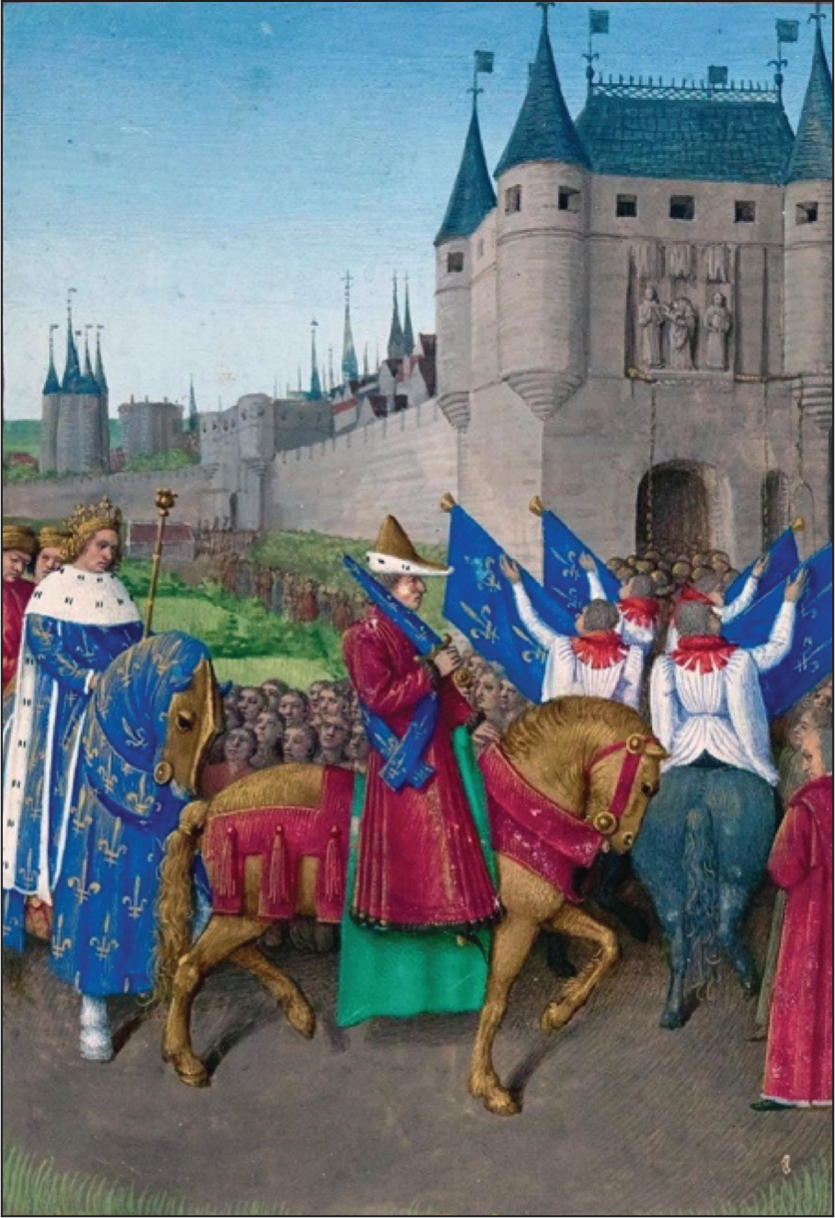
Often discussed as a dramatised staging of town–crown political reciprocity, 17 the royal entry included civic festivities and gestures of loyalty and homage, 18 whose goal was to make the ruler better disposed to that commune while also reminding them of the duties of office they were expected to respect. 19 Many studies have considered processions to be the ‘practices of citizens’ and forms of ‘civic religion among burghers’, 20 a so-called ‘festive drama’ designed to communicate the unity and interdependence of the urban commune, despite the apparent differences among its social groups. 21 The codified phases of these highly choreographed events have been identified by Gerrit Jasper Schenk as follows: 22 The occursio began outside the city gates, where a hoard of townspeople would go to greet the king on the road. A fifteenth-century illumination of the entry of King Charles V into Paris in 1364 (Figure 1) offers a sense of this scene, in which the king is shown approaching the city gate of Saint-Denis along a road lined with people stretching far into the distance. The second phase, ingressus, during which the monarch would be musically escorted through the city gates, is also represented in this image. This was followed by the third phase, processio, a lavish, loud, colourful ceremonial promenade through the cityscape.
1364 Entry of King Charles V of France into Paris via the St. Denis Gate. Grandes Chroniques de France, Île-de-France, c. 1455–60. Paris: Bibliothèque nationale de France, département des Manuscrits, Ms. Français 6465, f. 417r. Image available online via. The National Library of France. Public Domain.
While traces of royal entry ceremonies in Paris, for instance, go back as early as the ninth century, one of the earliest detailed descriptions of any specific programme of the royal entry into the city is that of Queen Isabella of Bavaria in 1389. It appears in the chronicle of Jean Froissart, 23 a prominent court historian from the borderlands of the Holy Roman Empire and France. Froissart’s text is detailed enough to gain a bird’s-eye view of the route Queen Isabella took (Figure 2). She and a large number of mounted escorts and townsfolk 24 entered the Gate of Saint-Denis, ventured over the bridge to Notre Dame Cathedral and ended at the Palais de Justice. Each number on the map represents a scheduled stop along the way.
Plan of the Parisian Royal Entry Route.
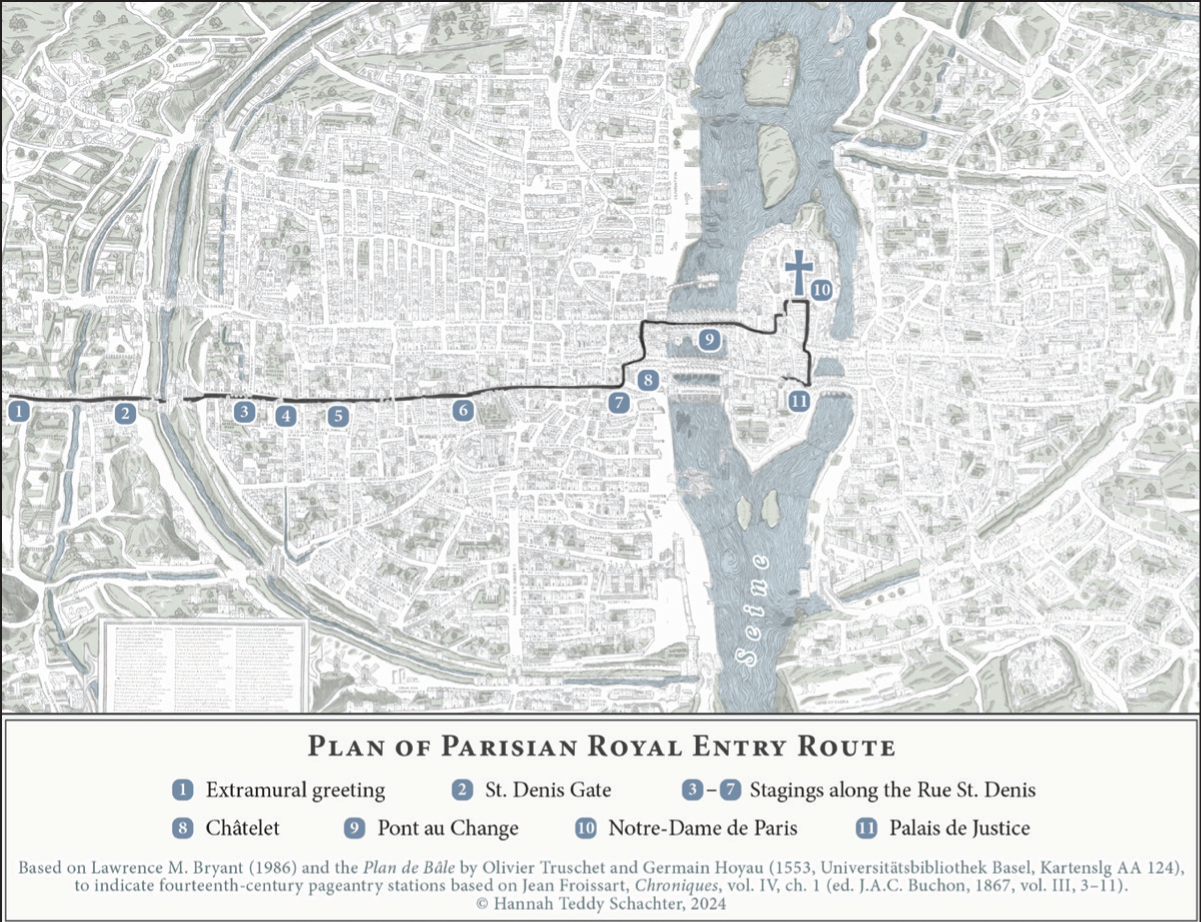
One reason for the stops was to feature the city’s various treasured landmarks for entertainment and spectacles, demonstrating how the city’s procession route was strongly tied to local traditions. A second reason was to have scheduled breaks to enable different groups of residents to express support for the ruler. For example, the queen’s canopy bearers in this particular procession all belonged to the city’s guilds, who at each stop handed off the canopy to a different guild. A third reason for these scheduled stops was for ceremonial encounters of fealty, oathtaking and homage. Such was the case for the clerics of Notre Dame Cathedral, who awaited the queen in the Cathedral square dressed in ceremonial vestments. Froissart does not describe the queen’s encounter with them in much detail, but a short notarial record of the chapter records a similar encounter when the newly crowned king of France, John II (r. 1350–64), entered the city in 1350:
Many clerics were waiting for him outside in the square, dressed in silk capes, and carrying … all the objects we usually carry in processions, so that it be as decorous and as dignified as possible. … Advancing towards him [the king], dressed, as it should be, in his papal vestments, with the cross, censers, candles, and the Gospels, [the Archbishop said]: ‘Sire, before entering this church, you have to take the oath that all your predecessors, the kings of France, have always taken at the time of their [first entry]: to maintain [our] conical privileges, legal rights and defend [us] to the utmost.’ Then the lord king bowed humbly to the cross, reverently and devoutly adored God and the Holy Scriptures, kissing the said book or text.
25
This record focuses on a common, traditional aspect of this encounter, in which the clerics request the confirmation of rights from their new monarch. It also emphasises ritual dress and the variety of objects, such as the Gospels, used to represent themselves as ecclesiastics. The king’s kiss and adoration of this object may also be the kiss of peace, which was an essential gesture in royal coronation rituals, which, across the European continent, kings often made during their royal entry processions to pardon prisoners and confirm rights during this period. 26
Through such ceremonial gestures, the procession was ultimately designed to give and confirm one’s privileges from the new ruler, as well as to present and represent one’s place in the city. This ritual was not reserved merely for elite groups, nor the religious. We even have various indications that the city’s children banded together to present themselves to their ruler, as in this example from Flanders:
Children bearing bows and arrows came forth to meet him [the count]…and announced that what they wanted was a kind of ‘fief’ which our boys had obtained formerly from his predecessors: ‘it is our right to obtain this privilege from you, that is, on feast days of the saints and in the summer time to wander freely in the woods, to capture small birds, to shoot arrows at squirrels and foxes, and to spend our time in boyish play of this kind.’ … Then Count William…with good grace and affection granted the boys their playful sports.
27
As these examples show, the procedure of royal entry processions followed a standardised procedure, whereby urban groups seeking confirmation stood in identifiable groups to publicly pay homage and seek confirmation from their ruler. The sources indicate that each group in the city had their specific markers of identity, special codes and particularities of manners, clothing, objects and finery. Such markers distinguished the group within the commune not only to the entering ruler but also to its urban peers. As Jean Favier commented, such processions served as the most visible manifestations of belonging to the various networks of burghers and their social ties. The procession was carried out in groups, in hierarchical order and with the signs of that group’s collective identity. 28 The ruler moved from station to station, where each group awaited its designated turn to perform their part in the ritual.
For Fealty, Honour and Privileges: The Jewish–Royal Encounter During Royal Entry Processions
During the royal procession of 1385, the Jewish community of Arles, like other groups, such as the churchmen and children described above, gathered in a particular spot in the city and waited for their turn to present themselves to the visiting royals. They expressed their fealty through the use of distinguishing and sacred objects, in this case, a Torah scroll, and sought some form of royal acknowledgement. As Jean le Fèvre makes clear in his journal, this was a gesture of homage and the confirmation of rights. He describes how the Jews of Arles participated in the ritual of oath swearing undertaken by the queen mother in the name of her minor child king ‘in fidelity to all the people of the city’ and goes on to write:
After this homage was made, as a sign of consent, each person raised his two hands high and there were many people of both sexes of Christians and Jews, [who] shouted ‘In the name of the king, etc., and lord of Arles!’ to observe the vows given by Madame.
29
The formal agreement between Queen Marie de Blois and the city of Arles has survived and contains four articles confirming the privileges of the Jews, who are designated as citizens. 30 It was as such, then, that the Jews participated in the processions of royal entry and the ensuing oathtaking rituals.
While only spotty evidence of Jewish participation in royal entry processions survives from areas of northern France, it is evident that this was common practice.
31
In one example, the Jewish physician Hesse of Solm (active c. 1360–1430) claims that some writings in his medical treatise were informed by what he had learned in Paris ‘among the great prelates and men of parliament when Charles [VI], King of France, was coronated’,
32
likely referring to this new ruler’s first entry to Paris following his coronation at Reims in 1380.
33
Clearer evidence of this practice is to be found in accounts from the Holy Roman Empire. Chronicling the Council of Constance (1414–18) to end the Papal Schism, Ulrich von Richental (d. 1437) described the royal entry of Emperor Sigismund into the city. This text was copied in 24 manuscripts, many of which contain a similar description of Jewish participation, for example, as general urban spectators. At one point, early on in the festivities, the whole town gathered to witness the Burgrave of Brandenburg’s oath of fealty to Emperor Sigismund:
And all the rooftops, peepholes, store fronts, and windows around the market were full of people, religious and lay, women and men, Christians, Jewish men and women, everybody.
34
In seeking to stress how the entirety of the city came out to witness the event, it lists a variety of social categories, including the Jews, who took part in the oathtaking at these events. Given the centrality of oathtaking during these processions as an act that ritually tied the whole urban populous together as witnesses, our chronicler seems to want to stress how the communis and pool of urban witnesses included Jewish men and women.
The text later depicts how members of the Jewish population gathered in a certain city square for their own moment of fealty, a scene that is illuminated in the Prague manuscript of c. 1465 (Figure 3). On the left, the pope is on horseback accompanied by various canopy holders, knights and torches around him. The pope raises his hand in benediction. The king, the crowned figure on the far-left margins of the right page, has dismounted his horse to receive the Jews. Standing under the canopy pictured right, this group of eight Jewish men are depicted wearing traditional Jewish prayer shawls draped over their heads and shoulders. While one Jewish man hands the king an item under a dark cloth, the other Jewish figures stand solemnly with candles, surrounded by further people (perhaps children?) seemingly part of this group in the far-right margin. The image underscores the involvement of the townspeople as urban witnesses, crowding around and watching from the windows and courtyard. The Jews have come to confirm their rights. The text of the Constance Rosgarten manuscript provides the detail:
And he [the pope] came to the house, which was called zum Schlegel at St. Lorenz, and the Jews of the city awaited him [outside] there standing with many great burning candles and all wearing their religious dress [habit] as they do when they celebrate their long day [Yom Kippur]. They carried their 10 commandments under a golden cloth … singing in Hebrew. When the pope came near, they kneeled and offered him the 10 commandments, asking him that he confirm their freedoms and privileges, as other popes had done before.
35
The Jews of Constance Receive the Pope and King in 1417. Chronik des Konstanzer Konzils, Constance, c. 1460-64. Prague: Národní Knihovna České Republiky, Cod. XVI.A.17, f. 147v–148r. Image available online via https://www.manuscriptorium.com/apps/index.php?direct=record&pid=AIPDIG-NKCR__XVI_A_17____449EM91-cs#search © The National Library of the Czech Republic.
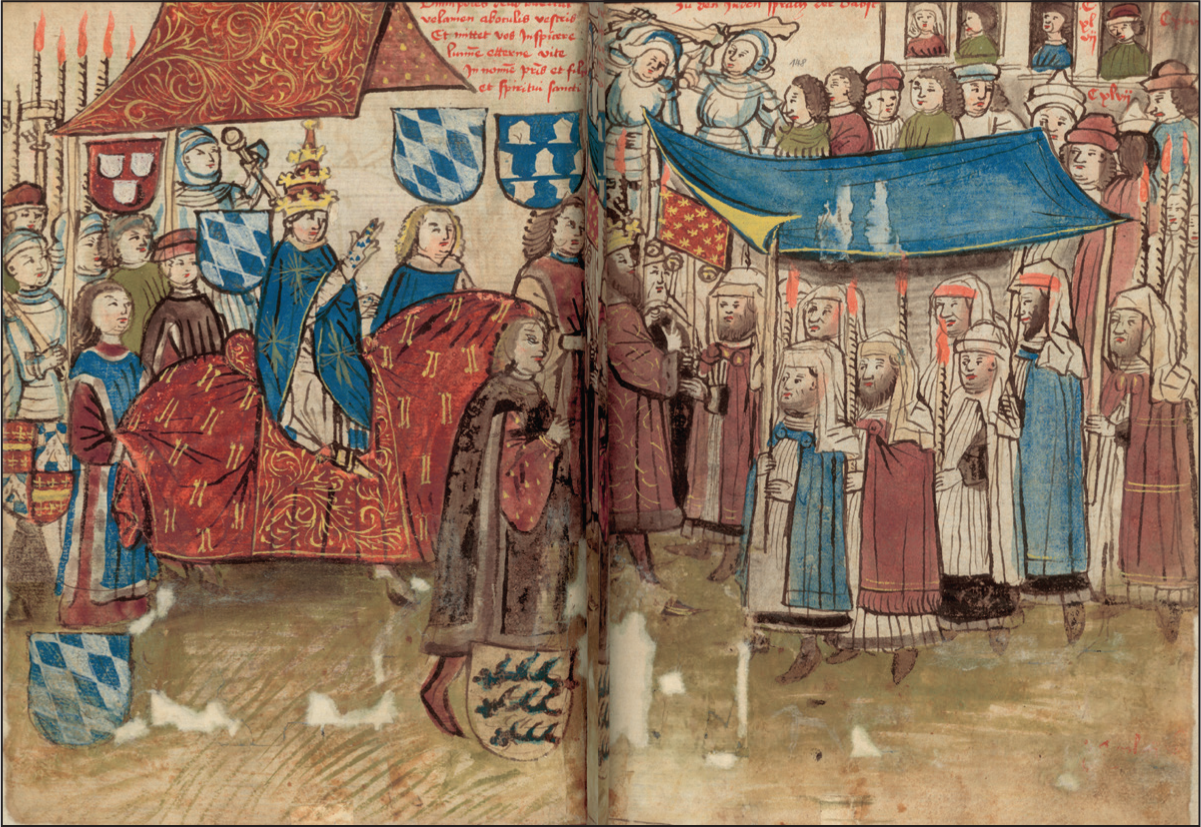
As in other depictions, the Jewish contingent uses the same choreography as other groups, distinguished only by identifying marks of dress—the habit mentioned above likely refers to a tallit, and the 10 commandments were likely a Torah scroll. The king accepts and confirms the Jews at this juncture, but with a theological caveat:
But he [the pope] did not want to take their commandments. Instead, our Lord, the king accepted them and said: ‘the laws of Moses are good and right, but they [the Jews] neither want them, nor do they understand this law’.
36
The text continues with the longer Latin rebuke delivered by the pope. Returning to the illumination, the artist does not depict the king’s response, but rather that of the pope, as indicated by the caption on the upper right-hand side: ‘zu den Juden sprach der Babst’, while a Latin inscription on the left-hand side records the pope’s blessing: Omnipotens Deus avertat velamen ab oculis vestris et mittet lumen eterne vite. In nomine patris et filii et spiritus sancti. [May the Almighty God remove the veil from your eyes (2 Cor 3.15–16) and send the light of eternal life. In the name of the Father, and of the Son, and of the Holy Spirit], imploring the Jews of Constance to convert.
Various examples of this type of papal response were studied by Amnon Linder, who argued that it was a regular and compulsory component of the papal entry and coronation processions in Rome—as well as often performed during papal entries across the continent—to approve the Law of the Jews while reproving the nation. 37 This processional Jewish–papal encounter is undoubtedly what led previous scholars to assume that royal entry processions were much the same, designed to reject Jews ritually from the Christian communis, while still compelling them to attend. Yet, we should be wary of such claims, not only because the Constance example is the only known case in which the king delivers this papal-like response, but also because the sense arising from texts by medieval Jews is that they often chose to attend royal entry processions of lay rulers of their own volition, as will now be demonstrated from the following Hebrew sources.
First, many Jews considered the entry procession of monarchs neither particularly religious nor mandatory. Having travelled extensively throughout German and French lands, rabbinic authority Eliezer ben Yoel HaLevi of Bonn (d. 1225) wrote that, while Jews are forbidden from lending or pawning religious vestments for clerics to wear while ‘singing and practicing their idolatry’ during their religious festivals, Jews are expressly ‘permitted [to sell] clerical vestments called cassocks [in which clerics] beautify themselves when they go out [to greet] kings’. 38 This ruling indicates that R. Eliezer did not consider the festivities associated with greeting monarchs to be a religious Christian affair worthy of limiting Jewish trade and conveys a clear understanding of and familiarity with contemporary clerical practices and dress. 39
In contrast, there are other, more stringent voices, imploring Jews to stay home during these processions. A passage in Sefer Hasidim tells of a pious man who refused to go towards the king upon his ceremonious arrival, because ‘they [the Christians] bring their idols and incense of their idolatry’; 40 and a fifteenth-century Hebrew moralistic work declares that ‘when the events of the gentiles happen in your city, then you should be careful not to watch them’. 41 What these sources do assert is that attendance appears to have been a matter of choice. While learned or more pious Jews may have chosen to stay at home, others, perhaps more ordinary, Jewish residents asked why one should refrain from attending. Taken together, the implication arising from them is that while these types of urban processions incorporated ritual elements similar to liturgical processions, the royal entry was a lavish event that Jews attended, to a certain extent, voluntarily.
Second, Hebrew sources indicate that presenting the Torah to rulers was an act that Jews were eager to perform, for two main reasons. First, Jews imbued this act with their own religious meanings. For example, in Sefer ha-Hinukh [The Book of Education], a highly popular late-thirteenth-century rabbinic text likely from northern Spain that was well known throughout Ashkenaz, the anonymous author indicates his displeasure at the conflation of this practice with the Talmudic precedent of taking the Torah out of the synagogue to greet the kings of Israel.
42
Following this earliest known instance of projecting the commandment onto non-Jewish rulers, the author writes:
This positive commandment [of parading the Torah] was conducted when the people of Israel were on their land, because the Levites had to carry the Ark of the Covenant in war or whenever the king of Israel commanded …. But now, we have no king, nor an ark to carry anywhere. So, this act that [Jewish] people do out of custom in the diasporas today, to take out the Torah scroll for the gentile kings, is not this commandment at all. Anyone can carry it. Still, if by way of honoring the Torah today, they shall choose a Levite to carry it, then blessings be upon them.
43
It would seem, then, that the author is trying to remind his readers that Jews actually have no king and that they should refrain from getting overzealous by their religious motivation to use the Torah to show fealty to Christian kings. That being said, the author concedes that for those who will do so anyway, they should designate a Levite for the honour in accordance with the mitzvah. It is worth noting that the author proclaims himself a Levite in his introduction to this work and therefore appears keen to reserve this honour of parading the Torah before rulers for only Jews like himself, who have Levitical status. 44
Second, Jews also attributed their own civic and political meanings to presenting the Torah to kings upon royal entry. This is apparent from an early-fourteenth-century theological composition, Shulhan Kesef [The Silver Table], written by the Jewish intellectual Joseph ibn Kaspi (d. 1340) of southern France. When asked by an honoured bishop why Jews should ‘also present the Hebrew Bible [Sefer Torat Moshe] and ask the kings … to honor and revere it when they come to town, even though we [Christians] also present our icons [and our books] before them […and] our books … are like yours’, 45 the rabbi answers that Jews present the Hebrew Scripture in God’s original script and language to kings, just as kings are to present royal privileges in their original script and language to the Jews. 46 Thus, for ibn Kaspi, the act of presenting the Torah had profound political significance. According well with scholarly discussions of royal entry as dramatised stagings of town–crown ‘political reciprocity’, 47 the text emphasises that in gracing Christians with the Torah, the Jews were reciprocating political honour to their rulers and the greater commune. This aspect can perhaps help explain the Jewish community’s interest, described in the Hebrew sources, in participating in these urban rituals.
Although the previous two sources discussed originate from Provence, which has been shown to possess a more geo-politically distinct community of Jews,
48
this communal service of Jewish presence echoes also among Christian contemporaries within the Holy Roman Empire. Describing the entry of the new king, John of Bohemia (r. 1310–46) into Brno in 1311, Bohemian chronicler Peter von Zittau
49
recorded his awe as the Jews of Brno went far beyond city walls to greet him:
And then the king, coming out from Olomouc, directed his course to Brno, where he was received magnificently not only by the clergy and all the Christian people, but also by the entire synagogue of the Jews. For the Jews had come rather far from the City of Brno and first met with the coming king. When I saw this unusual Jewish procession reverentially carrying the Torah scroll wrapped in muslin and receiving the king with Hebraic song, my mind was liquified as much from shock as from the ardor of their devotion, and my eyes led forth an issuing of tears.
50
In this case, the viewer’s emotional response indicates that the Jewish act indeed generated a sense of ‘communion’ with the non-Jewish population.
To summarise, while most examples of Jewish–royal encounters during royal entry processions are not so detailed, 51 existing evidence provides considerable reason to question scholarly assumptions of Jewish compulsory attendance and ritual exclusion from royal entry processions. Rather, they indicate that Jews were not forced to attend any more than were other residents of the city. Actually, the opposite seems more likely; Jews appear motivated to participate in these urban events for their own religious and political reasons. Their presence was often noted and appreciated by Christian contemporaries.
Scrolls, Banners, Prayer Shawls and Etrogim: Jews and Their Objects in Royal Entry Processions
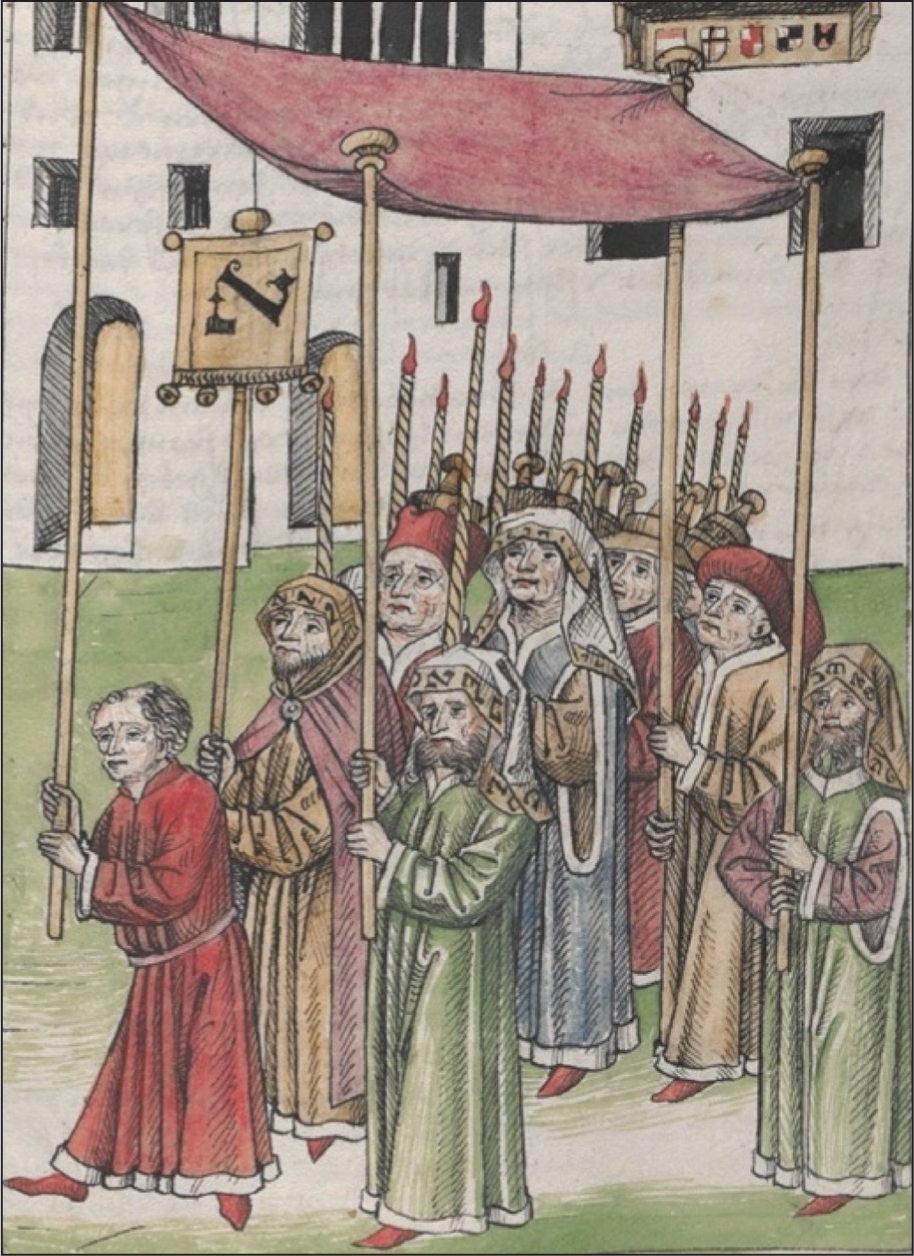
Throughout these urban processions, Jews used an array of objects to represent their religious identity to their rulers and neighbours. These included Torah scrolls, as noted above and elsewhere. In addition to their use of ritual objects such as scrolls, Jews also identified themselves by wearing distinguishing headgear and clothing and carrying distinctive banners. An illuminated manuscript depicting the grand processions of 1417 at the Council of Constance, now housed in Vienna, displays the banners carried by the various groups, 52 one of which presents a group of knights bearing a banner of Constance. 53 The Christian illuminator depicted the Jewish encounter with the king and pope in his manuscript with comparatively scrupulous attention to detail (compare Figures 3 and 4).
Figure 4 depicts a contingent of roughly 16 Jewish men, wearing a variety of ritualistic costumes and formal headgear: At the front, three men wear a traditional Jewish prayer shawl (talit) draped over the head and shoulders in a way that displays its decorative border or ‘crown’ [atara]. 54 Behind them, a cluster of men wear the typical Jews’ hat [Judenhut], which was adorned on more formal urban occasions. 55 Finally, one Jewish representative holds a banner lined with bells and bearing the aleph, 56 the first letter of the Hebrew alphabet, while others hold candles and a festive canopy.
The Jews of Constance Wait to Receive the Pope and King in 1417. Chronik des Konstanzer Konzils, Swabia, late fifteenth century. Vienna: Österreichische Nationalbibliothek, Cod. 3044 HAN MAG, f. 133r. Image available online via http://data.onb.ac.at/rec/AC13959719 . © The Austrian National Library.
A description of certain Jews of the Holy Roman Empire welcoming Vladislaus II, the new king of Hungary (r. 1490–1516), into Prague also refers to the use of banners and other ritual Jewish objects:
He [the king] was received by all the citizens … glorifying him on 30 September [1490] with noisy rejoicings. In the Old Town, the aldermen and the communes went in a glorious procession with the new banners, on which the emblems of all the king’s lands were painted. … Then, in the afternoon, the Jews also made a procession through the market square with their new banner, carrying sticks with apples
57
in their hands. In the New Town … all the guilds were assembled with their banners and a procession was made with loud cheering, drumming and trumpeting.
58
The description makes clear that the Jews were like other members of the city: They carried banners to identify themselves and took their turn in the procession in a particular section of the city. As for the reference to ‘sticks with apples’, that the procession took place in September suggests that the chronicler is referring to the lulav and etrog, or palm branches and citron fruits that Jews used symbolically during the Jewish holiday of Sukkot. 59 That Jews carried the lulav and etrog in this instance suggests not only that Jews, like other civic groups, performed their belonging and urban identity through unique banners, clothing and ritual objects, but also that they appear to have had some autonomy in choosing which objects to use.
Jews and the Civic Disorder of Royal Entry Processions
When such structured processions went as expected, then the people’s satisfaction was recorded: Jean Froissart recorded Queen Isabella of Bavaria’s entry to Paris in 1389 as ‘an order gladly seen by the queen, her ladies, and the lords’, 60 while a fifteenth-century description from Augsburg recorded that ‘there was a skillful order made, as one should keep; for it was all a well done, praiseworthy procession and quite gracefully executed’. 61 In a similar way, the propensity for disorder was ever-present during royal entry processions and was often commented upon in the sources. For example, the 1486 royal entry ceremony of Maximilian in Aachen was described by one onlooker as ‘a great disorderly riding around for about an hour and a half’. 62 Like their fellow townspeople, Jews too were embroiled in the disorder of royal entry processions, especially in the urban violence, logistical issues and financial burdens the events often caused.
The arrival of a ruler with a large and well-armed retinue inherently constituted a potential source of chaos and violence. Cities were well aware of this possibility. As Schenk has shown, this was the case during the 1442 entry of Friedrich III to Frankfurt, when a fight broke out between servants of the Bishop of Chiemsee and those of Count Ulrich of Mätsch. 63 It was also the case during the 1473 entry of Charles I, Duke of Burgundy, to Trier, when the royal guards and various citizens of the town came to blows. 64 As a result, many cities began making agreements with the entering parties prior to the date of arrival. The protection of their Jewish residents sometimes featured among these precautions. A week before the entry of Friedrich III to Nuremberg, for example, the city council asked the king, ‘as well as the princes and other rulers [to] agree beforehand that the Jews are not to be hurt or injured from the runners, boys, nor any others of their retinue’ during the procession, 65 while the stipulations of Maximilian’s entry to Nördlingen in 1500, the Kaiserempfangsbuch of Nördlingen, lists that ‘two officials were designated to make sure the Jews were not pressed’. 66
The provocative show of military force at these royal entry processions was only one factor that could have led to anti-Jewish violence. The sudden multitude of visitors seeking immediate lodging in the city was another, with the accompanying retinue of soldiers often needing to be housed by the urban residents themselves. Numerous sources indicate that the royal party often behaved with disregard for the towns they passed along the way, leaving the city to sort out the mess after they left. So, for example, the citizens of Nuremberg complained about ‘the royals and their guests’ and demanded that ‘the violent damage and indecency of the royal party must be justly met’.
67
Jews were apparently not exempt from the duty to house the visitors. Their concern about the anti-Jewish violence that could ensue from this urban obligation is reflected in a fifteenth-century collection of responsa sent to the rabbinic authority of Wiener Neustadt, Israel Isserlein (1390–1460):
It is customary in this land that, when the ruler comes to one of his towns where he does not dwell, then the Jews living there must give 20.5 Litrins to his marshal. … Often times it happens that they [his entourage] demand that we lend or gift him [the ruler] bedding and bedclothes. How shall we raise [the money] for these [financial] burdens? … It is true that I heard from local [Christian] burghers [lit. homeowners] that these burdens were initially imposed upon the Jews, because it is customary that the arrival of a ruler imposes on all the houses in the city to give lodges and bring in his soldiers [into their homes], and the Jews were afraid they would enter their houses recklessly, even damaging and doing them harm. … And the demands for bed sheets is for this reason, so that they will be exempted from bringing in the soldiers. … We should appease them [with money] so that the ladies will not be kidnapped as usual.
68
Arising from this text is a sense that the entire city was expected to do their share to house the visitors. However, Jewish anxieties around the ‘usual’ kidnapping of Jewish women led the Jewish community to try to negotiate payment for the bed or other chamber-related needs in lieu of physically hosting them in their homes.
Described in this responsum as an established practice, this kind of negotiation between Jews and their urban communes either to host rulers or to finance their housing elsewhere is also found in additional sources. For example, a municipal record on the occasion of Frederick III’s 1473 stay in Augsburg notes:
The lord of Weinsperg reminded the burgrave that this was already the custom and privilege among his predecessors: That if a Roman king rides to the land, he should have the right to any bed and bedframe he chooses while he is in town. He can also lie [take up lodgings] by the Jews, if he decides it justly so. But should no [Jews] be in agreement, then there would be no need; they [the Jews] would be obliged to pay for his bed and bedframe.
69
According to this source, it was common practice upon royal entry for rulers to sleep wherever they wished, even in Jewish homes. The record also indicates that, perhaps particular to the Jews, an agreement must be reached to house the ruler, and, if not, the Jewish residents would then be obliged to pay for the bedding the ruler required. Similar negotiations appear in the city records of Frankfurt am Main, where in 1442 the city council even ordered two men to help negotiate between the Jews and the king upon his arrival in the city. The Jews were obliged to provide parchment to his council, beds to his court and kettles for his kitchen, and although they declared that they knew nothing of such obligations, they were willing to negotiate, honouring the king with a gift but were not prepared to open up their homes to him. 70
This is not to say that Jews never hosted rulers. A bed was one of the most precious pieces of furniture in the Middle Ages, and various squabbles took place over who could offer the visiting ruler a bed, such as when the royal chamberlain, a wealthy citizen and a burgrave all fought over ‘the king’s bed dressings and other delicate things’ in Nuremberg in 1442.
71
This suggests that the act of hosting or paying for bedclothes was not always considered a burden, but rather was, in other instances, perceived as an honour. This is the case in earlier Hebrew sources, such as Sefer Hasidim, which describes how the Sabbath, traditionally likened to a queen and/or bride, is to be welcomed every week:
One should be quick to prepare the needs of Shabbat and scrupulous like a man who hears that the queen is coming [with] her servants … to his home. What does he do? He is happy and feels great joy and says what a great honour you give me. Come under my roof [lit. to my shade]. He says to his servants, prepare the home, clear and honour it and prepare the beds in light of this coming honour.
72
The emphasis on the preparation of the beds in inviting this queen into one’s home can be understood more broadly within the medieval urban context of hosting rulers during events such as royal entry. While this description is used as a metaphor to instruct how to welcome the Sabbath, this source may also hint at a tradition, stretching back to the twelfth or thirteenth century, that rulers would indeed take up residence in Jewish homes when they arrived in the city as honoured guests.
Jews and Acts of Belonging in Royal Entry Processions
Returning to Robert Darnton’s structuralist view that processions were staged performances of a city’s urban structure, as the above discussion makes it clear, Jews were part of the social arrangement of medieval urban centres when rulers came to town. They wanted to attend these processions, Christians expected to see them there, and each group benefited from the processions in similar albeit distinct ways, including the confirmation of rights, enactments of fealty and honour, and enjoyment of the sheer spectacle and entertainment. The study of how Jews participated in royal entry processions reveals social manifestations of civic identity, as well as performative acts of belonging: from their ceremonial, celebratory aspects to their mundane (and potentially inconvenient) logistical details. Rather than isolated, medieval Jews were involved in this choreography and appear to have embraced certain aspects of these urban rituals, including the presentation of their distinct markers of identity. The current of interreligious tensions can be found flowing just beneath the surface of these assemblies. However, when potential disorder threatened to put them at risk, the city went to some lengths to protect its Jewish residents, offering them channels through which to negotiate the terms of their civic obligations. In highlighting Jewish civic participation in this particular type of medieval urban ritual, a picture is drawn of how some occasions of urban life were designed not only to bring various urban groups together to present and represent themselves according to their differences but also to showcase them all as residents of the same city.
Footnotes
Declaration of Conflicting Interests
The author declared no potential conflicts of interest with respect to the research, authorship and/or publication of this article.
Funding
The author disclosed receipt of the following financial support for the research, authorship, and/or publication of this article: This article was written under the auspices of the European Research Council under the European Union’s Horizon 2020 research and innovation funding programme, grant agreement No. 681507, ‘Beyond the Elite: Jewish Daily Life in Medieval Europe’, 2016–22, and the Israel Science Foundation Breakthrough Research Grant 2850/22, ‘Contending with Crises: The Jews of Fourteenth Century Europe’, both held by Elisheva Baumgarten (PI). It was also written with the support of the Natan Rotenstreich (Vatat) Fellowship of Israel. I would like to thank Elisheva Baumgarten, Moishi Chechik, Savoy Curry, Andreas Lehnertz, Eyal Levinson, Albert Kohn, Aviad Markovitz and Birgit Wiedl, as well as the reviewers for their helpful comments. Sincere thanks also go to Katharina Schlude and the board of the Konstanz Rosgartenmuseum for graciously allowing me remote access to their archives during the COVID-19 pandemic.