



Abstract
Medieval citizenship is often defined as the rights and duties that individuals had in medieval polities, including political participation, individual protection within the city in cases of legal or commercial conflicts, or the privilege of being judged by certain courts, rather than by others, and by one’s peers, rather than by foreigners. Typically, the status of citizen was further bound to the taxes individuals of that polity had to pay or the military duties they had to fulfil. This understanding of citizenship differs significantly from the ways scholars in the field of political sciences have been discussing the term over the past two decades.
Citizenship in the medieval period is often defined as the rights accruing to individuals in polities. These included political participation, individual protection within the city in cases of legal or commercial conflicts and the privilege of being judged by certain courts, rather than by others, and by one’s peers, rather than by foreigners. These rights were typically accompanied by particular responsibilities, such as payment of taxes and the carrying out of military duties. This understanding of citizenship differs significantly from the ways political scientists have been defining the term in recent decades, which instead focuses on developing a conception of citizenship, often termed ‘lived citizenship’, that encompasses a variety of dimensions, from the political to the cultural, sexual and ecological. 1 This understanding can diverge greatly from formal citizenship, since it also encompasses ways of participating in political life that include those who, in fact, are not actually officially citizens of the country in which they live, such as, for example, asylum seekers demonstrating in protest of their lack of freedom of movement. 2 The risk with the concept of lived citizenship is that by viewing every human action as political, any social interaction can fall within its scope, thus rendering it so broad as to lose its relevancy.
In this article, however, I contend that the concept is, in fact, very useful for medieval studies, as it invites us to focus on the various facets of the realities of citizenship. Thus, this article examines experiences of lived citizenship in the Late Middle Ages that made the status of citizens visible and which, simply by triggering emotions and imparting a sense of community, made citizens aware of their political identity. Furthermore, because they involved both formal citizens and others, these experiences challenged legal definitions of citizenship and brought together people of various statuses.
In recent years, research on citizenship 3 has seen a shift in focus, coming to consider medieval urban political life in terms of ‘popular politics’ and ‘urban politics from below’. 4 It has also recognised a more multifaceted political participation that extended beyond the election of urban councils. 5
As a result of this shift, scholars have begun to move away from a focus on elections to other phenomena. In addition, by considering all forms and all degrees of political participation, from attending civic rituals to actively supporting a revolt against the ruling authorities, the significance of the legal dimension of citizenship itself becomes relativised. This leads to the adoption of a much broader definition of ‘citizen’ than that assumed by traditional historiography, which is limited to city dwellers enjoying the full scope of political rights (called cives or, very rarely, burgenses in Latin; burger in Middle High German). This is explicitly the case in Maarten Prak’s recent Citizens without Nations, in which the Dutch historian writes about ‘citizen practices rather than formal status’. 6 In another example, historian Thierry Dutour drops the term ‘citizen’ altogether, replacing it with ‘bonnes gens’ (good or honourable people), an expression that has no legal meaning, instead referring to a sense of social relations. 7
The study focuses specifically on what I term the southern German lands, by which I mean roughly the southern half of present-day Germany, along with German Switzerland and the region of Alsace. The area was home to towns of various sizes; from large cities such as Nuremberg, Augsburg and Strasbourg, each with over 20,000 inhabitants, to smaller localities with only a few hundred residents. Among these were imperial cities (Reichsstädte) as well as free cities (freie Städte), both of which were under the direct authority of the imperial crown and thus benefited from a significant degree of autonomy. Many more were territorial towns, under the rule of a local lord or prince, with, consequently, more or less room for manoeuvring. The result was highly diverse experiences of citizenship that varied from town to town. 8
It is this diversity that I attempt to reveal by taking a panoramic and introductory approach in examining how citizenship was determined less by the legal status of a given person, than by individual and collective experiences within specific temporalities and spatialities. To that end, I am employing the concept of lived citizenship, which allows for just this type of redefinition of the limits of the community of citizens. I propose to deal with this question in three stages. First, I will examine the temporalities of lived citizenship. Second, I will focus on the places where inhabitants could practice and live their citizenship, because these spaces favoured political exchange or because they nurtured shared experiences with peers and created community. The article concludes with a discussion of how these experiences were fundamentally unequal, with the result that lived citizenship excluded people as much as it included them.
The Everyday and the Exceptional: Temporalities of Lived Citizenship
The Electoral Rhythm of the ‘Oath Days’ (Schwörtage)
Although, as indicated above, the concept of citizenship in late medieval cities cannot be adequately comprehended solely by a consideration of the rights and duties of its citizens, these rights, especially with regard to political participation, are still of great significance. In fact, in many towns, a good portion of the male population participated in some way in electoral processes. This was particularly true in the so-called ‘guild towns’, that is, towns whose government was controlled by the craft guilds.
Zurich, for example, which by the end of the Middle Ages was a city of about 5,000 inhabitants, had a constitution, established in 1336, dominated by the craft and trade guilds. These instituted a remarkably complex electoral procedure, in which the city was run by a council, whose members were elected every six months. The noblemen and patricians chose six members, and the 12 craft guilds chose their 12 masters, as well as six members of the council. One burgermeister was also chosen every six months. In addition to these 50 men (25 for each half-year), there was also a grand council, called upon for matters that required the broader consent of the population, that was comprised of 144 representatives from the craft guilds and 18 from the nobility and patriciate. 9 The guilds upon which the system was based encompassed a large proportion of all the adult men in the city, with the exception of servants, journeymen and clerics. More than in France or the Netherlands, German towns strived to extend citizenship to broad social strata, in order to bind the population closer to the government. Thus, in Zurich, every man residing in the city, or belonging to a guild, and who did not explicitly refuse to become one, was considered a citizen. 10 This meant significant and broad-based participation in electoral processes, as members voted both internally, to elect the guild master who then went on to represent them on the council, and externally, electing representatives in general municipal elections who then elected the members of the city council. 11
Rituals to Strengthen the Community of Citizens: The Schwörtage
The electoral system and its elaborate rituals have been studied extensively by scholars. 12 The core of these rituals, from the origin of the medieval commune on, was the oath, conceived as conjurationes, that was sworn by the entire community and each elected official, with the annual rituals being geared toward ‘renewed conjuration’ or conjuratio reiterata. In Zurich, where half the city council was renewed every six months, each new council was sworn in on Schwörtag or Oath Day, which took place at Christmas and at Midsummer’s Day. The situation was similar in many other towns in the region, although there was some variation, with Pentecost as another date often chosen. Announced by the town crier in various places throughout the city, the Schwörtag took place at the main church, the Grossmünster. Every 20-year-old citizen was required to come and swear loyalty to the council, which, in turn, swore to govern the city according to the interests of the poor as well as the rich. 13 The oath was both a political as well as a religious act: hence the frequent choice of a church for the Schwörtag, also chosen because they were expansive enough to accommodate large numbers of people.
The Schwörtage ritual, which bore numerous similarities to counterpart rituals in England or Flanders, appealed to the senses and the emotions and served to bring the community together: We know that in Lucerne banquets were organised, while in Basel apples and pears were distributed to the children, who could not swear themselves but were in this way included. 14 In other places, such as Fribourg (in modern-day Switzerland) and Strasbourg, the city council paid for musicians to perform. Participation in the Schwörtage was a city-wide affair. In Berne and Fribourg, city officers, from the town clerk to the gatekeepers and from the meat inspectors to the municipal brothel keeper, were also sworn in on this day. In Fribourg, a city of about 6,000 people in the fifteenth century, of whom 40% were burghers, about 1,000–1,200 men would take the citizen’s oath and about 200–250 were elected each year to the small or grand council and 110–140 took an oath of office. As this indicates, nearly one out of five adult men actively participated in the city government and/or its administration. 15
Participation in these Oath Days was not limited to the formal citizens, but was, in many towns, also extended to other inhabitants, such as clerics or journeymen, by making them also promise or swear fealty to the council. Their swearing-in frequently took place on the same day as that of the citizens’ oath, which made them not quite equal, but certainly akin, to the major political community. 16 The importance of these rituals is the reason why they were so tightly controlled: It was necessary to prevent contestations or demands.
Ceremonial Entries and Feasts
In addition to the regular rituals of conjuratio reiterata, citizenship was also experienced through exceptional moments, which consolidated the community. The contours of this civic community were different and included, in one way or another, women and others who enjoyed neither the rights of formal citizens nor of journeymen or other residents (seldener). This was the case during ceremonial visits of a monarch or prince, which were unique opportunities for dialogue between the lord and the population of his city, even if only in highly codified forms. 17 These events often included an oath of fealty to the monarch made by all citizens, as well as the required attendance at a religious service by the various groups participating in the urban government, such as patricians or tradesmen, as well as festivities such as banquets or tournaments. 18
For example, the Strasbourg city council organised a shooting contest at the horse market in preparation for the visit of Emperor Frederick III in mid-August 1473. The council provided guards, who secured the event, and every craft guild was involved in the organisation. 19 These events expressed a lived citizenship different from that of elections days and Schwörtage, because other parts of the population, such as women and children, were also able to participate in it. In another example, when King Sigismund entered Berne on 3 July 1414, he was welcomed by 500 boys under the age of 16, carrying imperial banners (with the eagle) and municipal ones (with the bear), giving them the opportunity to take part in a political event. 20
Bringing Together the Sacred and the Political Community: The Processions
Processions were another method employed by the authorities to strengthen the community. First, the city council used them to advance its political agenda, for example by directing them against their political enemies. Second, they often involved broader segments of the population than purely civic rituals, including social groups, such as craftsmen, women and children, who were not represented in the city council. Because of this, processions of this type are now understood as being crucial elements of the so-called ‘civic religion’. 21
In Regensburg, the Corpus Christi procession, founded in 1396, was highly political. Beginning at the cathedral, it circulated the city walls, stopping at each of the gates and was accompanied by an armed troop on horseback. Regensburg during this period was an enclave within the duchy of Bavaria, which repeatedly sought to annex it. Thus, the procession served to display the cohesion of the community and the citizens’ willingness to fight for their freedom. 22 Moreover, the aldermen used this opportunity to review the state of the citizens’ military equipment before the procession; every citizen had to be armed and was only allowed to borrow weapons from other citizens, not from foreigners or non-citizens. 23
This procession was not unique. The Regensburg council also organised processions in honour of Charlemagne, the model of the Christian sovereign and promoter of urban liberties, 24 as well as in honour of the feast day of the patron saint of the city. In Erfurt, the city council organised processions in honour of the local holy bishops Adolar and Eoban. These began at the town hall and ended at the cathedral, where the aldermen were joined by the canons. 25 All members of the various political bodies were expected to participate, as well as officers and civil servants. Here too the procession was accompanied by a military escort, consisting of young men from the commune. This military force not only served to ensure order, it also put on display the military might of the city, as well as, apparently, the virile beauty of its youth, as the council selected ‘some beautiful young people among the burghers of the community’ to form the guard. 26
In addition to these regular processions, the council could also request exceptional processions, to ward away bad weather or an epidemic, for example, or to thank God for a military victory. In these instances, as happened in Strasbourg in 1438 and 1472, all the inhabitants of the polity were summoned, under penalty of punishment, to join the procession in which men and women marched separately. 27 Thus, during processions, the political and the religious communities merged, including more people than just the citizens active in the political organs, if only because women participated.
The events, election rituals, royal visits and other celebrations, whether exceptional or annual, constituted experiences of citizenship for many of those who lived in the towns and cities of the region. However, these were not the only ways to express citizenship.
Spatialities
In recent years, a lively debate has been taking place regarding whether or not Jürgen Habermas’ notion of ‘public sphere’ (Öffentlichkeit) was relevant for the analysis of medieval political life. 28 Pierre Monnet wrote that there is no such thing as ‘the political’ in itself, but that for a text, an action, or a fact to be ‘public’, it has to be shown or done in front of the appropriate audience, to occur in the appropriate places and to be repeated in regular forms, rituals or times. 29 So, having addressed the issue of temporalities, above, let us now turn to places.
City Halls or Merchant Halls
Town halls have long been studied as the locus par excellence of civic life and the symbol of a community longing for emancipation from its lord. 30 Since the beginning of the twenty-first century, however, scholarship has grappled more closely with the question of whether town halls were truly public places, where the public sphere could flourish, or whether they were typical of the late medieval world where political deliberation was reserved for an oligarchy and these spaces thus served rather as the place of secrets, ‘of the hidden’. 31 Studies have been unable to produce a definitive answer, in large part because of the multifunctionality of the municipal structures. On the one hand, the town hall was the site where delegations of political partners were welcomed. It was where the secular court convened 32 and where the aldermen and the Great Council deliberated. 33 In some locations, it was even the place where the Schwörtag was held. On the other hand, the town hall was where political decisions were made behind closed doors; it even had an attached chapel, the access to which was often reserved only for council members. 34
It is possible, therefore, that for the greater number of citizens, other buildings offered more direct experiences of citizenship. For example, a recent study focused on merchant halls in the towns of the Rhine valley. 35 These spaces were originally intended for issues of taxation–merchants would bring their products there to be assessed and taxed by the authorities. But the activities there soon expanded to fill other governmental and political functions, leading to the conclusion, which I have made elsewhere with regard to many of the cities in Alsace, that a citizen had more chance of passing through the doors of the Merchant Hall than those of City Hall. In several cities, such as Colmar (since 1480), Mulhouse (1431–1551) and Schaffhausen, the Merchant Hall in fact functioned as the City Hall, an indication of the extent to which the city was a community based on trade. In Sélestat, as well as in the towns of Munster in Alsace and Überlingen on Lake Constance, citizens gathered in the Merchant Hall for all kinds of economic transactions and this was also where the Schwörtag took place. I thus argue that the Merchant Hall was the central space of the public sphere, while the City Hall was rather the place of secrecy and exclusivity. As far as the question of experiences of citizenship is concerned, one can assume that the political functions of the merchant halls gave them a special flavour, and that whoever came to this arena, even if only for commercial matters, had an experience that bore political dimensions. 36
The great rituals of civic life also took place in large churches, which relates back to the equation that civic community equalled sacred community. In Zurich, as mentioned above, or in Fribourg, the Schwörtag took place in a church, while in Strasbourg it was carried out in the cathedral square. The constitutional charter of the city was even called ‘the charter in front of the cathedral’, short for ‘the charter to be sworn in front of the cathedral’. 37
Guild Houses and Guild Inns
Many studies have shown that inns and taverns were also public spaces with a strong political function. The council sometimes maintained its own social gathering place, the Ratsstube or ‘council inn’ (as in Colmar), and many craft and trade guilds also ran their own inns (Zunftstube, Trinkstube) that served a dual function of social and political gathering. 38 This was the case in Basel, as Katharina Simon-Muscheid has shown, where each guild managed and ran their own inns where members would gather to eat and drink at the end of the day and where they also met to discuss political matters. During the Reformation, pro-protestant ‘counter-meetings’ were held in these spaces in response to the reluctance of the more conservative aldermen meetings to raise these issues. 39
The situation was similar in other cities, such as Strasbourg, 40 where each craft guild had its own inn, reserved for its members only, where they would gather for a public reading of the constitutional charter a few days before the Schwörtag, and from where they would depart, as a group, on the morning of the event itself to walk to the cathedral square. 41 Furthermore, although nominally for members only, recent research indicates that in reality these inns were also frequented by non-members as well. 42 If not, there would have been no need for the decision of the Strasbourg city council, in 1385, to set a weighty fine as penalty for any outsiders found in them. It thus seems clear that these inns did indeed function as places of political participation from below and thus of lived citizenship. This explains not only the conflicts and competitions surrounding them but also the attempts of the authorities to control them. For example, in 1515, a fierce argument raged in the guild of shoemakers and tanners in Strasbourg over where the oath to the guild statutes should take place. It was, however, the city council that ultimately resolved the crisis, by making the binding determination that the ceremony would alternate between the inn of the shoemakers and that of the tanners. 43
City Walls and Patrols
Every citizen was required to serve in the urban militia. 44 This was both a duty, requiring an expenditure of time and assumption of risk, as well as a right, because it expressed an individual’s legitimacy to be armed for the sake of the community and take part in its defence. 45 Thus, one can say that not only the city walls but also the streets where citizens took on guard duties were places of lived citizenship. This is illustrated by the Harnischschauen, the inspection of citizen weaponry mentioned above in connection with the Corpus Christi procession in Regensburg. It is difficult to determine exactly how these inspections were carried out, but if they were done in a specific place and time, with all citizens gathered for the purpose, it would have been a true collective civic experience. Scholar Regula Schmid recently found a document from Neuchâtel, Switzerland, that seems to indicate that this was in fact the case.
In the year 1474, the inspections of the said burghers were made at the cemetery in front of the banner holder Nycolet Varnod, the Four Ministers and the Council, of nobleman Jehan du Terraoul, mayor of Neuschastel, and the second was done a week after the first. And my most revered lord was present at the first inspection of the said burghers and did some very gracious and profitable remonstrances to the Council and then retreated. 46
It is likely, however, that most towns did not hold inspections in quite as spectacular or ritualised a manner as described here. In Regensburg, a city without institutionalised craft guilds, the inspection of citizen weapons was geographically based. The city was divided into eight districts (Wacht) with each Wachtmeister (district head) carrying out a house-by-house inspection of those in their district. 47
The guard itself could be organised either by district or by guild. In fact, two different arrangements for the defence of the city and/or its guard often coexisted. The first followed sociopolitical patterns, with each guild or patrician association assigned a role. In Mulhouse, Strasbourg and Ulm, for example, each guild was charged with guarding a specific section of the city walls.
48
In Strasbourg, at the time of the visit of Emperor Frederick III in 1473, a surviving list shows the distribution of tasks, with each guild assigned to patrol a given district at a particular time:
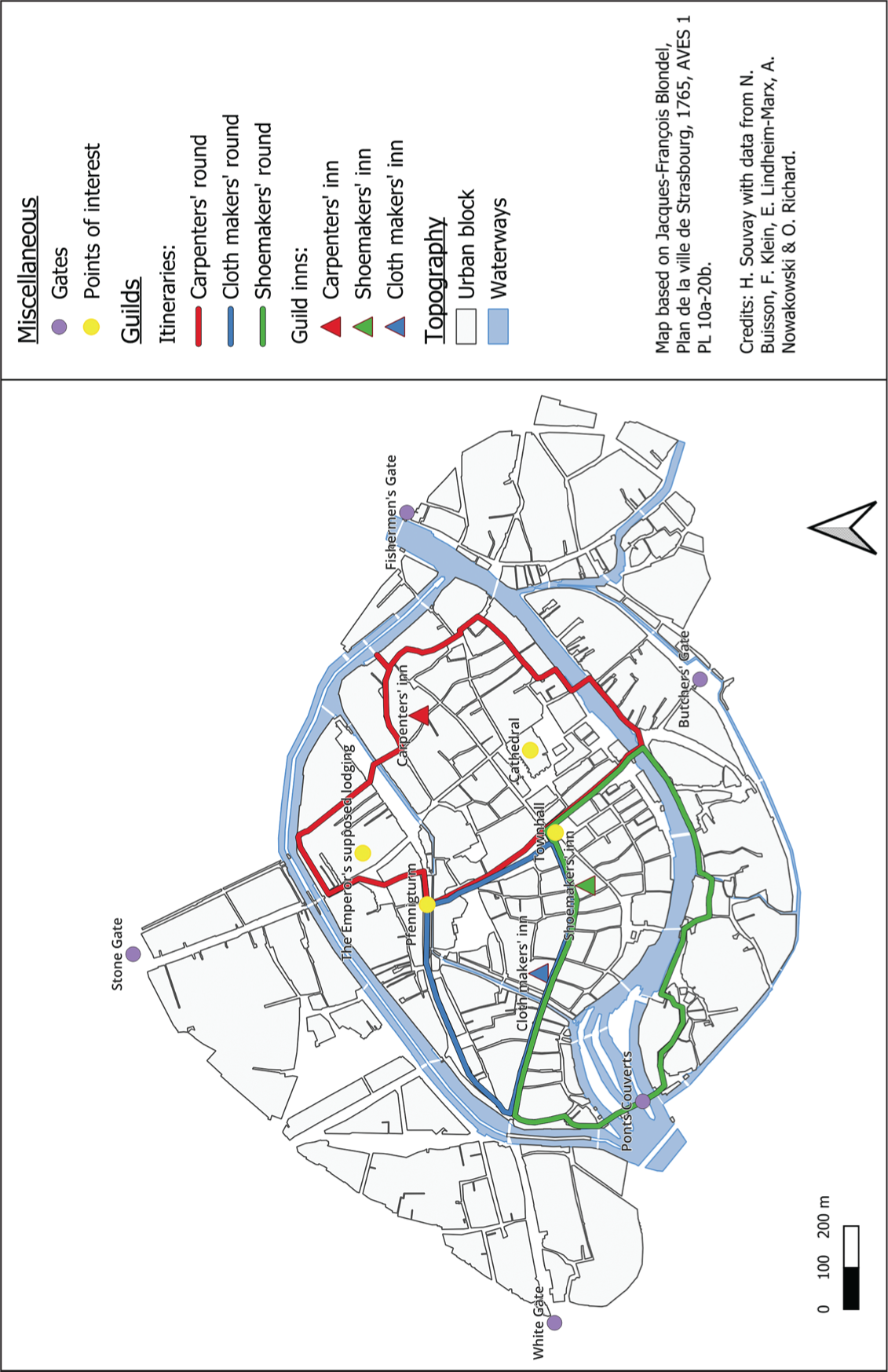
Those on the cloth makers’ guild inn must dispatch sixteen men per day for surveillance rounds in the city, in two groups. Eight of them must go along the Oberstrasse up to the Mint and then along the Holwig up to the Penny Tower (Pfennigturm), then on the wine market until the Customs Gate (Zolltor) and from there back to their guild inn.
49
The other eight had to perform the same patrols at night.
There was often also a geographically based arrangement, as in Regensburg with its Wachten or defence districts and in Vienna. Pierre Monnet hypothesised that guild-ruled cities (like Basel, Strasbourg and Ulm) preferred the former option, while patrician-ruled cities like Regensburg were more likely to choose the latter. 50 Yet several towns seem to have employed both systems, with craft guilds assigned to the section of the urban space where they were most active. In Strasbourg, the cloth makers patrolled the northwest section of the city intra muros; the shoemakers the southwest; and the carpenters the east, corresponding to the district where their guild house was located (Figure 1). In other words, it was as guild members that these craftsmen defended the city, rather than as municipal citizens.
Guilds Patrolling in Strasbourg During Emperor Frederick’s Visit in August 1473. 51
Citizen participation in the city’s defence was crucial given the exorbitant cost of hiring mercenaries. That is why city councils regularly sought to include non-citizens, such as clerics, in this task, demanding from them a financial contribution. For the citizens themselves, there is no doubt that these moments must have been experiences where one lived intensely, if not joyfully, one’s citizenship, in a group with one’s peers. The sense of shared destiny appears to have been an important component of this service, as indicated by the fact that during the fifteenth century, the statutes of many towns, such as Strasbourg, routinely forbade a citizen from hiring someone to carry out guard duty in their stead. Citizens were required to fulfil this duty themselves. 52
While I have tried, up to this point, to trace the lived citizenship experienced by the people living in the region during this period, the picture I have drawn of a community united by practices lived together is misleading. This union of citizens equal in rights and duties is a fiction. In fact, the lived citizenship of the period was experienced, in equal measure, as something inequitable and excluding.
Inequalities and Exclusions
For many, citizenship was not necessarily desirable, while for others it was not attainable. Noblemen and clerics, and their servants, were often reluctant to be bound to the city by an oath and chose to renounce their rights rather than be forced to assume duties that were despicable to them. But even those for whom citizenship was a desideratum, often had highly variable experiences.
Experiences of Inequality
Despite their ubiquity, elections were organised in such a way as to minimise their directness. The vast majority of citizens, namely the craftsmen, elected representatives. They, in turn, elected an electoral body whose job it was to elect the aldermen. The idea was to temper what we today call direct democracy by means of several screens, for example by having an electoral commission chose the aldermen.
The Schwörtage, those spectacular manifestations of civic communion, were similarly inequitable. In most cases, such as in Strasbourg in 1418, women were excluded even from attending the event. 53 Freiburg im Breisgau was an exception, as women were allowed to participate, promising, rather than swearing, fidelity, a lesser commitment more in keeping with perceptions of female weakness. 54 Children and servants, while often among those walking in civic processions, were also excluded from the civic oath-taking. 55 Foreign journeymen did participate, as we saw, but were not equally integrated into the urban community. Moreover, even among the active participants, the varying roles assigned to city councillors, representatives of the lord and simple citizens such as craftsmen, were organised along highly stratified lines that served to display the dominant sociopolitical hierarchies.
In processions marking the visit of royalty, women were not given the same roles as men and were occasionally even excluded from them altogether, as happened in Augsburg. 56 In any case, here too, more than the unity of the urban community, these processions were a manifestation of its hierarchy and structure. Everybody was assigned a place according to their rank, a status spatially expressed by their level of proximity to or remoteness from the prince. Thus, the first to greet the king were the patricians, who rode out on horseback to meet him outside the city walls, indicating both that they were rich enough to own a horse and that they served on horseback in the urban militia. 57 In the cortege that accompanied the sovereign through the city, rank continued to play an essential role, maintained with all possible care and deliberation by the urban authorities, with the members of the political elite, in addition to the clergy, standing closest to the prince. 58
The importance attributed to these hierarchies cannot be overestimated, as the following famous example illustrates. In Colmar, when marching in procession, the guild of bakers was traditionally positioned closest to the reliquary as a result of the prestige conferred by their magnificent candle. As other guilds acquired even more beautiful candles, they were pushed further and further away, ultimately being relegated to a spot far from the reliquary. So strongly was this demotion felt, that in 1495 the guild decided to leave the city in protest, in order to pressure the authorities to have their original position reinstated. 59
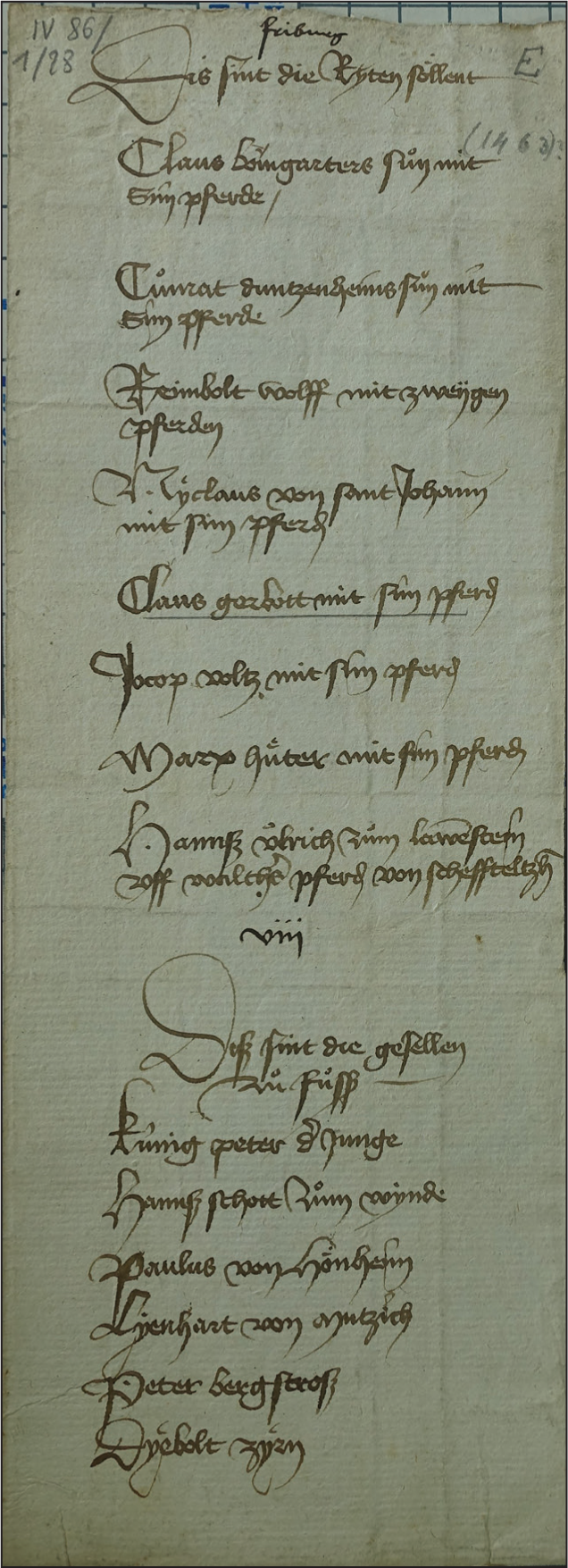
Even in the everyday experiences of citizenship, such as guard duty or patrols, inequalities were evident. One of the main marks of distinction was the use of horses, with those able to serve on horseback being distinguished from the masses of those serving on foot. In a militia list from Strasbourg, for example, dating to the second half of the fifteenth century, a reference to ‘those summoned for the gardener’s guild on the Steinstraße’, 60 begins with a list of four names followed by the comment ‘with a war horse’. The remaining six men on the list were referred to simply by name. 61 The list of the militiamen belonging to the guild of innkeepers and wine merchants is also divided into two sections—‘those on horseback’ and ‘those going by foot’ (Figure 2). 62 Whereas half of those appearing in the first section have also been identified as aldermen of the city, thus members of the sociopolitical elite, to the best of my knowledge, no one from the second group ever held a seat in the city council.
The Militiamen of the Strasbourger Innkeepers’ and Wine Merchants’ Guild (c. 1463).
Revolts
Riots and revolts should also be understood as experiences of citizenship, as historian Christian Liddy showed with regard to York, and Jan Dumolyn and Jelle Haemers in relation to Flanders. 63 This arises clearly from the sources themselves, which reveal the insistence of those in revolt on their sense of citizenship or their political identity as guildsmen. In 1424, for example, a revolt broke out in Colmar over the introduction of a new tax and ‘when the winegrowers came, they were asked to roll up their banner [which they were marching behind], but they refused and shouted loudly’ 64 before proceeding to go from one guild house to another in the name of the common people, asking the guildsmen there to swear allegiance to them.
Another famous example of a revolt or uproar that can be seen as a moment of lived citizenship is the so-called ‘nasty carnival’ (die böse Fasnacht) of Basel in 1376. The city had for several years been under pressure from the Austrian Duke Leopold III, who even lay siege to it in 1374. In 1375, he acquired Kleinbasel, a section of the city situated on the opposite side of the Rhine, and on 21 January 1376, he managed to get himself appointed to the position of imperial advocate for Basel (Reichsvogtei), the court of high justice. A month later, on 26 February 1376, as he was parading with an escort of knights and squires to a tournament in the cathedral square, one of the main political spaces in the city and where the annual swearing-in of the elected aldermen took place, a skirmish broke out between Leopold’s party and the townspeople. Several noblemen were killed, and others were taken prisoner. 65 While existing sources are not robust enough to enable a detailed interpretation of the political dimension of this riot, one chronicle indicates that the banners were taken out, and local historiography believes that these belonged to the craft guilds.
Conclusion
Citizenship in the late medieval cities of southern German lands was comprised of shared activities, as well as shared moments and spaces viewed by people as infused with their own sense of belonging. These activities and places were anchored by shared values that also served as the basis of citizenship. In many of the texts relied upon in this study, such as constitutional charters or accounts of revolts, an attention to the city’s honour, common good and shared profit are omnipresent. 66
However, all these activities and spaces also show how stratified medieval urban society was, highlighting and generating inequalities not only between citizens and other types of inhabitants but also within the citizens as a group as well. The craftsmen and merchants were not quite the same quality of citizen as the patricians who served in the militia on horseback, stood on the elevated platform during the Oath Days instead of in the crowd, or were positioned close to the prince during his visit to the city. As for the riots and revolts, they could unite citizens and other inhabitants against a common enemy, such as a tyrannical lord, but also set them against each other.
Although providing an overview of the topic, this article did not encompass other parameters of difference that greatly impacted how political identity was experienced in late medieval southern German lands, such as the specificities of lived citizenship in large versus small towns, or between cities governed by guilds and those where guilds had no political force. It also did not endeavour to trace the evolution of citizenship over the course of the period in question, despite the fact that lived citizenship for people in the fifteenth century was not the same as it had been 200 years prior, given the multiplication of urban institutions and offices along with new opportunities for political participation in the municipal government. Furthermore, the increasing formation of territorial principalities also resulted in stronger pressure being put on each town’s autonomy, which had consequences for its political life.
Finally, this study did not mention the Jewish inhabitants at all, who are the focus of this special issue, even when it seemed obvious that they should have been considered, such as with regard to processions in honour of royal visits. 67 Yet, it implicitly includes the Jews, because the diversity of experiences of citizenship demonstrated above sheds light on the sense of belonging city dwellers could foster not just when appearing as citizens of a particular city or in court to resolve a dispute over an economic issue. There were many ways of living one’s citizenship, according to social position, professional activity, age, gender and, as the following papers will demonstrate, religion as well.
Footnotes
Declaration of Conflicting Interests
The author declared no potential conflicts of interest with respect to the research, authorship and/or publication of this article.
Funding
The author disclosed receipt of the following financial support for the research, authorship, and/or publication of this article: The publication of this article was supported by the “Beyond the Elite: Jewish Daily Life in Medieval Europe” research project, funded by the European Research Council (ERC) under the European Union’s Horizon 2020 research and innovation programme under grant agreement No 681507 and the Israel Science Foundation Breakthrough Research Grant “Contending with Crises: Jews in Fourteenth Century Europe” 2850/22, PI Elisheva Baumgarten.