




Abstract
al-Bayrūnī’s Chronology of Ancient Nations is a famous work on calendars and historical chronology, written in the year 1000 of the Christian era. The present paper is the first investigation of the complicated textual history of the Chronology and an attempt to construct a stemma codicum. The investigation leads to some unexpected discoveries, among them the only known complete list of the twelve names of the animal cycle in the language of the Kitan (Liao) people.
Abū Rayḥān Muḥammad b. Aḥmad al-Bayrūnī (or al-Bīrūnī) was born probably in 362 of the hijra (972
I will not write at length about the details of his biography but would like to say something about his name, in particular about his surname (nasab) al-Bayrūnī. Concerning this name, we have a brief but very important entry in the dictionary of surnames (Kitābu l-ʼansāb) by as-Samʻānī, who lived about a century after al-Bayrūnī. As is his custom, as-Samʻānī begins his entry by spelling out in words the correct reading of the consonants and vowels which make up the name. The author’s purpose was obviously to make the reading of the name absolutely unambiguous, but in this case, his good intention was sabotaged by the copyists: the Codex Optimus, Istanbul Köprülü 1001 gives the name as al-Bayrūnī bi fatḥi l-bāʼ, but the British Library manuscript gives it as al-Bīrūnī bi kasri l-bāʼ. It is accepted by everyone that this is an arabicised form of a derivative of Persian bērūn, ‘outside’. Arabic does not have the vowel ē, so in borrowing from Persian it is represented sometimes by the Arabic vowel ī, but more frequently by the diphthong ay. So in principle, al-Bīrūnī and al-Bayrūnī are both possible, though I would suggest that the latter is the lectio difficilior. We can add that the title page of the Beyazıt MS of the Chronology (for which see below) also has the author’s name with fatḥah over the bāʼ. Here is as-Samʻānī’s text:
as-Samʻānī, Kitābu l-ʼansāb, Istanbul, Köprülü 1001, as read by Sachau, ‘Vorwort’ (the introduction to his edition of al-Bayrünī’s Chronology) p. xviii.
L = variants from the London MS.
See also the printed edition, Hyderabad/Deccan 1962 sqq., vol. II no. 652
البيروني بفتح الباء (L: بكسر الباء) الموحدة وسكون الياء آخر الحروف وضم الراء بعدها الواو وفى آخرها النون هذه النسبة الى خارج خوارزم فان بها من يكون من خارج البلد ولا يكون من نفسها يقال له فلان بيرونى ست ويقال بلغتهم انبيژك (L: ابنيرٮل) ست (*يت) والمشهور بهذه النسبة أبو ريحان المنجم البيرونى Translation: ‘al-Bayrūnī (L: al-Bīrūnī) …. This surname refers to the outskirts of (the capital city of) Choresmia, for in that country if someone is from the outskirts of the town and not from the town itself they say of him (in Persian) “fulān bērūnī-st”, but in their own language they say “anbīcak yitti”. The person known by this surname is Abū Rayḥān al-Bayrūnī, the astronomer.’
Compare the glossed MS of az-Zamaxšarī, Muqaddimatu l-ʼadab, where Arabic دثاء ‘outer garment’ is glossed as Choresmian انٮٮڅك ٮححاس
This seems to suggest that our author’s name in his native language was Anbicak, 2 and that this was persianised as Bērūnī, which in turn was arabicised as al-Bī- or al-Bayrūnī.
His kunyah is cited both as Abū Rayḥān and as Abū r-Rayḥān (with the article). In theory, a kunyah contains the name of a man’s eldest son, but there are exceptions. The collective noun rayḥān means ‘sweet basil’. It does occur very rarely as a male personal name, but it is essentially a servile name, like Kāfūr, ‘camphor’, ʻAnbar, ‘ambergris’ and other such words for aromatica. The huge biographical dictionary of aṣ-Ṣafadī lists only three men with this name, all of them presumably freedmen, two of them specifically styled ‘the Abyssinian’ (al-Ḥabašī). It is difficult to think that al-Bayrūnī, a free-born Muslim, would have given his son a slave’s name. It can, however, happen that a man will form his kunyah from a masculinised form of the name of his eldest (or most distinguished) daughter; thus the father of a Fāṭimah can be called Abū Fāṭim. 3 A famous example is the second caliph, Abū Ḥafṣ ʻUmar b. al-Xaṭṭāb, the father of the Prophet’s wife Ḩafṣah bint ʽUmar. Rayḥānah is a fairly typical Islamic female name, the name, in fact, of another one of the Prophet’s wives. So perhaps Abū Rayḥān had a daughter called Rayḥānah. Intriguingly, al-Bayrūnī wrote his introduction to astrology (at-Tafhīm), ‘at her request’, for a lady called, in the Arabic version, Rayḥānah bint Ḥasan, to which the early Persian translation adds: al-Xuwārizmī, so a Choresmian compatriot of the author. Rayḥānah bint Ḥasan cannot be the daughter of Abū Rayḥān Muḥammad, but she could have been (for example) a niece. In Islamic tradition, as in others, it is quite common for any given family to give preference to a small number of recurring personal names. In the context of the strict separation of the sexes in Oriental societies, it is not easy to believe that al-Bayrūnī could have written a book for a woman who was not a close relative.
al-Bayrūnī’s ‘Chronology’ is known in the Arabic original as al-ʾāϑāru l-bāqiyah ʿani l-qurūni l-xāliyah, literally ‘The remaining footsteps from bygone generations’. The title suggests that it is a book about ancient history. I would suggest that it does indeed belong to the genre ‘history’, but it is a history of very special sort; it is an astronomer’s take on history. Rather than merely telling us that king so-and-so ruled for such-and-such a number of years, months and days, the astronomer al-Bayrūnī first wants to establish what exactly is a year, a month and a day, how did the people at the period in question measure the passage of time and what are the consequences of this for establishing a universal chronology for human history. This leads him to an investigation of the dating systems and calendars of all the nations of the known world. It is a line of investigation that, as far as I see, was never pursued by any other writer in the classical Islamic world, nor indeed in the Western world until the time of Scaliger.
The date of the work can be established with a high degree of certainty. al-Bayrūnī refers not once, but several times, to ‘our year’ (sanatunā) as the year 1311 ‘of Alexander’, so: 1311 of the Seleucid era, which corresponds to the years 999 to 1000 of our common era. This information is confirmed by numerous historical allusions in the course of the text. At that time he was at the age of a mere 29 lunar years. It is very much a young man’s book, pugnacious and self-confident.
The Arabic text of the Chronology was published by the great Semitist Eduard Sachau in 1878 under the title Chronologie orientalischer Völker, 4 on the basis of three incomplete late manuscripts (described below as P, L and R). The same scholar published a richly annotated English translation under the title The Chronology of Ancient Nations 5 in London, in 1879. A new edition of the Arabic text was published in 2001 by the Iranian scholar Parwīz i Azkāʾī, Tehran 2001, based on Sachau’s edition, superficially collated with manuscripts B, E and S, with a Persian translation of the notes in Sachau’s English translation and additional notes by the editor. The now available principal manuscripts of al-Bayrūnī’s Chronology are the following, roughly in chronological order 6 :
B = Istanbul, Beyazıt (olim Umumiye) 4667, a complete copy. The MS is not dated as such, but at the bottom of the last page, there are two readers’ notes. The older of the two records the fact that a certain at-Taqī al-Muḥsinī ‘copied from it’ (nasaxa minhu) in Ramaḍān 603/1207, 7 which we must take as the terminus ad quem of the Beyazıt MS; the later reader’s note records the fact that its author ‘studied it and benefited from it’ (ṭālaʻtuhū wa stafadtu minhu) in the year 640. The handwriting is consistent with a dating around the middle of the twelfth century. It is a clear nasx hand, extensively, but not entirely, pointed and partially vocalised, with many marginal corrections, variants and annotations. The MS was first recorded by Rescher in 1912, 8 then described by Ritter in 1933, 9 and by Krause in 1936. 10 On the basis of this copy, Garbers and Fück filled the seven largest lacunae of Sachau’s edition in their articles of 1952, 11 and it was also collated (though not entirely systematically) by Aẕkāʼī for the Tehran edition of the Chronology.
M = St Petersburg, Asiatic Museum D 58, dated 1 Jumādā II 616/1219 (incomplete). This manuscript was identified by Salemann in an article published in 1912, 12 where he put the disjointed pages back in order, identified the numerous lacunae, produced a concordance with Sachau’s edition, and collated a number of short sections against Sachau’s text. Then in 1959, A. B. Khalidov 13 filled up some more of the lacunae in Sachau on the basis of this manuscript and of the Beyazıt copy and also published his collation of the fragments edited by Garbers and Fück against the Petersburg (then Leningrad) MS. I regret that I have not been able to see this important manuscript and quote it on the basis of Salemann and Khalidov. Following Salemann I cite it as ‘M’ (=Museum).
E = Edinburgh, University Library 161, dated 707/1307–8 (incomplete). A luxury MS beautifully calligraphed and with famous pictures in the Ilkhanid style. This is the archetype of the three manuscripts used by Sachau for his edition of 1878, namely:
L = London, British Library Add. 7491, dated 1079/1668–9; R = London, British Library Suppl. 457, dated 1254/1838; P = Paris, Bibliothèque nationale, 1489, evidently eleventh/seventeenth century. This one MS has copied not only the text but also the pictures in E.
There are seven large lacunae in the Edinburgh MS, all resulting from the physical loss of one or more folios; these pages were lost already in the seventeenth century, and their content is consequently missing in the three copies available to Sachau, and in his edition.
N = Istanbul, Nuruosmaniye 2893 (four fragments); at the end, there is an effaced note with the number (date?) 797 (which, if it is a date, would correspond to 1394–95
S = Istanbul, Topkapı Saray 3043, with an owner’s note dated 813/1410-1. This MS was collated by Aẕkāʼī, who remarked, surely correctly, that it is a copy of B. As the latter is available, I did not consider it necessary to take this MS into consideration.
A = Istanbul, Aya Sofya 2947, dated 839/1435-6, a complete copy. It is a luxury MS in ornate nastaʻlīq, copied in Samarkand. I have compared A with the readings in M recorded in the collation notes of Salemann and Khalidov, which led me to the inevitable conclusion that these two copies share a large number of common errors, to the extent that I think that A must have been copied (directly or indirectly) from M. In this case, its principal value resides in the fact that it has preserved the contents of the significant gaps in M.
At the very end of the text in MS A only, the scribe has copied out a note that is of considerable importance for the textual history of the Chronology, (the last pages of the Chronology are missing in M, but it must also have contained this note if A is really copied from M) stating that it was found on the last page of the archetype (ʻalā ẓahri nusxati l-ʼaṣli l-manqūli minhu). It reads as follows
15
:
وجد هذا الفصل بخط الامام اوحد الدين احمد بن محمد السرى على ظهرنسخة الاصل المنقول منه فاوضت بجميع ما في هذا الكتاب ما خلا رقوم بعض الاسماء التى نقلت صورة فاننى لم اتعرض بها (ظ: أعرضها عليه) لكى يصحح من مواضعها من السريانى وغيره فان المصنف يشير (يصير؟) فى بعضها انه نقلها على ما هى عليه فى النسخ مولانا الاجل العالم كمال الدين عز الاسلام مذهب الدولة سعد الكفاة معتمد الملوك ثقة السلاطين ابا نصر المؤيد بن على خلد الله ايامه مفاوضة وثقت فيها بحسن ضبطه وتصحيحه حساب ما عساه كان مختلا من الجداول وتصحيح اكثر الاسماء اليونانية والسريانية والعبرية والفارسية وتتبع ما لعله تساهل فيه هذا المصنف واخذه من الكتب حكاية وتفسير اكثر المعانى الغامضة على سبيل الحواشى وذلك فى مدة اخرها ثالث عشرين صفر سنة اربع واربعين وخمسماية وكتب احمد بن محمد بن القسم بن السرى فى التاريخ المذكورحامدا لله سبحانه مصليا على خاتم انبيائه محمد واله الاكرمين الاجمعين
The syntax here is highly convoluted. The key term is the first word (fāwaḍtu), which in this context seems to mean ‘I consulted with’ someone, or ‘I studied with’ someone, governing a direct object. This object occurs later in the text as the name ʼabā naṣr followed in a figura etymologica by the infinitive of the same verb (mufāwaḍah). The gist of this is, thus, that two men (and we will discuss their identity in a moment) ‘consulted with’ each other in correcting the text of ‘this book’ (the Chronology), in particular rectifying the calculation of the tables and the spelling of ‘most of the Greek, Syriac, Hebrew and Persian names’, and adding marginal glosses explaining the meaning of ‘recondite words’, all this ‘at various times the last of which was on the 23rd of Ṣafar of the year 544’ (1149). The author of the note adds that he wrote it (meaning: the note) ‘on the mentioned date’.
The author of the note is identified in the superscription as Awḥad ad-dīn Aḥmad b. Muḥammad, with a nisbah which I think should be vocalised as as-Surrī, referring to the village of Surr, alias Surrāʼ in the vicinity of Rayy (modern Tehran). 16 In the body of the note he gives his name in a slightly fuller form as Aḥmad b. Muḥammad b. al-Qāsim b. as-Surrī. He can be identified with a high degree of probability with a known author of a number of extant writings on astronomy, mathematics and medicine, among them an interesting treatise on ‘the errors and copying mistakes’ in the star catalogue in Ptolemy’s Almagest, which has been edited and translated by Kunitzsch, 17 and where the name of the author is given, as it is here, as Aḥmad b. Muḥammad b. as-Surrī. This person is also mentioned in the two Arabic biographical dictionaries devoted to scholars and physicians by Ibn al-Qifṭī and Ibn Abī Uṣaybiʻah, both of whom give him the šuhrah Ibn aṣ-Ṣalāḥ, 18 the former stating that he died in Damascus at the end of 548/1153, just four years after the date of our note. Thus, both the names and the dates agree.
The other party in the ‘consultation’ is identified as Abū Naṣr al-Muʼayyad b. ʻAlī, whose name is preceded by a long string of honorifics of the type that indicate that he was an eminent member of the civil bureaucracy, perhaps a wazīr or a senior secretary. Despite much effort I have not succeeded in finding any information about this person.
As such, this note reflects a situation well-known to students of Arabic manuscripts. A pupil finds a teacher with whom to study a text. The pupil brings along his own copy of the book, reads it out to the master and records the master’s corrections and comments in the margins of his own manuscript. When they have got to the end, the teacher will add a handwritten note on the last page of the pupil’s copy confirming that the pupil has studied the book with him. In this particular case, there is, however, a difference in that the ‘pupil’ is a person of very high social status. The teacher, here the mathematician and astronomer Ibn as-Surrī, in deference to his illustrious pupil, says not that the pupil has studied with him, but that the two of them have read al-Bayrūnī’s Chronology in ‘consultation’ and indeed attributes the corrections that they made to the illustrious pupil. I think we can take this with a very large pinch of salt. Ibn as-Surrī was a professional mathematician. We know from his mentioned book on Ptolemy’s star catalogue that he was a mathematician with a decidedly philological streak. He was intensely interested in comparing different manuscripts of the Almagest, including one in Syriac and is very keen to explain some of the errors in the various copies as the misreading of the Greek script. Thus, more than once he calls attention to the fact that the first Greek letter (alpha) is very similar to the fourth letter (delta), while these letters are not similar in Syriac or Arabic script, and thus that the erroneous replacement of ‘4’ by ‘1’ in some of the coordinates is due to the misreading of the Greek. When the author of our note refers to how he (or supposedly his noble pupil) has corrected ‘most of the Greek, Syriac, Hebrew and Persian names’ mentioned in the Chronology, we hear unmistakably the voice of Ibn as-Surrī.
This leads us to a number of conclusions. The fifteenth-century MS A derives (not immediately, but through at least one intermediary) from an archetype copied before 544/1149, about a century after the death of the author, roughly contemporary with MS B, the oldest surviving copy, if not older. This archetype was apparently the property of the grandee Abū Naṣr, who wrote into the margins corrections and annotations communicated to him by his teacher, Ibn as-Surrī. It also means that the note mentioning the year 544 must also have been copied from M and refers to a collation of the archetype of M not of M itself. Unfortunately, the last part of the text is missing in M, so it is not possible to confirm this deduction.
This leaves us with five ‘primary’ copies (copies without a known surviving archetype), namely B, M, E, N and A. (Even if A is copied from M it functions as a ‘primary’ copy for the many sections missing in M), and a variety of ‘secondary’ copies deriving entirely from extant ‘primary’ copies (S, and Sachau’s three MSS L, R, and P). The latter are occasionally of use when the relevant ‘primary’ copies have been damaged.
According to the results of my collations, the five primary copies fall into three families which I call α, β and γ. The α family is represented only by the Codex Optimus, B (and by its transcript S). The β family comprises the incomplete MS N only; the γ family is an offshoot of β, and comprises E and the closely related copies M and A. In a very large number of passages, B has one reading, and all the other witnesses share a different reading, and in most (though not all) of these instances the reading in B is manifestly superior. This means that all the other manuscripts have inherited a false reading from the archetype β. But in some instances, B and N share a correct reading against the manuscripts of the family γ. This means that in these passages the archetype β still had the correct reading, but that this has been corrupted in the archetype γ. The archetype γ is, however, very likely to be the old manuscript supposedly ‘corrected’ by Ibn as-Surrī in 544/1149 as mentioned in the note at the end of MS A.
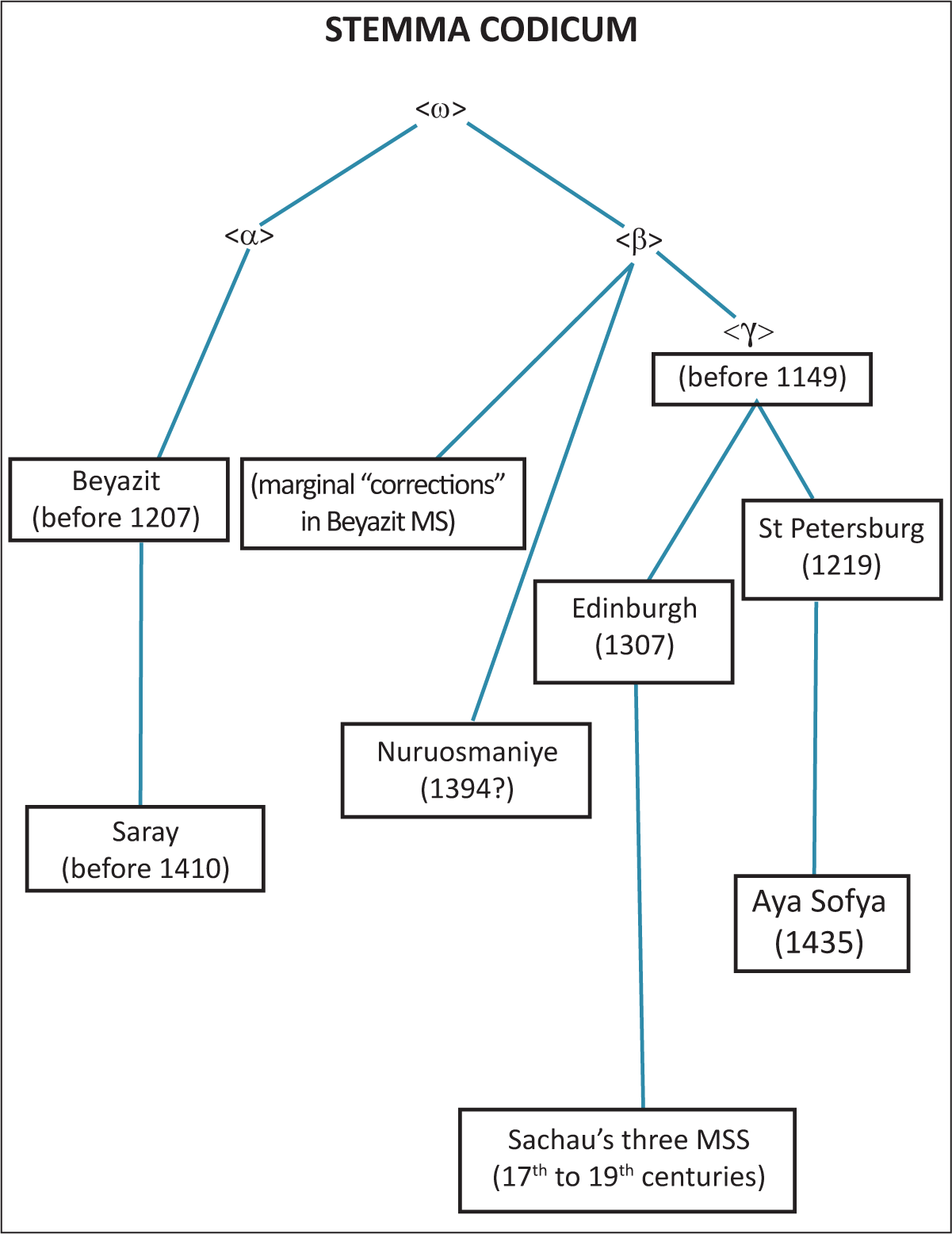
I would add at this point that the so-called corrections in the margins of MS B very often agree with erroneous readings in MSS of the β and γ families. It is, thus, obvious that the scribe who inserted these ‘corrections’ took them from a MS of one of these families.
Apart from a large number of individual readings, the manuscripts of the γ family share several substantial textual interpolations, notably the following:
Three additional columns in the table of month names (Sachau, pp. 69–70). These columns are in E and A only (lacuna in M); missing in B and N. See the discussion below. Detailed discussion of the mathematical problem known as the chess problem (Sachau, pp. 138–39). This text is in E and A only (lacuna in M); missing in B and N. The largest part of this is a credited quotation from a lost work of al-Bayrūnī called Kitābu l-ʼarqām, introduced by the words ‘Abū Rayḥān said’; the extraneous nature of this insertion is corroborated by the fact that al-Bayrūnī never refers to himself in the third person, but always as ‘I’ or ‘we’. Diagram of the cycle and epicycle of Mercury (omitted in Sachau’s edition, where it would have been on p. 346). The diagram is in E and A only (lacuna in M); missing in B (lacuna in N). Table of the feasts of the people of the book, with explanatory text, at the very end of the book (omitted by Sachau). Table and text in E and A and (text only) in M; missing in B (lacuna in N).
When and by whom was this material added to the text? As it is only in manuscripts of the γ family, it is reasonable to think that it originated in the manuscript corrected in 1149. Some of the additional material could have been added by Ibn as-Surrī, even though he does not say explicitly that he added any substantial blocks of text, but only that he has corrected the numbers in the tables and the spelling of foreign names. Some interpolated material could have been incorporated into the text before the editing of the text by Ibn as-Surrī. Some could have been introduced after that editing but presumably before the copying of MS M in 1219. On the whole, the textual history suggests that the interpolated passages found their way into the text before the middle of the twelfth century, that is: within a century of al-Bayrūnī’s death.
In the remainder of this paper, I will discuss the first of these interpolations, which is of calendrical and historical interest.
Chapter 5 of Sachau’s edition is devoted to the ‘nature of the months’. Here al-Bayrūnī gives a detailed description of about a dozen different calendars, in each case beginning with a list of the names of the months in the given calendar followed by a description of how the calendar works: Is it lunar or solar, how many days are there in each month, do they use intercalation, and so forth. Then, at the very end of the chapter, he writes that he has not discussed the months of other nations, such as the Indians, Chinese, Tibetans, Turks, Khazars, Abyssinians and the Black Africans (zanj), ‘although I have managed to learn the names of some of their months’, because he had no certain knowledge about them. This is, then, followed by a summary of the information contained in the chapter in the form of a table spread over two pages, preceded by a note where the author says explicitly that the table comprises ‘the names of the months that have been mentioned in the preceding part of this book.’
In the Codex Optimus (B), the table has 8 columns on the first page and 7 on the second. Each column has at the top a short indication of when the year begins in each calendar, and, below this, the names of the months. The columns on the first page enumerate, reading from right to left, the months of the Muslim Arabs, the Arabs in the Jāhiliyyah, the Thamūd, the Jews, the Persians, the ancient people of Sijistan, then the Sogdians and his own compatriots the Choresmians. All of these calendars had in fact been discussed at the appropriate places in the text of the chapter.
On the second page of the table we have, again reading from right to left, seven calendars: first that of the Syrians (i.e., the Babylonian names of the Julian months), then the Romans (rūm, that is the Latin names of the Julian months), then the Greeks (yūnāniyyūn, that is: the Macedonian names of the same Julian months), then the Copts, and the ‘people of the West’ (maγāribah, here the old Romance month names still, or until recently, used in North Africa), then the Indians and finally the Turks. As we can see, three of these are (despite the author’s indication to the contrary) not discussed in the body of the chapter, namely the calendars of the Greeks, the Indians and the Turks, and at least in the case of the Indians and the Turks, he has explicitly stated that he had no adequate knowledge of their calendars. The Indian column gives a reasonable transcription of the Sanskrit month names, in the correct order, and the correct statement that the year begins at about the time of the spring equinox. The Turkish column, however, says in the header that ‘I have not been able to ascertain how long these months are, nor when they begin, 19 nor of what nature they are.’ The entries in the column are a reasonable representation of the names of the months in the Old Turkish calendar, which had 10 numbered months (‘first moon, second moon’, etc.) followed by two named months (‘great moon, little moon’), but here their order is completely jumbled. So after the ‘great moon’ and the ‘little moon’, we have months 1, 2, 6, 5, 8, 9, 10, 4, 3 and 7.
As we will see in a moment, these 15 columns are found in the same order in all the manuscripts of the Chronology, and we must consequently assume that they were present in archetype ω. al-Bayrūnī himself gives a detailed description of the Indian calendar in his later book on India, with the names of the months, and these are enumerated also in his book on astrology (at-Tafhīm). It is thus possible that al-Bayrūnī added the Indian column, and perhaps also the chaotic Turkish column, in the margins of his own master copy of the Chronology, without taking the trouble to emend the passage in the text where he states that he has not included these two calendars in his book. It is, however, possible that the two columns were added by one of his pupils.
MS N has exactly the same tables in the same layout (8 columns on the first page and 7 on the second) and the same confusion in the order of the last column with the Turkish months.
On the other hand, the manuscripts of the family γ, that is: E and A (with the latter standing in for M, where again there is a lacuna at this point), and consequently also the two printed editions, have three additional columns. On the recto, there are two additional columns at the right side of the table, labelled (at least in MS E) ‘the months of the people of Qubā’ and ‘the months of the people of Buxāratak’, and on the verso there is one additional column, again at the right side of the page, a second and different list of Turkish months. In all three cases, there is no information about the workings of any of these calendars. These columns are unique to the MSS of the γ recension.
We will now look at the three additional columns one by one. As we have seen, E and A have two sets of Turkish month names on the second page of the table: on the left the garbled list of Old Turkish numbered months shared with the other families, and on the right an entirely different list of months. The latter is in fact a list of Turkish versions of the 12 terms of the Sino-Turkic animal cycle (rat, ox, tiger, etc.), which in turn is a renaming of the terms of the Chinese ‘twelve branches’. In Chinese and Central Asian traditions, the 12 terms are most commonly used to designate the 12 years of the duodecimal cycle, but they can also be used to count months or days. The Chinese year, like most of those in Western Asia, is lunisolar, with 12 months in a common year and 13 in an embolismic year. But in counting the months according to the duodecimal cycle, the intercalated months are not taken into account. This means, however, that any one of the 12 calendar months will always have the same ‘branch’ or ‘animal’ assigned to it, regardless of whether we are dealing with a common year or an intercalated year. In this sense, it is not actually wrong to treat the 12 animals as if they were the names of the months of any year, although, as far as I can see, no Turkish calendar actually used the animal cycle to count the months.
The second column from the right on the recto side of the table is labelled in MS E as the months of the people of
The first column on the right in E and A lists ‘the months of the people of Qubā’. 24 These have until now not been explained satisfactorily. Sachau 25 identified Qubā as a town in Ferghana, mentioned in Arabic historical sources. It survives as ‘Kuva’ in the Ferghana district of Uzbekistan, part of ancient Sogdiana. But the names listed here have no affinity with the Sogdian month names (which are listed separately in these tables, and confirmed by documents in the Sogdian language) nor with those in any other Eastern Iranian language. Besides, it seems strange that this column should list the names used in one not particularly important town, while all the others tabulate the months of great nations (Arabs, Persians, Jews, Greeks, etc.). I have a different proposal. Taking as my point of departure, the table as it appears in MS A (which at this point seems much superior to the version contained in E) it struck me that several of the names are similar to the Mongolian names for the 12 animals. These names were widely used in Persia after the Mongol conquest, though they were obviously unknown there in al-Bayrūnī’s day. However, closer examination showed that only six of the twelve names can be related to the Mongolian forms. Consequently, I delved further into the various Central Asian versions of the Chinese 12-animal cycle and eventually found what is doubtless the correct answer, namely that these are the names of the 12 animals in the Kitan language, the language of the Kitan people, 26 who ruled a large part of Northern China as the Liao dynasty between 916 and 1125 before being dislodged by the Jin dynasty. After that, the remnants of the Kitan moved westwards into Sogdiana, which they ruled as the Qara-Khitai, alias Western Liao, for nearly another century from 1131 to 1211. Then, the Qara-Khitai migrated to Kirman (South-Western Persia) where they held onto power, now as Muslims and vassals of the Mongols, from 1222 to 1305. The realm of the Qara-Khitai of Transoxania did in fact include the Ferghana oasis, and thus the town of Qubā/Kuva, and I played for a while with the idea that ‘the people of Qubā’ are the Qara-Khitai, but I abandoned this when I realised that Qubā قبا is quite simply a mispointing of Qitā قتا, or Qitāy قتاى, the name given to the Kitan in the older Arabic and Persian sources, against Xiṭāy خطاى in the later sources. 27
The Kitan language is imperfectly known. There are, however, a fair number of tombstones with inscriptions in Kitan using two different Chinese-based partially syllabic, partially ideographic systems of writing. The decipherment of the Kitan scripts has engaged much discussion among a small group of specialists. But, since the available sources are mainly tombstones, which cite the date of the relevant person’s death according to the Chinese calendrical system, the names of eleven of the twelve animals are actually relatively well attested. A consultation of the forms reconstructed (obviously without use of the tables in the Chronology) by Daniel Kane in his highly respected book The Kitan Language and Script (Leiden 2009) revealed that in all but one case the reconstructed Kitan forms are strikingly similar to those recorded in our table. 28
The animal cycle in the language of the ‘people of Qubā’ (read: +Qitā)
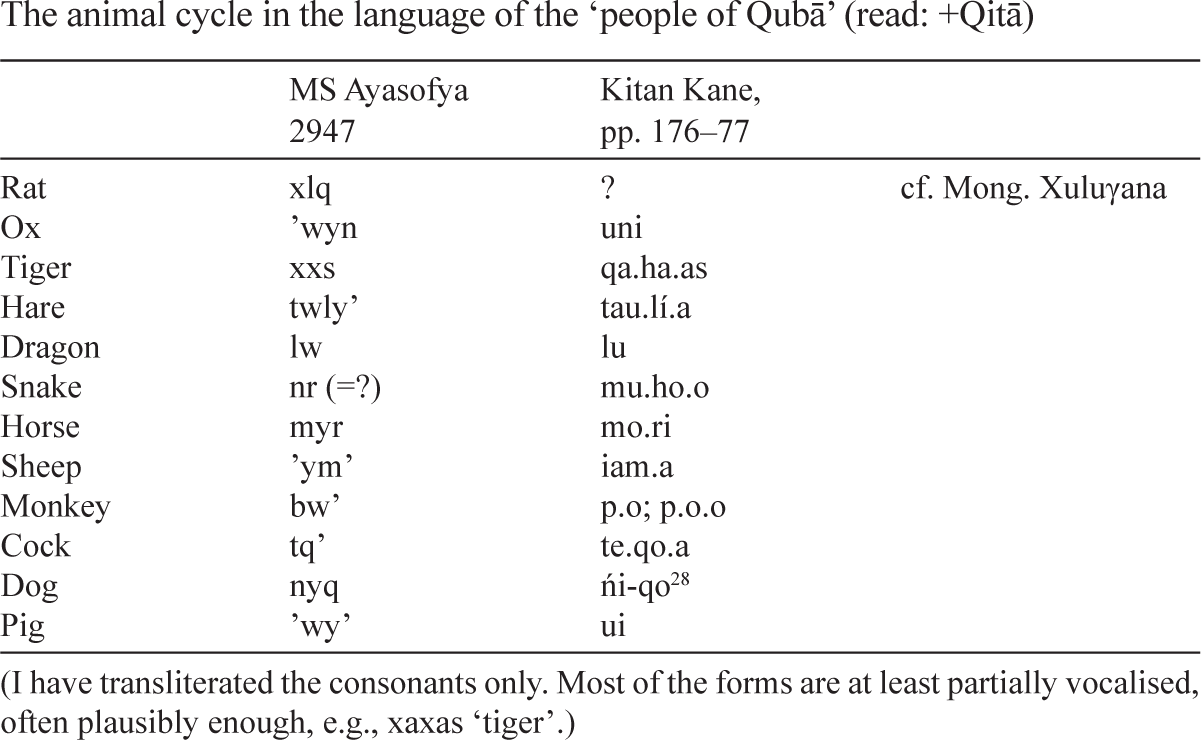
(I have transliterated the consonants only. Most of the forms are at least partially vocalised, often plausibly enough, e.g., xaxas ‘tiger’.)
We know from Muslim historical sources that an official delegation from the rulers of the Qitāy (Liao) and the Uighurs arrived in Ghazna during the reign of Maḥmūd. The most detailed relevant information is found in the geographical section of the Tabāʼiʻu l-ḥayawān of al-Marwazī 29 (died not long after 514/1120), who quotes in Arabic translation (§§22–23) the text of the letters from these two rulers, in which they plead for an alliance with the Ghaznavids against their enemies in China. But the embassy ended in failure. There is some uncertainty about the exact date of these events: al-Marwazī says that the ambassadors arrived in Ghazna in 418 (year beginning February 1027), while the Persian historian Gardēzī puts it one year earlier in 417 (begins February 1026). 30 But the letter from the ‘Lord of the Qitāy’, as quoted by al-Marwazī (§22), is dated to the Year of the Rat, which (unless the dates given by the two Muslim historians are wildly wrong) must mean the year beginning in February 1024. Obviously, it took the ambassadors some time to get from the Liao capital in Northern China to Afghanistan, but one is entitled to doubt that it took them two to three years. 31 There is however no reason to doubt the approximate date of the embassy, which must consequently have fallen in the latter part of the long reign of the Liao emperor Shengzong (reigned 982–1031). At the time in question, al-Bayrūnī was himself in Ghazna, attached to the royal court, and in fact, in his Minerology he expressly says that he posed a certain question to ‘the ambassadors who came from the khan of the Qitāy’ (wa kuntu saʼaltu r-rusula l-wāridīna min qitāy-xān). 32 One could easily imagine that the great chronographer asked these envoys what names they used for their months and that they replied with words to the effect that we Chinese do not actually have proper names for our months, but merely number them, or else we count them according to a duodecimal cycle, using the names of 12 animals. Given the fact that al-Bayrūnī tells us explicitly that he was in contact with the embassy from Kitan it is very attractive to surmise that this list of the Kitan names for the 12 animals goes back to al-Bayrūnī himself. They cannot have been listed in al-Bayrūnī’s original autograph, since this was composed some 20-odd years before the arrival of the ambassadors, nor in the two early copies of the autograph which we have called α and β, but al-Bayrūnī might have written them into the margin of the master copy at a later date, whence they could have been inserted in MS γ. Or the redactor of γ might have had them from some other work of al-Bayrūnī’s. But this is perhaps not the only possibility. In any case, the fact that the table uses the older form Qitā rather than the later Xiṭāy makes it more likely that this information passed to the Muslims during the time of the Liao Empire (that is, before 1122), rather than from the Qara-Khitay in Transoxania after 1131, though the latter possibility cannot perhaps be ruled out entirely.
The fact that the three additional columns are found only in E (and its offspring), and A does mean that the expanded table goes back to the archetype of the γ family, which, as we have suggested, is likely to have been the manuscript studied by Ibn as-Surrī and his pupil Abū Naṣr in 1149. This gives us at least a terminus ad quem for this textual interpolation.
To my knowledge, the additional column in the manuscripts of the γ recension of al-Bayrūnī’s Chronology is the only Islamic evidence for the Kitan animal cycle. It is true that there are a number of references in texts of the Ilkhanid and Timurid periods to the calendar of the ‘Qitāy’, but it can be shown that in this period ‘Qitāy’ simply means ‘Chinese’. One example might suffice. The ornate horoscope of the Timurid prince Iskandar Sulṭān 33 gives the date of birth of this potentate according to five different calendars: hijrī, Jalālī, Yazdigirdī, Rūmī (Julian) and ‘Xiṭāʼī’. The first four give the tabular equivalents of Monday 25 April 1384, but since it is stated that his birth took place on the ‘evening’ of the Muslim Monday (which begins at sunset), we need to conclude that it was in fact on what we call the evening of Sunday 24 April (if the calendar day is counted from midnight). The Chinese equivalent (as calculated by ‘Kairos’) of the latter is day 8 (xin) of the decimal cycle, and 8 (wei) of the duodecimal cycle, for which the corresponding animal is the sheep. The text of the horoscope specifies that the princely birth occurred on ‘the eighth day of the sexagesimal cycle which in the Qitāʼī (language) is called xin wei, and in Turkish qoy (=sheep)’. 34 The other ‘Qitāʼī’ words cited in the section are also all linguistically Chinese. It is thus clear that in the fourteenth century, Qitāʼī means ‘Chinese’. 35
Footnotes
Declaration of Conflicting Interests
The author declared no potential conflicts of interest with respect to the research, authorship and/or publication of this article.
Funding
The work on this project was made possible by a grant from the European Research Council.