




Abstract
Scholarly consensus maintains that there was a ‘Jewish neighbourhood’, or perhaps several such neighbourhoods, in cities throughout the Islamicate world. In the present article, I delve deeply into this concept, seeking to problematise and unpack it more fully, using the city of Fusṭāṭ in Egypt as a test case.
Introduction: The Question of ‘the Jewish Neighbourhoodʼ and the Case of Fusṭāṭ
Scholarly consensus maintains that there was a ‘Jewish neighbourhood’, or perhaps several such neighbourhoods, in cities throughout the medieval Islamicate world. 1 In the present article, I delve deeply into this concept, seeking to problematise and unpack it more fully, using the city of Fusṭāṭ in Egypt as a test case.
The term ‘Jewish neighbourhoodʼ is not self-explanatory, and its meaning varied depending on geographic region and time period. 2 The current study asks the following: What is meant by this term? What are its implications? How does one define a neighbourhood? And what are the criteria employed to define a neighbourhood as ‘Jewish’? The most obvious answer to the latter is that a neighbourhood is defined as Jewish if most, or at least a sizeable portion, of the residents living there are Jewish. Another possible definition is the neighbourhood in which most of the Jewish residents of a city reside, regardless of what percentage of the neighbourhood they make up. A third way to define a ‘Jewish neighbourhood’ is a neighbourhood that contains Jewish communal institutions and landmarks, such as the synagogue, ritual bath, kosher meat shop and so on. A fourth option is to go by what Jews and non-Jews of a city have traditionally defined as ‘the Jewish neighbourhood’, either legally or otherwise.
In determining what qualifies a neighbourhood as ‘Jewish’, we must first consider the concept of neighbourhood itself. This is made complex by the fact that, as an entity, neighbourhoods are not always clearly marked and distinguishable from each other; social definitions do not necessarily follow administrative demarcations; and different people and social groups might have different ‘mental maps’ of the same area. Thus, in the sources, even the mere identification of a neighbourhood’s name with a specific locale is not straightforward, all the more so when trying to reconstruct its ethnic or religious composition. 3 Setting these questions and complexities aside for the moment, but bearing them in mind, I turn now to a brief overview of the foundation of Fusṭāṭ and the scholarly consensus regarding its ‘Jewish neighbourhood’.
The city of Fusṭāṭ was founded by the Arab–Muslim conquerors of Egypt soon after their conquest of the region in 641
The nucleus of Fusṭāṭ developed around a Roman fortress, built on the eastern bank of the Nile at the mouth of a Roman canal that ran from the river to the northern edge of the Red Sea. 6 The fortress remained a prominent feature of the city, and some of its walls and gates still stand today. Likewise, the identification of the fortress as Roman survived in the mental map of the residents of Fusṭāṭ, and its name, qaṣr al-rūm, (lit. the fortress of the Romans, or the Byzantines) was still in use during the Late Middle Ages (fourteenth–fifteenth centuries). 7 The neighbourhoods that sprouted up around the fortress and became the city of Fusṭāṭ were named after the tribes and families who participated in the conquest and received tracts of lands for settlement in its aftermath. 8
Within the area of the old Roman fortress stands, to this day, the synagogue known in recent centuries as the Ben Ezra Synagogue, renowned for being the site where the famous Cairo Geniza was stored up until the late nineteenth century. During the High Middle Ages (eleventh–thirteenth centuries), Fusṭāṭ was home to one of the largest known urban Jewish communities in the Islamic Mediterranean and an important centre of learning, economic activity and Jewish local and regional leadership. As will be detailed below, there was at least one other synagogue in the fortress, and quite a few Coptic and Orthodox churches and monasteries, some functioning as pilgrimage sites, others as the seat of bishops and patriarchs.
The existence of ancient synagogues, churches and monasteries in the fortress, the information on the residence of Jews there during the Middle Ages, and the fact that this was the pre-Islamic nucleus of the city, all led to the commonly held view that the Roman fortress, or at least its south-eastern edge around the Ben Ezra Synagogue, was the location of the ‘Jewish neighbourhoodʼ of medieval Fusṭāṭ. 9 The basic logic of this argument is that of continuity—to quote Goitein, the ‘preponderance’ of Jews in and around the fortress was due to ‘the fact that Christians and Jews had lived in the Roman fortified city before the advent of Islam and remained concentrated in their old quarters in order to enjoy the propinquity of their ancient and highly revered houses of worship’. 10 According to this reasoning, the medieval ‘Jewish neighbourhoodʼ was located in the fortress by default.
The image of ‘the ghetto’ looms large above research on the subject of Jewish dwelling in urban settings. 11 Thus, Goitein, writing about Jewish life in the Islamicate Mediterranean, concludes that ‘references to Jewish quarters are by no means indicative of anything comparable with a ghetto’. 12 Concerning Fusṭāṭ specifically, he states that: ‘There was no Jewish quarter in that city, but the bulk of the Jewish population was concentrated in a few neighbourhoods, situated within, and bordering on, the old Roman fortress.’ 13 Goitein makes an implicit distinction between a ‘quarter’ and a ‘neighbourhood’. 14 This distinction, and the comparison to ‘the ghetto’, continues with Goitein’s successors. Thus, Norman Stillman writes that ‘although Jews formed a tightly knit polity, they did not live in ghettos as such… Goitein has concluded that in Fustat (old Cairo) … there were no Jewish quarters as such, only neighbourhoods with highly concentrated Jewish populations’. 15 Mark Cohen is more explicit in this distinction: ‘In most cities of the Islamic Mediterranean represented in the Geniza, Jewish quarters, in the sense of exclusive Jewish districts, hardly existed.’ 16 Doris Behrens Abouseif refers to Goitein when saying that ‘Christians and Jews dwelt near Muslims at al-Fusṭāṭ without clear segregation’. 17
But while Goitein, and successive scholars, stressed that there was no ‘ghetto’ or an exclusive ‘Jewish quarter’, and that Jews, Muslims and Christians lived side by side, they still maintained that in Fusṭāṭ (and elsewhere) there were ‘Jewish neighbourhoods’, namely, areas that were, as Goitein writes, ‘predominantly Jewish’. 18 In Fusṭāṭ, this neighbourhood was, according to scholars, concentrated in the Roman fortress. For example, Elinoar Bareket writes that: ‘The ancient Roman fortress stood in the heart of Fustat and most of its Jewish population was concentrated there… Most of the quarter’s inhabitants were Jews.’ 19 Stillman, in an essay on the Jewish communities of medieval Egypt, writes that the Roman fortress was a ‘Jewish neighbourhood’ that ‘had been inhabited by Jews and Christians prior to the Muslim conquest and remained heavily dhimmi 20 for centuries’. 21 And numerous other examples abound. 22 In short, scholarly consensus maintained the Roman fortress was ‘a Jewish neighbourhood’, and that this meant that Jews were demographically dominant there and that this is where most of Fusṭāṭ’s Jews lived.
In the present article, I will show that the scholarly consensus described above is not supported by our current knowledge. The Roman fortress was not inhabited by civilians prior to the Muslim conquest, so there was no ‘continuity’. Moreover, we have no evidence for a significant Jewish presence in the fortress prior to the tenth century, while we do have some evidence for Jewish presence elsewhere in the city. In addition, from the eleventh century onwards, we have plenty of evidence for Jews living in various parts of the city and know that communal institutions were also not restricted to any specific neighbourhood. Finally, and perhaps most interestingly, we have no reference for a ‘Jewish neighbourhood’ in the writings of the people of Fusṭāṭ themselves—neither Jews, nor Muslims nor Christians. I, therefore, claim that there was no ‘Jewish neighbourhood’ in Fusṭāṭ in the sense familiar to us from other locations. This has implications for developing a better understanding of the place of the Jews—spatially and socially—in the urban environment of Fusṭāṭ and the larger Islamic Mediterranean and results in a more accurate and nuanced usage of the term ‘the Jewish neighbourhood’.
Fusṭāṭ’s First Three Centuries
Recent excavations of the Roman fortress have established its different phases. 23 It began life as a fortress housing a Roman garrison, built in conjunction with the construction of a Roman canal from the Nile to the Red Sea. There are no indications of civil activity in the compound prior to the Muslim conquest and the establishment of the city of Fusṭāṭ. Furthermore, excavations under several of the ancient churches and monasteries in the fortress reveal that their construction can be dated to no earlier than the end of the seventh century, that is, half a century after the Muslim conquest. The main structures examined in the fortress, including the Ben Ezra Synagogue, were built on top of the Late Roman layers and thus in a later period. 24
These findings challenge the heretofore accepted understanding of the history of Fusṭāṭ and its Jewish and Christian communities. If there was no civil activity in the fortress, which continued to function as a military stronghold up until the Muslim conquest, and if its churches, monasteries and synagogues were all constructed only post-conquest, then there were no ‘ancient and highly revered houses of worship’ in the fortress for the Jews (or Christians) to cling to. Thus, what Goitein defines as Jewish ‘preponderance’ in and around the fortress has to be explained within an Islamic-era context, rather than as a continuation of a pre-Islamic situation. In fact, there is no evidence for a Jewish presence in the fortress before the early tenth century.
In actuality, the earliest evidence for Jews anywhere in Fusṭāṭ comes not from the fortress or from the ‘Jewish neighbourhood’ identified as such by modern scholars, but from the vicinity of the congregational mosque located just outside the fortress. This mosque, called during this period ‘the ancient mosque’, and later referred to as ʿAmr Ibn al-ʿĀṣ mosque, after the conqueror of Egypt, was the largest, oldest and most central in the city. A papyrus, probably dating to 806
Not only did a Jewish individual live in the heart of the newly established Islamic city, near the main mosque and a famous bathhouse named after an important Muslim figure–he lived there in a compound known as ‘the compound of the Jews’. 28 The naming of the place as such, in a legal document produced for the practical use of the judicial system, suggests not only that Jews lived there, but also that the identification of this complex with ‘the Jews’ was widespread, and comprehensible and useful in an official document. The presence of non-Muslims and even their houses of worship, in the heart of cities newly established by the Muslim rulers, is widely attested. 29
Thus, the current scholarly perception that Jews (and Christians) lived in the fortress before the advent of Islam and remained there also after the conquest, thus creating ‘a Jewish neighbourhood’ by inertia, is contradicted by the archaeological evidence. 30 Even more so, the earliest written evidence regarding a Jewish presence, and a compound publicly referred to as ‘of the Jews’, points to an entirely different location, in the heart of the new city founded by the Muslims. 31
The Tenth Century: The Synagogues in the Roman Fortress and the Question of Communal Landmarks and Institutions
As the papyrus mentioned above indicates, in the early ninth century, Jews lived in the vicinity of the congregational mosque in a compound identified by non-Jews as ‘the compound of the Jews’. This does not exclude the possibility that other Jews lived in other parts of the city, including in the Roman fortress—but no collaborating evidence has yet been found to indicate that this was the situation.
32
It is not until the tenth century that we find documents referencing Jews living in the fortress. The earliest is a copy of a letter sent in 922
Hebrew legal deeds concerning real estate, some explicitly dated to the second half of the tenth century and the first years of the eleventh century, confirm that Jews owned property in the fortress during that period. But as with the ninth-century papyrus, this does not exclude the possibility that other Jews lived in other parts of the city at the time, either in the vicinity of the ‘compound of the Jewsʼ mentioned in the ninth century, or elsewhere. In any case, the presence of Jews in the fortress in the tenth century certainly does not necessitate Jewish presence there already from the seventh or eighth centuries.
The earliest evidence for the existence of a synagogue, or rather two synagogues, in the area of the Roman fortress, dates to the late tenth century. The synagogue that housed what is now known as the Cairo Geniza was referred to throughout the Middle Ages as ‘the synagogue of the Jerusalemitesʼ in Hebrew or ‘the synagogue of the Palestiniansʼ (al-shāmiyīn, ‘the people from al-Shām’, greater Syria).
35
The earliest dated mention of this synagogue is from 997
Aside from the synagogue of the Jerusalemites, there was also a synagogue of the Babylonians, who followed Babylonian-Iraqi customs. This synagogue was also situated in the fortress, to the south of the Palestinian synagogue, and is attested to in various Jewish and non-Jewish sources from the eleventh through the fifteenth centuries.
38
Its earliest attestation is in a deathbed will from 1006
Thus, by the late tenth century, it was clear that there were two synagogues next to one another within the southern edge of the fortress. 41 During this period, the synagogue was the locus of communal life, not only serving as a place of worship but also functioning as a site for communal gatherings and the place where the Jewish court convened and produced deeds. It was the beneficiary of public funds, as well as private endowments and contributions. 42 Occasionally, other communal institutions and landmarks, such as ritual baths, would also be constructed in its immediate vicinity. Yet, there has been no evidence found to date regarding the existence of such institutions in this neighbourhood during this early period. For this reason, as well as others, we should be careful not to assume what we seek to prove. There is no evidence, at this stage, to suggest that all or most Jews lived near the synagogues or that most residents in this area were Jews. Nor should we forget that we have positive evidence for a ‘compound of the Jewsʼ elsewhere in the city in the ninth century, with nothing to suggest that the Jews left that compound and moved to the Roman fortress.
Moreover, the Roman fortress covers quite a substantial area. Although today it consists of only some three hectares (30,000 square metres), according to archaeological reconstructions it was estimated to have originally been much larger—encompassing five to seven hectares. 43 It contained numerous streets, alleys, churches, mosques, bathhouses, mills and shops, and we can assume that it was home to thousands of people. 44 The entire fortress should therefore not be assumed to have been a ‘Jewish neighbourhood’ just because of the existence of two synagogues in one of its corners.
If houses of worship are seen as indicative of a community that prayed, and supposedly lived, in proximity to them, then we cannot ignore the existence of other houses of worship in the immediate vicinity of the two synagogues. The Roman fortress was home to some of the most ancient Coptic and Orthodox (Melkite) churches, monasteries and holy sites. These were not just parish churches, but important sites of pilgrimage and the seats of bishops and patriarchs. Just a few dozen metres west of the synagogue of the Jerusalemites still stands the church known as Bū Serga. Built in the late seventh century, it is considered by believers to be the site where the Holy Family hid when they fled to Egypt. It has functioned as the official seat of the Coptic bishop of Fusṭāṭ and the site where the Coptic patriarchs were consecrated. 45 In the Roman tower in the south-western corner of the fortress stands the Greek-Orthodox Church of St. George, 46 while the ‘hangedʼ church (Arabic al-muʿallaqa), the seat of the Coptic patriarch of Egypt since the middle of the eleventh century, is located in the south-eastern corner. 47 This church is just 100 metres south of the synagogue of the Jerusalemites, and somewhere between the two stood the Babylonian synagogue. These are just three of the numerous ancient churches and monasteries situated in this area that are known to us from written sources or archaeological finds.
There were also mosques in the Roman fortress. The Egyptian Muslim historian and geographer Ibn Duqmāq, active in Cairo during the second half of the fourteenth century, left a detailed description of both Cairo and Fusṭāṭ, in which he mentions 18 mosques in the fortress alone. 48 One of these was built in the early eleventh century, during a period of great persecutions of non-Muslims, right next to the ‘hangedʼ church. Geniza fragments document several other mosques in the fortress in the late eleventh and early twelfth centuries. 49
The existence of these churches and mosques was not something the Jews of medieval Fusṭāṭ ignored. While in some deeds Jewish real estate was described in relation to the synagogue, as was shown above, in others, Jews described their location in relation to these non-Jewish landmarks. So, for example, in a Jewish court deed from 969
In short, if we wish to claim that the existence of two synagogues on the southern edge of the fortress identifies this area, or even the entire fortress, as ‘the Jewish neighbourhood’ of Fusṭāṭ, we should remember that in this immediate vicinity also stood churches, monasteries and mosques.
The Eleventh Century: Jews Throughout the City
From the early eleventh century onwards, the picture arising from existing sources changes dramatically, as attested to by numerous Geniza documents of various kinds
In my research, I have thus far assembled over 700 Geniza documents that refer to structures, streets and neighbourhoods in Fusṭāṭ. These documents date mostly to what S. D. Goitein called ‘the classical Geniza period’, 53 namely, from the early eleventh to the middle of the thirteenth centuries. This vast documentation of daily life enables us to portray a much more detailed and nuanced picture of Jewish embeddedness in Fusṭāṭ and to answer the question of what exactly constituted ‘the Jewish neighbourhoodʼ of the city. 54
From early in the eleventh century, we find Cairo Geniza documents referring to Jews living and owning real estate all around the city. Jews lived in a neighbourhood called Mamṣūṣa, adjacent to the fortress on its south-eastern wall 55 ; in Tujīb, to the north-east of the fortress; in various neighbourhoods to the north of the congregational mosque, such as Mahra, Maḥras ʿAmmār and Ḥabs Bunān; in al-Qalūs and al-Suraya, north-west of the fortress; and in al-Sūq al-Kabīr, Kaulām and Banū Waʾīl to the south. Jews were also present on al-Jazīra, the island in the Nile connected to the rest of Fusṭāṭ by a bridge, as well as in Gizah, on the western bank of the Nile, opposite the Roman fortress. Each of these neighbourhoods, and others, are mentioned several times in various documents throughout the period discussed, and in some of the neighbourhoods different streets and alleys are specified. I have used Paul Casanova’s map of early medieval Fusṭāṭ to mark some, but not all, of the locations of neighbourhoods or streets in which Jewish residences are mentioned in documents found in the Genizah (Figure 1). 56
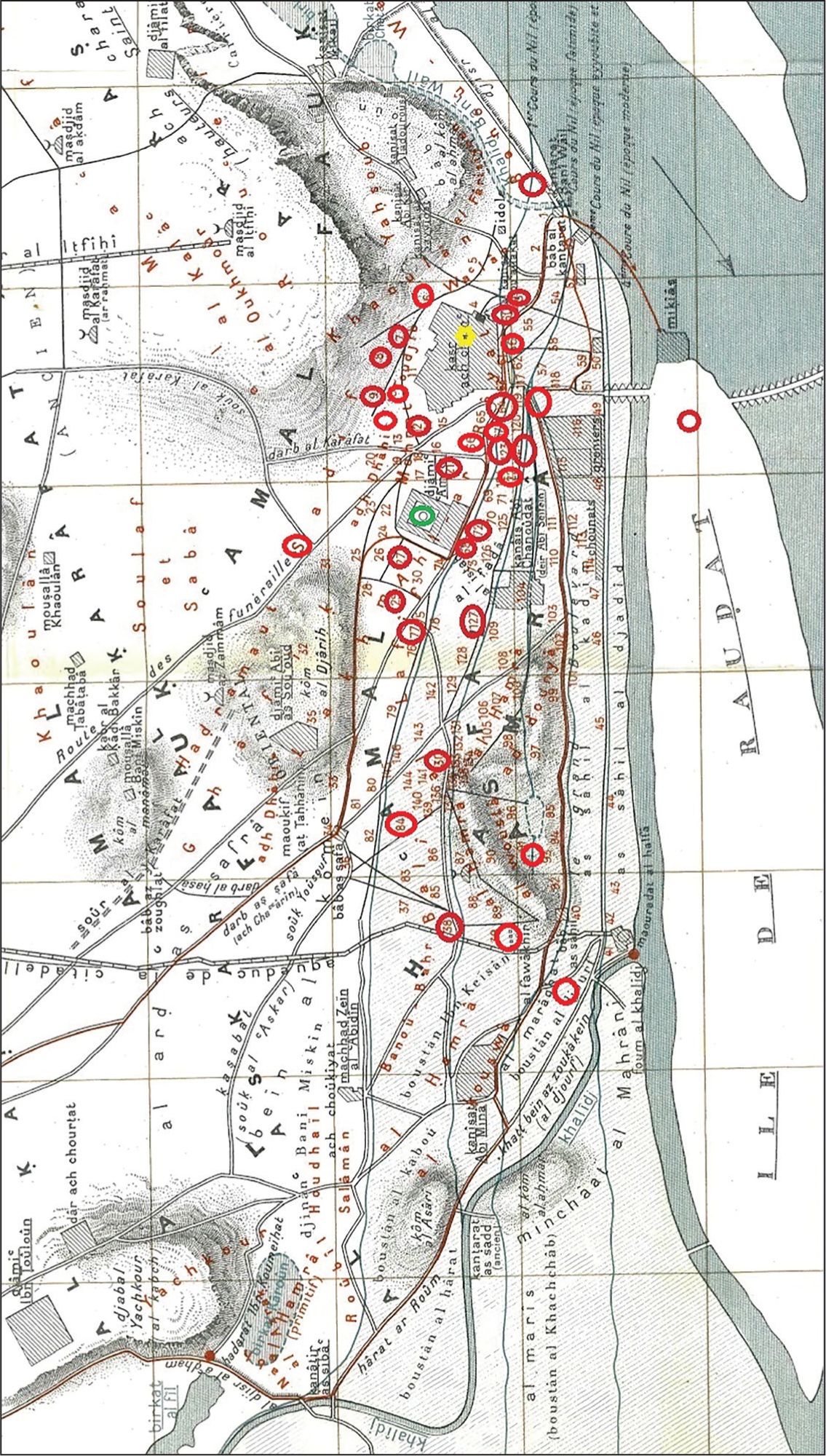
The broad geographical span of Jewish residence is not specific to any particular sub-period in the classical Geniza period. Rather, all these neighbourhoods seem to have been relevant for the Jews documented in the sources, either as sites for residence, commerce and investment or as locations of charitable endowments to the community.
There exists a wealth of information regarding the location of communal institutions as well as the private residences of some of the Jewish community’s leaders and functionaries during the second quarter of the eleventh century. For example, the Jerusalemites’ synagogue stood, as already described, on the southern edge of the fortress. Ephraim ben Shemarya, who was the leader of this community at the time, lived somewhere in the fortress in the early years of the eleventh century—as is attested in a court deed from 1016
The above-mentioned Yefet ben David was also a community official in charge of supervising the kosher butcher shops. During that period the Jerusalemite community had two such shops—neither of which was located in the Roman fortress. 62 Rather, one shop was outside the fortress on its north-western side, in a compound called ‘the Bathhouse of the Mice (ḥammām al-fār)’, an ancient compound already mentioned in ninth- century Muslim sources as a bathhouse built by ʿAmr Ibn al-ʿĀṣ, the Muslim conqueror of Egypt. 63 The second shop was outside the fortress to the south, in a neighbourhood called ‘the Great Market (al-sūq al-kabīr)’.
Yefet, along with other community officials, was also responsible for the apartments and houses endowed to the community, which were used either to house the needy or were leased to tenants whose rent was dedicated to funding communal needs.
64
In the discussed period, there is evidence of at least 12 such properties—four are explicitly described as adjacent to the synagogue or further along the same alley, and the location of two others was probably close to the synagogue as well. But two others were in other alleys in the fortress, at least one of which was located in the northern side of the fortress.
65
One house is mentioned as being in the Mamṣūṣa quarter, in the ‘Street of the Jerusalemites (darb al-maqādisa)’.
66
Another endowment, in the Mahra quarter to the north of the fortress, is mentioned in 1058
If we try to reconstruct ‘the Jewish neighbourhoodʼ in the 1040s and 1050s by following communal functionary Yefet b. David’s daily perambulations around the city, from his house, to the judge’s house, the synagogue, the kosher butcher shops and the various endowments, we find ourselves drawing a meandering path that connects various dots around Fusṭāṭ, rather than concentrating on any one area, in or outside the fortress. Michel de Certeau, in The Practice of Everyday Life, noted the vast difference between a bird’s eye view of a city (such as from a map or from above), a street-level view and the experience of walking through a city. 68 He suggested that a city is best understood from the street level, with preference given to lived experience as enacted within an evolving environment rather than ‘objective’ observance from afar, which creates the illusion of a static city. I suggest implementing the same notion with regard to ‘the Jewish neighbourhood’ of Fusṭāṭ. Instead of imagining a more-or-less well-defined area, viewed objectively from above, the neighbourhood(s) should be seen as a fluid entity, constantly re-created by the various locations spread across a vast portion of the city and the multiple possible routes between them. 69
Following Yefet’s daily route demonstrates that Jewish communal buildings and institutions were spread throughout Fusṭāṭ. Consider the most prominent of these institutions, the synagogue. While the Palestinian and the Babylonian synagogues did stand close to each other in the south-eastern corner of the Roman fortress, there were other synagogues and Jewish places of worship around the city, particularly private ones that took place in the homes of different individuals. For example, an eleventh-century letter from the head of the Palestinian yeshiva, who was in charge of Egypt as well, tries to persuade a Jewish dignitary to cease praying in his own house and pray in the public synagogue. 70 Another anonymous letter requests an esteemed physician to collect charity for the writer ‘from those who pray at your house’. 71 In the middle of the twelfth century, the learned and successful India merchant Abraham b. Yijū had a private synagogue in his house for at least several years, as is attested in a list of donors of oil for its lighting. Tellingly, Goitein comments on this document that ‘small, private places of worship must have been common and were tolerated because of their transitory character’, while in another reference to the same document, Goitein writes that this synagogue could not have been located in Fusṭāṭ, ‘where private synagogues were not tolerated’. 72 The contradiction between the two claims resembles the tension between what scholars find in the documents and what they expect to find. 73 In the early thirteenth century as well, we find evidence indicating that Jews prayed in private homes and study halls. 74 We also know that the community of Qaraite Jews living in the city had a number of prayer halls, the locations of which have yet to be identified. 75
Another important Jewish institution was the mikve or ritual bath. Research, however, suggests that none were constructed in Fusṭāṭ until the very end of the twelfth century, at the earliest. Prior to that, Jewish women purified themselves in any of the many dozens of public baths available throughout the city. 76 Thus, here too, rather than limiting us to the location of any specific Jewish ritual bath that could supposedly serve to identify an area as a ‘Jewish neighbourhood’, the sources point to the use of many dozens of public bath houses, frequented by Jews as well as Muslims and Christians, across the many neighbourhoods of the city. Likewise, the eruv, the Sabbath enclosure that eases the observance of Sabbath commandments, is nowhere mentioned in Geniza documents concerning Fusṭāṭ. 77
Taken together, the abundant information from the classical Geniza period, clearly shows a Jewish presence spread throughout the city. Jews lived and owned property in a variety of neighbourhoods; sometimes they dedicated these properties to the community, so that the community itself had a presence in different parts of the city, far from the two known synagogues. Even communal leaders, when choosing a domicile for themselves, and the community’s administrators, when looking for a place for a kosher butcher shop, did not limit themselves to a denoted ‘Jewish neighbourhood’. On the whole, the overwhelming evidence for the presence of Jews in various neighbourhoods seems to indicate that proximity to a synagogue was not a decisive factor in selecting where to live. It is also probable that Jews in those neighbourhoods prayed in smaller, local synagogues, perhaps in private compounds. Mentions of this type of practice do appear in Geniza documents but would otherwise not, by definition, leave a clear mark in documentary or archaeological material.
The Term ‘the Jewish Neighbourhoodʼ in Geniza Documents from Fusṭāṭ
S. D. Goitein was aware that Jews lived throughout Fusṭāṭ. Rather than abandoning the term ‘the Jewish neighbourhood’, he instead ascribed it to the various neighbourhoods in which Jews lived. For example, when discussing a Jewish apothecary which, in the middle of the twelfth century, was located in a neighbourhood called Sūq Wardān, to the north of the congregational mosque, the presence of ‘at least one other contemporary’ Jewish apothecary there was sufficient for Goitein to call Sūq Wardān ‘a Jewish neighbourhood’. 78
However, if we are to conclude that Sūq Wardān was a ‘Jewish neighbourhoodʼ because we can find references to three or four Jews living there over a time span of more than two centuries, then almost every neighbourhood in Fusṭāṭ was a Jewish neighbourhood, and the term becomes meaningless. Instead, I propose that we rethink our usage of the term ‘Jewish neighbourhood’ and its possible meanings. In this section, therefore, I wish to discuss the notion of the Jews of Fusṭāṭ concerning their place in the city, by examining their use of the term ‘Jewish neighbourhood’.
It is insightful to note that in the corpus of more than 700 Geniza documents I have thus far collected concerning Fusṭāṭ and Cairo, there is not a single reference to a ‘Jewish neighbourhoodʼ in the city, in Hebrew, Arabic or Judeo-Arabic. This term is also not found in any Muslim or Christian sources concerning Fusṭāṭ from the classical Geniza period, including records from the Muslim court preserved in the Geniza. This is especially telling since the term itself was familiar to the city’s Jews, who used it in reference to Jewish life elsewhere, in places such as Alexandria, Jerusalem or Kairouan. Concerning all these cities, and others as well, surviving documentation shows that the Jews living in these locations used the term ‘Jewish neighbourhoodʼ to refer to the areas where they lived, regardless of whether or not non-Jews also resided there. Yet it is completely absent in references to Fusṭāṭ, despite the incredible wealth of texts of various genres, dating to this period, that have survived. This makes it clear that the issue here is not a lack of relevant sources, but that the sources reflect a deliberate choice on the part of the Jews of Fusṭāṭ themselves, who did not perceive their spatial reality as organised along denominational lines. They simply did not see themselves as living in any sort of a ‘Jewish neighbourhood’. Further, to the extent that it can be gleaned from extant sources, this was a notion shared by the city’s Muslim and Christian residents. This again raises the question of whether this term should be used in scholarship about Fusṭāṭ, and if yes, in what sense.
The Jews and Their Immediate Neighbours as Reflected in Legal Deeds
After tackling the issue on the city and neighbourhood level, zooming in even further, to the level of the alley and the courtyard, further strengthens the case against a clear ‘Jewish neighbourhood’ in medieval Fusṭāṭ.
I have assembled a sub-corpus in my database of legal deeds detailing the sale, lease or endowment of real estate in the city during the classical Geniza period. In such deeds, it was customary to identify the property in question by situating it in relation to its immediate neighbours in each of the four cardinal directions. 79 This system is attested to in deeds from both Jewish and Muslim courts. In some documents, this information was not detailed, in others, it was lost over the centuries, but dozens of extant deeds still contain these descriptions, even if partial.
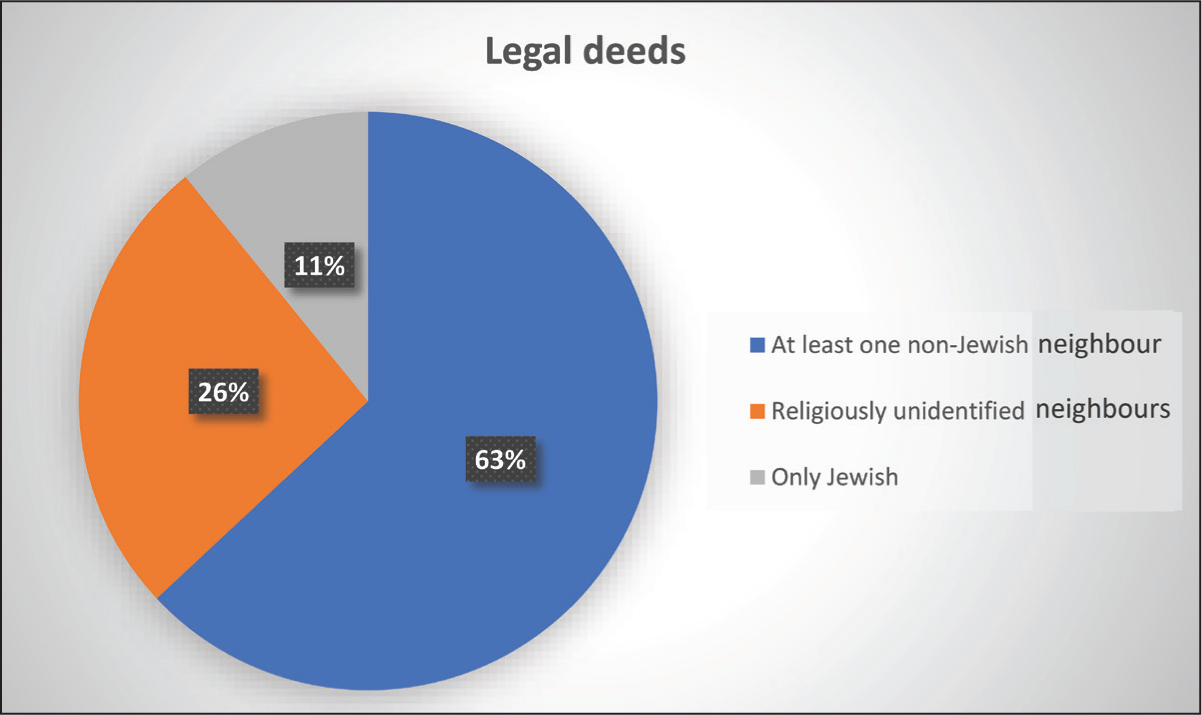
To date, I have assembled 46 such deeds from Fusṭāṭ alone in which at least one of the parties–the seller/lessor or the buyer/lessee–was Jewish, ranging in time from 959
Division of Legal Deeds According to the Religious Identity of the Neighbours Mentioned.
Religious Identity of Neighbours Mentioned in Real Estate Transactions (with the Addition of One Samaritan).
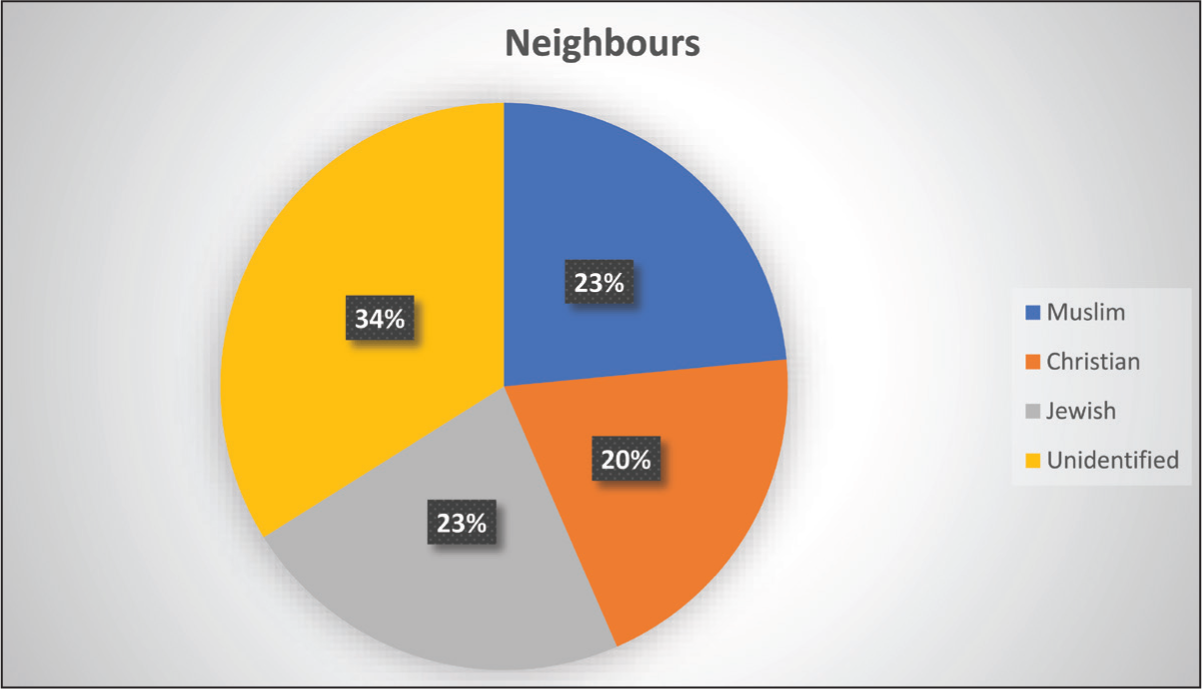
If we take this sub-corpus as representative of religious identity in a given area, we discover that ‘mixedness’ was widespread not only on the neighbourhood level but also in individual courtyards. Jews, Muslims and Christians were often next-door neighbours, with only a wall separating their adjacent courtyards. Even if the exact numbers can be further qualified in future discoveries, the larger picture they present is far removed from the image of a neighbourhood that was ‘predominantly Jewish’, to use Goitein’s words. 80 The findings from this sub-corpus are therefore consistent with the other findings thus far presented.
The proximity of neighbours of different religious affiliations was often even closer. Geniza documents of several genres, and other contemporaneous sources, attest to Jews, Muslims and Christians living in and owning houses in the same courtyards or buildings. Generally speaking, each courtyard consisted of several apartments or even individual rooms, on one or more floors, all built around a central open yard. Other houses were free-standing buildings, not attached to courtyards, which could also consist of several apartments on several floors. 81 Ownership rights were customarily defined as ‘shares’, with each asset being composed of 24 ‘shares’, which could be sold, leased, willed and given as part of a wedding gift and so on. 82 This means that more often than not, people owned just a few ‘shares’ of the structure.
For example, a deed from the Muslim court from 1118
Thus, the individuals in the above-mentioned documents were not only neighbours but were actually co-owners of the courtyard, house or shop. This is expressed in the legal-technical term ‘shared, not dividedʼ that occurs in most of the deeds of sale or lease from Egypt and elsewhere in the Middle East, from both Jewish and Muslim courts. 85 The term means that the asset discussed has not been parcelled, and so the shares cannot be located in any specific part of the asset. In other words, when ‘Alī ibn Muḥammad bought a quarter of the courtyard from his Jewish neighbour, it was not any specific quarter, but rather a quarter of the rights of the entire courtyard. This was also the case when Peraḥya mortgaged the two-thirds of the two shops he co-owned with the Christian oil-maker.
The fact that the assets discussed were ‘shared, not dividedʼ had immense implications on neighbourly relations and on inter-religious encounters in daily life. It meant that neighbours or co-owners had to agree on every change in the asset itself—a change not only in the ‘public areasʼ such as the open court, the storerooms and so forth but also on the individual dwelling units, since they were not owned individually but were ‘shared, not divided’. This applied also to expenditures on repairs, profits from rent, approval for leasing it out, as well as the right of pre-emption, attested in both Jewish and Muslim law, according to which the neighbour-co-owner had the right to prevent the sale of his partner’s share to another person, and, instead, buy it himself for the same price. 86
This shared ownership and its implications can be demonstrated, for example, in an account of expenditures on a compound partially endowed to the Jewish community. The community carried out renovations on its part of the compound, the costs of which were covered equally by all partners in the property, including a Muslim man named Makārim al-Ḥājj, whose name means he had performed the religious duty of pilgrimage to Mecca. 87 This is not the only case I have found of this type of shared ownership. 88 At this point, it is almost redundant to state that Jews, Christians and Muslims rented houses and parts of houses from each other and that members of one religious community dwelled in property endowed to another community. 89
Comparison
This degree of intermingling between Jews, Muslims and Christians in their residences was not unique to Fusṭāṭ. Evidence from the Geniza documents indicates that this was the case in Alexandria, Jerusalem, Damascus, Tyre, Kairouan and other cities as well. Members of all three religions lived in close proximity to each other—in the neighbourhood, the specific alley and even the individual courtyard. A Geniza letter from Jerusalem tells how the writer found an apartment for rent, which he describes as ‘neighbouring the synagogue’, whose owner was Muslim.
90
A Muslim court record from Damascus from 1112
In Alexandria, in contradiction to Fusṭāṭ, the Jews used the term ‘the Jewish neighbourhoodʼ to describe their place in the city and even made use of the definitive form, ‘the neighbourhood’. 93 Although the Jews of Alexandria definitely had a notion of a specific place in the city that was theirs, or identified with them, the Geniza documents point to at least two neighbourhoods as the possible ‘Jewish neighbourhoodʼ—al-Qamra and Bir Jabr. 94 Which of these two was then ‘the Jewish neighbourhood’, in the definitive form? Geniza documents further attest to Jews living in at least two other Alexandrian neighbourhoods, as well as other Jews who lived outside the city walls. The documents, as well as other contemporaneous sources, also mention Christians and Muslims, and at least one mosque and one church, as being located in the two neighbourhoods named above. 95 Goitein wrote succinctly in a footnote that ‘the “Jewish neighbourhood” (quotes in the original) of Alexandria should not be understood as the name of a locality’. 96 I understand Goitein’s comment as meaning that the Alexandrian documents referring to a ‘Jewish neighbourhood’ in Alexandria refer not to a specific place in the city, but rather to a notion of ‘our place’.
In Alexandria, then, according to Goitein, ‘the Jewish neighbourhood’ is a metonymy rather than a locality. But if we accept this observation, as I think we should, it means that the term ‘the Jewish neighbourhood’ should not be understood as necessarily reflecting a particular spatial reality. Rather, as Menahem Ben-Sasson, who studied the Jewish community of Kairouan, suggested, we should talk instead about Jewish neighbourliness, that is, close relations with immediate neighbours. 97 This seems to me like a better approach which can yield interesting results and further questions, once we abandon the quest for any specific, ‘predominantly Jewish’ neighbourhood.
As some scholars have already noted, previous scholarship sometimes used concepts borrowed from the Jewish experience in Europe, thus hindering our ability to gain a clear picture of the situation in the Islamicate world. 98 We have seen this above in the looming image of ‘the ghetto’. While an examination of the similarities and differences between Jewish urban residences in Christian Europe versus the Islamic Mediterranean during the Middle Ages is thought-provoking, the study of the issue in the Islamicate world should stand on its own and be defined by its own terms. Interestingly, with regard to European Jewish communities, recent scholarship has begun to challenge a number of entrenched notions, including questions of coercion versus voluntary Jewish concentration, and a more extensive Jewish participation in urban life than had previously been assumed. 99 If, as scholarship has revealed, individual Jewish families in medieval Christian Europe were living on their own in the countryside, or small long-standing Jewish communities made do without a formal synagogue, should we be surprised to find Jewish families spread out in neighbourhoods throughout a medieval Islamic city, rather than clinging close to a known synagogue?
Conclusion
In conclusion, it can be said that the accepted scholarly view of ‘the Jewish neighbourhoodʼ of medieval Fusṭāṭ is unfounded. The import of this determination is not that the neighbourhood of the Roman fortress was less homogeneous or that Jews owned private residences in other areas of the city. The information assembled calls not for a quantitative change, but a qualitative one. There was no ‘Jewish neighbourhood’ in Fusṭāṭ in any accepted meaning of the term. The two synagogues that we are aware of indeed stood close to each other in the Roman fortress, but other synagogues also existed, including those of the Qaraites as well as smaller synagogues in private homes. Other manifestations of Jewish communal life were also spread across the city. Likewise, the demarcation between private residences and communal landmarks was not as clear as previously thought, especially with regard to community leaders, important merchants and government officials, all of whom lived in various locations and whose homes functioned as meeting points, communication centres for correspondence, sites of court sessions and so forth.
This understanding leads us to look more profitably for the Jewish presence in a city, rather than the Jewish neighbourhood. This can be achieved, returning to De Certeau, by looking for the dynamic actions of the Jews in a fluid urban environment, rather than trying to pinpoint Jewish activity to a particular geographic location. As revealed in the documents from the Geniza, the Jews of Fusṭāṭ, like those of other medieval Islamicate cities, were active throughout their city; it belonged to them, they were its residents, its sons, the city was their homeland, just as it was for members of other religions. This is seen in the many expressions of attachment to it, and to manifestations of shared identity that transcended religious boundaries. 100
While the immediate goal of this article was to reveal the extent to which the Jews were embedded in the urban environment of Fusṭāṭ, this approach can and should be applied to the analysis of other urban centres in the Islamic Mediterranean. Fusṭāṭ is not the only city with a significant Jewish community but for which no ‘Jewish neighbourhood’ is mentioned. Ramla, a commercial centre and provincial capital of central Palestine, is another example. Furthermore, other cities, for which references to a ‘Jewish neighbourhood’ do exist, should also be re-examined in order to determine what exactly was meant by this term in the eyes of the Jews, as well as the Muslims and Christians, who lived there; and what were the spatial manifestations of this ‘neighbourhood’ within a reality that all the evidence indicates was spatially ‘shared, not divided’.
Footnotes
Declaration of Conflicting Interests
The author declared no potential conflicts of interest with respect to the research, authorship and/or publication of this article.
Funding
The author disclosed receipt of the following financial support for the research, authorship, and/or publication of this article: The publication of this article was supported by the ‘Beyond the Elite: Jewish Daily Life in Medieval Europe’ research project, funded by the European Research Council (ERC) under the European Union’s Horizon 2020 research and innovation programme under grant agreement No 681507 and the Israel Science Foundation Breakthrough Research Grant ‘Contending with Crises: Jews in Fourteenth Century Europe’ 2850/22, PI Elisheva Baumgarten. This article is part of my research on Urban life and Inter-religious encounters in the medieval Middle East, as a Martin Buber postdoctoral fellow at the Hebrew University of Jerusalem. Parts of the research were presented in various forums, and I benefited from their participants’ comments, specifically at the Princeton Geniza Lab led by Prof Marina Rustow, and the research group on Jewish Ritual and Space at Bar Ilan University, led by Prof Debra Kaplan. I thank my adviser, Prof Miriam Frenkel, as well as the editors of this special issue, Prof Elisheva Baumgarten and Hannah Teddy Schachter, who read drafts of this article and helped me clarify and sharpen my arguments. I also thank both anonymous reviewers for their thoughtful questions and suggestions. All mistakes are mine.