




Abstract
The trade routes of late antique and early medieval Eurasia conducted far more than goods. Exchanges occurred between a number of prominent book cultures with origins or, at least, ties to the Indian, Iranian and Chinese worlds. A Christian scroll (Pelliot chinois 3847) discovered in the famed Library Cave near Dunhuang is the product of such interactions in both its materiality and its written content. This Chinese manuscript of East Syriac Christians bears three texts, at least some of which were composed during the late eighth century of the Tang period (618–907). This article focuses on three terms used in the postscript of P.3847. Although a relatively well-known Dunhuang manuscript, the ‘bookish’ terminology of the postscript deserves consideration in its own right; this includes the only known occurrence of the Chinese term bei pijia 貝皮夾. From this study, insight is gained into both the semantic depth of these Chinese terms and the Christian appropriation of them.
The Chinese–Christian manuscript known by its modern pressmark Pelliot chinois 3847 (hereafter P.3847) bears witness to the meeting of several medieval Eurasian book cultures, 1 namely, Christian book culture coming from medieval Central Asia and Iran and even further afield, Buddhist book culture originating in India and Central Asia, and the book culture of China. 2 In the scroll’s modest postscript of just four lines, we find common Chinese ‘bookish’ nomenclature, words that not only describe bibliographic phenomena but also reflect the cultural importance of these written objects. This terminology also shows the ongoing assimilation of numerous aspects of Buddhist book culture within China, including its reappropriation in the Pelliot manuscript’s distinctly Christian context. In the case of bei pijia 貝皮夾, this adaptation process has produced what remains a hapax legomenon (the only occurrence of a term within a certain body of writings) in the voluminous Chinese written corpus. Although the importance of this small scroll was recognised almost immediately after Paul Pelliot (1878–1945) obtained it from the Mogao Library Cave in 1908, 3 the many modern translations have mostly glossed over the prominent use of ‘bookish’ vocabulary in the scroll’s postscript. This brief study focuses on three such terms—jing 經, beiye fanyin 貝葉梵音 and bei pijia—and shows how their usages reflect the multiple book cultures then operating in Tang China (618–907) and immediately thereafter, while also expressing particularly distinctive aspects of Christian book culture.
First and foremost, the scroll is a product of the Church of the East or East Syriac Church (formerly known as the Nestorian Church) in China, as seen in its three distinct, though also interrelated, texts. Upon unrolling the manuscript, the first text is a Chinese translation of the ubiquitous Gloria hymn, and it remains the only complete and direct translation of a known Christian work into Chinese from the so-called Jingjiao 景教 Documents, which date from the seventh to the early eleventh century AD. 4 The next text, the Zunjing 尊經 (Scripture of the Honoured), contains an invocation of the Trinity before giving a list of honoured Kings of Doctrine (fawang 法王) followed by the titles of venerated scriptures (jing 經) in Chinese, including an abbreviated form of the Chinese title of the Gloria hymn. The final text is the note or postscript, which provides rare historical background on the translation of Christian works into Chinese, and it is also the only example of this style of writing within the confirmed Jingjiao corpus.
While full treatment of each term is beyond the scope of the present article, the full postscript reads as follows
5
:
謹案諸經目錄,大秦本教經都五百卅部,並是貝葉梵音。唐太宗皇帝貞觀九年,西域太(大)德僧阿羅本屆于中夏並奏上本音。房玄齡、魏徵宣譯奏言。後召本教大德僧景淨,譯得已上卅部卷,餘大數具在貝皮夾,猶未翻譯。 I respectfully submit that according to the catalogue of scriptures (jing), the scriptures (jing) of the teaching from Da Qin altogether are 530 works (bu 部), and all of these are pattra leaves [in] foreign [liturgical?] tongues (fanyin 梵音). In the ninth year of the Zhenguan era of Tang Emperor Taizong, the Great and Virtuous monk Aluoben of the Western Regions reached the Central Xia (China) and submitted a memorial to the throne in his own tongue. Fang Xuanling [579–648] and Wei Zheng [580–643] translated and expounded the memorial. Afterwards, [the court] summoned the Great and Virtuous monk Jingjing of this teaching, who translated onto scrolls thirty of the above mentioned works. The remaining majority is entirely on pattra [with] leather clamps (bei pijia 貝皮夾), and these still have not been translated.
In transmitting a version of the historical narrative of Aluoben, the text of this postscript is one of three surviving sources—and it is unusual to have so many corroborating accounts—on Christianity in China during this period. 6 Furthermore, these Christian jing comprise a key motif in all three of the surviving narratives on Aluoben. Yet in modern translations of these Aluoben narratives, there have been two particularly common but misleading renderings for jing. 7
Some of those translations misleadingly render jing as sūtra. 8 As Salguero has noted, the Chinese term jing and Sanskrit sūtra are in fact ‘not interchangeable’, rather the Sanskrit term specifically denotes a subcategory within Indian Buddhist literature, and the Chinese term serves as a catch-all for many different types of texts including secular ones. 9 Thus, we should consider whether the Christian context warrants a correlation with this subcategory. As will be seen, the usage of jing within the stele’s text broadly refers to venerated texts rather than specifically denoting an Indian Buddhist subcategory or something parallel. Moreover, while the stele along with other Jingjiao texts liberally borrows Buddhist terminology, jing had widespread currency long before the arrival of Buddhism and was itself appropriated by Buddhists for a Chinese context.
A similar hermeneutical pitfall would be to read a particular Christian understanding where it is not indicated by the text. For example, reading jing as interchangeable with canonised Christian Scripture—with a capital ‘S’—would be overstepping the indications of the text as well as the cultural milieu in which it was composed. 10 In one instance, the Xi’an Stele probably refers to canonised Scripture when it says: ‘As regards scriptures, [Jesus the Messiah] left behind twenty-seven works’ (jing liu nianqi bu 經留廿七部) 11 ; these are almost certainly the twenty-seven canonised ‘books’ of the Christian New Testament, as then recognised by the Latin and Greek churches. 12 Because of both the words that accompany that Chinese inscription and the preciseness of ‘twenty-seven’, this particular instance of jing certainly suggests that canonised Christian texts are being referred to within the broad semantic framework of jing, even if this remains puzzling for an East Syriac context. 13 Having seen how the stele treats the single instance of what are probably canonised Christian texts, we can now consider whether the stele’s subsequent occurrences of jing refer to canonised Christian Scriptures.
The answer is probably both yes and no. The four remaining instances of jing in the stele all occur in a different context, in reference to the jing brought from afar to China. Unlike the probable reference to the New Testament mentioned above, the content of these four instances of jing is not specifically described. It surely included some or all of the twenty-seven works mentioned in the seventh column of the stele, and yet, in the absence of more details, it would seem remiss to conclude that this was the total extent of what jing could denote in the stele. Therefore, for these later instances, how should jing be understood? For an answer pertinent to both the stele and the Pelliot scroll, it is perhaps best to return to considering jing as ‘a catchall word for a variety of genres of scripture and secular classics’. 14
In discussing the Classics of Chinese literature, Schaberg notes, ‘The semantics of the “classic” (jing) in Chinese intellectual history derived from notions of continuity, cultural reproduction, and fidelity to models from the past.’ 15 These comments underscore the broad but authoritative semantic sweep of jing and explain, in part, its widespread usage by Ruists (Confucianists), Daoists, Buddhists, Manichaeans, Christians and others—though with their own very distinct nuances. Again, we must avoid reading something into the text that is alien to that particular cultural framework or that detracts from how the word might have generally been understood.
In several translations of the postscript and the stele, the word ‘books’ has been used for the jing brought by Aluoben, and in some, it is used interchangeably with ‘scriptures’. While jing are certainly books, Schaberg’s statement quoted above reminds us that, semantically, jing are so much more. In line with Schaberg’s summary of jing, the stele’s narrative speaks to both the physicality of these books (e.g. their transportation and physical translation) and their content (e.g. the authority and importance of these texts), and neither emphasis is ever completely exclusive of the other. Thus, the term ‘books’—while clearly denoting materiality—does not, of itself, denote content, nor does it indicate a transmitted corpus. Indeed, these jing do not simply refer to just any writings, but ones that have been carefully handed down and deemed worthy of the demanding commitment involved in such a transmission process. In short, jing does not simply denote ‘books’. Additionally, a word like ‘writings’ while fairing slightly better in referring both to materiality and content, yet, without additional context or modification, lacks, in itself, the reference to a tradition of transmission, which distinguishes jing from any ordinary written composition. 16
On the other hand, the word ‘texts’ pertains to content with little if any connection to materiality 17 ; it also, by itself, lacks any indication of a transmitted corpus. The term ‘scriptures’ indicates a transmitted, authoritative corpus. Perhaps this word’s greatest disadvantage is that in its capitalised form, ‘Scriptures’, it exclusively denotes canonised Christian Scripture; this would exclude a vast corpus of Christian writings used regularly by lay and clergy alike but not possessing canonical status. 18
For now, I have settled on ‘scriptures’ as a term to be used here, agreeing with the preference of Pelliot and others 19 ; I use it with a lowercase ‘s’ and without the definite article ‘the’—unless indicated from within the text. This word compactly conveys the continuity of a tradition and indicates an authoritative literary corpus—things implicit to the stele’s original audience. Furthermore, it would be hasty to assume all of these ‘scriptures’ were of a strictly religious nature, as might be understood by a modern audience 20 ; rather, it is not a stretch to imagine how all the foreign texts in the possession of followers of this teaching might have been lumped together as jing. Additionally, according to P.3847, the vast majority of these works remained without a Chinese translation, thus their content would remain a mystery to those unable to read the original language(s).
The Pelliot scroll, like the stele, unsurprisingly uses the word jing, ‘scriptures’, to refer to the books of these Christians. These jing of Da Qin are said to total ‘five hundred and thirty works’ (wubai sa bu 五百卅部) with the character bu serving as a general measure word for the specific number of these jing that is given. While jing refers to the entire corpus, bu specifies the individual texts that comprise this corpus, though the latter remains difficult to define. As Lin Wushu cautions, it is not clear what conventions or exact definitions were intended for bu, nor exactly what connotations the term possessed at the time, thus it is ill-advised to treat this number and the term bu with too much exactness (given the information we currently have). 21 The occurrence of bu in the stele for what are likely to refer to the twenty-seven books of the New Testament clearly shows that this word does not represent a single physical book, since canonised Scriptures would rarely be found in a single massive codex. Instead, thematic collections (e.g., the Gospels, the Pauline Epistles) were often bound together in a single manuscript. As exemplified by P.3847 itself, which contains two distinct literary works in one scroll, the 530 works (bu) that are referred to could have been physically distributed in any number of ways. It also remains uncertain how literal this number was to be taken. While the postscript’s use of jing places Christian books in a familiar domestic category for a Chinese audience, the text also highlights the foreignness of these books that came from afar, and the terms used are curious.
At the end of the postscript’s first column, the author specifies that ‘all of these [scriptures of Da Qin] are pattra leaves [in] foreign [liturgical?] tongues’ (bing shi beiye fanyin 並是貝葉梵音). This phrase appears to address simultaneously both the materiality and content of these books.
22
Beiye 貝葉 ‘pattra leaves’ came from India. Bei is the common abbreviation for beiduo 貝多 (Middle Chinese pajH-ta), the transcription of the Sanskrit word pattra denoting ‘the leaves of the palmyra palm (Borassus flabellifer) used as writing material, especially for Buddhist texts.’
23
The ninth-centuryYouyang zazu 酉陽雜俎 (Miscellaneous Morsels from the South Slope of You Mountain) provides us with a roughly contemporary description of these pattra:
24
貝多,出摩伽陀國,長六七丈,經冬不凋。此樹有三種,一者多羅娑力叉貝多,二者多梨婆力叉貝多,三者部婆力叉多羅梨,並書其葉。部闍一色取其皮書之。貝多是梵語,漢翻為葉,貝多婆力叉者,漢言樹葉也。西域經書用此三種皮葉,若能保護,亦得五六百年。 Beiduo (pattra) comes from the Kingdom of Magadha; [the tree] grows to six or seven zhang (approximately 3 meters) and passes through the winter without withering. There are three kinds of this tree: the first is the duoluo suolicha beiduo, the second is the duoli policha beiduo; the third is the bu policha duoluoli. In the case of all three trees, one can write on their leaves; bu she (the lead master?) yise 部闍一色 picks leaves on which to write. Beiduo is a Sanskrit word; in Chinese, we render this as ye 葉 (leaf). Thus beiduopolicha is ‘the leaves of trees’ in the Chinese language. The scriptures of the Western Regions use these three kinds of leaves (piye 皮葉); if cared for, they will last five to six hundred years.
These pattra books have been linked to the so-called pothi book form, a ubiquitous book form in many parts of India and Southeast Asia. 25 From extant examples of pothi books made of pattra leaves, the leaves were cut into oblong sheets and stacked one on top of the other. A hole was made through the middle of these sheets. A string was run through this hole and tied, on either end, to boards such as those made of bark. At Dunhuang and probably elsewhere in China, pothi books were made of oblong sheets of paper and not actual palm leaves. From the beginning of the Tang, Chinese texts begin to reference fanjia 梵夾, literally ‘Indian (or foreign) clamps’—jia denoting something held together on two sides. And yet, the inexactness of this term is notable as seen from a Sui–Tang source.
Fang Guangchang 方廣錩 points to the Daye zaji 大業雜記 (Miscellany of the Daye era)
26
compiled by an official named Du Bao 杜寶 who served the Sui (581–618) and Tang regimes, as containing the earliest extant occurrence of fanjia in a non-Buddhist work
27
:
有承福門即東城門南,門南洛(雒)水有翊津橋,通翻經道場。新翻經本從外國來用貝多樹葉,葉形似枇杷,葉面厚大,橫作行書,約經多少,綴其一邊,牒牒然,今呼為「梵筴(夾)」。 There is the Gate of Receiving Blessing (Chengfu men), which is the southern gate of the Eastern Wall; south of this gate the Luo River (Yellow River tributary) is the Yi Bridge, which leads to the ritual site for the translation of scriptures. New translations of scriptures originate from foreign kingdoms and use beiduo (pattra) tree leaves; the shape of these leaves is like the leaves of the pipa [tree] [the loquat tree, Eriobotrya japonica], the leaves [of the beiduo] are thick and large and used horizontally to write on; the number of scripture [leaves] that will be required is estimated, and they [multiple leaves] are joined together on one side, creating a ‘piled-up sight’. Nowadays, these are called fanjia.
This detailed and engaging account of the capital city of Chang’an predates the beiduo description in the Youyang zazu by roughly two hundred years. Although the text gives a succinct description of the materiality of foreign scriptures and the then popular name for that book form, it also raises additional questions. Sounding closer to a description of a codex than a pothi, the joining of the leaves ‘together on one side’ describes a binding distinct from known examples of the pothi in China. Thus, while in some ways similar to the pothi, we are dealing with another unique book form. Which book form is it? Did fanjia serve as a catch-all for various kinds of foreign, non-scroll forms?
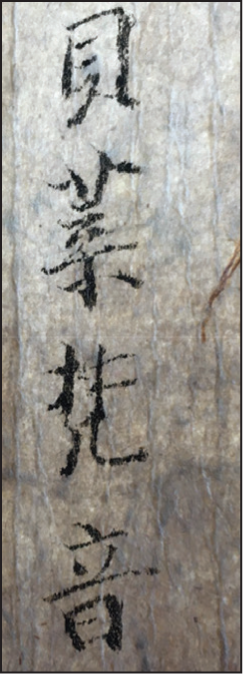
Beiye fanyin in P.3847 with a variant for ye 葉, author’s photograph courtesy of the Bibliothèque nationale de France.
For understanding the meaning of bei in P.3847, the use of pattra by Christians would be remarkable for a number of reasons, chief of which is the virtual absence of other textual references or archaeological discoveries of Christian texts on this writing material or associated form. There are a few partial exceptions from Turfan. The Sogdian manuscript E19 and a few Syriac texts are written on oblong sheets of paper distinct from the typical shape of sheets used in the Turfan Christian codices. Yet, none of these show evidence of being bound to other sheets via a cord running through the middle of the sheet nor is there any circle present nodding to the pothi book form. Secondly, a superficial reading would suggest that this sizable corpus was produced somewhere in India. While there were a number of large Christian communities in India at this time, the known production centres for East Syriac manuscripts were then in the Middle East (e.g., Merv). Later on, places in Central Asia, such as Bulayïq, may have produced their own manuscripts. An Indian place of origin for Aluoben and his books would also challenge the available evidence suggesting Aluoben came from somewhere in the Persian Empire or Sogdiana.
Outside of Turfan, extant Church of the East manuscripts from before and immediately following these books’ arrival at the Tang court in 635 are on parchment, not paper or pattra. The studies of both Dickens and Hunter and Coakley point to manuscripts from Turfan as the earliest extant East Syriac manuscripts on paper, and the earliest known example of these, MIK III 45, could be from the late eighth century. 28 Before these findings, the Church of the East was not known to have begun to use paper until the tenth century. If paper is actually being referenced in the postscript, this would be, by far, the earliest account of paper usage by East Syriac Christians and, given that these books were clearly said to come from afar and were not produced within Tang China, this could even call into question our current understanding of the spread of paper production in general. As seen below, textual evidence within and without our manuscript clearly shows—with one important, possible exception—that terms describing what were obviously foreign things were meant as catch-alls, intended, by convention, for a range of applications, not to be read as specifically tailored terms.
The term fanyin 梵音 can be literally understood as ‘foreign sounds’.
29
In texts from the period of our scroll, fan is typically associated with a myriad of things all originating from India (e.g., ‘India’ as a general geographic entity, Sanskrit, Brahmans, certain Buddhist concepts, and so forth). When employed in the context of geography, it could also be used for an even broader foreign geography than simply India. Here I would like to scrutinise carefully some occurrences of fanyin in reference to foreign languages, especially in their spoken forms. The clear sacred context also suggests that fanyin was associated with ritual use. The Song-era Taiping guangji 太平廣記 offers several relevant examples. Cited as sourced from the Bianzheng lun 辨正論 by Fa Lin 法琳 (572–640), a story from the Jin 晉 (266–420) period transmitted in the Taiping guangji, entitled ‘Wang Min’s Wife’ (Wang Min qi 王珉妻), associates fanyin with the foreign languages of the Western Regions and also has clear associations with the sacred
30
:
晉瑯琊王珉,其妻無子,嘗祈觀世音云乞兒。珉後路行,逢一胡僧,意甚悅之。僧曰:「我死,當為君作子。」少時道人果亡,而珉妻有孕,及生能語,即解西域十六國梵音,大聰明,有器度。即晉尚書王洪明身也。故小名阿練,叙前生時,事事有驗。 Wang Min of Langya
31
[at the time] of the Jin [dynasty]—his wife was barren, and he once prayed to Avalokiteśvara and begged for a son. Afterwards, Min was traveling on the road and happened upon a hu [foreign] monk, who liked Min very much. The monk said, ‘When I die, I will assume the role of your son.’ A short time later, the monk did indeed die, and Min’s wife became pregnant. At birth, [the boy] was able to speak, and could comprehend the fanyin [plural?] of the sixteen kingdoms of the Western Regions and was greatly astute and exuded competency; this person became none other than the Jin Minister (shang shu 尙書)
32
Wang Hongming. For this reason his childhood nickname was Alian [a term of endearment for a Buddhist monk]. When he recounted his previous life, everything could be confirmed.
Min’s childless wife had miraculously become pregnant with a baby boy, who was the reincarnated hu monk (huseng 胡僧) whom Min had met on the road. Because the term hu was often used very generally, we know little about the monk’s origin other than that he was a foreigner, most likely of an Iranian background hailing from somewhere in the Western Regions. In some cases, hu was specifically used to reference Sogdians, though this cannot be confirmed from the sparsely described context.
For the story’s audience, the description of the infant boy’s ability to ‘comprehend the fanyin of the sixteen kingdoms of the Western Regions’ alludes to the boy’s past life as a hu monk; as does his nickname, Alian; thus, fanyin, in this context, appears to possess additional sacred connotations. Additionally, fanyin is probably a later interpolation as this term seems to appear in the literature centuries after the Jin. 33 Not only is fanyin clearly referring to foreign languages, especially spoken language, but this attestation also demonstrates that this term could include non-Indic languages from the Western Regions as well. This example is also relevant as the postscript in P.3847 identifies Aluoben with the Western Regions. Furthermore, I have yet to find a case where fanyin is not used in a sacred context. The postscript’s use of fanyin appears to emphasise the conspicuous oral use of these texts from Da Qin, which would be expected for texts employed in liturgy. Thus, I have tentatively rendered fanyin as ‘foreign [liturgical?] tongues’, to account for the probable specificity of this term in pointing to the foreign languages of the Western Regions associated with use in liturgy. 34
The second occurrence of yin in the phrase benyin 本音, ‘his own tongue’, also refers to the foreign language spoken by Aluoben, which he used to submit ‘a memorial to the throne’. By itself, yin occasionally refers to ‘language’, though again its use here suggests an emphasis on the more general sounds characteristic of a language or languages. For example, in Yuan Zhen’s 元稹 (779–831) poem, ‘The Western Barbarian Captive’ (fu rong ren 縛戎人), composed in 809, a captive of the Tibetans says that Han loyalists under Tibetan rule ‘regularly teach their grandsons to emulate the local accent’ (chang jiao sunzi xue xiangyin 常教孫子學鄉音). 35 In the case of fanyin, the presence of fan probably gives it a sacred association, originally derivative of its associations with Indian Buddhism.
While fan contained strong associations with ‘all things’ originating from or associated with India, I am unaware of any arguments suggesting that these books came from India or that the language of these books was an Indic language. Indeed, we are clearly told that this teaching came from Da Qin. Additionally, the evidence within the text as well as from the closely related bilingual Chinese–Syriac Xi’an Stele both point to Syriac, the liturgical language of the Church of the East, as the most likely foreign language being referred to. In his translation of this postscript, Moule commented in a parenthetical note: ‘(Persian or Syriac?)’. From the texts unearthed at Turfan, and from well-noted East Syriac conventions in general, it is also possible that the books discussed in the note included bilingual works or at least bilingual rubrics (e.g., a Syriac text with Sogdian notes) reflecting the vernacular of the particular local people(s) or a lingua franca like Sogdian. Some scholars have even suggested that the term fanyin was simply used in error. 36 Why, then, was Syriac not simply given its own distinct designation?
To answer this question, it is pertinent to examine how medieval Chinese writers wrote about the languages they encountered in foreign scriptures. Unlike some, Lin Wushu does not view the aforementioned nomenclature as an error, rather a convention of that time. 37 In support of this statement, Lin cites a Manichaean text from Dunhuang, which uses fan as part of fanwen 梵文 (fan writings) and in a context clearly referencing writings from Western and Central Asia. The exact term fanyin occurs twice in Chinese Manichaean texts: once in the Compendium of the teachings of Mani, the Buddha of Light, and once in the Xiabu zan 下部讚 (known as ‘the Hymn scroll’). For these two Manichaean usages, Mikkelsen renders this term as ‘sounds of a foreign language’, which would implicate Parthian and Middle Persian. 38
As regards the nomenclature for such Buddhist texts written in Indian languages, Daniel Boucher observes, ‘[E]ven very learned Chinese Buddhist scholars did not understand the relationship between these [various Indian] scripts and the languages they transcribed’.’ 39 In differentiating between the two common medieval names for the foreign scripts of these Buddhist texts (hu 胡 and fan 梵), Boucher cautions that while some Buddhist colophons distinguished ‘manuscripts by script [that] should not lead us to the conclusion that early Chinese Buddhists had clear and accurate understandings of the languages of these source texts’. 40 If the comparatively ubiquitous Indic languages and scripts (then already known in China for almost a millennium) were typically not differentiated beyond very general nomenclature, it is unsurprising that Syriac did not receive a distinct rendering. Indeed, as Lin Wushu says, this was simply the convention of the day. Finally, and perhaps most pertinently, the court-commissioned Christian translator Jingjing 景淨 is mentioned in a Buddhist text as being unable to read Sanskrit (fanwen 梵文). 41
In summary, the word fanyin in P.3847 has been borrowed as a convenient and familiar term to refer to the foreign language(s) of these Christian books. Indeed, within the Jingjiao corpus and other concerned texts, the Chinese nomenclature denoting East Syriac Christians and their origins does not allow for easy identification. Among medieval Chinese writers dealing with the foreign languages of sacred scriptures, there was no impetus for breaking convention and applying a distinct rendering for the Syriac language or script. Even in P.3847, there was no ‘language of Da Qin’ or ‘script of Da Qin’ but rather the more ubiquitous fan, a common catch-all for the numerous languages of the Western Regions. As mentioned above, this is complicated by the fact that Church of the East documents were often multilingual. Moreover, as Boucher’s observations have shown, Chinese writers did not consistently and accurately distinguish between the far more familiar foreign scripts of Buddhist texts. Thus, the writings of these Christians were also called fanyin.
Continuing in the final fourth column of the note, the author provides additional details on the material aspects of the untranslated foreign books. Here we should consider whether the knowledge of a unique book form was also transmitted along with the written content of these books. Unlike the works Jingjing translated and placed in scroll form, the remaining untranslated works were physically all residing ‘on bei pijia’ (ju zai bei pijia 具在貝皮夾); the word zai in this phrase serves its common locative function and was notably not employed in column one (before beiye fanyin). The occurrence of pattra leaves in column one, when used with fanyin, certainly includes materiality, but it seems to be used in order to categorise the genre or type of corpus (e.g., a foreign liturgy). The second occurrence of pattra focuses on the material location of these texts. The addition of the character jia 夾—to be discussed shortly—further confirms that the author intended to communicate different ideas for the two respective occurrences of pattra. In other words, unlike at least one modern translation’s rendering, the note’s author is not merely repeating information. Given the economical use of words in the rest of the note, this would be exceptional in itself.
As the vast majority of the texts had still not been translated, they remained in their original formats, ‘pattra [with] leather clamps’ (bei pijia). In this case, the well-attested abbreviation bei is most likely being used for beiye (pattra leaves). Pi 皮 can generally be translated as ‘skin’ or the outer surface of an animate or inanimate object. ‘Animal hide’ and ‘pelt’ are also attested denotations of this character. 42 Saeki’s translation renders this character as ‘parchment’ and Moule similarly has ‘leather’. 43
Parchment refers to a product made by stretching and drying the skin of an animal (usually a sheepskin, goatskin or calfskin) and was a ubiquitous writing medium in the late antique and medieval European, Mediterranean and Syriac worlds. It is also the most ubiquitous writing medium for the extant Bactrian corpus; 44 however, it was not at all a common material used by Chinese bookmakers. 45 Therefore, the rendering of ‘parchment’ can be problematic in evoking connotations that simply were not there for the Chinese writers and readers of that day. 46 Unfortunately, Saeki provides no commentary for what would be a rare attestation of parchment in Tang China. It is still quite probable that leather skins were being described by the character pi. Parchment was, by far, the preferred material used to cover Christian codices at this time. Such durable material would also have served as practical protection during the long-distance travel that these books would have had to endure.
Regarding materiality, the character jia 夾 is perhaps the most provocative one of the entire note, especially in light of what was surely an intended juxtaposition with juan 卷. For texts originally containing little to none of their own punctuation, the placement of punctuation is often on par with the actual rendering of words as regards interpreting the text. Saeki places a ‘period’ or ‘full stop’ between bu 部 and juan. However, a period—signalling the end of that respective line of thought—is better placed immediately after juan, which dramatically affects the overall translation. This agrees with Wu Qiyu’s punctuation of this line; Lin Wushu’s translation also sees a break in thought here, though with the minor difference of a ‘comma’. 47 Thus, the author of the postscript appears to be contrasting two very different book forms. In the first column, the character bu denotes individual works within the sacred corpus from Da Qin; in this instance, juan did not follow bu. However, when referring to the works (bu) translated into Chinese by Jingjing, the author does add juan. Thus, here I render juan as ‘scrolls’.
In determining the intended meaning for this occurrence of jia, I have not found examples of bei pijia or pijia, however, the character jia in referring to foreign books is well attested in the binomials beijia 貝夾, fanjia 梵夾 and jingjia 經夾. In recent scholarship, all of these terms have been associated with the pothi book form—fanjia 梵夾 being perhaps the most well-known Chinese denotation. However, while there are some shared characteristics of these fanjia that match some aspects of the materiality of the pothi, there are notable points of divergence in Chinese descriptions.
The term first appears in writings from the Tang, which is surprisingly late given Buddhism’s arrival in China at least six centuries earlier. The earliest surviving occurrence of fanjia in a non-Buddhist work comes from the same work examined earlier, Du Bao’s Daye zaji. 48 The passage, analysed in our discussion of beiye, ends with the observation, ‘Nowadays, these are called fanjia’ (jin huwei fanjia 今呼為「梵夾」). This offers implicit acknowledgement that this book form was not always known by this term. From the Tang onwards, fanjia are commonly found throughout Chinese literature.
A Tang poet writes of ‘… the fanjia that bookworms find difficult to invade…’ (fanjia du nanqin 梵夾蠹難侵). 49 Another Tang poem intriguingly describes a ‘… short booklet of the same form as that of the fanjia…’ (duance qi cai ru fanjia 短策齊裁如梵夾); 50 this observation would seem to indicate that, at least for some, fanjia had distinct features. Finally, during this period, there are numerous accounts regarding translations of Buddhist texts into Chinese that include references to the original foreign book forms also being ‘translated’ (into scroll form).
There are, however, cases from Dunhuang of non-scroll book forms being used within China, mainly for devotional purposes. Imre Galambos identifies three non-scroll book forms discovered at Dunhuang: ‘the pothi, the concertina and the codex’. 51 Of the examples discovered at Dunhuang, the pothi and concertina forms were predominantly in the Tibetan language with only a few of these two forms bearing Chinese texts. 52
Was the production of these booklets, codices and other folded book forms on the periphery of the Sinophone world inspired by foreign examples like those codices brought much earlier by Christians or Manichaeans?
53
While there has been no conclusive evidence of ‘outside’ elements contributing to the development of the codex in China, a prominent scholar of the material aspects of Chinese books has already suspected as much.
54
Galambos goes further, stating:
Essentially, [the form of the codex found at Dunhuang] is the same book form that spread throughout the Western world during the period of Late Antiquity and ultimately evolved into the modern book. Even the method of successively folding larger sheets of paper to create quires was identical to how vellum or parchment sheets were folded in the West. There is little doubt that the appearance of the codex in the Sinophone (or rather, Sinographic) world is indebted to contact with Western manuscript cultures, even if the exact trajectory of the borrowing remains unclear.
55
The Pelliot scroll shows explicitly that the materiality of these Christian books was conspicuous to a Chinese audience. At the very least, these Christians brought a book form into China that was novel; thus, this is also a case of the transmission of Christian knowledge—regardless of how exactly the materiality of these Christian books may have influenced more local forms along the eastern Silk Roads.
Conclusion
Although already well known for other reasons, Pelliot chinois 3847 is also important for its witness to the notable interaction between several prominent Eurasian book cultures during the latter half of the first millennium AD. Indeed, the existence of this significant Christian document in scroll form is itself testimony to an outcome of such interactions. Its remarkable postscript is concerned both with the content and materiality of Christian books brought from afar. In that postscript, the presumably Christian scribe observes wider Chinese writing conventions in describing the materiality and content of these foreign books. These usages reveal a thorough understanding of popular bookish terms, of diverse origins, then circulating in the Sinographic world. Yet in the case of bei pijia, we encounter a novel term employed to communicate a novel book form to a Chinese audience. Even in doing so, the note uses mostly familiar bookish elements, such as bei and jia. However, combined with the word pi, it describes something new: the codices of Syriac Christians.
Footnotes
Declaration of Conflicting Interests
The author declared no potential conflicts of interest with respect to the research, authorship and/or publication of this article.
Funding
During much of the research and writing of this article, the author was the recipient of a PhD scholarship from the Gates Cambridge Trust.