




Abstract
This article concerns the contacts and interactions that took place on the Maritime Silk Road during the first millennium
Introduction: The Origin of the Question
The interactions between the maritime and overland silk routes first attracted my interest in 2004, while preparing an article about Bengal’s presentation of a giraffe as a tribute to the Chinese emperor in 1414 during Zheng He’s 鄭和 (1371–ca. 1435) maritime expeditions to the ‘Western Oceans’. 1 This event inspired a realisation that the two fields of maritime and overland communications, which up until then had seemed quite separate, were intertwined to a greater extent than previously thought. These events not only concerned maritime relations between China and Bengal at the time of Zheng He but also involved the usurpation of power in Bengal itself, the establishment of a puppet regime there, the question of the rulership’s legitimacy in China’s eyes, and the incursions of Bengal’s overland neighbour Jaunpur across its borders. I shall not provide further details of this episode here, partly because it is very complex and also because it concerns the second millennium rather than the first. Any interested readers can consult my article on ‘The Giraffe of Bengal’ in an earlier issue of this journal.
Where the Bengal situation touches on the questions addressed here is in the nature of the embassies between China and Bengal and between China and Nepal, Delhi and Jaunpur, as well as the career path of eunuch Hou Xian 侯顯 who was one of the leaders of several of these embassies. There are some problems surrounding these diplomatic missions, but they are solved if what are usually thought to have been overland embassies from China to Nepal and Jaunpur are seen as overland extensions of China’s maritime relations with Bengal. Briefly, Hou Xian was primarily a maritime envoy who served in responsible roles in the second and third of Zheng He’s overseas expeditions (1407–1409 and 1409–1411), as well as on a mission to Bengal in 1415. This involvement in maritime activities at first seemed to contradict his later leadership roles in the embassies to Nepal in 1413 and Jaunpur in 1420, often seen as overland missions. 2 References in the sources also seem contradictory because the dates of his missions to Bengal and to Jaunpur seem impossibly close to each other—it is thought that if Hou Xian went on an overseas mission to Bengal, he could not have undertaken a continental mission to Jaunpur in the same year. 3 However, if we see that he could first have sailed to Bengal and then travelled to the other polities overland from there, the problem disappears, as both missions were accomplished as part of the same journey. 4
A wider, perhaps more globalised view of the situation might view maritime and overland communications as parts of a single system. In fact, there has been some important research into this subject in recent years, particularly by Thomas Allsen and Nicola Di Cosmo, although they have mostly focused on the Mongol period (1271–1368). 5 There are several reasons why continental and maritime communications have seemed quite separate in the past. First, different sets of scholars have tended to study maritime operations from those who have worked on overland activities. The maritime field, in particular, is quite specialised, as it often involves highly technical subjects like navigation and shipbuilding, and the dissemination of scientific and technical knowledge related to these subjects. Some of the specialists on maritime subjects are José Manuel Malhao Pereira (retired officer in the Portuguese Navy and scholar of nautical sciences), Xin Yuan’ou 辛元歐 (professor of modern shipbuilding engineering), Qian Jiang 錢江 (maritime historian of China) and Xi Longfei 席龍飛 (professor at the Wuhan University of Technology and specialist in ship design). It has been quite rare for scholars to work in both maritime and overland history; some who have done so are Roderich Ptak, Morris Rossabi and Liu Yingsheng 劉迎勝, and the list seems to be growing.
Second, maritime routes tend to involve a different set of places from overland routes. For instance, Ceylon (Sri Lanka) was only reached on maritime routes, and the same is true of Java and Brunei (Borneo), whereas Dunhuang, Khotan and locations further along the overland silk route like Herat in present-day Afghanistan are only reached by land. The two categories of routes intersect in some locations, however, as we have already seen in the case of Bengal and its overland neighbours, and these will be points of interest in what follows.
Third, the personnel who served as envoys on Ming diplomatic missions tended to specialise in either maritime or overland missions. Official envoys in pre-modern times were often eunuchs, and certain eunuchs seem to have officiated on maritime expeditions, while others travelled to overland destinations. Below is an abbreviated list of some eunuchs who served on Zheng He’s maritime expeditions, for example
6
:
Wang Jinghong 王景弘
Hou Xian 侯顯
Wang Guitong 王貴通 (Wang Qinglian王清濂)
Hong Bao 洪保
Yang Qing 楊慶
Yang Min 楊敏Li Kai 李愷
Li Xing 李興
Zhu Liang 朱良
Zhou Man 周滿
Yang Zhen 楊真
Zhang Da 張達
Wu Zhong 吳忠
I am less familiar with the eunuchs who travelled overland at the time, but the two who accompanied Chen Cheng’s 陳誠 land-based missions to Herat in 1414–1420 were Li Da 李達 and Lu An 魯安, and these are not on the above list. The case of Hou Xian has already been mentioned.
An example from the first millennium, covered in this article, concerns the eunuch Yang Liangyao 楊良瑤 (736–806), to be discussed in detail below. He was sent on overland assignments early in his career and only later on an important maritime diplomatic mission to the Abbasid Caliphate. Even such maritime missions often had overland components, as it was sometimes necessary to travel overland from a capital city like Baghdad or Chang’an to a port like Muscat or Guangzhou.
Another type of interaction between maritime and overland communications treated here is the phenomenon in which one set of routes—usually overland—is blocked by foreign occupation or internal disorder, and the choice is made to follow maritime alternatives. Wang Gungwu’s study of the Nanhai mentions various times when this happened during the first millennium. It tended to occur in periods of division or conflict, such as the Three Kingdoms period when the Kingdom of Wu 吳 in the south was independent of Wei 魏 and Shu-Han 蜀漢. Wang calls the Central Asian route ‘precarious’ at this time.
From 263 to 280
Another type of trade blockage was caused by commercial monopoly. The Sogdians had such a tightly controlled and efficient trade network across the northern land route between the fourth and eighth centuries
In the case of Zheng He, the suggestion has been made that the rise of the Timurid empire in Samarkand was the Central Asian deterrent that inspired the Ming to take to the sea, but this theory was dispelled in 1973 by Morris Rossabi in his article ‘Cheng Ho and Timur: Any Relation?’. 9
There are some serendipitous connections between maritime and overland ventures, but not much can be made of these. For instance, the arrival of the ‘giraffe of Bengal’ by sea in the Chinese capital (then Nanjing) in 1414 just happened to coincide (in the same season of that year) with the departure of Chen Cheng’s first overland expedition from the Chinese border to Herat. Perhaps this near simultaneity was not entirely coincidental because both resulted from Emperor Yongle’s 永樂 (r. 1403–1424) policy of openness towards the outside world. There may have been other coincidences and chance encounters that have yet to be noticed and are not recorded in the histories, but we shall have to wait for them to turn up in excavated texts, inscriptions or other sources in the future.
Maritime Contacts and Interactions in the First Millennium
The contacts and interactions described in this section are divided into those recorded in Chinese historical sources and those known from other records, especially Buddhist travel accounts. They will be treated chronologically, beginning with passages that appear in the earliest dynastic histories, then in the Buddhist accounts and culminating in a passage from the Xin Tangshu 新唐書. I shall refer to the most well-known passages only briefly, highlighting the interactions they reveal between maritime and overland activity.
Early Contacts Recorded in the Chinese Dynastic Histories
Several short passages and references in the Hanshu 漢書, Hou Hanshu 後漢書, Sanguo zhi 三國志 and Liangshu 梁書 indicate the existence of maritime contacts between China and regions to the west as early as 111
The places mentioned in some of these passages are difficult to identify, and there has been considerable scholarly debate about previous attempts to do so. I am extremely grateful to Samuel N. C. Lieu for pointing out some of the most recent scholarship on this issue, particularly the article by David Graf and Edward Dreyer which is referenced below.
The Passage to Huangzhi, 111 bce
This passage is taken from the ‘Yue di’ 粤地 (Region of Yue) section of the ‘Geography Treatise’ (Dili zhi 地理志) in the Hanshu. 12 Wang Gungwu’s translation of the Chinese text is given here (using his identifications), followed by a table summarising the places and distances between them as cited in the text. I have added pinyin romanisation in brackets after the Wade-Giles place names given by Wang Gungwu and have used pinyin spelling in the table.
Details from the Huangzhi Passage in the Hanshu, 111
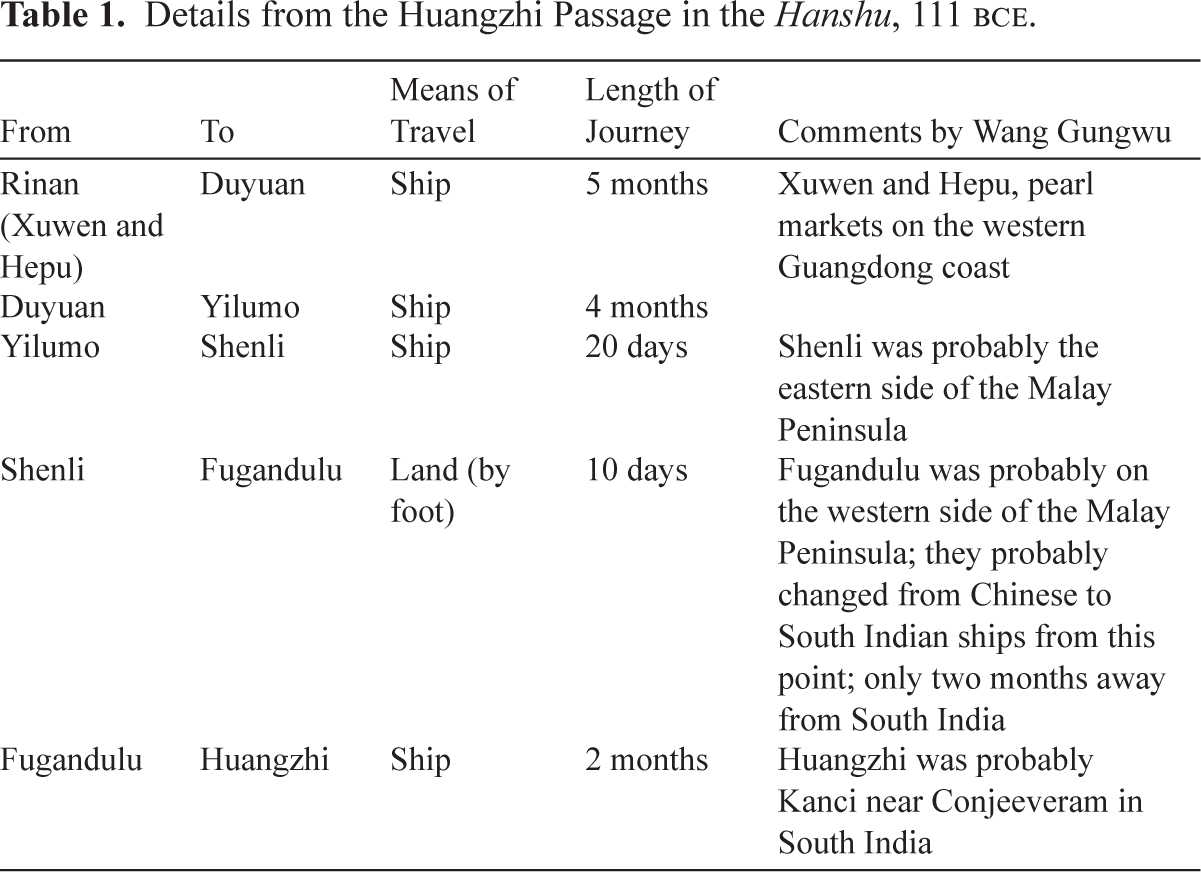
From the barriers of Jin-nan [Rinan] (that is, from) Hsü-wen [Xuwen] and Ho-p’u [Hepu], going by boat for about five months, there is the kingdom of Tu-yüan [Duyuan]. Again, going by boat for about four months, there is the kingdom of I-lu-mo [Yilumo]. Again, going by boat for over twenty days, there is the kingdom of Shen-li [Shenli]. Travelling on foot for over ten days, there is the kingdom of Fu-kan-tu-lu [Fugandulu]. From Fu-kan-tu-lu, going by boat for over two months, there is the kingdom of Huang-chih [Huangzhi]. The customs of the people there resemble those of Chu-yai [Zhuya] (Hainan Island).
These countries are very large and populous and are full of strange things. They have all come with tribute ever since the time of the emperor Wu-ti [Wudi, i.e. Han Wudi]. There are chief interpreters attached to the Yellow Gate (eunuchs serving in the palace) who go to sea with the men who answer their appeal (for a crew) to buy bright pearls, pi-liu-li [bi liuli] (opaque glass), rare stones and strange things, taking with them gold and various fine silks to offer in exchange for (the foreign products). In all the countries they reach, the people supply them with food and keep them company.
The merchant ships of the barbarians are used to transfer them (the Chinese) to their destination. The barbarians also profit by the trade and by plundering and killing people. Moreover (the Chinese travellers) must face the hazards of wind and wave, and may die by drowning. Those who do not die take many years to go and come back. The circumference of the large pearls is about two ts’un [cun] (a Chinese inch) or less.
自日南障塞、徐聞、 合浦船行可五月,有都元國;又船行可四月,有邑盧沒國;又船行可二十餘日,有諶離國;步行可十餘日,有夫甘都盧國。自夫甘都盧國船行可二月餘,有黃支國,民俗略與珠厓相類。
其州廣大,戶口多,多異物,自武帝以來皆獻見。有譯長,屬黃門,與應募者俱入海巿明珠、璧流離、奇石異物,齎黃金雜繒而往。
所至國皆稟食為耦,蠻夷賈船,轉送致之。亦利交易,剽殺人。又苦逢風波溺死,不者數年來還。大珠至圍二寸以下。
Although there is no unanimity among scholars in the identification of most of these places, there are a few anchor points. According to Wang Gungwu, Xuwen and Hepu were probably established pearl markets on the western Guangdong coast. When it was realised that the pearls found off the coast of India were larger and better in quality, these ports died out, and a new incentive was created for developing the sea trade with India. 13
Most historians agree that Huangzhi was probably Kanci near Conjeeveram in South India. 14 Wang Gungwu thinks Shenli and Fugandulu, which were 10 days’ apart by land, were probably on two sides of the narrow neck of the Malay Peninsula. He notes that Shenli was nine months from China, and Fugandulu was two months from South India. He argues that ships belonging to the Yue 越 sailors—Wang prefers not to call them Chinese in this time period—were probably used as far as Fugandulu, but that South Indian ships were employed for crossing the Bay of Bengal. This passage is usually cited as China’s earliest contact with India.
The Journey of Gan Ying, 97 ce
The following passage in the Hou Hanshu tells the story of Gan Ying 甘英, who was sent by Ban Chao 班超, protector (duhu 都護) of the Western Territories (Xiyu 西域), as an envoy to the Eastern Roman Empire. He did not reach his final destination because, having been warned by the Parthians that to continue could be dangerous and might take several years to return, he stopped when he reached Tiaozhi 條支. This location has been identified by Graf and Dreyer as Charax Spasinou,
15
at the head of the Persian Gulf, which had recently been absorbed into the Parthian Empire:
In the ninth year of the Yongyuan reign period [97 和帝永元九年,都護班超遣甘英使大秦,抵條支。臨大海欲度,而安息西界船人謂英曰:「海水廣大,往來者逢善風三月乃得度,若遇遟風,亦有二歲者,故入海人皆齎三歲糧。海中善使人思土戀慕,數有死亡者。」英聞之乃止。
Arrivals by Sea from Burma, 120 and 132 ce
The Hou Hanshu reports that the Shan 掸 kingdom (Burma) sent a gift of dancers and jugglers from Da Qin to the Han court at Luoyang 洛陽. Although their trade was usually carried out by land, over the Burma border into Yunnan, this mission arrived by sea:
The first year of Yongning (120 永寧元年,撣國王雍由調復遣使者詣闕朝賀,獻樂及幻人,能變化吐火,自支解,易牛馬頭。又善跳丸,數乃至千。自言我海西人。海西即大秦也,撣國西南通大秦。明年元會,安帝作樂於庭,封雍由調為漢大都尉,賜印綬、金銀、綵繒各有差也。
A tribute mission arrived by sea from the states of Yetiao and Shan in 132
Embassies from India in 159 and 161 ce
This passage from the Hou Hanshu illustrates how disturbances in the ‘Western Regions’ 西域 could disrupt overland communications. Although relations with India (Tianzhu 天竺) were usually carried out overland, these embassies came to China by sea:
During the reign of Emperor He, India [Tianzhu] sent several envoys carrying tribute and offerings. Later, there was rebellion in the Western Regions, and these relations were interrupted. Then, during the second and the fourth years of the Yanxi reign period under Emperor Huan (147–167 和帝時,數遣使貢獻,後西域反畔,乃絕。至桓帝延熹二年、四年,頻從日南徼外來獻。
An Embassy Purporting to be from Da Qin, 166 ce
Such an embassy claiming to be from the Eastern Roman Empire (Da Qin) arrived with gifts of ivory, rhinoceros horn and tortoiseshell, which originated in Rinan 日南, Central Vietnam. Its members claimed to be official Roman envoys sent by Andun 安敦 (sometimes identified as Marcus Aurelius Antoninus, r. 161–180), but they were probably commercial entrepreneurs from the Levant doing business in Vietnam. It is known that Rome had an active trade with Vietnam at the time.
22
The passage from the Hou Hanshu reveals the historian Fan Ye’s 范曄 scepticism about the envoys’ legitimacy:
In the ninth year of the Yanxi reign period (166 至桓帝延熹九年,大秦王安敦遣使自日南徼外獻象牙、犀角、玳瑁,始乃一通焉。其所表貢,並無珍異,疑傳者過焉。
Most scholars do not take the references in these passages to particular individuals seriously. However, this excerpt provides evidence of the extensive trade, especially in luxury goods, between the Eastern Roman Empire and Vietnam in the Later Han. 24
In addition to these passages from the dynastic histories, there is also evidence that Roman coins of 152
During the Three Kingdoms period (220–280) and the Jin 晉 dynasty (265–280), the merchants of South China were cut off from the north by internal wars and had no access to the overland trade routes to the West. Passages from the Sanguo zhi (History of the Three Kingdoms) and the Liangshu (History of the Liang Dynasty), cited in Wang Gungwu’s subsequent chapter on ‘A Mission to Fu-nan, 220–420’, reflect the impetus that was given to the Nanhai maritime trade at this time as a result. A merchant from Da Qin named Qin Lun is supposed to have come to Jiaozhi [the region of Hanoi], which was part of the Chinese empire at this time. 28
Buddhist Pilgrims and Their Travel Accounts
This section discusses three Chinese Buddhist monks who travelled to India, the birthplace of their religious faith, partly to obtain scriptures, and also to study at monasteries, sharpen their knowledge of Sanskrit and visit the important sites of the Buddha’s life. They are chosen here because one of these pilgrims travelled only by overland routes (Xuanzang 玄奘, travelled 629–645), another used only maritime routes (Yijing 義淨, travelled 671–695) and a third used both continental and maritime routes (Faxian 法顯, travelled 399–414).
Faxian’s Journey
The first Buddhist monk to be mentioned here is Faxian 法顯 (337–ca. 422), whose travel account was entitled Fuoguo zhi 佛國志, also known as Faxian zhuan 法顯傳. One of Faxian’s main aims was to obtain copies of the Vinaya texts, which concerned monastic discipline and were particularly rare in China.
Although not the first Chinese Buddhist monk to make a pilgrimage to India, he was the first one to go there and come back, and to write a travel account of his journey that has survived to the present. 29 He travelled by both land and sea, making his outward journey overland and returning by ship. Exactly what motivated him to take the sea route home is not clear; it may have been because he wanted to visit Ceylon (present-day Sri Lanka), which was a Buddhist centre at the time. It is significant, though perhaps not surprising, that Faxian was aware that travelling back to China by sea was an option.
According to his account, after boarding a ‘large merchant vessel’ at Tamlaripti (present-day Tamluk, about 35 miles south-west of Kolkata in West Bengal), the voyage to Ceylon took 14 days and nights. Here again, as in the time of Zheng He, Bengal functioned as a point where maritime and overland communications intersect.
After staying in Ceylon for two years, from 409 to 411, he boarded a ‘large merchant ship capable of holding 200 people’ for the next leg of his journey home. The ship sailed for fifteen days and then ran into a storm. It suffered some damage and drifted, arriving at Yepoti (Yava-dvipa, probably Java or on the island of Sumatra) 90 days after its departure from Ceylon. Faxian stayed there for about five months and then boarded another ship from Java/Sumatra bound for Guangzhou. This was an even more harrowing journey, in which Faxian was almost thrown overboard after the ship was blown off course. Being a holy man, he was deemed by some of his fellow travellers to have caused the tempest by supernatural means:
After more than a month [of sailing], when the night-drum had sounded the second watch, they encountered a black wind and tempestuous rain, which threw the merchants and passengers into consternation… . After day-break the Brahmans deliberated together and said, ‘It is having this Śramaṇa on board which has occasioned our misfortune and brought us this great and bitter suffering. Let us land the bhikshu and place him on some island-shore. We must not for the sake of one man allow ourselves to be exposed to such imminent peril.’
30
一月餘日,夜皷二時,遇黑風暴雨。商人、賈客皆悉惶怖。。。。曉已,諸婆羅門議言:「坐載此沙門,使我不利,遭此大苦。當下比丘置海島邊。不可爲一人令我等危嶮。」
Some of the passengers objected to this course of action, so they did not force him to disembark, and eventually, after 82 days at sea, aiming for Guangzhou, the ship finally arrived on the coast of Shandong province, despite having been stocked with only 50 days of provisions.
Faxian relates a serendipitous indirect encounter with Chinese culture during his travels, revealing how much he missed his homeland. During his visit to Ceylon, he saw a merchant making an offering of a white silk fan to a large jade Buddhist statue in a monastery. Having been away from home for over 10 years, Faxian writes:
Suddenly (one day), when by the side of this image of jade, he saw a merchant presenting as his offering a fan of white silk; and the tears of sorrow involuntarily filled his eyes and fell down.
31
忽於此玉像邊見商人。以一白絹扇供養。不覺悽然淚下滿目。
While strictly speaking this was not an intersection between maritime and overland communications, since the fan (like Faxian) had probably reached Ceylon by sea, it is a link between the Chinese mainland from which Faxian had journeyed overland and the island of Ceylon, which could only have been reached by sea. After returning from his pilgrimage to India, he spent the remainder of his life translating Buddhist texts into Chinese. Rong Xinjiang cites Faxian’s travel account several times in his book on the Silk Road, though only for its descriptions of places on the overland road; he does not mention the maritime route.
Xuanzang’s Travels
The travels of Xuanzang (602–664) were entirely overland. Rong Xinjiang frequently cites his travel account, Da Tang Xiyu ji 大唐西域記 (Record of the Western Regions during the Great Tang), as well as the biography of Xuanzang written by his associates Huili 慧立 and Yanzong 彦惾, 32 concerning places he mentions on the land route.
Rong’s descriptions demonstrate the volatility of the political and military situation on the land route, and hence the difficulty for overland travellers. For example, when Xuanzang first visited Gaochang on his way to India, he was treated generously by the ruler of Gaochang, Qu Wentai 麹文泰. However, when he passed through the same place on his way back to China in 644, and went to repay the latter’s hospitality, ‘he found that the Gaochang kingdom had been destroyed four years earlier by the troops of [Emperor] Tang Taizong 唐太宗, and the region had been renamed Xizhou 西州 under Tang jurisdiction.’ 33 This is a good example of the dramatic changes that took place from time to time on the Silk Road, which potentially could drive overland travellers to take the sea route.
Yijing’s Journey
Whereas Xuanzang travelled entirely by land, the monk Yijing 義淨 (635–713) journeyed to India exclusively by sea. 34 We may begin to understand why he chose the maritime route from Rong’s discussion of the Four Garrisons of Anxi, which ‘fell to the Tibetans (Tubo 吐蕃) in the 4th month [of 670]’. 35 The usual land route through the Hexi corridor would have been disrupted and dangerous.
Rong reminds us that Yijing set sail on a Persian ship from Guangzhou in 671.
36
Wang Gungwu has noted this as well, writing that in the period 618–684,
the most important development was the arrival of the Persians to the Nanhai and then to the coasts of China. In the course of the next century they and the Arabs who came after them were to become the middlemen of the Nanhai, and their ships the chief means of communication.
37
The disciple and biographer of the Japanese monk and traveller Ganjin 鑑眞 (688–763) also observed the prevalence of foreign ships and the bustling foreign trading activity in Chinese ports around this time, noting
ships of Brahman, Persian, Kunlun and other origins in countless numbers on the river [at Guangzhou], carrying incense, medicines, and other treasures, piled up as high as mountains, in ships with a depth of six or seven zhang”.
38
江中有婆羅門、波斯、崑崙等舶,不知其數;並載香藥、珍寶,積載如山。舶深六、七丈。
Other travel accounts by Buddhist pilgrims who did not take the maritime route are cited by Rong Xinjiang, for example, those by Song Yun 宋雲 (fl. 518–522), Hyecho 慧超 (704–787) from Silla and Ennin 圓仁 (794–864) from Japan.
An Important Passage from the Tang Period
The information discussed in this section was originally included in Jia Dan’s 賈耽 (730–805) Huang hua sida ji 皇華四達記 (Record of the Four Reaches of Imperial China), which is now lost. Fortunately, a passage survives because it was copied into the ‘Dili zhi’ 地理志 (Geography Treatise) of the Xin Tangshu 新唐書 (New Tang History).
39
This text is well known and is often quoted because it has such an unusually detailed description of the route from Guangzhou to Baghdad, probably dating from about 800–801
The authenticity of Jia Dan’s text has previously been questioned, however, because it has not been clear where or how he obtained so much information about the sea route. He was not a sailor himself or an envoy, but a scholar-official who climbed high in the domestic bureaucracy, occupying the posts of Minister of Works in 784, then censor-in-chief, Eastern Capital regency judge, Minister of the Eastern Capital, chief defence commissioner of Ruzhou 汝州 (near the Eastern Capital), right vice director, joint manager of affairs, secretarial chancellery and grand councillor, before his death in 805. It is unlikely that, with such a full career as an official, he travelled personally on the route he describes. If he did not, how did he come to know so many details about the sea route to Baghdad?
The question has only recently been answered, thanks to Rong Xinjiang’s ‘New Evidence’ article. Although the perennial problem of identifying the places mentioned in the text certainly surfaces here, there are enough anchor points in this passage to give it credibility. In his article, Rong reproduces the passage from the Xin Tangshu in his text, identifying the places. Now, this article, together with the 2015 article by Angela Schottenhammer, 44 gives us provenance for the passage, which will be explained below.
Because the passage itself is quite long, it is not reproduced in its entirety here. Instead, the places and distances between them are listed in Table 2.
Jia Dan’s Itinerary from Guangzhou to Baghdad in Tabular Form.
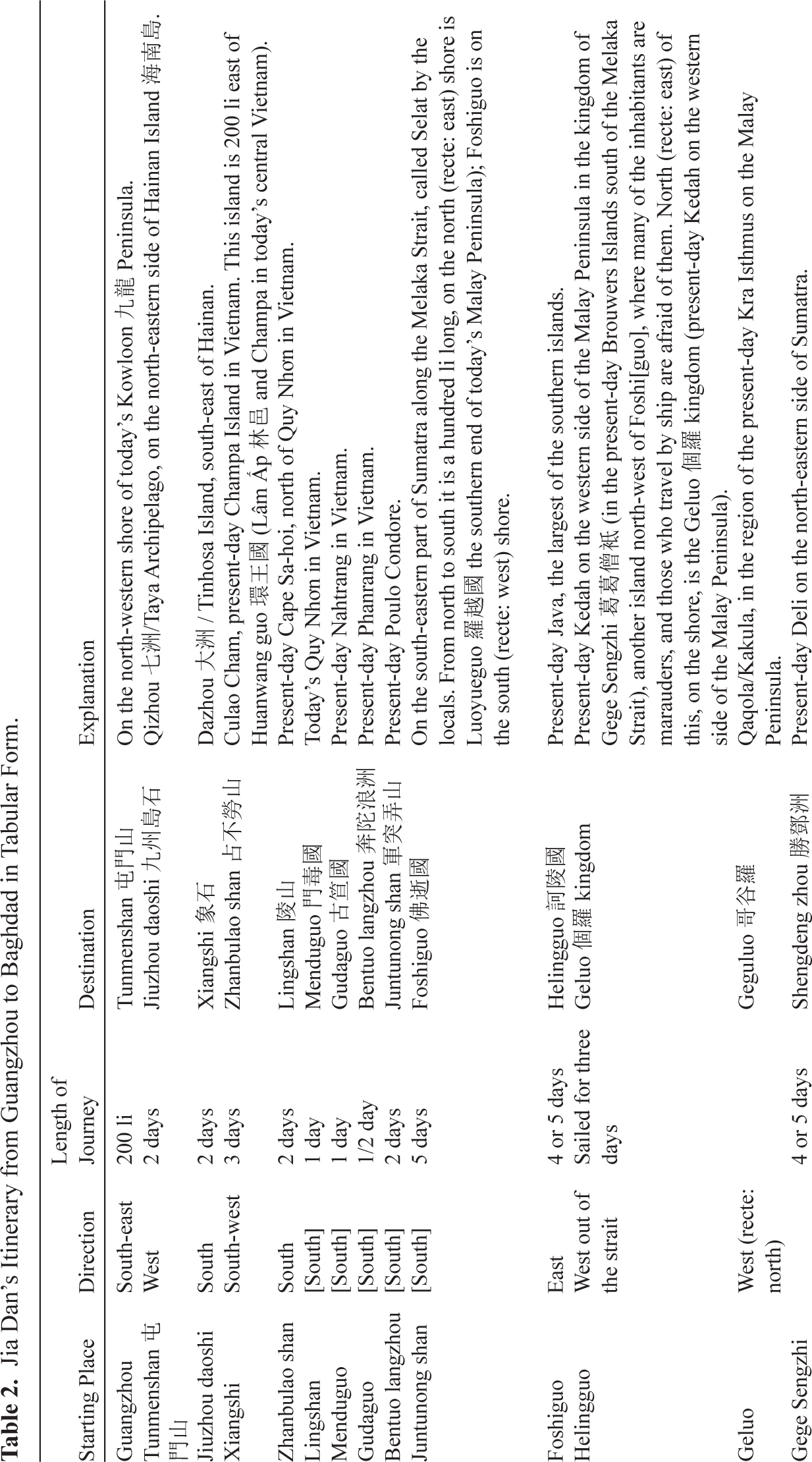
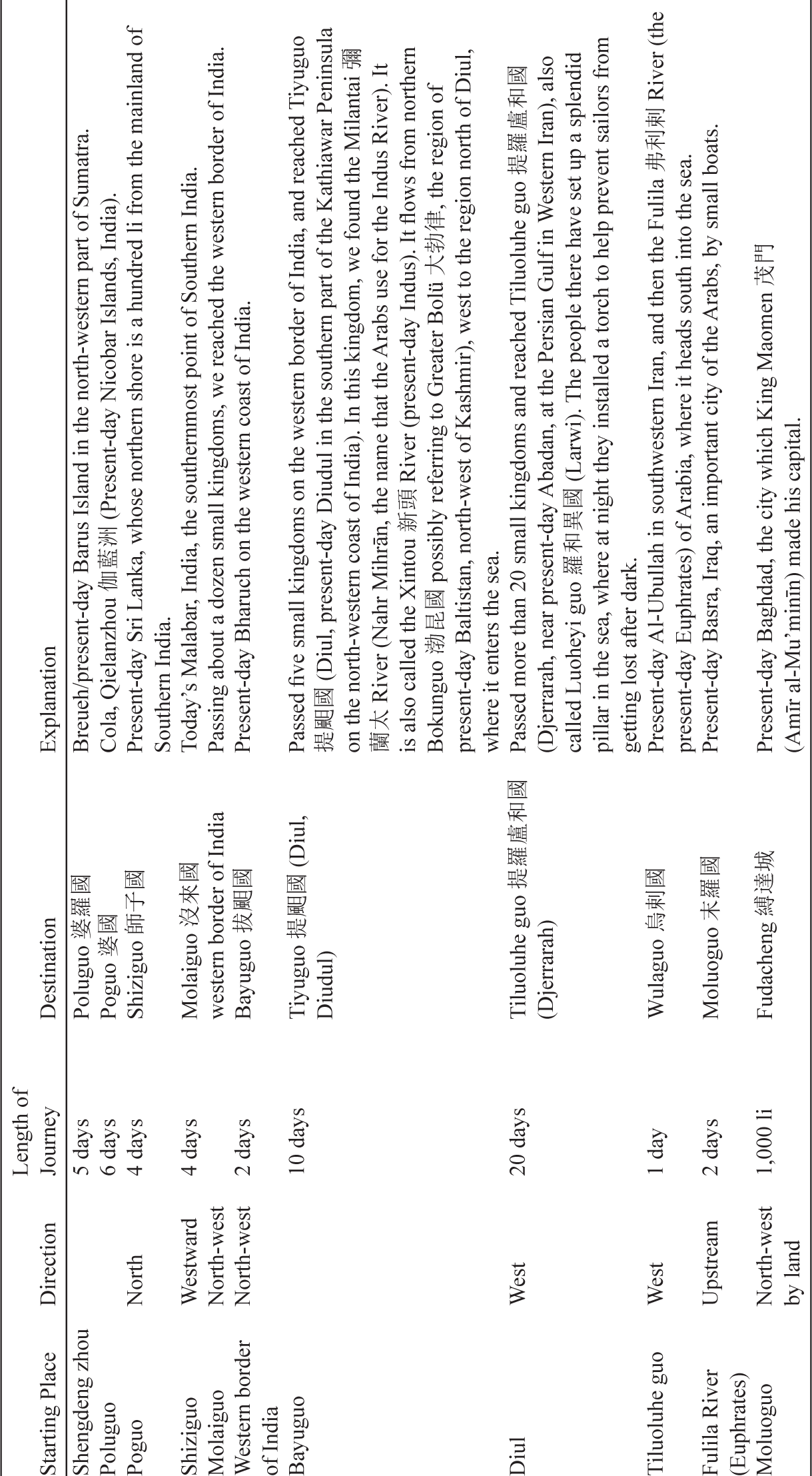
I shall explain the new information presented in Rong’s ‘New Evidence’ article concerning China’s relations with the Abbasid Caliphate during the Tang period. This new information supplies the provenance we need for Jia Dan’s text and gives it a measure of authenticity that it did not have before.
Yang Liangyao’s Embassy to the Abbasids in 785
It was in December 2011 when Rong Xinjiang first shared his research into the eunuch Yang Liangyao at a conference, resulting in the publication of his ‘New Evidence’ paper the following year. His paper discusses the stele unearthed in Shaanxi province in 1984 containing Yang’s funerary inscription. 45 The inscription reveals that Yang had been sent by sea on a diplomatic mission to the Abbasid Caliphate (750–1258) in 785 and was rewarded for successfully completing this mission in 788. According to Rong, this stele saved Yang from oblivion 其被湮没的名字才重顯于世, 46 since we know of no other textual information about him—he is not mentioned in any of the dynastic histories or elsewhere. Even more astounding is the fact that nothing was known about this diplomatic mission to the Abbasids before the stele was unearthed.
Apart from the fact that we now have information about a eunuch who served in the Tang court that we did not have before, the funerary inscription is important for two other reasons. First, it tells us about the diplomatic mission to the Abbasids in 785, and second, it helps us authenticate the valuable description by Jia Dan of the maritime route from Guangzhou to Baghdad. Below I shall treat these two issues separately.
The Mission to the Abbassids
The inscription gives the following basic facts about Yang’s life:
He belonged to the Yang family of Hongnong 弘農 in present-day Henan. His great-grandfather had been a high-ranking officer of the Tang imperial guard under Emperor Xuanzong 玄宗 (r. 713–756). Yang himself served as a palace eunuch from the beginning of Emperor Suzong’s 肅宗reign (r. 756–762), helping to put down rebellions in Langshan 狼山 (Jiangsu) in 765, Guangzhou in 774–777 and Huaixi 淮西 in 800. His first foreign assignment was to Annam 安南 as pacification commissioner in approximately 771. In 784 he was sent as an envoy to the Tibetans to request help against the rebel general Zhu Ci 朱泚 (742–784), who had proclaimed himself emperor. In the following year (the fourth month of 785), he was sent on his first overseas assignment: a mission to the Abbasid Caliphate. The journey there and back took at least two years, and he was rewarded for his efforts in 788. As far as we know, this was his only maritime mission. In 800, he supervised military affairs in Ruzhou in the metropolitan area of the Eastern Capital (Luoyang) and was appointed frontier marshall for three armies 以本官領右三軍僻仗使 in 805. He then returned to Chang’an to serve Emperor Shunzong 順宗. He also devoted himself to Buddhist activities, copying religious texts, repairing temples, building pagodas and helping the poor; he died in 806.
Of interest here is the fact that as he advanced in his career he moved from serving inside the palace to taking on external roles that were further and further afield, first putting down internal rebellions from 765 onward, and then serving as pacification commissioner in Annam in 771. His assignments from this time on reflect the gradual worsening of the internal situation in the post–An Lushan period, the weakening of Tang central power, the outbreak of rebellions in multiple areas of the empire and the threats that the Tang was experiencing from outside as well. The culmination of Yang’s career was in the 780s when the Tang was facing all these dangers at once. Yang was sent on a land-based mission as ambassador to the Tubo (Tibetans) in 784 to request their help against the usurper Zhu Ci, and then in 785–787/788 when, in the face of an existential threat to the Tang Empire itself, he was sent on his first and only long-distance maritime assignment as envoy to the Abbasid Caliphate.
Although the inscription does not specify the reason for the diplomatic mission to the Abbasids, Rong Xinjiang argues forcefully that it ‘must have been connected to news of the strife between the Tibetans and the Arabs in the Western Regions’, 47 concluding that it was probably to request help from the Arabs against the Tibetans. The evidence that he presents for reaching this conclusion is cited in the discussion below. First, however, it is necessary to answer one important question that arises from the brief sketch of his life that appears in the funerary inscription: Why were the Tibetans seen as allies against a Tang rebel general in 784 and as enemies one year later, in 785?
The Tibetans were a long-standing force on China’s north-western periphery. When the Tang destroyed the Western Turkic Qaghanate in 658, establishing the Anxi Protectorate in Kucha as the headquarters of the Four Garrisons of Anxi, the remnants of the Western Turks joined the Tibetans in a tug of war with China over this region, lasting nearly a hundred years. At times this enlarged Tibetan force succeeded in pushing the Tang eastward, away from the Western Regions, and at other times the Tang re-established its hold in these regions. However, when the An Lushan rebellion broke out in 755, a power vacuum was created as Tang troops stationed in the Four Garrisons had to withdraw to the capital, Chang’an. The Tibetans quickly filled the vacuum, and from 764 to 776, they took Liangzhou 涼州, Ganzhou 甘州, Suzhou 肅州 and Guazhou 瓜州 in the Hexi 河西 corridor in quick succession, also surrounding Shazhou 沙州 (Dunhuang).
In 783, relations between the Tang and the Tibetans temporarily improved, and a peace treaty was negotiated. It was at this time that the Jingyuan mutiny 涇原兵變 took place, with the rebel general Zhu Ci proclaiming himself emperor. Emperor Dezong 德宗 (r. 780–805) fled the capital, and in 784 sent Yang Liangyao on his overland mission to request help from the Tibetans, promising to concede Anxi and Beiting to them in return. The Tibetans did their part, blocking the forces of Zhu Ci, sending troops and ultimately helping the Tang to win victory against the rebel. However, when the Tibetans asked for the promised territories from the Tang in return, their request was blocked by Li Mi 李泌 (also called Li Bi, 722–789), a close adviser to Emperor Dezong at the time. Wary of giving the Tibetans so much territory and power, Li Mi argued in a memorial to the throne that the inhabitants of these regions were loyal to the Tang and would resent being consigned to Tibetan rule. Emperor Dezong was persuaded by Li Mi’s arguments and supported him in the refusal to give the promised territories to the Tibetans. Tang-Tibetan relations immediately broke down. The Tibetans invaded the frontier with a vengeance, taking the regions of Jing 涇, Long 隴, Bin 邠 and Ning 寧, penetrating deeply into the metropolitan region of Haozhi 好畤 (north-west of present-day Qian 乾 county) and threatening the capital. Martial law was imposed in Chang’an in 785.
This sudden intensification of the Tibetan threat seems to have been the immediate reason why Emperor Dezong sent Yang Liangyao to Baghdad to negotiate an alliance with the Arabs against the Tibetans. Not only were the Tibetans putting pressure on the expanding Arab forces, but they were also threatening the borders of three other neighbouring powers as well: India 天竺, the Nanzhao (Yunnan 雲南) and the Uighurs 回紇. These other external powers must also have been asked to help, although this fact is not recorded in the Chinese histories until several years later. Under the year 787, the Zizhi tongjian 資治通鑑 reproduces a memorial submitted by the Uighurs affirming their alliance with China—thus showing that they too had been asked to help. The memorial suggests that the situation was favourable not only for the Uighurs but also for the Arabs to ally with the Tang against the Tibetans. 48 This memorial was probably written in 785, despite its not being recorded until 787.
The passage in the Zizhi tongjian quotes a conversation in which the emperor asks Li Mi, ‘Given that the Uighurs are willing to support the Tang against the Tibetans, why is it necessary to recruit help from Yunnan (Nanzhao), the Arabs and India as well?’ Thus, it must have been Li Mi’s suggestion to ask the other powers to help too. Li Mi argued that it would put pressure on the Tibetans from all sides: the Uighurs on the north, the Arabs and India on the west and Yunnan (Nanzhao) on the east. Each of these powers had their own reasons to oppose the Tibetans.
Rong Xinjiang provides evidence that Li Mi’s policy was effective. A passage in the biography of the Chancellor Han Huang 韓滉 (723–787) in the Jiu Tangshu 舊唐書 shows that the Tibetans endured attacks by foreign powers on all sides:
I have heard that the [Tibetan] army has gradually become weaker in the past few years. In the west they are under pressure from Arab forces, in the north they are pressed upon by the large numbers of Uighurs, and in the east they are blocked by the Nanzhao forces.
49
臣聞其近歲己來,兵眾寖弱,西逼大食之強,北病回紇之眾,東有南詔之防。
Rong also points to the following passage from the Tang huiyao 唐會要 (Essential Documents of the Tang), showing that the Tibetans had to divert substantial forces to counter the attacks of the Arabs:
In the 2nd year of the Zhenyuan reign period (786) the Tibetans became our primary adversaries. The greater part of the Tibetan troops went west to resist the Arabs, hence they rarely caused trouble to our borders, where their forces are insufficient.
50
貞元三年,與吐蕃為勁敵, 蕃兵大半西御大食,故鮮為邊患,其力不足也。
Although there is a mention of the mission to the Abbasids in the Chinese records, its purpose was said to be the spreading of Chinese influence to this area. Its true nature—as an effort to negotiate an alliance with the Arabs against the Tibetans—was not recorded in the Chinese records and has only been brought to light through these investigations into Yang Liangyao’s funerary inscription.
Why there is so little direct description of the mission in the historical records is an interesting question. It may have been because it was a top-secret plan. Rong Xinjiang mentions that one of the reasons why the sea route was used instead of the land route was because the Tibetans occupied the Hexi corridor and many other locations in the Western Regions. This is a good example of a blockage in the land route causing a sea journey to be made. According to Rong, it would have been particularly dangerous for Yang’s party to use the land route, because they
had a clear political and military assignment and had imperial edicts with them, which would have stated clearly that they intended to ally with the Arabs to attack the Tibetans. If these had fallen into the hands of the Tibetan army or other tribes allied with them, the envoys would doubtless have been killed, and this would have left the court’s mission unfulfilled.
51
The outcome of Yang’s diplomatic mission was therefore that the Arabs helped to distract Tibetan attention away from China’s borders.
It is worth emphasising that this is the only evidence we have of this embassy to the Arabs in the sources. Thus, if Yang Liangyao’s funerary stele had not been unearthed in 1984, we would not have known about this embassy. One possible reason for the scarcity of records was that the emperor and his highest officials did not want this potential alliance to be widely known. 52
The Route from Guangzhou to Baghdad
Yang Liangyao’s funerary inscription is also important, as mentioned above, because it provides provenance for Jia Dan’s description of the maritime route from Guangzhou to Baghdad. Rong Xinjiang asserts that both Yang and Jia Dan were in Chang’an around 800
Jia Dan had been ordered by the court to make a survey of China’s knowledge of the West. In addition to his 10-volume Huanghua sida ji, he also produced a map, Hainei huayi tu 海內華夷圖 (Map of Chinese and Barbarian Lands of the World) and a 40-volume text, Gujin junguo xiandao siyishu 古今郡國縣道四夷述 (Description of Commanderies, Kingdoms, Counties and Circuits Inhabited by the Four Barbarians in Ancient and Modern Times). To gather information for these works, Jia Dan interviewed various foreigners as well as envoys who had returned from distant regions. It seems highly likely that Yang was one of his interviewees, and that Jia used the latter’s information to compile his record of the sea route to Baghdad.
Thus, we have Yang Liangyao to thank for this valuable information, and Jia Dan for recording it. Whereas formerly his itinerary was viewed with scepticism, the possibility that Jia Dan obtained his information about the route from someone like Yang Liangyao, who had first-hand information, means that it can finally be taken seriously.
Yang’s Sailing Schedule
One question that still remains concerns the sailing times of the outgoing and return voyages, and how long Yang spent in Baghdad. The stele states that Yang departed from Chang’an in the fourth month of 785 and that he received a promotion in the sixth month of 788. However, we do not have the precise date of his return to China. This can be estimated based on the habitual sailing times, particularly of Arab navigators in the eighth and ninth centuries, combined with the lengths of their journeys and approximate speed of their ships, as well as the annual rhythms of the monsoon winds.
At first, Rong says that Yang probably stayed in Baghdad for a few months. This seems likely, given the timing of the monsoons. Later, however, at the end of his discussion, Rong suggests that he may have stayed as long as a year. This seems questionable, partly because of the sailing times of other voyages, such as those not only of the Arab navigators but also of Zheng He. Moreover, an article by Qian Jiang 錢江, cited by Rong, states that the return voyage from Muscat on the Persian Gulf, to Guangzhou and back, took approximately 18 months. 53 To this sailing time, two lengthy overland journeys would have to be added, one on the western end from Muscat to Baghdad (1,091.21 miles, or 1,756.19 km as the crow flies), and another on the eastern end, from Guangzhou to Chang’an (813.92 miles or 1,309.88 km as the crow flies).
Rong’s list of the possible dates for each leg of the journey is presented below using Western months:
Left Chang’an in June 785 Arrived in Guangzhou in August 785 Sailed from Guangzhou in October 785 Arrived at Muscat in April 786 Arrived in Baghdad in May 786 Stayed several months Left the Persian Gulf in Sept 786 Returned to Guangzhou in May 787 Reached Chang’an in July 787 (if he left Guangzhou right away) Was promoted in the 6th month of 788
It should be noted that whereas he allows two to three months (June–August 785) for the journey from Chang’an to Guangzhou, which is approximately 814 miles, he allows only one month for the journey from Muscat to Baghdad (April–May 786), which is in fact 277 miles longer. This schedule increases my scepticism about the possibility that he stayed in Baghdad for an entire year. While it does not seem likely, the question needs further investigation.
To conclude this section, we should note that the intersections and interactions between maritime and overland missions take various forms in the saga of Yang Liangyao. First, the career of one person included both overland and overseas diplomatic missions. Second, the journey from China to Baghdad and back involved travelling both by sea and by land at both ends. Yang had to travel by land between Chang’an and Guangzhou, and between Muscat and Baghdad, as well as by sea from Guangzhou to Muscat. Third, we have observed that the sea route was taken because the land route was blocked for this particular mission. Finally, the description of the route between Guangzhou and Baghdad involved communication between a land-based official (Jia Dan) and one who had actually travelled overseas on that route (Yang Liangyao).
Persian Nobles Arrive by Land and Merchants by Sea
Rong’s article on the integration of Persian and Chinese cultures provides several insights into the interplay between maritime and overland travel after the fall of the Sasanian Empire to the Arabs in 651. When the Sasanian Empire (224–651) collapsed, and even shortly before, members of the Sasanian royal family and other nobles went east to take refuge. Some stopped in Tokharia, while others travelled all the way to China. In China, they tended to retain their noble status, with some of the royal descendants serving as guards for the imperial family or in the ritual administration. One, named Li Su 李素 (743–817), who features in Bill Mak’s article in this volume, worked in the Chinese Bureau of Astronomy for over 50 years, eventually becoming the bureau director. His grandfather, like a number of other Persians, had adopted the Tang imperial surname Li, which, according to Rong, helped the family integrate into Chinese society. These members of the Persian upper classes came at an earlier stage than the merchants and tended to travel via the overland rather than the maritime silk route.
Rong notes that the Tang had contact with the Sasanian Empire from the fifth century
According to the Weishu 魏書 (History of the Wei Dynasty), ten Persian diplomatic missions visited the Northern Wei between 455 and 522. These journeys, which must have been undertaken overland, may have been facilitated by the unification of North China under the Northern Wei. Five came when the capital of that regime was at Pingcheng 平城 (present-day Datong 大同) and five when it was at Luoyang after 493. The Luoyang qielan ji 洛陽伽藍記 (Record of the Monasteries of Luoyang), compiled in 530, contains information about the hostels used by Persians in that city. 54
Some Persians also travelled to South China, though not in large numbers, offering tribute to the Northern and Southern dynasties. An embassy came via Gandhara, following a route from the Tuyuhun 吐谷渾, to Sichuan, the Yangzi river and Nanjing, and presented a Buddha’s tooth. After the Northern Wei divided into the Eastern and Western Wei in 534, the Rouran Qaghanate 柔然汗國 (330–555) blocked the northern routes, and contact with Persia broke off for a time. The Rouran were crushed by the Turks in 552, however, and Persian envoys came again to Chang’an the following year.
Communications between the Sasanians and China were cut off again from 565 until the end of the Northern and Southern dynasties (589). The Turkic Qaghanate had allied first with the Sasanians against the Hephthalites, and then with Byzantium against the Sasanians, thus no Persian envoys arrived during this period until the Sui. After China was unified by the Sui house in 581, Emperor Sui Yangdi 隋煬帝 resumed contact with the Western Regions, sending an envoy to Persia in 605, and immediately sparking a return embassy. However, relations disintegrated in the disorder at the end of the Sui.
In 632, Yazdegard III became king of the Sasanian Empire. However, the following year his regime was attacked by the Arabs. A series of envoys were sent to China in 639, 647 and 648 requesting assistance but none was immediately forthcoming.
55
When the final defeat of the Sasanian Empire by the Arabs occurred in 651, Yazdegard III fled to Merv and was killed there. His son Peroz (Fīrūz), who succeeded him as king of Persia, fled to Tokharia. In 654, Peroz sent an embassy to the Tang to report these developments and ask for help. However, China at the time was unable to offer any assistance because it was preoccupied with the rebellion of Ashina Helu 阿史那賀魯, ruler of the Western Turks. Peroz sent another embassy in 661, requesting military aid from China. This request was more successful. By this time, Rong says,
the Tang had already defeated the Qaghanate of the Western Turks, and the sovereignty of the small kingdoms east and west of the Pamirs (under Western Turk control) reverted to the Tang dynasty. The Tang then established the system of ‘loose-rein’ prefectures and counties (jimi zhoufu 羈縻州府) to strengthen its control of these regained areas. In the same year (661), Wang Mingyuan 王名遠 was sent to Tokharia to set up a loose-rein Area Command; concurrently, a Persian Area Command (Bosi dudufu 波斯都督府) was set up in the city of Zābol (Jiling 疾陵), where Peroz was based.
56
The so-called Persian Area Command was a fictitious institution that in theory stretched from China across Central Asia to Persia. It was envisaged as an umbrella organisation under which other local and smaller Area Commands operated under Chinese authority in such areas as Ferghana, Tashkent, Samarkand, Bukhara, Tokharia and so forth. It was set up by Emperor Gaozong (r. 649–683) as a way of claiming territory to counter Arab expansion in Central Asia, primarily in 659–661. However, all such claims to authority came to nothing when China lost the Battle of the Talas River to the Arabs in 751.
Peroz was made head of the Persian Area Command in 663, and so-called ‘Persian’ tribute embassies were sent to China between 667 and 671, probably by Peroz, who was still based in Tokharia. Pressure from the Arabs continued to increase in that location, however, and in 674 Peroz fled to Chang’an, where he died in 677 or 678. After his death, his son Narses (Ninieshishi 泥涅師師, also called Narsieh or Narseh), who was still in Chang’an, was appointed king of Persia. This was in 678. 57 Narses went back to Tokharia for a time to fight Arab forces there but returned to China in 708. He died soon after that in Chang’an.
In the face of the Arab attacks in Central Asia during this period there was a steady stream of Persian envoys coming to China between 683 and 706, probably from Tokharia, and a further 17 embassies are recorded from 719 to 771. 58 Rong acknowledges that some may have been merchants pretending to be envoys, but he argues that because they were called envoys and received as such, we should see them as envoys rather than merchants. 59
Many Sasanian coins have been found on the overland Silk Road, but these were brought by Sogdians, not Persians. 60 Because the Sogdians were so well organised in their communities and trade networks, Persian merchants were unable to compete with them commercially. The Sogdians were also protected by their suzerains the Hephthalites and the Turks, while the Persians had no such backing. Here we see the example of the Sogdian monopoly on trade squeezing out the Persians from participating in commercial activity at the time.
The Arrival of Persian Merchants by Sea
The blockage of the land route caused by the Arab advance forced people to take to the seas. From the seventh century, Persian merchants came to the southern ports of China mostly by ship, setting up their businesses in southern provincial capitals such as Yangzhou, Hongzhou and Guangzhou. The sea route stretched between Persia and Guangzhou, crossing the Indian Ocean and the South China Sea. The fact that the Tang monk Yijing sailed for India on a Persian ship in 671 indicates the prevalence of Persian ships on the Chinese coast. Persians were famous for their seamanship, and known for being shipowners in such cities as Guangzhou and Yangzhou.
Merchants had a low status in the Sasanian Empire, and their status did not improve after they came to China. They tended to set up their businesses in the large southern cities probably because they arrived by sea. The Sogdians, on the other hand, usually came by land, tending to settle along the northern overland routes, in such places as Gaochang, Dunhuang, the Gansu corridor, Luoyang and Chang’an. Persians also tended to scatter and settle in various areas of China, while Sogdians stayed in their own communities. Edward H. Schafer notes that while Sogdian was the lingua franca of the Central Asian routes, Persian was the common language for travel on the Southern Seas. 61
Persian merchant ships did not come frequently or in large numbers to China until the middle of the seventh century. By the middle of the eighth century, Persian ships had formed major fleets in the South China Sea and the Indian Ocean. Rong Xinjiang quotes many anecdotes from Tang literary writings, jottings and fictional accounts concerning the wealth of Persian merchants and their celebrated acumen in spotting valuable gemstones. 62 Their numbers were quite large by the end of the eight century, as seen in the morbid statistics resulting from the revolts in Yangzhou and other places in ‘thousands’ of casualties. In 758, Persian merchants attacked Guangzhou, threatening the governor to the extent that he fled the city. Rong’s discussions of these topics help us understand the references to Persian merchants one sees in Tang fiction and anecdotes.
Thus, the obstructions on the land routes from both conflict and monopoly served as motivations for Persian merchants to take the sea route to China. The impulse to travel to China and settle there must have been strong. One issue that is not clear is where the Persians began their sea journeys after their home empire was destroyed. If they first fled to Tokharia, they may have sailed from India or Southeast Asia, or perhaps one of the former Persian sea ports on the coast of the Gulf of Oman or the Indian Ocean.
Conclusion
The above discussion gives a sense of the liveliness of both overland and maritime activities stretching from China westward to Southeast Asia, India and Persia during the first millennium. They involved kings, princes, nobles, diplomats, scholars, religious pilgrims and merchants. We have a substantial amount of information about the Sogdian and Persian merchants who came to China, and one hopes it will be possible to learn more about the Chinese merchants, like the shadowy figure whose fan Faxian glimpsed in Ceylon, who may have ventured west for commercial reasons during the first millennium. More research is needed to understand these issues, and more work on shipwrecks also needs to be done.
With regard to the interplays and interactions between maritime and overland communications, we have seen several examples of blockages in the overland routes due to external invasion, internal disorder and trade monopolies that drove people onto the seas. While the allure of trading with China was strong, as there were certainly markets in China for foreign goods, there were also diplomatic reasons for making the journey, one of which was to ask for help to counter foreign invasions or encroachments. Moreover, the missions of Yang Liangyao first to the Tibetans by land and then to the Arabs by sea show that requests for assistance went in the other direction as well, with China needing help from both its close and distant neighbours in the face of foreign and domestic threats. A further interesting point about this mission is that while the Arabs were expanding on land, the Chinese sent their embassy to them by sea, presumably because it was safer, but also showing the immense size of the Abbasid Caliphate at the time.
The boundaries between maritime and overland communications were crossed by Yang Liangyao, who initially performed his diplomatic duties by land and later by sea, and by the Persians who first travelled overland to China and later on the oceans. Some journeys involved travel by both means, as was the case with the Han sea voyages which incorporated land crossings of the Malaysian peninsula or the Kra isthmus, as well as Yang Liangyao’s journeys which involved land crossings at both ends.
Archaeological discoveries such as those detailed by Rong Xinjiang have significantly expanded our knowledge of maritime and overland communications in the first millennium. More knowledge must have circulated and transferred about navigation and shipbuilding than our records show, and it is hoped that additional information will surface on these subjects in archaeological and other finds in the future.
Footnotes
Acknowledgements
I am very grateful to Professor Mei Jianjun who encouraged me to pursue its publication, and to Professor Samuel Lieu for his patient and helpful comments and references. For the Special Issue in general, I would like to express my hearty thanks to the Medieval History Journal, to the co-editor Bill Mak, and to the various authors and peer reviewers who dedicated their precious time and effort to its completion.
Declaration of Conflicting Interests
The author declared no potential conflicts of interest with respect to the research, authorship and/or publication of this article.
Funding
The author received no financial support for the research, authorship and/or publication of this article.