




Abstract
This paper explores the cultural and scientific connections between China, India and Iran through examining a specific type of incense burner with a gimbal device. Similar artefacts have been found in Tang China (618–907
Within me is Hell fire,
But without floats the perfume of Paradise.
Inscription on a thirteenth-century Mamluk censer 1
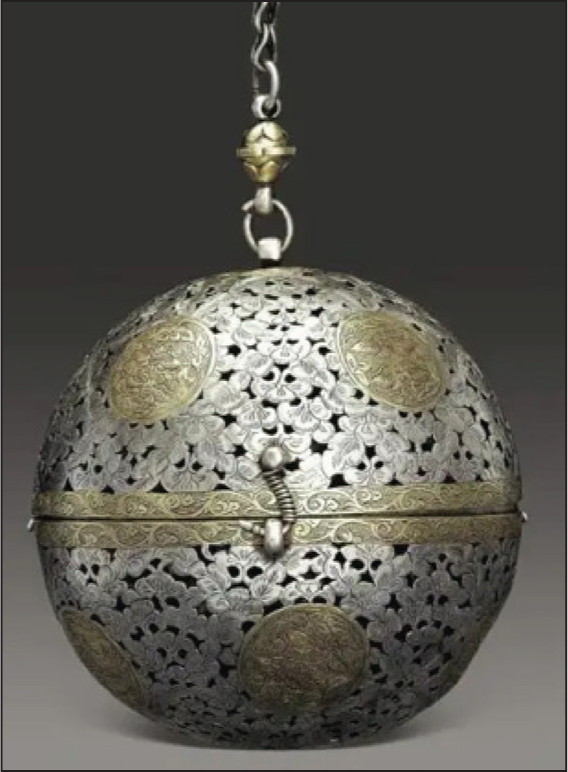
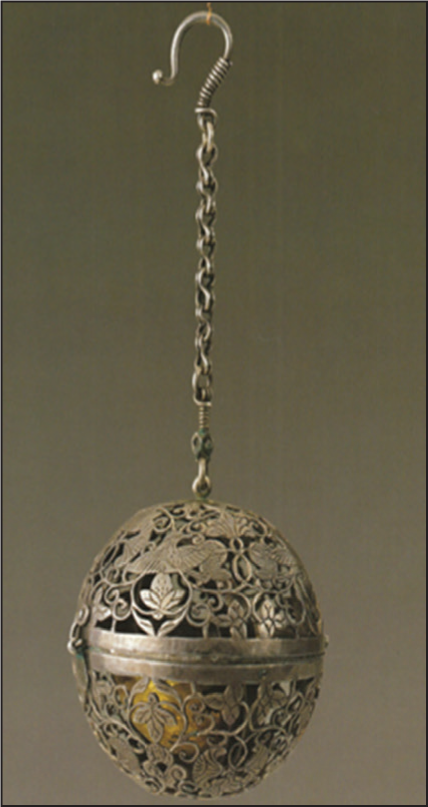
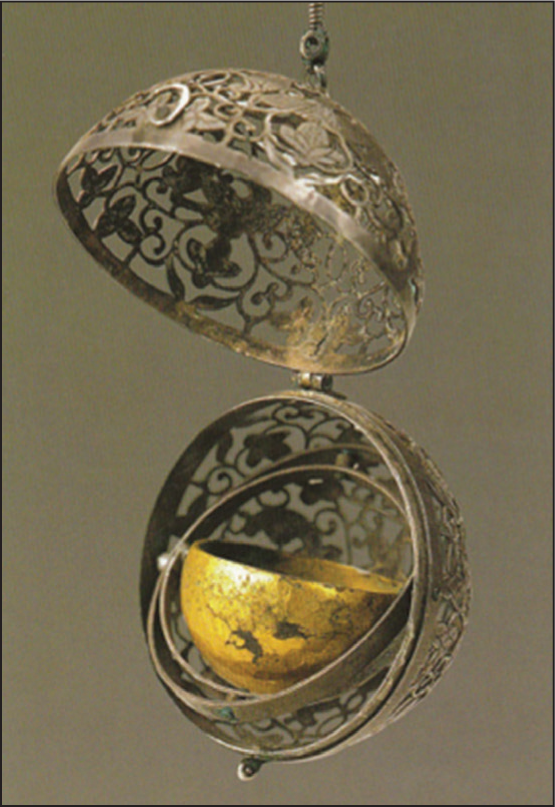
When the underground crypt below the Famen Monastery 法門寺 in Shaanxi, China, was opened in 1987 after being sealed for over 1,200 years, a large number of artefacts came to light. Among these were two silver incense spheres composed of openwork hemispheres, united with a hinge and bolt. 2 The censers have a smaller interior incense bowl, mounted to the outer case with an ingenious gimbal system, a suspension mechanism later applied to the gyroscope in which the incense bowl is suspended within two pivoted rings, which enables the interior incense bowl to stay level no matter how the sphere rolls (Figures 1–3). Soon after these two incense spheres were found, they gained great prominence in the Chinese media. They were hailed as national treasures and proclaimed to be the earliest bearer of the gimbal, predating its appearance in Europe by centuries.
Incense Sphere. Famen Monastery Crypt. Ninth century. Silver with gold inlaid. D. 18 cm. Famen Monastery Museum, Fufeng, China.
Incense Sphere. Hejiacun hoard (Xi’an), eighth century. Silver, partially gilded. D. 4.6 cm. Now kept at the Shaanxi History Museum, Xi’an, China. After Qi and Shen 2003: 222–3.
The earliest artefacts of this type were found in Tang dynasty (618–907
This paper contends that the circulation of incense spheres among these cultures occurred much earlier and that it took place in a continuous fashion. It begins by conducting a comprehensive examination of the relevant artefacts from Tang China (including a closely related example in the Shōsō-in in Nara, Japan), highlighting their cultural meaning based on where they were discovered. The paper then examines Islamic and European materials, arguing that incense spheres appeared in these regions before the Pax Mongolica facilitated Eurasian mobility. Focusing on the Tang examples, it then discusses how their naming, material, shape and usage all suggest their novelty, rarity and high value. Situating the objects in their cultural and material contexts, this paper posits that Tang incense spheres may have been imported or made under strong cultural influence from Central Asia, India, Iran or beyond. As such, it is asserted that they serve as witnesses to the convergence and acceptance of diverse ideas and craftsmanship in the wealthy, inclusive and multicultural society of Tang China. Both the Tang incense spheres and the later Islamic and Western examples, provide evidence of the exchange of technological and scientific knowledge, as well as art and olfactory culture across Eurasia over time.
Tang Incense Spheres and Their Sites of Discovery
In contrast to the prevalence of incense spheres as national treasures today, in Tang times they seem to have been rather rare. They were much less well represented in textual and visual sources than the famed Hill Censer (boshan lu 博山爐) or the long-handled censers. Archaeology, however, tells a different story.
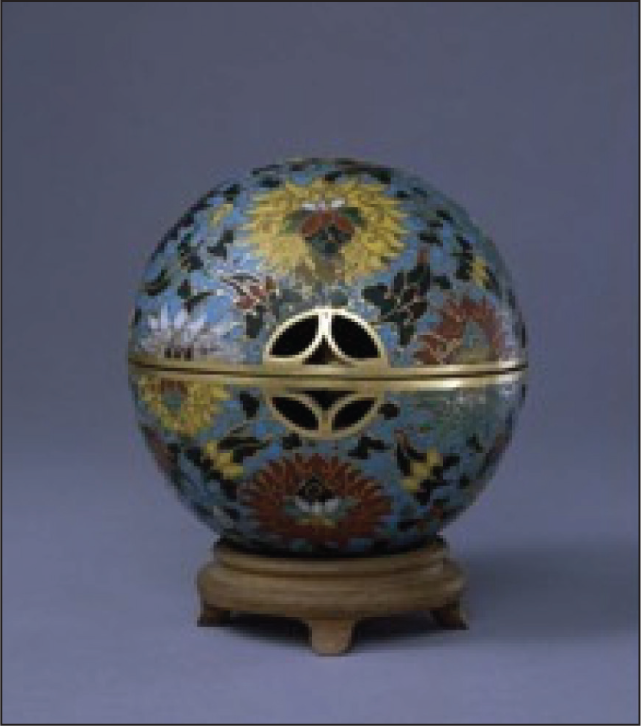
Apart from the two examples from the Famen Temple, incense spheres have also been found in other Tang hoards. Among the earliest is one example from the Hejiacun 何家村 hoard in present-day Xi’an 西安, which was buried in the mid- to late eighth century. It was previously thought that the hoard dated to the time of the An Lushan 安祿山 rebellion in 755, and that its purpose was to safeguard family treasures. Recently, some scholars have speculated that this may have been a storage site for the imperial workshop. 6 The censer was, thus, probably made before the mid-eighth century. It is one of the smallest, measuring 4.6 cm in diameter and features motifs of flying birds, grapes and pomegranate flowers, showing influences from the art of Persia and the Mediterranean world. Four incense spheres have been discovered in the Shapocun 沙坡村 hoard and one from a Tang tomb in Sanzhaocun 三兆村. Apart from these, there are two Tang silver censers kept in the Carl Kempe Collection, one in the Metropolitan Museum of Art, and others in the hands of art dealers or in private collections. As for those from later periods, the Palace Museum holds a Yuan dynasty cloisonné incense sphere (14 cm in diameter, see Figure 4) and a Qing 清 dynasty (1644–1912) imitation of the Yuan censer. 7
Censer from the Yuan Dynasty. Diameter 14 cm, cloisonné, three perpendicular rings, bayonet fitting. The Palace Museum, Beijing, China. Photo credit: https://www.dpm.org.cn/collection/enamel/229318.html .
The Shōsō-in also holds two spherical incense burners with gimbals, one made of silver and the other in brass or copper. The silver one measures 18 cm in diameter and features motifs of phoenixes and lions. A manuscript dated 756
All the Tang spherical censers mentioned above are made with beaten silver, and some were partially gilded. They were then finely carved into openwork with a chisel. The Tang incense spheres uncovered from these archaeological sites date at the latest to the eighth or ninth centuries
The space in which the spheres were found sheds light on the context of their production and circulation. The Famen Monastery inventory stele clearly indicates that the two incense spheres found in its crypt were part of the imperial donation that accompanied the return of relics of the Buddha to the monastery under Emperor Xizong 僖宗 (r. 859–873). 9 The crypt was constructed largely along the lines of Tang imperial burials, which means that the objects were probably symbolically arranged instead of randomly placed. 10 At the time of the discovery, the two incense spheres were carefully kept in finely woven gold and silver baskets and located in the innermost rear chamber, which lay approximately beneath the centre of the pagoda. Guarded by a large stupa-shaped incense burner at its door, this chamber contained the most precious items. 11 This context suggests that the incense spheres, together with the numerous other artefacts found in this chamber, were considered the most precious and treasured objects that were worthy of being placed close to the relics of the Buddha hidden in the lowest level of the chamber. At the same time, they were probably not regarded as important ritual objects but rather as objects intended for personal use, as they were grouped with items such as tea utensils.
At a broader geographical level, all the Tang examples with clear provenance have been found in or near the area of the Tang capital, Chang’an 長安 (modern-day Xi’an). Despite the impressive amount of gold and silver metalwork contained in a few other locations, such as in the area around modern-day Yangzhou 揚州, which was the centre for manufacturing, collecting and distributing gold- and silverware from the mid-eighth century, and in the ninth-century shipwreck rediscovered in 1988 off the coast of the Belitung Island in Indonesia, few censing paraphernalia have been found, and not a single incense sphere. 12 This suggests that incense spheres were rare objects, perhaps due to the elevated cost and specialised skills required to make them.
Middle Eastern and ‘Veneto-Saracenic’ Incense Spheres
Looking West, we find a large number of incense spheres that share remarkable similarities with the Tang examples encountered in modern-day Afghanistan, Iran, Syria and even Western Europe. Incense spheres found in Central and Western Asia date to as early as the twelfth century
The earliest currently known incense sphere found outside East Asia is a Seljuk (1037–1194
Incense Globe. Herat, ca. 1200. D. 13.2 cm. After Ahuan Islamic Art 1986: 1.
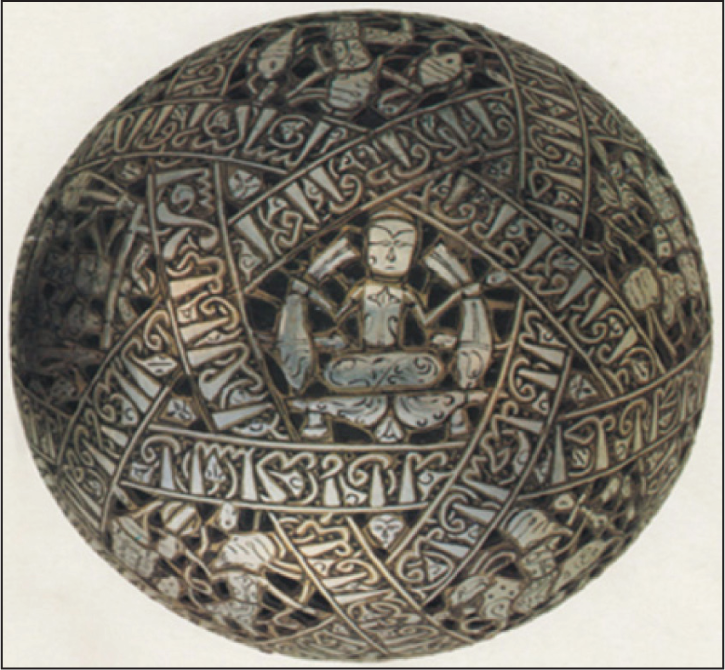
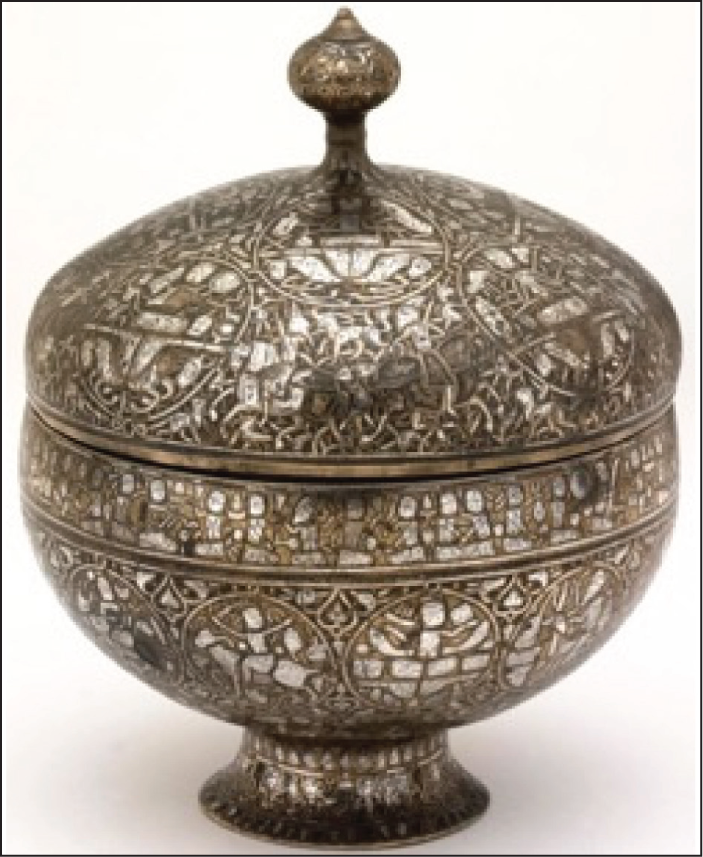
‘The Vaso Vescovali’, lidded bowl of high tin bronze, engraved and inlaid with silver. Khurasan or Herat, 1200 (circa). D. 18.50 cm, H. 21.50 cm. © The Trustees of the British Museum.
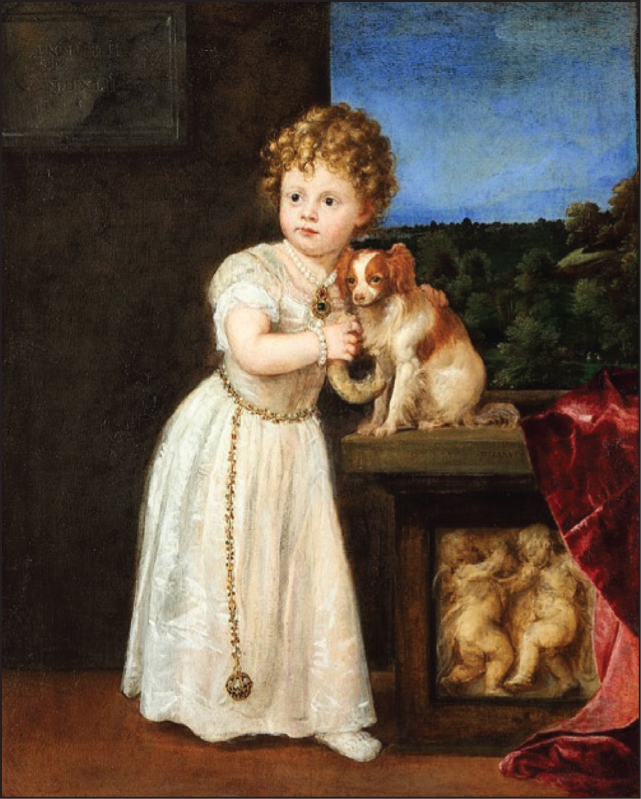
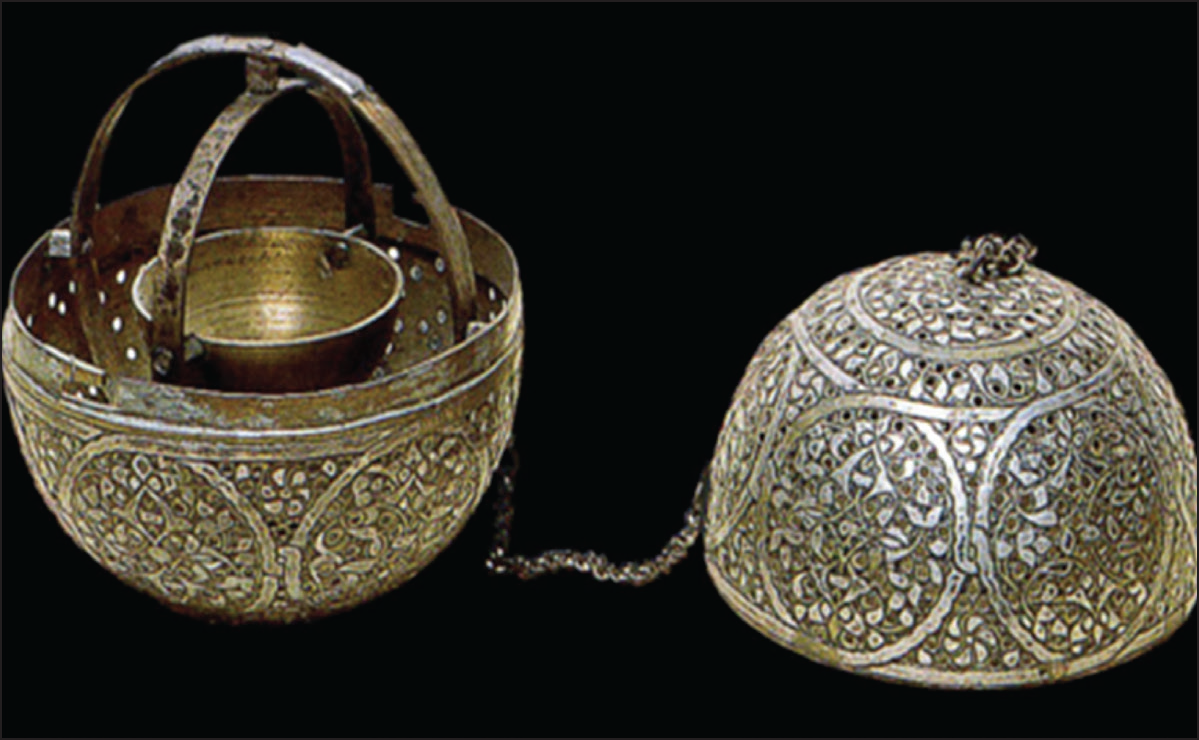
Further West, in late Medieval/early Renaissance Italy, more incense spheres were found. They were part of a group of metalworks often labelled ‘Veneto-Saracenic’, a name referring to their display of a mixture of Middle Eastern and European elements in their style and technique. 16 Most Veneto-Saracenic incense spheres are now kept in European museums including in Venice, Bologna, Florence and London; a few are in Cairo and Jerusalem. In one of the most comprehensive studies on this group of metalwork, Sylvia Auld catalogued a total of 64 ‘Veneto-Saracenic’ incense spheres. 17 Beyond artefacts, Auld also brought to our attention the appearance of an incense sphere in pictorial art. An example occurs in a portrait by the Renaissance painter Titian (Tiziano Vecellio, c. 1488–1576), made for Clarissa Strozzi, the then two-year-old daughter of the influential Florentine banker Roberto Strozzi and his wife Maddalena de’ Medici, daughter of Lorenzo de’ Medici (1449–1492) (Figure 7). 18 In the portrait, painted during the family’s exile to Venice following Roberto’s involvement with the Turkish sultan, little Clarissa is depicted wearing a jewelled chain with a perforated metal sphere suspended at its end. This little sphere, hanging from Clarissa’s waist, reveals the family’s connection with the Islamic world. 19 It also shows the broader fascination of Renaissance Italy’s elites with ‘oriental’ art. Indeed, the famous Renaissance patron Cosimo I de’ Medici (1519–1574) had two incense spheres in his collection, noted as profumieri damasceni in his 1553 inventory, thus indicating the great appeal that incense spheres had in European courts at the time. 20 (See Figure 8 for an example from Florence.)
Titian, ‘Clarissa Strozzi (1540–1581) at the Age of Two’. 1542. Oil on canvas, 115 cm × 98 cm. Gemäldegalerie, Berlin, Germany. Photo credits: State Museums in Berlin, Picture Gallery/Christoph SchmidtCC BY-NC-SA 4.0.
Incense Burner. Brass and Silver, D. 11 cm. Fifteenth century. Museo Nazionale del Bargello, Florence, Italy.
Textual sources reveal that such objects were in use in Central and Western Asia even earlier. The Persian polymath, Al-Bīrūnī (973–after 1050), describes how such incense burners were rolled between guests at a dinner he attended.
21
In the western extremity of the Islamicate, a prominent Arab poet of Sicily, Ibn Ḥamdīs (c. 1056–1133), praises a sphere rolling across a silken carpet in front of the Zirid prince ‘Alī ibn Yaḥyā (r. 509–515
The presence of incense spheres in Herat and Khurasan in the twelfth century, in addition to these references in texts and fine arts, suggests that this type of object was known in the Islamic world before the Mamluk period (1250–1517
History, Nomenclature and the Paradoxical Association with Buddhism and the Boudoir
The connection between Tang incense spheres and Middle Eastern ones is unmistakable, largely because they are both equipped with the distinctive gimbal device. Although the focus of this article is on the censers rather than on the gimbals, it is useful to review key discussions concerning this device.
The first scholar to include a Chinese angle into the discussion of the global history of gimbals was Berthold Laufer, who maintained that the mechanism was one example of the Hellenistic influence on ancient Chinese science, through the routes that would be now popularly called the Silk Roads. 25 Joseph Needham, on the contrary, suggested that it might have been a case of an Asian invention having been transmitted westward by the Arabs, or possibly by Jewish travellers at an earlier stage. 26 The historian of science George Sarton, adopting a more diplomatic position, suggested that they might have originated independently in China and the West. 27 All three scholars referred to roughly the same textual sources for the early uses of the gimbal, which are summarised below.
The name ‘Cardan suspension’ comes from the Italian mathematician Jerome Cardan (Girolamo Cardano, 1501–1576), who described such a device in his De Subtilitate (1550) and indicated that it was previously used in oil lamps. Before that, a ninth-century Latin manuscript of chemical recipes, Mappae Clavicula,
28
and a thirteenth-century sketchbook compiled by the French architect Villard de Honnecourt both included descriptions of similar devices.
29
Leonardo Da Vinci (1452–1519) left a drawing showing a similar device, claiming to have planned to use it with a compass.
30
The earliest description of a compass suspended in gimbals, in turn, occurs in a sixteenth-century Spanish book on navigation by Martin Chavez, Breve compendio de la esfera y de la arte de navigar.
31
The source that led to divergent conclusions regarding the gimbal’s origin was a passage from an Arabic manuscript of the Pneumatica by Philon of Byzantium (ca. 220
As for China, two passages are often cited to corroborate the early appearance of the gimbal in China. The most commonly cited passage comes from the Xijing zaji 西京雜記 (Miscellaneous Records of the Western Capital), a collection compiled no later than the sixth century.
33
The passage in question concerns a skilful artisan of the Han dynasty named Ding Huan 丁緩 (fl. first century
Textual examination, therefore, confirms Needham’s suggestion: a mechanism like the gimbal was known in China at the latest from the sixth century
Furthermore, the gimbal does not seem to have been used in any later scientific or technological developments in the Chinese context. The eleventh-century polymath Shen Kuo 沈括 (1031–1095), for instance, did not apply the gimbal to his compasses, either in floating positions or in mountings. 38 While the Tang incense spheres remain exquisite witnesses to the artistic achievements, metalwork craftsmanship and engineering knowledge of that era, it is difficult to argue that it had any direct impact on later scientific developments.
A close examination of Tang-dynasty textual references to incense spheres suggests that they were probably considered a novelty at the time, imported or produced as luxuries and/or exotic objects. The name of the object, for example, remained opaque and unstable for most of the eighth to tenth centuries—periods to which most of the unearthed artefacts are attributed. For centuries, these objects were referred to with different names and the same terms were also employed to designate other things.
Before the Famen Monastery discovery, archaeologists and scholars had named Tang incense spheres xunqiu 熏球 (censing globes) or xiangqiu 香球 (aromatic globes) because of their spherical shape and their function of burning incense. In the monastery’s crypt, together with the incense spheres, archaeologists found an inventory stele (yiwuzhang bei 衣物賬碑) dated to the 15th year of the Xiantong 咸通 era (874) of the Tang dynasty, which provided a list of items, together with the weight of the objects. After comparing the objects found in the deposit and the items mentioned in the inventory stele with their respective weights, scholars were able to identify the incense spheres with the term xiangnang 香囊, which literally means ‘scented sachet’. 39
Xiangnang is a familiar term. Objects called ‘scented sachet’ have been mentioned as personal accessories attached to clothes or hung in carriages to aromatise the inner space of vehicles. 40 In an account from the Jiu Tangshu 舊唐書 (Old Tang History), a scented sachet became a relic of the tragic love story between Emperor Xuanzong 玄宗 (r. 712–756) and his favourite concubine, the legendary beauty Yang Guifei 楊貴妃 (Lady Yang). 41 The anecdote relates that in the year 758, when Chang’an was recovered, Xuanzong returned to the capital and became the emeritus emperor. He sent a trusted servant secretly to rebury Lady Yang, whom he was forced to execute during their escape from the capital following the turmoil of the An Lushan Rebellion (755–763). When the servant uncovered Lady Yang’s shallow burial near the Mawei 馬嵬 post-station, he found that the concubine’s body had already decomposed; only the scented sachet buried with her was still there. The servant, thus, recovered the sachet and presented it to Xuanzong, who cried sorrowfully at the sight of the object. 42
The scented sachet, a deeply intimate personal object, would have evoked Xuanzong’s memories not only of the appearance but also of the fragrance of the deceased concubine. The object from then on became a source of inspiration to later poets and dramatists. Zhang Hu 張祜 (c. 792–c. 853) wrote a poem entitled ‘Taizhen xiangnang’ 太真香囊 (Taizhen’s Scented Sachet) recalling this love story and, centuries later, the notable Yuan playwright Guan Hanqing 關漢卿 (c. 1241–1320) echoed this motif with a play named Ku Xiangnang 哭香囊 (Crying at the Scented Sachet), of which only a fragment survives.
The account of the sachet remaining intact while the body decayed previously bewildered scholars, as a ‘scented sachet’ had traditionally been thought to be a textile bag. Hence, when the two silver incense spheres recovered from the Famen Monastery crypt were identified as ‘scented sachets’, scholars happily proclaimed that the one buried with Lady Yang must have resembled these metal ones.
43
This interpretation, however, is not unproblematic. Art historian Shang Gang 尚剛 has already noted that Lady Yang’s scented sachet, as described by Zhang Hu, who lived not long after her death, refers clearly to one that is made of cloth and decorated with embroidery.
44
We also know of scented cloth sachets from as early as the Western Han dynasty (206
First appearing in a fifth-century text, the compound term ‘scented sachet’ (xiangnang) continued to be used for describing scenting accessories made of textiles.
46
However, a few eighth- and ninth-century texts also use it to describe objects made to contain fire or burn incense. One passage explicitly indicates that xiangnang is an object made of metal. The passage in question is an entry in the Yiqiejing yinyi 一切經音義 (Pronunciations and Meanings of the Complete Buddhist Scriptures), a Buddhist dictionary compiled by Huilin 慧琳 (736–820), a Tang lexicographer monk born in Shule 疏勒 (present-day Kashgar). It reads:
As for the scented sachet, it is a utensil used for burning incense. Brass, iron, gold or silver are used to make an exquisite sphere. Inside, it contains an ingeniously engineered mechanism for holding an aromatic substance. No matter how the outside rolls around, the inside sachet remains constantly level and can be made not to tilt. It is used by imperial consorts and concubines. 香囊者,燒香器物也。以銅鐵金銀聆䏊圓作,內有香囊機關巧智,雖外縱撗圓轉而內常平,能使不傾。妃后貴人之所用也。
47
The description perfectly matches the unearthed artefacts.
Several poems also describe a similar object with the same term. Bai Juyi 白居易 (772–846) mentions a ‘hand-warming little scented sachet’
48
and Yuan Zhen 元稹 (779–831) praises the elegant rolling of a censer when moved by a gentle breeze.
49
The lines in Wang Jian’s 王建 (765–830) ‘Qiuye qu’ 秋夜曲 (A Song of an Autumn Night) clearly use the term to describe an incense burner:
In the scented sachet, the fire has died, the scent has grown faint. Facing the curtains, she closes her eyes and [asks] when dawn will break. 香囊火死香氣少,向帷合眼何時曉。
50
What complicates the picture is that the description of objects by other names also seem to fit incense spheres. In Chaoye qianzai 朝野僉載, the author Zhang Zhuo 張鷟 (c. 658–730) describes a brazier with a Cardan suspension called ‘Wood Fire Expert’ (muhuo tong 木火通) designed by an artisan from Haizhou 海州 (in modern-day Zhejiang 浙江), which was potentially intended for Wu Zetian’s 武則天 (r. 690–705) new Bright Hall (mingtang 明堂).
51
The term ‘incense ball’ (xiangqiu 香毬) also appears in several passages describing a similar object. A poem by Yuan Zhen, for example, simply entitled ‘Incense Ball’, reads as follows:
Following convention, I only revolve about, yet at the core I remain constant. My love for my lord shall never be set askew, still you are surprised as the fire perpetually burns. 順俗惟圓轉,居中莫動搖。愛君心不惻(側),猶訝火長燒。
52
Both the mechanism and the allusions to romantic love are in line with the image of incense spheres.
Furthermore, ‘incense ball’ became an established term used for incense spheres from the eleventh century. It is mentioned in the institutional histories of the Song 宋 (960–1279), Jin 金 (1115–1234) and Yuan dynasties. During the Song dynasty, it was increasingly used by the imperial family in formal ceremonies and became an established accessory for their carriages. 53 ‘Incense ball’, however, was sometimes also the term used to describe pellets of aromatics used in games and Buddhist rituals. There are, in addition, ‘lamp balls’ (dengqiu 燈毬), which are identical to incense spheres, only used as lamps. The Needham Research Institute in Cambridge, among other institutions, holds a globe with the gimbal designed to hold a candle. 54
The association of the term ‘scented sachet’ with metal incense spheres, thus, only began in the eighth century and the object’s nomenclature remained fluid in the two centuries that followed. This might suggest an unstable knowledge of the object, which was a novelty. Attempts would, thus, possibly have been made to familiarise it to Tang audiences by comparing it to known objects (e.g., a scented sachet) or describing its shape (incense ball).
An examination of the textual references to incense spheres, moreover, reveals their usage at the time. Aside from Huilin’s Buddhist dictionary entry, all the poetic references associate these objects with the court, the capital city, women and intimacy. In Wang Jian’s poem, an incense sphere becomes part of the female space. It may have been given to her as a gift, as a token of love. The fire dying out in its heart symbolises that her longing and desire were turning into despair and were at risk of being extinguished altogether. When the dawn breaks, the dream of love will be awakened, while the scent of burnt aromatics—a remembrance of the past moments spent together—may still linger. In Yuan Zhen’s poem ‘Incense Ball’, the incense sphere itself becomes the personification of love, a constant feeling that will not change even when the sphere revolves about. The fire in its heart symbolises passion, which, no matter how the world changes, will never burn out. Finally, Bai Juyi’s poem ‘Incense Ball’ reminds an old friend of the game they had played together in Chang’an in the old days, where an incense sphere rolls around, moved by a gentle breeze, sending out a plume of fragrance with an indiscernible, inconspicuous and intimate message. 55
The tendency to associate incense spheres with intimacy and the boudoir grows over time. More than any other censing paraphernalia, incense spheres became an outward symbol of the intimate relation between smell and eros. By the Ming dynasty, incense spheres had become considered an ‘elegant utensil of the boudoir’ (guifang zhi yaqi 閨房之雅器), and were also disparaged as ‘excessive crafts’ (yinqiao 淫巧) designed for women. 56 In the famous Ming vernacular novel Jin Ping Mei 金瓶梅 (The Plum in the Golden Vase, published c. 1610), one of the protagonists, Li Ping’er 李瓶兒, used a silver incense sphere to aromatise her bedclothes. 57 Incense spheres were increasingly associated with feminine space and the art of seduction; so much so that they came to be considered ‘vulgar’ (su 俗) and went out of fashion. 58
Curiously, the object is also mentioned in a Buddhist context. When Huilin gave the definition of the term ‘scented sachet’, he was annotating the Da bore boluomiduo jing 大般若波羅蜜多經 (Mahāprajñāpāramitā sūtra), a Mahayana sutra collection translated by the eminent monk Xuanzang 玄奘 in 660–63. The original passage in Xuanzang’s translation where xiangnang is mentioned reads:
Further, oh Kauśika, if noble sons and noble daughters dread their enemies, malevolent animals, calamities, curses, pestilence, poison or spells, they should copy the great divine dhāraṇīs of prajñā-pāramitā (Perfection of Wisdom), divide them according to their sizes, put them into incense sachets and store them in bejewelled canisters. They should carry [the dhāraṇīs] at all times, worshipping and venerating them, so that all the fearful things will be dispelled. 復次,憍尸迦
59
!若善男子、善女人等,怖畏怨家、惡獸、災橫、厭禱、疾疫、毒藥、咒等,應書般若波羅蜜多大神咒王,隨多少分香囊盛貯置寶筒中,恒隨自身供養恭敬, 諸怖畏事皆悉銷除…
60
This passage demonstrates that Buddhist devotees used something called a ‘scented sachet’ to carry their talismans. Aromatics may have been used to help preserve the dhāraṇīs and endow them with additional protective power.
Whatever Xuanzang’s translation committee may have been imagining when they used the word ‘scented sachet’, when Huilin was commenting on this term in the eighth to ninth centuries, he clearly had in mind an object very similar to the Tang incense spheres. Huilin also notes that these were used by ‘imperial consorts and concubines’. 61 How did such objects find their way into both the hands of Buddhist devotees and the boudoirs of noble ladies in Chang’an? This paradox is also manifested in material culture, where incense spheres, usually associated with courtly life and feminine space in literature, appear in a Buddhist temple like the Famen Monastery. While it is not unusual to find domestic and personal items among donations to Buddhist monasteries, 62 in this case, a more likely potential explanation could be that incense spheres were not known as ‘boudoir objects’ ab initio. Rather, they were treasurable objects circulating along the Silk Roads, adopted by Buddhists and aristocrats independently because of their ingenious craft, delicate design and elevated value. Below, I shall further substantiate this hypothesis by demonstrating how the shape, decorative motifs, material and mode of use all demonstrate influences from Central Asia, Iran, India and beyond.
The Spherical Shape: An Image of the Cosmos?
While much attention has been paid to the gimbal, the spherical shape has rarely been discussed. This, however, represents a highly unusual case in Chinese censing culture. As several scholars have noted, traditional Chinese censers derived their shapes from ritual vessels.
63
This is not only a modern observation. As early as the Song dynasty, a collector and scion of the imperial family, Zhao Xihu 趙希鵠 (fl. 1180–1240), outlined the evolution of spherical censers from sacrificial vessels:
The ancients connected with the gods using artemisia (xiaoai 蕭艾) and did not burn incense, therefore, they had no censers. The vessels called censers today are all made after the sacrificial vessels in the ancestral temples of the ancients. The censer jue 爵 derives from the wine vessel jue of the ancients. The ‘lion’ censer takes its shape from the ancient cauldron with feet. The spherical censer is copied from the cauldron (yu 鬵) of the ancients. There are many others of this kind and there are also new casts, but they all resemble in shape vessels that existed in times of old. The only exception is the ‘Hill Censer’, which was used in the palace of the heirs apparent in the days of the Han. It is from this type that the manufacture of censers first commenced. 古以蕭艾達神明而不焚香,故無香爐。今所謂香爐,皆以古人宗廟祭器為之。爵爐則古之爵,狻猊爐則古踽足豆, 香毬則古之鬵,其等不一,或有新鑄而象古為之者,惟博山爐乃漢太子宫所用者,香爐之制始於此。
64
Zhao traces the origins of several censer types known during his lifetime, all of which derive from an ancient sacrificial food or wine vessel. He singles out the Hill Censer, indicating how this particular form gave a new status to the incense burner, from which point incense burners became a type of object independent of ancient archetypes.
Excavated sacrificial vessels and incense burners adhere to the observation mentioned above. Most Chinese censing paraphernalia followed a ‘food/drink vessel–ritual bronze–incense burner’ paradigm, aside from a group of zoomorphic censers. Even in the case of the Hill Censer, some scholars have observed its similarity with the ancient food vessel, dou 豆. Incense spheres, by contrast, do not fit into this model. Why, then, were incense spheres made into this shape? Was this dictated by the shape of the pivoted rings? The round shape of the rings may have influenced the shape of the outer shell, but such an influence should not be taken for granted. Was the object designed to be rolled, or associated with the popularity of ball games in the Tang? These are plausible scenarios, but they do not explain why all these objects are divided in the middle horizontally, into two hemispheres. None was designed to be opened along a vertical axis. Furthermore, incense spheres are made up of two hemispheres joined together, containing concentric rings inside, which surround a single hemispherical pot in the centre. This depicts an object very much like an instrument known and in circulation in ancient and medieval China: the armillary sphere. This similarity did not go unnoticed. Already in the Ming dynasty, Tian Yiheng 田藝蘅 (1524–c. 1574), who called the incense spheres ‘elegant utensils of the boudoir’, for instance, observed that:
The gilded incense spheres of today are like armillary spheres, they contain three levels of contrivances in the centre, so that the weight is evenly distributed and [it] can be rolled around without cessation. They can be placed under the bedclothes without the fire dying out. 今鍍金香毬如渾天儀,其中三層關棙,輕重適均,圓轉不已,置之被中而火不覆滅。
65
This passage makes an explicit connection between censing paraphernalia and an armillary sphere. In modern times, Needham pushed this correlation further, suggesting that the gimbal mechanism may even have been derived from the construction of armillary spheres. Ding Huan, the alleged inventor of the incense sphere, may have been among the artisans who knew how to make such an armillary sphere. 66
We have already discussed the difficulties of seeing the Tang artefacts as direct descendants of Ding Huan’s invention. Below I will show that while a connection between the censer and the astronomical instrument is plausible, it is equally problematic to conclude that Tang incense spheres derived from earlier Chinese armillary spheres.
First, we need to review the significance of armillary spheres, and by extension, astronomical instruments in early and medieval Chinese history. The construction of armillary spheres started in China with Zhang Heng 張衡 in the second century
The same tradition was followed in the Tang dynasty. When Wu Zetian became the first and only female emperor in Chinese history, she ordered the construction of the new Bright Hall (mingtang), which was a highly symbolic building representing the perfect state, with an armillary sphere placed in it. 69 In this instrument, according to the Dayun jing shu 大雲經疏 (Commentary on the Great Cloud Sutra), an essential text for Wu Zetian’s political project, the heavenly bodies were represented by spheres. 70 Incense spheres found in Tang hoards are all very small and portable, which makes their interpretation as evoking the image of the cosmos or imperial authority unlikely.
Furthermore, probably because of the close relationship between astronomy and statehood, private ownership of astronomical instruments, along with unsanctioned learning of astronomical knowledge, was banned under Tang law. 71 This, of course, does not mean that no one in the empire owned astronomical instruments or derivative objects. However, all the Tang incense spheres of known origin come from the courtly context and from the capital; thus, their existence would not have escaped the government’s notice. In addition, the textual evidence clearly suggests that these objects were used in female spaces and leisurely activities. Hence, adapting an astronomical instrument—an item that potentially relates to the fate of the state at a cosmological level—for such frivolous purposes would seem like an act of profanity.
On the other hand, even though incense spheres had not derived from an earlier Chinese armillary sphere, they still might have evoked the impression of the cosmological workings in the mind of their beholders. It is for this reason that later authors made connections between the two. The concept of a spherical heaven (huntian 渾天) has a long history in China and was held to be true by scholars like Ge Hong 葛洪 (283–343),
72
and by imperial astronomers like Shen Yue 沈約 (441–513) and Li Chunfeng.
73
Zhang Heng’s commentary on the armillary sphere describes the earth as a sphere enveloped in another sphere, an assertion that is quoted by Gautama Siddha 瞿昙悉达 (fl. eighth century), an astronomer of Indian descent serving at Xuanzong’s court:
The spherical heaven resembles an egg. The heavenly body is as round as a pellet, while the earth, like the yolk inside an egg, resides alone in its centre. Heaven is large, and the Earth is small, within and without Heaven there is water. Heaven envelops the Earth, just like the eggshell contains the egg yolk. Heaven and Earth each ride on their qi and stand, floating on water. 渾天如雞子,天體圓如彈丸,地如雞子中黃,孤居於內。天大而地小,天表裏有水。天之包地,猶殼之裹黃。天地各乘氣而立,載水而浮。
74
This description of the cosmos greatly resembles the incense sphere, with the outer shell representing Heaven, and the interior container symbolising the Earth, which floats and moves independently.
In contrast to the grand authority and solemnity invested in astronomical instruments in early and medieval China, further West, in the Greco-Roman world and the Islamicate, astronomical instruments were at times appropriated for aesthetic appreciation. We find, for instance, a mosaic of an armillary sphere in a Hellenistic-Roman site not far from Palermo, Casa di Leda (c. second century
While Islamic astronomical instruments arrived in China much later, 77 Indian and Persian astronomers were active in Tang China, enriching Chinese astronomical and calendrical knowledge. Gautama Siddha, mentioned above, was of Indian descent. An Esoteric Buddhist monk in charge of constructing an armillary sphere under imperial order, Yixing 一行 (683–727), incorporated Hellenistic astronomical elements into his project. 78 Some of the foreign travellers or settlers seeking fortune in the Tang also gained renown for their skills, like Jilie 及烈 (Gabriel), the Syriac Christian monk (i.e., from the Church of the East, known in China as Jingjiao 景教), who was famed for being able to craft ‘ingenious utensils and extraordinary objects’ (qiqi yiqiao 奇器異巧). 79 Moreover, Chinese artisans may have sojourned in Central and West Asia. Du Huan’s 杜環 notes in his eighth-century travel account state that he saw Chinese gold and silver metalworkers and painters in the Abbasid Caliphate. 80 All this suggests that there were artistic and technological exchanges between China, India and Central Asia in the making of metalworks in the Tang period. The Tang incense sphere may well have been a result of such exchanges.
Foreign Elements on Tang Incense Spheres: Materials, Motifs and Shape
In addition, Tang artefacts are multicultural objects, embodying the composite and eclectic culture in which they were found. The choice of material used to make the objects, to begin with, reflects cultural influences from Persian and Sogdian art, on the one hand, and Buddhism on the other.
The Tang incense spheres known to date are all made of silver, partially gilded. As Annette Kieser has observed, the materials of choice for highly regarded objects in early China, notably ritual vessels in which sacrifices were offered to the ancestors, were jade and bronze, while gold and silver gained popularity in medieval times. 81 The growing appreciation for gold and silver in medieval China has been attributed either to the aesthetic taste of the nomadic tribes that had ruled large parts of northern China after the fall of the Han, or the cultural-artistic influence from Persia and Sogdiana. Silver dishes, cups and ewers with distinctive Persian and Sogdian characteristics dating from the Tang period have been found. Some of them were imported and some were made locally by foreign or Tang artisans in imitation of Central or Western Asian style. 82 All these elements would have permanently reshaped the appreciation of gold and silver objects, as well as the ways and techniques of working and decorating them.
Another element that contributed to the increasing esteem for gold and silver wares was Buddhism, since these precious metals were preferred in Buddhist rituals. 83 This is attested by the large number of gold and silver objects found in the Famen Monastery crypt, which were there probably not only as aesthetically pleasing collections but also as items of spiritual significance.
The decorative motifs on these objects also demonstrate a mixture of cultural features. Native Chinese patterns like flying birds, mandarin ducks and lobed frames were combined with motifs indicating strong Mediterranean influence such as grapes and palmette, as well as Central Asian–style pomegranate flowers and animals. One incense sphere from the Famen Monastery unusually contains the motif of bees, while the image of a parrot—a bird considered extraordinarily rare and exotic—appears on a few examples (for instance, one from the Shapocun hoard and one in the Kempe collection). Parrots were brought to the Tang capital from Persia and the kingdoms in present-day Southeast Asia. Lady Yang had a famous parrot that she called ‘Snow-Clad Maiden’ (xueyi niang 雪衣娘), offered to the court by the prefecture of Guangnan 廣南 (in today’s Guangdong). 84 The decision to carve images of parrots was symptomatic of the vogue and taste for exotica. The interior bowl of a Famen Monastery example bears the lotus motif, showing Buddhist influence. Motifs featured on incense spheres further demonstrate a similarity with contemporary gold and silverware under Persian and Central Asian influence. Therefore, whether the incense sphere was imported or made locally, like the majority of Tang gold and silverware, it exudes a strong allure of exoticism.
Moreover, Tang incense spheres are attached to a chain and a hook, which means they were designed to be suspended, swung and moved around. No obvious precedent existed in central China. 85 We find, however, a related item in a mural associated with Jingjiao Christianity. A fragment of a mural from Qocho (near Turfan) found by Albert von Le Coq in 1905 depicts a priest swinging a golden (yellow) incense burner in his left hand (Figures 9 and 10). 86 The mural probably dates from the eighth century and presumably depicts a Palm Sunday scene. The identification of the object as a censer is due to the depiction of a quickly rising wavy line that dissolves in spirals at its top, likely representing smoke. Despite a few iconographic anomalies, 87 this seems to be early evidence of the use of an incense burner in Syriac Christian liturgies as well as an early example of a swinging censer. The censer depicted in the Qocho mural looks more like a plate or a shallow disc rather than a sphere; three chains instead of one are attached to the censer, yet it still conforms to the notion of a swinging thurible used in a Christian church on the Tang periphery.
Fragment of a Mural from a Christian Sacred Building and Detail, Qocho, Xinjiang, China. Seventh–eighth centuries Colours on clay. Photo credits: Staatliche Museen zu Berlin, Museum für Asiatische Kunst.
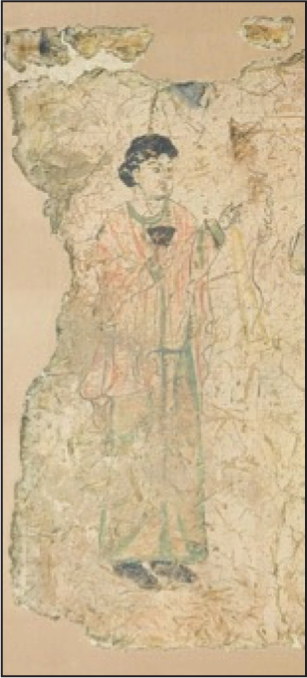
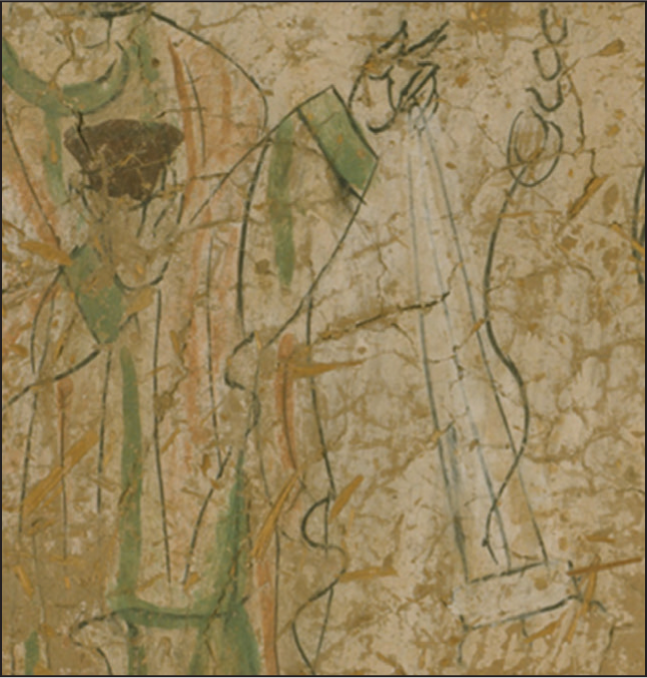
Jingjiao Christians travelled from the West along the Silk Roads. They had started to spread their teachings in central China no later than the seventh century
To add to this point, several recent studies reveal information about the vibrant aromatic trade along the Silk Road. Scholars have also argued for the transmission and adaptation of other types of censing paraphernalia in medieval China. For instance, Jessica Rawson shows that the famed ‘Hill Censer’ of the Western Han, whose imitated form was still used in the Tang dynasty, may owe its origin to examples from Western Asia via Siberia or Central Asia. 90 The long-handled censer, encountered both in paintings and in archaeological finds, is also believed to have originated in Gandhara 91 or even in the Near East. 92 Tang incense spheres may have been part of this olfactory and material culture in circulation. Incense spheres are, thus, yet another example of cultural artefacts that remind us of the constant flow of peoples, ideas, goods and knowledge in medieval times across Eurasia.
Conclusions
Made with precious metals and decorated with exquisite and exotic motifs such as lions, parrots and pomegranates, Tang incense spheres represent the high level of sophistication and elevated skills achieved in the making of perfuming paraphernalia at the time. Tracing the locations where incense spheres were found, a map of connected material culture emerges, in which Chang’an, Herat, Damascus and Venice are linked.
Incense spheres discovered in Tang hoards, which are the earliest artefacts found to date, reveal multicultural origins upon close examination. Persian and Sogdian silversmith elements, Buddhist ideas and Syriac Christian liturgical practices, may all have left their traces on the making of the object. These censers, with their sophisticated engineering device and spherical shape, are unique specimens that have intrigued scholars, past and present, and encouraged them to speculate about their cultural and scientific significance, as well as their possible connection to the armillary sphere. If this connection did indeed exist, the transfer of the structure to the incense sphere would have most likely occurred outside China. Because astronomy was closely linked with imperial authority in China, the production of astronomical instruments was strictly regulated, while such customs as the use of portable astronomical instruments existed in the Mediterranean and Islamic world.
After this investigation, in which a variety of factors have been considered, it is still unclear whether incense spheres were transmitted to the Tang dynasty via the Silk Road, or created locally, having been inspired by foreign imports, or even crafted by artisans from India, Persia or Central Asia who were in China. These possibilities remain speculative, awaiting additional evidence for confirmation. It is hoped that further research on the interplay of olfactory culture, metalwork and astronomical instruments among Chinese, Indian, Islamic and Central Asian cultural spheres will provide a clearer understanding of the global journey of incense spheres, and of those who bore them. Meanwhile, we can say that incense spheres are rare artefacts that testify to exchanges of artistic, cultural and technological knowledge among China and Central and West Asia both before and after the year 1000. These objects shaped how people in these different cultures engaged with scent and art, and may have tangentially played a role in the transmission of astronomical and mechanical knowledge.
Footnotes
Acknowledgements
I am grateful to all those who have read various drafts of this paper and provided constructive feedback.
Declaration of Conflicting Interests
The author declared no potential conflicts of interest with respect to the research, authorship and/or publication of this article.
Funding
This work was supported by St John’s College, University of Cambridge, the Chiang Ching-kuo Foundation for International Scholarly Exchange and the Needham Research Institute, Cambridge.
This work was supported by St John’s College, University of Cambridge, the Chiang Ching-kuo Foundation for International Scholarly Exchange and the Needham Research Institute, Cambridge.