



Abstract
Not all chronicles were written in books. This article examines a widespread alternative, the tablet (table, tabula), which was a display board typically made of wood and parchment. They were once ubiquitous in churches, but today there are few extant examples. This article offers a ‘textual archaeology’, using manuscripts and antiquarian literature to reconstruct lost texts. It presents a case study at St Paul’s Cathedral, London. It examines the functions and audiences of the London historical tablets, and places them in their spatial, textual and manuscript contexts. Tablets displayed a variety of historiographical genres: chronicles, institutional histories, miracle and saint narratives, and lives and deeds of benefactors. Their spatial location indicates particular concentrations around the main pilgrimage sites of the church. Surviving witnesses hint at a broad audience for these texts in London, including local laymen, clergy and pilgrims. Tablets were used to assert the institutional claims and identity of the church, to inform tourists and pilgrims, and to assist in the creation of public memory through ceremonies and rituals. Tablet chronicles point towards medieval uses of the past that were public-facing, accessible, and engaged with the institutional and cultural life of London.
Introduction
In a chapel next to the northern entrance to St Paul’s Cathedral in London, there used to rest a sacred relic known as the holy rood of the north door. It inspired a complex legend. Supposedly, Joseph of Arimathea—the man who had assisted Jesus on the day of his crucifixion—kept part of the cross and later brought it on a missionary journey to Britain. Disaster struck when a piece of the holy rood was thrown into the sea by a pagan king. Years later, the legendary King Lucius ordered the realm of Britain to convert to Christianity which caused the missing crucifix to rise miraculously out of the Thames. Lucius placed the relic in the principal church of his land, which was then at St Paul’s rather than Canterbury. The rood was thus a tangible link between the life of Jesus and the medieval church: it was an expression of the centrality and importance of St Paul’s within the Christian life of England, as well as a source of miracles and popular devotion.
The most detailed extant version of this story could be found in the mid-fifteenth-century history named John Hardyng’s Chronicle. In one copy of this text, British Library MS Lansdowne 204, one user wrote a note that the same story could be found ‘in a table afore the rode at north dore and in a storye in a wyndow byhynde the sayd rode’. 1 One important implication of this note is that it attests to the variety and diversity of medieval historical storytelling. The reader could peruse versions of the same story told in three different formats. First in John Hardyng’s Chronicle, recorded in the typical format of a codex or book. Secondly, in narrative art, in a stained-glass window. Finally, in a format known in Latin as a tabula or in English as a ‘table’ or ‘tablet’, meaning a text written on a public display board. Of the three formats in which the annotator had encountered this tale, only the chronicle today survives. The window and the tablet probably perished with the holy rood during the 1538 purge of the relics at the cathedral during the Reformation. 2
Medieval chronicles in books have survived in vast numbers and this has led modern historians to assume that the codex was the default format for historical writing. By contrast, medieval historical narrative art rarely survives in England. Chronicles written on tables are even rarer. Only three are known to survive, two in York Minster and one from Glastonbury Abbey. 3 The annotation in Lansdowne 204 should, however, remind us that medieval readers had access to retellings of the past that were broader, more varied and more multimedia than surviving fragments would suggest. Historical stories could be formatted as a codex, roll, table, visual art or in oral forms. Medieval uses of the past could be multi-media and multi-genre. Historians have long acknowledged that historical writing has a large hinterland consisting of an amorphous mass of other ways that societies use and talk about the past—proposed terms to help us describe this include collective memory, sense of the past, social memory, historical culture and cultural memory. 4 This essay will adopt D. R. Woolf’s term, ‘historical culture’, which has gained circulation in medieval and early modern studies. 5 Historical culture encompasses the ‘material, social, and circumstantial’ forces that influence how a society thinks about its past. It signals a shift away from viewing historiography as a cannon of texts; instead, it should be viewed as one way amongst many that societies think about the past, and as inevitably influenced by the material, political, social and cultural aspects of its age. 6
Historical culture is potentially vast as a topic and this article will focus on one specific corner of it—namely, the use of tablets to hold historical writing. Tablets were, like codex chronicles, a form of historical writing, but differed from chronicles in ‘material, social and circumstantial’ ways. They differed materially because they were produced using different materials, different manufacture, and a different physical form compared to the codex. There were also ‘social and circumstantial’ differences—whereas a codex was produced for a library, archive or personal book collection, a tablet was created for public display. This opens up obvious questions of audience—who constituted the ‘public’ that the tablet was displayed for? Perhaps less obviously, it raises questions of space, as tablets were created for specific places—understanding tablets requires that we understand medieval space, particularly about who controlled a space and who had access to a space. We are used to thinking of theatre, modern art or performance art as ‘site-specific’, but this is not a common perspective when dealing with medieval written intellectual culture such as chronicles. 7 Tablets are therefore not an antiquarian quirk—instead, they offer modern historians new ways to rethink the relationship that historical writing had to form, audience, place and space.
Amongst historians studying medieval tablets, the dominant approach has been compilatory: historians have collated examples of tables from different locations and thus they have demonstrated that tablets were extremely common in English churches from the fourteenth to the sixteenth centuries. 8 These compilatory studies have, for the most part, not been very comparative or analytical: a welcome exception is Martin van Dussen’s article, ‘Tourists and Tabulae in Late-Medieval England’, which uses several examples to argue that tablets responded to the culture of tourism and pilgrimage. 9 The other approach has been to analyse a single text in its local context: most notable is Jeanne Kronchalis’ study of the Glastonbury Magna Tabula, one of the few surviving tablet chronicles. 10
Most authors agree that tablets played one or more of the following three functions. First, they asserted the legal claims and the institutional identity of the church in which they were located. For instance, both the York and Glastonbury tablets paired their chronicles with short legal texts including charters and papal indulgences that had been granted to their churches. 11 A second function was as an educational aid for the clergy: in some instances, tables held basic didactic texts such as the seven deadly sins or the Benedictine rule. 12 Others contained texts comparable to those used in lay instruction: the parish church of St Stephen Walbrook in London, for example, had tablets containing the 10 commandments, the seven deadly sins, seven remedies against sins, the seven deeds of mercy, a ‘table of holy wryte’ and many other prayers and short didactic texts. 13 This has promoted a sense among historians that tablets were a didactic genre, connected to education. Canon Purvis argued that the York chronicle tables were used to instruct the vicars choral, and Kronchalis suggested that the education of schoolchildren may have been a function for the Glastonbury table. 14 A third purpose may have been connections to pilgrimage: often, tablets contained stories of the main saints and relics in an institution and could, therefore, have been of interest to pilgrims and tourists. 15
This article examines the function and uses of chronicle tablets by using a single local case study, namely, the tablets of St Paul’s Cathedral in London, which would have been familiar to the fifteenth-century annotator of Lansdowne 204. London offers a fruitful case study for a number of reasons. One is that London hosted well-developed traditions of antiquarian writing and civic chronicling from the thirteenth century through to the early modern period. 16 A rich source base has also fostered a relatively large and thriving historiography discussing London’s historical culture, which this article aims to draw from and contribute to. 17 Although the original cathedral tablets do not survive, they are nonetheless well-documented in the medieval and early modern antiquarian sources. 18 It is possible through a process of ‘textual archaeology’ to uncover a variety of tablets that once existed in the Cathedral. From surviving witnesses, we can discern the audiences and uses of these texts. York and Glastonbury’s tablets were on free-standing display boards, and we therefore cannot locate precisely where they stood in their respective churches. By contrast, St Paul’s Cathedral employed tables mounted at fixed positions in the walls, which means that we can be very specific about the spatial distribution of these texts. The St Paul’s tablets thus can be used to discuss space, textual traditions and audience with greater specificity than most other tablet traditions.
This article approaches the case study in three parts. First, it uses textual archaeology to discuss the form, genre and texts that the Cathedral authorities chose to inscribe on tablets. Next, it approaches the evidence spatially, identifying particular clusters and patterns in the tablets. Finally, it discusses the uses and audiences of the tablets, with a particular focus on extant manuscript witnesses.
Recovering the Tablets of St Paul’s: Texts and Genres
Tablets are best understood as a format for literature, not as a genre of literature. Tablets consisted of a large writing surface, usually of parchment mounted on a wooden board. Texts for public display were also sometimes painted on cloth, carved in stone or placed on metal plaques: there are obvious visual similarities between these different types of public-facing ‘display board’ texts. Given how rarely the originals survive and how often we are reliant on transcripts, it is not always self-evident whether wood, stone, metal or cloth was the original medium. The tablet format was used to display chronicles, but they also held several other genres of text. This section presents a broad survey of how tablets were used in St Paul’s: namely, of all of the different texts and genres that are attested in tablet form.
One of the most common uses for display boards was to commemorate individuals or families. Many tablets were linked to donors to the cathedral, or to chantries. For example, a tablet above the altar of the Chapel of Saints Anne and Thomas bore the names of several donors, including Dean Thomas Moore (in office 1406–21), as well as the prayers that the chantry priests were required to say for these individuals. 19 Others, particularly those attached to tombs, contained genealogical or biographical information. A tablet erected during the reign of Henry VII next to the tomb of the Duke of Lancaster John of Gaunt (d. 1399), for instance, noted Gaunt’s titles, marriages, and that he was the progenitor of the Tudor dynasty. 20 Collectively, chantry and tomb boards indicate that the tablet format was an important part of public memory: it was vital to establishing and perpetuating the memory of individuals, families and dynasties. There is tentative evidence that the Cathedral commissioned some of these boards: notably, one table affixed to the tomb of Richard Burley (d. 1387) misidentified the occupant of the tomb as Richard’s uncle, Sir Simon Burley (d. 1388). 21 This mistake was unlikely to have been made by the Burley family but may have been the result of inaccurate research by later cathedral officials. Boards of this sort were linked to commemorative practices, but also suggest an antiquarian sensibility: the Cathedral authorities sometimes erected these boards long after the deaths of the individuals in question, as is clear in the case of the Tudor-era board at John of Gaunt’s tomb. These boards flattered the families of patrons and helped chantry priests to do their jobs. They also may have had tourist-facing aspects, responding to visitors’ interest in notable and illustrious graves.
Tablets also adorned shrines of saints and frequently contained hagiographic and miraculous texts. There is obvious continuity between saints’ shrine boards and tomb inscriptions, given that the veneration of saints often focused on the sites of their burial. The tomb of Bishop Roger Niger (1228–41)—who was locally treated as a saint—bore three short tablets, which could feasibly have been of wood or metal. 22 The first contained a brief Latin inscription noting his burial and the second was a lengthier recitation of his biographical details. Most unusual was the third which recorded in Latin one of his miracles. It claimed that, during a church service, a dense cloud entered the Cathedral, bringing foul weather and causing an outbreak of panic and fear amongst the onlookers. The Bishop bravely continued with the mass and, through the positive effects of divine service, he purified the air. 23 Bishop Roger’s tablets are similar in type to those recorded on other tombs, as recounted above: they gave biographical details, glorified the occupant of the tomb, and perpetuated their memory. Similar in character was the brief Latin laudatory biography which was installed at the tomb of St Erkenwald (d. 693), as part of its 1533 restoration. 24 Another brief laudatory biography could be found on the tomb of King Sebbi of Essex (seventh century), who was also acknowledged as a saint. 25 Much more unusual is the tablet placed at the tomb of King Aethelred the Unready (d. 1016) because it was defamatory in nature. It recorded that St Dunstan uttered a dire prophecy at Aethelred’s coronation that the reign would end in ruin and foreign rule because the king had acted treasonously against his own brother. This came to pass when Aethelred died amid an invasion of the Danes. 26 The tablets collected in this paragraph suggest that public boards were often used to contain biographical, hagiographic and miraculous narratives. They commonly appeared on saints’ shrines, such as Roger, Erkenwald and Sebbi; meanwhile, details from the life of St Dunstan appeared on the tomb of King Aethelred. Thus, the existence of a table next to the holy rood of the north door, as noted above, was comparable to the normal practice of the Cathedral.
Secular historical writing was also placed on tablets. At least three inscriptions were placed around the tomb of Bishop William the Good (d. 1075), all of which recorded that he intervened with William the Conqueror to secure the first charter for the Corporation of London. 27 One Latin prose inscription, which the antiquarian John Weever described as being an inscription in stone rather than a board, attributed itself to ‘senatus populusque Londinensis’ (aldermen and commons of London). 28 A second, in Latin verse, was composed by ‘cives’ (citizens) of the city. The dates of these two inscriptions are unknown: the earliest reference to them that I have been able to find is in the 1566 edition of John Stow’s A Summarie of Our Englysh Chronicles. 29 Stow later claimed that these monuments had been defaced ‘dyuers tymes’. 30 If this is a reference to Reformation iconoclasm then this implies that there was a long pedigree of tablets at this site, although it also could mean that these two tablets were recent restorations or recreations. A third inscription, described by Weever as a tablet ‘fastened to the pillar next adjoining to his grave’, was made in English verse by Mayor Edward Barkham (1621/2). 31 Aside from the historical information on these tablets, perhaps their most interesting feature is that they attest to the agency of London laymen in setting up and restoring tablets. Bishop William’s intercession on behalf of the lay leaders of London was a notable act of partnership between the religious and the secular authorities of the city: the creation and maintenance of these tables similarly attested to an ongoing relationship between the Corporation of London and the diocese.
Three tables containing historical information were fixed to columns in the ambulatory in the northeast of the Cathedral. The first of these, which we shall refer to as the ‘topography tablet’, began by describing the size, shape and dimensions of the ‘new work’ building programme of the Cathedral, which had been completed in the early fourteenth century. This was followed by a short account of the 1338 ceremony for the setting up of the spire. 32 The next table, which we shall term the ‘short chronicle tablet’, contained a brief historical text that mostly consists of events in the London area. 33 Its first entry concerned the finding of the holy rood of the north door during the reign of King Lucius. The remainder of the text, spanning from the great fire that consumed St Paul’s in 1087 through to the earthquake that struck the convocation of the clergy at Blackfriar’s church in 1382, recounted local events and displayed a notable preference for disastrous or portentous occasions.
The third text in this location was referred to as the magna tabula (great tablet). 34 It consisted of a long chronicle in several phases. It began by recounting universal history from creation, using the scheme of the ‘seven ages of the world’. The next section gave the legendary history of London, from its foundation by Brutus of Troy through to the time of Julius Caesar. Afterwards, came a potted history of England, including a description of the heptarchy and a list of monarchs who were martyred. The final section gave the names and dates of royal coronations from the time of Alfred the Great through to the fifteenth century. The chronicler occasionally interpolated brief accounts of events; these annalistic entries were rare but became increasingly frequent in the reign of Edward III. The endpoint of the chronicle varies in the manuscript witnesses: in ended in 1399 in BL, Add. MS 22142; in most other witnesses it continued to the 1431 French coronation of Henry VI. 35 This may indicate periodic updating of this text by the Cathedral authorities.
This brief overview indicates that tablets were a ubiquitous part of the built environment at St Paul’s Cathedral. Fixed display boards were attached to tombs, mounted on pillars and placed next to relics. Tablets were a flexible format that could hold a wide variety of contents. Most contained information about the past, presented in a range of genres including biography, genealogy, hagiography and chronicles. The most common type of historical writing on boards were accounts of individual events. For instance, the topographical board recounted the setting of the Cathedral spire, Bishop William’s tomb inscriptions commemorated his intercession for the Corporation, and Roger Niger’s tomb boards recorded one of his notable miracles. Wide-ranging historical narratives were less common: the short chronicle tablet and the great tablet provide clear examples of true chronicles displayed in a tablet form, and the table next to the holy rood could provide a further instance. Chronicle tablets were just one part of a broader practice of publicly displaying factual and historical information on boards.
Three main functions have been posited for tables, as described above: namely that they asserted the institutional claims of the church, aided in education, and assisted pilgrims. Judging purely from that choice of texts and genres, there is little to indicate that the St Paul’s tablets were used for educational purposes. There are no basic didactic texts, prayers or primers on any of the known tables. Of course, it is feasible that boards of this type once existed, but they were too commonplace to be noted in documents and the originals perished in the Reformation. There are more promising grounds for the other two functions. Many of the texts described were connected to pilgrimage sites. In particular, tablets appeared next to the rood at the north door as well as the tombs of the main saints of the Cathedral. A connection to pilgrims is therefore likely.
As for advancing the institutional claims of the church, it is notable that tablets were used differently in St Paul’s compared to Glastonbury or York. In those churches, tables were used to display charters, legal documents and indulgences that buttressed the legally enforceable powers of the church. Texts of this type were not displayed at St Paul’s. Nonetheless, the St Paul’s tablets engaged with the institutional identity and cultural importance of the cathedral. The great tablet included a short account of the foundation of the Cathedral and the tablets at saints’ shrines marked out the cathedral as a place of sacred and miraculous power. The story of King Lucius and the rood—in which that king marked St Paul’s as the prime church of his kingdom—was reproduced on several different boards. The topography tablet expressed pride in the material fabric of the church. Considered together, the tablets had little to say about the ‘hard power’ of the church, as expressed by its legal rights. They instead focused on its ‘soft power’, as represented by its cultural role and religious importance.
The Spatial Distribution of the Tablets
Tablets were, then, widespread: but where within the Cathedral would they have been found? The clearest pattern is that tablets clustered in areas that were particular sites of reverence, that is, places that were subject to pilgrimages or special rituals. The clearest connection between ritual practice and the creation of tablets can be seen at the tomb of Bishop William the Good. As part of their accession ceremony, newly elected mayors of London were required each year to pray for Bishop William’s soul, in thanks for his past benefaction to the Corporation of London.
36
As has been noted above, the mayor, citizens and Corporation paid to have several tablets constructed at the Bishop’s tomb, which was the site of this annual ritual. The seventeenth-century tablet directly referred to the ceremony:
Upon a solemne scarlet day, The City Senate pass this way, Their gratefull memory for to show…
37
The ceremony reinforced the ancient roots of the corporation, but also acknowledged a vital role for the church in the secular life of London: it thus was to the institutional benefit both of the Corporation and the Diocese. The rituals in this spot were intended to perpetuate the memory of Bishop William. In parallel to these annual ceremonies, the tablets formed a permanent and fixed point in space around which memory could be focused and marshalled.
The most concentrated area of reverence was the north-eastern ambulatory, the passage that led around the edge of the chancel of the Cathedral. 38 This led from the main body of the church through to the tomb of St Erkenwald, which was the primary religious shrine of the Cathedral. Thus, many pilgrims would have walked this way. This route ran past the tombs of two locally revered saints, King Sebbi and Bishop Roger Niger. As has been noted above, both of these tombs were the subject of tablets, which may well imply that a key function for these texts was to inform pilgrims and to guide and direct their attention. There was a high concentration of tablets in this area, not all of them attached to pilgrimage sites. On the pillars on the right side of the ambulatory, there were three tablets, named above as the topography, short chronicle and great tablets. This area also included the non-saintly burials of Roger Burley, John of Gaunt and King Aethelred, each of which was identified above as bearing a tablet. Thus, tables were not just erected on pilgrimage relics, but also sprung up along pilgrimage routes. It is possible that Cathedral authorities erected additional tablets in this area as a way to inform, educate and entertain pilgrims as they travelled towards the shrines of Saints Erkenwald, Sebbi and Roger.
There may, however, have been one particularly important pilgrim whose viewing pleasure was prized most of all by the Cathedral, namely, the king. Coronations and other festive occasions were typically accompanied by a royal triumphal entry into London, during which the king stopped off at St Paul’s Cathedral for a procession. 39 Kings would probably have passed through the ambulatory to visit the saints’ shrines. Had a king chosen to pause and consider his surroundings, he would have found that many of the tablets were interested in kingship, dynastic concerns and the legitimacy of the crown. First, he would have walked past a niche that contained the tombs of Kings Sebbi and Aethelred. Sebbi’s tablet provided a positive and pious royal life; Aethelred provided an exemplum of evil rule and divine wrath. It was unusual for a tomb inscription to defame the occupant of the grave but, in this instance, the contrasting images of good and bad kingship stood to edify the reader. He would also have walked past the tomb of John of Gaunt where, at least from the reign of Henry VII onwards, he could have found a tablet on the genealogy of the Tudor dynasty. He also would have walked past the Great Tablet: its opening section dealt with the foundations of the monarchy of Britain, its middle section contained lists of sainted kings, and its later section gave the names and coronation dates of a long line of kings. It was noted above that there is evidence for periodic updating of the Great Tablet to incorporate new coronation dates, with the last verifiable addition consisting of the 1431 French coronation of Henry VI. Only a few months after that date, Henry VI visited the Cathedral as part of his 1432 Triumphal Entry into London. 40 Could the revisions to the Great Tablet have been carried out in preparation for this occasion? If so, then this could confirm the importance of the king and his retinue as an intended audience for the tablets. The king was, of course, only an occasional visitor and may not have been an attentive one. Foreign pilgrims and local visitors may also have been impressed by the propagandistic showcase for royal legitimacy found in the ambulatory tablets.
The king-focused display boards are not the only example of tablets that need to be read intertextually. Sebbi and Erkenwald’s tablets reference each other, and they are best understood as a pair. Similarly, the Great Tablet and Short Chronicle Tablet both referred to the story of the origin of the rood at the north door. These brief references were amplified by the presence of another tablet (and a stained glass window) next to the rood. Although each tablet could be understood individually, they also encouraged readers to circulate around the church and to visit the principal sites of interest. In short, they encourage something akin to the modern tourist experience.
Particular points of reverence in the Cathedral have been shown to correlate closely with the presence of tablets: in particular, tablets were placed near relics, saints’ shrines and the sites of special rituals such as the tomb of Bishop William the Good. It is feasible that other points of reverence could similarly once have been the sites of tablets that are now lost. Once a year, the mayor and senior civic officials were required to come to a service and to pray for the souls of John of Gaunt and his wife Blanche: it is tempting to speculate that one of the audiences for the biographical and dynastic tablet at Gaunt’s tomb may have been the participants in this ritual. 41 Other ritual and reverential sites could perhaps have also been sites for tablets, now lost. Prime sites for further examination should include the tomb of Gilbert Becket and the image of St Uncumber. Becket’s tomb was visited by the mayor as a part of the annual accession ceremony, meanwhile St Uncumber’s image was the focus of a local pilgrimage. Could these sites have once had accompanying tablets which were destroyed in the 1538 purge of the relics of the Cathedral, along with the rood of the north door and its accompanying tablet? 42
Spatial analysis of the tablets indicates that they were very common within the church, but also clustered at particular points of reverence, devotion or interest. In some cases, they appeared at sites of important rituals; in other instances, they appeared next to holy and devotional objects and tombs. A tomb did not need to be the subject of a special ritual for a tablet to be composed for it: sometimes they were selected because they were located near to a point of reverence. This meant that tablets appear to ‘spread’ outwards from points of reverence, and cluster along ceremonial and pilgrimage routes. On some occasions, tablets need to be read intertextually, as contrasting or complementing neighbouring texts. This intertextuality did not depend on the texts being of the same genre: the genealogical information on John of Gaunt’s tomb, the hagiographic information on Sebbi’s grave and the chronicle information on the Great tablet were all united by an interest in dynasty and kingship. The potential for these texts to be used as aids for tourism, pilgrimage or ritual is thus clear, but the questions remain: who actually made use of these texts and for what purposes?
Readers and Users of the Text: Textual Archaeology
We can use the manuscript record to gain insight into how some of the tablets were used. In particular, the three ambulatory pillar tablets, named above as the Topography Tablet, Short Chronicle Tablet and Great Tablet, each achieved widespread influence. They were transcribed faithfully by some writers and used more loosely as sources by others. Even though the originals do not survive, we can use a methodology of ‘textual archaeology’ to dig through surviving documentation and to examine who used these tablets and for what purposes.
The St Paul’s tablets proved to be influential and provided sources and inspiration to several authors as they created new texts. Martin van Dussen has, for instance, identified a narrative in Prague, Knihovna Metropolitni Kapituly, MS H.15 written by a Bohemian traveller who came to London in the fifteenth century. Immediately following his description of the tomb of John of Gaunt, the author incorporated a discussion of the great size of the Cathedral which used information drawn from the Topography Tablet that hung next to Gaunt’s tomb. 43 This supports the idea that tablets found an audience amongst travellers and pilgrims. A more local adaptation of the topography table can be seen in Bodleian Rawlinson MS Poet. 32, a miscellany consisting of several booklets that were produced separately but appear to have been united in London around the early sixteenth century. 44 It contains (in a non-professional hand) an English translation of the topography tablet. In this instance, it included only the dimensions of the cathedral and not the account of the spire renewal ceremony of 1338. 45 The topography tablet thus found readers both amongst local Londoners and distant travellers and pilgrims.
The Great Tablet was particularly influential on the production of chronicles in London. John Cok, a London clergyman and hospital administrator, used the Great Tablet’s king list as the basis of the institutional chronicle in the cartulary of St Bartholomew’s Hospital. He made a few small additions, most notably his eyewitness account of Henry VI’s coronation. 46 Some Londoners probably made use of the universal history section of the Great Table that discussed the seven ages of the world. An English language text of this kind appeared in the printed miscellany known as the Customs of London, compiled by London Haberdasher Richard Arnold and published circa 1503. After laying out the seven eras, this text then gave a list of dates: whilst most of these dates were of universal significance, it also included the rather more parochial occasion of the ‘foundacion of þe chirch of Seint Paules in London by Kynge Athelbert’. 47 This probably indicates that Richard Arnold used the chronicle tablets of St Paul’s as a source. One user of the Customs of London copied this text into Balliol College Library, manuscript 354: most of this manuscript was compiled by London Grocer Richard Hill, during his 1503–11 apprenticeship. 48 Other ‘Seven Ages’ texts circulated in London—one can, for instance, be found in Rawlinson Poet. 32, on the page facing the translation of the Topography Tablet that was discussed above. 49 However, the bland and formulaic nature of such ‘Seven Ages’ texts means that we usually cannot be certain whether the Great Tablet was used as a source.
The greatest influence of the tablets was felt amongst London’s tradition of lay civic chronicling. London citizen historians used the tablets as sources across several generations. London Chamberlain Andrew Horn (d. 1328) produced a continuation of the Annales Paulini, the chronicle of the Cathedral. 50 In his entry for the year 1314, he described the completion of the new building work at St Paul’s. He incorporated into his entry a list of facts about the size of the Cathedral, containing the same measurements in the same order as in the Topography Tablet. 51 This probably indicates that the first version of this tablet was produced as part of the celebration for the completion of building works in this period.
The tablets were also influential on the fifteenth-century vernacular town chronicling tradition, known as the ‘London chronicles’. 52 Both the Short Chronicle Tablet and the London chronicles record a vivid set of portents for the year 1202 which contain the same information and verbal parallels. The tablet, for instance, describes terrifying hail- stones that were ‘quantitatem ovorum’, meanwhile the Great Chronicle of London used the phrase ‘grete hayle stones atte the gretnesse of eyren’. 53 Another distinctive story found on the Short Chronicle Tablet was an antisemitic tale about a Jew of Tewksbury, who fell into a privy on a Saturday. He would not allow himself to be drawn out on the Jewish Sabbath, but the Christians would not allow him to be drawn out on a Sunday due to their holy day, and thus the Jew died. 54 This story again proved popular in London chronicles, although the precise date to which it was attributed varied. 55
One chronicler who was a frequent visitor to the North-eastern ambulatory was Robert Fabyan, Sheriff of London and the compiler of the New Chronicles of England and France, a London chronicle printed posthumously in 1516. The New Chronicles records two ceremonies that would have caused a sheriff to go to the northern ambulatory: Fabyan discussed in detail the historical development of the mayoral ceremony to reverence the tomb of John of Gaunt, and more briefly alluded to an otherwise unattested ceremony in which the mayor and sheriff prayed together at the tomb of St Erkenwald. 56 These ceremonies would have caused Fabyan to become familiar with this region of the Cathedral and the tablets there. He also referenced several of the tablets in his writing. When determining the chronology of royal reigns, Fabyan cited as an authoritative source ‘a table hangynge upon the wall of þe North syde of þe ile in þe back of þe quere of Seynt Poules Churche of London’. 57 This was a reference to the king list section of the Great Tablet. It is likely that Fabyan also made use of the tablet on Aethelred’s tomb that recounted Dunstan’s prophecy: he commenced that king’s reign by discussing the prophecy and closed it by noting that the king’s tomb can still be seen in the Cathedral. 58 He also retold the anecdote in which Bishop Roger Niger saved the Cathedral from a foul storm cloud, which could have been sourced from the board on that bishop’s tomb. 59 Fabyan was, amongst London citizens, a particularly scholarly and historically interested individual: his chronicle offers clues as to how erudite and intellectually curious readers responded to a church that was well-stocked in tablets.
Aside from these adaptations, many compilers of manuscripts simply copied up transcripts of these texts, without significant addition or alteration. Table 1 contains brief provenance information for some of the known copies of the ambulatory tablets. As will be noted, all three tablets appear together on only one occasion, in British Library MS Harley 565. In all other instances, one or two of the tablets were copied. The Topography Tablet and Short Chronicle Table each appear in five manuscripts, and the Great Tablet appears in three. There is a strong local bias in the manuscripts mentioned in Table 1: most were created in London and almost all can be linked to either to metropolitan clergy or to lay London citizens.
Manuscript Circulation of the Ambulatory Pillar Tablets.
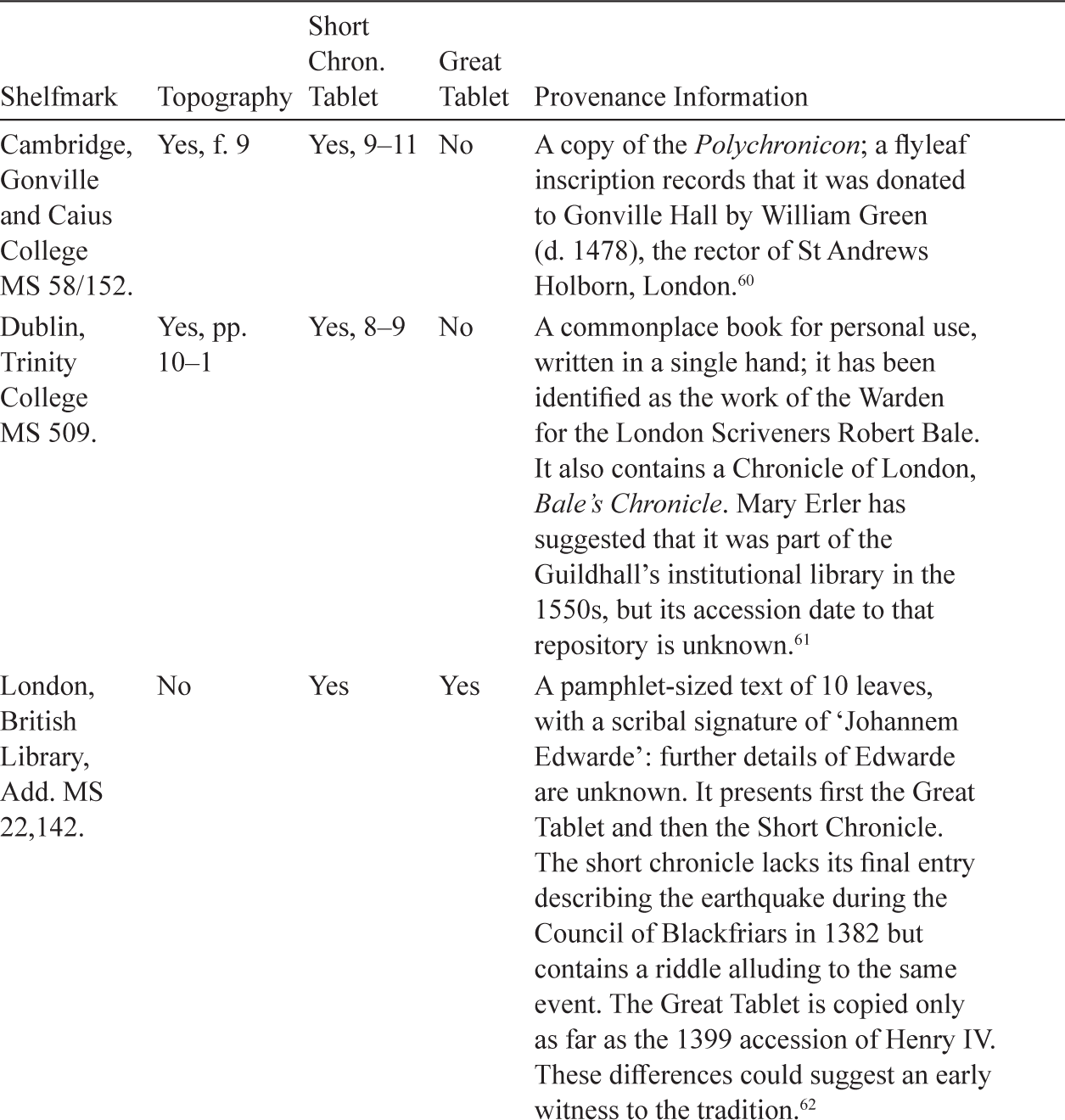
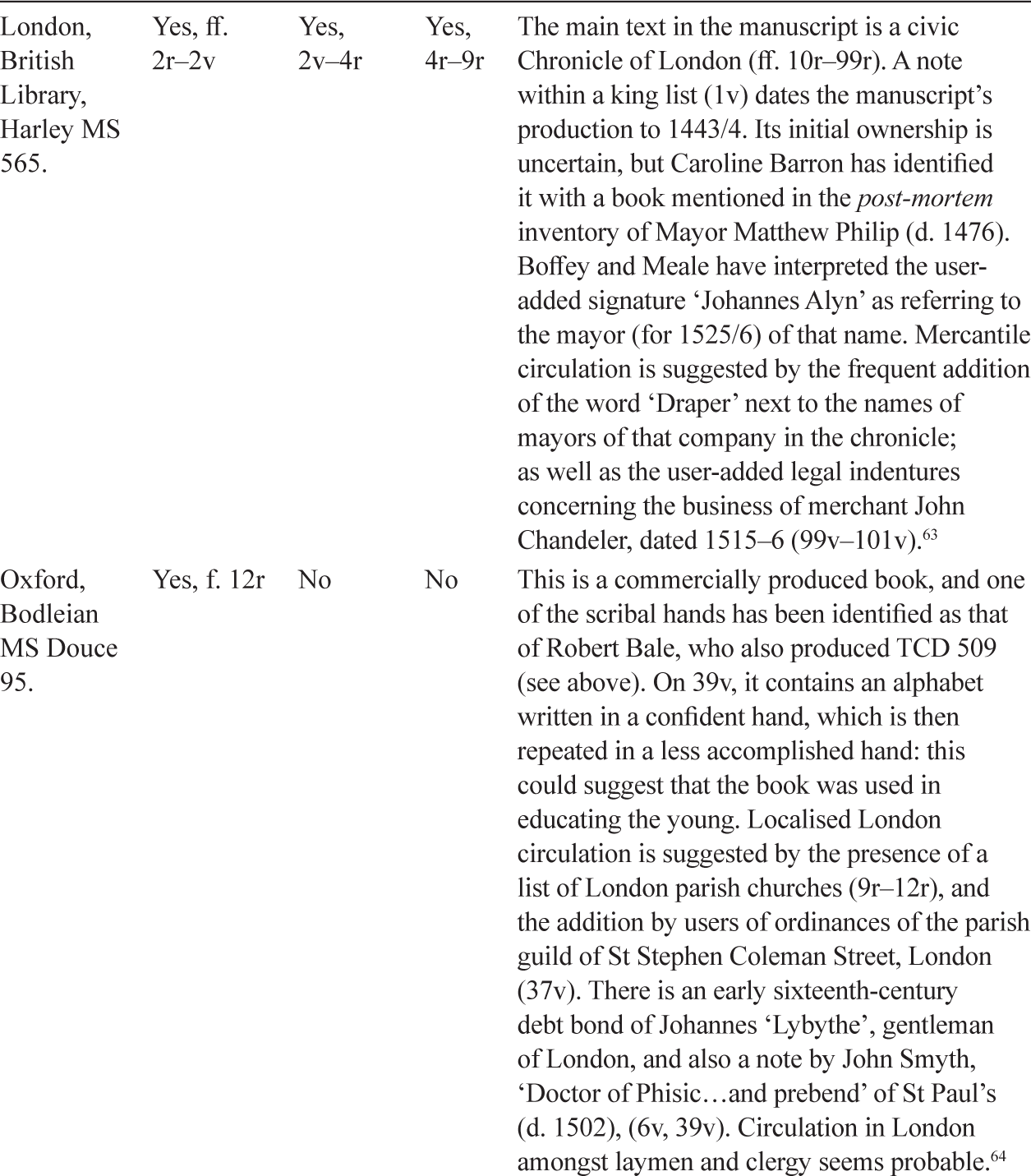
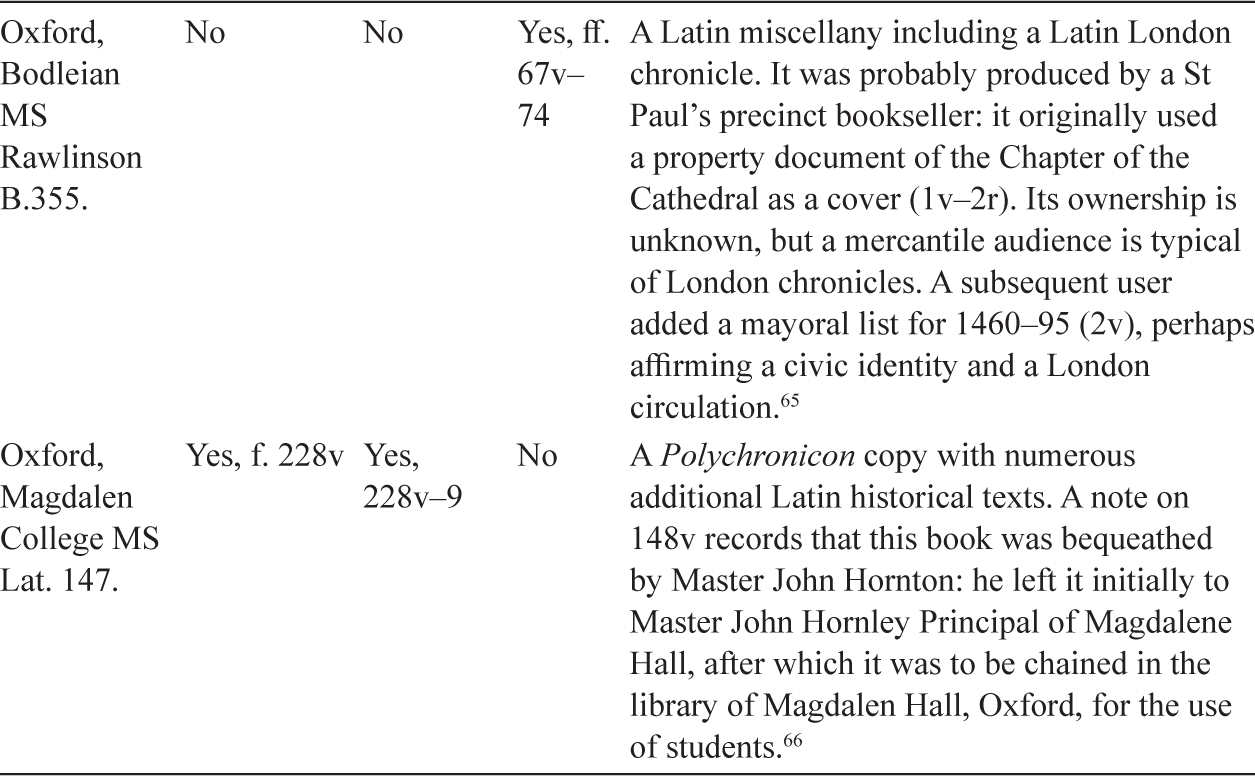
One pattern is that many copies were preserved in miscellanies that were compiled for personal or household use. In particular, the tablet chronicles often appeared as a short text that accompanied a longer and more substantial chronicle: these were London chronicles in the case of Harley 565, TCD 509 and Rawlinson B.355, or were Polychronica in the case of Magdalen Lat. 147 and Gonville and Caius 58/152. The tablets were thus relatively short historical texts that could express local pride whilst adding to or complementing the larger chronicles in the same miscellany. The other pattern was that the tablets were popular in institutional settings: copies or adaptations of the tablets could be found at an early date in the institutional libraries at the Guildhall (Horn’s Annales Paulini; TCD 509), St Bartholomew’s Hospital, Magdalen Hall in Oxford and Gonville Hall in Cambridge. Institutional and household books were not mutually exclusive categories: TCD 509, for instance, began as a personal book before passing into institutional ownership.
Other methodologies have suggested that pilgrims were an important audience for tablets; textual archaeology can provide some support for this thesis. The Bohemian traveller who compiled Prague, Knihovna Metropolitni Kapituly, MS H.15 stands out as a notable example. I have been able to identify two other instances of tourists using tablets at St Paul’s, both of which are much later. A 1578 account of London by a French immigrant, the Singularities of London, and the 1612 Itinerarium Angliae by German lawyer Paul Hentzner, both record some of the tablets of St Paul’s albeit not those containing chronicles. Instead, they record the boards on tombs, including those of John of Gaunt, Sebbi, Aethelred and Bishop William. 67 This is a slender source base, but broadly supports the idea that tablets were erected at least in part for the amusement of tourists and pilgrims. Nonetheless, most surviving examples of transcription or adaptation of the chronicles are much more local in character.
Of the local witnesses, many can be linked to metropolitan clergy: namely, John Cok at St Bartholomew’s Hospital, William Green at St Andrews Holborn and John Smyth, Prebend of the Cathedral. The presence of two copies in University Libraries at an early date is probably best explained by the high instance of graduates amongst London’s clergy, and the close links between these clergy and their alma mater. For metropolitan clergy, the Cathedral was their mother church and was the site of important ceremonies and processions. The Cathedral was dominant within the diocese not merely through its legal powers and jurisdiction, but also by setting a cultural path that subordinate churches copied. It was probably for this reason that the St Bartholomew’s Hospital chose to model its institutional chronicle on the St Paul’s Great Tablet.
Another important local audience were laymen and London citizens. Transcriptions of the tablets and texts influenced by the tablets appeared widely in manuscripts owned by Londoners. They had a particular connection with civic chronicles, as can be seen in Horn’s Annales Paulini, Harley 565, Rawlinson B.355, TCD 509, Fabyan’s New Chronicles, Richard Arnold’s Customs of London and Balliol 354. Other copies that may be linked to lay London citizens include Rawlinson Poet. 32 and Douce 95. Several tablet users were important London officers, namely the Mayors Matthew Philip and John Alyn, the Sheriff Robert Fabyan and the Chamberlain Andrew Horn.
The evidence gathered in this section indicates that there was no universal model for the use of the tablets. They were sometimes transcribed faithfully, on other occasions they were filleted for useful information or adapted in a loose and free manner. They were often incorporated into household reading, but also formed a part of institutional archival compilations. They were popular with lay and cleric alike. Most of their readers were local, but they also fascinated people from as far away as Bohemia. Users took ownership of the tablets: whatever functions had originally been intended for these tables, medieval people were capable of reading them against the grain and creating new and innovative uses for these texts.
Conclusion
This article has had two primary questions. First, how were the tablets at St Paul’s put to use, politically, spatially and culturally? Secondly, can practice at St Paul’s inform broader discussions about historical culture? Audiences for the tablets have proven to be diverse—indeed, more so than the previous historiography had suggested. Known users include a Bohemian pilgrim, local city officials, metropolitan clergy, university lecturers, gentleman antiquaries and London merchants. Pilgrims were an important audience for tablets at St Paul’s, as has been reported at other churches. Tablets typically were affixed to the tombs of saints and close to important relics such as the rood of the north door. Tablets also clustered along the main pilgrimage routes, particularly in the ambulatory passage that encompassed the graves of Roger Niger, Sebbi and Erkenwald, three of the main saints’ shrines in the Cathedral. This supports the idea that a prime function of tablets was to assist, edify and entertain pilgrims.
As important as pilgrims were, the evidence from London also points towards large-scale use of the tablets by locals. Two groups are particularly well represented amongst known users: London merchants, and metropolitan clergy. This is in striking contrast to the previous historiography of tablets, in which local laymen have been left largely unexplored as a potential audience. Many local uses of the tablets may have been anchored around ritual and ceremonial occasions. The most direct connection to ritual can be seen in the tables that perpetuated the memories of donors to the cathedral or chantry founders. These tablets were a form of memorialisation in parallel to the masses and religious rituals of commemoration practised by the priests. Civic ceremonies were an important context for the tablets at the grave of Bishop William the Good and may have also been relevant to the tablet at the tomb of John of Gaunt. Royal ceremonies and triumphal entries may have been a contributing factor to several of the king-focused tablets in the northern ambulatory. Ceremonies such as these caused Londoners to make regular or semi-regular visits to the cathedral in a localised analogue to pilgrimage. The type of people who were most likely to participate in these ceremonies—the metropolitan clergy and the corporate elite of the city—were also the groups that were most likely to transcribe and adapt the Cathedral’s tablets. Many of the tablets in the Cathedral were probably created partly or wholly as aids to the ceremonial and ritual life of Londoners.
Some previous scholars have also drawn a link between tablets and youth education—this has largely not been upheld or proven within the London evidence. There is no extant evidence of boards containing basic didactic texts in the Cathedral. There are two feasible explanations for this apparent gap—one is that these tablets existed, but they were too commonplace and unremarkable for our sources to record their existence. The alternative is that there was a separation of function between churches in the city. Basic didactic functions were not carried out in the cathedral—instead, they were the province of local parish churches. There is, nonetheless, some evidence that the tablet texts were conceived of as instructive reading for learners. Some transcriptions or adaptations from the tablets can be linked to manuscripts that were used in clerical education, notably Magdalen MS Lat. 147 for Oxford students and Gonville and Caius MS 58/152 for Cambridge students. Others can be linked to the household training of apprentices: notably, the Customs of London contained documents pertinent to the training of apprentices; Douce 95 contains traces of scribal training; and Balliol 354 was compiled by an apprentice. The appearance of tablet texts in manuscript miscellanies alongside copies of the Polychronicon or London chronicles may suggest that the tablets were seen as basic primer historical texts that could complement a longer and more complex chronicle. There is little evidence that tablets were directly used in education within the Cathedral, but they nonetheless contributed to the educational culture of London households.
One point on which the Cathedral’s use of tablets proved to be strikingly different from some comparator institutions is in the use of fixed rather than mobile tablets. The flukes of survival have meant that the only extant chronicle boards—those produced at Glastonbury and York—are of a mobile and unfixed type. It may have been the mobility of these texts that allowed them to survive the Reformation: the Glastonbury tables were sold into private ownership and the York tablets were lost for centuries in the Minster’s coal cellars, saving both from the ravages of iconoclasm. Fixed-place boards are known to have existed in other churches, notably those of Stone Priory in Staffordshire and St Peter Cornhill in London. 68 The exclusive use of a large number of fixed boards in St Paul’s Cathedral should lead us to consider whether the surviving tables are representative of typical practice. More particularly, the practice of fixing tablets may well change their use compared to mobile boards. In London, tablets were created for specific spaces. The Cathedral was able to control these spaces—to determine what was displayed there and to regulate who had access to each space. Tablets were site-specific—this meant that each tablet has to be understood in relation both to location, and to the political power required to control that space.
The St Paul’s tablets are a good case study of the intertwining of political power with history; yet here too they contrast with some comparator institutions. At York and Glastonbury, tablets contained chronicles that emphasised the ‘soft’ cultural power of the churches. This was, however, paired with tablets containing legal documents, papal bulls, and other texts which emphasised the ‘hard’, legally enforceable powers of the church. At St Paul’s, the tablets provided origin stories for the Cathedral, as well as some of its most important and prestigious relics—thus the ‘soft’ power of the church was emphasised. There do not appear to have been any corresponding ‘hard’ power boards. It is not clear why St Paul’s focused on institutional ‘soft’ power whilst Glastonbury and York focused on ‘hard’ institutional power. Perhaps ‘hard power’ tablets are signs of disputatiousness and vulnerability. York and Glastonbury both had clearly defined rivals who could threaten their jurisdiction— the Archbishopric of Canterbury and the Bishop of Bath and Wells respectively. Both churches needed to define themselves against these rivals and prepare the way for the likely event of jurisdictional disputes—‘hard power’ tablets may have been a way of publishing rights and preparing the way for disputes. The ability of St Paul’s to focus on soft power could perhaps be a sign of a relatively secure position.
Perhaps more intriguingly, St Paul’s use of soft power tablets could mark a distinctive power strategy, in which Cathedral space and tablets were used to negotiate power relationships. The Cathedral authorities controlled the space within the precincts of the cathedral, but they did not guard it jealously. Instead, they allowed other local authorities to erect tablets promoting their interests on Cathedral walls. Tablets in the Cathedral were not only concerned with the direct institutional interests of the Cathedral: the inscriptions at the tomb of Bishop William promoted the authority of the mayor, and several of the ambulatory tablets were concerned with the legitimacy of kingship. Various other tablets commemorated specific donors, patrons and families who had ongoing relationships with the Cathedral. Tablets were enmeshed within institutional power relationships—they expressed and negotiated the relationship that the Cathedral had with its neighbouring institutions and political powers. Instead of treating other powers as rivals, the Cathedral treated them as stakeholders and negotiated their relationship through means of space, historical writing and by allowing them to erect display boards within church precincts. Potential rivals such as the mayoralty of London were offered ways to enhance their power by working with the Cathedral—this helped to define the relationship between different institutions through cooperation rather than conflict. This process also carried on outside of the Cathedral as the tablet texts inspired and influenced institutional histories written elsewhere, such as the London chronicles, and became incorporated into the libraries and archives of the Guildhall, metropolitan churches and the Universities. By not focusing closely on the institutional interests of the cathedral, the tablets arguably became more influential and more important. By pursuing a soft power rather than hard power strategy, the Cathedral helped to foster its institutional relationships and gained greater cultural influence within the city.
This fits into a broader pattern where tablets appear to have been extremely ‘open’ texts. They were open in the sense that they were exposed to the public and placed on general view. This also brought a certain openness to their use and meaning. Tablets gained meanings through their placement in space, through the movement and churn of audiences, and in the context of regular rituals. Their precise meanings were thus unstable and depended on time, place and audience. Tablets were a genre in flux, and they were not prone to a single or fixed meaning. The evidence from the manuscript record suggests that readers responded enthusiastically to this openness. Users regularly repurposed the texts to meet their needs. The tablets were transcribed, excerpted, quoted, appropriated and turned into entirely new texts. They were used in creating new institutional histories and to produce texts that had entirely new purposes and little connection to the Cathedral. The tablets were thus highly amenable texts, prone to acquiring new contexts and new meanings through processes of reception and use.
The question remains—do the St Paul’s tablets have a wider significance for understanding London’s historical culture, or indeed, for understanding historical culture in general? It is evident that the London cathedral tablets had a prominent role in London’s historical culture due to their wide audience, high frequency of use, and long duration of use. This article has collected a large number of references to the tablets. The users came from a relatively diverse set of backgrounds and used the tablets in a wide variety of ways, from faithful transcription through to outright appropriation. While this article has focused on tablets, it has nonetheless shown that tablets influenced and interfaced with a variety of different genres that made use of the past in medieval London: civic ceremony (e.g., at the mayoral accession ceremony); post-mortem commemoration rituals and monumental architecture (e.g., at John of Gaunt’s tomb); narrative art (e.g., the holy rood stained glass windows); hagiography (e.g., at Roger Niger’s tomb); archival storage (e.g., at St Bartholomew’s Hospital); and chronicle writing (e.g., the London chronicles). Each of these genres implies a particular way of using and employing the past. Collectively, all of these genres indicate that the Cathedral was suffused with different ways of depicting the past—it was a vibrant and diverse site of historical culture.
Early modern historians have focused on ‘St Paul’s Walk’ within the cathedral as a nodal point for the circulation of news, rumour and gossip. 69 This article implies that we should in the future perhaps also see the Cathedral precincts as a focal point in the circulation of factual information and cultural ideas. These were encoded in the ceremonies, rituals, art, architecture and practices of the cathedral. Tablets existed to guide, direct and discipline the ways that visitors to the Cathedral understood and interfaced with the artefacts of historical culture that they encountered there. For D. R. Woolf, an important feature of historical culture was the ‘social circulation of the past’—and St Paul’s Cathedral is revealed here as a vital location in which depictions of the past circulated. 70 Different social classes, different genres of representing the past, and different approaches and attitudes to history collided within the cathedral. The cathedral gained cultural and social importance by occupying and controlling this vital cultural mixing point. The St Paul’s tablets provide a microcosm for the larger and more complex processes whereby London’s various different senses of the past could meet, mingle, interface and ultimately be reshaped into a historical culture. The Cathedral was one of the vital localities at which this cultural process took place.
Finally, although the tablets were important to London historical culture, it should be noted that the intensity with which they were used and recorded fluctuated over time. The vast majority of our sources fall into two periods: most of the merchant and metropolitan clergy sources come from the second half of the fifteenth century, meanwhile, most of the antiquarian sources come from the early modern period, particularly the late sixteenth and first half of the seventeenth century. In both instances, we can anchor these waves of interest into wider changes to historical writing. The former period roughly coincides with the rise and decline of the vernacular London chronicle tradition, which roughly flourished from the 1440s to 1510s. 71 Links between the London chronicles and Cathedral tablets are suggested by the large number of manuscripts in which these two types of text are co-located, as well as the fact that many tablet users came from the same social groups—London officials and London citizens—who primarily wrote and read town chronicles. 72 The second half of the fifteenth century saw a wave of interest in antiquarianism amongst London citizens which had a distinctively civic character, often focusing on London’s past. During this period, the St Paul’s tablets gained a distinctive audience, interest and circulation; it is thanks to this circulation that the vast majority of our medieval sources were created.
The second period meanwhile coincides with a rise of the social and cultural phenomenon of the ‘antiquary’, as typified by the foundation of the first society of antiquaries (1586–607). The St Paul’s tablets chimed with two trends that antiquarians brought to historical writing. The first was a topographical turn, associated with an increase in writing about cities and the use of geography as a frame to write historical texts. 73 Sure enough, the tablets appear frequently in urban topographical writing about London. 74 The second is a material turn, in which antiquarians often gave a close and specific focus to funeral monuments and church architecture, a phenomenon which had a political and cultural resonance given the threat posed to these monuments by iconoclasm in the sixteenth and seventeenth centuries. 75 Another group of witnesses to the St Paul’s tablet tradition grew out of this tradition of monumental and architectural writing. 76 Thus, the sources for the St Paul’s tablets typify wider shifts in historical cultures. We can discern within our sources changing audiences over time, and shifts in their behaviour, circulation and intellectual interests. The fifteenth century saw a turn towards the urban and local, and a sixteenth to seventeenth century turn towards the material and the topographical within historical writing. It is also marked by differences in social status, with our fifteenth-century records produced to a significant degree by merchants, local government officials and city clergy; and the later records often produced by gentlemen, courtiers and scholars.
Historians have, for the most part, treated tablet chronicles only as a minor curiosity: although interesting on their own rather limited terms, they have been assumed to hold few truths that have a wider significance. This article has suggested otherwise. It has posited that tablets can bear analysis under several different methodologies, including textual archaeology and spatial approaches. Connections have been identified between tablets and cultures of post-mortem commemoration, devotion, pilgrimage, education and the relationships between governing institutions in late medieval London. They can be shown to illustrate significant changes in the intellectual and social culture, and the ways and means by which the past circulated within the medieval and early modern city. We need to cease treating tablets as local peculiarities and instead see them as witnesses to the diverse, vibrant and public-facing historical cultures that thrived in the Middle Ages.
Footnotes
Acknowledgements
I would like to thank my doctoral thesis supervisor, Professor John Watts, and my examiners, Professor Julia Boffey and Dr Ian Archer.
Declaration of Conflicting Interests
The author declared no potential conflicts of interest with respect to the research, authorship and/or publication of this article.
Funding
This research received no specific grant from any funding agency in the public, commercial, or not-for-profit sectors. It is however based on materials that I encountered when investigating London civic chronicles as part of my doctoral research. My doctorate was funded by Oxford University’s Arts and Humanities Research Council Doctoral Training Partnership; together with the Balliol College’s Peter Storey Scholarship fund.