




Abstract

Introduction
In today’s competitive business landscape, organizations can no longer rely on intuitions to make important business decisions. The impact of every decision carries the weight of potential success or failure, with a single misstep potentially jeopardizing an organization’s very existence. Poor decision-making is estimated to cost firms on average at least 3% of profits, which for a $5 billion company amounts to a loss of around $150 million each year (Purdy, 2023). Yet, some companies navigate uncertainty with remarkable precision and achieve sustained growth. This is because they are able to leverage data and draw insights before taking any business decisions. However, with abundance growth in data, information processing by humans is overwhelming. This is where AI-powered information systems step in.
AI-enabled decision-making involves integrating AI technologies and algorithms within the organization’s current environment to enhance decision-making accuracy, speed, and efficiency across various domains (Petrova, 2023). AI systems can churn through large volumes of data, identifying patterns and correlations that are normally difficult for humans and that could consume potential amounts of time for individuals. The use of AI offers objective, data-driven decisions, removing any human-centric biased interpretations.
Today, AI’s capabilities have extended beyond speed and accuracy. Organizations can analyse intricate relationships, identify subtle influences, and anticipate future trends that might escape human attention. It can process unstructured data like text and images, opening doors to previously untapped sources of information. This unlocks a world of possibilities, from optimizing marketing campaigns to predicting equipment failures before they occur, all based on a deeper understanding of the data landscape. While human expertise remains crucial, AI acts as a powerful amplifier, empowering businesses to make smarter, faster, and more informed decisions, propelling them into a future fueled by data-driven intelligence.
Different Phases of AI Evolution
In the early days, AI-enabled information systems were rule-based (Mikullovci, 2023), limited by pre-defined logic that struggled to adapt to changing situations or environments. They were good at tasks with clear-cut rules, like evaluating loan applications based on pre-defined criteria like credit score or income. However, those systems cannot be used beyond their programmed rules.
This gradually led to the emergence of augmented intelligence (Dordevic, 2023) that employs machine learning capabilities, empowering systems to learn from data and improve their capabilities over time. The next leap came with the rise of deep learning, mimicking the human brain’s structure with interconnected layers of artificial neurons. This unlocks extraordinary abilities like image and speech recognition, allowing systems to extract even deeper insights from information. Meta’s photo tagging and understanding to voice commands in smartphones use deep learning AI technologies. Further development came in the form of natural language processing (NLP), enabling information systems to understand and communicate in human language, paving the way for chatbots and virtual assistants.
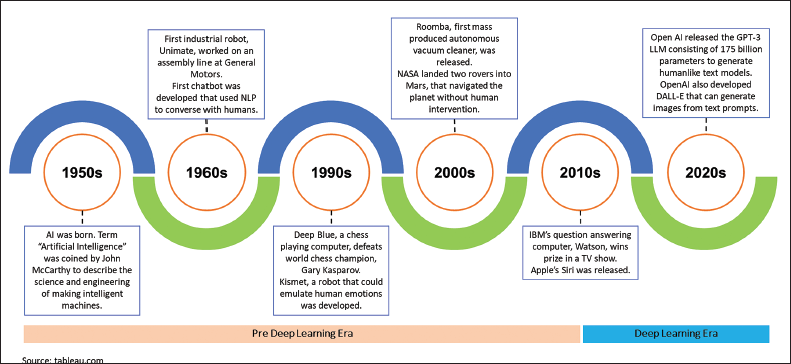
Today, AI-powered systems integrate multiple techniques, combining rule-based logic with machine learning and deep learning for comprehensive information processing. This ‘fusion approach’ fosters highly effective systems, tackling real-world challenges with ever-increasing accuracy and sophistication. The rise of generative AI (Gen AI), which is based on large language models (LLMs) has fostered innovation and ushered in new ways of generative insights in a more comprehensive and time-efficient manner. Refer to Figure I for a visual representation of the evolution of artificial intelligence.
Benefits of AI-enabled Decision-making
AI systems offer a multitude of benefits for business decision-making.
Walmart, a retail giant, uses AI/ML-driven inventory management systems to deliver seamless holiday shopping experience for its customers. These AI systems analyse historical sales data, online searches, page views, and future data such as weather patterns, macroeconomic trends, and local demographics. This integration allows the system to anticipate demand, which helps it to strategically place holiday items across distribution centres, fulfilment centres, and stores, optimizing the entire shopping experience (Walmart, 2023).
Dealing with Concerns in AI-enabled Decision-making
As businesses increasingly turn to AI for decision-making, a spectrum of concerns has emerged, prompting a critical examination of the technology’s ethical, social, and operational implications. While AI promises unparalleled efficiency and insights, certain use cases have raised eyebrows, underscoring the need for a thoughtful approach to implementation.
Recommendations: Implementing and Using AI Systems in an Effective Manner
AI has emerged as a key tool in corporate decision-making and is finding growing application in shaping policies and public sector initiatives globally. However, the effective utilization of AI for strategic decision-making remains a capability limited to a select few organizations. Prioritizing the following actions will empower organizations to harness AI technology effectively within their decision-making processes.
Case Study: Maersk Optimizes Logistics Using AI
Maersk, a leading Danish transportation, shipping, and logistics company, faced a significant challenge in determining competing performance indicators in their operations. The dilemma revolved around prioritizing between speed (rapid loading and unloading of ships or trucks, increasing throughput but potentially incurring higher short-term costs) and reliability (maintaining a consistent schedule during the loading process, potentially sacrificing some speed but ensuring on-time arrivals). Human judgement struggled to determine the optimal balance between these objectives due to the complex interplay of factors throughout the entire supply chain.
Maersk’s data team leveraged AI to analyse vast amounts of data and model different scenarios. The AI identified a counterintuitive solution: prioritizing reliability (slower loading/unloading) resulted in better overall outcomes. The AI-driven analysis contradicted the port managers’ experience, suggesting that while increasing speed at individual ports might improve local throughput, it created bottlenecks elsewhere, negating overall gains. Maersk built a model to simulate the impact of both approaches (speed and reliability) across their entire value chain. The model confirmed the AI’s findings.
By prioritizing reliability over speed based on AI insights, Maersk achieved measurably better organizational alignment, translating into tangible improvements in outcomes. The AI-driven approach not only optimized performance but also enhanced decision-making by providing a nuanced understanding of the intricate relationships between various factors. Maersk’s case demonstrates how AI can play a pivotal role in resolving complex business challenges and steering organizations towards more informed and effective strategies (Fortune, 2023).
Conclusion: The Way Forward
The integration of AI into decision-making processes is no longer a distant future but a present reality. While challenges and ethical concerns exist, the potential for AI-powered decision-making to propel businesses forward is undeniable. By integrating AI tools, businesses can gain a competitive edge, optimize operations, and unlock new possibilities. However, responsible implementation is crucial. Businesses must actively address ethical concerns, prioritize human oversight, and foster transparency in their AI-driven decision-making processes. Embracing AI with careful planning, ethical considerations, and continuous learning can equip organizations to navigate the ever-evolving business landscape with increased efficiency and more informed insights.
Footnotes
Declaration of Conflicting Interests
The author declared no potential conflicts of interest with respect to the research, authorship and/or publication of this article.
Funding
The author received no financial support for the research, authorship, and/or publication of this article.