




Abstract
Emergency dispatch rooms are designed to respond as smoothly and swiftly as possible to crises and critical events, such as fires, accidents, terrorist attacks or medical emergencies. In the 1980s and 1990s, emergency dispatch rooms in the Netherlands underwent profound changes in their design, work practices and technological equipment. Telecommunication networks became digitised, working procedures were harmonised, and data and information were made exchangeable between the different emergency services. All these efforts had to make responses to crises more effective. The perpetual expectation and anticipation of crises in our society are the raison d’être of emergency rooms, and as such, their very existence and operation can be considered as deeply linked to the notion of tele-crisis. This article seeks to find out how ideas about crises were reflected in the sociotechnical design of emergency dispatch rooms. Which norms and values became embedded in these ‘crisis technologies’? Which ideas about crises played a role in the vehement debates around the sociotechnical reorganisation of these nerve centres of emergency communication? And to what extent were these new developments in crisis technology intended to make crisis response more effective, indeed considered as a contribution to a better emergency response?
Keywords
Introduction: Technology and Crises
If you are confronted with a life-threatening situation somewhere in Europe, you call 1-1-2 to get in contact with the emergency helpline. The emergency helpline connects you with an operator working at an emergency dispatch room, who can send an ambulance, police or fire brigade to help you. Emergency dispatch rooms are designed to respond as smoothly and swiftly as possible to crises and critical events, such as fires, accidents, terrorist attacks or medical emergencies. The historical roots of dispatch rooms in the Netherlands are situated in the late nineteenth century, when telegraphy networks were created between fire stations and police stations (Kuppens et al., 2010). In Amsterdam, the central node of this network was located in a big room on the top floor of the city hall. Established in 1874, this room in Amsterdam can be considered the first signalling location for public safety. The Hague followed with a similar infrastructure in 1889 (Koppers, 2000).
A century later, in the 1980s and 1990s, emergency dispatch rooms in the Netherlands underwent profound changes in their design, work practices and technological equipment. Communication networks became digitised, working procedures were harmonised, and data and information were made exchangeable between the different emergency services. All these efforts were made to more effectively respond to crises. This article seeks to find out how ideas about crises were reflected in the sociotechnical design of emergency dispatch rooms. Which norms and values became embedded in these ‘crisis technologies’? Which ideas about crises played a role in the vehement debates around the sociotechnical reorganisation of these nerve centres of emergency communication? How did actual crises shape these technologies? And to what extent were these new developments in crisis technology intended to make crisis response more effective, indeed considered as a contribution to a better emergency response?
While crises and critical infrastructure are key themes in the history of Science, Technology and Society studies (STS) (Högselius et al., 2013; Van der Vleuten, 2020; Williams, 2021), the technologies specifically aimed at crisis response have not yet received much scholarly attention in these fields (Hua-Henning, 2021). Emergency communication has been more intensively studied from organisational science and crisis management perspectives and while these studies give valuable insights into the working and routines in Dutch control rooms (Soeparman et al., 2008), and the role of organisational culture and values in the collaborations between US emergency professionals (Stinchcomb & Ordaz, 2007), they tend to overlook historical processes and choices. Taking an STS perspective and studying the social shaping of these technologies (MacKenzie & Wajcman, 1999) not only enhances our historical understanding of societal norms and values embodied in technologies of crises, but also sheds light on how they are negotiated and debated. Changing ideas and assumptions about what constitutes a major crisis, as well as what the best ways to anticipate and respond to them, can be made visible by scrutinising the histories of crisis technology. Therefore, this article focuses on a key crisis technology, the Dutch emergency dispatch room and its communication infrastructure, between 1986 and 2006.
In the late 1980s, the Dutch government decided to change the way public safety and emergency response were organised in the Netherlands. Instead of having multiple dispatch rooms per region, specifically dedicated to one discipline (either ambulance, police or fire brigade), they proposed a new system where the three disciplines would be ‘co-located’ or even ‘integrated’ at one location. This decision caused a lot of debate in organisations involved in public safety in the Netherlands, and it turned out to be very difficult to implement. In 2006, the ideal of fully integrated and co-located dispatch rooms was still not realised (Visiedocument Meldkamer Domein Politie, 2005). The purpose of this article is not so much to analyse how this decision came about and what its overall impacts were on public safety, but more specifically, how crises and communication technology were co-constructed in the sociotechnical design of Dutch emergency dispatch rooms in the turbulent twenty-year period between 1986 and 2006.
This research draws on newspaper article analysis, an analysis of national governmental documents, and historical archival research in regional archives of Dutch fire services and police. Primary archival sources include policy reports, correspondence between key actors in public safety, parliamentary documents and minutes of meetings of public safety actors. The developments analysed in this article took place over a period of twenty years, between roughly 1986 (when the idea to create co-located dispatch rooms emerged) and 2006 (when the GMS-project (Geintegreerd Meldkamer Systeem) to implement the co-located dispatch rooms reached a new phase). Table 1 for an overview of the key developments in three time periods. Geographically, the focus is on developments and discussions in the South of the Netherlands, the South-Limburg region, where the changes in the dispatch rooms were piloted and implemented first. The analysis situates these developments in wider national (and also international) debates on emergency communication during disasters. The archival sources were collected from the Archive Sociaal-Historisch Centrum Limburg (SHCL) and online repositories of governmental documents. The documents were thematically coded and analysed.
Overview of Key Developments in Dispatch Rooms (1986–2006).
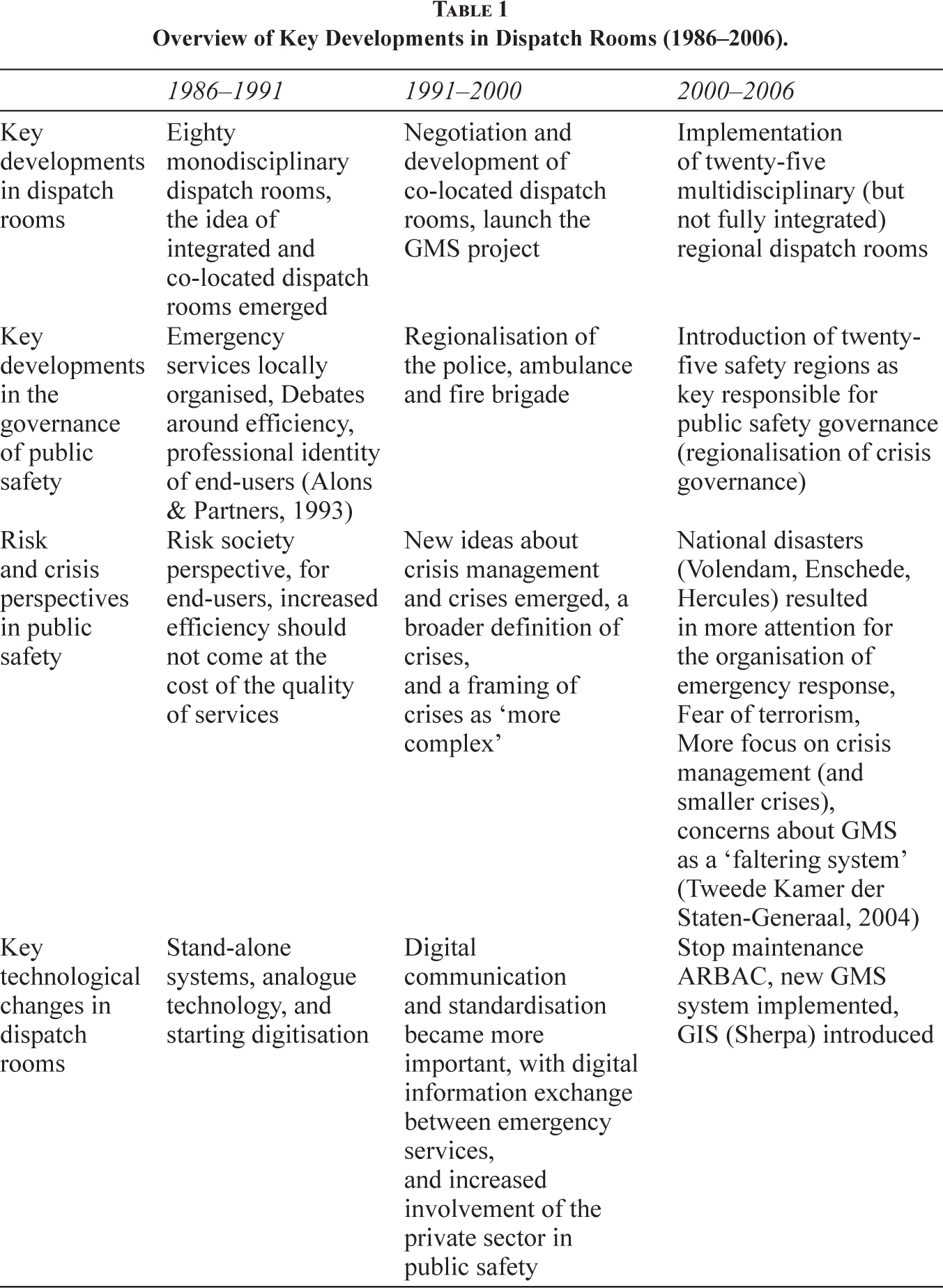
Based on this analysis, I will argue that: (a) the crisis technologies embedded in emergency dispatch rooms embodied specific norms and values of the professionals and other key stakeholders involved in crisis response (the second section); (b) crises and crises imaginaries were important in shaping technological and organisational developments in Dutch emergency response between the late 1990s and 2006 (the third section); and (c) these new developments in crisis technology, intended to make crisis response more effective, in fact contributed to novel fears and new concerns about vulnerabilities (the fourth section).
Professional Identity and Crisis Technology
One of the few historical studies of technologies of risk response is an analysis of the introduction of the fire alarm telegraph in Frankfurt from 1873 to 1900. By studying the design, use and materiality of this technology, Jan Hua-Henning (2021) shows ‘how societal norms find their way into risk management’ (p. 687). He convincingly demonstrates how the introduction of the fire alarm telegraph was linked to the rise of industry, capitalist interests, urban liberalism, municipal administration and the legitimisation of nation states. It turns out that firefighting technologies were not only used for fire signalling but also to control political unrest. Furthermore, the technology facilitated collaboration between the fire department, the city administration and the Prussian police authorities in Imperial Germany.
Conceptualising the emergency dispatch room as another ‘crisis technology’, this section will analyse its social shaping by focusing on the values and ideals it embodies (MacKenzie & Wajcman, 1999). This section shows that the norms and values of efficiency, quality of the information, (professional) identity, as well as ideas about the appropriate training of operators and collaboration, are of particular relevance in the negotiations around the reorganisation of the Dutch emergency dispatch rooms. In the late 1980s, Dutch emergency response was organised in around eighty separate local dispatch rooms for ambulance, fire rescue services and police. The communication technologies used were stand-alone systems, analogue, radio and telephony-based. As a consequence, it was difficult to communicate between emergency services and to coordinate their actions in case of larger disasters. Therefore, the solution was sought in a regionalisation of emergency response and in enhancing the collaboration between the three emergency response professions. Moreover, at that time, the digitisation and automation of communication technologies and the engagement of the private sector in public safety were seen as promising developments for this domain.
In a 1989 Feasibility Study for a new regional dispatch centre in the North of Limburg, the general need for more efficiency and efficacy of governmental organisations, including the police, is emphasised. The study refers to a broad societal debate about the tasks and responsibilities of the police and the changing ‘public demand’. It is expected that more collaboration between the three emergency services will lead to significant cost reductions in terms of personnel and finances (Feasibility Study Regional Dispatch Room, 1989). This argumentation is supported in another document that argues that ‘one of the most important arguments for integration [of dispatch rooms] is the reduction of the personnel needed (operators)’ (Policy Note, 1992). The same document also notes that it is unclear whether the higher level of education needed for the operational staff of integrated dispatch rooms and the costs of new decision support systems have also been calculated in the new plans (Policy Note, 1992). However, the professional stakeholders in public safety and supposed end-users of dispatch rooms did not all agree with the goal of automation purely for reasons of cost reduction. They argued that automation would only be acceptable if this would imply an improvement in the quality of their work (Alons & Partners, 1993).
Besides cost reduction, efficiency and quality as values guiding the redesign of the dispatch rooms, collaboration is another important value. In this debate, collaboration refers to the cooperation between the disciplines of police, ambulance and fire department in one emergency dispatch room. However, in the late 1980s and 1990s, the need to collaborate was not easily accepted among the three professions. The police, characterised as a ‘traditional structure’, often view collaboration as a ‘hard to accept interference of strangers in their own business’ (Feasibility Study Regional Dispatch Room, 1989). In April 1993, the Working Group that prepared the integrated dispatch room considered the feasibility of a fully integrated dispatch room with one technical infrastructure at one location as ‘unrealistic’. One of their arguments relates to the responsibility, identity and requirements for the quality and professionalism of the operator. For example, an operator working at a dispatch room for the fire services needs to have a firefighting education as well as an ICT degree, while an operator for the ambulance services needs to have a degree in nursing. Police and fire service representatives find that an operator needs to be an effective communicator in the first place, but according to representatives of the ambulance services, the training of operators touches the core of the dispatch system: an operator without a nursing training needs very different information from the system than someone with a nursing background (Alons & Partners, 1993). For these reasons, in the early 1990s, the working group thought that ‘co-location’ was a better option than ‘integration’. In this way, each discipline keeps its own responsibilities, while more integration can perhaps be the longer-term result of a gradual process of development (Minutes Working Group Integrated Dispatch Room, 1993).
A report commissioned by the Ministry of the Interior helps to better understand the importance of professional identity in the shaping of the emergency dispatch room (Alons & Partners, 1993). This report is based on fifteen interviews with professionals in the disciplines of ambulance, police and fire services in the early 1990s. They argue that for each of these disciplines, the emergency dispatch room is the ‘heart’ of the organisation, and a symbol and expression of the norms and values of professionalism of the disciplines involved. The report therefore concludes that a fully integrated dispatch centre can only be achieved if a proper coordination and harmonisation of the aspirations, norms and values of each of the disciplines involved takes place (p. 1). The fire services see their main responsibility as disaster response on location, and the ambulance services focus on health care, on location, but also during transportation. The ambulance professionals prioritise the expertise of the ‘white coats’ (doctors), while the police and fire services abide by the authority of the ‘uniform’.
The intensity of the debate becomes clearer if we understand that, for the end-users, giving up some control over the dispatch room is perceived as a direct attack on their professional identity (Alons & Partners, 1993, p. 13). For each discipline, the integrated dispatch represents a vision for the development of its own profession. Therefore, the debate around this crisis technology can never be value-free. Moreover, during disasters in particular, the differences between the disciplines come to the fore even strongly (Alons & Partners, 1993).
Not surprisingly, the need to protect their own professional norms and values resulted in quite specific requirements and aspirations for the design of the emergency dispatch rooms (Bode, 1993). The ambulance and fire services wanted to keep their own communication network for disaster response. As mentioned above, the ambulance services demanded that operators have had a medical or nursing training, have knowledge of the organisation of health care and practical experience with ambulance service. The police wanted a new technical infrastructure that supports collaborative developments in the Euroregion. Furthermore, they wanted to make sure that an emergency call for police assistance always gets the highest priority in the workflow of the emergency dispatch room. The police, more than the other emergency services, promoted the implementation of the newest technological developments in the emergency dispatch room and wanted a permanent availability of up-to-date information. And last but not least, ‘historically grown prejudices need to be broken’ (Bode, 1993).
The contested nature of the introduction of the new dispatch rooms is corroborated in a study by organisational sociologists Boersma et al. (2012). They studied the historical development of emergency dispatch rooms in the Netherlands from the 1970s to 2010 and focused on the cooperation between Dutch emergency services. They argue that there is still a lot of fragmentation, misunderstanding and miscommunication between the emergency services. They also emphasise the role of drift: after some time, organisational units will drift apart in the different ways they use a system, and as a consequence, local varieties will emerge (Wolbers & Boersma, 2013). Moreover, the implicit governance model of emergency response that is advocated by the professional field is one based on values of efficiency, a great reliance on information systems and transparent information, and a clear chain of command with clearly defined and separated responsibilities. This so-called ‘warehouse model’ of emergency response stands in contrast with other models that are more sensitive towards different meanings of crisis information for different stakeholders and the role of negotiations in crisis management (the so-called ‘trading zone’ model) (Boersma & Wolbers, 2021).
In sum, this analysis has shown how the norms and values of efficiency, quality of the information, (professional) identity, training and collaboration dominated in the vehement debates around the reorganisation of the dispatch rooms in the 1990s and early 2000s. The professional identity constructed by each of the three end-user professions had a strong impact on their demands for the technical and organisational set-up of the new dispatch rooms. Having their own dominant norms and values and way of working, it seemed almost impossible to reach agreement on an integrated dispatch room system. Yet, in the efforts to justify the new system, a number of critical events that happened in the 1990s and early 2000s were successfully invoked by governmental proponents. This will be illustrated in the next section, addressing the question of how crisis imaginaries and experiences shape technological choices in emergency response.
Imagination and Experiences of Crisis
In December 1992, the regional Health Service of South-Limburg, responsible for Emergency Response in case of accidents and disasters, argued that ‘changing insights about dangers that may threaten individuals or society’ (p. 5) resulted in a governmental decision to reorganise public safety in the 1980s. War is no longer seen as the only threat that public safety organisations have to prepare themselves for. Instead, other threats, ‘increasingly threats and disasters that are caused by far-reaching technological developments’ (p. 5) need to be considered. In the new set-up of emergency response, ‘the need for instant help under all circumstances, has been prioritised’ (Districtsgezondheidsdienst Zuid-Limburg, 1992).
This broadening of the notion of what a crisis is (not only war) is typical for crisis discourses of the late twentieth and early twenty-first century. As historian of technology Rosalind Williams argues: ‘The meaning of crisis has evolved from tightly defined situations to spreading, unbounded ones’ (Williams, 2021, p. 523). In the twentieth century, crisis no longer refers to a time of decision but to ‘turbulent periods that destabilise, perhaps even destroy, established structures and orders’ (p. 526). The ideas about reorganising emergency response also seem to announce some early twenty-first-century redefinitions of crisis. Crises are not something acute, but they have become ‘a chronic condition’: ‘crisis is no longer a turning point in history but the ongoing condition of history, part of its normal operation’ (p. 532). According to Williams, ‘the current historical consciousness is the perception of living in a rolling apocalypse’ (p. 532).
One of the techno-organisational solutions proposed by the Dutch government to accomplish this new focus for emergency response, being able to respond to new and diverse types of crises, was a merging and digitisation of emergency dispatch rooms. As mentioned above, before the 1990s, the three emergency services (police, fire brigade and ambulance) had their own dispatch rooms (eighty over the whole country) to collect emergency calls and initiate the appropriate response. Every region had quite a number of dispatch rooms. In the region of South-Limburg, there were, for instance, eight operational dispatch rooms in the early 1990s. In the wake of the organisational regionalisation of the police, fire and ambulance services at that time (Evaluatiecommissie Wet Veiligheidsregio’s, 2020), the idea was to have one central dispatch room per region (Politiecom, 1992). At the same time, the governance of public safety would be organised in twenty-five so-called Safety Regions, all with their own integrated dispatch room. A national project, called GMS, was launched to develop a new system for information management for the integrated dispatch rooms and the region of South-Limburg was proposed as a pilot region (Minutes Working Group Integrated Dispatch Room, 1993). In the integrated dispatch room, it was reasoned, (digital) information flows needed to assess the crisis situation and decide on the appropriate reaction would come together and allow for a faster emergency response.
I will argue that the decision to reorganise and further regionalise the emergency dispatch rooms was shaped and reinforced by critical events and crises that happened in the Netherlands during the 1990s. A newspaper article from July 1996 in Rotterdams Dagblad refers to ‘emergency dispatch rooms being the nerve centre in case of disasters’ such as ‘the air crash near Eindhoven and floods in 1995’ (Rotterdams Dagblad, 1996). Based on these crisis experiences, it is considered an advantage to have an integrated/co-located dispatch room for police, fire brigades and ambulance, to be able to more quickly organise the right response. Furthermore, it is argued that this system can make sure that during a disaster, further assistance can be organised, based on new information that comes in (Rotterdams Dagblad, 1996). Other advantages mentioned at the time are: synergies in the exchange of information, a shared information system, and improved possibilities for coordination in case of extreme circumstances or major disasters (Minutes Working Group Integrated Dispatch Room, 1993).
In the early 2000s, reference was made to other disasters. In a letter of June 2003 from the Ministry of the Interior to the Commanders of the Regional Fire Brigades, two disasters are mentioned as the direct reason for the co-location of emergency dispatch rooms: an explosion of a fireworks storage facility in Enschede in May 2000 (see Hommels & Cleophas, 2013), and a café fire in Volendam on New Year’s Eve 2000/2001 (Minister of the Interior, 2003b). The Enschede fireworks disaster caused twenty-three deaths and 900 injuries, and the Volendam fire fourteen deaths and 200 injured people. In a governmental document reflecting on these disasters, it is mentioned that the committee investigating the Volendam fire concluded that many of the mistakes made during emergency response, ‘can be attributed to a lack of multi-disciplinary preparation’. The document emphasises the centrality of dispatch rooms at the beginning of upscaling after a disaster and concludes that there is a need to improve the provision of information, the communication between emergency services and the overall functioning of the emergency dispatch rooms. To achieve all these improvements, it is argued, the further implementation of the national GMS project is needed (Kamerstuk, 2001).
We can see this governmental crisis narrative as an example of the ‘triple temporality of crises’ as defined by historian of technology Kalmbach et al. (2020). They argue that
[O]ver the past two decades, we have seen how national governments across the world have implemented policy changes that strengthen state authority by actively using various kinds of crisis narratives, related, for instance, to transnational terrorism or migration waves. It seems that certain societal solutions—political, legal, administrative, or technological—may become normalised by stating the existence of a current crisis or referring to an imminent future crisis, solutions that would not have been considered outside of a specific crisis imaginary. (p. 273)
As such, ‘crisis imaginaries weave together historical and futuristic crisis narratives and thereby impact concrete choices taken in the present’ (p. 274).
In the case of emergency dispatch, we see that key governmental actors refer to historical crises and disasters (huge fire, floods, air crash, explosion in neighbourhood) and expectations about the nature of disasters in the future, to justify decisions about the ways in which emergency response needs to be organised, namely co-located or integrated and with a big emphasis on digitisation and automation. Thus, as Kalmbach et al. argue, ‘a focus on crisis narratives and their impact on socio-technical imaginaries widens our understanding of why certain technologies actually have come into being’ (p. 274). In this case, the solutions were already considered before these disasters happened, but the disasters were ‘mobilised’ to accelerate the process of implementing them.
In policy studies of agenda-setting processes, scholars have argued that crises can have a signalling function for policymakers. According to John Kingdon (1995), a crisis lays bare the emergence of a problem that can then influence a policy agenda. Problems sometimes need a little push to get the attention of governance actors. He argues that the push is sometimes provided by a crisis or disaster. Stone (2012) adds that policy problems have a narrative structure and that stories of change usually end with a prediction of crisis and a proposal for steps that need to be taken to avoid this crisis. Similarly, the Dutch government used a specific framing of disasters (as revealing the problem of specific weaknesses in emergency response) to justify and accelerate the contested redesign and reorganisation of Dutch crisis response.
Thus, this section has shown how crises and disasters were invoked by key governmental actors in the debate about emergency response (such as the Dutch government) to support their proposal for co-located and integrated dispatch rooms. This analysis supports Kingdon’s (1995) ideas of how agenda-setting processes in policy-making relate to crises and highlights the importance of Stone’s narratives of change related to crisis. Furthermore, it gives an example of Kalmbach et al.’s notion of a ‘triple temporality of crises’ whereby events in the past are mobilised to support a future vision that has consequences for choices made in the present. Having discussed how crisis technologies are socially shaped and how crises shape technology, the next section will focus on how technology (designed for more safety) can also shape new crises.
How Technology Shapes (New) Crises
Earlier historical research on the vulnerability of critical infrastructure, such as emergency communication networks, has suggested the notion of ‘vulnerability irony’, referring to the phenomenon that the efforts to reduce infrastructure vulnerabilities can lead to new vulnerabilities (Hommels et al., 2013). For example, in the 1990s, new standards for emergency communication were introduced with the intention of making Europe safer by improving the cooperation between international public safety organisations. However, this process of standardisation resulted in a strong dependence on a small number of commercial suppliers and their willingness to improve and maintain the system. Thus, this process of improvement also created new vulnerabilities (Hommels & Cleophas, 2013), exemplifying the notion of ‘vulnerability irony’—a paradoxical situation where attempts to reduce vulnerabilities, in fact, created new ones.
In this section, I will analyse the debates around the replacement of a specific technology that was used in Dutch emergency dispatch rooms, the so-called ‘ARBAC system’ (Automatisering Regionale Brandweer Alarm Centrales), by GMS, ‘an integrated dispatch room system’. ARBAC was a pioneering decision-support system used in emergency dispatch rooms of the fire brigade. It had been operational in the Netherlands since 1985. As ARBAC only matched the fire services’ tasks at the dispatch room, it no longer fitted in the intended transition to co-located or integrated dispatch rooms. Furthermore, the technology was seen as outdated. Therefore, the Ministry of the Interior made the decision to develop a successor of ARBAC that would fit in a multi-disciplinary dispatch room: GMS (Minister of the Interior, 2003b). By 2003, almost all dispatch rooms used GMS, and therefore, the Ministry of the Interior proposed to stop the maintenance of ARBAC (Minister of the Interior, 2003b).
The successor to ARBAC was developed in the IFORA project. Documents on the IFORA project (Informatievoorziening Ongevallen- en Rampenbestrijding) reveal a number of reasons for the replacement of ARBAC (Van Es, 1993). Around 1995, the situation in dispatch rooms was described as ‘an undesirable situation with a number of stand-alone information systems’ (Van Es, 1993). One of the disadvantages was that the operator had to use a variety of screens and support systems. Operators had to ‘type over’ information, used multiple screens and keyboards at one workstation, and these different systems were not very well-integrated. IFORA documents refer to the future development of new radio panels for dispatch rooms, which would add to the complexity, but that could possibly enhance the integration of systems as well. Furthermore, at that time, the ARBAC system was more than ten years old and was considered ‘limited’ through its technology (both in terms of hardware and software) and ‘out-dated’ (Van Es, 1993). Moreover, ARBAC was considered too slow: ‘an experienced operator has already made the decision to act, long before ARBAC comes up with a suggestion’ (Alons & Partners, 1993, p. 8).
At that time, automation was considered an important solution to enhance the efficiency and efficacy of the dispatch rooms. The idea that the new technical solutions that exist should also be used is quite prominent in the public safety domain in the late 1990s. There is a strong belief in the integration between computer technology and communication technology and the idea that ‘the digitization of radio communication opens entirely new perspectives’ (Alons & Partners, 1993, p. 8).
However, despite these hopes and expectations towards new digital technologies, in 1992, some new risks were also identified:
In emergency of dispatch rooms that are not specifically linked to one discipline, there is the danger that the knowledge for the correct handling of emergency calls and the appropriate support during incidents may not, or not quickly enough, be available at the dispatch room. (Policy Note, 1992)
Concerns are raised about whether the integrated dispatch room’s operators of the future will have ‘sufficient knowledge and quality’. The belief in technology is not endless, as an experienced operator can deviate from standard emergency response actions (proposed by the systems in the dispatch room), using their experience and situated knowledge. In the 1990s, the fire alarm dispatch room was often located in the same building as the fire department, so there was a lot of additional expertise present. The concern is that operators who do not have this background will be completely dependent on the standard solutions provided by the information systems. They are worried that the situational knowledge of operators, about specific local circumstances and regulations, will be greatly reduced in co-located dispatch rooms where so-called ‘grey’ operators without a specialisation in one of the three disciplines are supposed to work (Policy Note, 1992).
Another source of potential new vulnerabilities was associated with the technological setup of the new integrated dispatch rooms. In a letter from the Ministry of the Interior to the fire service commanders, it is mentioned that: ‘In a co-located dispatch room, new threats may emerge, like the connection of systems to the internet’ (Minister of the Interior, 2003a). Since the internet is a public system, this could result in ‘outsiders’ getting access to confidential public safety-related information. Moreover, the GMS system is linked to the internal networks of the three disciplines. As a consequence, ‘unqualified’ employees of, for example, the ambulance services, could get access to files of the fire brigade (Minister of the Interior, 2003a). These examples show the amount of distrust among the three disciplines and the risks they see attached to the sharing of data over public infrastructures such as the internet.
Finally, the transition from the ARBAC system to GMS did not go flawlessly, and this also created new vulnerabilities. The introduction of GMS necessitated the transfer of information and agreements about which fire brigade had to respond in case of a fire in a specific geographical area. After transferring this information to GMS, it turned out that the geographical boundaries set in GMS were not exactly the same as in the old ARBAC system. This resulted in a number of complaints about ‘faulty dispatches’. A solution was found in the development of a completely new ‘coverage plan’ with a more precise definition of which fire brigade was responsible for which area (Regional Fire Department, 2003).
These concerns about the vulnerability of the GMS system persisted at least until 2004, as the minutes of a parliamentary debate reveal. Members of parliament referred to GMS as a ‘faltering system’ (p. 1), and they mentioned that there were software issues and a lack of trust among the end-users of the system. In response to these worries, the Minister claimed that the decision to move on with the implementation of the new public safety system has, in fact, become irreversible, even though research had shown that the technology used for the GMS system no longer fulfilled the requirements. Ironically, the Minister argued that years of tinkering with the system, in response to requests from the end-users, made the system overly complex and therefore more prone to disruptions (Tweede Kamer der Staten-Generaal, 2004).
In sum, this analysis has shown how the introduction of GMS as a replacement for ARBAC resulted in a number of concerns related to new vulnerabilities. One of the vulnerabilities identified was related to the replacement of local know-how from experienced operators by standard solutions from a decision support system. Second, the risks of data integrity and access were seen as a major problem in the new digital and integrated set-up of the emergency dispatch room. Third, the actual implementation of GMS created new vulnerabilities in South Limburg when mistakes were made in emergency response, due to flaws in the transfer of data from ARBAC to GMS. Fourth, governmental actors argued that system instability was created by continuous tinkering and adjustments to fulfil the requests of the end-users.
Conclusion
This article has sought to find out how crises and communication technology were co-constructed in the sociotechnical design of Dutch emergency dispatch rooms in the turbulent twenty-year period between 1986 and 2006. Which norms and values became embedded in these ‘crisis technologies’? Which imaginaries and experiences of crises played a role in the vehement debates around the sociotechnical reorganisation of these nerve centres of emergency communication? And to what extent did these new developments in crisis technology, intended to make crisis response more effective, indeed contribute to a better emergency response? In the analysis, I focused on three interrelated dynamics in the co-construction of crises and technology: how crisis technologies are shaped, how crises shape technology, and how technology creates new crises.
To understand the social shaping of crisis technology, I highlighted the role of important values such as professional identity in the process of shaping the new emergency dispatch system. Focusing on the ideas and values of different actors involved, both at the level of the national government and the end-users, the analysis showed the diverging visions and their implications for the design of the new emergency dispatch room. All three disciplines interpreted the dispatch room as the heart of their work. Hence, changing the technologies and organisation of the dispatch room implied an attack on their professional norms.
The role of crises in shaping (crisis) technologies became apparent in the ways in which the national government invoked disasters that happened in the 1990s and early 2000s in the Netherlands, as arguments for the further integration of dispatch rooms. They linked the need to innovate the dispatch rooms with a new vision about the nature of future crises. Rather than being prepared for war, the emergency services should prepare for other crises, caused, amongst others, by technology. Here, technology is seen as both the cause and solution to crises (see also Van der Vleuten, 2020). Furthermore, this government rhetoric is a good example of the triple temporality of crisis (Kalmbach et al., 2020). Changing framings of crisis over time had implications for the way emergency services were supposed to be organised.
Crises themselves can also be understood as created by new technological developments. The introduction of integrated dispatch rooms based on new digital infrastructure, such as the internet, caused concern about the integrity of those networks and the chance that ‘outsiders’ (i.e., other operators of a different discipline) could get access to confidential information. Furthermore, due to mistakes in the transfer of data from analogue to digital, the first six months after the introduction of GMS revealed some new system vulnerabilities in the guise of faulty dispatches. A continuous tinkering with the system, in an attempt to make it fit better with the demands of the end-users, is also seen as a reason for its software instability. Thus, these examples illustrate a number of ‘vulnerability ironies’, as the unintended outcomes of technological measures to reduce vulnerability.
To conclude, this analysis has shown different ways in which crisis and communication technology are co-constructed, which can serve as a heuristic for further analyses, based on historical and sociological research of other technologies and other crises. Furthermore, it has highlighted a so far understudied domain of technology in STS: crisis technologies. For researchers interested in the societal role of risk, disaster and crises, these technologies form an excellent strategic research site to be further explored. For scholars in organisational studies of crisis management, this analysis adds a longer-term historical understanding of the myriad ways in which crisis and public safety technologies are interconnected.
Footnotes
Acknowledgements
I would like to thank the editors of this Special Issue, Stathis Arapostathis, Léonard Laborie and Yannis Fotopoulos for their thoughtful comments on earlier versions of this article. I am also very grateful for the valuable suggestions of two anonymous reviewers.
Declaration of conflicting interests
The author declared no potential conflicts of interest with respect to the research, authorship and/or publication of this article.
Funding
The author received no financial support for the research, authorship and/or publication of this article.