




Abstract
The concept ‘research excellence’ remains ill-defined in performance assessment and science funding frameworks. This article introduces a framework that distinguishes ‘global excellence’ and ‘local excellence’, which enable a better understanding of ‘research excellence’ in African science. Where global excellence is primarily determined by acknowledged visibility and partially measurable reputation within the (inter)national scholarly community, its local counterpart relates to utilisation of knowledge and know-how among non-scholarly users and communities. Our empirical study of global excellence, based on a citation impact analysis of ‘basic research’ publications during the past 15 years, with one or more African-based authors, shows a large degree of dependence on and cooperation with non-African international partners. More detailed analysis of research-active universities in the African Research Universities Alliance also highlights their large dependency on international resources and funding in their highly cited ‘globally excellent’ research. Our analysis of local excellence focusses on the research objectives of the centres of excellence at universities in sub-Saharan Africa, showing a mix of local and global components. The notion of local excellence is in need of appropriate definitions and further operationalisation. The distinction between global and local excellence, within science funding and research assessment frameworks, offers a more comprehensive view and better understanding of high-end research performance of universities in Africa. Developing quality criteria and performance indicators of local excellence may incentivise researchers to contribute to socio-economic development and innovation.
Keywords
Introduction
African Universities and Excellence
From the early 2000s onwards, a general understanding gradually emerged among African policymakers that the higher education sector is a crucial factor in the socio-economic development of their countries. Illustratively, the Accra declaration of the Association of African Universities (2004) states:
… a renewed commitment to the development of higher education in Africa as a ‘public mandate’ whose mission and objectives must serve the social, economic and intellectual needs and priorities of the peoples of the African continent while contributing to the global creation, exchange and application of knowledge.
Nowadays, very few would question that upgrading higher education systems and universities is essential for twenty-first century Africa—not only with regard to teaching and training of students but also for the creation and exploitation of science-based knowledge and know-how. Universities are expected to be (more) responsive to needs of local or regional partners and stakeholders, develop productive university–community engagements and focus on opportunities to engage more actively in application-oriented research (Cloete et al., 2011). The prime mission of these research universities is to deliver highly skilled graduates for employment in local or regional labour markets, but many are underfunded and suffer from the pressure of servicing an increasingly large influx of bachelors and master’s students.
Africa’s research-active universities are increasingly seen as major contributors to the development of local communities and economies and as key assets for developing more equitable and resilient societies, but the resource constraints in which they are forced to operate, and the diversity of their organisational functions and sometimes conflicting missions, tend to create tensions and obstacles that hamper their effectiveness (Cloete et al., 2015). Important framework conditions are often severely underdeveloped such as: securing access to adequate funding and human resources for scientific research, appropriate science policy initiatives, effective deployment of incentive systems to promote international-level performance and having access to state-of-the-art technical infrastructure and research facilities.
Clearly, any attempt to gain an international reputation in scientific research is challenging and not easily reconciled with providing mass education (Cloete et al., 2018). Universities are therefore often forced to relegate science, including research capacity building and technical support, to a distant second place. 1 Engaging in international research cooperation, especially with partners from sophisticated science systems in high-income economies of the ‘Global North’, is seen as one of the vehicles to help achieve an organisational upgrade of Africa’s research-active universities (Slippers et al., 2015; Tijssen, 2015). Those universities that hope to gain from such cooperation are likely to aim for stimulating growth in scientific disciplines or thematic areas that promise to deliver a critical mass of highly skilled researchers and scholars, better conditions for undertaking high-impact scientific research and attracting new domestic or foreign investments for basic or applied science. A second pathway for development involves emulating ‘good practices’ from the Global North with regard to science policies and incentives to improve research performance. So far, the results of this strategy exhibit widely varying degrees of success among researchers and universities in Africa (Cloete et al., 2018; Tijssen & Kraemer-Mbula, 2018).
The concept of ‘excellence’ has continued to generate traction. The Africa Research Excellence Fund (AREF), founded in 2015, is an illustrative example. AREF’s definition of the concept is spelt out in their vision statement: ‘… to improve the quality and impact of health research in Africa by building a community of inspired African health researchers who deliver world-class, life-saving research to all’ (
The term ‘excellence’ has also attracted scrutiny from academic analysts as well as other commentators in Africa. By framing research excellence in terms of its practical utility with local settings, Linda Nordling, an African science writer, poses a fundamental question in the heading of her review ‘Excellence: what is it good for?’ (Nordling, 2018b), highlighting tensions between performance standards from the Global North and the limited capacity within Africa’s science systems and universities to pursue such lofty aspirations.
The heightened interest in science and research performance was reinforced by the emergence and rapidly increasing prominence of world university rankings from the mid-2000s onwards (Boshoff, 2009; Tijssen, 2008). Although such rankings are heavily criticised nowadays, 3 being listed among the world’s best universities could still be considered a legitimate mark of international quality and prestige. Perhaps because none of the African universities are among the global top performers, 4 several sub-Saharan African countries and funding agencies have become aware of quality assurance issues and are now more focussed on pursuing excellence. The rise of centres of excellence (CoEs) within sub-Saharan African universities from 2004 onwards, as discussed in subsection ‘Capturing Local Excellence: Case Studies of Centres of Excellence’, occured largely in parallel with increased visibility of university rankings.
Research Design and Questions
Global research excellence within universities is usually seen in terms of achieving a worldwide prestige and reputation among peers and partners within (inter)national scholarly communities. Visibility, relevance and achievements—as perceived and appreciated by among the scholarly community—relate to knowledge creation, producing scientific publications that accumulate numerous citations from those fellow academics or receiving prestigious international awards and hefty research grants for foreign donors.
But what about ‘local excellence’—the ‘applied’ segment of science that addresses local issues, with results meant for utilisation by external users, and targeted at socio-economic development? Although ‘global excellence’ and ‘local excellence’ are driven by different objectives and targeted users, a clear-cut distinction between them is neither feasible nor advisable as they are often interconnected and sometimes inseparable. Nonetheless, monitoring and assessing ‘global’ and ‘local’ dimensions of excellence, as two distinct concepts, within African research-active universities and CoEs, may offer advantages in terms of developing ‘fit-for- purpose’ quality criteria and more appropriate performance indicators.
In the drive for acquiring demonstrable evidence of excellence, quantitative indicators, performance metrics and international comparability have increasingly come to the fore. In this article, we critically discuss the issue of research excellence in Africa from this instrumental perspective. We focus our attention on the complementary notions of global excellence and local excellence. On the ‘global excellence’ side, it is vital to ascertain how much of the science done in Africa is connected to, and dependent on, the international scholarly community and the Global North. As for local excellence, here we are confronted with a scarcity of empirical information, as well as underdeveloped quality criteria, and performance indicators. The numerous centres of excellence (COEs) that now exist within African universities may offer important clues on how to distinguish, capture and assess local excellence. Our overarching analysis of ‘global’ and ‘local’ is guided by two main research questions:
How can one define and operationalise both types of excellence while taking into account their interrelationships and general characteristics of science in Africa? What are the possible implications of implementing such a distinction for science funding and evidence-informed research performance assessment frameworks in Africa?
The next section describes our information sources and research analytics in more detail, with a clear separation between the global and local perspectives. Results of our data analyses, addressing these two questions, are presented in the third section. The fourth section concludes with a critical reflection on our findings and presents suggestions for moving towards a better operationalisation of research excellence within African science policy contexts.
Methodology and Information Sources
Capturing Global Excellence: Big Data Analytics of Knowledge Production
The global dimension is addressed empirically by means of a quantitative ‘bibliometric’ approach that extracts its information from research publications. Large numbers of the publications with one or more Africa-based authors are internationally co-authored publications; up to 70%–80% in the case of East Africa and Southern Africa (World Bank & Elsevier, 2014). These publications, covering almost every scientific discipline, mainly comprise discovery-oriented ‘basic’ research. 5 The large majority of these research publications are produced or co-produced by Africa’s research-active universities.
Researchers and scholars in the (inter)national academic communities tend to regard these publications in peer-reviewed international scientific journals or academic books as a mark of international-level research performance, especially in the case of ‘highly cited’ journals of international reputation or prestigious book series. The level of academic achievement is often gauged by the degree of impact on publications by other researchers, which can be estimated by the number of times it is cited within the reference lists or footnotes of subsequent research publications. The majority of these citations signal that the cited scientific work, and the associated university(y)(ies) where the research was carried out, has been instrumental in scientific development. 6 Publications that become highly cited in their own (sub)field of science are often seen as a pinnacle of international research achievement, as a measure of ‘global excellence’. 7
We focussed our data collection on those top-cited research publications. Our bibliometric data were extracted from processing hundreds of thousands of research publications. In this case, it was extracted from the curated version of the Web of Science database (WoS) at the Centre for Science and Technology Studies—CWTS (Leiden University, Netherlands), from which all research publications were selected with at least one author address referring to a physical location in Africa and belonging to the WoS document types ‘research article’, ‘letter’ or ‘review article’.
The past four decades have generated an extensive scholarly literature on the ambiguity and multi-varied functions of these citations, as well as biases and limitations in the worldwide coverage of databases such as the WoS and Scopus, all of which may significantly affect research performance measures and evaluation outcomes (e.g., Glänzel et al., 2019; Moed, 2005). 8 Irrespective of these caveats, the basic premise still holds: citation quantities reflect the degree of scientific impact of research on international peers and global scholarly communities. A frequently cited publication has had a much greater influence on subsequent research activities than a publication with no citations or just a few. The top percentiles of a worldwide citation impact distributions, which can therefore be used as an indicator of ‘global research excellence’ (Tijssen et al., 2002). This citation-based approach has been adopted in many studies ever since, where the ‘top 10% most highly cited’ category is often used as an acceptable measure for generic comparative purposes. Entities that are able to produce such publications can thus be seen as representing high-impact ‘excellent’ science. 9 Hence, an African university that has produced several of these highly cited publications in international journals may claim an excellent performance and may find itself in academic league tables and world university rankings, where citation-based metrics often feature as a prominent indicator of academic research performance.
Capturing Local Excellence: Case Studies of Centres of Excellence
The emergence of ‘centres of excellence’ (CoEs) in academia and science started about 30 years ago as a policy measure, mainly applied by governments in Asia and Europe, in order to promote capacity building and cooperation between universities and the industry (e.g., Ahn, 1995; Fisher et al., 2001; Normile, 1995). Gradually, such CoEs have become a new organisational component of many national science and innovation systems worldwide. Fuelled by aspirations and available resources to upgrade science and higher education systems, and following examples from the Global North, the past two decades has seen a flurry of initiatives to create CoEs in Africa. These physical centres and/or virtual networks are either funded or supported by organisations and charities from the Global North or by national funding agencies and science councils.
The first wave of CoEs in Africa occurred in the mid-2000s, when the African Union (AU) mandated two flagship programmes: AU/New Partnership for Africa’s Development (NEPAD) Networks of Water COE (
While all these CoEs aim at enhancing the public value of science, the latter three initiatives are especially noteworthy, given their size as well as close organisational relationships with research universities in sub-Saharan Africa:
While all CoE programmes are designed for capacity building, providing education and local development, they differ as to their scientific research missions: while the ACE centres are focussed on applied research, the ARUA CoEs and DST-NRF CoEs also engage in ‘basic’ discovery-oriented research. Each and every one of these CoEs may offer case study material, by way of their mission statements, on how notions of local and global excellence are conceptualised and operationalised within specific organisational settings.
Main Empirical Findings
Global Excellence: Bibliometric Profiles of African Research Publication Output
Our macro-level analysis of the twenty-first century trends in African research publication output in peer-reviewed scientific journals reveals a strong and continued dependency on international cooperation. The category ‘International - outside Africa’ cooperation shows a significant upward trend in the continent’s publication output share in global science: up from almost 1.3% during the 2000–2005 period to 2.0% during the 2011–2016 period (Tijssen & Winnink, 2018). If we discard this particular category from the analysis, we find a comparable growth rate (the share increases from 1.0% to 1.3%). Hence, Africa’s publication output share in worldwide science has gradually increased over time, but this is in large part due to international and intercontinental cooperation.
The growth in internationalisation, and support from foreign partners, had a positive impact on global excellence. The share of Africa-authored publications in the world’s 10% most highly cited publications has gone up from 5.5% during the 2000–2005 period to 7.5% during the 2011–2016 period. When removing internationally co-authored publications from this trend analysis, those shares drop to 3.3% and 4.1%, respectively. So, even if one discards international collaboration, the level of global excellence in Africa has improved during those 15 years. These shares are still much less than 10% of the global total, an indication that Africa is still significantly under-represented in highly cited science at the world level.
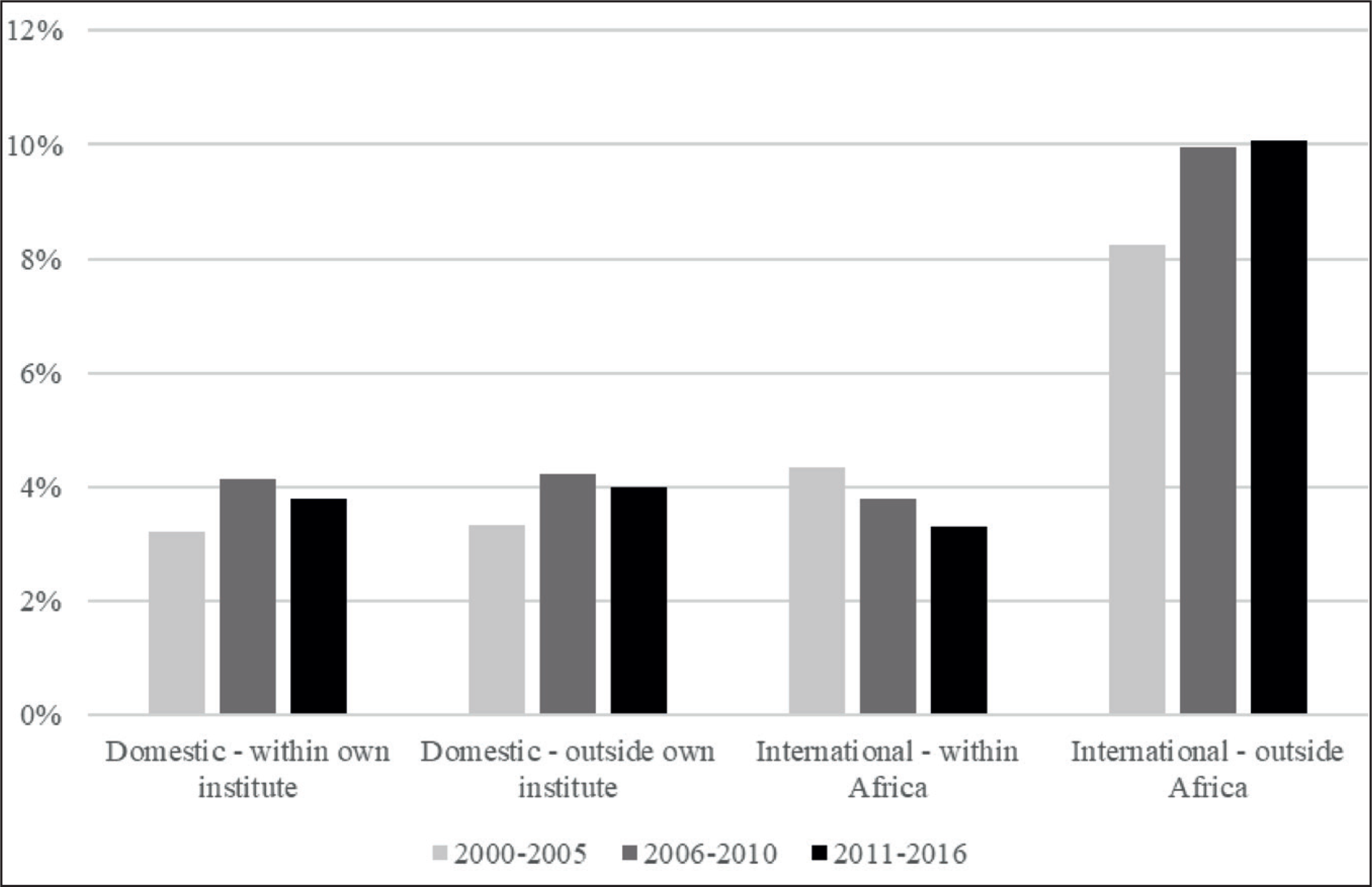
Adopting a citation-impact approach of global excellence in Africa, we faced a second important methodological issue: how should ‘African science’ then be delineated and measured? Isolationist or integrative? Should one discard any non-African partners or include them for a fair assessment of excellence? Focussing on both features of Africa’s contribution to the global science system, we apply a dual perspective, where we examine geographical collaboration patterns and classify each highly cited research publication accordingly. Selecting those publications with multiple author addresses, of which at least one is in Africa, we defined the following four macro-level categories: (a) ‘domestic cooperation—within own institute’; (b) ‘domestic cooperation—outside own institute’; (c) ‘international cooperation—within Africa’; and (d) ‘international cooperation—outside Africa’. 12 The results are presented in Figure 1. We observe a marked difference between cooperation with partners within Africa, with a steady decline to a 3% share in the top 10% most-cited publications, whereas the share has gone up to 10% in the case of partners outside Africa. These findings suggest that institutional cooperation plays a key role in the research that ultimately results in highly cited publications. Global excellence is much more likely to emerge from engaging with partners located outside Africa.
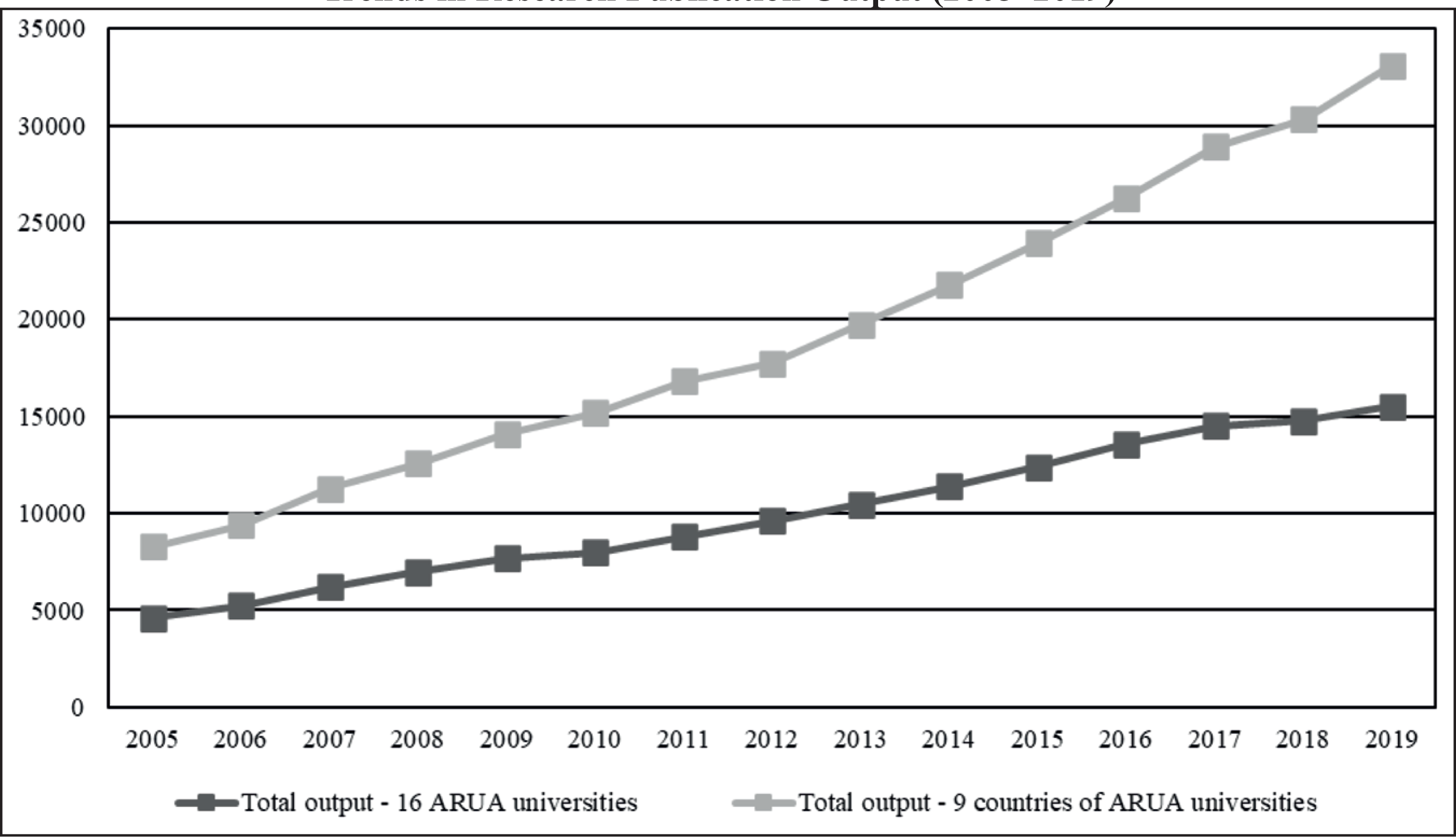
The relationship between global excellence and international support is also clearly visible within the 16 members of the ARUA (see Note 4). Collectively, these research-intensive universities produced a total of 15,505 (co-)authored WoS-indexed research publications in 2019, and 149,697 publications in the years from 2005 to 2019. Figure 2 presents the annual upward trend of their research publication output in international scientific and scholarly journals, relative to the output growth of their respective home countries (Ethiopia, Ghana, Kenya, Nigeria, Rwanda, Senegal, South Africa, Tanzania and Uganda). Although the share of these ARUA universities in their respective national publication outputs has gradually declined from 56% in 2005 to 52% in 2019, these universities remain the largest contributors to sub-Saharan African science in terms of sheer volume.
To assess the international dimension of their ‘global excellence’ profile, we focussed on their publications in the top 1% most highly cited worldwide. 13 Table 1 presents the geographical breakdown of those top cited publications according to three components of that profile: (a) location of co-authoring research partners; (b) origin of citations to those publications; (c) institutional funding sources mentioned in the ‘funding grant acknowledgements’.
Geographical Distributions Related to Top 1% Highly Cited Research Publications Produced by ARUA Universities
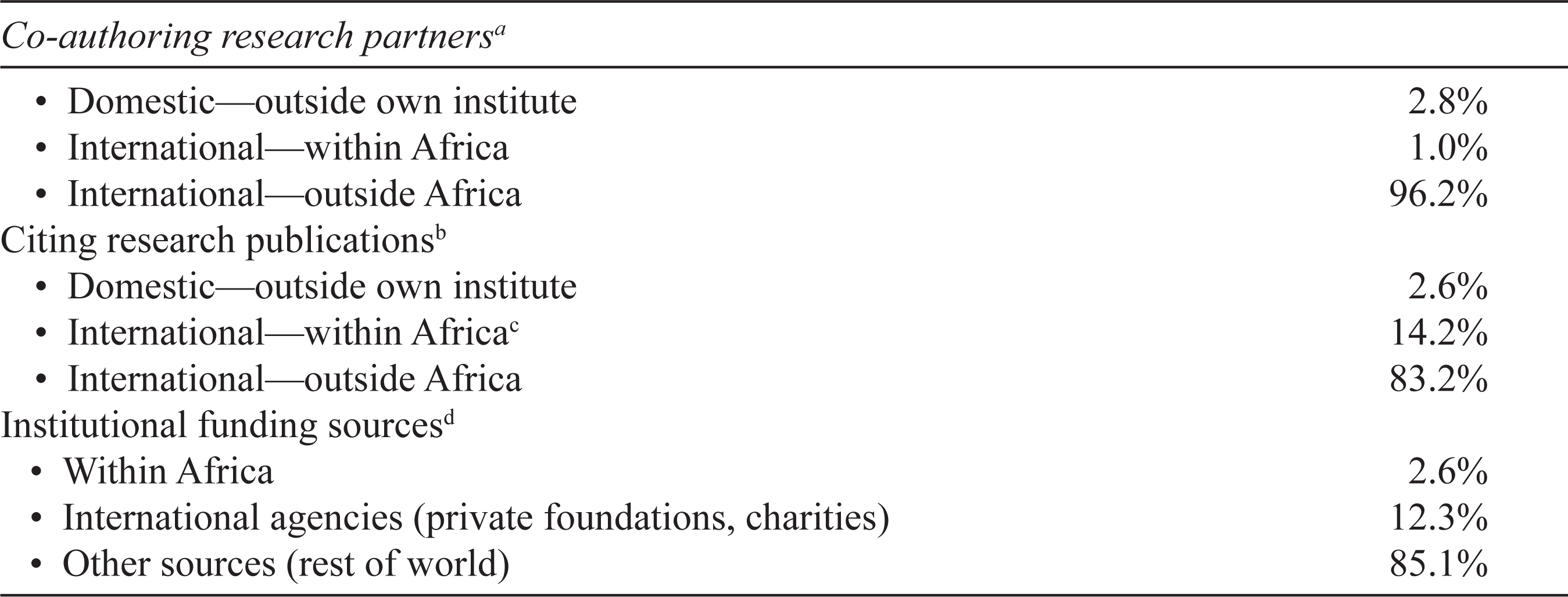
bA 6-year citation window is applied to each publication year, up to and including 2018.
cAlthough a significant 14% of the worldwide citations to highly cited publications are from other African (co-)authored researchers, these citing publications are again mainly from international co-publications that involve at least one Africa-based author.
dRetrieved from the ‘funding grant acknowledgement’ information item in each publication.
Africa itself represents only a minor fraction in each of these three interconnected components. Highly cited research produced by these African universities is obviously dominated by non-African collaborative partners and foreign entities. One might argue that this large degree of reliance on internationalisation is not representative for the entire publication output of the ARUA universities and associated scientific research. However, the citation impact analysis of their entire WoS-indexed output says otherwise: the share of citations from research outside Africa is still 81%, only slightly less than the 83% fraction within the top 1% cited publications. This is not a surprising outcome because the African research that is published in the international peer-reviewed scholarly literature has been heavily dependent on international support and foreign grants during the past few decades (Narváez-Berthelemot et al., 2002; Tijssen, 2007).
With such a small fraction of the highly cited research originating from Africa-based sources only, Africa’s ‘globally excellent’ research base seems critically dependent on foreign partners and resources. However, the causal relationships between African research capability and its ability to produce high-impact science are unclear. Moreover, the research excellence represented in these upper percentiles of global science is clearly biased in favour of international cooperation and networks. A closer look at the various CoEs in Africa reveals a more nuanced view of how global excellence is embedded in African science and education systems.
Local and Global Excellence: Varied Objectives of Centres of Excellence
The influx of CoEs during the past 15 years has created many niches of excellence. Their large number and varied objectives are meant to modernise universities both in terms of their educational mission and in terms of their scientific research capacity. The nature of the pursued excellence comprises many local and global elements. For example, the ARUA website states:
Among ARUA’s key objectives is to develop a robust knowledge ecosystem based on local research carried out by African-trained scholars and postgraduate researchers. Apart from contributing to finding solutions to Africa’s development problems, and having local socio-economic impact, research outputs from ARUA universities also aspire to be internationally visible and globally competitive. (see
This particular blend of local and global is further specified in ARUA’s aims for its CoEs:
“In collaboration with ARUA partner universities, the CoE shall:
Conduct cutting edge research that is innovative and with the potential for transformation. This should be highly regarded internationally and generate a global recognition of African research capabilities and contribution to knowledge’ Pursue partnerships worldwide with a view to locking African researchers into global networks that assist them to achieve global competitiveness; Strengthen capacity-building for research in Africa by enabling researchers of high international repute and very promising research students to come together for appreciable periods of time”. … but explicitly promoting the following local goals:
“Provide appropriately high-quality environments for significantly expanded postgraduate and postdoctoral training; Provide opportunities for African researchers to work on large-scale problems over long periods of time; Seek to bring together the leading researchers from Africa and elsewhere in working groups in order to generate a critical mass of interdisciplinary researchers capable of working collaboratively to tackle Africa’s most crucial development challenges through their work; Seek to develop an interactive relationship with the wider community including with other universities, African governments, industry and NGOs.”
The World Bank–funded ACEs focus explicitly on regional development. The August 2020 version of their website ( Enhance capacity to deliver regional high quality training to address the development challenge; Enhance capacity to deliver applied research to address the regional development challenge; Build and use industry/sector partnerships to enhance impact of the Center on development and increase relevance of the Center’s education and research; Build and strengthen regional and international academic partnerships to raise quality of education in other institutions in the region; Enhance governance and management to improve monitoring and evaluation, administration, fiduciary management, transparency, ability to generate resources, and project implementation.”
In a recent statement, the World Bank also acknowledges the global dimension of its CoEs, in terms of adhering to international quality criteria: “34 programs are certified to meet international quality standards, thus showing African higher education can meet global standards” (World Bank, 2019).
In contrast to the World Bank’s statements on objectives and standards, it is unclear if and how views of DST-NRF have evolved regarding the excellence of their funded CoEs. The only available documentation on this topic is the initial CoE Handbook (DST, 2004), which states three objectives and expectations with an international component:
Taking the lead in cutting edge research; Building South Africa’s research standing; Positioning South Africa to lead in the knowledge economy … and two objectives focusing on local relevance: Building research capacity; Researching key questions for South Africa.
The various CoE programmes embody different perspectives on how science and education may contribute to development in Africa. As a result, CoE mission statements present a heterogeneous collection of ambitions, expectations and goals, often with intersecting and overlapping local and global components. Implementing a clear-cut analytical distinction between local and global excellence seems untenable at the aggregate level of CoE programmes, but they may prove feasible at the lower level of individual projects or other organisational units. However, CoE objectives or performance targets are likely to change and shift over time, the inevitable outcome of adaptation to (inter)national circumstances or organisational priorities. Capturing this diversity and dynamics will require a multifaceted assessment perspective on the local dimension of a CoE’s performance, with carefully customised quality standards as well as multiple sources of relevant information.
Discussion and Concluding Remarks
Citation-based Measures of Excellence
Unfortunately, there are no systematic data nor comparative statistics on either the local impacts of African universities or those of their CoEs. Citation-impact data are currently the only available source of comparative data on their impact on worldwide science. In most cases, citation-based assessments will introduce an overly one-sided perspective, in favour of the international scientific impact, and strongly geared towards discovery-oriented, peer-reviewed ‘basic’ research. Although citations are admittedly an incomplete and biased source, applying an institute-level citation-based approach to research excellence, university leadership and institute managers may benefit from such information to develop ambitions and strategies for internationalisation and global excellence. Macro-level comparative citation impact, included in international statistical reports, data may also spur debate among (inter)national funding authorities and science policymakers about the place of contemporary African knowledge production in global science. However, the narrow focus on the top percentiles of citation frequency distributions as an indicator of excellence reduces, by definition, the scope for research performance comparisons to (a very small fraction of) published science. Focussing on Africa, the science writer Linda Nordling points out an inherent bias of citation-based assessment approaches:
“Africa funds a minute portion of its highly-cited research, a metric often used as a proxy for quality. But that tells us more about idiosyncrasies in the way that we evaluate research than it does about Africa’s own commitment to rigour and usability.” (Nordling, 2018c)
Citation-impact-based indicators may also create unintended and dysfunctional ‘citation-seeking’ behaviour among researchers, thus leading to an impact-obsessed ‘get cited or perish’ cultures. Nor does citation impact necessarily reflect crucial features of their core organisational missions. For example, having one or more heavily cited research units on campus, or even just a single professor, may certainly boost a university’s international visibility and prestige in research, but it reveals nothing about their other research-related performances (knowledge transfer, teaching and training) or whether the existing research capacity is sustainable in the long run. As Tijssen and Kraemer-Mbula (2018) argue:
“Any meaningful notion of excellence should go beyond the production of research publications in international journals, and counting citations to those publications from colleagues or peers in global academic communities. When judging specific African features of research grant proposals or final scientific results, supplementary information will have to come from an expanded, customised set of Africa-relevant indicators and quality standards.”
Framing and interpreting global excellence in terms of observable, external impacts—either citations or otherwise—are clearly insufficient to address the complex and challenging realities of contemporary science on the African continent (Tijssen, 2020). As far as we are aware, none of the current CoEs seem to explicitly apply citation-impact analysis within their assessment frameworks. Maybe because citation impact analysis presents a backward-looking ‘past performance’ view: although such impacts reflect the visibility, absorption and utilisation of knowledge, the necessary capacity-building and knowledge creation processes usually occurred several years ago. In contrast, decision-makers, funders and other stakeholders also need a forward-looking vision of science and development strategies. Hence, other information sources and views, like judgements of research proposals by expert panels, should be brought to bear. The next section presents arguments for balanced assessment approach of research excellence in Africa, where the local geographical component should be factored in more prominently for policy framing and institutional learning.
Transforming Research Assessment Frameworks
High-quality assessments of research excellence hinge on the availability of compelling and robust empirical information. Strong claims of excellence require strong evidence. Developing a common information base requires a shared understanding of appropriate quality standards of science in African countries that are yet to be developed. Empirical information or expert opinions need to be firmly contextualised. Not only should the differences between the rich countries of the Global North and low- and middle-income countries (LMICs) of the Global South be incorporated into stakeholder expectations and those development strategies, but also—and perhaps even more importantly—the difference between internationally oriented scientific knowledge production and the kind of research that addresses specific local issues or problems. Such a distinction requires a deep understanding of the notion ‘local excellence’ across its various components and helps to create an analytical framework with a sufficiently wide range of performance indicators that are fit for purpose.
Africa’s science granting councils and other funding agencies should develop such a ‘localised’ contextualisation of excellence and adopt performance criteria that are tailored for performance-enhancing initiatives and programmes aligned to national or regional priorities. Africa’s science funding and performance assessment systems should make a clearer distinction between global and local in terms of quality criteria, recognition and rewards (Tijssen & Kraemer-Mbula, 2018). Such a diversified and balanced assessment framework should be supported by an appropriate mix of metrics-based performance indicators and qualitative ‘showcase’ narratives.
In the edited volume Transforming Research Excellence: New Ideas from the Global South (Kraemer-Mbula et al., 2020a), several ideas are presented on how to reframe and re-conceptualise the concept of excellence in ways that emphasise productive complementarities, rather than (potential) conflicting interests, that may emerge when aspiring for achieving both local and global excellence. Such an alignment requires explicit criteria with regard to quality characteristics, which are essential for proper interpretation of research performance profiles. Moving towards a possible implementation, my chapter in this book presents a series of general recommendations, specifically targeted at science funders in Africa, to develop a more appropriate assessment framework of research excellence (Tijssen, 2020). Five of those recommendations advocate a more clear-cut distinction between standards and indicators for local excellence and global excellence:
determining ‘excellence’ is contingent on appropriate performance standards and benchmarks; proper understanding and operationalising requires multiple perspectives (both local and global); it is important to make a clear distinction between common global benchmarks and ‘local’ customised ones; experiences within LMICs in adapting concepts of research excellence and ‘research quality’ to their local contexts constitutes valuable sources of information to establish good practices in assessment and evaluation practices worldwide; the choice of performance indicators and/or excellence benchmarks will always be context-dependent and goal-dependent; there is a clear need to incorporate local contextual factors in customised indicators; frameworks designed to assess research excellence ought to be flexible enough to incorporate changes in the local context and priorities, as well as dynamics of the global science system.
Policy and Management Implications
The inputs and outputs of research performance assessment processes are significantly affected by quality standards, available empirical evidence, analytics and indicators. The assessment framework itself is driven by expectations of stakeholders and views of funders concerning the socio-economic relevance of science and value added by research performing organisations. Contemporary policy debates on science systems in sub-Saharan Africa are increasingly dominated by multiple stakeholders and policy agendas that emphasise social transformation where universities should become more responsive to local labour market demands, societal challenges and economic circumstances (e.g., Bank et al., 2019). The choice of performance criteria, and the most appropriate units of assessment, will increasingly determine how universities and CoEs perceive themselves, which, in turn, will affect their strategic decision-making in issues of research portfolio management and investments for the future.
Providing education to large numbers of students will undoubtedly remain the prime mission of universities in Africa. Only the small group of ‘leading’ research-intensive universities, like the ARUA members, will continue to invest significant resources in scientific research performance and pursue global excellence. As shown in this publication, this pursuit comes with a significant degree of reliance of non-African resources and funding, where international donors may determine what local or global excellence could or should entail. These stakeholders and decision-makers may face strategic trade-offs between striving for international scholarly prestige and upgrading local engagement agendas, for example, in terms of ‘Africanisation’ or ‘decolonisation’ of their education or research activities. It seems more than likely that the required investments and efforts to achieve or sustain levels of global excellence will not necessarily create or enhance local relevance of research outcomes. However, global and local are essentially two sides of the same coin. One focusses on ‘basic’ discovery-oriented research and knowledge production for fellow members of the worldwide scientific community (including colleagues and peers in Africa), while the other is more concerned with ‘applied’ problem-oriented research of relevance for users and innovators in local or national communities. The two perspectives are complementary and interdependent, rather than contradictory, and align with the research interest portfolio of many academic researchers in Africa, who are probably both globally and locally engaged.
Africa needs to transform the Global North’s views and rhetoric on excellence (Kraemer-Mbula et al., 2020b). Stakeholders within higher education and science systems should therefore develop policies, information infrastructures and administrative systems that support a broader appreciation of research excellence, where global and local excellence should be treated as mutually supporting and reinforcing components of the research endeavour. Context and customisation are crucial. Broad stroke measures should be replaced by Africa-centric quality standards, unsuitable metrics by appropriate performance indicators. Such changes in policies and practices could accumulate into transformative effects by contributing to a range of applications to support ‘excellence-driven’ science: career opportunities and incentive systems for researchers, support evidence-based quality assurance systems at universities, stimulate research funders to develop research impact agendas with global and local quality standards and to assist national policymakers in (re)valuing the importance of science and innovation infrastructures in efforts to steer African countries towards a more prosperous, sustainable and equitable futures.
Footnotes
Declaration of conflicting interests
The authors declared no potential conflicts of interest with respect to the research, authorship and/or publication of this article.
Funding
The authors received no financial support for the research, authorship and/or publication of this article.