




Abstract
COVID–19 has not only resulted in nearly two and a half million deaths globally but it has also spawned a pandemic of misinformation and conspiracies. In this article I examine COVID–19 misinformation and conspiracies in the United States (US). These misinformation and conspiracies have been commonly argued to be anti-science. I argue, although it is important to rebut false information and stop their spread, social scientists need to analyse how such anti-science claims are discursively framed and interpreted. Specifically, I show how the framing of the anti-science conspiracies utilise the credibility of science and scientists. I also explore how the COVID–19 misinformation and conspiracies were given different meaning among different social groups. The article is divided into three sections. In the first section I analyse the discursive emplotment of the Plandemic video that had Dr Judy Mikovits presenting several COVID–19 conspiracy theories and went viral before it was taken down from major social media platforms. I show how the video draws on the credibility of science, scientists, and scientific journals to present misinformation and conspiracies claims against vaccination, mask wearing, etc. The second section explores how COVID–19 misinformation and conspiracies were interpreted among the African-American community by drawing on the history of black community’s experiences in the US and as such how their interpretations stand in contrast to the interpretations of the COVID–19 misinformation and conspiracies among the White community. The last section analyses the role of STS in engaging with anti-science and post-truth issues and emphasises the need to excavate genealogies of the present even with regard to misinformation and conspiracies.
On 1 July 2020, The Alliance for Science, a Cornell University based group that ‘seeks to promote access to scientific innovation as a means for raising the quality of life globally’, 1 bluntly headlined one of its news reports: ‘“Anti-Science” attitudes undermining US efforts as coronavirus cases soar’. 2 The report quotes Dr Anthony Fauci, who has been the Director of the National Institute of Allergy and Infectious Diseases (NIAID) from 1984: ‘There is a general anti-science, anti-authority, anti-vaccine feeling among some people in this country {United States}—an alarmingly large percentage of people, relatively speaking.’
There can be little dispute that the coronavirus pandemic has also spawned a pandemic of misinformation – not just in the United States (US), but in other countries as well. 3 Coronavirus pandemic has, in fact, become the new flashpoint in what has been called the post-truth era. The term post-truth was presented by Oxford English Dictionaries as the word of the year in 2016 and, according to the Oxford Dictionaries, it means ‘relating to or denoting circumstances in which objective facts are less influential in shaping public opinion than appeals to emotion and personal belief’ (as quoted in Lynch, 2020, p. 50).
Michael Lynch in a recent article problematises the above definition of post-truth. ‘The contrast … between “objective facts” and “appeals to emotion and personal belief”, Lynch points out, ‘does not quite capture the challenge to science in the current era’ (Lynch, 2020, p. 50). Lynch argues that ‘instead of an outright rejection of science and objectivity, what is involved is an effort to produce adversarial claims of objectivity and institutional supports for those claims’ (Lynch, 2020, p. 50). He concludes that ‘{p}erhaps the problem is not anti-science per se, but the collapse of more nuanced debate into over-generalized “scientific” claims in the public airing of disagreements’ (Lynch, 2020, p. 55).
In this article I build on Lynch’s argument about anti-science campaigns and post-truth era in the context of the COVID–19 pandemic. Specifically, I argue, although it is important to rebut false claims and stop their spread, in order to better understand anti-science misinformation and conspiracies, we need to analyse how anti-science misinformation and conspiracies are discursively framed and interpreted within and by particular social groups. The social patterns of anti-science claims have been highlighted by various studies. For example, a study published in the American Journal of Public Health found that the percentage of students with public health exemption (PBE) from vaccination doubled from 2007 to 2013 in California. The study showed that ‘{a}cross all models, higher median household income and higher percentage of White race in the population … significantly predicted higher percentages of students with PBEs in 2013’ (Yang et al., 2016, p. 172) Similarly, a study on climate change beliefs, based on ten Gallup surveys (2001–2010), found that conservative white males were four times more likely than all other adults to believe that ‘the effect of global warming will never happen’ (McCright & Dunlap, 2011). In fact, on Brexit vote too, which prompted the christening of post-truth as the word of the year of 2016, the racial divide was strikingly evident: whites were the only racial/ethnic group whose majority voted for leave and the white vote for leave was around 20% more than the voting percentage for leave by the other ethnic/racial groups. 4
Let me clarify. I am not suggesting that the white racial group is more pre-disposed towards anti-science or post-truth positions. Rather, I wish to highlight that when we investigate anti-science claims, if we do not contextualise our investigation in relation to particular social groups and in particular temporal/historical and geographical contexts, we will get a very skewed understanding of what is happening. Moreover, we would miss an important element of anti-science claims – how the veracity of a representation (with regard to climate change, effectiveness of vaccine, and, more broadly, what is considered a ‘scientific fact’) becomes hostage to its interpretation, mobilisation, and circulation within and by particular social groups. Hence, as I show in the article, anti-science claims often utilise certain tropes, which allows the claims to align with existing social concerns and through that with particular social groups, and then these claims are spread through the actions of these groups. In short, with regard to anti-science (and post-truth) claims, we need to move beyond the issue of what representations are, which, not surprisingly, leads to calls for spreading better understanding of science (and in some cases spread of ‘scientific temper’), and analyse how these representations are discursively framed and, thereafter, interpreted and circulated. 5
A focus on how anti-science claims are discursively framed, as I show, highlights that these claims are often sustained through critiques of certain institutional relationships of science(s) and rely on idealised and reified constructions of science to glide over situated critiques of those anti-science positions. Critique of such idealised constructions of science is, thus, not just necessary, but also urgent. In relation to anti-science misinformation and conspiracies, it is also important to explore whether and how they are interpreted differently by different social groups. Such an exploration, as I show in the article, requires tracing the history of the present. 6 For example, in relation to COVID–19, although there are overlaps in the interpretative content, it is noteworthy how the misinformation and conspiracies that became popular among the African-American community in the United States (US), commonly drew upon the history of exclusion and exploitation of the black community. In contrast, the misinformation and conspiracies among the white community often drew on the trope of freedom and protection of the republic, which, in turn, cannot be separated from the colonising discourse of settler colonies such as the US that links whiteness to citizenship and property (Harris, 1993; Reardon & TallBear, 2012). 7 My analysis of differing interpretations of COVID–19 misinformation and conspiracies as history of the present does not aim at presenting an underlying unchanging historical logic or cause for present day actions. Rather, in line with Michel Foucault’s concern with genealogical analysis and exploration of history of the present, it seeks ‘to trace the erratic and discontinuous process whereby the past’ becomes genealogically linked to the present (Garland, 2014, p. 372).
The article is divided into three sections. The first section analyses how a video titled Plandemic, which went viral soon after it was posted on social media platforms, utilised idealised and reified constructions of science, scientists, and scientific journals to present anti-science misinformation and conspiracies. Thereafter, in the second section, I explore some anti-science misinformation and conspiracies that spread in the African-American community and compare the differing responses to the misinformation and conspiracies among the blacks and the whites. In the last section, building on Bruno Latour’s recent claim in relation to COVID–19, I analyse the role of science and technology studies (STS) in engaging with anti-science and post-truth issues. Specifically, I show that Latour’s call to shift our imaginary and biopolitical strategy towards pathogens and pandemics is important. However, the COVID–19 pandemic has also highlighted the limitations of Actor Network Theory (ANT) and thus I argue for the need within STS to carefully explore the history of the present. 8
Discursive Emplotment of Misinformation and Conspiracies About COVID–19
‘We’ve gone through swine flu, bird flu, AIDS. All of the pandemics, epidemics are perpetrated fraud to control, to drive our healthcare system. Literally, it’s bankrupting our country’ (as quoted in The Guardian, 2020). 9 Dr Judy Mikovits, who made the above claim, is a virologist whose 2009 paper in Science was retracted by the journal because the research on which that paper was based was discredited. Mikovits made the claim in a 26 minutes video titled Plandemic that was posted on several social media platforms on 4 May 2020 and soon went viral.
In this video Mikovits is interviewed by Mikki Willis, a filmmaker, and she makes a number of claims in relation to COVID–19. For example, she states: ‘Wearing the mask literally activates your own virus. You’re getting sick from your own reactivated coronavirus expressions and if it happens to be SARS-Cov–2 then you’ve got a big problem’. 10 Her reasoning, as she explained in another interview, is that ‘it’s probable that it’s {SARS-Cov–2 or COVID virus} been in every flu vaccine since ‘13 to ‘15 because that’s when this work was being illegally done’. 11 Thus, according to Mikovits, SARS-CoV–2 (COVID–19) virus has been dormant in our bodies for years and wearing masks activates the virus. 11
Mikovits makes many claims in the video with regard to COVID–19. Another of her claims that has become a part of COVID–19 conspiracies suggests alternative therapies for COVID–19 are already available and asks why has the focus been on the development of a vaccine. This claim is presented as a conspiracy by the scientific establishment and the drug companies. ‘The game’, Mikovits says, ‘is to prevent the therapies until everyone is infected and push the vaccine, knowing that the flu vaccines increase the odds by 36% of getting COVID–19’. 11 She specifically targets Dr Anthony Fauci but also states that the American Medical Association (AMA) too is behind controlling alternative therapies for COVID–19. She states in the video: ‘The AMA was saying, ya know, doctors will lose their license if they use hydroxychloroquine’. 11
In the weeks and months that passed since the Plandemic video was first posted on several social media sites, there were not only numerous responses via videos and print media that have shown that Mikovits claims are wrong, but the video, Plandemic, was also later taken down from social media sites such as Facebook, YouTube, Twitter, etc., for its role in spreading misinformation. I am not going to go into the details of how Mikovits claims are wrong. It has already been done very effectively by many scientists and medical professionals and I am not trained as a medical scientist. I would instead focus on the emplotment of the COVID–19 misinformation and conspiracies in the video to show how, in fact, the credibility of science and scientists is mobilised to present anti-science claims. I also analyse how a network of social media and social influencers resulted in the ‘virality’ of the video. I use the verb virality to highlight the need to not only focus on the veracity of claims, but also on how such claims travel, as has been emphasised by several news reporters and social scientists (see, e.g., Peters et al., 2020). 12 Virality, apart from the obvious reference to the speed with which information travels, can also create or at least add credibility. The term virality also indicates the mutative potential of the media, albeit the mutation may not be at the level of the content, but in the form, which allows the media content to continue to proliferate. The Plandemic video, for example, in spite of its removal from several social media sites, continues to be available at several websites and is being viewed and commented upon by a number of people.
Plandemic very slickly uses the credibility of science and the scientist to present misinformation about COVID–19 and Dr Judy Mikovits. The video starts with Mikovits and Mikki Willis, the filmmaker, walking together on a street with soft music in the background and a voiceover (of the filmmaker) making the following claim: ‘Dr Judy Mikovits has been called one of the most accomplished scientists of her generation. Her 1991 doctoral thesis revolutionised the treatment of HIV AIDS. At the height of her career, Dr Mikovits published a blockbuster article in the journal Science’. 13 The video, thus, uses Dr Mikovits work in the field of science and the reputation of the journal Science, albeit falsely (there is no mention of the discrediting of Mikovits’s work), to lay the groundwork for the claims that follow in the interview. I highlight this to show that it is, minimally, intellectually lazy to argue that anti-science claims are a result of a rejection of scientific objectivity and value neutrality of science. In fact, as the video shows, the opposite is happening here – reified construction of scientific objectivity and value neutrality of science and the scientist are used as the scaffold to present the claims that follow.
The challenge to science follows soon after the above quoted part of the voiceover:
‘The controversial article sent shockwaves through the scientific community as it revealed that the common use of animal and human foetal tissues were unleashing devastating plagues of chronic diseases. For exposing their deadly secrets, the minions of big pharma waged war on Dr Mikovits, destroying her good name, career, and personal life’. 14
It will be useful to note that the criticism here is not of science per se; rather what is being criticised is the projected alliance (or subservience) of science/scientists to the interests of big pharmaceutical companies. The introductory voiceover ends by laying out the reason for the interview with Dr Mikovits, situating it in the context of COVID–19 pandemic: ‘Now, as the fate of the nation hangs in balance, Dr Mikovits is naming names of those behind the plague of corruption that places all human life in danger’.
14
Thereafter, Willis, the filmmaker, and Dr Mikovits, are shown sitting in front of each other in a room and Willis starts interviewing Dr Mikovits:
Willis: ‘So, you made a discovery that conflicted with the agreed upon narrative’. Mikovits: ‘Correct’. Willis: ‘And for that they did everything in their powers to destroy your life’. Mikovits: ‘Correct’. Willis: ‘You were arrested’. Mikovits: ‘Correct’. Willis: ‘And then you were put under a gag order’. Mikovits: ‘For five years, if I went on social media, if I said anything at all, they would find new evidence and put me back in jail. It was one of the few times I cried. It was because I knew there was no evidence the first time. And when you can unleash that kind of force to force someone into bankruptcy with a perfect credit score. So that I could not bring my 97 witnesses, which included the heads of Tony Fauci, Ian Lipkin, the heads of public health and HHS, who would have had to testify that we did absolutely nothing wrong’.
15
Willis: ‘So what did they charge you with?’ Mikovits: ‘Nothing’. Willis: ‘But you were in jail’. Mikovits: ‘I was in jail with no charges. I was called a fugitive from justice {police cars are shown making a raid in the night while Mikovits talks}. No warrant … I have no constitutional freedoms or rights’.
Before we proceed further, it is important to note that the framing of Willis’s first question genealogically links Mikovits scientific work (although it was later discredited) to the commonly used trope to describe a scientific discovery—‘discovery that conflicted with the agreed upon narrative’. The video thus presents reaction towards Mikovits’ work not simply as a conspiracy of the pharmaceutical companies, but also a result of it being ahead and beyond the accepted scientific knowledge. That is to say, Mikovits is being presented simultaneously as a revolutionary scientist, who made an important discovery, and somebody who became a target of special interests.
Such framing of Mikovits and her research reflects the biased view of the filmmaker. Willis does not even discuss the discrediting of Mikovits’s research that had resulted in the retraction of latter’s paper, which was published in Science. In the narrative emplotment of Mikovits and her ‘scientific’ claims idealised constructions of science and scientific research are used to not just gloss over and hide falsehoods with regard to the scientist and her claims, but to present her as a hero.
In the video, Willis, the filmmaker/interviewer, continues the earlier quoted exchange, stating that a lot of people would have taken retirement or laid low, but now that Mikovits’s gag order has been released, instead of lying low she has decided to publish the book Plague of Corruption: Restoring Faith in the Promise of Science (the book cover shows on the screen, while Willis reads the book’s title aloud). Willis thereafter states, ‘apparently their attempts to silence you has failed’ and then says he has to ask ‘how do you sit here with confidence to call out these great forces and not fear for your life as you leave this building’. Mikovits replies, ‘because if we don’t stop this now, we can not only forget our republic and our freedom, but we can forget humanity, because we will be killed by this agenda’. Thus, the Plandemic, after presenting Mikovits as a revolutionary scientist, presents her as a hero who is willing to take on ‘great powers’ in spite of grave dangers to herself, including to her life, in order to protect the nation at the time of the COVID crisis.
The interview moves on to Dr Anthony Fauci, initially focusing on how Dr Fauci was central to the coverup in relation to Mikovits. Then, Willis asks, so now the whole ‘world is listening to his {Dr Fauci’s} advice for how to handle the current pandemic, how do we know what he is saying is what we need to be learning’. Mikovits replies, ‘what he is saying is absolute propaganda’. And then Mikovits links her claim of Fauci’s advice as propaganda to what she calls was propaganda that started way back in 1984 in relation to the development of a vaccine for AIDS (see Leavy, 2009 for a report on the controversy over the AIDS vaccine). The interview continues on Dr Fauci and then shifts to concerns about the COVID–19 infection data in the US. Mikovits suggests that the cases are being wrongly counted. Willis states that he has seen so many videos of doctors who have been perplexed by the CDC’s guidelines. One doctor (a white man in coat and tie, but the specific identity is not provided in the video, so it is difficult to confirm) is shown telling a news reporter that one of his patients, an 86-years-old woman had pneumonia. And, although this patient was not tested for COVID–19, since they later came to know that her son had tested positive for COVID, though the son did not show the symptoms, he (the doctor) was being told that it would be appropriate to write COVID–19 on the death certificate of the 86-years-old patient.
This video shot is followed by a white man wearing medical personnel’s gown (his identity is not given) who states, ‘when I am writing my death report, I am pressured to write COVID. Why is that? Why are we being pressured to add COVID?’ This person then adds: ‘To maybe increase the numbers and to make it look little worse than it is. I think so’. The video then moves back to the news report in which a white male/doctor (in coat and tie) was talking about difficulties in listing COVID as a cause of death and he is asked by the news anchor ‘why would they want to skew the number of deaths due to COVID–19?’ The doctor replies: ‘Well, fear is a great way to control people. And sometimes people’s ability to think for themselves is paralyzed if they are frightened enough’. He then adds that is not the situation in which he wants people to be. Again, it is worth noting that in the misinformation in relation to COVID–19 data in the US the credibility of medicine and medical scientists are used.
More broadly, the Plandemic sets the stage for a scientist/hero who against all odds is shown taking on the establishment in which the popular voice of caution from the medical community, Dr Anthony Fauci, is discredited and people are asked to take their own decision. The discursive emplotment of the video draws on several tropes that resonate with existing discourses of particular social groups—that of David versus Goliath, of white victimhood that emerged in the United States in the 1970s and 1980s (Berbrier, 2000), protection of ‘our freedom’ and the republic, calls against wearing of masks and challenging of COVID fatality numbers, which, apart from aligning with interests of particular groups, have been presented as attempts to malign President Trump, conspiracy of pharma companies in protecting their self-interest, etc. It is important to take note of these tropes because then it will make better sense how this video went viral. It will show how ‘manufacturing consent’ occurs through alignment of interests.
Judy Mikovits’s book, Plague of Corruption: Restoring Faith in the Promise of Science (Mikovits & Heckenlively, 2020), which was briefly discussed and its cover displayed in the Plandemic video, for example, went on to become one of the best sellers on Amazon soon after the video went viral. 16 The book continues to top the selling charts in several categories of books, including virology. On Amazon the Plague of Corruption had more than 4,500 customer reviews by the end of October 2020, around six months after it was published, and more than 90% of the reviewers gave the book 4 or 5 stars. One reviewer wrote: ‘Before we can restore faith in science we have to know how it was lost. Who betrayed us and why’. Another reviewer states: ‘This book is the second collaboration of a top scientist and an attorney’. 17
Interestingly, Mikovits co-authored the Plague of Corruption with Kent Heckenlively who ‘bills himself as the “world’s #1 anti-vaxxer”’. 18 Heckenlively too is not overtly anti-science. His author page on Amazon describes him thus: ‘I worked as a lawyer with my dad for several years, then found myself drawn to my original love of science and became a science teacher. Now I get to teach science during the day and write about it at night’ (emphasis added). 19 His most recent book, also co-authored with Judy Mikovits, is titled The Case Against Masks: Ten Reasons Why Mask Use Should be Limited (Skyhorse Publishing, July 2020).
Plague of Corruption has a foreword written by Robert F. Kennedy Jr., a lawyer and an activist who is also well-known for his anti-vaccine position. Kennedy, in the foreword, compared Judy Mikovits’s situation to that of Galileo fighting the orthodoxies of his time (Kennedy in Mikovits & Heckenlively, 2020). The blurb of the book quotes well-known French virologist, Luc Antoine Montagnier, who in 2008 shared the Nobel Prize in Physiology and Medicine for the discovery of the human immunodeficiency virus (HIV). Dr Montagnier’s blurb for Mikovits’s book, Plague of Corruption, which appears on the cover of the book, states that the book ‘delves into the midst of this rampant corruption, which hides from the public scientific truths which might go against these corporate economic interests’ (emphasis added).
Montagnier also told the news platform CNews that ‘the virus has come out of a laboratory in Wuhan, which has been specializing in these types of coronaviruses since the beginning of the 2000s’, thereby adding fuel to another conspiracy in relation to COVID–19—that the virus was made in a laboratory in China. 20 In the US the conspiracy about SARS-CoV–2 being human-made in a laboratory, in spite of it being discredited by almost all the scientists, continues to have valence and is continually used by President Trump in his references to COVID–19 as ‘Wuhan virus’ or ‘China virus’. 21 The Plandemic video was thus linked to a number of interests and conspiracies from the start. And the video and the book complemented each other in spreading misinformation and conspiracies regarding COVID–19. The virality of the video, after it was posted, also reflects alignment of interests.
‘Just over a week after “Plandemic” was released, it had been viewed eight million times on YouTube, Facebook, Twitter and Instagram … On Facebook, “Plandemic” was liked, commented on or shared nearly 2.5 million times’ far out numbering Taylor ‘Swift’s May 8 announcement about her “City of Lover” concert’ and the Zoom wedding video in which the cast of ‘The Office’ reunited, which was aired on 10 May 2020. 22 The virality of Plandemic, according to Renee DiResta and Isabella Garcia-Camargo, required ‘manufacturing an influencer’. 23 In fact, I would argue that the role of the influencers in making the Plandemic go viral reflects a process in which the influencer was not manufactured, rather, the influencer, through alignment of interests became key to manufacturing consent. The influencers, as such, became important nodes in the fast-spreading network of misinformation.
Mikovits had a ‘Twitter account for her speaking and writing career on the anti-vaccine conference circuit; it amassed roughly 1,700 followers in three years’. However, after her book, Plague of Corruption was released on 18 April, within 25 hours Mikovits Twitter account ‘amassed 18,000 followers, even though it had posted only one tweet during that period’. A tweet, which was later deleted, indicated that Zach Vorhies, ‘a self-styled whistleblower involved with Project Veritas (a group known for creating misleading ideological attacking videos)’ ‘was running Mikovits PR’. 24 Vorhies’s motivation was tied to his interest in taking down Dr Fauci, for which Vorhies was also running a GoFundMe page. 25
Another such influencer involved in promoting the Plandemic was ‘Dr Christiane Northrup, a women’s health physician’, who had developed ‘nearly half a million Facebook followers’, ‘following … her appearances as a medical expert on “Oprah”’. Northrup had ‘previously expressed misgivings about vaccines’ and she shared ‘Plandemic with her Facebook followers the very next day after it was released on various social media sites’. 26 Several other social media influencers shared the videos with their followers. Not all of these influencers and also different groups, which included QAnon as well as liberal/left groups, had the same interests in spreading the video, but their interests aligned with some or the other trope that were presented in the video. In this regard, it is also important to note, as Renee DiResta and Isabella Garcia-Camargo have argued, when the video was posted by Mikki Willis ‘to Facebook on the afternoon of May 4th … it did not highlight the content of the video, but instead emphasised that the video would imminently be censored’, which had the effect of ‘framing Mikovits as a whistleblower icon’. 27
The emplotment of the Plandemic, stylistically as well as in terms of the content, as I have shown, uses tropes that aligned with the interests and concerns of particular social groups, which, in turn, affected its virality after it was posted on social media sites. It is also important to highlight that the video does not present itself as anti-science. Instead, it utilises the idealised and reified constructions of science and scientists to gloss over and hide the veracity of the claims made by Dr Judy Mikovits. Let me reiterate, the issue with the video is not simply the falsehoods and lack of questioning of the veracity of Mikovits’s claims. We also need to ask how these falsehoods and lack of questioning of Mikovits’s claims did not become relevant for the viewers. In that regard, as I have argued, we cannot ignore how the discursive emplotment of ‘science’ and so-called ‘scientific claims’ in the video facilitated a sense of trust for the general public.
Discursive emplotment of a video (or other forms of dissemination of information) by utilising certain tropes to create potential alignment of interests cannot, however, explain some other aspects of the COVID–19 conspiracies. We also need to investigate how the misinformation and conspiracies were interpreted by different social groups; in particular, how histories of particular social groups may play a very significant role in the acceptance and spread of misinformation and conspiracies. In the next section, I focus on some COVID–19 conspiracies that spread among the African-American community in the United States (US) and contrast their interpretations of COVID–19 misinformation and conspiracies with those by the white community. More broadly, as I show in the following, we need to analyse the acceptance and spread of the conspiracies among the African-American community not only as a matter of immediate racial concerns, for example, racial injustice, but to also situate those concerns in the particular way the US was constituted as a white settler colony, that is, excavate the genealogies of the present.
COVID–19 Misinformation and Conspiracies Among the Blacks and the Whites
In late February and early March, when the Center for Disease Control (CDC) first stated that COVID–19 was heading towards a pandemic status, a claim about immunity of black people started to circulate in the African-American community. An NBA player tweeted: ‘So NONE of these Corona Virus cases have been black people?! LEMME FOUND OUT WE IMMUNE. It’s the least God can do after slavery’. 28 Another NBA player tweeted: ‘Not making light of it at all. Serious question: Has a Black person got coronavirus yet?’ 29 Soon the claim about black people’s immunity to coronavirus picked up and it even became an act of resistance. For example, when a white police officer was shown on video appearing to intentionally cough at a black woman, the latter replied: ‘Oh, I ain’t worried about that shit! Y’all get that shit, Black people don’t’. 30
The belief in black people’s immunity to COVID–19 at least in part stemmed from the exceptionally small number of infections recorded in Africa. In early March, when more than 3,000 people had already died worldwide and nearly 90,000 cases were recorded in 60 different countries, the African countries had reported just a few infections. 31 As Brandi Collins-Dexter of Shorenstein Center on Media, Politics and Public Policy at Harvard Kennedy School noted in his report, ‘COVID–19 misinformation and black communities’, this misinformation was sought to be explained through the presence of melanin: ‘melanin, the pigment found in hair, skin and eyes, offered a layer of protection from the virus’. 32 The belief in the immunity of black people also has a colonial genealogy. In the eighteenth century, as a result of Dr John Lining’s widely circulated belief that black people were naturally resistant to yellow fever, ‘{r}eferences to innate black immunity functioned both as damaging hearsay and as medical information passed over time and across distinct locales’ (Hogarth, 2017, p. 20). 33
The misinformation about the immunity of the black people to COVID–19 could not be sustained for long. The coronavirus and the spread of the pandemic disrupted the spread of misinformation about black people’s immunity. By mid-March news reports had started showing that COVID–19 infections and deaths among black (and Latinx and Native American) communities were disproportionately high. COVID–19, in fact, exposed the wide racial disparity in healthcare access and outcomes. A CDC report showed that in comparison to the whites, Native Americans had 2.8 times higher cases and 1.4 times higher deaths, African-Americans had 2.6 times higher cases and 2.1 times higher deaths, and Hispanic/Latinos had 2.8 times higher cases and 1.1 higher deaths. 34
As the reports of disproportionate COVID–19 infections and deaths in the black community spread, misinformation and conspiracies behind creation of the coronavirus and the proposed development of a vaccine started to gain traction. In mid-March a video was posted on Instagram that promoted ‘the theory that Bill Gates was responsible for creating the novel coronavirus’. The video soon went viral–it ‘was viewed more than 2.2 million times {and} was promoted by a number of social media influencers, including at least 20 verified Instagram users and more than 50 other users’. 35 The conspiracy surrounding Bill Gates’s role in relation to coronavirus has genealogical links to longstanding conspiracy theories that claimed that Bill Gates was involved in forcible population control.
The earliest version of this conspiracy has been traced to 2010, when Mame-Yaa Bosumtwi, a Ghanaian-born, US-educated former communications officer for a Gates Foundation funded initiative in Ghana, had claimed that a Gates-funded genocide was being carried out via Pfizer’s contraceptive, Depo-Provera, that was being provided to women in Africa. In 2011, this particular conspiracy acquired transnational reach when it was picked up by the US group ‘Rebecca Project for Human Rights’ that claimed in a report: ‘Researchers allegedly injected thousands of impoverished and illiterate Ghanaian women with Pfizer contraceptive, Depo-Provera, and administered other unidentified oral contraceptives during human research experiments to reduce population and modify health care’. 36 This particular conspiracy had slowly subsided. 37
However, as discussed earlier, Bill Gates became the centre of the controversy during COVID–19, when a video was posted on Instagram and other social media sites. The conspiracy video took a clip from Bill Gates’s TED talk in 2015, in which drawing on the example of Ebola and calling for the need to be better prepared for pandemics, Gates had warned: ‘The biggest risk for the global catastrophe doesn’t look like this {the image of a nuclear bomb}. Instead, it looks like this {image of the flu virus}’. The conspiracy video was, however, captioned: ‘Bill Gates either predicted or planned the coronavirus outbreak’. 38
‘Cedric the Entertainer posted the video to his Instagram account and wrote, “So they knew”’. Within days the video was viewed nearly 400,000 times. 39 Soon memes started emerging that linked proposed coronavirus vaccine as conspiracy by Bill Gates. One such meme used a childhood photo of Cardi B, the music artist, and claimed, ‘my mama said nobody elected Bill Gates to do anything and we ain’t takin no vaccine from some shady ass nerd that wants to depopulate the planet’ (See Figure 1). Similar concerns were voiced by a number of people. In the black community this conspiracy was articulated through ‘the frame of Black genocide’, which is a result of ‘longstanding distrust of mainstream media and history of trauma from interactions with powerful institutions, like medicine and government’. 40 The trope of ‘Black genocide’ also informed the COVID misinformation and conspiracies in relation to the role of 5G wireless network.
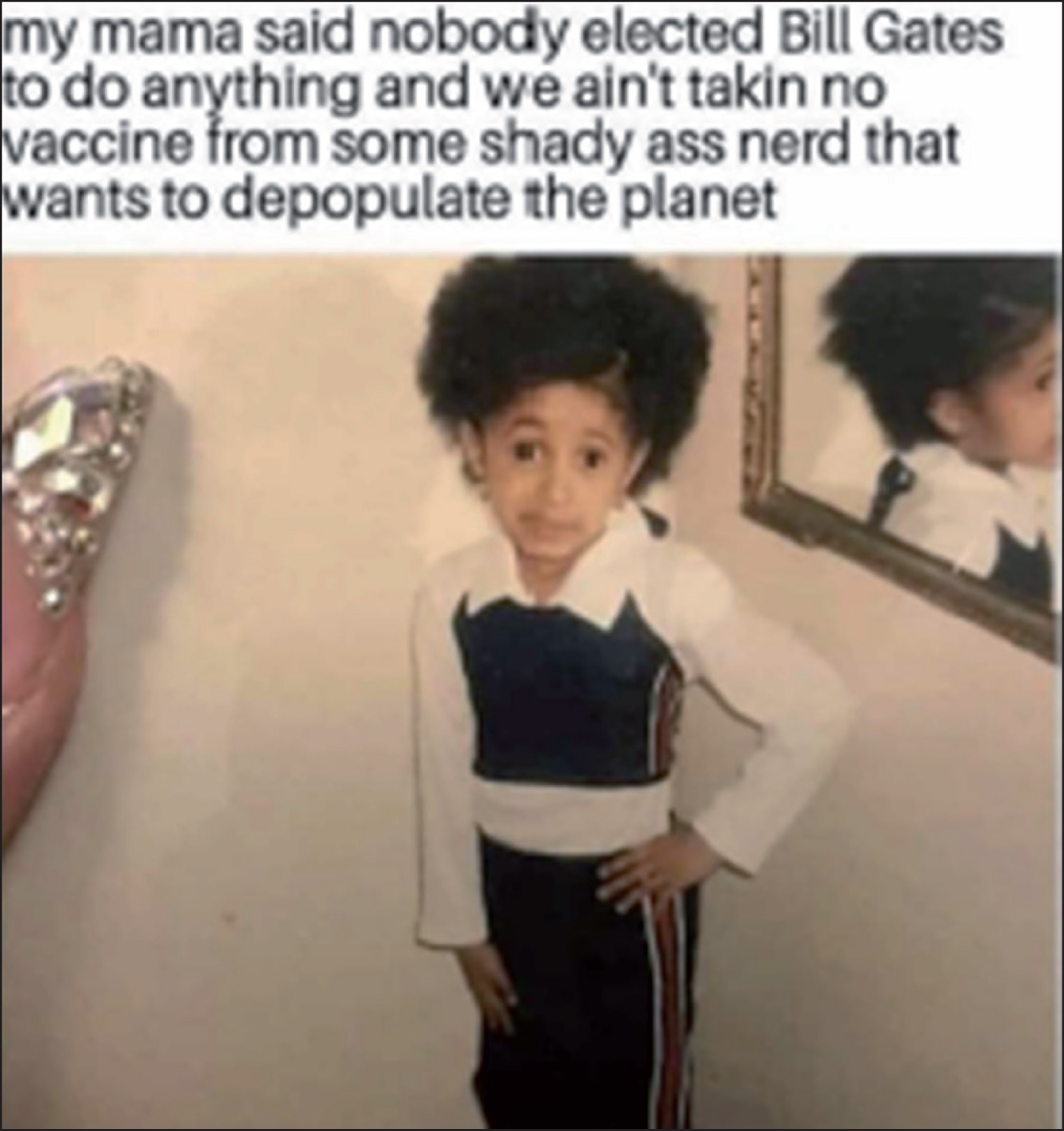
Amber Butts, writing in a different context, states: ‘Even when black conspiracy theories are misguided, they are not nonsensical’. 41 Butts draws on several examples, including those from her own experiences to highlight how the conspiracies among the black community often reflect the long history of mistrust resulting from racial discrimination and exploitation. She, for example, writes about the deep impact of her own experience during a visit to a white doctor, because she was ‘feeling like something was blocking … {her} air passages’ (after her grandmother’s death) and the doctor ‘stuck a black tube with camera down … {her} left nostril’, a procedure for which she had not given consent: ‘The realities of medical racism, terror and experimentation on Black, Brown and Native women’s bodies kept me from going back to that doctor’. 41 Butts, thus, highlights how in order to properly understand an action or event we need to trace the history of the present.
The broader issue that Butts raises—that ‘conspiracies are misguided, {but} they are not nonsensical’—is an important lesson for us when we study the role of conspiracies not just among the Black community, but in any community (see, e.g., Turner, 1993). Conspiracies, in significant ways, seem to embody displacement and condensation of not only the past experiences of an individual but also the history of the social group to which s/he/they belong. 42 In that regard, it is useful to return to one of Mikovits claims—‘because if we don’t stop this now, we can not only forget our republic and our freedom’. Mikovits’s statement may seem a general reference to all American citizens. However, it is telling how protecting ‘our freedom and our republic’ have been invoked in anti-mask wearing protests in the US largely by the whites. For example, Ashley Smith, the co-founder of ReOpen NC, a group that was formed in April 2020 with a call to reopen North Carolina, during one of their anti-lockdown protests stated: ‘We’ve seen a dramatic and sudden attack on our Constitutional rights … so this is just a day to stand against that and memorialize our fallen heroes for the liberty they fought and died for’. 43 Some other anti-mask and anti-lockdown protesters carried signs that read ‘No Liberty, No Life’ and ‘Give me liberty or give me COVID–19’. 44
Similarly, the COVID conspiracy in relation to Bill Gates was articulated very differently among the whites. Rev. Danny Jones, a white senior pastor of the Northlake Baptist Church in Gainesville, Georgia, called Bill Gates as the anointed one to lead the new world order ushered by the coronavirus in one of his sermons that went viral. Citizen Media News posted the video of the sermon on YouTube on 30 April 2020, but the video is available through other sources. The Citizen Media News video post of the sermon on YouTube had more than 1.5 million views until November 2020. This particular post of the video has had more than 20,000 likes and more than five hundred comments with viewers writing,
Everything this man is saying is true, verifiable. Bravo!
Rev. Jones goes on to detail how Bill Gates and others are trying to institute a new world order through the coronavirus pandemic: He states:
On 23 December 2019 the prestigious Scientific American magazine reported that the Bill and Melinda Gates Foundation and MIT (the Massachusetts Institute of Technology) had developed a biometric tattoo where a nanochip can be injected into your forearm at the same time you are being vaccinated, therefore, your arm can be scanned to reveal your identity, your vaccinations, maybe even your medical records. The biometric tattoo is a part of a bigger plan called ID 2020 that was announced this January {2020} at the World Economic Forum in Davos, again sponsored by the Bill Gates Foundation, the Rockefeller Foundation, and several other billionaire organisations.
The eventual goal, the pastor goes on to state, is to make the people submit to the United Nations or any other form of world government. The reference and scope of Rev. Jones’s conspiracy theory (he calls it as such in the sermon) of biometric chip taking away individual freedom is not limited to any particular community. He does not just refer to Americans, but people from different parts of the world and the comments on this video post on YouTube too shows global and multi-racial viewership (at least to an extent).
The issue, however, as I have been highlighting in the article, is not the form of a particular conspiracy (for example, the role of Bill Gates in relation to coronavirus), but how it is articulated through the real and perceived experiences of particular social groups. In this video too, as Rev. Jones quote above shows, science is not dismissed (he cites the Scientific American, albeit falsely). And, unlike the Black community, the conspiracy about Bill Gates is not situated in a history of exclusion and exploitation of the community, but as a concern to protect individual freedom and the republic. Other articulations of Bill Gates related coronavirus conspiracy similarly highlight the concern with loss of freedom, although it often also draws on the trope of white victimhood (see Figures 2 and 3).
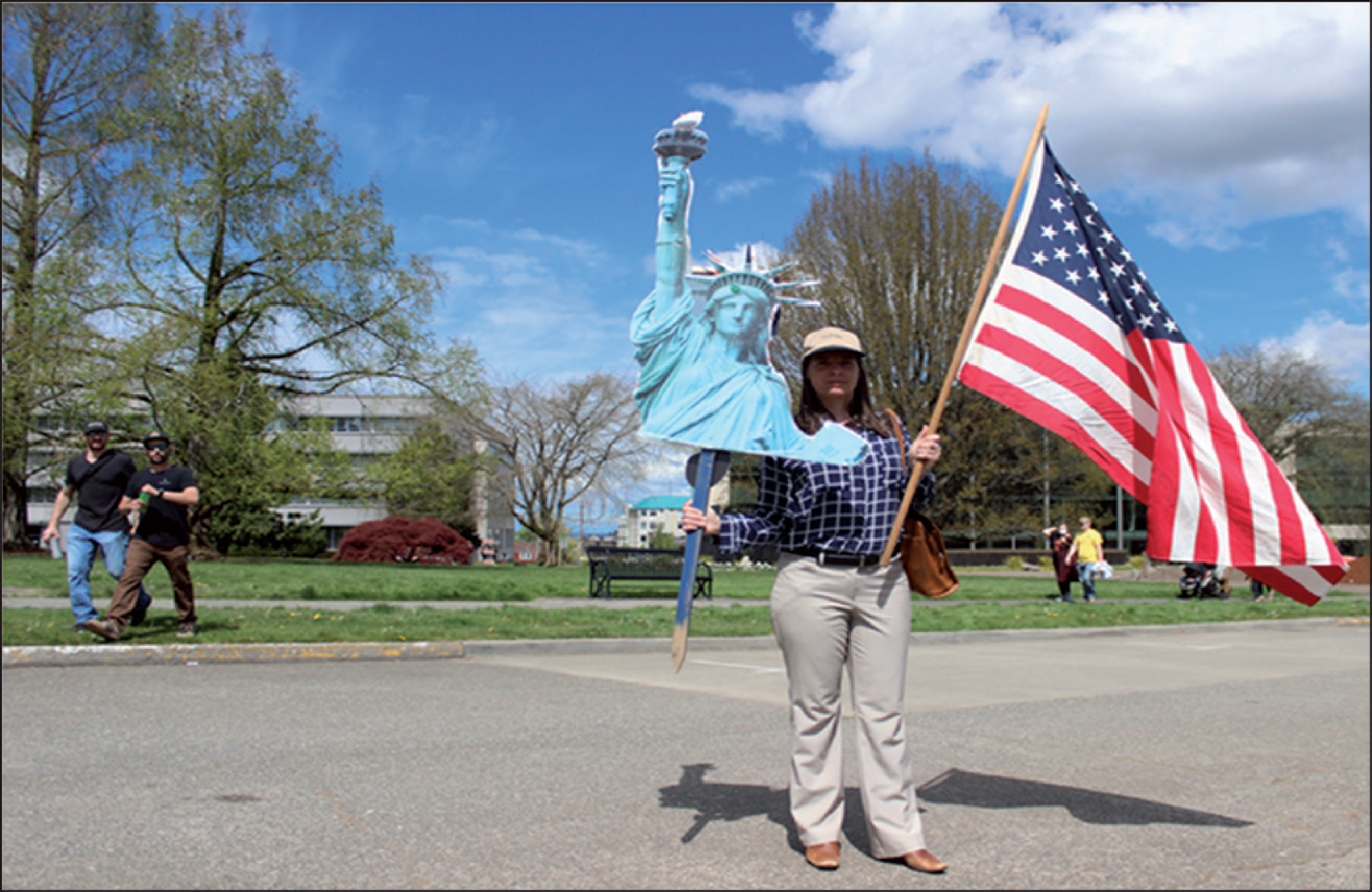
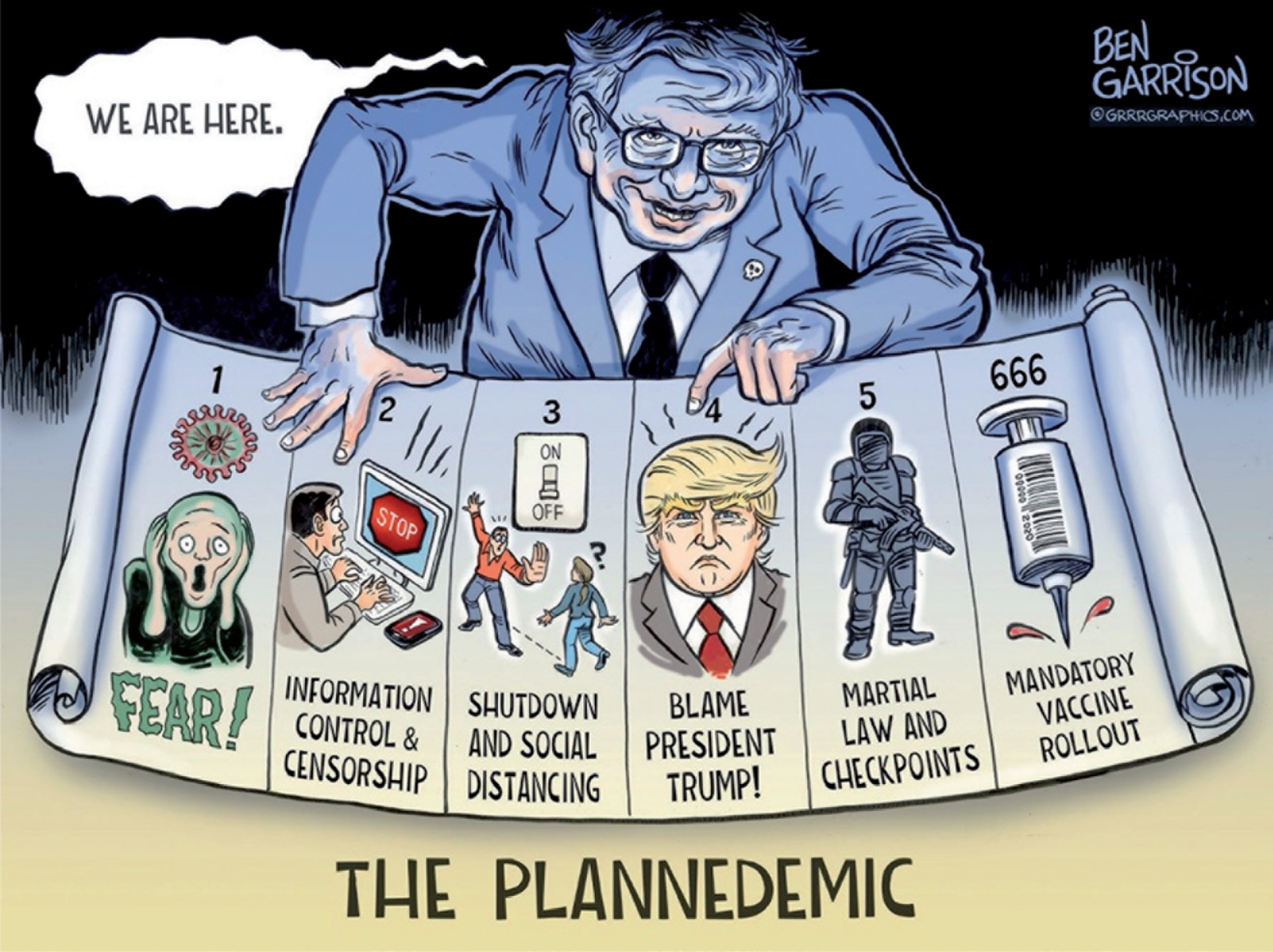
The trope of protecting freedoms and the republic that has been expressed in the white community has to be situated in relation to the colonial discourse of whitening of Americas as a key element in the making of the nation, which, consequently, results in defining of citizenship among social/racial groups differentially. Theodore Roosevelt, the 26th President of the United States (1901–1909) in his response to historian-journalist Charles Pearson’s National Life and Character: A Forecast (1893) had, for example, reflected, ‘the peopling of the great island-continent with men of the English stock is thousand-fold more important than the holding {colonizing} of Hindoostan for a few centuries’ (as quoted in Anderson, 2006, p. 254). Roosevelt categorically states: ‘Nineteenth century democracy needs no more complete vindication for its existence than the fact that it has kept for the white race the best portions of the new world’s surface, temperate America and Australia’ (emphasis added). 45
As is evident from Roosevelt’s responses to Charles Pearson the colonial history of America continued to bear upon imaginaries and practices long after the United States gained independence. Patricia Hills Collins rightly argues, ‘U.S. national identity may be grounded more in ethnic nationalism than is typically realized’ (Collins, 1998, p. 70). Collins shows how ‘differential population policies developed for different {racial and ethnic} segments of the U.S. population emerge in direct relation to any group’s perceived value within the nation-state’ (Collins, 1998, p. 76). It is important to situate the recent events related to coronavirus in this broader context. For example, surveys have shown differences in relation to mask wearing during COVID–19, which Dr Robert Redfield, the Director of the Center for Disease Control (CDC), had called perhaps the most effective tool in preventing COVID infections. 45 A PEW Research Center survey conducted in June 2020 showed a striking variation in mask wearing in terms of political affiliation with 53% of people, who identified as Republican or Republican leaning, as opposed 76% of those who identified as Democratic or Democratic leaning saying they wore the mask all or most of the time. The stark difference in mask wearing in terms of political affiliation, at least in part, could be because of President Trump’s position. 46 The same survey also showed variation in mask wearing across races: 62% of the whites, 69% of the blacks, 74% of the Latinx, and 80% of the Asians said they wore masks all or most of the time. However, as I have been arguing, we need to investigate anti-science claims—for example, not wearing masks—by situating them in relation to the experiences of social groups and by tracing the genealogies of those experiences.
There have been several reports of fear in the black community that wearing masks could result in their being targeted by the police. ‘One black man … a 35-year-old attorney and state senator from Illinois who was shopping at his local hardware store in Chicago’s South Loop while wearing a face mask’ was stopped by a uniformed officer to check his id and receipt, ‘{w}hile many white customers streamed by wearing masks’. 47 Such cases are not isolated. Vickie Mays, a professor in the departments of psychology and health services at University of California, Los Angles, put it bluntly: ‘Which death do they choose? COVID–19 or police shooting?’ 48 In short, the figures of racial differences in not wearing masks during COVID–19 pandemic has to be situated in the context of experiences of particular social groups, both historically and in the immediate context.
In relation to anti-mask wearing misinformation and conspiracies the deployment of the trope of ‘our freedom and our republic’ largely by the whites is, thus, not a coincidence. It is genealogically linked to the US republic being constituted as a white settler nation even after the US gained independence in 1776. ‘We the people’, as the Chief Justice Roger Tanney explicitly wrote in the US Supreme Court rulings of 1831 and 1857 ‘was never intended to include blacks, slave or free’ (as quoted in Duster, 2006, p. 490). And, as I showed earlier, Theodore Roosevelt, albeit he expressed it differently, continued to link whiteness to the American nationhood, at the turn of the twentieth century. Colonial genealogies of citizenship can be traced, as I have shown, even in the way COVID–19 misinformation and conspiracies have been articulated and framed. In the following section I analyse the role of STS in relation to COVID–19 misinformation and conspiracies.
Anti-science Conspiracies, Post-truth and STS
‘Within weeks of its emergence’, as Warwick Anderson rightly observes, ‘SARS-CoV–2 was galvanizing celebrity European philosophers and social theorists, most of them men in a vulnerable age demographic, to reflect publicly and plentifully on the meaning of the pandemic’. 49 Among these philosophical and theoretical meditations, an essay that Bruno Latour wrote, which was initially published in La Monde and thereafter republished as a blog on the Critical Inquiry website, has gathered a lot of attention. The blog is provocatively titled ‘Is This a Dress Rehearsal?’ 50 Latour, as he states in the essay, is ‘advancing a hypothesis’—‘that the health crisis prepares, induces, incites us to prepare for climate change’.
Latour criticises ‘the noise surrounding a “state of war” against the virus’ that has propelled the responses of the nation-states, which, according to him, are ‘caricatured form of the figure of biopolitics…straight out of a Michel Foucault lecture’. 52 It is unclear what Latour means by ‘caricatured form of the figure of biopolitics ….’ However, his concern with the responses to COVID–19 as a ‘state of war against the virus’ is important, because we have seen how those responses have not been effective. Latour’s concern has resonance among, at least a section of influential biologists. Joshua Lederberg, who had received the Nobel Prize in 1958 ‘for his discoveries concerning genetic recombination and the organization of the genetic material of bacteria’, 51 had, for example, called for a stop to the use of war as a metaphor for infection and asked biologists and public health officials to look for ‘{n}ew strategies and tactics for countering pathogens’ (Lederberg, 2000).
Lederberg’s argument is not simply that bacteria and virus are important ‘actants’ whose networks should be carefully unravelled. According to Lederberg: ‘We should think of each host and its parasites as a superorganism with the respective genomes yoked into a chimera of sorts’ (Lederberg, 2000, p. 288). The report on the ‘Forum on Microbial Threats’ of The National Academies, which was dedicated to the ‘life and scientific legacies of Joshua Lederberg’, pointed out in 2009, ‘a reconsideration of our interactions with pathogenic microbes is warranted, and it must be based on a better understanding of the host-microbe relationships in general’, adding,
Estimates indicate that 90% to 99% of the approximately 10
14
cells that comprise a healthy human body belong to the complex microbiota that share our space. Only a small fraction of the roughly several thousand bacterial species that inhabit our bodies cause illness; very little is known about the other non-pathogenic bacteria, or even about microbes that in most cases cause chronic, subclinical disease in humans (Relman et al., 2009, p. xiii).
These biologists and medical scientists are calling for not simply a reorientation of biological and medical research of microbial infections, but also a reimagination of our understanding of the society and the relationship between humans and non-humans. The report categorically states: ‘An axiomatic starting point for further progress is the simple recognition that humans, animals, plants, and microbes are cohabitants of the planet. That leads to refined questions that focus on the origin and dynamics of instabilities within this context of cohabitation’ (Relman et al., 2009, p. 64). Latour is, thus, right in claiming: ‘Covid has given us a model of contamination’, which is ‘an incredible demonstration of network theory’. He adds, ‘I’ve been trying to persuade sociologists of this for 40 years. I’m sorry to have been so right. It shows that we must not think of the personal and the collective as two distinct levels’. 52
Although, Latour restricts his comments on COVID–19 in relation to France, the situation in the United States (US) too, in spite of the stark difference in the American state’s response to COVID–19 under President Trump, can benefit from a network analysis of the roles of human and non-human actors. However, COVID–19 pandemic has also brought to the fore the underlying theoretical and methodological limitations of Actor Network Theory (ANT), in particular ANT’s failure to engage with the history of the present and latter’s constitutive role in understanding the experiences and actions of different actors. 53 Let me illustrate my claim through the racialised impact of COVID–19 pandemic in the US. It would also show that COVID–19 is not a ‘dress rehearsal’ that ‘prepares, induces, incites us to prepare for climate crisis’. Rather, it is also the theatre of action wherein marginalised people of colour are literally saying ‘I can’t breathe’, not because of air pollution, but because of racialised violence.
The Center for Disease Control (CDC), as I discussed earlier, highlighted the striking difference in COVID–19 infection and mortality rates across different racial and ethnic groups and captioned the statistical information thus: ‘Race and ethnicity are risk markers for other underlying conditions that impact health’. 54 From March to May 2020, as COVID–19 infections and mortality surged in US, the police killings of Breonna Taylor and George Floyd started massive ‘Black Lives Matter’ protests that spread globally, including in France. 55 The massive resurgence of Black Lives Matter protests during the COVID–19 pandemic was not a random coincidence. During COVID–19 race and ethnicity became health markers because they are also markers of a range of conditions that affect infections and mortality—‘including socioeconomic status, access to health care, and increased exposure to the virus due to occupation (e.g., frontline, essential and critical infrastructure workers)’. 56
In response to the Black Lives Matter protests many individuals and social groups have started counter protests called ‘All Lives Matter’. Several well-known US political figures support this latter counter movement, including some black people such as Ben Carson, the former US secretary of Housing and Urban Development. If we do not take into consideration the category of race (also class, gender, etc.) and the history of racism in situating the actions and voices of various actors, forget about the excavation of the role of race and racism, how will we even be able to show that Black Lives Matter is not a parochial call and All Lives Matter is not that democratic, as the name seems to suggest.
Describing the roles of marginalised actors has to take into account the fact that materialised expressions or inscriptions are critically impacted by experiences of marginalisation and violence (Biehl, 2005; Das, 1996). Moreover, the experiences of marginalised actors and the articulation of their experiences may be submerged within the dominant discourse and as such the dominant discourse needs to be deconstructed or critiqued (see, e.g., Mbembe, 2017), otherwise we run the risk of, for example, the colonial discourse continuing to impact even after colonialism is over, as we witnessed most starkly in the case of Rwanda (Mamdani, 2001). Descriptions also become tricky because, as Homi Bhabha, drawing on a Native American proverb pointed out, ‘{t}he discourse of post-Enlightenment … colonialism often speaks in a tongue that is forked, not false’ (Bhabha, 1994, p. 85). In the post-Civil Rights era of the United States (US), another twist has been added to such forked speech. For example, in one of the anti-mask wearing protests a white woman justifies her position by stating, ‘when George Floyd was saying that he can’t breathe and then he died and now we are wearing a mask and we say “I can’t breathe”, but we are being forced to wear it anyway’. 57 The experiences of violence, brutality, and exclusions of Black people that, as I showed earlier, became the trope through which COVID–19 misinformation and conspiracies were given meaning in the Black community, are thus appropriated and in the process voices against racial exploitation and hierarchy are diluted.
William Barr, the Attorney General under President Trump, went a step further stating, ‘putting a national lockdown, stay at home orders, is like house arrest. Other than slavery, which was a different kind of restraint, this is the greatest intrusion on civil liberties in American history’. 58 Such appropriations of experiences of the ‘other’ are often complemented with calling people who raise the issue of racism as racists. Lisa Nakamura, for example, shows that when the issue of racism was raised among the videogame players of the World of Warcraft, one of the players replied: ‘g2 lv love people who consider things racism when in actuality {sic} they are rascist {sic} for making the difference {sic} in their head, if every one just viewed {sic} every one else as “people” theyd {sic} be no problem’. Another one added: ‘what’s rasict {sic}, no we are only one race the human race, now if there where another species and he was making fun of them, then it would be rasict {sic}’ (as quoted in Nakamura, 2009, p. 238). 59
In short, describing the ‘inscriptions’ of each individual, humans as well as non-humans, may seem democratic. However, if it leaves out history of the present and thereby fails to ‘problematize the present by revealing the power relations upon which it {the present} depends and the contingent process that have brought it into being’ (Garland, 2014) such an analytical/theoretical position, analogically, starts to seem more like the claim of ‘All Lives Matter’, which is symmetrical and seemingly democratic, but aimed at suppressing the voices (inscriptions) of the marginalised and exploited social groups.
Conclusion
Today … being in public without a mask on, is comparable to experiencing racism at its core.
—‘Anti-Mask Lives Matter’—an anti-mask group 60
It is the innocence which constitutes the crime.
—James Baldwin, The Fire Next Time (1993, p. 6)
On 19 September 2020 the Time magazine carried a report titled ‘COVID–19 Conspiracy Theories Are Spreading Rapidly—and They’re a Public Health Risk’. 61 The report traces spawning of conspiracies during public health crisis to the medieval ages and argues how COVID–19 conspiracies, because they have become obstacles to minimising the spread of the pandemic, are posing public health risk. COVID–19 conspiracies have been widely reported and followed even when their false claims have been discredited and removed from social media. The anti-science positions and the anti-science attitudes expressed in these conspiracies have also been frequently highlighted. The spread and acceptance of scientific falsehoods seems to show how people are either acting as dupes or being duped by others in the context of uncertainties propelled by the pandemic.
The anti-science misinformation and conspiracies, among other things, again brought to the fore a long-standing criticism of the field of Science and Technology Studies (STS)—that STS’s symmetrical treatment of scientific controversy and rejection of neutral or value-free science has ‘lowered scientific facts to the level of beliefs’ (Lynch, 2020, p. 51). Michael Lynch, responding to such criticisms, argues that ‘{a}s originally proposed, symmetry and relativism in STS were circumscribed as part of an effort to approach diverse forms of knowledge without initially classifying particular instances as true, false, rational, irrational, successful or mistaken and doomed to failure’ (Lynch, 2020, p. 53).
In this article, I have argued that the methodological symmetry of STS towards true and false beliefs is in fact useful and necessary in order to investigate COVID–19 misinformation and conspiracies more carefully and thereby act more effectively against conspiracies and misinformation. We need to investigate how, for example, a reified and idealised understanding of science becomes a tool to spread anti-science and other misinformation. In the first section of the article, I analysed a viral COVID–19 conspiracy video, Plandemic, and showed how it draws on the credibility of science, scientists, scientific journals, and doctors to spread anti-science falsehoods. In particular, I focused on how the video was discursively emplotted to make it seem credible and align its claims with the interests of different social groups. After the video was posted online on different social media platforms the alignment of interests, which were reinforced and propagated by social media influencers, resulted in the video going viral and it continues to inhabit the social media ecology through different mutations.
A careful investigation of the COVID–19 misinformation and conspiracies shows, although it is important to quickly and effectively rebut the false claims, we also need to carefully analyse how these anti-science misinformation conspiracies are crafted and thereafter interpreted and mobilised by different social groups. In that regard, I also examined some COVID–19 misinformation and conspiracies that spread in the African-American communities and showed how they draw on the histories of exclusion and exploitation of the black community. Moreover, as I showed, the tropes used to defend the misinformation and conspiracies in the black community was often very different from those used among the whites. I, thus, argued that even in relation to misinformation and conspiracies we need to carefully investigate the history of the present. More broadly, my concern, much like Joshua Lederberg’s and Bruno Latour’s suggestion in relation to the pathogens that cause pandemics, is that the war metaphor that aims to put a complete stop to misinformation and conspiracies is hardly going to be useful. In the present times, when access to world wide web has become instantaneous, an era characterised by some as ‘viral modernity’ (Peters et al., 2020), we will have to learn to live with misinformation and conspiracies and their virality and in order to better deal with them we need to critically and carefully study misinformation and conspiracies.
Footnotes
Declaration of conflicting interests
The author declared no potential conflicts of interest with respect to the research, authorship and/or publication of this article.
Funding
The author received no financial support for the research, authorship and/or publication of this article.