




Abstract
The tension between providing adequate information and achieving sufficiently high participation in population-based screening programmes, such as mammography, represents an ongoing challenge for health authorities. The theory of nudge illuminates how individuals may be nudged towards healthy behaviours without restricting individual freedom of choice. We analyse information provided on health authority webpages and uncover the subject positions available to healthy women deciding whether to participate in screening. We do so by comparing different policy contexts where women must opt in to screening (Australia) or opt out (Scandinavia).
We conclude that information is used to nudge women towards screening. Alongside focus on the ease of being screened, tensions exist in simultaneously portraying women as being at risk of breast cancer and providing reassurance of their healthy state. We identify persuasive devices that emphasise responsibility to participate in screening and conclude that webpages play a dynamic role in authorities’ attempts to, on one hand, achieve high participation in screening, and on the other, promote mammography screening as an individual choice.
Introduction
Information on medical screening to potential participants is controversial due to the tension between two parallel imperatives for screening providers—obtaining high participation-rates and ensuring informed choice for screening participants. Information provision has been criticised for attending too much to the first task, being pro-screening and undermining the autonomy of women to use the information to make an informed choice (Gummersbach et al., 2010, 2013; Hersch et al., 2011; Jorgensen & Gotzsche, 2004, 2006). Such critique has grown out of the contemporary policy focus on screening as an individual choice (Armstrong, 2018). In this context the identification of responsible subjects positions individuals as free to choose (Rose, 1999). It is therefore vital to explore how choice is associated with engendering subjectivities in information by screening providers to potential participants. While previous research has focused on types of information provided to women eligible for screening, no previous studies have explored the discursive content of such information.
Information provision through webpages is increasingly utilised by health and policy providers in the context of high internet usage by consumers for health information (e.g., Cancer Australia, 2018). Some claim the internet empowers the reflexive late-modern individual through its democratisation of knowledge on health and medicine and ending the monopoly of medical experts (Henwood et al., 2003). Studies on internet health information have illustrated how both individual actors and organisations such as policy agencies fit technology to their needs (Henwood et al., 2003). A high number of webpages present information on mammography screening, some of which are published by private X-ray providers, some by patient organisations such as national cancer associations, and others by public health service and screening providers. The persuasiveness of the information provided is dependent on the context in which it is produced and the legitimacy of the producer. Pro-screening information is used by screening organisations in the USA, where private providers and organisations dominate in the absence of a national programme for cancer screening (Martucci & Schmidt, 2018). However, information from public screening providers has also been found to utilise persuasive techniques, or ‘nudging’ (Hofmann & Stanak, 2018). Nudging is the use of strategies to alter behaviour in a predictable way without forbidding any options, achieved by attention to the ‘choice architecture’ (e.g., the design of information) and, in particular, the use of ‘default’ settings to encourage desired behaviours (Thaler & Sunstein, 2008).
Nudging women to participate in mammography screening is of particular interest, due to controversy about benefits versus harms of interventions, and debate about whether public health programmes have contributed to a lowering of the mortality rate from breast cancer (Autier & Boniol, 2018; Keating & Pace, 2018). Despite such debates, women participate in high numbers. This leads to questions about which subjectivities are available to women within the screening context, how screening providers contribute to the construction of these subjectivities and how individual choice is achieved. With the internet increasingly used to seek health information, we analysed how public screening providers in Australia and Scandinavia provide information to women about screening participation. Discourse analysis draws attention to both the stated and inferred content and the style of presentation in the shaping of meaning, enabling examination of the subject positions presented to women who look for information on mammography screening from the internet. Australia and Scandinavia were chosen because they have public breast cancer screening programmes and represent liberal welfare states. As such, they govern by combining a focus on individual choice while retaining some responsibility for population health. However, these countries differ somewhat in their public health approaches. For instance the Danish public health policy has been more focused on individual behavioural responsibilities, while Norwegian and Swedish public health policy orient more towards the welfare state and the responsibility of the government (Vallgårda, 2007), and in Australia a mix of both individual and population oriented approaches is evident.
Choice as (Individual and Government) Responsibility
The notion of choice is now a ubiquitous part of the lexicon of healthcare financing and provision for policymakers who increasingly adopt neoliberal tenets of health care. The increased involvement of the market into healthcare (particularly in health systems where universal taxation-based health care has previously been the norm) requires that individuals are constructed as consumers of healthcare, rather than as recipients of services (Harley et al., 2011). The consumerist approach to healthcare is predicated on individuals taking a self-interested and calculated approach to meeting their health needs, often encapsulated in rational choice theory (Collyer et al., 2015). With consumerism becoming an integral component of healthcare provision, even publicly funded services such as screening, adopt the language of choice in order to encourage participation in their services. Yet, as has often been pointed out, healthcare is not like other consumer goods (Palmer & Short, 2014). There is information asymmetry between providers of services and the public; individuals make decisions in the context of uncertainty—and sometimes fear—and actions are often undertaken on the basis of experiential or subjective knowledge, rather than assessment of scientific ‘facts’.
The notion of choice first gained legitimacy as important in healthcare through the rise of consumer movements and debates about informed choice (Greener, 2009). Far from opening up a sharing of power relations between healthcare experts and the general population, the notion of informed choice became more about devolved decision-making from experts and the responsibility of individuals. Inherent in the notion of informed choice is that there is a ‘truth’ about the healthcare being offered—that is, that it is not contentious and that the knowledge is value free; usually the risks are presented as minimal and the benefits as great. Informed choice puts the onus on the individual to ‘be informed’ about the options available, and to make the ‘right’ choice. This does not, however, imply a retreating state. While the neoliberal state steps back from financial and organisational responsibility for welfare, it recasts itself in an ‘enabling’ role, nudging citizens to ‘take responsibility’ (Peeters, 2013). Though healthcare is perceived as value free, all health policies have a direction that has been set by the government (Kosters & Heijden, 2015). Guiding individuals in the right direction is a way of governing that allows the state to act as a shepherd, while ensuring individual freedom (Foucault, 1991). This can explain how the theory of ‘nudge’ gained momentum in countries such as the US, UK and France (Vallgårda, 2012). Nudging is about leading individuals towards making a good choice without forbidding any options, thereby securing individual freedom (Thaler & Sunstein, 2008).
Nudging and Scripts in Cancer Screening
Nudging techniques are widespread in population-based screening programmes. A recent review on nudging in medical screening found 109 articles describing nudging as comprising pre-set appointments, personalised letters, phone calls, monetary incentives, appeals to fear, or framing of information (Hofmann & Stanak, 2018). Framing information is a powerful form of nudging since people rarely reframe the information to produce a different answer, bringing into question whether autonomy in choice is possible (Damhus et al., 2018). However, ensuring autonomous individuals make choices is a way of governing in advanced liberal societies (Rose, 1999). Nudge builds on psychological behavioural theories suggesting that individuals will choose the easiest option (Thaler & Sunstein, 2008). However, science and technology researchers have criticised the nudge approach for not taking into account knowledge of how technologies are invested with meaning, and that meanings vary across cultures and groups (Pinch, 2010; Selinger & Whyte, 2010). Studies of science and technology have shown how technology is inscribed with meaning, and that its use is negotiated between the script of the technology and its users. The notion of script enables analysis of how the design of technology builds in certain assumed users and uses of the technology (Akrich, 1992). The inscribed reader is ‘developed’ in relation to the behaviours they are expected to perform, but this does not determine their practices (Wilson, 2002). Technological scripts are based on how designers imagine their use, and comprise inscriptions of what should be delegated to the technological asset, and what it is up to the users or actors to initiate (Akrich, 1992). Moreover, Akrich (1992) suggest that a deciphering of the script may allow us to read the order inscribed in a tool. Therefore, we explore how the positioning of individuals as choosers nudges towards participation through creating a script for action for those targeted for mammography screening. Though not explicit in the theory of nudge, we argue that the function of the script can be seen as nudging in action; and that this is evident in the way that information is provided on the internet. While nudging is about leading individuals to choose what is normatively perceived as better by the choice architects, the concept of script enables explanation of the power that remains inherent in technology with the designers being unable to foresee completely how users will negotiate the technology. Therefore, it is of particular interest to explore how discourses are inscribed in information on breast cancer screening, and how they may nudge individuals in certain directions.
Different discourses may contribute simultaneously to the meanings invested in technologies such as screening, and to informed choice within the context of biomedicalisation, where all women are positioned as at risk (Klawiter, 2008). Neoliberal narratives about women’s health portray women at risk as vulnerable, but as having the option to be empowered through choosing (Dubriwny, 2013). Choosing participation rather than non-participation may also be explained by the contemporary imperative privileging—doing something rather than doing nothing—which is evident across medicine (Hofmann, 2002) and the prevention discourse (Koch & Svendsen, 2005), of which screening is part. While the introduction of a screening programme appears to transfer the responsibility to screening providers (Pfeffer, 2004), information materials emphasise individual responsibility and the duty to participate in screening (Howson, 1999). With several Scandinavian studies indicating that trust in health authorities’ recommendations leads to participation (Solbjor et al., 2012; Willis, 2008), the official webpages of screening programmes are important sources for information. These webpages provide a glimpse of how screening providers understand informed choice, and how the scripts provided to women are implemented as nudging techniques from screening providers.
The aim of this article is to explore how information is provided to women, as authorities juggle the dual imperatives of participation in screening and individual choice. We focus on how women are positioned as potential participants in screening, the information provided, and the techniques used to convey information.
Method and Material
In order to examine how choice is presented across diverse policy contexts, we undertook a discourse analysis of webpages produced by public mammography screening providers in Australia and Scandinavia. A comparison of the Australian and Scandinavian programmes reveal both similarities and differences regarding the organisation of breast cancer screening. These mammography screening programmes are similar in that they are financed and administered by the public health authorities. In Norway, the Cancer Registry is responsible for the national breast cancer screening programme, while in Sweden and Denmark, each health region is responsible for their programme, and in Australia, the programme is organised at the national level, with states having responsibility for implementation. In Denmark and Norway, women aged 50–69 are included in the programme, while most regions in Sweden include women aged 40–74. Originally, in Australia women aged 50–69 were targeted for inclusion in the programme; in 2013 this age range was changed to 50–74. Women aged 40–49 years and over 74 can access the programme if they choose to do so. Scandinavian participation rates are consistently higher than in Australia; above 75 per cent in Norway (Sebuodegard et al., 2016) and 83 per cent in Denmark (DKMS, 2016), and vary between 72 per cent and 85 per cent in the Swedish counties (Tabar et al., 2018; Wu et al., 2018). In Australia participation in the target age group has remained approximately 55 per cent since reporting began in 1996–1997, and varies only slightly between the states (AIHW, 2014).
A difference between the Australian and Scandinavian screening programmes is how women are approached to participate. The Australian programmes have opt-in structures where women (while being invited by mail and then receiving reminder letters) must take the initiative to make an appointment for the mammography examination, whereas the Scandinavian programmes all have opt-out structures, meaning that women receive an invitation letter with a pre-set appointment time. In addition to the invitation letter, the screening programmes have developed information leaflets and web-based information. The structure of information provision differs between the countries, and this is evident in the webpages. In Norway, information is found at the webpage of the Cancer Registry, under the heading of ‘mammography programme’. In Sweden, information towards participants is found at ‘Vårdguiden’, which is an information service for the Swedish regions. In Denmark, the national health authorities (Sundhedsstyrelsen) provide a link in the leaflet, but each health region has its own webpage with information on breast cancer screening. Australia has a National BreastScreen webpage that provides an overview of the population-based programme and each state/territory has its own webpage providing the state/territory specific information.
We first identified the webpages for all public health authorities with responsibility of mammography screening policy and/or delivery of screening services, that is ‘Socialstyrelsen’ (Sweden), ‘Sundhedsstyrelsen’ (Denmark), Cancer Registry (Norway) and BreastScreen Australia (Australia). From these, we found webpages directed towards the screening population. All webpages that provided information directed towards participants were included in our sample.
Analysis
Critical discourse analysis examines how language and other rhetorical devices are used to create meanings and social practices, thus exploring power relations underpinning the production of meaning in text (Machin & Mayr, 2012; Mulderrig, 2018). Discourse analysis allows us to understand texts as social processes that create outcomes, rather than simply conveying information (Harley et al., 2011). A multimodal approach analyses the full range of communicative modes through which meaning is produced, which is particularly important when analysing discourse, since semiotic principles which operate across texts and visual elements might reinforce or complement each other (Moya et al., 2008). We were interested in the visual and linguistic devices (Mulderrig, 2018) used to present ideas about choice, harms and risks to ascertain how techniques of nudging were operationalised in these webpages. Following Mulderrig (2018), we examined the discursive devices that promote identification with the desired behaviour, the strategies used to maintain expert knowledge and promote the desired policy messages, and the use of dominant discourses directed at resonating with women’s experiences. In undertaking the discourse analysis, we first chose three analytical categories to see how choice was framed and which nudging techniques were evident. We searched each webpage for indications of—1) choice, 2) persuasive techniques, and 3) presentation of benefits versus harms of screening. Also emerging in the analysis was the emphasis on information about the screening examination (i.e., practical steps once the decision to be screened is made). We analysed the roles, relations and responsibilities for women that these discourses imply (Mulderrig, 2018). Each page was read carefully (by KW in English, and MS in Norwegian, Danish and Swedish) for the content provided, as well as the style of presentation—for example, the choice of words (lexical style) used to create meaning, the use of visual images, diagrams, and the ease with which consumers could access information (number of clicks and in what order, as well as necessity to scroll through information). Analysis was undertaken between November 2017 and April 2018.
Findings
The data comprised one Norwegian, one Swedish, five Danish and nine Australian webpages (see Table 1)—a total of sixteen webpages with subsequent links. All front pages required users to follow links in order to reach information. Thus, individuals searching these pages need to click on at least one subsequent link in order to access all the information provided. The webpages varied in design and the amount of text and images used. All pages utilised colourful headings. The Australian pages used pink, which is associated with pink ribbon and breast cancer awareness campaigns. Scandinavian pages primarily used shades of red and blue with black text. The Australian pages had more images and personal stories with a high number of pictures of individual women followed by text describing their reasons for participating in mammography screening. The Scandinavian pages provided more text-based information. A video of a mammography examination was provided on most Australian pages and on one Danish page.
List of Screening Webpages Analysed
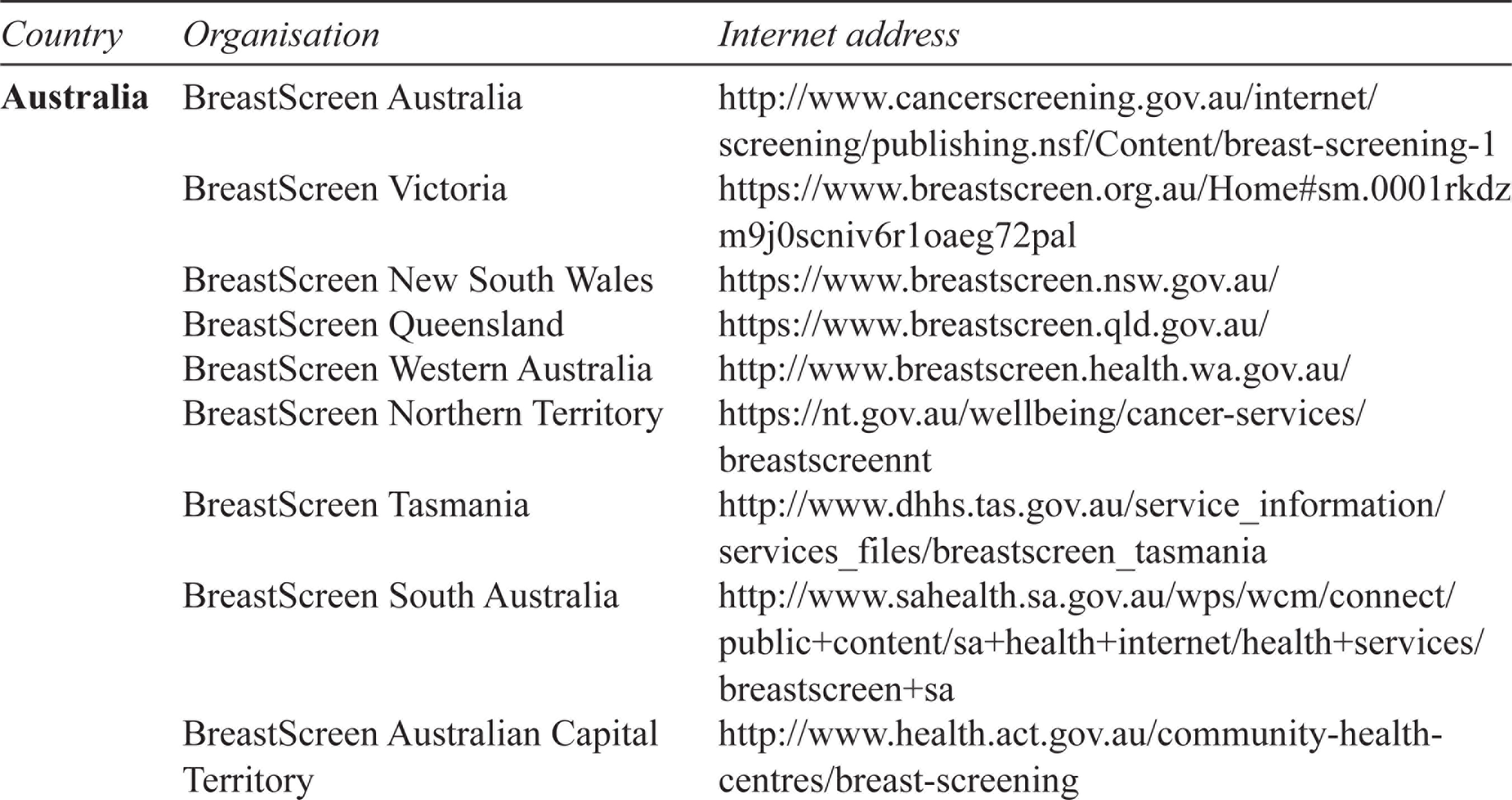
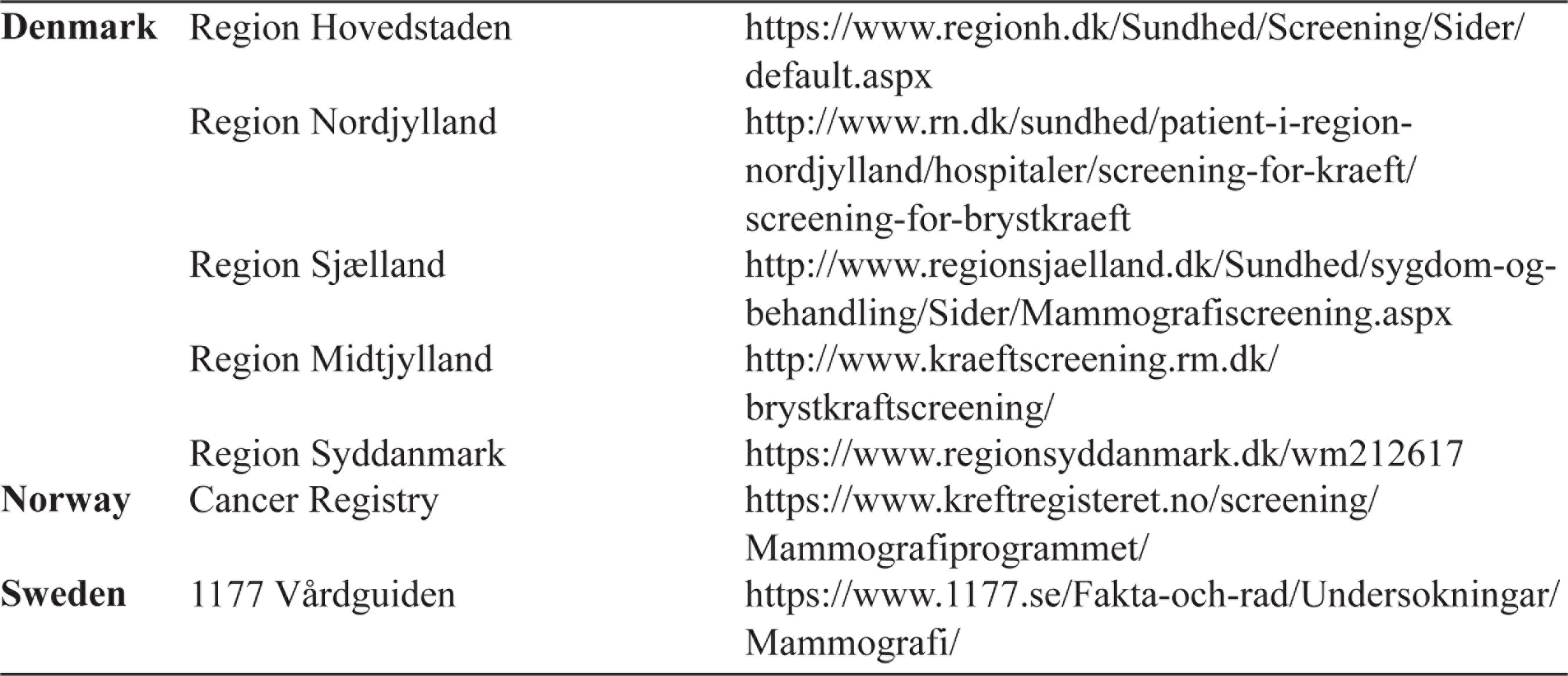
List of Screening Webpages Analysed
Our analysis indicates that there are three main discourses in the information on the webpages that contribute to the production of different subjectivities. First, normalisation discourses are used to present mammography as easy and routine for the everyday woman. Second, discourses of risk and reassurance portray the choice to be screened as one made by risk aware subjects. Third, the discourse of responsibilisation positions the choice to be screened as one made by women as responsible citizens. The presentation of information across all themes draws on the discourse of scientific evidence to provide the rationale for screening.
The key message in all webpages is the ease of participation in mammography screening. Mammography screening is featured as easy to access, quick and easy to do, and convenient; and thus part of the everyday routine of the health conscious woman. Using time as an indicator of convenience, several pages indicate that there is little preparation needed, with the examination process lasting less than 30 minutes. Integral to the ‘normalisation’ discourse, is presentation of messages to women about the need to prioritise their own health in their everyday lives. Women are portrayed as having busy schedules, and the focus on including mammography as part of their normal routine, nudges them towards prioritising participation in screening. The underlying message is that all women are busy but should still make time to participate. The Swedish front page states that ‘Screening is voluntary and free of charge’, and describes mammography screening as an ‘offer’, and most of the Australian webpages state that ‘it is easy and it is free’. Thus, participation is the default option for the routinised normalisation of health behaviour. Non-participation is left as a position for women who are assumed to be disorganised, or worse, irresponsible.
The ‘quick and easy’ discourse focuses on normalisation of the desired behaviour. Focusing on practicalities points to screening as a normal activity for women and to screen as routine. This is particularly evident in some of the Australian pages, where images illustrating checklists with tick-off boxes suggest mammography screening is in line with everyday responsibilities such as walking the dog and buying milk; notable also because these activities are located in the domestic sphere, thus conveying a gendered perception of women’s day-to-day activities and responsibilities.
Visual representations such as videos of women having a mammography examination also serve to ‘normalise’ the experience. Five of the eight State-based Australian pages provide a video (and in one case, there is also a video of a local radio celebrity having a mammogram), but of the Scandinavian pages, only one Danish page uses video. These videos show the process of mammography examination, including how women are greeted by the radiographer and cared for during the examination. Throughout the examination, the radiographer speaks with a soft voice and conveys a friendly attitude. This emphasis on care draws on trust in health personnel to make potential participants feel safe about such examinations, while not hiding the fact that the examination might be unpleasant. Apart from some Australian examples, where ethnic diversity is shown, women are of white ethnicity and within the younger age range of the screening population. They are tall with a relatively slim build, showing that mammography screening targets healthy women.
The Australian webpages are more likely to personalise the video participants. For example, ‘Karen’, who is portrayed in the webpage from Victoria (AUS), is shown having her mammography examination after buying flowers, indicating how she fits a mammogram into her other everyday activities. The video shows her entering the screening unit, being met by the radiographer, and during the mammography examination. The Danish video is less personalised, not naming the woman participating, and only showing her within the screening unit ready to have the mammogram, after removing her top. Thus, the Danish video appears more clinically oriented, while the Victorian one presents screening as an element within ‘Karen’s’ full life. Moreover, the face of the Danish woman is not shown, nor is she talking in the video, while ‘Karen’ from the video on BreastScreen Victoria presents the case for participation in mammography screening as an important action to take for herself. Putting ‘your health first’ is a rhetoric used throughout many pages to counter the gendered stereotype of women being primarily carers of others, and not of themselves. As ‘Karen’ says:
Would I go back again? Absolutely. ‘I do this for me’. That’s what makes it so important.
Mammography Screening as a Mediator of Risk
Risk Versus Reassurance
A discourse of risk is evident throughout all the webpages. With numbers having power to define a problem, statistical evidence is used to construct breast cancer as an important problem, and women are portrayed as vulnerable to risk of breast cancer. All webpages provide information on the number of women diagnosed with breast cancer every year, or state that breast cancer is the most prevalent cancer among women. In recent years, risk estimates for breast cancer have become more personalised, for instance through risk calculators (Levy et al., 2008). In these webpages, however, risk is generalised to depict all women as at risk. Emphasising general risk highlights that the target group of mammography screening programmes is non-symptomatic women (i.e., almost all women). While all the pages direct their information towards non-symptomatic women, there is one exception. The Swedish page mixes information to the screening target group and to women who experience symptoms.
The construction of breast cancer mortality as an important problem demands solutions, and early detection is the solution posited as provided by mammography screening. Mammography screening is the answer to the problem that risk presents, namely that non-symptomatic women might have breast cancer in the future, or that women could have undetected cancer. Thus, with early detection believed to reduce mortality from breast cancer, all webpages employ slogans such as ‘Mammography saves lives’.
Science, a socially valued form of knowledge, functions to legitimise the claims made. Such evidence is, however, presented diversely. The Norwegian page provides information about research projects and scientific debate, including the full report from a research-based evaluation. Ongoing research within the mammography programme is presented on the front page through red headings with links to more information, indicating how the programme is contributing to research-based knowledge on screening. On some sites, scientific evidence is represented through links to reports or other sources, rather than being stated on the webpage. On most pages, the scientific foundation of the knowledge claims is implicit, rather than explicit, with ‘facts’ about breast cancer presented with no reference to scientific evidence; instead numbers and stylised images are used to indicate risks and benefits. Drawing on the perceived legitimacy of numbers as representations of scientific knowledge, nudges women towards participation in two ways—first, by providing apparently objective evidence of benefit for those choosing whether to participate, and second, by lending screening providers an objectivity obtained from science. Use of scientific claims not only functions as a technique to lead trusting women towards participation. It also suggests that women who are invited to mammography screening draw on a specific rationality, which includes information-seeking and making an informed choice based on the best available scientific evidence. A consequence of this discourse is the positioning of women as autonomous individuals with the responsibility to act on the scientific evidence. When evidence is presented as unambiguous and uncontested, the options for choice are narrowed.
The webpages vary in their presentation of different screening outcomes and the emphasis given to harms versus benefits. Most Australian pages mention harms but do not give them prominence on the webpage; and where they are specifically discussed, harms are minimised. Taking the two most populous states, Victoria and New South Wales as examples, different strategies are used to minimise information about the harms of mammography screening. On the Victorian site, ‘potential risks’ are listed after a section on benefits, and while the harms of radiation, inaccuracy of screening, the possibility of call back, overdiagnosis and possible anxiety created by screening are listed, they are all accompanied by statements that minimise the likelihood of this occurring. On the New South Wales webpage, more elaborate strategies of minimising the risks are evident. Instead of risks, the webpage heading refers to ‘limitations’ of mammography, and the section where these are discussed is headed ‘addressing your concerns about mammography’, suggesting that they are anecdotal perceptions rather than evidence-based risks. The anecdotal style continues as each concern is listed. Each commences with ‘you might have heard [concern]’, before being refuted. All the Scandinavian webpages have sections on harms and benefits, with the Norwegian page being most detailed. While all these webpages argue that benefits outweigh the harms, overdiagnosis is presented as a more uncertain issue. The Danish capital region links to the national brochure which points out that there is dispute about overdiagnosis, presenting numbers from the Danish screening programme showing that 1 in 10,000 screened women is overdiagnosed, and international numbers claiming that the number is 12. The Norwegian page links to an explanation on why overdiagnosis is difficult to estimate, concluding that ‘there is more uncertainty concerning estimates for overdiagnosis since there are no good statistical methods to do these calculations’.
Statistical Imagery
Communication of epidemiological information for a lay audience needs to be accessible in order to be persuasive. Most Australian and Scandinavian webpages use images presenting a large number of individual stylised women-like figures. These representations are used both to exemplify statistics about potential outcomes of screening participation and as general visualisations of screening. The images depict high numbers of individuals, showing how screening is a mass phenomenon. Some of these illustrations explain statistical data on how many of the screened women that will experience a recall, a biopsy and a cancer diagnosis. Those figures representing women diagnosed with breast cancer are highlighted, for instance through a magnifying glass or given another colour. While these images make statistics more easily accessible to readers, they also position participants as potentially being one of those figures. Since all these women look the same from the beginning, it is clear that individuals diagnosed with cancer could be any one of these figures. In this way, these figures illustrate several of the main points in screening, which is that some are at risk for having breast cancer and are in need of treatment, and that you cannot know before screening who will benefit. However, this coexists with the message of reassurance. The figures also illustrate the relatively small number of women with breast cancer, compared to all those who are screened. There are subtle differences between the webpages in the use of statistics. For example, on the New South Wales (AUS) page, eight figures are highlighted with the script indicating that ‘Around 8 (between 6 and 10) deaths from breast cancer will be prevented’, while a similar illustration on the Norwegian page highlights six figures, followed by the text: ‘6 women will be diagnosed with breast cancer that need treatment’. This small difference indicates that the New South Wales page appears more persuasive. First, the number of affected women is higher (eight versus six), and second, the eight are prevented deaths, while the six in the Norwegian page are in need of treatment, which does not automatically mean death from cancer.
Responsibilisation and Civic Responsibility
All webpages encourage participation in mammography screening, with the main message being the ease of participation, at the same time focusing on individuals and informed choice. Within a neoliberal discourse, out of which the theory of ‘nudge’ originated, individual choice is an ideal; individuals are understood as autonomous, choosing subjects, and this is evident on the webpages. The Norwegian page in particular positions women as autonomous through providing detailed information on choice throughout the text. First, the front page refers to the report from the evaluation of the programme, which emphasises that each woman must decide whether to participate by evaluating benefits and harms based on her own values, health and circumstances. Second, it is also stated under the heading ‘harms and benefits’ that the invitation to screening is a voluntary offer, and that the information provided on the webpage is meant to assist in deciding whether or not to accept the invitation.
Throughout the webpages, the hierarchy of knowledge and authority is evident; with providers positioned as being able to recommend participation and women provided with the responsibility of doing so. For example, on the Swedish page it is stated: ‘The health authorities [Socialstyrelsen] recommend women aged 40–74 to participate in mammography screening’. Some of the Danish pages also refer to the recommendation from the health authorities, and the Norwegian page provides the full evaluation report which concludes that mammography screening has an effect on mortality from breast cancer.
Even when opting out of mammography, women remain in dialogue with the providers. Most Scandinavian pages contain information on how to withdraw from the programme. The Danish and Norwegian pages link to a form for opting out, while the Swedish page inform that it is possible to contact the mammography ward. However, in the Swedish system ‘staff will often ask you to write a letter to confirm that you do not wish to be called’. All pages elucidate that if you opt out, you are allowed to opt back in. Thus, your citizen right to participate does not end if you opt out of the programme, nor does your responsibility to choose.
While the Scandinavian pages are explicit about participation in mammography screening as a voluntary offer, the Australian webpages, which represent an opt-in system, urge women to choose participation. For example, the question on the Victorian webpage: ‘Is breast cancer screening the right choice for you’, is followed by this text, ‘For most people aged 50–74, having a breast screen is a
What is evident on all the webpages is the message that while detection is the responsibility of the screening programme, participation is the responsibility of each individual woman.
Discussion
In this article we have presented findings from a multimodal discourse analysis of Australian and Scandinavian webpages on mammography screening which found three main discourses: normalisation, risk and responsibilisation, all supported by a scientific discourse providing evidence for participation as the best choice for individuals in the targeted screening population. We argue that these discourses create a script for action for women seeking information on mammography screening.
When information on the webpages focuses on practical issues concerning participation, women are positioned as ready and willing to participate in screening. Situating screening participation as a question of practicalities presents it as ‘the default option’ (Thaler & Sunstein, 2008) for potential participants. The discourse of normalisation expressed through practical information is predicated on trust in public authorities. In the Scandinavian countries, trust in authorities is high, and science-society relations are based on trust (Asdal & Gradmann, 2014).
All the webpages we analysed refer to scientific or health authorities’ recommendations about mammography screening. Such recommendations have been criticised for nudging towards participation since they build on the trust that women may have in welfare state authorities (Ploug et al., 2012). In the Scandinavian context, information building on scientific evidence and trust provides a normative script that makes it difficult for the individual to choose non-participation and still act as a responsible citizen. In Australia, where participation is lower than in Scandinavia, webpages rely on expert recommendations along with other strategies of persuasion, including video stories featuring women who represent the target demographic, information that repeats gendered roles and responsibilities (e.g., being able to care for others), and an emphasis on ease of participation (screening is presented as easily integrated into everyday life). Australia’s use of these complementary promotional strategies suggests its national breast screening programme has a greater need to persuade women to participate than in Scandinavia, where participation levels are higher. Many of the personalised stories on the Australian pages are cautionary tales with a script of being tempted to delay screening, then attending, having cancer diagnosed and now either in treatment or ‘cured’—with the message of ‘don’t delay’ to opt-in to the programme.
Akrich (1992) argues that an individual becomes a citizen when entering into a relationship with the state, and that citizenship can be inscribed into technology through the way it arranges users into networks. When the welfare state is a provider of technology, they are configuring intended users as passive and good citizens (acting as intended by the state), but simultaneously active consumers (Rose & Blume, 2003). In our study of web-based screening information materials, women are depicted not as consumers but as active choosers of participation. This corresponds with a Dutch study finding that general internet health information enrolled citizens in specific activities by highlighting risks, directing paths towards information, individualising choice, and linking health practices and citizenship (Adams & Bont, 2007). Our findings show that the webpages utilised culturally significant discourses, thereby creating subject positions defined by normality, risk, responsibility and good citizenship. The concept of ‘responsibility’ (Beck & Beck-Gernsheim, 2002) describes the responsibility citizens have for using available medical tests. This is particularly relevant in the risk society where medical tests such as mammography screening are seen to reduce risk of future morbidity or mortality. Discourses of risk are particularly strong in relation to breast cancer, where all women are seen to be at risk for breast cancer (Klawiter, 2008). Through focusing on risk, webpages can promote certain choices as a way of reaching empowerment through taking care of one’s health (Adams & Bont, 2007). Thus, those who choose not to use the technology become citizens who fail to perform their civic responsibilities (Rose & Blume, 2003).
Inscribing certain discursive positions for users of the technology thus operates to nudge individuals towards the best choice defined by service providers and health authorities. In the case of mammography screening, nudging women towards screening is the paternalistic side of libertarian paternalism, which suggests that since experts have the knowledge, they are obliged to act on it to help others (Vallgårda, 2012). This paternalism contrasts with the neoliberal ideal of the autonomous choosing subject. While nudging is meant to maintain the ideal of individual free choice, critics claim that nudged individuals are not making autonomous choices (Kosters & Heijden, 2015).
While our analysis has identified the range of strategies used to nudge towards participation, a limitation of a multimodal critical discourse analysis is that it only demonstrates the meaning potential inherent in a text, and cannot make claims about the writer’s intentions or how individual readers will receive a text (Kim et al., 2018; Machin & Mayr, 2012). Moreover, our analysis is based on web pages as they were at one specific moment in time, and content may have been changed since. We also acknowledge that women looking for information on mammography screening might refer to other webpages than those analysed. Nevertheless, a focus on the webpages of public screening providers provides insights into health authorities’ position on mammography screening, their reliance on the notion of individual choice; and the normative, gendered scripts women must negotiate when deciding whether to take part in mammography screening.
Conclusion
The webpages analysed provide valuable insights into the strategies employed by health authorities in providing screening information, particularly how they draw on the differing structures of participation (opt in versus opt out) in the differing policy contexts of Australia and Scandinavia, and tailor the style and content accordingly. Mammography screening has a long history of contestation about the scientific evidence, its benefits, as well as its potential harms; and screening providers remain caught in the tension of encouraging women to exercise choice in screening while attaining as high a rate of participation as possible. For technologies that work within this contested terrain, it is particularly important to decipher how assumed users are inscribed. Designing default settings that favour screening, or using strategies of persuasion that emphasise the ease of participation, inscribes users as responsible for the choice of whether or not to be screened. In neoliberal healthcare settings, where active care of the self is an ascribed citizenship ideal, the choice not to participate is hardly a viable option for those who consider themselves to be ’responsible’ individuals.
Footnotes
The authors declared no potential conflicts of interest with respect to the research, authorship and/or publication of this article.
Funding
The authors received no financial support for the research, authorship and/or publication of this article.