




Abstract
While Responsible Research and Innovation has the potential for democratising the governance of research and innovation, translating it in the Global South would need dialogues and engaging with the plural knowledge systems and ongoing experiments on innovation at the margins that seek to construct alternatives. Entrenched power relations in the South do not allow for public dialogues that allows for society to engage with, if not speak back, to scientists in co-creating newer knowledge. Through the case study of the System of Rice Intensification (SRI), an agroecological innovation that arose outside the formal research establishment, we show how vulnerable farming communities can proactively co-create alternatives to existing dilemmas in Indian agriculture. Re-imaging RRI in India, we suggest, requires closer attention to the role of civil society organisations in creating innovation spaces through informal and heterogeneous networks of social learning. Networks, we suggest, allow for better expression of creative dissent that could open newer vistas and alternative framing of knowledge. The RRI agenda is thus incomplete without an engagement with the politics of knowledge, and scientific controversies reveal technological lock-ins that hinders alternative framings and pathways.
Responsible Research and Innovation (RRI) is an emerging area of interest for both scholars of innovation management and science and technology studies. RRI presents opportunities for democratic governance of research and innovation towards ‘right impacts’; responsiveness through designing institutional processes that could make innovations socially acceptable and enables the framing of responsibility towards greater collective activities—‘science for and with society’ (Owen, Macnaghten, & Stilgoe, 2012). Rip (2014) sees RRI as a discourse and an emerging patchwork of practices which creates opening in existing (and evolving) divisions of moral labour. As a process, the RRI framework includes anticipation (of futures), reflexivity (of researchers and innovators on the effects of their work), inclusion (of relevant stakeholders) and responsiveness (to the needs and ambitions of society; Stilgoe, Owen, & Macnaghten, 2013). Most RRI literature has been from the European Union. RRI is an aspiration but also an explicit programme to connect societal challenges with research goals and questions in the Netherlands. There have also been some cases of transatlantic dialogues in the domain of nanotechnology.
This article explores the potential of RRI in the Global South (the two-thirds world) and in agriculture where it has been insufficiently studied. 1 As an emerging field of the twenty-first century, there is a case for a dialogue on RRI with scholars from the Global South. Governing agricultural innovation in India is both complex given the large and diverse kind of stakeholders and inherently plural with different and differing views on innovation. I argue, through the case study of an agroecological innovation—the System of Rice Intensification (SRI), that while the aim and aspiration of a new social contract of science through RRI is welcome, there is a need for RRI to be more than a knowledge management exercise. It requires an awareness and engagement of the structures of power that exclude alternative knowledge systems. We need to also ask as to how inclusive and reflexive are scientific agencies? Would a mere prescription of a framework of responsibility and responsiveness suffice or would researchers have to go deeper into examining the politics of knowledge and the structures that disable inclusion? Given the complex and messy nature of innovation, how can RRI in the Global South be reframed to enable designing inclusive processes and innovation spaces for knowledge dialogues? Should the governance of innovation also include mapping and seeking alternative framings in what Bijker (2017) proposed for ‘constructing worlds’?
In the first part of the article, I explore the RRI dimension of anticipation by looking, in the anticipation of futures, at the Indian innovation paradox. The metaphors and processes of envisioning futures, have in India, privileged the scientific or technocratic expert and excluded alternate visions or perspectives. Vulnerable farmers, disenfranchised by the scientific community, have been among the front runners advancing RRI. This has implications for both the dimension of deliberation in RRI. I suggest that India needs to take its innovations at its margins by farmers or civil society organisations seriously.
In part two of the article, I explore these questions through the innovative, turbulent and messy journey of an agroecological innovation, the SRI in India. I examine the challenges in a sustainable transition from the dominant input-intensive Green Revolution (GR) paradigm to the knowledge-intensive agroecological paradigm. Agricultural research institutions in India have been shaped by the GR paradigm that has been credited with making India food secure in the 1970s. Depleting soils, plummeting groundwater reserves and a significant loss of crop diversity and its excessive focus on certain regions have led to neglect and exclusion of farmers in ‘unfavourable’ regions. Paradoxically, these vulnerable farmers are now seen at the forefront of innovations in agroecology even as the scientific establishment seems locked-in to conventional pathways. Responsible innovation needs to map the global politics of knowledge that could be a big impediment in this process of sustainable transformation. In presenting an alternate paradigm of innovation, SRI researchers have reworked the idea of responsibility by presenting alternative narratives when confronted with a powerful scientific establishment that is focused on the gene revolution. These ‘facts’, as the SRI case would show, are to be sought and scoped for more proactively at sites of collective experimentation and innovation spaces. In this exercise, I argue using an STS perspective that scientific controversies rather than being shunned need to be explored as useful sites for revealing the uncertainty of science. Opening up the ‘black box’ through a critique of the dominant narrative creates opportunities to open up knowledge dialogues.
This process of deliberation that includes contestation has implications for research programmes and research policy, which I explore in the third part of the article on governing innovation. A proactive RRI should allow, and even push for, inclusive processes of reframing of agendas, and not just make science accountable to society but make it to work through constructing socio-technical worlds. Newer technological cultures could be built through examining and building alternative narratives (Bijker, 2017). In creating and enabling an international network of researchers, the promoters of SRI not only open up the debate on SRI but also present newer possibilities of responsibility for Indian agricultural researchers. The SRI case is thus not one single story of responsible innovation but of several narratives of change that push us to rethink and reimagine RRI as a knowledge dialogue on science and democracy.
Anticipating Innovation in India: The Inclusion Challenge
Innovation that was earlier seen as peripheral to larger science and technology policies is now central to a mission-driven project aimed at ‘Reinventing India as an Innovation Nation’. 2 Innovation in India is imbued with multiple meanings and metaphors. New phrases such as ‘frugal innovation’, ‘jugaad’ and ‘reverse innovation’ have entered the innovation management lexicon (Birtchnell, 2011; Govindarajan & Trimble, 2013; Kumar & Puranam, 2012). Beyond the buzzwords and the aspiration to become an innovation superpower, India also faces huge challenges of inclusion and equity. An uncomfortably large number of vulnerable Indians—tribals, peasants, artisans—arguably the largest numbers in the world, who practice, access and are serviced by indigenous knowledge systems are not part of this innovation story. Unlike the Global North that has little living memory of indigenous knowledge; in India practitioners of indigenous knowledge compete, negotiate and innovate both against and with modern scientific knowledge. They offer counter-narratives to the larger, mainstream, nation state narrative on innovation. Anticipating future and governing innovation, key elements of RRI, need to appreciate this plurality of knowledge systems.
Official Indian policies such as India’s science, technology and innovation policy (STIP, 2013) or Technology Vision 2035 (TV 2035) 3 have visions of the future, but have surprisingly little to say on social innovation, sustainability or notions of responsibility in innovation. Policy documents see innovation in a linear way and privilege the know-all technical expert who would deliver solutions to the ‘lay’ citizen seen as lacking knowledge. Public participation in science and technology policy is significantly lower than other domains (Prasad, 2008). The role of civil society as knowledge intermediaries is recognised in RRI, but public policies in India tend to delegate civil society’s role to the bottom of the innovation chain in seeking to disseminate innovation rather than regarding them as partners in a search for newer models of ‘inclusive innovation’ (Bound & Thornton, 2012; Prasad, 2005). Of the twenty-four names listed as key contributors to TV 2035, only two were from outside the formal S&T architecture of the country in a particularly applied vision on food and agriculture. The agency of citizens and of ‘other’ knowledge systems is conspicuous by its absence in a vision created by the techno-scientific bureaucracy (Sekhsaria & Thayyil, 2017).
Unlike the Global North, existing power relations in India do not allow for public dialogues that allow for society to engage with, if not ‘speak back’ to scientists in co-creating newer knowledge (Gibbons, 1999). Translating RRI in the Global South needs to take cognisance of such dissonances and explore alternate visions of the future. As an aspiration for more democratic innovation governance, ideas of RRI resonate with a few experiments in rethinking and re-imagining science-society relations as conversations on science and democracy (KICS, 2011). The deliberative dimension of RRI in the Indian context needs to account for this complexity. As the case shows, responsible innovation occurs through innovation spaces for creative dissent within the scientific establishment and having knowledge dialogues that allow for informal and heterogeneous networks of social learning. A mere meeting of stakeholders would not lead to deliberation unless this is preceded by an exercise that maps and allows for the articulation of diverse ideas and discourses.
Vulnerability and Innovation in India
Agriculture in India is beset with paradoxes. India leads world production of milk and buffalo meat, is second in wheat, sugar, fruits and vegetables, and paradoxically also leads the world in number of farm suicides. Over 270,000 farmers committed suicide in the last fifteen years, more than half of them (52%) continue to be indebted (Dandekar & Bhattacharya, 2017). While productivity initially increased, farm incomes have stagnated or declined. A wave of farmer protests have emerged across the country in 2017–2018 with farmers demanding loan waivers as they face increased costs and declining incomes due to depressed commodity prices, and high variability and unpredictability of weather.
The GR significantly changed the production landscape in India. Punjab and Haryana that were marginal to rice cultivation in India became the new rice bowls producing low-value rice procured by the government for its buffer stock and distribution. The ecological costs of the GR paradigm that was premised on input-intensive agriculture of a few cereals, rice and wheat, in favoured regions can no longer be ignored. 4 India is the world’s largest consumer of groundwater (210 billion cubic meters), 89 per cent of it is used for irrigation. Poor quality and groundwater shortage is experienced in more than 60 per cent of districts in India (Shah, 2013). Fertiliser subsidies in India not only cost the Indian exchequer vast amounts of money but are skewed in favour of irrigated areas and a few crops (Rupela & Gopikrishna, 2011). Recent estimates indicate that small and marginal farmers (who are over 85% of all farmers) received only about one-third of the total subsidy on fertilisers and less than 50 per cent of agricultural credit (Subramanian, 2017).
Fast-changing agrarian relations in the countryside means that even if farmers managed access to inputs over a period, this has led to high dependence on newer ‘merchants of knowledge’ or petty retailers at village level for credit, technical knowledge and even sale of their product (Aga, 2018). Indian farmers are experiencing a loss of agency, ‘agricultural individualisation’, and ‘knowledge dissonance’ (Vasavi, 2012), and deskilling (Stone, 2007). This knowledge dimension is less understood and discussed on India’s agrarian crisis. The response of the Indian agricultural establishment to the agrarian crisis has oscillated between denial and techno-fixes. For instance, in rice while it is acknowledged that yields have stagnated after the GR, the rice research focus has been predominantly on irrigated rice. Unfavourable (or rainfed) environment in rice research has been underinvested (Pandey & Pal, 2007). Recent course correction through a greater focus on the eastern region has been less than innovative. Schemes like ‘Bringing Green Revolution to Eastern India’ (BGREI) only extend GR with little discussion on the knowledge aspect or any engagement with vulnerable farmers as stakeholders.
In contrast to the input-intensive strategy of GR, there has been a movement for agroecology that seeks to reclaim the agency of the farmer and highlight the sustainability imperative and the need to move away from existing GR-based technologies and food systems. Agroecology—defined as ‘the application of ecological concepts and principles to the design and management of sustainable agro-ecosystems’ (Altieri, 1995)—draws from ongoing food sovereignty and ecology movements, and presents an alternative paradigm and narrative of change that is knowledge-intensive. Agroecological methods provide greater environmental sustainability and enhance the resilience of farmers by reducing their dependence on costly and sometimes difficult-to-access chemical inputs. There is increased overall productivity through a diverse range of agricultural products and environmental services, and reduced risks of crop failure (Pimbert, 2018; Silici, 2014).
Agroecology is not a recognised knowledge frame in India by the research establishment and thus despite the widening spread of practices that go under different names—Non-pesticidal Management (NPM) that later got reworked as Community Managed Sustainable Agriculture (CMSA), Zero Budget Natural Farming (ZBNF), SRI or its adaptation to crops other than rice or System of Crop Intensification (SCI)—they have largely remained outside mainstream research and extension agencies (Khadse, Rosset, Morales, & Ferguson, 2018; Prasad et al., 2015). Most agroecological practices draw upon farmers’ knowledge but work with modern scientific knowledge of agronomy, entomology, soil-microbiology, etc., in interesting ways and thus are neither ‘traditional’ nor ‘modern’. SRI is one such agroecological innovation and is the case that we take up for discussion here. We show how a newer paradigm that lays emphasis on farmer and collective experimentation can actually enable vulnerable farmers to innovate and reclaim control of their lives and lands.
Constructing Worlds: SRI and the Green Revolution
The GR paradigm has shaped the institutions of agricultural R&D since the late 1960s with a focus on productivity and increased food supplies. It is now accepted, even by erstwhile champions of GR like Swaminathan, that this strategy has several long-term adverse effects (Kesavan & Swaminathan, 2018) with declining returns, reduced farm income, nutritional imbalance and adverse environmental impacts. SRI, in contrast, presents an alternate, even counter-intuitive, paradigm for rice farming. Through innovations in agronomical practices (rather than genetic improvement) and changes in the management of rice plants, soil, water and nutrients, SRI principles enable the emergence of more productive and robust phenotypes. These principles translate into a set of practices that differ considerably from conventional rice cultivation techniques and involve transplantation of young seedlings, widely spaced, in unflooded but moist soil conditions, and involve the greater use of organic matter in soil, and a hand or motorised weeder for weed control which also aerates the soil surface. SRI contributes to the three pillars of climate-smart agriculture by increasing productivity, farm livelihoods and food security; helping farmers adapt to and increase their resilience to the impacts of climate change; and mitigating greenhouse gas emissions (Styger & Uphoff, 2016; Uphoff, 2017).
As an innovation story, SRI is a messy and complex one with its slow evolution in remote Madagascar by Henri de Laulanie, a Jesuit priest and agronomist, in the 1980s. It was unknown to the rest of the world until 1999. Due in large part through the efforts of the political scientist, Norman Uphoff, then Director of the Cornell International Institute for Food Agriculture and Development (CIIFAD) and his working with and through networks of civil society organisations, researchers and policymakers, SRI has spread to more than fifty countries of Asia, Africa and Latin America. While seed funding from CIIFAD helped initial spread, the innovation has largely been possible through the entrepreneurial energies of a small and lean team at Cornell, later SRI Rice. 5 Its origin outside the formal scientific establishment and the claims of yield in excess of what was considered the biological maximum pitted it against the International Rice Research Institute (IRRI) and much of the rice research establishment leading to scientific controversies referred to as the ‘rice wars’ (Prasad, 2006). Despite the controversies, it has been adopted and adapted by an estimated 10 million farmers across the globe to crops beyond rice.
As an innovation, SRI has evolved through multiple actors. The framing of SRI, from the very start, has been not as a technology or practice but as an agroecological movement with deep commitment to sustainability and a vision of natural systems as ‘open systems’ (Uphoff, 2017). This framing carries notions of responsible research presenting an alternative ‘narrative of change’ to the strategies and narratives of yield enhancement. Another dimension of SRI as a responsible innovation was in it being presented as ‘open source’ and non-proprietary knowledge from the outset, thereby ensuring free access by farmers and researchers to the new ideas and opportunities. As SRI practices involved no miracle seed or herbicides for improving productivity, resource-poor farmers, first in Madagascar and later in other parts of the world, were encouraged to draw on their own potential for experimentation instead of expecting and letting commercial interests drive and dominate agricultural innovation. This helped diverse actors from India access and improve upon the innovation.
SRI’s entry, and subsequent spread, in India since 2000 exemplifies the multi-institutional character of the innovation as an RRI with an active role played by civil society organisations in shaping the innovation. Civil society organisations, we suggest, mediate different kinds of knowledge and also co-create them. Table 1 summarises the nearly two decade innovation journey of SRI in India under five phases.
Various Phases of SRI as RRI in India
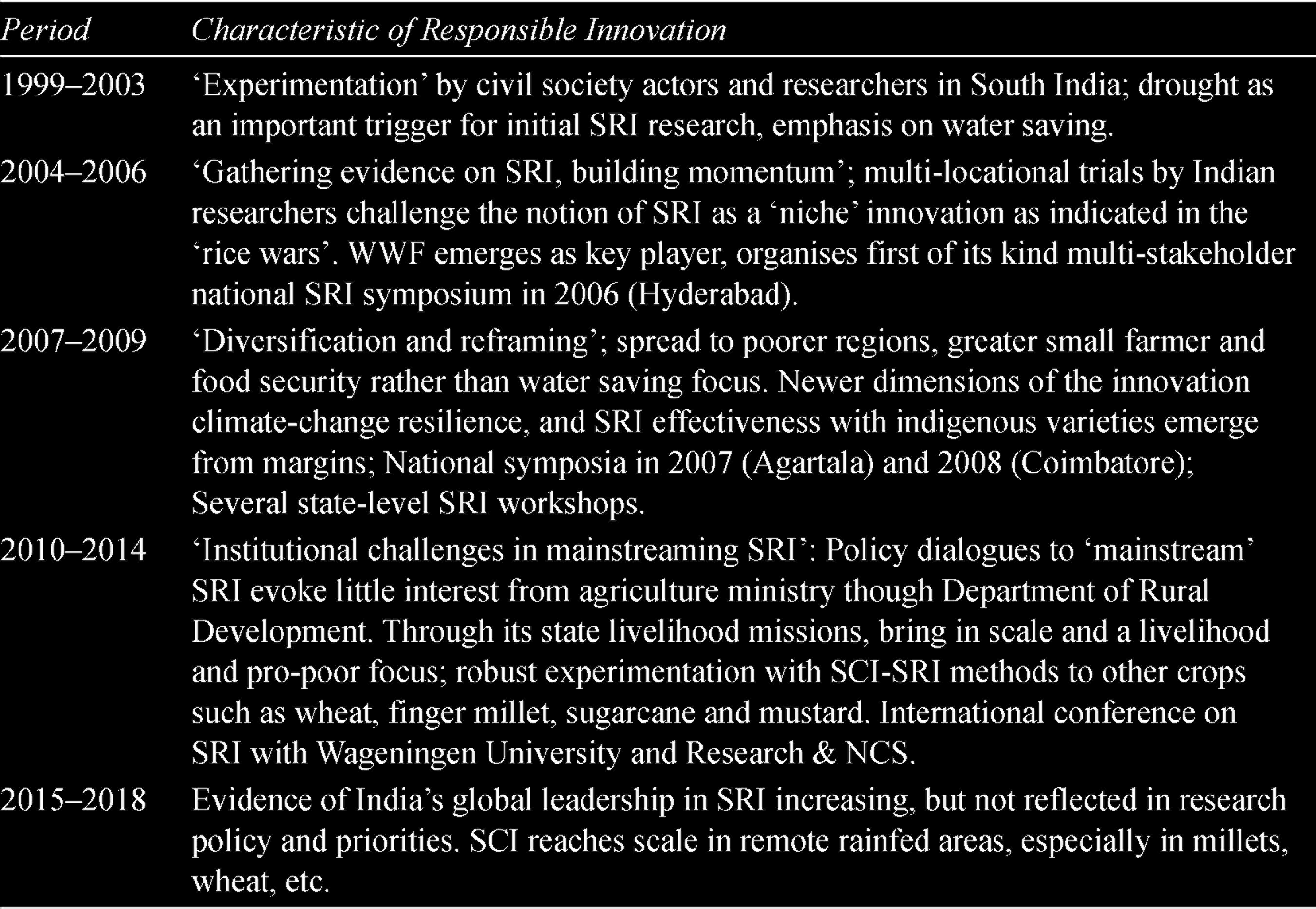
SRI was simultaneously introduced by researchers and CSOs in 1999–2000, but initial results were not spectacular. Open innovations allow different actors and users to imbue multiple meanings to an innovation and enable its spread in diverse ways (Prasad, 2006). Wide experimentation by CSOs and farmers in Andhra Pradesh led by World Wide Fund for Nature (WWF), India, based at International Crop Research Institute for the Semi-Arid Tropics (ICRISAT) provided a spur to SRI from 2003–2004.
In the second phase of SRI in India, WWF played a proactive role in gathering evidence and providing momentum to the innovation. WWF later funded various collaborative workshops and experiments in research and extension, first in Andhra Pradesh and later in different parts of the country. In a significant institutional innovation, it created an innovation platform, the National Symposium on SRI in 2006, rare in the Indian context that opened the research agenda to farmers and CSOs who engaged in knowledge dialogues with scientists and administrators. Institutional innovations complemented the technical innovations and experiments on SRI, and Indian researchers started contributing to the global pool of SRI knowledge.
A significant shift in the innovation happened with a change in location. Spurred by a field visit to the rice fields in Tripura in Northeast India, where SRI had gone to scale in a state that had no agricultural university or strong research centres unlike Hyderabad, WWF and its partners conducted the 2nd national symposium at Tripura in 2007. States that were not part of the earlier GR such as Bihar, Odisha, Uttarakhand and Tripura were now at the forefront of innovation on SRI. SRI soon emerged as a movement of and for small and marginal farmers who were shaping the innovation differently with a greater focus on food security instead of the earlier emphasis on water saving. More women participated too in these states. Newer institutional arrangements such as the learning alliance in Odisha (Prasad, Beumer, & Mohanty, 2007) and state-level workshops in Uttarakhand and Himachal Pradesh democratised the innovation with different discourses that were more locally rooted (Prasad, 2015).
Despite its spread, there were significant challenges in institutionalizing or mainstreaming the innovation within Department of Agriculture due to the scientific controversy on SRI. Interestingly though, state Department of Rural Development in Bihar, Jharkhand and Madhya Pradesh took up SRI through rural women’s self-help groups and brought in a livelihood rather than a productivity focus to the innovation. While there was some traction with a few policymakers, leading to dialogues with Planning Commission members and to the formation of a subgroup to formulate ideas for upscaling of SRI, national research centres continued to be sceptical and often pushed back against SRI protagonists by invoking doubts voiced in the ‘rice wars’. An informal alliance known as the National Consortium on SRI (NCS) continued to push the agenda forward by bringing newer information and data onto the table, continually seeking to engage policymakers and pointing out opportunities for India to be an international leader in this area, as close to 40 per cent of all journal articles published on SRI currently are from Indian researchers (Prasad, 2016).
The above developments in SRI in India indicate a dynamic and diverse journey by multiple actors. Notably, there is no single organisation that has singularly led all the developments over the years and across locations. On the contrary, the complex interplay of actors has been facilitated by their deriving strength from participation in national and international networks and newer forms of spaces for innovation. Acceptance of good or responsible ideas is not as easily achieved through a meeting of actors and stakeholders in a consultative process. Conflict and controversies need to be seen as part of the RRI process, and this surely was the case in SRI.
Scientific Controversies and RRI
High yields reported from some SRI fields in Madagascar that exceeded what established rice scientists considered as the biological maximum led to the ‘rice wars’ and scientific controversies (Prasad & Basu, 2005). The controversy peaked in 2004 during the International Year of Rice (IYR). Nature carried an article on SRI ‘Feast or Famine’ provocatively subtitled captioned ‘Proponents call it a miracle. Detractors call it smoke and mirrors. Will SRI feed the hungry or needlessly divert farmers from tried and true techniques (Surridge, 2002)?’ The declaration of the UN General Assembly in 2004 to focus attention on a single crop, rice, was unprecedented, and resulted from the successful advocacy and lobbying by IRRI. Those who already had experience with SRI suggested that most of the aims of the IYR agenda could be met, quickly and with considerably lower costs by following SRI principles.
The controversy was about contrasting world views and played out in different forms in conferences, journals and mainstream media. The critique of SRI was led by rice scientists from IRRI who dismissed SRI as anecdotal, technically flawed and lacking scientific evidence. They were countered by a small set of scientists who argued that field evidence of SRI actually presents an opportunity to rethink agronomy drawing from hitherto ignored research directions that could better explain the SRI phenomenon. As an emerging alternative with significant potential scientists, they believed, should carry out several experiments with SRI to not just find if it works but also seek to discover the ‘science’ behind SRI and take farmers experiences with SRI seriously (Stoop & Kassam, 2005). The disinterest and subsequent hostility of IRRI scientists though had a lot to do with their lock-ins towards a particular agricultural future.
From a Science Technology and Society Studies (STS) perspective, an exploration of scientific controversies reveal the ‘uncertain side of science’ (Pinch & Leuenberger, 2006) with scientists commonly using scientific findings with ‘interpretative flexibility’ (Pinch & Bijker, 1984). An earlier article by Surridge (2002) celebrated IRRI’s research direction for a Second Green Revolution that was to involve the ‘most audacious feat of genetic engineering yet attempted’. This involved developing a New Plant Type to raise a hypothetical yield ceiling by 25 per cent, or by genetically modifying rice to have a C4 photosynthetic pathway instead of its evolved C3 pathway. Millions of dollars were to be invested as part of a consortium effort that IRRI was leading, and putting this high on the research agenda was part of the IYR campaign to legitimate and mobilise research and donor funds (Sheehy, Mitchell, & Hardy, 2007). SRI, an upstart innovation from outside established scientific circles, was surely a threat to such intentions. SRI proponents reported that remarkable yield improvements could be achieved with just a fraction of the funds and investments needed for a C3/C4 transformation.
There was a short but intense period of discussions in some of the leading scientific journals on agronomy like Field Crops Research (FCR) between 2004 and 2008 on SRI. A close look at the articles—not just at their content but the asymmetry in the way that papers for and against SRI went through the review process—reveals interesting insights into the politics of knowledge. The scientific journal had a rather disproportionate amount of rhetoric deriding proponents of SRI as ‘advocates of nonsense’ and practitioners of ‘non-science’ and SRI as a ‘curiosity’ and ‘unverified field observation’ (UFO). Discussion on science vs non-science is germane to many social science journals, especially those concerned about the relations between science and society, but it is curious that phrases such as ‘non-science’, or UFO had never appeared in the journal’s history since 1978. For a scientific journal with a high impact factor, it was unusual to see the polemics and rhetoric against SRI. Scrutiny of the articles’ histories reveals that articles critical of SRI had an unusually short time from receipt to acceptance for publication (as few as 7 or 11 days). Responses by SRI proponents took many times longer to process (88 days at a minimum).
Internal changes from 2008 onwards indicate more normal review periods. FCR has had only two articles on SRI since 2009, and none since 2012. SRI researchers chose to publish in other peer-reviewed journals such as Paddy and Water Environment, Experimental Agriculture and Plant and Soil, which have been more open to research on SRI. The discussion on the politics of knowledge I suggest needs to be seen as part of discussions on RRI. Not all responsible innovations might have such a contested journey, but the narration of the scientific controversy is only to illustrate the challenges of governance of RRI when there are different knowledge systems. In the absence of official support, Indian researchers drew from and contributed to SRI knowledge through participation in international networks. This alternate organisation of innovation and knowledge through newer innovation spaces merits closer attention.
Organising for SRI: Networks and Responsible Innovation
Networks have had a silent, often invisible empowering role for individuals working within established and hierarchical organisations. The connectivity that networks have provided—ideas, critical feedback, personal friendships—have encouraged agricultural researchers to think outside prevailing ‘boxes’ and to be ‘creative dissenters’. They have provided space for conversations across the boundaries of their own disciplines (Prasad, 2016; Prasad et al., 2012). At the international level, SRI Rice has proactively connected SRI enthusiasts across the world. An offshoot of CIIFAD at Cornell University, SRI-Rice has been the main source of information on SRI. Researchers have benefited from the specialised documentation service on the SRI-Rice website, which provides access to all available SRI articles, databases, thesis and reports on SRI and places them online. 6 SRI-Rice has provided useful support in many ways, for example, by plugging young researchers into informal transnational networks, by sustaining an informal worldwide peer group, and building research capacities and visibility among researchers in developing countries by providing pro bono editorial support and advice. SRI Rice has in turn facilitated and worked with many informal networks and some formal national networks such as that originally led by WWF in India and the NCS, capturing local research that often escapes international databases.
The open-source collaborative architecture of the SRI movement has facilitated the emergence of a new ‘knowledge commons’ for agriculture, countervailing the currently dominant trend towards proprietarisation of agricultural technology. This has taken diverse forms such as e-groups and regional networks; joint participation in panels at mainstream professional and subject conferences; wide sharing of manuals, videos, and PowerPoint presentations made in different forums; and specialised Facebook pages on equipment. The diversity of these networks induces transformation in knowledge systems and can avoid the kind of domination by researchers in innovation platforms manifested elsewhere (Prasad, 2016).
Research policies and futures in the Global South are often shaped by international trends. Given the size and importance of its rice crop and the large indigenous rice research capacity, India could have chosen a different research pathway organising independent assessments of SRI. However, but for a few scientists, mainstream Indian rice researchers were reluctant to carry out research trials on SRI. One of the responses to the rice wars and the Nature article was from Alapati Satyanarayana who in his response presented alternate facts of the SRI trials in the state of Andhra Pradesh ending with an invitation to the international scientific community to engage with the (scientific) issues of SRI. 7
Changes in settled thinking often require dissonant voices within the scientific establishment who interact with and listen to non-research actors, in the process reconciling diverse experience and translating ideas for paradigm change and sustainability to engage agricultural researchers. Dr T. M. Thiagarajan (TMT), a soil scientist, and the lone Indian researcher to have participated at the International SRI Conference at Sanya in 2002, was one of them who led SRI research in Tamil Nadu. Satyanarayana and TMT opened up research pathways for other Indian scientists to practice ‘creative dissent’ (Prasad, 2014) by avoiding direct confrontation with the establishment and working silently on SRI. Beyond the scientific controversies in journals, there were several engagements, encounters and dialogues as part of the everyday practice of scientific research (Prasad, 2009).
They were joined by, among other, the soil microbiologist, the late O. P. Rupela, whose trials provided useful insights into the complex below the surface environment that contributes to the SRI phenomenon and Amod Thakur, an agronomist, who was inspired to take up SRI research following the scientific controversy and is the most published researcher on SRI from India. A prominent creative dissenter who gently led and encouraged his colleagues towards knowledge dialogues was the late N. K. Sanghi who worked proactively with CSOs in pushing for an alternate paradigm for agriculture (Prasad, 2015; Prasad et al., 2012). Despite any clear policy or research programme on SRI, these handful of researchers have been able to work with farmers and CSOs to extend SRI principles, even to other crops. A good example is the evaluation research done on the System of Wheat Intensification (SWI, extending SRI ideas to wheat-growing) at the Indian Agricultural Research Institute (IARI) in collaboration with the CSO Professional Assistance for Development Action (PRADAN) in 2011–2013. IARI scientists and PRADAN brought to Delhi a farmer from Bihar who had practiced SWI. Together they developed agreed-upon research protocols for comparing SWI with IARI’s recommended best practices. The farmers then managed the SWI plots accordingly so that the new methods were used properly and the SWI yield advantage was increased to 46 per cent (Dhar, Barah, Vyas, & Uphoff, 2015).
How exactly did SRI research in India benefit and what might be lessons for research policy in India and the world? A detailed look at the research indicates significant surprises and reiterates the need to construct alternate facts.
Governing Innovation: India as a Reluctant Leader of Agroecology
In an insightful and reflexive piece on science, technology and democracy, Wiebe Bijker (2017) suggests that STS could be used not just as a critical frame but to help navigate, if not solve, complex societal problems that are also technical. A study of technological cultures, he suggests, needs to include a proactive attempt to construct socio-technical worlds. How can, he asks, STS offer a response to alternative narratives without falling back into naive positivism? Can STS help to make science accountable to society and make it work—make it function in our democracies and let it produce scientific knowledge?
In this concluding part, we build on this idea further by suggesting alternative pathways for research policy on agroecology in India. By a re-reading of scientific controversy relating to technological lock-ins by the dominant research paradigm in rice and the politics of knowledge has hindered alternative narratives. Vanloqueren and Baret (2009), in their study, have pointed to how existing institutions and the overall organisation of our research systems favour the dominant genetic-engineering research strategy rather than explore and validate agroecological methods. Though their reference was not to SRI, the evidence presented on the politics of knowledge show similar trends in maintaining the dominant genetic-engineering research pathway instead of alternatives. We have also shown how despite the controversy creative dissenters from India, drawing support from national and international networks have been able to consistently present alternate facts and building a credible research pathway. We present below a surprising alternative framing that could enable India to be a leader in agroecological research through SRI.
India has been arguably the most active sites for contestations, controversies, dialogues, alliances, innovation and experimentation on SRI. More research on extension of SRI principles to wheat, sugarcane, mustard, finger millet, etc., has happened from India in what is now being termed as the System of Crop Intensification. This field evidence, is surprisingly, reflected in publications too. Figure 1 shows the distribution of SRI publications in different journals from 2002 to 2017, and the share of Indian and Chinese researchers’ contribution to the same.
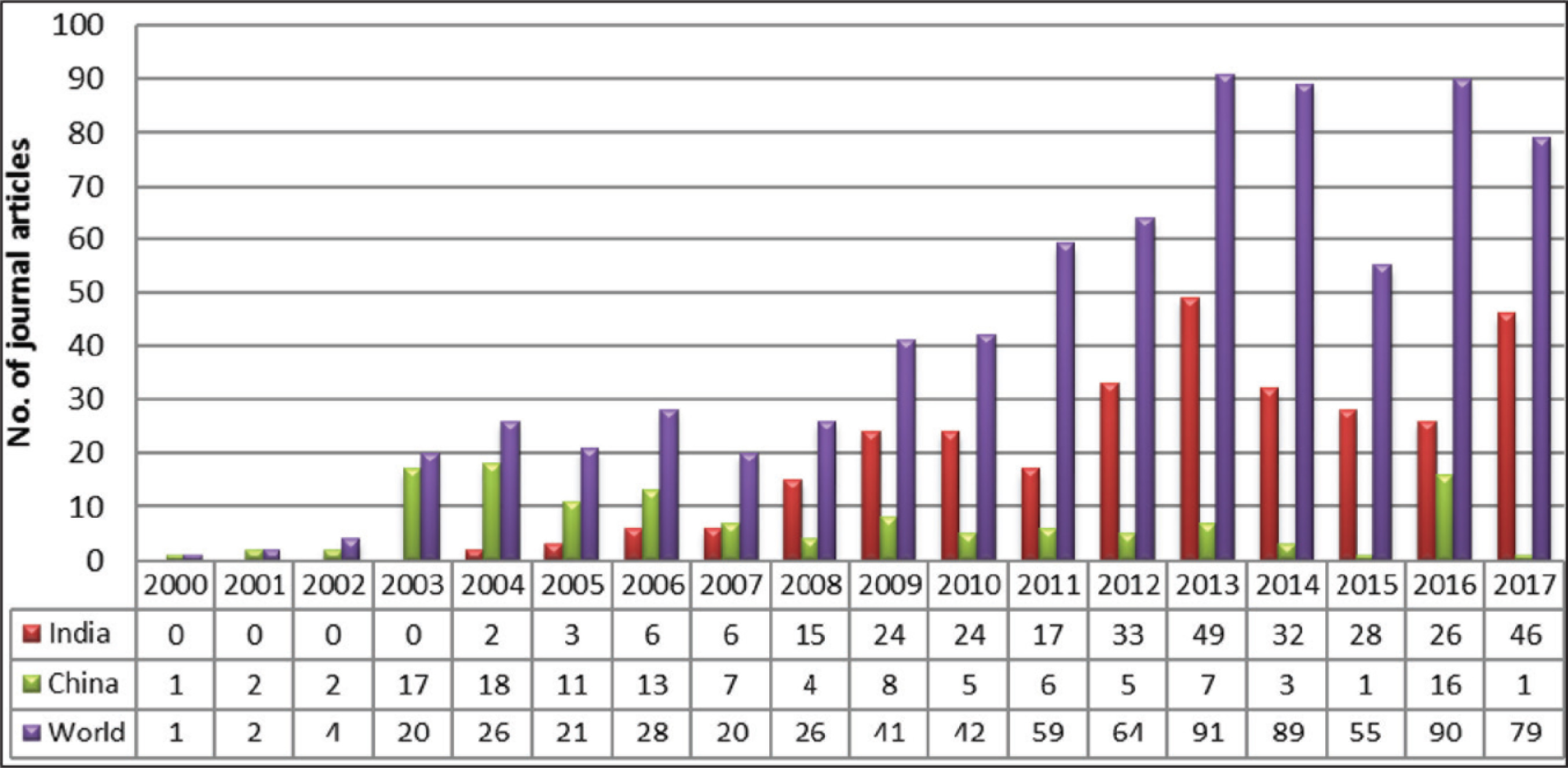
China dominated SRI research until 2007 and though Indian research on SRI began slowly India has dominated global publications on SRI since 2008. Indians share of world journal output on SRI is in excess of 47 per cent of world total. While not all the articles from Indian journals are of even quality and Indian researchers could do better by using the available information available in the SRI research networks and work towards better coordination and organising their own work, it is important to recognise that India has an unusual opportunity to lead research on agroecological innovations. Instead of being an ‘also ran’ in the race in genetic engineering research would the Indian research establishment shed its reluctance and reimagine responsibly the innovation of its own researchers by taking leadership and charting a new research direction? Would responsible innovation in the Indian context of agricultural research mean greater openness to ideas from farmers, CSOs and its own dissenting researchers? Can this reimagined RRI happen without a recognition of the politics of knowledge in sustainable transition? Research on SRI is promising, but still a work in progress. There are cases where SRI has not worked as well as usually reported, and farmers have reasons for preferring some principles of SRI more than others (Sen, 2015). SRI, we suggest, is neither a panacea for either the challenges facing farmers across India nor the solution to reforming the Indian agricultural establishment. It is a responsible innovation that can open up pathways for future research and needs more mainstream research funds than has been the case.
The case of SRI helps us explore the various dimensions of RRI in the Global South and in agriculture. Responsible innovation needs to be situated within the broader frame of knowledge and its politics. Scientific controversies are sites that not only reveal the uncertain nature of science but also provide us an opportunity to socially construct alternatives by looking more closely at innovation at the margins. RRI as a frame is welcome and can be empowering if the anticipation of futures is more proactively engaged in the process of mapping alternative knowledge systems in the Global South. Reflexivity of researchers and innovators could benefit from understanding creative dissent in the South as much reflexivity is often under the radar and is often discovered in multi-stakeholder interactions and dialogues. These researchers on SRI provided newer narratives challenging the mainstream view of rice production and knowledge surrounding it. They presented several lesser known dimensions worthy of research that could translate into alternate research programmes. The SRI case suggests that it is indeed possible to have an alternative narrative to agricultural research where India could be leading the world on agroecology while at the same time empowering its farming communities. This is a dramatic counterpoint to the often-voiced criticisms of an ossified agricultural research system in India where ‘nothing of significance has emerged from this system to galvanise farming in recent decades’ (Jishnu & Sood, 2015).
Inclusion of civil society organisations and their knowledge might be a key learning on RRI in the Global South. As we have seen, CSOs can create knowledge spaces and dialogues that can empower farmers and dissenting researchers. Networks, both local and transnational, have an important role to play in the governing of innovation. There is a case for reworking the RRI concepts of anticipation, reflexivity, inclusion and governance as my analysis of SRI would indicate. RRI can be an empowering frame in the Global South if there is a stronger programme to present bolder visions of the future, such as India being a leader in agroecology and present insights into constructing newer socio-technical worlds that would be more inclusive of farmers’ knowledge and those from civil society.
The SRI case shows that a sustainable transition in agriculture research would require more than simply increased funding and expenditure to continue research along its current trajectory, which is evidently constrained by diminishing returns. It also directs attention to the larger framework and power that influences S&T choices. The RRI project in the Global South needs to be reimagined both in terms of its understanding on knowledge as well as in proactively creating spaces for knowledge dialogues. The messy and complex journey of SRI in India offers some insights in re-imagination project.
Footnotes
Declaration of conflicting interests
The author declared no potential conflicts of interest with respect to the research, authorship, and/or publication of this article.
Funding
The author would like to acknowledge the support of the Fulbright Nehru fellowship at Cornell University in 2013–2014 that enabled some of this research.