




Abstract
Responsible research and innovation (RRI) aims at mitigating the negative unintended consequences of technologies, developed by large business organisations, on society and environment. Scholars point out that the broader ethical underpinnings of RRI in terms of ‘transparency, interaction and mutual responsiveness’ are difficult to achieve in a typical business environment as conforming to these principles may erode the very competitive advantages the corporations seek to achieve through innovations. At the same time, the scholarship on frugal innovations by ‘the vulnerable’ puts forward an alternative narrative of innovations. Seeking to respond to the gap created by the apparatus of the mainstream market, and the State, these innovations reflect many pro-social motivations, and desire for inclusive development. The two discourses, however, remain isolated from each other. Our article is an attempt to initiate a dialogue between them. We intend to widen the scope and ambit of both RRI and the frugal innovation scholarships, which might help garner more policy and social support in favour of developing socially relevant, inclusive and context-specific innovations.
Introduction
The discourse on responsible research and innovation (RRI) has mostly focused on innovations in large business organisations. Scholten and Blok (2015) and Blok and Lemmens (2015) point out that ‘transparency, interaction and mutual responsiveness’ (Von Schomberg, 2011, 2013) towards stakeholders, the three cornerstones of RRI, may become difficult to achieve in such settings. Innovation is the primary source of competitive advantage in private firms, and asymmetries in information are seen as a means to survive and flourish in the market. This often limits the scope of responsibility and accountability of actors hoping to innovate responsibly, and, in turn, may dilute the mandate of RRI to help achieve the grand targets of sustainability, addressing climate change and poverty alleviation. Frugal innovation, largely, remained separate from the domain of RRI scholarship. These innovations, however, have significant overlap with the developmental goals of RRI.
In the present research, the top-down frugal innovations conducted by large firms are differentiated from the bottom-up frugal innovations done by the vulnerable groups of populations (Leliveld & Knorringa, 2018). Bottom-up frugal innovators are direct users of their innovations. Existing research points out the relevance of various social, non-market forms of motivation in pursuit of these innovations. We are interested to explore the way the three pillars of RRI, namely the transparency, interaction and mutual responsiveness, get unfolded in the bottom-up frugal innovation settings. These insights from bottom-up frugal innovations may help the discourse on RRI to transcend its own ‘comfort zone’, where its approaches and concerns largely remained Euro-centric. 1 Re-contextualised, and reframed, the discourse on RRI, however, holds potential to contribute immensely to the making of an alternative narrative on innovation and development, targeted to achieve the goals of sustainability and inclusive development better. A fruitful dialogue would also help such frugal innovations attract better policy support, at a time, when its usefulness and worth remain below the radar of policymakers and social elites.
The next section introduces and explores the concepts of RRI. The third section deals with the discourse on frugal innovations by the vulnerable, and the fourth section analyses how some of the elements of RRI are inherent in the frugal innovations by the vulnerable. Subsequently, we make a few concluding remarks.
Responsible Research and Innovation: The Contours of the Framework
RRI seeks to include the notion of responsibility, along with those of integrity, impartiality, honesty, lucidity and openness, in all scientific endeavours. It proposes to avoid, through precaution, actions that might lead to unwanted consequences and wants us to be better prepared to deal with such implications in case they could not be averted (Grinbaum & Groves, 2013). Governance of socio-ethical aspects (Scholten & Blok, 2015) of research and innovation in new and emerging technologies is seen as a challenge in the current democracies (Stilgoe, Owen, & Macnaghten, 2013). This challenge calls for a new approach towards innovation, which would balance the economic with the sociocultural and environmental aspects (Blok & Lemmens, 2015). Invoking ‘responsibility’ in the innovation processes is seen as a prerequisite to achieve that balance.
The accountability of scientists in cases of uncertain and potentially harmful innovations remains contested. While certain risks of unwarranted consequences are unavoidable, the purpose and motivations of research may require clearer social assessment (Blok & Lemmens, 2015; Stilgoe et al., 2013). Emerging technologies typically operate in a regulatory vacuum. Such technologies often raise questions about their desirability, possible consequences as well as the nature of anticipatory measures (Guston et al., 2014). Therefore, anticipatory assessment of technology is important (Kuzma, 2007; Van den Hoven, Lokhorst, & Van de Poel, 2012). Perhaps for these reasons, scholars (Von Schomberg, 2011; Stilgoe et al., 2013) call for a shift in the focus of RRI, away from, merely, the ‘governance of risk’ to the ‘governance of innovation’.
Von Schomberg (2011) argues that societal interventions in the research and innovation process at an earlier stage helps dealing with the uncertainties related to acceptance of technologies, as well as governance of their unintended impacts. He defines RRI as ‘a transparent, interactive process by which societal actors and innovators become mutually responsive to each other with a view to the (ethical) acceptability, sustainability and societal desirability of the innovation process and its marketable products …’ (Von Schomberg, 2011, p. 9; 2013, p. 19). 2 Stilgoe et al. (2013) propose four dimensions of responsible innovation, namely anticipation, reflexivity, inclusion and responsiveness, as a framework for RRI. We consider these dimensions as the basic tenets of the RRI, around which we frame the contours of the intended dialogue between RRI and frugal innovations. An elaboration of these dimensions, as mentioned in Stilgoe et al. (2013), is, therefore, in order.
Anticipation includes systematic thinking with an aim to increase resilience and reveal opportunities for innovation, and shape the agenda for socially robust risk research through foresight, technology assessment, horizon scanning, scenarios, vision assessment and socio-literary technique to engage with existing imaginaries, in a participatory manner. At the same time, actors and institutions need to be reflexive regarding the norms in place.
Reflexivity is not only warranted at an individual level but also at the level of their social identities. 3 In the framework of RRI, reflexivity could be implemented through a rethinking of moral division of labour and enlarging or redefining the role responsibilities. The processes of reflexive capacity development among scientists and within institutions, and creation of connections between research practice and governance too enhance reflexivity.
Inclusion of internal and external stakeholders in the decision-making is another central feature of RRI. Inclusion of new voices in the science and innovation studies brings legitimacy to these studies. The scholarship has identified several ways to achieve this, ranging from consensus conferences, citizens’ juries and panels, focus groups, to science shops, deliberative mapping, and deliberative polling. Lay membership of expert bodies, user-centred design and open innovation could also, arguably, help achieve this objective.
The most important aspect of RRI, however, is to be able to be responsive to the challenges received from the society. In the literature, this has been sought to be achieved through numerous means, such as constitution of grand challenges and thematic research programmes, regulation, standards, open access, value-sensitive design and alternative intellectual property regimes 4 (Macnaghten & Owen, 2011; Stilgoe et al., 2013). Regulation is understood to alleviate the negative unintended consequences of innovative activity, especially on health, environment and social integrity. Regulation, however, appears with a lag, after an innovation has occurred, because of the requirement of evidence to support the harmful effects of the innovation. 5 The fact that regulation-making is slow, and, often, follows an innovation, path dependencies and locking-ins of (undesirable) technologies might occur before regulations intervene, making it difficult for the regulation to alleviate their harmful influences completely. 6 This is why the RRI framework proposes better foresight (‘horizon scanning’ 7 ) and complementary risk governance mechanisms (Owen et al., 2009), in order to complement regulation-making from the very initial stage of the innovation process. Since RRI aims at grand problems of climate change, sustainable development, resource depletion and poverty alleviation, its framework and problematisation need to internalise the issues of power and the diverse interests of parties involved, Blok and Lemmens (2015) argue. The aims of ‘transparency, interaction and mutual responsiveness’ towards stakeholders remain difficult to achieve too, especially within a business environment, where innovation is the main source of competitive advantage and withholding information is seen as an essential means to survive and flourish in the market. Weeding out the so-called ‘irresponsible’ innovation governance structure is, therefore, fraught with serious challenges in such settings.
In addition, following the ‘Collingridge’s dilemma’, it is difficult to predict social consequences of a technology in the very early stages of an innovation, making it difficult to turn back or make changes in a problematic technology at a later stage, when the technology is already well entrenched in the socio-technical system (Ribeiro et al., 2018). Some scholars argue that responsible innovation discourse has put more emphasis on the process part of it, without giving much thought on how making the process more responsible will shape the final outcome (Blok & Lemmens, 2015; Oudheusden, 2014). This may lead to ineffective policy formulation and implementation.
Frugal Innovations by ‘the Vulnerable’
Frugality and Frugal Innovations: A Conceptual Overview
The term frugal or frugality is used to refer to the activities involving judicious use of resources and avoidance of waste (De Young, 1986). It reflects a wide range of behavioural characteristics and search (or decision-making) processes in the various branches of social sciences (Bhaduri, Sinha, & Knorringa, 2018). In popular parlance, frugal innovation refers to doing more with less (Radjou & Prabhu, 2015). From a behavioural science perspective, Lastovicka, Bettencourt, Hughner, and Kuntze (1999) define frugality as the ‘degree to which consumers are both restrained in acquiring, and, in resourcefully using, economic goods and services to achieve longer-term goals’. Adam Smith (1776, pp. 92–93, 124) referred to the idea of frugality in emphasising the role of experience in coming up with innovative solutions. These solutions are developed in the actual environment, and not in confounded set-ups (e.g., laboratory). Often the practitioners of knowledge are better equipped to offer such solutions. In addition, for Smith, ‘being industrious’ (Smith, 1776, p. 247) or ‘judicious’ (Smith, 1776, p. 249) too embody frugality. Gigerenzer (2008) and Gigerenzer, Todd, and ABC Research Group (1999) suggest that frugality in decision-making needs to be understood both from the perspective of the decision-maker as well as the environment in which the decision is made. Frugality, to them, refers to the satisfaction of needs using simple search criteria, rather than profit maximisation and constraint optimisation. 8
The emerging discourse on frugal innovations can broadly be categorised into two groups. The, so-called, ‘top-down’ frugal innovation discourse analyses the changing nature of organising innovations, post-financial crises, to reach out to the bottom of the pyramid, by making products which are cheaper, simpler, yet functional (Radjou & Prabhu, 2015). This construct has attracted criticisms for not adequately taking up the normative and social challenges to resource scarcity and poverty in the Global South. Pansera (2018), for instance, appeals to reframe the frugal innovation discourse by making technology ‘… value-based, normatively framed, socially controlled, and democratically debated’.
This is what indeed the ‘bottom-up’ frugal innovation discourse intends to construct. This branch of frugal innovation discourse does not confine the people on the margin to be mere recipients of technologies developed elsewhere, but considers such groups as active contributors of knowledge in innovation processes. These innovations are based on the perceived needs of communities they live in, their local contexts and shaped by social relations (Bhaduri, 2016). Commonly, these innovations are alternatively called ‘grassroots innovations’ 9 or informal sector innovations. 10 For Bhaduri and Kumar (2011), these innovations respond to the gaps left unfulfilled by the State and the market. The innovators, in most cases, draw upon multiple forms (and the combinations) of knowledge base, ranging from locally available traditional knowledge to the individual experiential knowledge, to (less frequently) codified forms of knowledge available in technical manuals and books. Much of these activities are undertaken without any clearly defined timeline, planning or predetermined source of funding. These innovations remain socially controlled in so far as their designs and usefulness are an outcome of social networks (Kumar, 2016 (2014)) and local feedback processes (Manyati, 2014). The sources of finance for these innovative activities too largely remain local and informal. Unlike their ‘top-down’ counterparts, or RRI, these innovations take place in the actual environments of their use. 11
Table 1 summarises various aspects of innovation processes for the ‘bottom-up’ and ‘top-down’ frugal innovations.
Models of Frugal Innovation
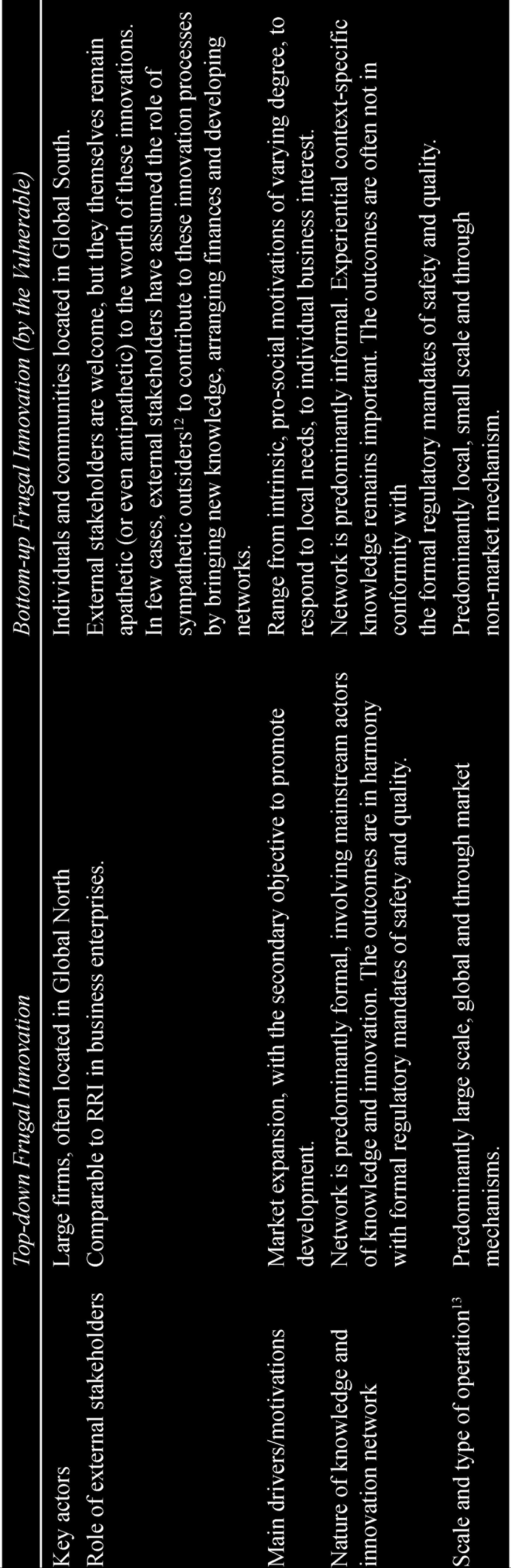
It is evident from Table 1 that the ‘bottom-up’ frugal innovations do not stop merely by ensuring the access of the vulnerable groups to new technologies. They, instead, envision these groups as an active participant in the making of an innovation.
In this article, such a frugal innovator is considered ‘vulnerable’ for multiple reasons. To Mechanic and Tanner (2007), vulnerability is shaped by a multitude of factors and their interactions, including personal incapacities, developmental problems, disadvantaged social status and inadequacy of interpersonal networks. Brockhaus, Djoudi, and Kambire (2012) propose that methods for assessing vulnerability should be based on specific research questions rather than definitions. In the present case, the lack of formal education, access to financial and material resources necessary for a decent living contributes to their vulnerability in general. As an innovator, however, they are specifically more vulnerable because of their unconventional approach to innovations, which do not find support/appreciation among the mainstream scientists, innovators and social opinion-makers. The lack of social acceptability to their research methods (and knowledge base) makes it almost impossible for them to access credit for their innovative efforts even from public sector financial institutions. 14
We now discuss the key characteristics of these innovation processes in order to return to our moot question; that is, how these innovations, and the narrative surrounding them, can widen the ambit of RRI, by highlighting the possible ways to better conceptualise some of the core underpinnings of RRI. The data sources are multiple, and this article is not based on any dedicated sample. Instead, it reflects on various surveys, interactions with innovators, and case studies the lead author and his team has conducted since 2007. In addition, we draw upon studies done by others in this field, and the various publicly available data sources and newspaper reports.
A caveat is perhaps in order. These innovations are mostly incremental in nature, reflecting adaptation to resource crunch situations. It is worth recalling that innovations in its pre-Schumpeterian avatar included even activities such as repairing of existing products (Godin, 2008). We must also note that the sites of these innovations are diverse, ranging from the clusters of informal sector enterprises to social collectives, to independent individuals of the countries in the Global South. 15
Frugal Innovations by ‘the Vulnerable’: Motivation, Appropriation and Regulation
The innovators in our sample gave diverse responses with regard to the importance of appropriating their innovations. 16 Many innovators seem to be indifferent to formal ways of appropriation. This behaviour is commonly attributed to ignorance about, and, non-availability of resources needed to adhere to, IPR. Though relevant, such an explanation is not sufficient. To us, their diverse response to knowledge appropriation means and mechanisms provides useful insights into the complex process of knowledge generation, motivation and social control of these activities.
We mentioned that such innovations respond to local/individual needs, and based on awareness about local context, and raw materials. Many innovators rely on locally available scrap (waste) materials to do these innovations. 17 This does reduce costs, and therefore, the (financial) uncertainties associated with the failure in the innovation efforts. However, the use of scrap has also been motivated by the awareness of locally available devices and technologies, upon which these innovations are predominantly based. The search for appropriate scrap in this case comes as the default first step in the innovation process, and not a fall back option. It is, however, difficult to control the quality of such ‘scraps’, making reproduction of these innovations often a strenuous task. Note, that reproducibility, with consistent quality, is often a prerequisite for the grant of IPR. 18
In addition, the IPR, when granted, may have consequences, which are undesirable from a normative standpoint. Sharma and Kumar (2018) show how filing the IPR required an innovator to replace the locally available raw materials (often scraps) by better/standardised materials. This exercise might raise the cost of the product, putting it beyond the reach of the very community whose needs had inspired the innovation in the first place. Since, filing an IPR often requires collaboration with professional scientists and business units, we have found evidence of IPR reducing the control of the original innovators over his/her innovations, to these industrial units, or the ‘experts’ (Sheikh, 2017). 19 Innovators are often, reportedly, not much worried about the threats of imitation of their technologies. We found such instances in our fieldwork too. The innovator of a battery-run e-rickshaw is not concerned with somebody imitating his technology in another part of the city. Such indifference is apparently also present, for instance, among artisan-innovators of the Kamukunji metalwork clusters in Nairobi. Even a casual visit would show several tiny units displaying their products next to each other. Obviously, imitation would be easy in such a setting, especially with overlapping skills. Why do they not leave the cluster to initiate their own business in a separate place? 20 From a pure economic rationality point of view, it does not perhaps offer them enough advantage to relocate and find the ‘market’, unless the product they produce is of substantially different quality. Subsequently, the costs to defy the social and communal norms that guide their participation in such informal economy clusters may override their benefits. 21 In addition, since innovation is a continuous process—and happens through trial and error, observational learning, and interaction—they perhaps see the loss through imitation being outweighed by the gains through reciprocal learning, and interactions while co-locating with peers. Imitation to them, unlike large firms, offers new opportunities of learning and capacity building in the long run. Individuals who can imitate/adapt faster than others often hold a high social status among peers. At times though, they do not think their innovations are ‘novel enough’ to warrant any protection. 22
A large part of such innovations take place in non-market contexts too (Neder & Thomas, 2010). Secrecy, in such cases, becomes less important. Bhaduri and Kumar (2011) found that concerns of private appropriation become dominant for Indian grassroots innovators, only if the innovations show commercial prospects. Many of these innovations are conceptualised, however, not with an eye to commercial gains. The joy of creation and/or fulfilling social obligations remains a key motivation for the majority of these innovations. 23 Responsiveness to social concerns, therefore, seems to be the primary concerns in these cases.
Bhaduri and Kumar (2011) make an attempt to understand the extent to which innovators discuss their projects with people around them. Only a handful of them reported having such discussions. However, the reason for non-discussion was not to protect their intellectual property or the threat of leakage. Many of them restrained from discussing their projects with others either due to non-availability of suitable persons or due to the fear of being ridiculed at. Indeed, in India, until very recently, such local innovators had rarely been given much social recognition. They would get the recognition in their neighbourhood only when they are able to demonstrate the usefulness of their innovations. 24 Such social apathy to local-level innovative efforts creates undesirable barrier to, following the RRI parlance, stakeholder engagement.
When such social apathy does not exist, or the innovators enjoy the confidence of the society, we find multiple kinds of interactions between the innovators and the society. Kumar (2014) finds that such interactions take the forms of informal but positive ties with the members of their family and/or community. Demand from small farmers in Harare, Zimbabwe, has been found to have shaped manufacture of de-haulers by farmer groups themselves (Manyati, 2014). Sheikh (2017) found that innovators distributed their innovations to the fellow members in the community, free of costs, to receive feedback, which helped them modify and upgrade their designs and processes. Similarly, revival of traditional community knowledge and providing employment opportunities were some of the core concerns, which shaped the innovative efforts towards ‘Mitticool’. 25
A young entrepreneur of a social enterprise producing smokeless stove in Kenya, for instance, boasts of their strong interactions with the local community as the most important source of their competitive strength. 26 However, his familiarity with the local requirements made it difficult for him to get a ‘scientific validation’ of his products from the regulatory agency. For cooking stoves to be safe and effective, the regulation wants the maximum heat to be retained within the container. On the other hand, the users require this heat be emitted from the stove to keep the household warm, creating a tension between regulatory norms and the societal preference. The dilemma arises because conforming to the scientific standards might give them improved market opportunities elsewhere while depriving the local community of their aspired stove. Several grassroots innovations documented by the India’s NIF reveal such dilemmas where innovations which fulfil the local needs fail to conform to the standards of regulatory agencies or scientific institutes. Understandably, therefore, creating an appropriate policy space for such innovations remains a daunting task and an ongoing challenge. 27
Some Key Normative Implications
Frugal innovations by the vulnerable, essentially, represent an alternative, bottom-up perspective to the discourse on development (Bhaduri, 2016). At the most abstract level, these innovations validate the knowledge of the people on the margin, conventionally seen as mere recipients of technology and knowledge made by ‘the experts’. The pursuit of these innovative efforts is mostly in response to societal needs. Thereby, the fear of undesirable social consequences for these innovation might be less critical. The possibilities of unintended (negative) technological consequences are also limited, due to several reasons. The first and, perhaps, the most obvious reason is the incremental nature of these innovations, which makes their consequences more detectable. The small scale of production and innovations could, in addition, prevent large-scale undesirable consequences to the environment and the society, making the ‘Collingridge’s dilemma’ redundant. The continuous interaction with (and dependence on) the society perhaps acts as a safeguard against going too far against the interest of the society. Finally, its contribution to sustainability remains notable. Through use of scrap and by emphasising on repairing, it postpones ‘planned obsolescence’, and helps reduce the threats of technological waste. Several innovative efforts also explore potentials of the various alternative sources of energy, contributing to sustainability efforts at the local levels. 28
We have mentioned earlier that including laypersons in the decision-making process of the experts remains a key aspiration of RRI scholars. The insights from the frugal innovations by the vulnerable may strengthen the justification for the need for such inclusion. The recent scholarship on the history of innovations (Godin, 2008) and technological changes during the industrial revolution (Mokyr, 2017) too point out the important role played by the laypersons in innovative activities.
Does Frugality Meet Responsibility?
We now analyse how frugal innovations could meet the criteria of responsibility in its innovative activity. As noted earlier, we would explore the meeting points around the four dimensions of RRI, namely anticipation, reflexivity, inclusion and responsiveness. We take each of the four dimensions of RRI and analyse how, and to what extent, the frugal innovations by the vulnerable adhere to these concerns.
Anticipation
As discussed in earlier sections (the third section), the incremental nature and small scale of frugal innovations make them less threatening towards the goals of sustainability. The situations of unintended adverse consequences can be arrested by discontinuing its use, without incurring substantial costs to the socio-technical systems they are entrenched in. 29 In contrast, such costs could be substantial for large-scale innovations because of the difficulties in reversing/discontinuing the innovation in use, when evidences of their harmful consequences get surfaced (Ribeiro et al., 2018). 30 The difficulty to detect potential adverse consequences at an early stage arises also because these innovations are undertaken in the confounding environment of a laboratory. The subsequent scaling up and transfer of these technologies to the new environment(s) of their actual use is far from frictionless. The actors too change, as the technology moves out of the lab to production, and to the market. Anticipation of adverse consequences for the actual context is, therefore, inherently difficult at the early stage of these innovations. For bottom-up frugal innovations, on the other hand, such problems in anticipating adverse consequences could be less serious, since these are conceived and undertaken in the actual environment of their use. The people who undertake such innovations are also the first users, making them more responsive to the risks and the ‘unintended consequences’. The small scale of production and use makes it easier too to arrest negative consequences, once revealed, overriding the concerns of the ‘Collingridge’s dilemma’.
Reflexivity and Inclusivity
The kind of reflexivity that is expected from the scientific community (discussed in the second section), in order to conduct RRI is quite different from what is observed in our frugal innovation arena. These innovators are reflective of the needs prevalent in their immediate vicinity, and they try to solve the issues using local resources (the third section). They often take a pragmatic approach to these solutions by emphasising on using their familiarity with the local conditions and locally available raw materials. The narratives around these innovative activities might not be loaded with explicit moral and ethical underpinnings, yet guided by their innate desire, and the various societal norms and expectations. This is, however, not to deny that at times these innovators could also be guided by their own personal interests and aspirations. The adverse societal consequences of such desires and interests, if any, would, nevertheless, be limited due to the small scale of operation. 31
Note that the funds for these innovations are either one’s own or arranged through informal networks. Generally, such credits come with ‘unlimited liability’ (often intergenerational in nature). It is likely that the innovator would in such cases be more cautious in using funds than people who have access to (formal) credits with ‘limited liability’. This lack of opportunity to spread the risks in our view might promote judicious spending of money. 32
The scope of reflexivity and inclusivity, however, are often limited by the lack of social appreciation of such innovative efforts. Ironically, there often is little recognition of their work by fellow community members, even though solving societal problems remain at the core of these activities. These innovators do not command much respect and admirations, unlike the mainstream scientists at least in the early stages of their innovation. This hampers the continuous feedback between the innovators and the community. Their work, at the same time, does not get much appreciation from the scientific community, regulators or the mainstream innovators either.
Responsiveness
Finally, the overall responsiveness of a frugal innovative activity (measured as an outcome of efforts towards transparency, inclusiveness etc.,) does not lead to the making of new regulations, or standards, as envisioned in the RRI scholarship. However, one can find the trace of such responsiveness in terms of the practical, easily revocable, small-scale, innovative efforts to ‘solve’ societal problems in the ‘actual environment’. It bears particular importance in the absence of credible alternatives from either the State or the market.
Conclusion
The article aims at exploring a space for dialogue between RRI and frugal innovations to frame the possible pathways of future research and policy deliberations. Such a dialogue in our view would help broaden the scope of the discourses on RRI and frugal innovations. Currently, the empirical research on RRI faces a deadlock in terms of living up to the expectations of its theoretical promises. Similarly, with its increasing preoccupation with a product-oriented approach, frugal innovation discourses have sidestepped some of its original goals, such as thrust on reuse of materials, sharing economy and flexibilities in innovation organisation (see Radjou & Prabhu, 2015). Over time, the discourse has become sharply divided into two streams, one focusing on large firms endeavour to cater to the Bottom of Pyramid (BoP), while the other (minority) view trying to generate research and policy momentum to investigate the nuances of innovative activities at the BoP. The present article, built around the second category of frugal innovation scholarship, examines how a dialogue between frugal and responsible innovation discourse may take shape.
The use of the word ‘responsible’ has opened up newer possibilities of dialogues within the larger field of innovation studies. We find that the broader ethical underpinnings of RRI in terms of ‘transparency, interaction and mutual responsiveness’ to ensure inclusivity could be visible at the sites of the frugal innovations by the vulnerable too. 33 These activities also provide a more concrete understanding of the alternative intellectual property management practices that many scholars of RRI insist on. RRI can benefit by including the sites of these local, inclusive, practical and sustainable frugal innovative activities into its ambit. As discussed extensively in the article, these frugal innovations tend to be problem-solving, practical and user driven. They draw their social sustainability implications from their small scale of use and entrenchment in local socio-technical systems. The innovators take a ‘satisficing’ approach with regard to their appropriation behaviour, and do not, generally, insist on monopoly creation through IPR, ensuring a freer use or access to these technologies. This is likely to ensure better inclusion in the process of development, a key aspiration of the RRI discourse. Although the RRI discourse emphasises on these are often, arguably, difficult to comply with anticipation, reflection and inclusion to be truly responsive, in a large corporate setting. Frugal innovations by the vulnerable groups, being borne out of daily needs, shaped by local resources, and the agency of local people, on the other hand, tend to be inclusive. RRI’s mandate is global in nature. The experiences from the sustainable development discourses have taught us the need for complementarities between such global goals and local level actions. Frugal innovations by the vulnerable groups is one such local adaptive mechanism to the problems of scarcity and poverty, that might help achieves these goals. A coherent synergy between these two strands of innovation scholarship may, therefore, be helpful in framing the future development pathways. All this, as Ribeiro et al. (2018) argue, might help better ‘social alignment’ of RRI.
Admittedly, RRI scholarship pays a much careful attention to study innovation processes than what the scholars on frugal innovations have achieved so far. A deeper engagement with the RRI scholarships might make the scholars of frugal innovations more sensitive to examining innovation processes in general. In this way, the discourses on frugal innovation could come closer to the ideas of ‘frugal’ and ‘frugality’ envisaged by Adam Smith. Coming to the specific case of frugal innovations by the vulnerable, an engagement with the RRI might help motivate the innovators, funding agencies, regulatory bodies and the civil society to strengthen their interactions to generate public awareness and debate about the need for a rethinking on policies of appropriation and standard-making. Currently, the innovations by the vulnerable groups remain ‘below the radar’. With the rising number of such innovators, there is a need for government intervention to facilitate these innovations, through creation of equitable knowledge-sharing platforms, funding opportunities, awareness, etc. States could collaborate with the civil society in the framing of responsible regulation that is sensitive to the needs of the actors ‘on the margins’. All this has the potential to reshape the processes of such innovations by including more diverse actors.
Scale of such innovations remains a sore point. While a very large scale may dilute the context specificity of these innovations, their current very small scale of operation may also need a rethink. The involvement of new actors, motivated by the broader ethos and mandates of RRI, can inject new thoughts into the possible pathways of scaling up such innovations without diluting the core concerns of context specificity of these innovations and their societal control.
Finally, we have noted earlier that frugal innovation research has, over time, sidestepped some of the core concerns of its founding scholars, namely the thrust on reuse, sharing and flexibility in organisations. Incidentally, the innovative activities by the vulnerable seem to remain aligned to these concerns. A renewed mandate, to be responsible, might help bring these concerns back into the agenda of frugal innovation research.
Footnotes
Declaration of conflicting interests
The authors declared no potential conflicts of interest with respect to the research, authorship and/or publication of this article.
Funding
The authors disclosed receipt of the following financial support for the research, authorship and/or publication of this article: The data and observations on Kamakunji cluster (Nairobi) and Dindigul cluster (Tamil Nadu) were gathered during a fieldwork by the first author funded by the Prince Claus Chair Curatorium, The Netherlands.
Acknowledgements
We gratefully acknowledge the constructive critical comments from the special issue editors Wiebe Bijker, Poonam Pandey and the three anonymous reviewers of the journal. Participants of the conference at Indian Institute of Delhi made important observations. A study leave obtained from Jawaharlal Nehru University in 2016 helped the first author to interact with several frugal innovators in different parts of India.