




Abstract
The B-school scenario in India is vast; with institutions in thousands, and hundreds of thousands in annual intake. Despite availability of ranking metrics, these portray only a partial picture of the top institutes alone, leaving the majority of Indian B-schools unmapped. The competitive arena for institutes is asymmetric, creating a problem with existing indexes as they do not aid aspirants or major stakeholders to make accurate estimates of institutional performance. Using secondary data from a statutory body (AICTE), the paper studies how this asymmetry is played out in aspects of graduate outcome performance- namely outturn and placement, as well as institutional financial performances within the context of a single state. Publicly available information from media and other intelligence reports have been further leveraged to augment facts. The study clusters institutes based on graduate outturn and placements into a vulnerability-risk grid, allowing accurate assessments of how B-schools are performing across a selected time-period. Financial risk assessment also helps in identifying the problem hotspots which require direct intervention. The paper is unique in its contribution to classifying risks among management institutes using a method which is scalable and adaptable. It identifies key imperatives to establish academic parity, by clustering deficit aspects based on the level of the b-schools performance.
Keywords
Introduction
India’s higher education scenario is one that has grown rapidly in the post-liberalisation phase of 1991. However, the rise in number was not matched by a corresponding increase in quality (Bhattacharyya & Chaturvedi, 2013; Chakraborty, 2013; Palety, 2009). The higher education system has been viewed by academia as poor quality, with particular points of concern being the skill level of teachers, outdated syllabus, lack of quality research output, poor infrastructure, inadequate financing, mismatch with industry needs, a complete absence of international tie-ups—barring a few prestigious institutions and negligible presence in global university rankings (Sheel & Vohra, 2014). Published reports as well as academic research show that government initiatives have not been successful in ushering in transformation and quality improvements at institutions (GOI, 2009; Jagadeesh, 2000; Khatri et al., 2012). At the same time, research also reported on growth of private universities in India, mismatch of quality and quantity, wrongful and unethical practices in assessment parameters and outdated policies (Mahajan et al., 2016; Reddy et al., 2016).
At a time, India had the largest number of B-schools 1 in the world (C.S-W, 2016). From 3865 institutes at its zenith in 2012 down to 3037 institutes in 2019 (Rana et al., 2020), the management education scenario in India has witnessed a period of continuous decline, compounded by issues of economic slowdown, global downturns, and a general fall in demand for MBA courses (Balachandran, 2015; Chhapia, 2012; Das, 2020; ET Online, 2017; FE Online, 2018; Indiatoday.in, 2015; Shashidhar, 2020). Yet, even at present, management programmes continue to dominate the professional higher education landscape, offering more than 370,000 seats a year across the country (Rana et al., 2020). However, the distribution of business schools in terms of quality and performance characteristics are highly skewed, with the vast majority performing poorly on various parameters like ranking, accreditation, enrolments and placements. This problem is markedly emphasised when ASSOCHAM in 2016 claimed that ‘93% of the MBA graduates in India are unemployable’ (Ahmedabad Bureau, 2018).
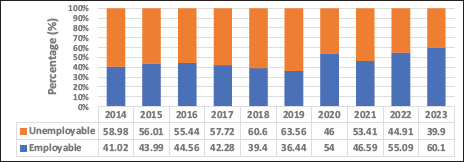
A report by the Confederation of Indian Industry (CII) stated that MBA faced a decline in employable talent, falling to a low 36.44% in 2019 (Wheebox et al., 2019). MBA courses had lost their lure among prospective employers, and employability of Management graduates had been seeing a year-by-year decrease. Not only had MBA courses lost their aura of exclusivity, but also the output in terms of talent. The report points out that the excessive supply of seats resulting from a large number of institutes have adversely affected quality of student intake, and are also affected by variations in quality of curriculum and pedagogy in these institutes (Wheebox et al., 2019). The inherent challenge therefore, was the question of Quality vs. Quantity, as is evidenced by reports which suggest that only 14% of all Higher Educational Institutions (HEIs) of the country have accreditation from the National Accreditation and Assessment Council (NAAC) and fewer still, for specific programmes by specialised agencies (Ravi et al., 2019). In terms of accreditation for programmes such as MBA, data from the National Board of Accreditation (NBA) suggests an equally bleak picture, with only 462 unique accreditations awarded till the present time, and only 165 post-graduate management programmes having valid accreditation as on February 2021 (NBA, 2022). This makes comparisons very stark, when tallied against the total number of institutions functioning at the present time.
The real issue therefore, is that the competitive scenario in MBA is highly asymmetric, as is evidenced by data available from accreditation agencies, government ranking indices as well as ranking reports from the print and online media: only a small number of institutions are featured here, as against the vast total that are wholly unrepresented. India’s National Institutional Ranking Framework (NIRF) reports ranking of only the top 100 institutions in management each year, with participation typically ranging at between 20% and 25% of the total number of institutions in India (NIRF, 2020a). The scenario is also similar for media-based ranking indices, which may feature up to 300 top B-business schools across the country, distributed into different geographical zones and clusters, but which do not portray the full picture (Businesstoday.in, 2019; BW Online Bureau, 2019; Deka, 2020; The Week-Hansa, 2019). This makes the issue of asymmetry particularly acute, as the vast majority of institutes (and therefore student enrolments) are not appropriately mapped or indexed, causing potential aspirants and stakeholders to make decisions in the face of unavailable, partial or incomplete information.
This article therefore attempts to portray the existing asymmetry in the B-school sector in India, in the context of a single South Indian state, limited by the inherent complexity of analysing an enormous volume of data. Kerala, called the ‘Scandinavia of the third world’ (Tornquist, 2000), and considered one of the most developed and literate states in the country (Agarwal, 2012), has reported advanced metrics in various human development indicators over the years, and stands out in contrast to the vast majority of India’s states. Lieten (2002) had described Kerala’s performance in education as ‘outstanding’. Kerala therefore is suitable for detailed examination. The article attempts to categorise Kerala’s B-schools into different tiers based on enrolment and placement figures, mimicking a data-driven format adopted by CRISIL Research (2014). Principally, the study examines the value proposition of management courses in the state, by clustering institutes based on unit-level data, and thereafter examining enrolment–placement-pass rate trends over an 8-year period. The study specifically investigates graduate outcome trends in terms of pass-rate and placements, and identifies attributes and characteristics of most interest in selection of B-schools, based on qualitative inputs from eminent academicians in the state. Financial performance of institutes is also examined carefully for the purpose of stratification. Notably, this study is unique and different as it makes a holistic attempt to study the lower echelons of management education in the country, in contrast to the existing available literature which have mostly focused mainly on the top-rung institutes (see Awasthy et al., 2015; Bhattacharya et al., 2021; Dasgupta & Pawar, 2020; Dass et al., 2020; Gupta et al., 2022; Khatun et al., 2022; Krishnan, 2021; Kumar, 2019; Patri et al., 2023; Roy & Banerjee, 2012; Upadhyay et al., 2022).
Review of Literature
Quality of Education in India: Issues
Quality has always been a point of contention for Higher Education in post-independence India. Right from the establishment of the University Grants Commission (UGC) in 1948, successive educational commissions have continued to emphasise on quality and inclusion of talent (MOE, 1962; NCERT, 1970). However, the commissions of the pre-liberalisation era were guarded and cautious about giving free rein to expansion. The education commission of 1964–1966 had favoured stringent restrictions to access to assure quality, and this was largely the trend going right until the late 1980s when the National Policy on Education of 1986 was formulated. The perpetual emphasis was on protecting the status quo rather than expanding into new horizons (Mathew, 2016). This consequently reflected on the small number of institutions offering management programmes nationally until 1991 (Dayal, 2002).
However, post-India’s economic liberalisation after 1991, successive governments showed willingness to permit the rapid expansion and massification of the management education sector, responding to public demand as well as calls for greater access across social divides (Govinda, 2017; John et al., 2022). The result was the monumental boom in B-schools in India, rising from less than 350 institutions in 1991 to a 10-fold increase to around 3,500 institutions in 2017 (John & Kamala Raghavan, 2022). This resulted from a phase shift in outlook towards massification, where several high-level committees advocated for the expansion of the higher education sector. The Birla-Ambani Committee of 2000, the National Knowledge Commission of 2006, and the Narayana Murthy Committee of 2012 were among these (GOI, 2000, 2006, 2012). However, higher education was simultaneously plagued with allegations of insularity and corruption by the former Prime Minister Dr Manmohan Singh (IANS, 2007). The apex technical education regulatory body (AICTE) has also been accused of graft and corruption at senior levels (Kumar, 2009; Pandey, 2009; Vishnoi, 2009).
Quality has hypothesised linkages to industrial and economic growth (Gambhir et al., 2016). The government in preparation for expansion had formulated several interventions to address quality deficits and establish credibility as well as public faith in higher education. Autonomous bodies such as the NAAC and NBA, set-up in 1994 as Quality Assurance Agencies (QAAs) were a step in this direction (see Fernandes & Singh, 2021; Popli, 2005; Sahay & Thakur, 2007; Prasad & Bhar, 2010; Shome & Gupta, 2018;). Involvement of statutory bodies such as the AICTE as well as NAAC also led to the inclusion for Internal Quality Assurance Cells (IQAC) within institutions. The voluntary national ranking initiative, NIRF was established in 2015 by the Ministry of Human Resource Development for ranking a wide gamut of higher educational institutions based on specific sets of parameters and weights (Varghese, 2018). The bigger challenge, however, was to institute an enveloping system that allowed for objective assessment of all HEIs while simultaneously avoiding the circuitous problems of red-tapism, bureaucratic interference, inordinate delays and corruption. This was suggested as much in policy reports commissioned by the Government of India (GOI, 2007) This was further articulated still in the 12th five-year plan (2012–2017) where quality and standards of education were emphasised (Planning Commission (Government of India), 2013). This was thereafter taken one step further with the National Education Policy (NEP) of 2020 (GOI, 2020). NEP has been hailed as ‘Sweeping it its vision’ for freeing institutions from excessive regulation (Ramamurthi, 2020). The anticipated and intended outcome is a dramatic increase in quality.
The Problem of Elitism and Inclusion
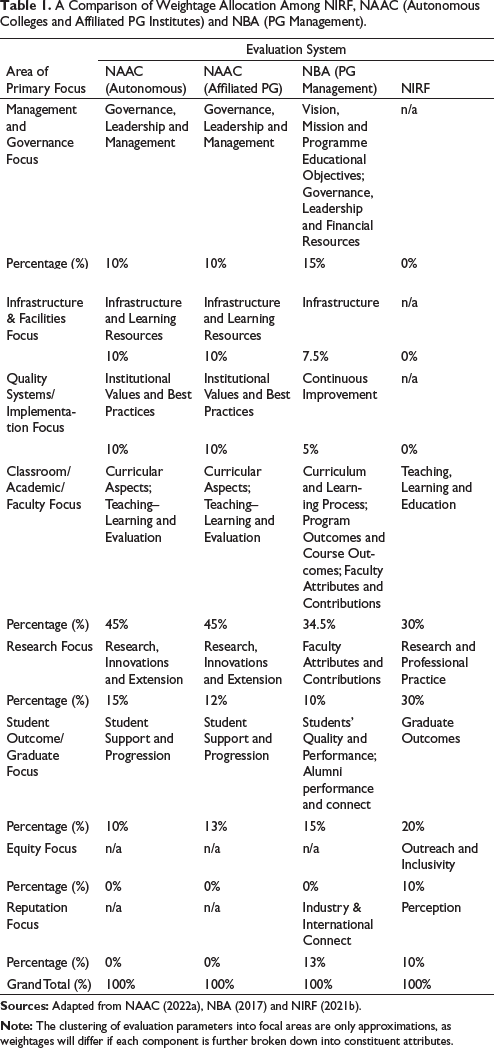
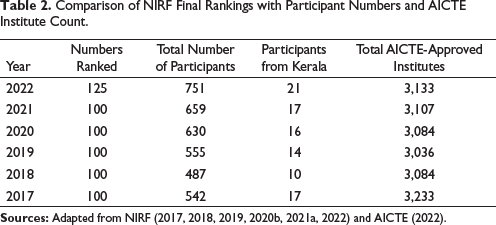
Manimala et al. (2020) stress the vitality of accreditation as a benchmark of quality and excellence in HEIs, and its benefits both to institutions and key stakeholders. The problem however, is the extent of inclusion within metrics such as NAAC, NBA and NIRF. The most recent report of NAAC (which accredits institutions) showed that only 20% of all HEIs in India enjoy accreditation (NAAC, 2022b). The data is bleaker still for NBA (which accredits programmes) where the number of accreditations is a small fraction of the total number of HEIs functioning in India (NBA, 2020). NIRF too ranks only the top 100–150 institutes in each category, leading to a huge amount of exclusion (NIRF, 2021c). John and Kumar (2021) showed that in the Indian context, it is difficult for an institute to obtain one recognition without acquiring the others. This suggests that the scenario may be all-or-none involving NAAC, NBA and NIRF for B-schools in the Indian context. To gain a deeper picture, Table 1 separates the compositions of the three along thematic cues. It is observable that the evaluation parameters and weightages are different. Table 2 shows data obtained from NIRF for institute participation and ranking among B-schools, suggesting huge levels of exclusion.
A Comparison of Weightage Allocation Among NIRF, NAAC (Autonomous Colleges and Affiliated PG Institutes) and NBA (PG Management).
Comparison of NIRF Final Rankings with Participant Numbers and AICTE Institute Count.
Management Education: Competition Among Indian B-schools
A conservative estimate from 2014 had valued the size of the Indian B-school market at INR 38 billion (Chitrao, 2014a). Analogically extending it to 2021–2022 would size the market at approximately INR 118.016 1 billion (for AICTE-approved B-schools). Rana et al. (2020) reported that 89% of all AICTE-approved business schools in the country were privately run with no governmental aid, and functioned with the motive of making profits. Yet, Chand (2022) showed that students from AICTE-approved institutes constituted only an eighth the total number of enrolments in India in 2018–2019, where admissions were more than 1.5 million annually. His examination of the entire management education sector calculated that 81% of all institutes and 76% of all courses in India were privately administered and funded, accounting for over 75% of all student enrolments. This suggested the size of the sector and the extent to which it was unmapped.
The above figures showed that management education was dominated by private HEIs. However, quality of such B-schools in smaller cities and towns were a matter of concern (Chitrao, 2014b). The issue was raised several years earlier in an apex government report which mentioned exploitation, commercialisation and compromise of quality in B-schools (GOI, 2009). The report specifically claimed that lack of focus on research, qualified faculty and curriculum were the most serious problems. This continues to remain relevant even until the present time. Chand (2022) argues that the vast majority of private B-schools are struggling to get admissions, find qualified faculty and ensure that their students get placement. The fall in demand for management courses meant that admissions norms would have to be relaxed to fill the available seats, resulting in poorer quality of intake. This in turn, affected the output. He thus bifurcates private sector B-schools into two groups: The first which has accepted reputation and quality indicators/indexes and is comparable to publicly funded institutions, and the second which only meets the minimum standards prescribed by AICTE. There is a however, a third group comprising of institutions offering certificate management courses not under the purview of any technical government regulator. Hardly any public data is available on such institutes. Data for the second group that struggles with the competitive forces driving admissions, placements and recruiting qualified teachers is the focal object of this study.
The Need to Map the B-school Landscape
The student is the principal consumer of education (Sinclair & Zairi, 1995), and therefore merits study to examine underlying motivations. Jain (2005) had typified the Indian MBA student averaging at about 22 years of age, having less than 2 years of work experience overall, with a quarter of any class comprising of fresh graduates and another quarter having less than a year’s worth of experience. This is contemporaneously supported in recent literature where demographic details of students (mainly hailing from the middle-classes) and characteristic educational attributes of teachers were also explained (as cited in Kumar, 2022). Debnath & Shankar (2009) argue that the student as a primary customer would want to know that value of their degree in terms of the fees paid. A few studies have identified factors that determine selection or choice of a B-school in India. Nyaribo et al. (2012) identified that fees charged (and easy access to loans), employability/employment prospects, infrastructure and reliable references were all important while selecting a B-school. Yousaf et al. (2018) clearly highlighted that institute technical competence, expertise, benevolence (primacy of student’s interest, fostering student wellbeing and psychological security) and integrity (honesty, ethical and professional conduct in brand communications) significantly contributed to building student loyalty. Chand (2022) claimed that the past placement performance, teaching quality, rankings, social media visibility, WoM and positive feedback from alumni drive admissions performance. These factors become important in a highly competitive setting, where students will discriminate among institutes and make exacting demands while seeking admissions (Joseph et al., 2005).
A significant amount of academic literature in the Indian context have remarked on the intense competition existing among B-schools (Khatun & Dar, 2019; Mahajan et al., 2014; Mishra & Nargundkar, 2015; Shahaida et al., 2009; Sreekumar & Mahapatra, 2011; Yeravdekar & Behl, 2017;). For privately funded institutes, this is also a scramble for resources as student fees is the primary (if not sole), source of income. Getting quality students of merit and scholastic ability becomes the key challenge, as this would directly impact the outcomes (successful graduation and placement). It therefore becomes imperative to build brands; establishing parity points with reputed institutions while emphasising differentiators with those at the same level. Jain (2009) demonstrates the symbiotic relationship between B-school brand name and media ranking, with both being almost entirely dependent on admissions of top-quality students (ensuring good placements and jobs) and top-quality faculty (for sound research output). Aggarwal Sharma et al. (2013) further highlight the importance of such brand building as they reduce the perceived risk in decision-making for potential aspirants. The larger problem, however, is the paucity of funds for B-schools in the lower tiers to spend on marketing activities. Brand-building and marketing is resource intensive. Institutions that struggle with admissions would not be able to afford them.
Problems with India’s B-schools
Debnath and Shankar (2009) assert that the outcomes of a B-school are qualified graduates and placements. In this light, employability of management graduates has been a major concern in recent years as evidenced from Figure 1. Typically, less than 50% of graduating MBAs in India are suitable for work. A number of graduating students (Pass-rate) as a proportion of enrolments, on the other hand, have not been studied with the same interest.
A part of the problem lies with India’s university system, where hundreds of affiliated institutions function under a single university leading to huge administrative burden (Umashanker & Dutta, 2007). It becomes difficult for B-schools to differentiate in this system while adhering to strict university guidelines in offering courses. The larger problem is the pedagogy and curriculum itself, which is archaic and pivoted on rote learning. This is misaligned with the requirements of industry, skill-development in graduates, exposure to professional work environments via internships, consultancy projects and corporate exposure, and skill-development in faculty. The problems of outdated curriculum have been persistently raised in academic literature (Goyal et al., 2020; Khatun & Dar, 2019; Malik & Venkatraman, 2017; Singh & Misra, 2017; Srivastava, 2012), government guidelines (AICTE, 2018), industry sector reports—both local (E&Y & FICCI, 2014; Gupta et al., 2019) and global (British Council India, 2014; Cheney et al. 2005), as well as national media (Banerjee, 2016; Berlia, 2016; ET Online, 2017; Kalra, 2021; PTI, 2015; Special Correspondent, 2018; TNN, 2022).
B-schools try to circumvent these problems in securing internships and placements for students by making exaggerated claims. This has been reported in popular media (FP Staff, 2014; Pathak & Umarji, 2014, Roy, 2007), but not investigated in academic literature. India’s foremost B-school, IIM-Ahmedabad attempted to bring in a standardised and transparent placement reporting schema in 2010 called Indian Placement Reporting Standards (IPRS) (Nair & Dave, 2010), but the proposed format found few takers among India’s multitude of B-schools (Umarji & Pathak, 2013). A second iteration of this was launched in 2017, detailing the need to bring in transparency and standardisation of reporting, but it has not gained much traction (IIM-Ahmedabad, 2017). Information about placements and internships among India’s myriad B-schools continues to remain hazy until the present time. The resulting problems reveal themselves in the supply side of the sector. Default of educational loans has soared during the COVID era, with loan on MBAs comprising approximately 7.1% of all defaults by value (Srinivasan, 2021). Data shows that for MBA alone, INR 6.855 billion of the total INR 95.41 billion in educational loan borrowings have become non-performing assets (NPAs). What this may indirectly imply is the amount of faith Indians have in HEIs. The Advertising Standards Council of India (ASCI), a watchdog of the advertising industry, in its annual report claimed that educational institutions enjoy the highest level of trust from Indian audiences at a whopping 82% (ASCI, 2021a). Incidentally, the largest number of complaints and violations were also from the same sector (ASCI, 2021b).
The Indices of Competitive Asymmetry in Indian B-schools
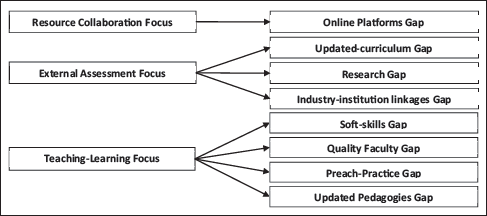
Sridevi (2020) identified eight critical gaps where asymmetry exists among Indian B-schools. These are broadly related to curriculum, pedagogy, research, implementation of teaching concepts, industry linkages, quality of faculty, soft-skill development and the use of non-traditional internet-based platforms for exposure to global practices. In reality however, it is difficult to measure these gaps at a unit-level among institutes as the data is not available in most cases. Measurement, benchmarking and comparisons are therefore, challenging for B-schools within a region or state. In spite of this, the benefits of MBA education cannot be understated. Literature has shown how it adds value as a profession (Baruch, 2009; Baruch & Peiperl, 2000; Kelan & Jones, 2009; Mihail & Kloutsiniotis, 2014). It has shown to improve career development prospects (Baruch & Leeming, 2001) and help in career advancement due augments in skills and employability (Mihail & Elefterie, 2006). Within the Indian context, it was shown that MBAs performed better in decision-making, strategic and systems skills, while possessing better business knowledge of managerial functions than non-MBAs (Saxena & Bendale, 2014). Baruch et al. (2019) in their Indian study showed that MBA enhanced employability and monetary gains in terms of future earning, while simultaneously building self-esteem, self-efficacy as well as relevant competencies in business aspects.
Data Collection and Methodology
Data for the state of Kerala was collected from the AICTE’s statistics portal where information on approved B-schools alone is available. Institute-wise data for intake, enrolment and placements were collected for the period 2014–2015 to 2019–2020. Unit-level data was not available outside this period. Aggregate data on gross enrolment, outturn and placement for Kerala during period 2012–2013 to 2019–2020 was collected. No data was available on institute-wise outturn. Analysis of financial data was made possible with the help of institute submitted ‘Application Report Part I’ during approvals each year. This information was directly provided by Smt. Anju of the office of the Hon’ble AICTE Chairman, Dr Anil D. Sahasrabudhe after formal requests. Reports from Kerala for 83 B-schools in 2020–2021 and 84 B-schools in 2021–2022 were directly received via the AICTE’s e-Governance cell. The financial data provided details of diversity in funding sources (Income from Central Government, State Government, Student Fees, Donations, UGC and other bodies) as well as a break-up of expenses by various categories.
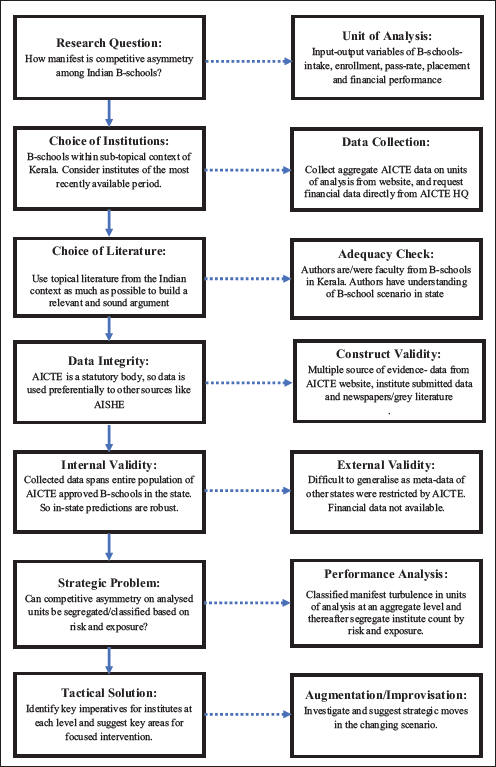
The current study has imbibed a conceptual flavour in designing the study, amalgamating academic literature alongside opinions and personal experiences (Gilson & Goldberg, 2015) (backed up by hard quantifiable empirical data from a highly credible source) to assert argumentatively the main scope of the work. This article provides an exposition of the competitive asymmetry existing among Indian B-schools in a highly topical context. Suggestions advanced by MacInnis (2011) in designing conceptual works were utilised here. Furthermore, the suggestions of Jaakkola (2020) and Hulland (2020) in conceptual research design were largely followed with minimum deviation. Insights and unique findings were predominantly reconciled using opinions, supporting data and personal experiences of the authors. Drawing inspiration from the work of Rana et al. (2021), a considerable level of autonomy is applied in designing the framework of the research. Figure 2 is a visual depiction of the framework utilised in the study.
Steps Followed in the Research Process.
Analysis
The objective of the article is to calculate regional asymmetry in competition among B-schools, taking Kerala as the focal region of interest. The competitive asymmetry is based identifying underlying differences in outturn, placements and institutional financial performance. The current analysis tries to determine institute strength based on these parameters. Individual datasets for each institution would be required to assimilate and make cumulative assessments for descriptive tables and figures. The institution would thereafter be placed within a vulnerability-threat matrix based on scoring in each category.
Outturn and Placements
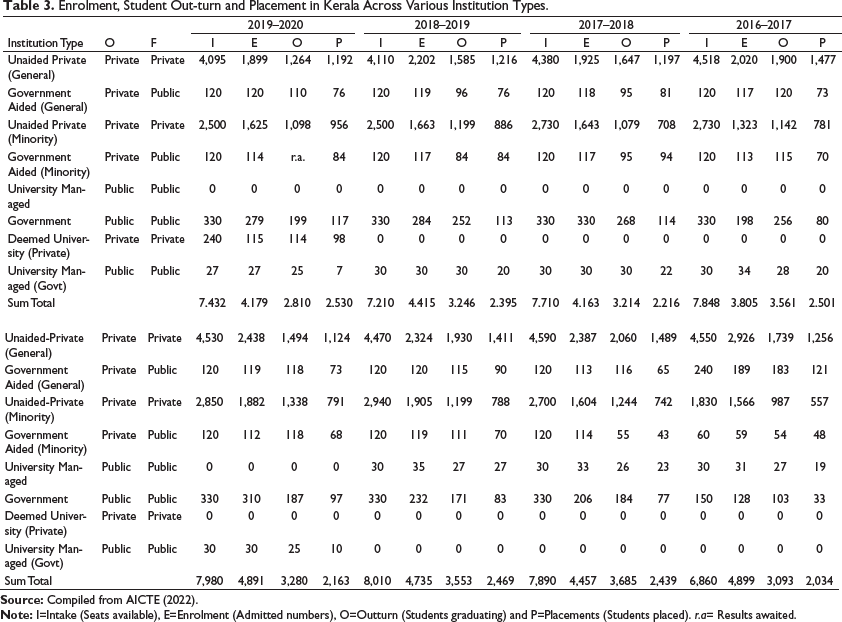
Table 3 indicates the aggregate values of intake (available seats), enrolment, outturn and placement across various institute types over an 8-year period. The problems of poor enrolment in Kerala’s B-schools have already been discussed in detail in John and Kumar (2021). In this study, the focal point of interest is the unaided-private B-schools which account for the bulk of the intake and enrolments. Both graduate outturn and placements are a problem. The data in general shows a steep decline when moving from intake to placements. Outturn itself shows a significant amount of variation in terms of enrolments, ranging above 60% (2012–2013) but never exceeding 85% (2017–2018). This is surprising considering that the university system is old with outdated curriculum and syllabus, in contrast to the academic rigor of top institutes like the IITs and IIMs. The substantial numbers of students who are failing to graduate within the stipulated time-period might give indications about the quality of students as well as the quality of instruction in the classrooms, and merits further detailed enquiry. Placement performance as a percentage of outturn also portrays an uneven picture ranging from near 60% (2013–2014) to above 90% (2019–2020). The data shows high variability in outturn and placements each year. When a total aggregate of enrolments, outturn and placements are calculated from all the years for all institute types, it is seen that only 3 out of 4 students graduate on time, and 7 out of 10 graduating students get placed from campus. Anomalous instances where outturn exceeds enrolment (as in Government-aided or Government) may be attributable to instances where institutes report data of students clearing their arrears.
Enrolment, Student Out-turn and Placement in Kerala Across Various Institution Types.
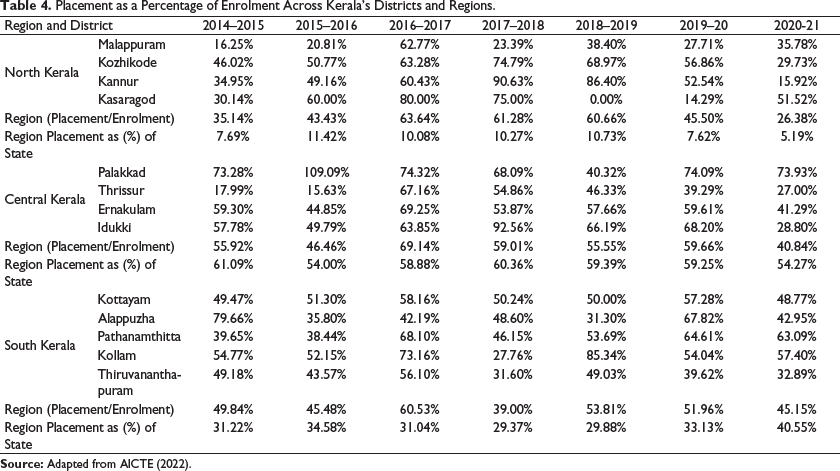
Considering the developmental asymmetry in Kerala, where the northern region lags behind the central and southern regions (Salim, 2018; Tripathi, 2019), it could be seen that the trend is reflected in terms of placements here as well (Table 4). Placements from Northern Kerala accounts for only a minuscule portion in the state total. Further, placement performance is generally poor, with some years being the exception. Central and Southern Kerala performs better in placements, though it is generally not exceeding the 80% mark. Some years show very poor placement performance. The anomalous instance of placement exceeding 100% may be explained by the same reason given earlier regarding students clearing arrears.
Placement as a Percentage of Enrolment Across Kerala’s Districts and Regions.
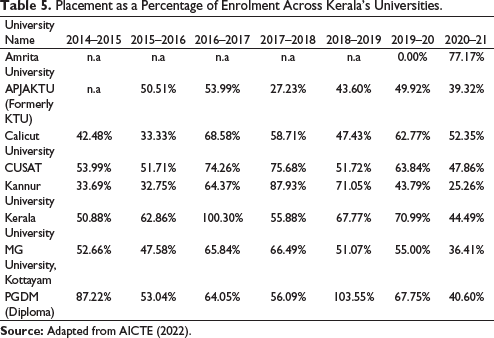
The study by John and Kumar (2021) showed that among Kerala’s AICTE-approved B-schools, 14 colleges were accredited by NAAC and only 7 programmes accredited by NBA. Incidentally, these are the institutes that predominantly perform well in enrolment and placements. To understand if the university system might be contributing to poor placements in the state, a comparison is seen in Table 5, across the major universities in the state. The general trend supports the earlier claim of significant vagaries, but PGDM programmes are a particular concern. Considering that its syllabus is more attuned to industry needs, it is surprising to see significant variations and also some very low percentages of performance in some years.
Placement as a Percentage of Enrolment Across Kerala’s Universities.
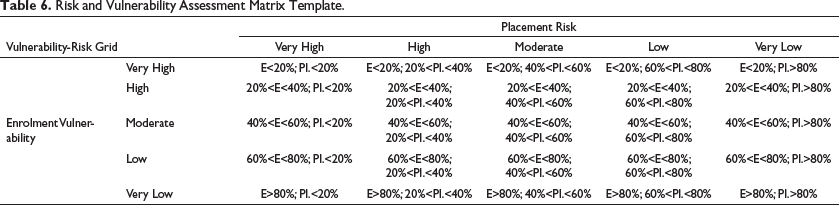
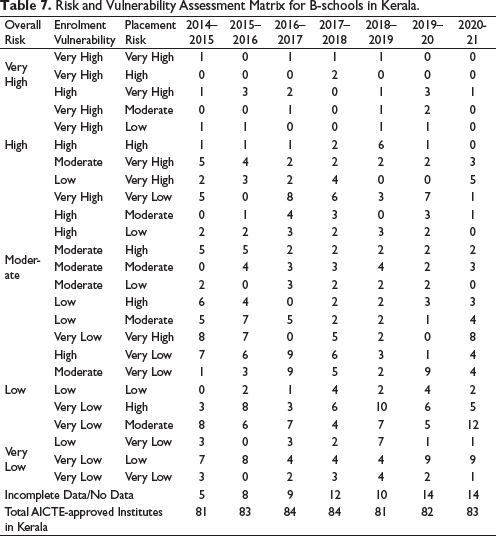
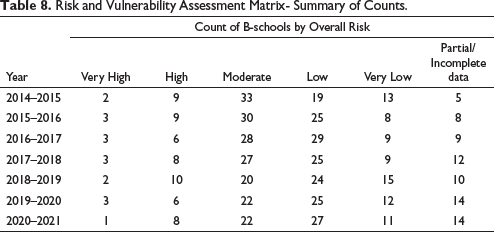
The amount of variation observed necessitates an analysis to cluster B-schools in terms of a vulnerability-risk matrix. A 5×5 grid is thus developed to categorise institutions in terms of enrolment and placement. Enrolment performance is measured in terms of intake, and placement performance in terms of enrolment. The vulnerability-risk classification is divided into five cohorts of risk/vulnerability: Very High (<20%), High (20–40%), Moderate (40–60%), Low (60–80%) and Very Low (>80%) based on the above-mentioned performance measures. A set of 25 unique cells representing various clusters are thus generated (Table 6). All approved institutions from 2014–2015 to 2020–2021 are thereafter placed into these cells as indicated in Table 7. Barring institutes for which no data or partial data was available, it could be seen that a significant portion of the B-schools come under the moderate risk category, with about 10% in the high risk, and less than 5% in the very high-risk categories (Table 8).
Risk and Vulnerability Assessment Matrix Template.
Risk and Vulnerability Assessment Matrix for B-schools in Kerala.
Risk and Vulnerability Assessment Matrix- Summary of Counts.
Financial Analysis
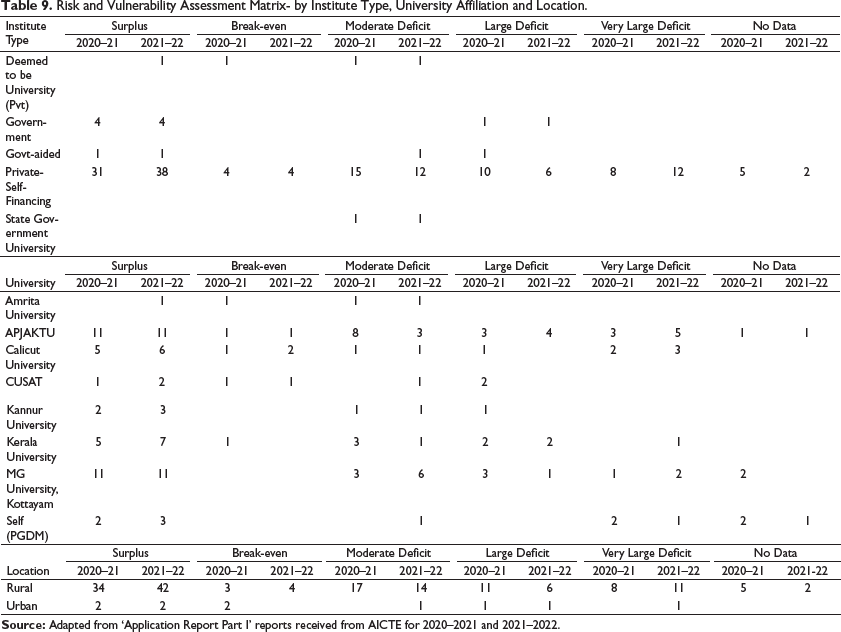
Analysis of financial data for each institute is based on calculating the difference between expenses and income. An institute generates surplus if income exceeds expenses, and breaks even if the expenses are equal to income. For institutions where expenses exceed income, the deficit is categorised into three ranges. Moderate Deficit is when the deficit is less than 20% of the income. Large deficit results when deficit is between 20 and 50% of income and very large deficit is when the deficit is greater than 50%. The available data across the two financial years are summarised in Tables 9 and 10.
Risk and Vulnerability Assessment Matrix- by Institute Type, University Affiliation and Location.
Risk and Vulnerability Assessment Matrix- by Districts in Kerala.
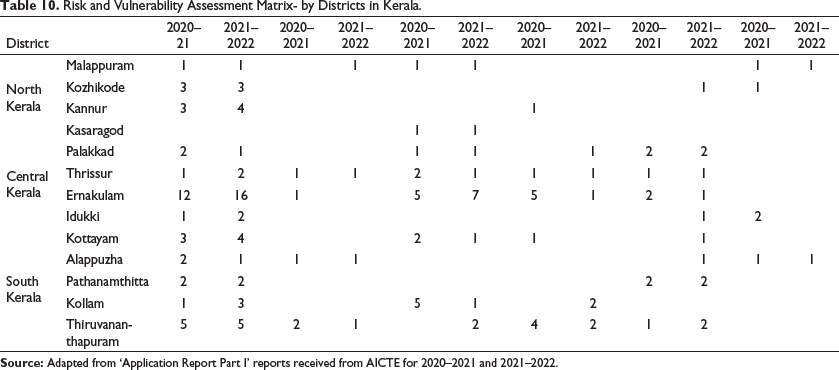
The data reveals that a within the private-unaided institutes, except institutes with no data or partial data, a significant number of B-schools are exposed to financial challenges in terms of falling short on funding. For the Deemed University which just emerged on the scene, it is too early to make any assessment of viability. However, among the few institutes offering PGDM, standalone institutes are highly vulnerable. In Kerala, available land data shows that only five B-schools are located in urban areas, with all the remaining institutes in rural regions. However, the spread of institutes within regions as indicated in Table 10 shows that the bulk of institutions in the financial redline are in central and southern Kerala. This may be because aspirants have a larger number of institutions to choose from in these regions, as well as conveniences offered in terms of access and mobility, allowing a few institutes to attract the best talent in the region.
Results
An overall assessment of B-schools in Kerala is given in Table 11. Despite its commendable achievements in education and literacy, Kerala grapples with the problem of employment among its MBA graduates. A report prior to the outbreak of COVID-19 showed that the state had high unemployment among professional graduates, with 6,413 MBAs alone among the unemployed (Rajiv, 2019). Comparing this with the data in Table 3 shows that this is much more than the number of MBAs graduating every year. In the COVID era, the number of unemployed have only increased (Express News Service, 2022; Kuttapan, 2021). The absence of employment opportunities naturally would create problems for graduates who have availed student loans. The data available for the most recent State Level Bankers’ Committee (SLBC) suggests that Education Loan NPAs are at INR 10.23 billion in Kerala alone, accounting for 9.17% of all outstanding Education Loans in the state (SLBC, 2022). Reports have also suggested that banks are not entertaining educational loan applications, especially under the INR 0.4 million limit (as no collaterals are required) affecting prospects for students in the lower socio-economic strata (Abraham, 2022). Even prior to the outbreak of COVID-19, Kerala was among the top defaulters in education loans due to the higher level of borrowings from public sector banks (CARE Ratings, 2018). To make things worse, recent industry reports also show that Kerala does not feature in the top-10 Indian states in employability of its graduates, despite consistently commendable performances in skillsets such as command over English, numerical ability, critical thinking and computer proficiency (Wheebox et al., 2015, 2021). Kerala has quickly slipped in the employability rankings from 2015—when it featured at the top, through 2018 and thereafter in 2019—where it fell down the list, until 2021, when it was completely left out of the picture (Wheebox et al., 2015, 2018, 2019, 2021). The larger problems cited are the lack of corporate infrastructure and job vacancies (Wheebox et al., 2021). An analysis in 2016 for identifying the top states for presence of different industry sectors could not identify even a single industry where Kerala was prominent (Wheebox et al., 2016). In 2022 however, quite surprisingly, Kerala was back at the top of the list, highlighted as a state with outstanding performance (Wheebox et al., 2022). Incidentally, the Kerala government was a partner for this particular report, showcasing its publicly funded government skilling initiative. Yet again in 2023, the report cited Kerala’s particular problems in alarming rates of unemployment, lack of employment opportunities, large number of prospects seeking internships, and outflow of qualified graduates to other states and overseas, excluding it from the top 10 states list (Wheebox et al., 2023). Considering the steady decline of the state in performance metrics during previous years to its sudden pre-eminence, and then the abrupt fall from grace—any claims made therein should be corroborated with other reliable sources before arriving at meaningful conclusions.
Evaluating Kerala’s B-schools in Existing Market Climate.
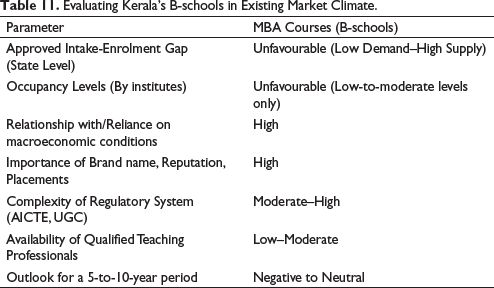
If the problem of demand is considered, setting aside the difficulty in obtaining loans from banks, then the issue of trust deficit in Kerala’s B-schools may be what remains to be largely addressed. Graduate outturn and placements leave a lot to be desired in the state, with a significant number of students failing to graduate on time, and a substantial figure failing to obtain placements. Since WoM is identified as an important determinant in identification/selection of B-schools, these factors may play an important role as determinant attribute during admission season. Students’ inquiries about classroom instruction quality, university exam performance and placements through peers and alumni might influence their application decision. Institutions that are found wanting in these aspects might be left out of consideration by prospects, leaving these B-schools to seek out less qualified graduates for admissions.
Discussion
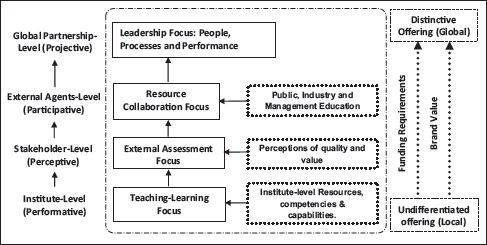
The identified asymmetry in the competitive landscape of B-schools implies that it is necessary to strategise based on the level at which the B-school is functioning. Drawing on the work of John and Kumar (2021), it is suggested that B-schools should try to concentrate their resources on specific outcomes based on which level at which they are located within the hierarchy (Figure 3). Nascent, entry level or institutes that only meet the minimum AICTE standards are at the lowest level, and should mobilise their resources aimed purely at excelling in classroom instruction quality. The efforts needed could be localised as it is primarily driven by faculty performance and innovations in classroom delivery mechanisms. Institutions that have accreditation and larger recognition should move to build stakeholder commitment and respect by building on perceptions of quality and value. Such institutes can gain reputation in ranking metrics and other external projections of quality at a regional or national level. Institutions that come above this level may focus on higher levels of engagement with public, industry sectors through joint research or consultancy and other management institutes that have parity.
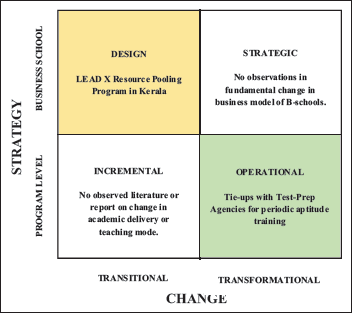
Attempting now to map the existing eight gaps in Indian B-school’s quality as identified by Sridevi (2020) with the lower three levels of the B-school hierarchy proposed by John and Kumar (2021) permits categorisation of the core problems contributing to the competitive asymmetry in Kerala. This in indicated in Figure 4. Strategic changes at a transitional level within B-schools and at a transformational level within programmes are happening within the state (Figure 5). The ‘Lead X’ programme of Lead College of Management in Palakkad which has brought in several unaided-private B-schools under different managements across several districts under an apex admission, placement, training and skilling apparatus is a design level change that is transitional is one such example (Lead College of Management, 2022). Smaller standalone institutes and nascent institutes are now pooling in their capabilities to overcome the resource-intensive challenges in seeking admissions and ensuring placements every year. Institutional tie-ups with test-preparation agencies for skilling graduates to qualify placement exams conducted by MNCs during recruitment drives are an operational change happening at the programme level. Studies have stated how an industry for preparatory training, soft-skills training and placement training in competitive exams is pivoted on the MBA sector (Chand, 2022; Saxena & Bendale, 2014). Incremental changes in teaching method and classroom delivery like case-studies based learning and experiential learning are also possible, although this has not been documented in the state.
Conclusion
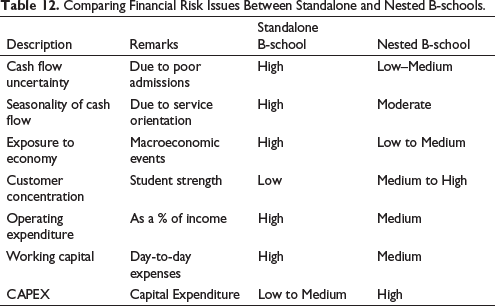
In general, nested B-schools (which are part of a larger college) have a better chance of survival that standalone B-schools for the reasons cited in Table 12. The majority of B-schools in Kerala in the unaided-private sector which are exposed to risk in enrolment–placement as well as financial performance would need to strategise their resource utilisation, capabilities and focus to survive in the coming period. Institutes at the lower rung would need to primarily concentrate on teaching–learning and classroom instruction if they need to attract prospective students. Brand-building should focus on quality of teaching translated to university exam performance first, and placements, second. A number of fundamental questions need to be asked in terms of measuring parameters for successful performance, bolstering research quality and industry interaction, and identifying the competitive landscape in which they operate. John and Kumar’s (2021) study already showed that the B-school count in Kerala would reduce and that the sector is going to experience a contraction. Strategic allocation and utilisation of assets in the only means to survive the shake-out which will follow in a situation of continued poor enrolments and placements.
Comparing Financial Risk Issues Between Standalone and Nested B-schools.
The article also identifies larger issues of public policy which are relevant to social discourse (see Bhushan, 2021). NEP 2020 aims to phase out single-stream educational institutes and the affiliated college system within a period of 15 years (CARE Ratings, 2020). The objective is in creating large universities and multidisciplinary education hubs (HEI clusters/knowledge hubs—each with 3000+ students) (CARE Ratings, 2020). This could sound the death-knell for private standalone B-schools. The problems for other B-schools would be finding haven within such education hubs.
The views of the Kerala State Higher Education Council (KSHEC) which dubbed the NEP as the philosophy of the ‘Corporate-Hindutva alliance’ needs to be examined in the unfolding context (KSHEC, 2020). Without discussing the political undertones, what is evident is that a system of consolidation is already at work in Kerala, laying the path forward for a future envisaged by NEP—despite the stated vehement opposition. If the current scenario were to continue, the number of institutes in rural areas would decrease, and lead to higher urban concentration of these educational hubs. Whether these urban hubs would be in Kerala is a big question-mark. When considering that 77% of all HEIs in Kerala are in rural locations (Ministry of Education, 2020), this would be a major challenge towards the future.
Limitations and Future Research
There were observed discrepancies in the AICTE statistics dashboard when comparing the aggregated state-wise data in the dashboard and compiling individual institution data from the universities/institutes tab. Several data fields were blank when unit-level collection was conducted for each institute. The financial data accuracy of the Application Report Part 1 is subject to the integrity of voluntary disclosure of the concerned institutes. Panel Data regression would significantly help in gaining insight in larger trends relating to placement performance across a time-series pattern. Future studies should examine if this asymmetry exists in other states as well.
Footnotes
Acknowledgements
The authors wish to thank the office of Dr Anil D. Sahasrabudhe, Chairperson-AICTE and the officials of E-Governance Cell, Dr Ravindra Kumar Soni (Advisor-II) and Sh. Manoj Singh (Assistant Director) for providing us with required data for the research study on financial performance.
Declaration of Conflicting Interests
The authors declared no potential conflicts of interest with respect to the research, authorship, and/or publication of this article.
Funding
The authors disclosed receipt of the following financial support for the research, authorship, and/or publication of this article: The author was a fully funded research scholar of IIT-Madras and is supported financially under the HTRA (Half Time Research Assistantship) scholar scheme of the institute.
