




Abstract
Although development experts acknowledge several development potentials of remittances, a clear understanding of the impacts of remittances and democracy on human capital accumulation regarding gender at the global level is still missing. In this research, we analyse the influences of remittances and democracy on human capital accumulation in terms of educational success, specifically primary, secondary and tertiary education, and average years of schooling with a gender focus at the global level through instrumental variables (IV) regression model. Our model using data from various valid international sources finds that (1) remittances have a significant positive impact on secondary and tertiary education and average years of schooling; (2) these have a higher significant effect on females’ education compared to their male counterparts; and (3) these are more instrumental for education in higher democratic developing countries rather than countries having no- or low-level of democracy. Next to remittances, the results find that (4) democracy has a significant positive influence on primary education and average schooling years; and (5) this is helpful for the educational advancement of both males and females but more effective for women compared to men. Based on our results, we suggest that remittances to developing countries and democratic practices in these countries can support investing and leveraging females’ education, which is a key mechanism for empowering women around the globe.
Introduction
The remittance is the money transferred by international migrants from the destination country to the country of origin. According to the International Monetary Fund (IMF) definition, remittances are the money from workers’ transfers, employee compensations and migrants’ handovers (Kpodar & Imam, 2024). Workers’ transfers are the amount of money transferred by migrant workers employed in another’s country who also resided in that country for working purposes intended for a particular period, say one year or more—for instance, the transfer of industrial labourers and workers in hotels and restaurants. Employee compensations are transfers from the income and honorarium of non-residents’ employees for works done for the other country’s residents—for example, transfers from the payments of development professionals, ambassadors, consultants, researchers, students’ stipends and scholarships, and other benefits such as cash and kind. Migrants’ transfers are the money transferred from one country to another due to the change of residence of individual(s) who permanently live in the country of destination. This transfer is measured as a part of the capital account, while workers’ transfers and employee compensations are measured as parts of the current account (Mozumdar & Islam, 2017).
The remittance stream attracts development professionals and researchers because of its growing amount and several development impacts in the least developed and developing countries. 1 In 2022, the developing countries received a total volume of USD 626 billion as remittances (official record), which is double the total volume of the net official development assistance and development aid received by them (Ratha et al., 2022). The remittance flow in different regions, especially in South Asia, Latin America and the Caribbean, East Asia and the Pacific, has grown more steadily since the 80s compared to the world average for developing countries (World Bank, 2020). Furthermore, its flow rose to all six developing regions (East Asia and Pacific, Europe and Central Asia, Latin America and the Caribbean, Middle East and North Africa, South Asia and Sub-Saharan Africa) in 2019. In 2022, the Asian region had six spots among the top ten remittance recipients, while only one country from Latin America (Mexico), one country from Europe (France) and two countries from the West and North African region (Nigeria and the Arab Republic of Egypt) (Ratha et al., 2022). The leading three remittance-receiving countries around the world for the year 2022 are India, Mexico and China, and they received more than one-third of total remittances to developing countries (Ratha et al., 2022). The above facts and figures make clear that remittance has become a vital source of financial support for many developing countries than developed countries. 2 By using remittances, receiving countries can build their economy more dynamic and resilient (Beine et al., 2012).
Human capital accumulation could promote and sustain economic growth in low-income developing countries (Bils & Klenow, 2000; Pritchett, 2001; Romer, 1990). Cohen and Soto (2007) show evidence of the positive impact of human capital accumulation (average years of schooling) on economic growth. Remittances may positively influence human capital accumulation by investing these into education, training and healthcare. Among them, investment in education is regarded as the utmost critical mechanism for creating and accumulating human capital (Becker, 1993). Using remittances in education may reduce the incidence of child labour, increase school enrolment (Calero et al., 2009) and decrease the dropout rate of school children (Edwards & Ureta, 2003). Furthermore, it may trigger educational attainment (Acosta et al., 2008). Next to remittances, democracy proves to be helpful for educational advancement. Although the role of remittances in education has been examined widely both at micro and macro levels (Driffield & Jones, 2013), a few studies analyse the influences of remittances and democracy on education at the global level. To fill up this knowledge gap, our research intends to elucidate the influences of remittances and democracy on human capital accumulation in the matter of education, explicitly average years of schooling, primary, secondary and tertiary education, at the global level focusing on gender. Specific research questions are as follows:
What are the effects of remittances and democracy on education?
What is the influence of remittances on education in relation to gender and democracy?
What is the impact of democracy on education in relation to gender?
Human Capital Accumulation, Remittances and Democracy
Human capital is recognised as an intangible asset that includes individuals’ knowledge, skills and capabilities in a particular arena, such as society or country. Based on the structure of a society, education, training and healthcare are several ways to form and develop humans into capital (Becker, 1993). Among the ways, education is acknowledged as the best mechanism for human capital accumulation (Becker, 1993; Mozumdar & Islam, 2017). Gao et al. (2021) and Xia et al. (2022) reveal that remittances can encourage human capital investment and improve educational outcomes in developing countries. Based on data from three Haitian communities, Bredl (2011) shows a considerable influence of remittances on education. He explains that remittances play a crucial role in education, preventing budget constraints for low-income families, while financial constraints are critical in schooling decisions. Alcaraz et al. (2012) studied the influences of remittances on school attendance and child labour on the recipients of Mexican households. They report a negative shock on remittance receipt during the 2008–2009 United States’ recessions. Due to this negative shock of remittances, they have seen a decline in school attendance and a significant increase in child labour.
Elbadawy and Roushdy (2010) uncover that remittances positively affect school attendance for boys more than girls. The effect is specifically visible in boys who are very close to the age of university admission, and a positive effect is only valid for those girls between the ages of 15 and 17. Likewise, Young in 2008 finds that remittance is the reason for the slight improvement in school attendance among children between the ages of 10 and 16 in the Philippines. The increase of 10% in remittances in household income may lead to a 10% increase in the presence of boys in schools. In this case, the presence of boys between the ages of 17 and 21 is much higher. They suggest that the impact of remittances on education may vary by context, gender and age.
Hanson and Woodruff (2003) find the effect of remittances on children’s schooling and health in Mexico. They report a positive relationship between child education and having a family member abroad. They also argue that remittances are the mechanism that links the two. Similarly, Borromeo (2012) show that the receipt of remittances positively affects the likelihood of finishing high school for Filipino males aged 17 to 22. However, the receipt of remittances negatively affects the possibility of graduating from elementary school and college for females aged 13 to 22 and 21 to 22 years, respectively. The study of Köllner (2013) finds that in the case of non-mandatory higher education, remittances negatively impact educational attainment. While accounting for endogeneity, the remittance variable’s coefficient becomes insignificant. This study suggests that once education is volunteered, remittances are not used for investments in human capital accumulation.
Khan and Khan (2016) observe the effect of remittances on school enrolment and the level of education attained among children aged 4–15 years in Pakistan. The IV censored ordered-probit model results show that children from remittance-receiving households are likelier to be enrolled in school. The lowest effect of remittances on school enrolment is more significant for girls and rural households, and remittances may help to cut down regional and gender disparities in Pakistan’s school enrolment of children.
Mozumdar and Islam (2017) study the impact of remittances on human capital development regarding educational attainment from a global perspective using generalised least square modelling. The results show a significant positive effect of remittances on the changes in average years of schooling and secondary enrolment rate in developing countries. They conclude that the effect of remittances may have regional, gender and financial level differences in human capital development.
Matano and Ramos (2013) analyse the effect of remittances on educational outcomes in Moldova. Using the Instrumental Variable (IV) probit estimation technique, they show that remittances increase the probability of attaining higher education by around 33% after controlling for several individual and family characteristics. In addition, the migrants’ education level significantly positively impacts family members’ education.
Valatheeswaran and Khan (2018) find that remittances have a positive and significant effect on private school enrolment. After grouping the samples into different groups, they identify that remittances significantly impact children living in rural areas and socially disadvantaged groups.
Khan (2016) identifies that remittances reduce the burden of poverty on immigrant families, and they begin to spend more on educating their children. Moreover, remittances help increase school enrolment, attendance and academic performance. Remittances positively affect male and female children’s education only at the primary school level. It has been positively linked to school enrolment, attendance and academic performance at this level. Also, Begum (2018) studies the relationship between remittances and educational attainment in the Dominican Republic: Remittances increase households’ income, influencing education spending. She finds that there is a positive relationship between education attainment and remittances.
Perera and Wijeratne (2017) study the impact of remittance on educational productivity. Research has shown that migrant households spend a more incredible amount of remittances on primary education than non-migrant households. Nevertheless, this shows that remittances have no significant effect on the productivity of rural primary education. It is concluded that the absence of parents for the child’s education and the distribution of the mother’s time play a more critical role than the share of remittances allocated for education.
Next to remittances, a vast literature suggests that democracies provide more education to their citizens than autocracies (Acemoglu et al., 2015; Ansell, 2010; Brown, 1999; Dahlum & Knutsen, 2017; De Mesquita et al., 2005; Engerman & Sokoloff, 2005; Gallego, 2010; Harding & Stasavage, 2014; Huber & Stephens, 2012; Lindert, 2004). Nevertheless, Helliwell (1994) suggests that a minor positive effect of democracy exists on education. Later, Lake and Baum (2001), Feng (2003), Baum and Lake (2003) and Brown and Hunter (2004) report that democracy affects educational enrolment and attainment significantly. Lipset in 1959 states that in those countries where sustainable democracy exists, they have a high level of education. Alemán and Kim (2015) find that in developing countries, democracy affects education more intensively. Dahlum and Knutsen (2017) show that democracy positively affects education because democratic governments may invest more in public education, especially primary education (Stasavage, 2005). Ansell in 2006 examines the relationship between democracy and education and reveals a positive relationship between democracy and public education spending. Similarly, Klomp and de Haan (2013) suggest a positive correlation between democracy and human capital accumulation, mainly regarding education. Also, Sanborn and Thyne (2014) find a strong relationship between higher levels of mass, primary and tertiary education and democracy. De Mesquita et al. (2005) elucidate that democracy broadens the way to raise education budgeting.
Data and Methods
Empirical Model
To analyse the effects of remittances and democracy on human capital accumulation, a two-stage least square (2SLS) (also known as instrumental variables [IV]) regression model is applied to avoid biases resulting from endogenous explanatory variables. The econometric model of human capital accumulation combines explanatory variables of international migrants’ remittances and democracy and several control variables. The following is our model:

In Equation (1), i indicates the cross section/country, and t denotes the time period; HCA symbolises human capital accumulation; R denotes remittances to developing countries; D indicates democracy; X captures the set of control variables; α is the unobserved country-specific fixed effect; and ε it represents the error term. We want to test β2 and β3, whether the coefficients of remittances and democracy are statistically significant for human capital accumulation.
In the first regression model, the dependent variable human capital accumulation is represented by educational attainment, measured as ‘the overall average schooling years over 25 population’. The subsequent regression models (second, third and fourth) test the effects of remittances on the gross enrolment in primary, secondary and tertiary education. Consequently, the share of the total population in three levels is the dependent variable for the particular level of regression.
Control variables. The first control variable is ‘GDP per capita in constant USD 2000’. We add this to the model to indicate a country’s economic growth level. Furthermore, enrolment at schools highly depends on the income of the family members (Amuedo-Dorantes & Pozo, 2010). The second control variable is net export and import because this might help the investment in education narrow the liquidity constraints (Chinn & Ito, 2002). ‘Gross domestic savings’ is the third control variable because this may support education in the long run (Leff, 1969). The fourth control variable is government expenditure because this can increase educational attainment (Fan et al., 2000; Fölster & Henrekson, 1999).
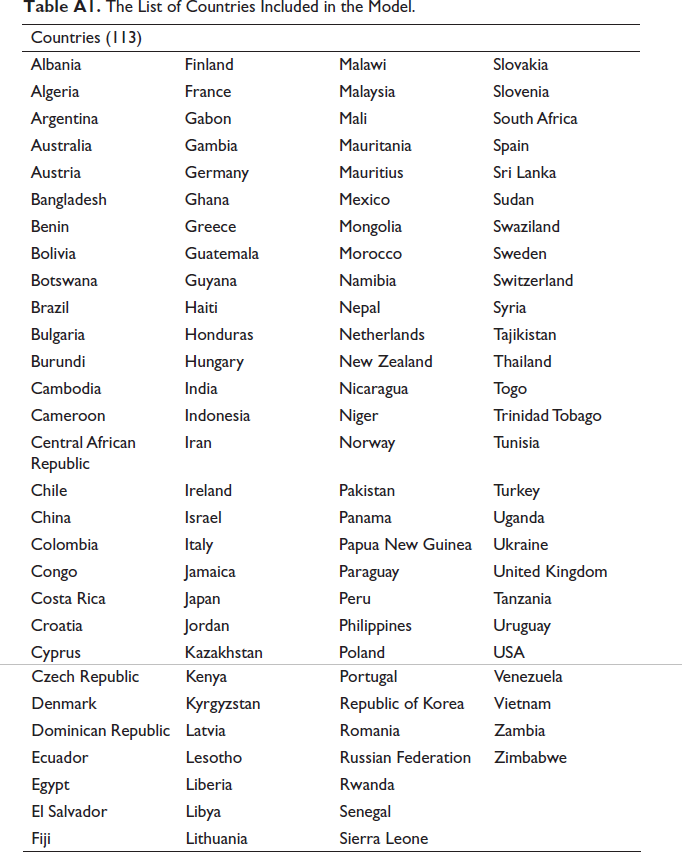
All variables, except democracy (polity2), are specified as a natural log. A complete list of countries included in our model is represented in Table A1.
Data Sources
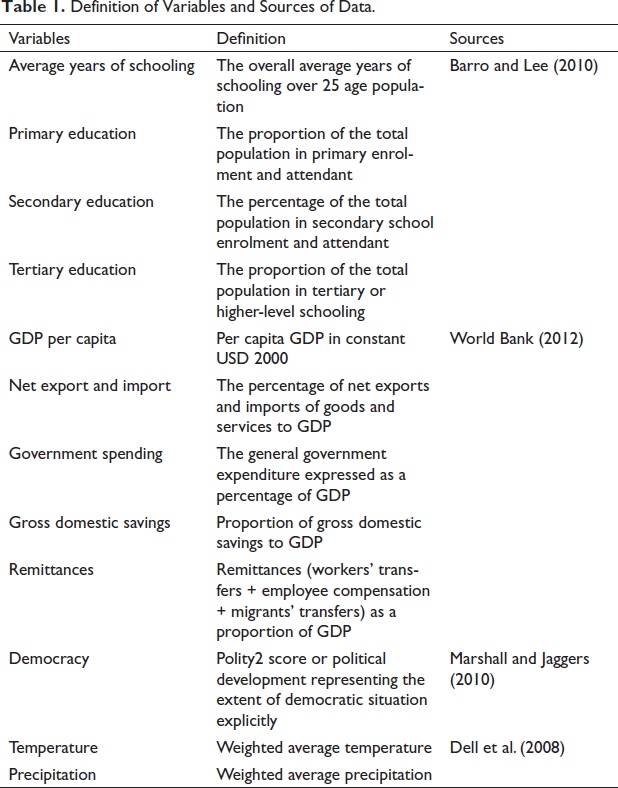
We develop a dataset including up to 113 countries between 1960 and 2010. Most of the data are gathered from the World Development Indicators (WDI) of the World Bank (2012), the Barro and Lee (2010) dataset on educational attainment, the Dell et al. (2008) dataset on temperature and precipitation, and the Marshall and Jaggers’ (2010) Polity IV score dataset regarding democratic development. Remittances (workers’ transfers, employee compensation and migrants’ transfer) data are collected from the WDI. The data on average years of schooling, primary, secondary and tertiary education are obtained from the Barro and Lee (2010) series. ‘GDP per capita’, ‘net exports and imports to GDP’, ‘gross domestic savings to GDP’ and ‘government spending to GDP’ data are accumulated from WDI. Data on political development representing democracy is obtained from the panel of Polity IV score. Climatic conditions, precisely the weighted—average temperature and precipitation data, are collected from Dell et al. (2008). Data sources and operationalisation of variables are elucidated in Table 1.
Definition of Variables and Sources of Data.
Endogeneity
Regression modelling through ordinary least square (OLS) estimation may create a bias if one of the explanatory variables is not exogenous, that is, it suffers from the endogeneity problem. For this reason, it is an additional challenge to estimate Equation (1) if the error terms correlate with remittances, denoted as an endogeneity problem in this study. The estimated coefficient of remittances may be biased if remittances and errors are correlated. Two possible sources of bias can arise here. The first source may be the omitted variables; for instance, remittances can be inversely connected with per capita income or household income, whereas they can be positively correlated with education/schooling. The second source may be a joint determination of remittances and human capital accumulation. One may argue that remittances promote investment in education and similarly the other way around, that is, investment in education can also increase the remittances inflow. Due to the reason mentioned earlier of the endogenous explanatory variables, OLS can create underestimation or overestimation of the magnitude of regression coefficients. IV model can be one of the solutions in regression analysis to deal with the biases arising from endogeneity (Baum, 2006, p. 184; Cameron & Trivedi, 2010, p. 171; Greene, 2003, p. 219). Hence, we apply the IV model to get the unbiased estimators or coefficients of the regressors.
To apply the IV model, we review the literature to find relevant instruments of remittances. We find that the environmental situation of a region is one of the crucial reasons for migration from one place to another, and the climatic condition is a crucial determinant of income and health development (Tang et al., 2009). In the IV model, some researchers use ‘yearly rainfall’ (Miguel et al., 2004), while others use ‘annual precipitation’ as growth instruments (Miguel & Satyanath, 2011). Based on this, we argue that climatic condition is a good instrument of remittance because this is an important source of revenue for many developing countries. We, therefore, use weighted average—precipitation and temperature as instruments of remittances in IV estimation following Miguel et al. (2004) and Miguel and Satyanath (2011).
Sargan-Hansen Test
The Sargan–Hansen test checks the validity of the IV model’s instrumental variables (instruments). It is also known as the test of over-identifying restrictions (Baum, 2006, p. 190). If the test does not reject the null hypothesis (the omitted instruments are not valid), the model is good enough because the instruments pass the test.
Model Fit Indicators
In our IV model, we explain the estimated coefficients along with their standard errors, the p-value of the F test representing the significance of the model, the F statistic and the p-value of the Sargan test for checking the validity of instruments.
Results and Discussions
This section represents the outcomes of the empirical investigation and explains the analytical results along with coherent literature.
Human Capital Accumulation
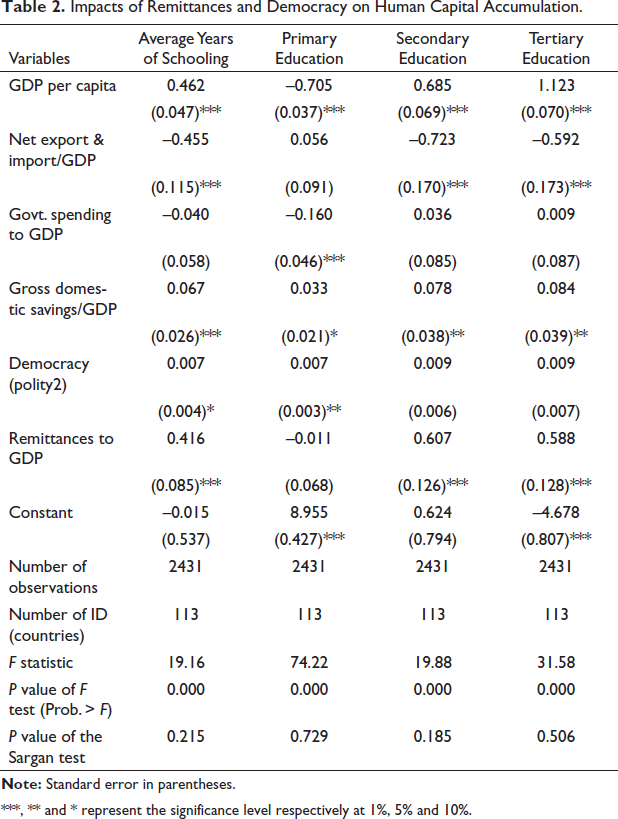
Table 2 estimates Equation (1) for primary, secondary and tertiary education and average years of schooling. In all sets of regression, we control for the variables listed in the methods. A natural log for the variables helps us explore the model’s remittances through elasticity.
Impacts of Remittances and Democracy on Human Capital Accumulation.
***, ** and * represent the significance level respectively at 1%, 5% and 10%.
The results of our IV model indicate that remittances have a significant positive relationship with average years of schooling. If the percentage of remittances to GDP to developing countries is increased by 1%, the average years of schooling may lift by 0.42% globally. This is a significant influence of remittances on global education. However, our model reports that remittances are statistically not significant for primary education. One of the reasons for this could be the low cost (and almost free) of primary education than secondary and tertiary (higher) education around the globe. Most governments of low-income and developing countries give much subsidy to primary schools for increased enrolment of kids. This is due to a critical condition of funding to developing countries from foreign funding agencies and development organisations. Nonetheless, remittances have a significant positive relationship with secondary and tertiary education. Although at secondary and tertiary levels of education in many developing countries, an opportunity cost exists to go to school rather than work. Remittances amplify the economic power of the migrants’ families, and thereby they can spend more money on both secondary and tertiary education. Panel estimation of the model indicates that if the percentage of remittances to GDP is increased by 1%, secondary and tertiary education enrolment may increase respectively by 0.61% and 0.59% globally. This suggests that, for instance, the average 12.9% annual growth rate of remittances to developing countries in the decade of 1999–2008 can lead secondary and tertiary education respectively by around 7.87% and 7.61%, and consequently, it can lead to average schooling years by 5.42% around the globe. Córdova (2006) and Amuedo-Dorantes and Pozo (2010) confirm our findings on secondary education, who also suggest a significant positive influence of remittances on secondary school education. Furthermore, our model suggests a significant positive impact of remittances on the global tertiary level of education (Table 2).
Next to remittances, our model reports that democracy has a positive relationship with average schooling years and primary education. Our results are in line with Lake and Baum (2001), Feng (2003), Baum and Lake (2003), Stasavage (2005) and Bobba and Coviello (2007), who also report a significant positive influence of democracy on education. Furthermore, Klomp and de Haan (2013) strongly suggest that democracy significantly influences human capital accumulation. Our results, therefore, confirm the positive influence of democracy on educational advancement around the globe.
On control variables, the results of the IV model show that GDP per capita is positively related to average years of schooling. Although a negative relationship exists between GDP per capita and primary education, our model finds a positive effect on both secondary and tertiary education. Consequently, it can be crucial in increasing schooling in developing countries. It finds that net exports and imports to GDP negatively influence average schooling years and secondary and tertiary education. General government spending has a negative influence on primary education. However, gross domestic savings to GDP can positively influence human capital accumulation as our model shows a positive and significant effect on all levels of education along with average years of schooling (Table 2).
Impact of Remittances on Education in Relation to Gender and Democracy
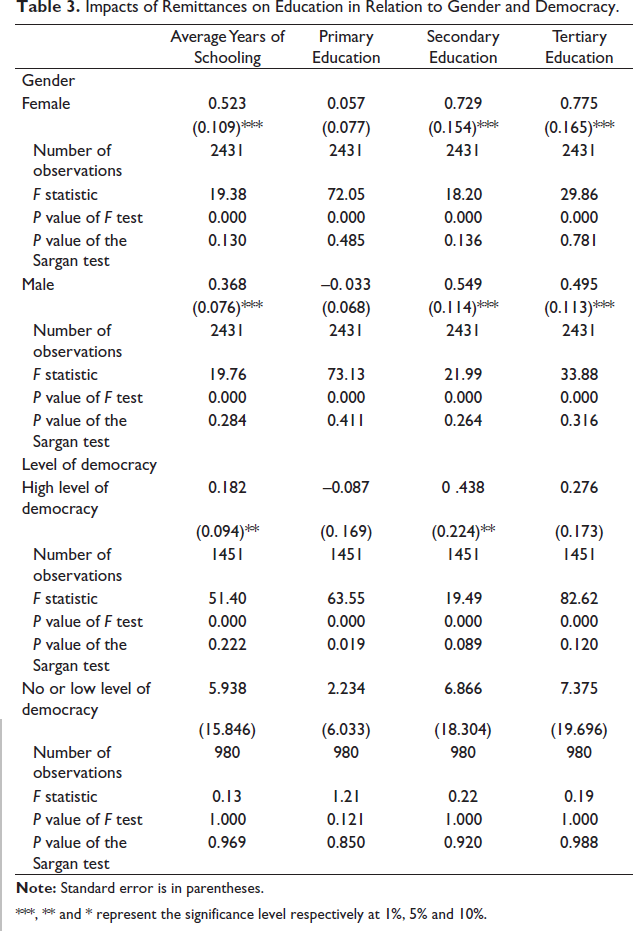
To differentiate the effects of remittances on males’ and females’ education, we analyse the data separately for them. IV model shows a significant positive influence of remittances on males’ and females’ secondary and tertiary education and average schooling years (Table 3). However, our results are the opposite of Bansak and Chezum’s (2009) findings, who report a more significant positive influence of remittances on male children’s education than female children’s education in the case of Nepal. Our model reports that if remittances to developing countries increase by 1%, then it can lead to average schooling years, secondary and tertiary education respectively by around 0.52%, 0.73% and 0.78% for females, and by around 0.37%, 0.55% and 0.50% for males around the world. Based on this, we suggest that the impacts of remittances to low-income developing countries are more significant for females’ than males’ education. There may be two possible reasons behind it. First, most low-income households in developing countries prefer to send male kids to school instead of female kids because of financial constraints. Second, they also prioritise more for males’ education over females at the secondary and tertiary levels because of the high cost of education. Our results are supported by Amuedo-Dorantes and Pozo (2010), who also report a higher remittance effect on girls’ school attendance than that of boys. Therefore, remittances can promote females’ education more than males’ education by overcoming financial constraints and investing the remittances for their education.
Impacts of Remittances on Education in Relation to Gender and Democracy.
***, ** and * represent the significance level respectively at 1%, 5% and 10%.
Next to gender, our model finds that remittances significantly positively influence average schooling years and secondary education in the case of developing countries where a high level of democracy exists. It may be the reason that democratic governments put more emphasis on education. Nonetheless, our model finds statistically not significant effects of remittances on education in the case of developing countries where no or low level of democracy exists. This suggests that the democratic situation of developing countries does matter for the implication of remittances on education.
Impact of Democracy on Education in Relation to Gender
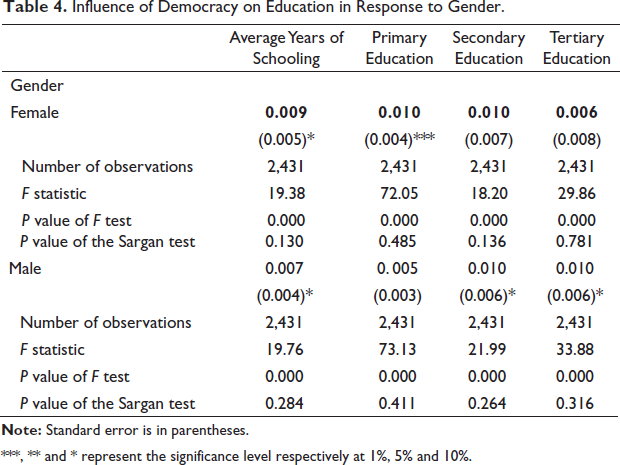
Next to remittances, our IV model tests the influences of democracy on education, precisely average schooling years, primary, secondary and tertiary education, in relation to gender at the global level (Table 4). Our model finds that democracy significantly correlates with females’ and males’ average schooling years. Moreover, our model reports that democracy has a significant and positive relationship with females’ primary and males’ secondary and tertiary education. The results also show that the coefficient of democracy is slightly higher for females’ years of schooling (0.009) compared to that for males (0.007). Based on this, we suggest that democracy can promote more females’ education, which helps empower them around the globe.
Influence of Democracy on Education in Response to Gender.
***, ** and * represent the significance level respectively at 1%, 5% and 10%.
Conclusion
The remittance flow to developing countries is steady worldwide, and development professionals and policymakers acknowledge its several development potentials. Nevertheless, literature on the influences of remittances and democracy on human capital accumulation in relation to gender at the global level is still limited. Comprehending this call, we analyse the effects of remittances and democracy on human capital accumulation in terms of education, especially primary, secondary and tertiary education, and average schooling years, at the global level through IV model. The results of our model using data from various valid international sources show that remittances positively and significantly influence average years of schooling and secondary and tertiary education around the world. Furthermore, remittances have a significantly higher contribution in the case of females’ education compared to their male counterparts. Our results also suggest that remittances are more instrumental for education in higher democratic developing countries than in developing countries with no- or low-level democracy. Next to remittances, the results show that democracy significantly positively influences primary education and average schooling years globally. Moreover, our results suggest that democracy is effective in advancing the education of both males and females, but this is more effective for women than men. Based on the results above, we conclude that remittances to developing countries and democratic practices can support investing and leveraging women’s education, a key mechanism for empowering them worldwide.
Appendix
The List of Countries Included in the Model.
Limitations and Future Research
This research has some shortcomings, which are as follows. First, although our research is a cross-country analysis, we include 113 countries and exclude a few countries around the globe due to the unavailability of relevant data. Second, we use formally recorded data on remittances, which may be an underestimation of such data because it does not count informal flows of remittances. Household-level data can verify our results. Third, the generalised method of momentum (GMM) model of Arellano and Bond (1991) is not used in this study because of the less dynamic data on education. This research uses mean data of five years for three levels of education, including average schooling years. As dependent variables data in our model are not wholly dynamic, further research can validate our results by running the GMM model using a new set of dynamic data on education and overcoming the shortcomings above.
Footnotes
Declaration of Conflicting Interests
The authors declared no potential conflicts of interest with respect to the research, authorship and/or publication of this article.
Funding
The authors received no financial support for the research, authorship and/or publication of this article.
