



Abstract
Recent research on democratisation has highlighted the importance of religious actors in shaping political development. Scholars argue that the nature of state–religion relations could impact political activism of these actors. Comparing two of the largest Muslim countries in Asia, Indonesia and Pakistan, the objective of this article is to understand their post-authoritarian divergent political trajectories through an examination of their state–religion relations. Based on the comparative analysis of the institutional relationship and political theology, the article concludes that Indonesia and Pakistan differ in their respective patterns of state–religion relations, whereas the ‘respect-all’ model of Indonesia’s state–religion relations, characterised by mutual respect and accommodation between political authorities and religious institutions, helps consolidate its democracy by constructing institutional independence, its moderate political theology also embraces democratic values and pluralism. In contrast, Pakistan’s integrated state–religion relations, the absence of a ‘respect-all’ model, and its commitment to traditional political theology aimed at establishing an Islamic state pose challenges to its democratisation efforts. Drawing implications for peacebuilding and security, Indonesia’s state–religion relations could offer a potential model for Muslim democracy in South Asia and beyond.
Introduction
Ever since Alfred Stepan’s ‘twin tolerations’ principle paved the way for acknowledging the possibility of democracy in a religious society, the transition of several Muslim countries from the authoritarian rule could now be examined from the perspective of democratisation. The point of departure for this article is that Indonesia and Pakistan constitute two comparable cases of the Muslim societies that have transitioned from authoritarian rule in recent decades but differ in terms of their post-authoritarian democratic outcomes. 1 The historical, ideological and structural points of departure for both countries are roughly the same. Both colonies gained independence in the immediate post-World War II period—what Huntington (1993) calls the ‘second wave’ of democratisation. The predominantly Sunni-Muslim populations of both the countries, at that juncture, were united in their aspirations for an increased role of religion in the public sphere. 2 In addition to sharing a similar ideological outlook, the initial political trajectories of both societies bear remarkable similarities. Both states, in the course of their political development following independence, quickly fell victim to the ‘reverse wave’, in that democracy fell to authoritarianism and, as a result, have been subjected to more than 30 years of authoritarian rule. 3
The most recent transitions to democracy in Indonesia and Pakistan followed the downfall of the Suharto and Musharraf regimes in 1998 and 2008, respectively. Notably, Indonesia has displayed signs of democratic consolidation, while Pakistan’s democratic performance has been less favourable. Shortly after its transition in 1998, Indonesia significantly improved its Freedom House Political Rights score, achieving a 4-point gain to reach a score of 3. By 2006, eight years post-transition, Indonesia consistently received a score of 2, the second-highest possible score on the Freedom House scale. Despite the recent challenges encountered by Indonesian democracy, as indicated by Warburton (2020) and Power and Warburton (2020), it has still managed to attain a Political Rights score of 2 in 2022. This achievement represents the highest score maintained by a Muslim democracy for nearly two decades. This democratic progress is further underscored by Polity IV rankings, where Indonesia has maintained a consistent +8 rating since 2006. In contrast, Pakistan has struggled to enhance its ranking since the return of civilian governance. Although it managed to improve its Political Rights score from 6 to 4 in 2009, maintaining this score for nearly a decade, it failed to make further progress. Unfortunately, Pakistan’s ranking has declined since 2019, reverting to a score of 5 in Political Rights. Similarly, in Polity IV rankings, it has been unable to surpass its +7 rating achieved in 2013. In terms of the characteristics of consolidated democracy that manifest themselves in attitudes, behaviour, and in political institutions, again, the case for Indonesian consolidation, as the article shall explain, is much stronger than Pakistan. 4
What explains the democratic gains of Indonesia relative to Pakistan? While acknowledging the multifaceted nature of the democratisation process influenced by various internal and external factors like the military’s role, economic disparities, ethnic divisions, political culture and regional tensions, this article underscores the pivotal role of state–religion relations in shaping democracies. One of the eminent scholars of democratisation, Alfred Stepan, has long drawn scholars’ attention to the complex interplay of state–religion relations (the twin tolerations) and democratisation. Recent research has expanded on Stepan’s ideas explaining how variations in the two tolerations could affect democratisation outcomes by influencing religious actors’ political activism (Kunkler & Leininger, 2009; Toft et al., 2011). On account of the institutional and ideological nuances, these actors could either be staunch supporters of democracy or, conversely, derail the democratisation process by siding with the authoritarian regimes. 5 These works provide empirical validity to Stepan’s institutional imperatives by showing how a twin-tolerations-friendly model encourages pro-democratic activism in religious actors while an unfriendly pattern leads to counter-democratic activism.
This article, accordingly, employs a comparative approach to investigate the divergent political trajectories of Indonesia and Pakistan by examining their state–religion relations. Utilising a combination of qualitative and quantitative data within a comparative framework, this research aims to provide a comprehensive and nuanced analysis of state–religion relations in both countries. It offers valuable insights into the broader context of democratisation and its implications for peace and security in the South Asian region. Qualitatively, the research draws on an in-depth review of literature on democratisation, political theology and tolerance, alongside primary sources such as government documents, religious texts and statements from religious and political leaders. Quantitatively, the article incorporates data from reputable surveys and statistical sources to complement the qualitative findings.
The article sets off by engaging democratisation literature to highlight its various processes and issues. The debate on religion, specifically Islam and its relationship to democracy, bring this article to Alfred Stepan’s conception of the twin tolerations. In the following section, the article utilises this theoretical device to contrast the nature of state–religion relations in Indonesia and Pakistan. Without asserting deterministic causality or oversimplifying the intricate democratisation process, the article concludes that Indonesia and Pakistan diverge in terms of their respective patterns of state–religion relations, which may account for the discrepancies in their post-authoritarian political trajectories.
Democratisation, Religion and the Twin Tolerations
Democratisation is typically understood as involving multiple processes—opening, transition, consolidation and de-democratisation (O’Donnell et al., 1986). The erosion of authoritarian rule signifies the opening phase followed by a transition that is marked by a regime change from a non-democratic to a democratic political system. This is believed to be accomplished when the society under purview agrees on some fundamental political procedures that lead to popular elections and, as a result, a government comes into existence. With the emergence of a legitimate and autonomous executive power, democratisation enters its final phase, consolidation. A successful consolidation, scholars believe, occurs when democracy emerges as the ‘only game in town’ and manifests itself in three dimensions: behaviour, attitude and constitution (Linz & Stepan, 1996, pp. 5–6).
A democracy is consolidated when, behaviourally, ‘no significant political groups attempt to overthrow the democratic regime or secede from the state’; attitudinally, an overwhelming majority of its population, even in the face of crises and hardships, does not lose faith in the democratic principles and instead seek political solutions; and constitutionally, when a democratic constitution is set in place, and all players become subjected to the resolution of conflict within specified laws (Linz & Stepan, 1996, p. 6). Failure to institutionalise democratic norms, scholars’ caution, might leave democratic institutions vulnerable to de-democratisation or the ‘reverse wave’—that is, slipping back to some form of non-democratic rule. A related and relatively recent issue concerns the place of religion, specifically Islam, vis-à-vis the democratisation process.
Against the traditional and essentialist standpoints that either wholly discount ideological forces or view them in a negative light (e.g., Huntington, 1996; Rawls, 1993), the present article attempts to engage the religion and politics discourse espoused by scholars who believe that no religion or civilisation is inherently pro- or anti-democratic. One of the leading democratisation scholars, Alfred Stepan, for instance, contends that Islam, like all other religions, is multivocal in the sense that it has some elements that are used to create democratic friendly attitudes and practices while other elements are highlighted to support a non-democratic political system. Furthermore, in redefining the minimal institutional boundaries of a democratic polity, he maintains that secularism in a strict dichotomous sense is not a necessary condition for democracy. What is minimally required is not a complete exclusion of religion from the political affairs, but the ‘twin tolerations’, that is, an agreement of non-interference between its religious and political actors (Stepan, 2000, pp. 37–40).
The first principle of the twin tolerations holds that a democratic state should not control religion by restricting religious actors’ access to civil and political arenas. While political authorities guarantee religious and political freedom, the second tenet of the twin toleration demands that no religious institution in a democratic polity should have a constitutional prerogative over the elected officials. In other words, religious authorities do not control the state and, instead, respect the democratic norms and other citizens’ rights. These two tolerations, according to Stepan, mark the minimal institutional boundaries for a democratic state–religion relationship. In many long-standing democracies of the West, Stepan argues, the development of these tolerations could best be understood as socially and politically constructed arrangements. In other words, there is nothing unique about Western democracies, as traditionally claimed. Such a compromise, in fact, could be crafted elsewhere with the twin-tolerations-friendly policies and practices (Stepan, 2011, p. 114).
If Islam is multivocal and the twin tolerations are socially constructed arrangements, then what is the nature of state–religion relations in the Muslim democracies? Stepan argues that the Muslim societies that fulfil minimal institutional and political imperatives of democracy generally fall into two types of state–society–religion patterns. Except for Turkey, which follows the separatist model, the rest of the Muslim and Muslim-majority democracies—India, Indonesia, and Senegal, for instance—come close to what he calls the ‘respect-all’ pattern of the twin tolerations (Stepan, 2011, p. 126).
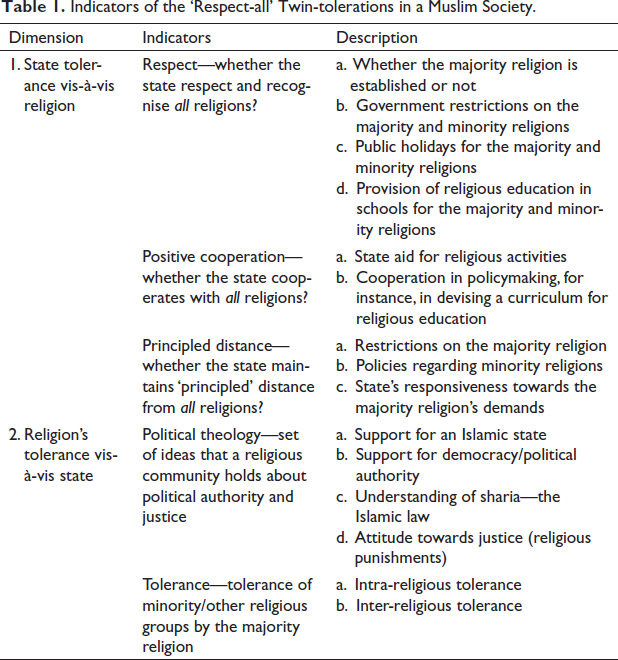
In his various works, Stepan has set numerous quantitative and qualitative markers for the dual dimensions of the respect-all model, as noted in Table 1. 6 The first dimension of the twin tolerations, that is, the state tolerance vis-à-vis religion, enlists those regulations and practices by the political authorities that ensure religious actors’ freedom and respectful treatment by the state, ensuing in positive cooperation between the two. The second dimension, that is, religion’s tolerance vis-à-vis state, underscores the attitude and behaviour of religious actors that are indicative of tolerance towards the political authority and the fellow citizens. Together, these two dimensions reflect the socially and politically constructed nature of the twin tolerations in a Muslim society. In what follows, the next section attempts to expand on these indicators by mapping the state–religion relations in Indonesia and Pakistan.
Indicators of the ‘Respect-all’ Twin-tolerations in a Muslim Society.
State–Religion Relations in Indonesia and Pakistan
The institutional requirements of the twin tolerations are helpful in determining whether a religious society’s political system meets the minimum qualifications of being democratic. From the institutional standpoint, many Muslim countries (except Iran, in which the Supreme Leader, a religious figure, is constitutionally much stronger than the elected president, legislature or executive) could qualify as democratic. For example, most relevant to the current discussion, both Indonesia and Pakistan, our comparative cases, seem to qualify as being democratic. The respective constitutions of both countries do not favour any religious institution or actor over the elected government. Islam is declared as the official religion in Pakistan, but the Islamic Ideology Council and the Shariat Court—two of the top constitutionally sanctioned religious institutions—only have the advisory power that is not binding on the political authorities. Likewise, there are no explicit laws, neither in Indonesia nor Pakistan, that prohibit the religious actors from participating in civil and political societies.
Despite their apparent qualification, a more nuanced and meticulous analysis reveals that the nature of state–religion relations in both polities is quite different. Conceiving the twin tolerations as a continuum representing the range of twin tolerations-friendly and unfriendly patterns, Pakistan lies more towards the unfriendly end in which religious actors could preclude the necessary degree of autonomy for political authority (Stepan, 2000, p. 43). While the national constitution does not designate any preferential status to any specific group or institution, over the years, however, the instrumental use of religion by the state has furnished the majority religion (Sunni Islam) with the necessary power and influence to interfere in democratic politics. Additionally, as we shall see below, both the government’s involvement in religion and religious majoritarianism have precluded the basic religious freedom to minority groups. Indonesia, on the other hand, exhibits twin tolerations-friendly state–religion relations in which both religious and political actors abide by the democratic rules, and religious minorities possess relatively greater freedom than Pakistan. These differences in the state–religion relations, it is believed, impact the respective levels of democratisation in both polities.
State Tolerance Vis-à-vis Religion
Respect
There are several ways a state in a Muslim or a significant Muslim majority society can award respect and recognition to religion(s). For instance, as noted in Table 1, the states in the respect-all model have traditionally shown their respect by not granting the majority religion an official status. It is important to clarify that establishing an official religion does not automatically render state–religion relations non-democratic. As Stepan’s established religion model of the twin tolerations verifies, many Western democracies do not necessarily violate the two principles of the twin tolerations since the established religions lack the legal and cultural power to override democratic politics or infringe upon the minority rights.
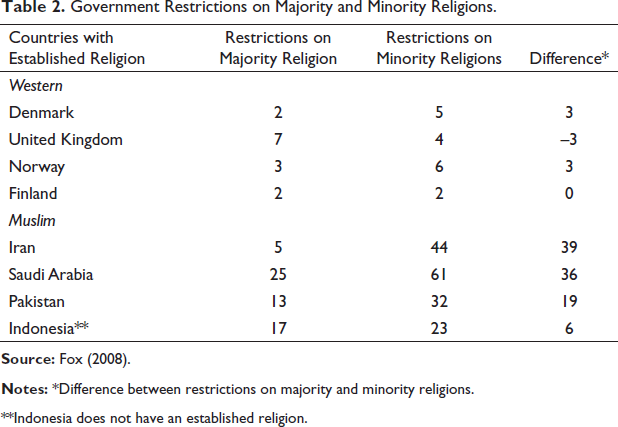
The defining parameter here is the effect of established religion on religious freedom. One way to measure this impact is by treating the established religion model as a continuum. Table 2 shows the degree of state control of religion in various established religion polities of the world. A comparison of government restrictions on the majority and minority religions might reveal the degree of state control and/or preferential treatment. More difference implies a more favoured status for the majority religion that could correspond to less respect for religious minorities. As shown in Table 2, all the established-religion Muslim polities score higher on religious restrictions relative to the established-religion Western democracies. However, within the Muslim polities, apart from Indonesia, the rest of the Muslim countries have high scores on the fourth column that roughly translates to relatively less respect for the minority religions.
Government Restrictions on Majority and Minority Religions.
**Indonesia does not have an established religion.
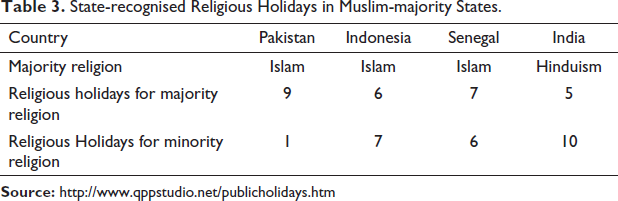
The state respect for religions might also be gauged by looking at the number of religious holidays for the majority and minority religions. As Table 3 clarifies, Indonesia, Senegal, and India, the three respect-all states, accord considerable respect to minority religions by sanctioning public holidays on religious occasions. Pakistan, in contrast, only allows one religious holiday to its Christian minorities on 26th December, the second day of Christmas. 7 Finally, the provision of the majority and minority religious education in public schools constitutes another dimension of state recognition of diversity and pluralism, which ties into respect for religion and religious minorities. Both in Indonesia and Pakistan, religious education is compulsory in public schools. However, Pakistan only provides religious education in the majority religion, that is, Islam (Fox, 2008, p. 200). While religious minorities are exempt from receiving state-sanctioned religious education in Islam, scholars on Pakistan’s education have consistently highlighted various mechanisms through which the state forcefully imparts its Islamic education to its non-Muslim minorities (Ahmad, 2008; Dean, 2008). The religious minorities in Indonesia, on the other hand, can choose a religious education consistent with their faith. Since the New Order regime, public schools in Indonesia provide compulsory religious education in all the state-recognised faiths—Islam, Catholicism, Protestantism, Buddhism and Hinduism. 8
State-recognised Religious Holidays in Muslim-majority States.
Positive Cooperation
The state cooperation and assistance to the majority and minority religions constitute another dimension of state respect and recognition. State aid for religious activities—building a house of prayer and assisting in pilgrimages, for instance—and its cooperation with various religions on important policy matters—devising a religious education curriculum or seeking input on related policy matters—can have a double effect. On the one hand, it shows the state’s attitude towards various religions, and, on the other hand, it can bolster religious pluralism. A mere glance at the institutional mechanisms in place for dealing with religious groups makes this contrast apparent. The ministries of religious affairs in each country are the right place to start since these governmental bodies deal with issues related to the majority and minority religions.
After its creation in the mid-1940s, the Indonesian Ministry of Religious Affairs (I-MORA) has remained consistent and, over the years, grown both in terms of functions and influence. The ministry now oversees eleven units, three expert staffs, two centres, and occupies a whole block in downtown Jakarta. 9 Since 2008, the ministry’s budget has been increasing by an average of 25% annually, reaching almost 4 billion USD, approximately 8% of the total state budget, in 2015 (see Table 4). Over the years, the ministry has extended its reach to bring the institutions of religion, primarily Islamic education, within its fold. It has developed effective policy cooperation with the leaders of Islamic educational institutions resulting in a standardised curriculum. Consequently, all the institutions of Islamic education in Indonesia follow I-MORA’s authorised curriculum. Due to its extensive network of religious education—from madrasas and state colleges to Islamic universities—more than 80% of I-MORA’s annual budget goes towards managing these institutions.
Indonesian Ministry of Religious Affairs, Budget 2015–2016.
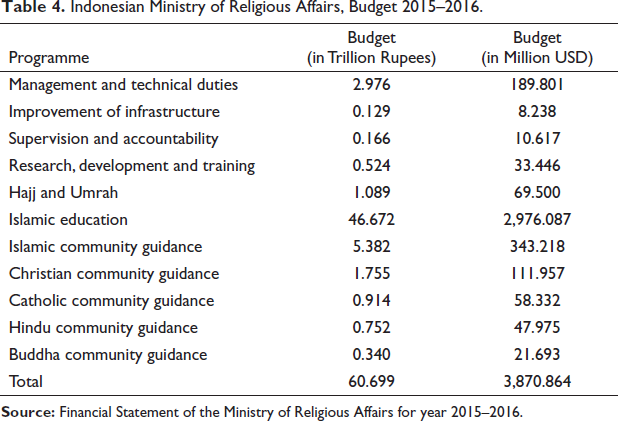
In comparison, the Ministry of Religious Affairs in Pakistan (P-MORA) has never been so consistent, diverse, or influential. I-MORA outperforms P-MORA in terms of scope and levels of institutionalisation. A mere glance at their respective annual budgets is sufficient to highlight the contrast between the two institutions (compare Tables 4 and 5). Created in the mid-1970s, two-and-a-half decades after the creation of Pakistan, the ministry underwent several transformations. Two of its important portfolios—subjects related to minorities and religious tax (Zakat) collection—have been, at various points, separated from the ministry. Where it has made the ministry financially less independent, it has also precluded effective cooperation between the ministry and the minority religious groups. As seen in Table 4, five Directorate Generals within I-MORA provide guidance to the officially recognised religions—Islam, Christianity, Catholicism, Buddhism and Hinduism. No comparable specialised mechanism exists in P-MORA.
Pakistan Ministry of Religious Affairs, Budget 2015–2016.
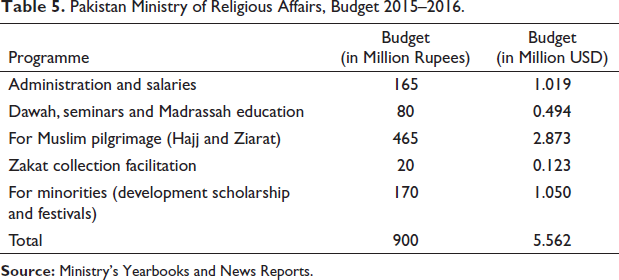
What is more, before the promulgation of the Pakistan Madrassah Education Board Ordinance (PMEB) in 2001, religious education did not come within the ministry’s purview. In the backdrop of the US invasion of Afghanistan in 2001 and the growing concerns over the alleged linkage between madrasa education and terrorism, the ministry was given the task to reform the madrasa system through registering private madrasas and establishing a parallel network of public madrasas where religious and formal education would be taught together. Unlike Indonesia, however, the cooperation between the religious and political authorities over these issues never fully materialised. Ever since the introduction of PMEB, madrasa reforms have become a thorny issue between the two with no substantive outcome. With regards to establishing a parallel system of religious education, the ministry, thus far, has only been able to launch three madrasas. These model madrasas—in Islamabad, Sukkur and Karachi—host less than 1,000 students compared to millions of students who study in more than 30,000 private madrasas across Pakistan (Government of Pakistan, 2016).
Principled Distance
The final dimension in the state’s toleration towards religion concerns its attitude and policies towards various religions. A state that values all religions would maintain, in Rajeev Bhargava’s terms, ‘principled distanced’ from all religions (Bhargava, 2007). A principled distance does not imply a state’s neutrality or equal treatment of all religions; rather, this approach imposes restraints on religious majoritarianism or on religions that violate human rights. One way to grasp principled distance is to look at the state’s regulations towards the majority religion. In Table 2, we can see that the Indonesian state has more restrictions on the majority religion than that of Pakistan. What is more, its restrictions on minority religions are far less than Pakistan’s. One important restriction, for instance, the Indonesian state has on all religions, including Islam, is that it is illegal to proselytise and attempt to convert others to one’s faith (Fox, 2008, p. 202). Also, there is no restriction on the members of minority religions to compete for public offices. In fact, the former governor of Jakarta, Basuki Tjahaja Purnama (2014–2017), was a member of the minority Christian religion. As various experts have noted, the Indonesian state is also relatively less responsive to the majoritarian demands (Stepan, 2011, p. 135). These policies and state attitudes, taken together, have effectively prevented the majority religion from establishing its hegemony.
In contrast, there are no parallel restrictions on the majority religion in Pakistan which has always been socially and politically assertive. Due to the majority religion’s demands, the state has been compelled to determine the religious status of a former Muslim sect, the Ahmadis. Consequently, since the passing of the second constitutional amendment in 1974, it is illegal for the members of this sect to associate themselves with the majority religion or its religious practices. Moreover, the constitution not only restricts non-Muslims from running for political offices but in the absence of any safeguarding measures, the forceful conversions of minority religions to Islam are also prevalent. 10 The social influence and power of the majority religion has also prevented any concrete measures redressing some of the controversial laws—blasphemy and Hudood Ordinances, for instance—which provide the legal framework to persecute women and religious minorities wrongfully. In 2006, the military regime of General Musharraf, and in 2017, the civilian government of Pakistan Muslim League (N) tried to introduce constitutional reforms evoking a strong response from the members of the majority religion. In the latter instance, the government apologised and had its sitting Law Minister resign due to the pressure of religious groups (Abbas & Rasmussen, 2017).
Religious Tolerance Vis-à-vis State
Political Theology
Whereas political authority’s religion-friendly policies and respectful attitude constitute the first toleration, religious actors’ attitude and behaviour towards the state, in turn, determine the nature of the second toleration. Political theology, consequently, encompasses those attitudes of religious actors that relate to political authority. 11 All religions, Stepan claims, are multivocal in the sense that they contain elements that could be stressed to promote either a twin tolerations-friendly or unfriendly political theology (2000, p. 48). The former could be created by advocating elements that promote respect for political authority and fellow citizens. Consequently, the set of ideas this article wishes to examine relates to an understanding of legitimate political authority, the notion of justice, and attitude towards tolerance (see Table 1).
At the institutional/organisational level, the article compares the political theology of Indonesia and Pakistan’s major religious actors—leading Islamic groups and religious political parties (see Table 6). Through their grassroot connections, mass following and educational institutions, these actors also influence the Muslim masses in their respective societies. At the societa. 12 level, the article utilises two of the leading surveys on the role of religion in the public sphere: (a) World Values Survey (WVS), and (b) Pew Research Centre’s Forum on Religion and Public Life (PEW). 13
In Indonesia, Nahdlatul Ulama (NU) and Muhammadiyah (MU) constitute the two largest socioreligious organisations with a combined membership exceeding 70 million. Historically, these actors have advocated the concept of an Islamic State, reflecting a traditional political theology (Abdillah, 1997; Kunkler, 2013). However, in the post-transition period, they invoke pro-democracy elements in the Islamic tradition to support a democratically arrived compromise (Pancasila) over an Islamic state. As scholars of religion and Indonesian politics have pointed out, this shift in the perspectives of religious actors, moving from a traditional political theology that emphasised strict sharia rule and the concept of an Islamic state to a more moderate political theology that accommodates democratic principles, diversity and pluralism, owes to the emergence of neomodern religious thought. 14 Influenced by this qualitative shift in the interpretation and understanding of religion, Indonesian mainstream religious political parties now also favour Pancasila (see Table 6). The latest arrival to the Indonesian religiopolitical landscape is Jemaah Tarbiyah, a Muslim Brotherhood-inspired organisation. Between the traditional NU and the modernist MU, it offers a third alternative to the Indonesian Muslims. The movement’s political instrument, Prosperous Justice Party’s (PKS) initial emphasis on Islamisation and sharia led some scholars to fear the resurgence of radical Islam in Indonesia, however, even after winning significant seats in the last four legislative elections, PKS policies have been pragmatic, and it has also come to terms with the Pancasila compromise (Hilmy, 2010; Machmudi, 2008).
Political Theology of Major Religious Actors in Indonesia and Pakistan.
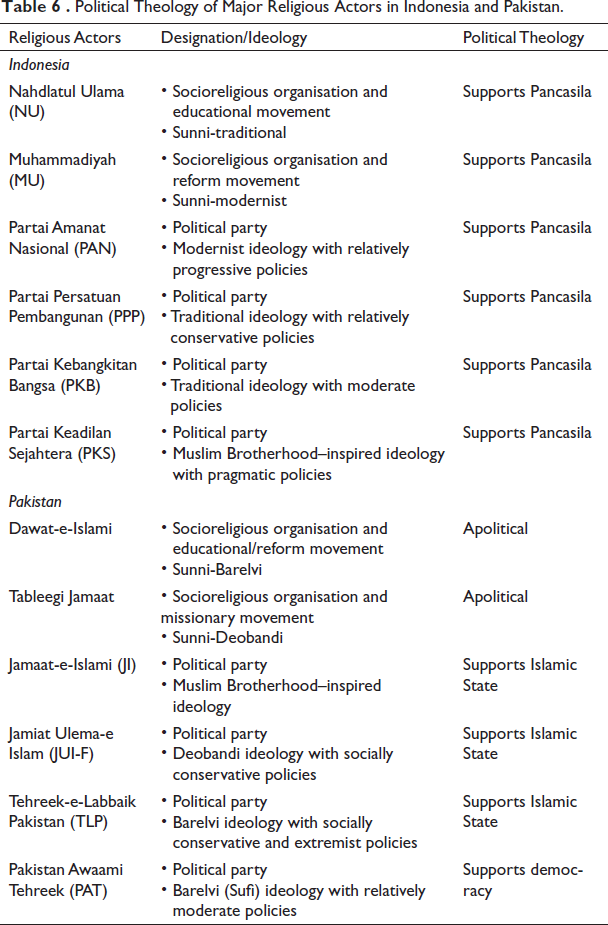
Unlike Indonesia, where NU and MU provide legitimacy to the democratic rule by endorsing politically crafted compromise of Pancasila, two of the largest socioreligious groups in Pakistan, Dawat-e-Islami and Tableegi Jamaat, have not openly embraced the democratic ethos. Despite being apparently apolitical, the traditional religious thought under which these groups operate prefers a univocal interpretation of sharia based on conformity (taqlid) and a rejection of intellectualism. 15 This strict understanding of sharia is also evident in the traditional political theology of the two major Sunni sects—Barelvi and Deobandi. 16 The political parties associated with these groups, Jamiat Ulema-e Islam (JUI-F) and Tehreek-e-Labbaik Pakistan (TLP), for instance, seek to create an Islamic state via elections (see Table 6). The only exception, however, is the nascent religious movement of Minhaj-ul-Quran and its affiliated political party, Pakistan Awami Tehreek (PAT). Minhaj and PAT do not endorse the Islamic state concept otherwise popular among the mainstream Sunni groups. Nonetheless, its support base is limited, and the movement falls short of articulating a political theology marking a clear break from the traditional religious thought. 17
The influence of traditional and neomodern religious ideologies, along with their respective political theologies in Indonesia and Pakistan, also shapes the political beliefs of individuals in these countries. Figure 1 notes the attitudes of Indonesian and Pakistani societies regarding democracy and religion. The first variable shows a considerable number of people in both polities who think democracy as a political system is important. The relative importance of political authority in relation to religion, nonetheless, varies. An overwhelming majority in Pakistan (60%), for instance, favoured interpretation of laws by the religious authority as an essential aspect of democracy. The level of support in Indonesia for this position is almost one-half of that in Pakistan (33%). This lack of trust in political authority is also reflected in their favour of the army taking over the incompetent civilian government (54%) compared to 28% in Indonesia in the third variable (Maqsood, 2016).
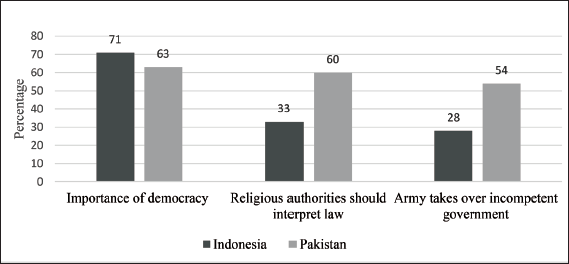
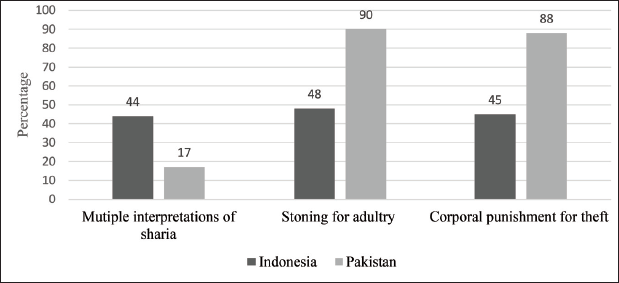
Figure 2 is based on the PEW data representing the views of Indonesian and Pakistani societies on the crucial question of sharia. Here, again, the views of Indonesian society show a remarkably different character from their Pakistani counterpart. Indonesia, as it can be observed, has a moderate view of sharia, distinct from the stance taken by Pakistan, which some scholars have more recently labelled as the ‘Islamic Zion’ owing to its Islamic fundamentalism (Sulehria, 2022). On the question of the possibility of multiple interpretations of sharia, almost one-half of the Indonesian respondents (44%) agreed. Pakistan, on the other hand, only generated 17% of responses in favour of multiple interpretations of sharia. In other words, the multivocality argument generates more support in Indonesia than in Pakistan. An immutable univocal character of sharia can also be observed in Pakistani society by the degree of support for religious punishments for adultery (90%) and theft (88%), which is among the highest in the Muslim world. 18
Religious Tolerance
While state toleration of the majority and minority religions constitutes an integral element of the first dimension of the twin tolerations, developing an overall accommodating attitude in society vis-à-vis beliefs and practices of other citizens is also a running theme in much of Stepan’s works. Arriving at a moderate political theology through debates among religious communities, as Stepan notes, could be achieved if the society is tolerant enough to let religious scholars and intellectuals disseminate their views in the public sphere (Kunkler & Stepan, 2013, p. 6). Religious tolerance, it could be argued then, is indispensable for constructing twin tolerations. In Indonesia and Pakistan, the majority population follows the Sunni variant of Islam while Shia, Ahmadi, Christians, and Hindus are considered the minority religious groups. 19 For intra-religious tolerance, the article is interested in the Sunni-Shia relations, while Muslim-Christian relations serve as a gauge for inter-religious toleration. The forthcoming analysis reveals that, despite recent upsurges in intolerance, Indonesia exhibits greater religious tolerance than Pakistan when viewed from a comparative standpoint. A glance at the comparative figures is sufficient to highlight the contrast in the two cases.
Although the Sunni-Shia relations in Indonesia, like the rest of the Muslim world, have been far from ideal, the first reported incident of sectarian violence in post-transition Indonesia occurred in 2011 in which a mob set ablaze a Shia neighbourhood (Formichi, 2014, p. 22). By contrast, in the post-transition phase, nearly 800 incidents have been recorded in Pakistan, resulting in approximately 3,000 casualties. According to the Jinnah Institute, an Islamabad-based research and policy foundation, between the years 2012 and 2015, nearly 1,900 Shia community members lost their lives to violence. 20
Concerning intra-religious tolerance, that is, Muslim-Christian relations in both countries, comparative literature is also telling. The plight of Christians in Pakistan has recently become an issue of grave concern (Gregory, 2012). Considered one of the lowest social groups in terms of access to resources, most Pakistani Christians work either as a bonded labour in rural areas or as sanitary workers in the major cities (Kuklin, 1998). Despite being a minority compared to the Muslims, most Christians in Indonesia, since its independence, have enjoyed positions of influence and authority, both in the society and in the civil-military bureaucracy. Consequently, the Muslim-Christian relations in Indonesia are entirely different in which Muslims resent the higher position of Christians disproportion to their numbers in the society. The access of Christians to resources can also be grasped by looking at their educational attainment from a comparative perspective. According to PEW’s measure of educational attainment of religious groups by country, the Indonesian Christian groups (both Protestant and Catholics) are estimated to receive an average of nine years of schooling, while the average schooling for the Muslims in Indonesia is 7.9 years (Hackett et al., 2016, p. 23). It is not surprising that no such data for Christians are available in Pakistan. The average schooling of Muslims is also very low, that is, 3.8 years.
Finally, to lend support to the above claims, it is helpful to contrast the two societies on various indices. According to the Positive Peace Index of the Institute for Economics and Peace that ranks countries on key domains, including the level of tolerance between different ethnic and religious groups, Indonesia is ranked 83rd. At the same time, Pakistan scores 138th position on its 2019 Positive Peace Index. 21 The plight of religious minorities in both countries might also be gauged from the Peoples Under Threat Index of The Minority Rights Groups International. This index highlights countries in which minorities are most at risk. In its 2019 list of 70 countries prone to violence, Pakistan is among the ‘top-10’ (a place it has maintained since 2007), while Indonesia ranks 67. 22 According to the 2019 World Watch List, a USA-based organisation that compiles annual reports of the ‘top 50 countries where Christians are persecuted for their faith’, Pakistan holds the fifth position in the ranking, with only North Korea, Afghanistan, Somalia and Libya ahead of it. In contrast, Indonesia is ranked 30th on this list. 23 This article does not aim to argue that Indonesia is an exceptional case in the Muslim world when it comes to religious tolerance. Quite the opposite, in the contemporary post-Reformasi era, a growing body of research suggests the rise of intolerance in Indonesian society, as evidenced by studies such as Cheetham (2016), Mujani (2019) and Sebastian and Arifianto (2020). The point this article is trying to get across is not that the situation in Indonesia is ideal for religious minorities. Rather, in a comparative perspective, Indonesia does seem to exhibit more signs of religious tolerance than Pakistan.
Conclusion
To summarise, it can be asserted that Indonesia and Pakistan diverge in terms of their respective versions of state–religion relations as examined from the standpoint of the twin tolerations. Indonesia scores relatively high on almost all the indicators of state tolerance vis-à-vis religion, the first dimension of the respect-all pattern of the twin tolerations. In the language of Toft et al. (2011), we can assert that Indonesian religious authorities possess institutional independence from political authorities, while in Pakistan, both authorities are integrated. In the second dimension, Indonesia also outperforms Pakistan by developing a pro-democratic political theology and tolerance for religious diversity. 24 Both of these factors, as Toft et al. (2011) demonstrated, could explain Indonesian religious actors’ pro-democratic attitudes and activism.
In terms of attitudes, a democracy is believed to be consolidated when the majority of its population, even in the face of crises and hardships, does not lose faith in democratic principles and instead seeks political solutions. The majority of Indonesian people, as noted, have confidence in the democratic institutions, while in Pakistan, the majority opinion (54%) favours a non-democratic solution (see Figure 1). The transformation in the attitudes of Indonesian religious actors is also telling. The same individuals, organisations, and political parties that once championed the idea of an Islamic state are now increasingly embracing democratic institutions. In terms of behaviour, Linz and Stepan (1996) assert, within a consolidated democratic polity, no significant force should attempt to overthrow the democratic government. By promoting moderation in political theology and establishing institutional independence between religious and political authorities, Indonesia has effectively neutralised one of its anti-democratic actors: the religious right. 25 In contrast, religious actors in Pakistan have not shown a similar ideological progression. They continue to operate within an integrated institutional framework guided by traditional political theology, which fundamentally lacks democratic imperatives such as pluralism, tolerance and multivocality.
The essential difference between Indonesia and Pakistan, it is thus argued, is not that the society in the latter is divided between a democratic and an Islamic state. Rather, the debate about the proper role of religion in the modern polity has not been settled in a way that may bridge the gap between religion and democratic values to legitimise and consolidate the latter. The lack of consensus on democracy as ‘the only game in town’ might explain why the non-democratic alternatives—including the establishment of an Islamic state or military rule—still find widespread support among the religious actors and masses, presenting formidable challenges to Pakistan’s democratisation process. 26
If Pakistan wants to consolidate its democracy, the article argues, it could learn from its Muslim counterpart to construct the twin-tolerations-friendly policies. Future research, in this regard, could provide a rich contextual understanding of whether and under what conditions Indonesia could serve as a potential model of democratisation. 27 To better understand the role of religion vis-à-vis political development, it is also suggested that democratisation scholars should look further into the potential mechanism(s) of transformation in the ideological realm. How, for instance, ulama, the custodians of ideological change in Muslim societies, could arrive at a pro-democratic (neomodern) reading of the religious scripture? Does the syncretic nature of Indonesian Islam hold the key or the recent reforms in the system of religious education have impacted Indonesia’s religious thought? Addressing these questions could enlighten the path to a potential ‘theory’ of Muslim democracy as envisioned by Hashemi (2009) and Khan (2006).
The complex interplay between state–religion relations and democracy not only holds profound implications for individual countries like Indonesia and Pakistan but also reverberates across the broader Asian region, with potential consequences for peace and security. The proliferation and consolidation of democracies in Asia would intrinsically contribute to regional stability and peace. South Asia’s history has seen instances where tensions stemming from state–religion relations have escalated into conflicts, sometimes with regional ramifications (Harshe, 2005). Therefore, fostering inclusive, respectful state–religion relations within democratic frameworks is not only vital for addressing internal religious tensions but also for reducing the potential for inter-state disputes. By adopting a ‘respect-all’ approach similar to Indonesia’s, countries can reduce the likelihood of sectarian strife and violent extremism, thus enhancing both domestic and regional security. Additionally, strong democratic institutions rooted in respectful state–religion relations can facilitate more effective governance, thereby addressing socioeconomic disparities and grievances that can fuel conflicts. While the Indonesian model offers valuable lessons, addressing the region’s unique challenges requires tailored approaches that consider historical, cultural and political contexts to promote stability and peace in this diverse and complex part of the world.
Footnotes
Declaration of Conflicting Interests
The author declared no potential conflicts of interest with respect to the research, authorship and/or publication of this article.
Funding
The author received no financial support for the research, authorship and/or publication of this article.