




Abstract
This article discusses women’s role in Kerala’s small-scale marine fishing industry and changes that took place during COVID-19. Pandemic conditions enabled and accelerated the restructuring of Kerala’s fishing industry practices, leaving marginal groups even more marginal. Small-scale producers and sellers were edged out by larger players in a new wholesale market. Meanwhile, female vendors who utilised public transport and face-to-face sales methods found themselves locked out from new retail methods introduced during the pandemic, which made use of smartphone apps, online platforms, and private light vehicles. Underemployed workers with access to digital technology and mobility moved in to fill the lockdown retail gap. The Gulf states’ continuing squeeze on jobs and resultant migration slow-down contributed to these trends. Female fish-vending activity has also been affected by Kerala’s acceleration of bourgeois respectability norms. The state government’s modernisation and centralisation policies also led to the shrinking of women’s spaces in fish auction markets. Recent inequalities in digital and mobility access sit on top of longstanding entrenched class and status inequities and conservative gender norms, while the enduring chronic ‘wicked problem’ of Kerala’s unemployment levels demands urgent attention.
Introduction
This article discusses women’s role in the coastal fishing industry of Kerala, South India, and some specific changes that occurred during the COVID-19 pandemic.
Kerala’s fishing industry is gender-segregated: men fish, while women who make up 35 per cent of the fishing community workforce take on a variety of roles including curing and processing, making and repairing nets, carrying loads and helping menfolk. Women’s most significant role by far has been in sales.
Under the conditions imposed by the pandemic small-scale fish producers and sellers found themselves edged out by larger players. While the state government deemed fish an ‘essential commodity’, female fish vendors did not enjoy the same loosening of pandemic-related mobility restrictions as did comparable traders, such as fresh vegetable sellers. As a result, women from fishing villages faced multiple disadvantages, carrying the burdens of being members of Kerala’s most marginalised community as well as those shaped by Kerala’s stringent norms of feminine respectability. These made protest difficult and, when possible, ineffective, with fishing community women facing hostility and negative stereotyping when they attempted to resist the loss of their livelihoods. Reliant on public transport and face-to-face sales methods, women also found themselves locked out from emergent new retail methods making use of smartphone apps and private light vehicles. Young men, underemployed and unemployed, moved in to fill the lockdown ‘retail gap’. The Gulf states’ continuing squeeze on jobs and resultant migration slow-down contributed to this trend. COVID-19’s successive lockdowns exacerbated the situation, restructuring the fishing industry, pushing women out of employment and hugely increasing the community’s economic vulnerability.
Kerala’s Fishing Industry
The state’s 590 km coastline is home to around one million people belonging to various marine fishing communities who are differentiated by caste status as well as by religious affiliation (Christian, Muslim or Hindu), with around 190,000 registered fishermen and their families living across 222 villages (Government of Kerala [GoK], 2021).
Thiruvananthapuram district is strongly associated with artisanal fishing, with more than 55,000 active seagoing fishermen, spread across 42 fishing villages, and the highest number of active women fish vendors in Kerala state. The majority of fishers in the district belong to the Mukkuvar community (Ashni & Santhosh, 2019; Ram, 1991; Subramanian, 2009). They are Latin Catholics and are classified by the state as an Other Backward Community (OBC).
Comparatively, families that have women fish vendors were, historically, a little better off. A slightly higher level of income, via women’s fish vending activities, made women’s contributions crucial. The loss of women’s income is proving catastrophic for many families.
The Latin Catholic Church plays an important role as an intermediary between fishers and the state bureaucracy (Ashni & Santhosh, 2019; Kurien, 1985; Subramanian, 2009; Sundar, 2012). The Church plays a direct role in issuing restrictions on fishing and fish sales, both as per directives from various government agencies and also those locally initiated by Parish councils.
Despite the apparent success of the well-known ‘Kerala model of development’ (Franke & Chasin, 1994; Isaac & Franke, 2002; Oommen, 2008) which has led the state—in combination with ongoing post-1970s migrants’ remittances—to achieve quality of life indicators comparable to those of so-called developed nations, fishing communities’ socio- economic conditions remain low. Fishers live in crowded environments subject to the destructive effects of coastal erosion, often lacking proper sanitation and access to potable water. Fishers rank well below state averages with regard to access to health services and education, ownership of land, and income (Devika, 2017; Kurien, 1995; Sathiadhas, 2006). Regardless of state interventions, more than 50 per cent of fishers’ households stand below the poverty line as compared to a state average of 11 per cent (Ganga, 2019). Fishers also suffer high levels of indebtedness (Salim et al., 2017).
Artisanal fishers’ livelihood precarity is underpinned by artisanal fish being seasonal and perishable, and their lack of access to facilities to freeze, store and transport fish. The fishing community’s own internally driven indigenous value systems also prefer and prioritise freshness, selling the day’s catch immediately and locally.
The bulk of fishing income goes towards covering daily household expenses, acquiring or servicing fishing gear and repaying debts. Without regular and successful fishing, as happened during the pandemic, household incomes become uncertain or reduced. This leads to increased indebtedness, amplifying precarity (Campling et al., 2012; Devika, 2017; Salim et al., 2017).
While fishing costs for gear, engines and fuel have been increasing at a steady pace, Kerala’s marine fish catch has declined in recent years, with a reduction in species such as sardines which are the mainstay for artisanal fishers (Kerala State Planning Board, 2017; Sathiadhas, 2006). Annual numbers of fishing days have also reduced over the years, due to climate change conditions and an increasing number of government precautionary fishing bans (Devi et al., 2018; Khadar, 2021). As a result, recent years have been marked by a sharp increase in risks and uncertainty with regard to fishers’ livelihood practices (Krishnan, 2021).
Modernisation in the form of building harbours and reducing regulatory interventions have also witnessed the state government shifting protective and supportive attention away from artisanal fishers and towards industrial fishing, such as trawling and ring seines/purse seines. There has also been a noticeable lack of commitment to the implementation of the Kerala Marine Fisheries Regulation Act (KMFRA), intended to protect artisanal fishing from incursions by large-scale vessels. In addition, a steady increase in fishing activities undertaken by large and multilevel fishing vessels in seas and zones recognised specifically as the fishing areas of traditional fishers has gone unchecked. The developmental state’s programmes of urbanisation and centralisation such as building new ports and occupying fishers’ customary livelihood areas for private or corporate interests have also exacerbated fishers’ vulnerability and precarity (Devika, 2017; Ganga, 2019).
Government interventions such as centralising fish markets or setting up ‘auction markets’ through ‘harbour management committees’ (where active artisanal fishers have limited representation and little voice) have also blocked fish-vending women from acquiring sufficient quantities of fish for daily vending. Taken together, all these developments have produced a net effect of reducing fishers’ household income (Salim et al., 2017).
Fishers’ socio-economic marginality continues to be compounded by the low status they occupy within Kerala’s caste hierarchy (Devika, 2017; Ram, 1991; Subramanian, 2009) which has mutated but not disappeared. Kerala’s anti-poverty programmes have failed to reach out to and make a significant impact on fisher communities (Premjith & Saisree, 2017). The community remains caught between longstanding forms of marginalisation deeply embedded within caste society and the modern expressions of hierarchies wrought by the state. Even in Kerala’s much-celebrated ‘public sphere’, the enduring persistence of old patterns of dominance and stigma means higher-caste males frame, set and disseminate the discourse, while savarna Hindu social norms are enforced (Herbert, 2017). The dominance of high-caste Hindus within leftist organisations is another bitter irony (Kaul & Kannangara, 2021). Social exclusion within putatively ‘democratic’ or leftist-popular arenas becomes especially pertinent when we discuss below the impact of the lockdowns, resistance and police harassment on these communities.
Forecasting with Fishers
Unlike neighbouring areas, Thiruvananthapuram district has few trawlers and very little large-scale fishing. There is as yet no licence for fishing to operate from the district for the mechanised/motorised (MM) category of industrial fishing. Our study area consists of fishers operating small motorised boats (up to 34 ft in length); these are the most common fishing vessels alongside motorised fibreglass canoes and non-motorised catamaran rafts (Kurien, 1996; South Indian Federation of Fishermen Societies, 2017).
The ‘Forecasting with Fishers’ project studied various Kerala villages from March 2018 to October 2022. The main criterion for selection of study sites was involvement in artisanal fishing. Over 90 per cent of our study families are of similar socio-economic status and rely primarily on fishing (men) and selling fish (women) for their livelihood, or combine fishing as the main activity with other sources of income, such as auto-driving or running small shops (Devika, 2017).
In the project pilot, five fishing villages across three Kerala districts were studied, using survey data from 165 households across Puthiyathura, Maryanadu, Poonthura, Pulluvila and Anjengo. The project’s main focus was to study the improvement of forecasting and communication of event forecasting (Martin et al., 2020, 2022; Osella et al., 2019). Data was also collected on fishing activities via fishing logs, on women’s specific situations in these activities, and fisher life histories. This article uses data collected both during Phase 1 (coinciding with the COVID-19 phase) and during Phase 2. During Phase 1, a digital and telephonic questionnaire collected initial data from 10 households in each of five villages. These questionnaires provided the basis for face-to-face interviews in all five villages once the first lockdown was lifted.
During Phase 2 (August 2020–August 2022), three villages were selected for follow-up and in-depth study, including 2,700 daily fishing logs, 320 in-depth interviews, 18 focus group discussions, 300 household surveys and detailed weather observations. This phase covered 60 households in Marianad, 60 in Puthiyathura and 45 in Vizhinjam. (A short film about the project offers texture and background to our data on women’s work. Romer Ignatious’ ‘Fishy Story’ was released in April 2022—and can be found at
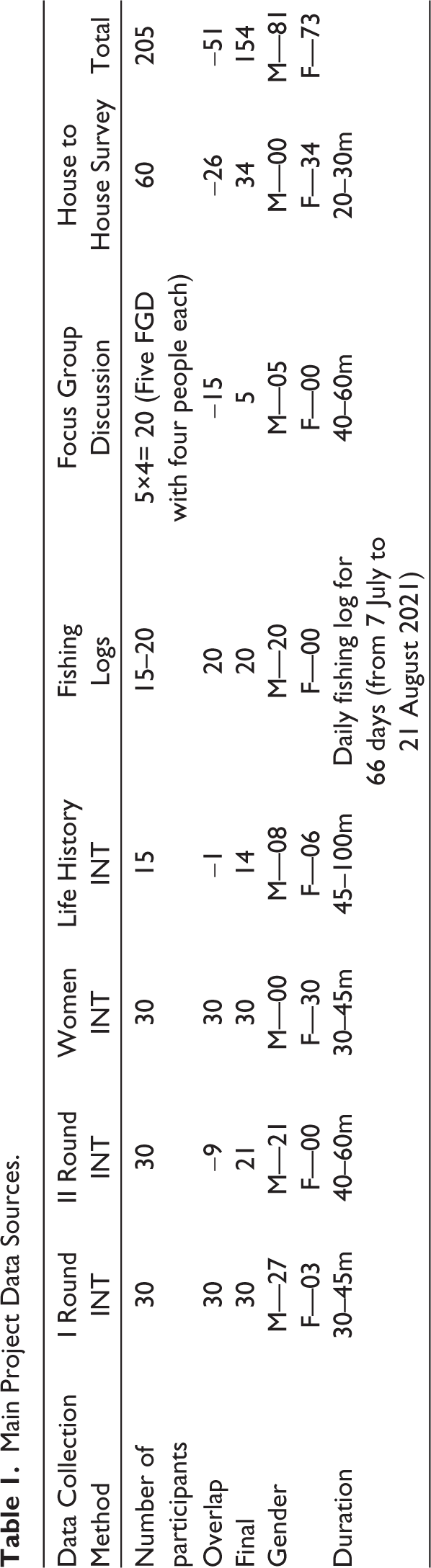
This article utilises data, as per Table 1, from the Marianad site. Research assistants supported data collection and interview transcription.
Marianad Respondents
Marianad was selected as the principal site, where three research assistants with personal and familial connections used snowballing to identify potential respondents. Although the parish priest was helpful in the early stages he was not directly involved in the project, nor did he act as a gatekeeper.
During telephonic interviews during lockdowns, to keep the project alive, additional data began to emerge on a fresh topic: local responses to, and evaluations of, the stringent government restrictions upon people’s movements.
Main Project Data Sources.
Women’s Roles in Fishing
Women play several roles within the industry but never go to sea for fishing purposes (Ram, 1991), with just one female fisher recorded among the entirety of Kerala’s 190,000 fishers (Vipinkumar et al., 2018). Fishing, like agriculture, is framed in Kerala within a wider gendered division of labour with the norm of sole or primary responsibility for household and childcare work falling on women. Women rise early to fulfil their ‘double burden’ of paid work and household tasks.
Some have the support of older children.
I usually wake up at 5 am. I don’t cook. My children will do [this] for me. After tea, I prepare for the fish landing centre. I reach the fish landing centre at around 6.30 am. I return home between 4 and 6 pm after the fish vending job at Vengode [about 20 km north of her village].
Many do not have support and manage all the tasks themselves.
I wake up at 6 am and go to the beach–fish landing centre. I get fish through auction and do my fish vending work until 10 am. Sometimes this would go up to 12 pm. I get fish from the fish landing centre and sell them there only for a retail price. Then I come back home and cook for the family.
Listening to women recount their average day makes plain how far this work is from being a ‘small side job’—it was a core part of family subsistence strategies.
I get up early in the morning and go to the fish landing centre at around 6 am. At 10 am I have to reach the Market in Kaniyapuram [about 5 km north of her village, close to the national highway] to start fish vending. To reach there by auto, it costs ₹200. … Most days when I reach home, it would be around 7.30 or 8 pm. Yesterday I bought mackerel to sell in the Kaniyapuram market. I was able to earn ₹300 as a profit.
The sales work was a full-time occupation for women in fishing communities.
I wake up at 4 or 5 am. I go to the fish landing centre at around 6 am. I get fish from there. Then, with friends, I collect ice from Kollam [a neighbouring district, about 50 km away]—I need to get there early. After this, we come back to Pothencode [about 15 km north] to sell the fish in the morning retail market. I come back home at around 8 pm. After my arrival, if I do not have any health issues, I continue to do my domestic work. I go fish vending 6 days a week. If there are any health issues, family-related or neighbourhood functions, I take a break in between. I have been vending fish for the last 24 years.
The Village Auction Market
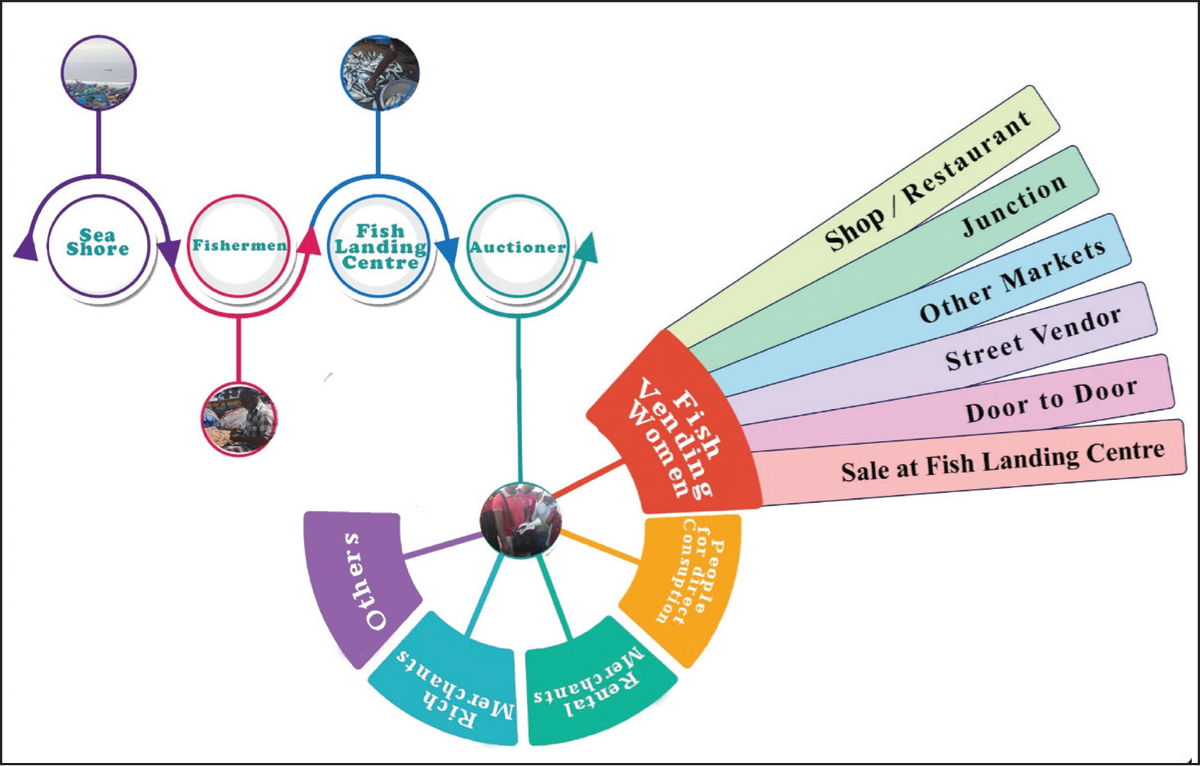
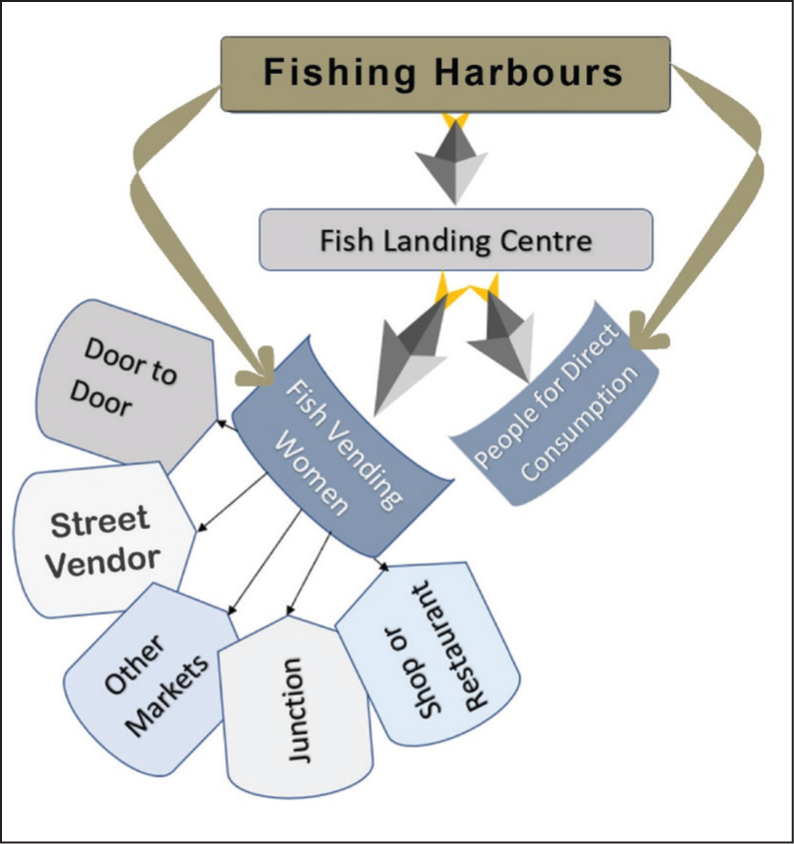
Figure 1 explains how fish move from shore to sales outlets, showing the range of players in the chain. Figure 2 focuses on women’s activities and their sales outlets.
Fish Moves from Shore to Auction to the Women Vendors.
Women’s Sales Outlets.
There are several different layers to fish marketing:
Sellers (fishers with the support of auctioneers) to buyers (retailers including merchants as bulk buyers and women as small-scale buyers) Sellers (fishers) to people for direct consumption Sellers (fishers) to factory buyers Sellers (bulk sellers—men) to fish vending women as small-scale buyers Sellers (both bulk and small-scale sellers) to buyers (for direct consumption) Sellers (small-scale women fish vendors) to buyers (for direct consumption) Sellers (auctioneers) to buyers (for direct consumption) Sellers (karavelakkar, shore-workers) to buyers (for direct consumption)
Women small-scale vendors attend auction markets in their own home villages, but may also travel long distances for buying and onward selling. Women engage in a variety of sales techniques: at the procurement place or fish landing centre, they go door-to-door, sell to shops and restaurants, selll in streets, markets, bus stands or junctions.
Once I finish the chores … say around 8 am …if they [fishermen] get a handsome catch at night, then we [fish vending women] will start the day early too … Once we buy the fish, we will also buy ice to keep it covered and fresh. Some of us will go to individual houses and sell the fish there. My choice is to sell fish by the roadside, I am a street vendor … Once I finish selling the fish in my basket, I will get back home. There are days when I won’t be able to sell off all the fish I bought, then I will take it back home.
Under Kerala’s geographical system of caste-based customary rights (avakasham), up to the 2010s women vendors held a monopoly on fish selling in their own villages. In some areas, women still hold these rights but in most of Kerala, including Marianad’s auction market, women have been edged out.
In the Marianad village fish landing centre, where women are deeply embedded in social relations, they are sometimes able to negotiate with fishermen, auctioneers and larger merchants. In other outlets, women struggle to hold their space and lack any bargaining power.
Increasingly, the principal buyers of fish at auction markets are men who run export-related businesses and other large merchants. A few are associated with Marianad, but many are outsiders from other districts. Sometimes, when the catch is not good in the village, these merchants and other medium-sized merchants from outside arrive and make fish available in the village fish landing centre or in the auction market, using both weighing machines and lot auctioning. Small-scale fish vendors now depend upon these merchants who sell ‘iced fishes’ (local term for fish which is 1 or 2 days old and kept on ice—note, this is not frozen fish). Village women may assist these external traders or support them by selling their fish onwards. Women fish vendors may also buy small amounts of fish from these retailers on credit allowing them to make fish available within the community even in the absence of good local fish catches.
Gender-specific Issues
For some women, it is the encroachment of higher class and caste norms of feminine bourgeois respectability into labouring communities’ aspirations that marks the shift from fish vending. Here, longstanding Malayali norms of feminine respectability and the well-known ‘Kerala paradox’ of educated but unemployed females are prominent (as often noted, education is seen as a path towards marriage and motherhood rather than employment (Devika, 2021). As one respondent [ There are no women entrepreneurs in Marianad.
Another [Rachel] stated,
My sister used to be a fish vending woman as well, but she has stopped after marriage because her husband does not like it.
It is especially among the wives of Gulf migrants that the possibility is arising for women to withdraw from fish-vending and move into the mainstream-desirable ‘housewife’ status. While a few women’s husbands find work as migrants and withdraw their wives from the labour force, the overall slowdown in employment in the Gulf and the ‘wicked problem’ of Kerala’s male under/unemployment contributes to the problem of women finding alternatives, more ‘respectable’ income streams, as young males coming into Kerala’s sparse job market hunt continually for new sources of employment and income (Rajan, 2020; Thomas & Jayesh, 2019).
Women still in the fish-vending sphere face a hostile environment. As one research assistant noted, women also
… face hurdles and difficulties from the men in those markets … During the unloading of fishes, these Union members create scenes.
Kerala’s famous strong trade unions often protect one segment of the working population at the expense of another. Questions of territorial protectionism also come into play here:
There are also issues around the places of selling … people, who have been there for some years, usually create problems for them. Kaniyapuram market is an example, where their fish were taken away by the people there. [
At Marianad’s auction market, women’s space is now limited to outside spaces or a small corner within one of the two buildings. The other building is allocated entirely to large outside merchants and fishermen to keep their gear. Men also use this space for playing cards. Several respondents (men and women) complained about men usurping spaces that used to be assigned to women. Another common observation was that public spaces are not designed with women in mind and seem to be forgetting that women are a critical part of the wider fishing economy.
The fish markets in the non-coastal areas do not have enough toilets or water facilities and there are severe issues of hygiene. [
The COVID-19 Scenario
By far the biggest factor in Kerala’s recent shift away from female fish vendors was prompted by COVID-19 and by the lockdowns that followed. While COVID-19 brought new levels of difficulty that impacted the whole community, lockdowns ripped away women fish vendors’ livelihoods in specifically gendered ways.
First came the national curfew on 22 March 2020, followed by a nationwide complete lockdown for 56 days from 25 March to 14 May 2020, with local (parish) total bans on fishing and fish sales for a month (22 March to 18 April 2020).
During this period, bans on fishing and fish sales did not take fishers’ concerns into account and created much confusion. The government-controlled agency Matsyafed entered the auction market to intervene in fish sales, with some percentage of the commission being given to them. Matsyafed also decided and set fresh fish prices without adequate consultation with fishers. Although government propaganda pretended otherwise by presenting the intervention as a form of support, these interventions heightened the sense of confusion and lack of trust in government measures among the fisher community.
While male fishers were overlooked and overruled, the stakeholders who were completely excluded from any consultations or consideration were fish-vending women who were not given space to raise their concerns and needs. Male police officials were deployed to control the movement of women and prevent them from engaging in fish sales beyond their home villages, despite the women following COVID-19 norms and protocols in the same way as other ‘essential commodity’ street vendors and others in the unorganised sector like flower sellers and vegetable vendors.
Over May, June and early July 2020, partial fishing and fish sales were allowed. However, localised outbreaks of COVID-19 in fishing villages and adjacent areas in the second week of July 2020 led to the ‘triple lockdown’. This prohibited all movement outside village boundaries even though a small group of men, mostly outsiders, were allowed to move from place to place. Owning their own vehicles and through the use of mobile technology and social media platforms they were able to engage in the marketing of fish. Fishing village women, however, facing complete restrictions on their mobility were forced to withdraw completely from the sales market. Fishers and women vendors who protested their loss of livelihoods and the unfair treatment meted out to them under the ‘triple lockdown’ were singled out and stigmatised as ‘super spreaders’. The stigma of disease burdened fishers’ already precarious identity and women, whose sales activity requires a degree of mobility, carried the heaviest burden.
This was happening even while fish remained in the category of ‘essential food item’ and local citizens’ demand for fish, a daily staple in Kerala, was unchanged. While vegetable vendors were permitted, under popular demand and vendor protest, to re-open for sales during the lockdown, this consideration was not offered to female fish vendors. Fish-vending women’s protests were merely deemed unruly, unlawful and further evidence of the community’s lack of adherence to Kerala’s public norms of performative ‘law-abiding respectability’ (Jament et al., 2023). Even when fishing bans were lifted, villagers’ mobility remained restricted. This then gave a boost to outside vendors, providing spaces for them to gain a foothold in the fishing business. Some forms of mobility restrictions on fish vending women from coastal areas continued for months, even after COVID-19 restrictions in the rest of the state were lifted. This supported the new entrants’ consolidation of their markets. By now, women from fishing communities had been completely edged out of their traditional occupation and their only source of livelihood.
Women faced a number of lockdown-related problems. First, police harassment which has always been a problem has increased. As one participant reported,
Police do not allow our vendors to sell their fish on the roadside … the Chief Inspector was very hostile to women fish vendors …They threatened us saying that our fish and fish baskets would be destroyed … they imposed a fine of ₹5000 … There were also reports of women fishers not having been paid (I have not yet been paid)
Another woman said,
Police are … cruel to the fish vending women; they destroy the trade vessels and fish.
Second, fishing women’s lack of mobility and digital access left them severely disadvantaged. Outsiders not under the coastal belt lockdown restrictions travelled into auction markets, bought and transported fish outside the lockdown area using their own vehicles and arranged sales directly with the restaurant and private domestic buyers via social media platforms.
New entrants into the fish market, especially youngsters with vehicles, create challenges …. These new retailers make innovations … using mobile phones, own transport systems as well as do door-to-door marketing … Earlier, I used to sell fish worth ₹10,000, now I am able to do only ₹2,000–3,000.
More people entered the fish vending business. Most of them are young people … they come to the auction market with a few sacks … and take them to the markets in their vehicles. … Though these people started the fish vending job as some relief from corona-related job losses, they would like to continue this job even after corona.
Outsiders were attracted to fish vending because basic investments are small: with as little as ₹1,000, it was possible for outsiders who were from areas that were not under triple-lockdown to enter coastal areas, buy fish and start a business. Young tech-savvy men set up Facebook ads and built WhatsApp groups of customers, who readily switched suppliers because access to daily fish is important in Kerala. Fish-vending women, reliant upon public transport or shared autos and lacking smartphone capabilities, found themselves unable to compete in this new scenario.
The presence of these new players in the industry effectively broke fish-vending women’s relationships with customers, with the collapse of older methods of face-to-face sales at small roadside markets and door-to-door sales. Now that new entrants have discovered this new income source and new customer bases, and relationships have been built, it is unlikely that things will return to what they used to be. For buyers, the simplicity of the new system, which brings the ability to shop instantly and price-check across live online platforms, outweighs any sentimental attachment to former personalised relationships or a sense of obligation to those women who have long depended upon small-scale sales for their livelihood.
Women’s dwindling and ultimately disappearing livelihoods were also affected by the scaremongering that existed around COVID-19 and fears of contagion. Together these contributed to reinforcing the fisher community’s already deeply entrenched marginality by playing upon the familiar trope of the poor and marginal as especially prone to disease and disorder (Roelen et al., 2020). Coastal villages were sensationalised in the media as spaces of contagion and danger, and their inhabitants were portrayed as lawbreaking ‘superspreaders’ who could not be trusted.
Loss of Community Monopoly
The lockdown moment which witnessed the entrance of people from outside the Mukkuvar and other traditional fishing communities into the sector has had a notable and unanticipated consequence: the relaxation of deeply sedimented status norms associating fishing activities with specific caste communities.
Before COVID-19, under Kerala’s notoriously stringent and intricately nested network of traditionally recognised community-specific rights and obligations, historically, fish-work was allocated to specific communities. There was a significant presence of women fish vendors in most Catholic fishing villages (30/42 fishing villages) in the Thiruvananthapuram area. Almost all fishers were men from the Catholic community; and almost all fish sellers were Catholic women. Handling fish was a community prerogative under still-persisting high-caste Hindu ideas about ‘impure’ occupations (similar to leatherwork, butchery and so on).
The entrance of new players, from non-fishing community backgrounds, and of people who, pre-COVID-19, would never have considered fish vending as an employment option, is a remarkable shift. The new ‘vehicle and phone’ salespeople include people from several different groups. In addition to individual sellers from among those who have lost jobs as the Gulf economies slowed down, resulting in the mass return of migrants, there are some who, with monies saved from their Gulf sojourn, have opened new retail fish and meat online shopfronts or opened small shops with refrigeration and freezing facilities. Some of the new vendors are men who had worked in IT companies and who lost their jobs due to pandemic-related company shutdowns. Some of them are highly educated: young men who have dropped out from engineering and other degrees, calculating that there is no point in studying or having their families invest in their higher education when Kerala’s job market is so dire. There are even some finance and business graduates in the new cohort for whom a move into fish sales represents an exciting new business opportunity. There are now over 100 fish retailers with both cold storage facilities and online stock information and ordering capabilities operating outside of the coastal belt and active in neighbourhood-based daily sales, with names like ‘Today Fish’ in Thycaud and ‘The Morning Catch Malayinkeezh’. 1 Online vendors using Facebook and WhatsApp often have client lists of over 200.
Most new entrants share common characteristics: they are young men who are digitally literate and active users of social media, who own a vehicle, have a little capital for start-ups and who possess higher literacy skills and a little know-how of online marketing. There are even a few young women who own vehicles; these women would never, pre-pandemic, have considered fish selling as a respectable or feasible option.
There have also been moves into the market by larger organisations. State organisations like Matsyafed (the ‘fish federation’) and people’s organisations like SEWA (Self Employed Women’s Association), along with local community organisations such as TSSS (Trivandrum Social Service Society) have all been supporting the shift—even getting directly involved. The state is driving modernisation of fish sales, with mobile apps being adopted via Matsyafed and the Kerala State Coastal Area Development Corporation (KSCADC). ‘MIMI fish’ and ‘Anthipacha’ are both state-driven mobile marketing initiatives.
In short, the shift away from direct buying from fishing community women is now widely considered as the accepted and acceptable new model. The state government is also making moves towards shifting away from the traditional method of auction at fish landing centres. This is starkly at odds with trends that had been noted not long before COVID-19 dramatically changed this picture. One study (Hapke & Ayyankeril, 2018), which outlined a scenario with regard to divisions of labour, commodity chains, and globalisation’s deleterious effects upon livelihoods, had envisioned the withdrawal of some women from fish-related labour but noted that the entire fishing business was still deeply embedded within the specific communities having long-standing caste/community relationships to fishing.
A Restructured Economy—Where Women’s Critical Contributions Have Been Blocked
Traditionally, many artisanal fishing families were dependent upon the income women brought in for survival or to support long-term household projects such as children’s education. As women’s income has dried up, families are now further enmeshed in debt and increasingly desperate.
I have been in the job for more than 25 years. Earlier I used to earn a good amount … Nowadays, especially after Corona-related restrictions and the entry of new retailers … I and my fellow fish vending women have to face many challenges.
Fish vending is the main source of income for the whole family. But after the Corona pandemic, it has become very difficult for us to survive.
This situation can be understood as growing from four dynamics:
First, shifts due to state policies of centralisation, and the adoption of globalised practices of managing supply chains are accelerating. These processes have gathered speed over the past 15 years (Hapke & Ayyankeril, 2018). Further, as noted by Gopal et al. (2022) the lack of acknowledgement of women’s significant roles in the fishing industries and supply chains has severely eroded their ability to participate in decision-making and policy consultation, ‘as they are excluded from these spaces citing their “absence” and supported by social and cultural norms, which are impediments in protecting rights and livelihoods for women in fish value chains’ (Gopal 2022: 523). By not being recognised as vital stakeholders in this sector, women’s lives, and by extension, that of their households’, have been catastrophically affected.
Second, as already noted, there is a small but growing tendency for supply chain management in small and fast-moving sectors to shift to social media channels. Pedroza-Gutiérrez and Hernández’ (2020) study of real-life supply networks in the fish trade demonstrates the importance of these social networks in providing access to capital, knowledge and social capital; having central or node status within a network was also important. Our study highlights how social media is an especially powerful agent of transformation, behaving as an enabling resource in terms of bringing instant information on prices, availability of the product, customer demand and more. It also works to reinforce social networks since it is a technology that can be used by some to elevate their importance and reach within sets of networks. This is underscored by the entrance of former Gulf migrants, marked by their relationship to technology and social media expertise, into the field. This is in stark contrast to fish-vending women who are less likely to own a smartphone, much less have the requisite technological expertise to engage with social media.
Third, as Bassett et al.’s (2021) comparative study of seven small-scale fisheries’ supply chains makes plain, COVID-19 worldwide has disrupted and reshaped supply chains. Table 2 in their article notes disruptions, adaptive responses, and impacts. Globally, the strategy of ‘Build a local consumer base using social media’ emerged as a common response. Common impacts of COVID-19, noted globally, included reductions in work, demand and income for fishers. More generally, the authors note that, across all seven of their case studies, shorter supply chains and more local distribution formats emerged. They also observed, across all cases, not the emergence of new networks, but, rather, the use of pre-existing social networks (2021:6). As another study agrees, this interesting finding emphasises the importance of pre-existing networks, support, social organisations and connections, which can then be mobilised in the case of a macroeconomic shock (Bennett et al., 2020). While their study notes that fishers in Sumatra, California, Peru and Andaman and Nicobar managed to leverage and intensify pre-existing networks to ride the COVID-19 shockwave, the situation of Kerala’s women fish vendors was quite different, in that these women lacked access to technology or its informed use, and had little or no pre-existing robustly supportive networks. As we have seen, a range of other actors were actively hostile or exclusionary towards women vendors.
Finally, women suffer disproportionately in any economic crisis, and female-owned businesses, whatever the sector, have faced more and severe effects than businesses owned by men. An empirical study of small-scale female entrepreneurs in Kenya notes that the pandemic exacerbated pre-existing inequalities of class and gender, while also deepening vulnerabilities. This case study notes how women’s reliance on travel to conduct their sales work is presented as a core reason for female-run business shut-downs. The inability to travel and a lack of access to personal transport were key determinants in Kerala women becoming shut out of their markets. The study notes that women globally are over-represented in precarious, small-scale and informal sectors, with the pandemic having disproportionately disruptive effects (Kaberia & Muathe, 2021).
While it is true that selling fish has never been easy work,
Once I finish the chores at home … say around 8 am … We [fish vending women] will have to buy the fish on a bid. A basket of fish will be sold to the highest bidder … we also need to buy ice to keep it covered and fresh…. I get up early in the morning and go to the fish landing centre at around 6 am. By 10 am I have to reach the Market … and start vending … Today I reached home at around 5 pm, but most days, it would be around 7.30 and 8 pm. women’s sales activities were a critical livelihood strategy and a valued source of income in a community with few other options.
As we conclude, we compare the Kerala situation with that of Bangladesh. In their study, Joy et al. (2021) discuss the impact of fishing bans and lockdowns on livelihoods and household situations. The study, based on empirical research and a literature review, identifies 17 factors affecting resilience, spread between five capitals—human, social, physical, natural and financial—and four resilience properties. Kerala’s fisherwomen struggle with capital deficits on several of these fronts, paralleling the situation of Bangladeshi fishers where the pandemic threw into relief the importance of four resilience properties: pre-existing sectoral robustness; resourcefulness of those affected; redundancy/alternative income streams; and rapidity of recovery. While Kerala’s fishers are better educated, organised and informed than their Bangladeshi counterparts, the drag in speedy state responses and support, along with a lack of alternative income, left these resourceful workers over-exposed, with women’s livelihoods being especially vulnerable and completely overlooked.
Conclusions
Several factors have contributed to the decimation of fisher women’s livelihoods.
Socio-cultural factors include Kerala’s jealously guarded self-image as an educated and ‘modern’ state and its notoriously conservative public morality. Fishing communities are painted into a corner where they are represented as uncouth, backward, undeserving and unreformable. The situation of fish-vending women is especially abject, far removed from Kerala’s idealised savarna Hindu housewife-mother stereotype.
Statewide regional and policy factors have also contributed to this situation. The wicked problem of Kerala underemployment is actually worsening, as the Gulf economy slow-down brings into harsh relief the degree of Kerala’s dependency on migration remittances. Parallel livelihood schemes have been under discussion since the state’s formation in the 1960s, but nothing of substance has materialised. Even educated, qualified and trained people struggle to find work. Fishers, many of whom are without formal qualifications, cannot compete in this market.
People from fishing communities are also often unwilling or unable to leave their traditional (sure but not secure) livelihoods and search for work in new areas. Coastal life and fishing are historically and culturally deeply embedded in the way of life here; it is worth remembering that this was mandated and enforced by caste laws until the late 1950s. We note a paradox around the recent loosening of caste- traditional specific occupations and the relaxation of what were, until very recently, mandated monopolies. While studies focus on the positive side of this process, for example, non-Brahmans’ entry into temple priest roles (Roopesh, 2017), the fisher experience provides a negative example.
At the same time, processes of primitive accumulation and the gradual concentration of capital and power in the hands of fewer and larger, wealthier players, have been supported by the state. Large boats, trawler methods, bulk buying and selling have articulated state policies of modernisation and city ‘beautification’. Fish-vending women and small roadside markets are now seen as part of the city’s ugly face, to be replaced with modern shopfronts.
As noted above, pandemic-related shifts have also exacerbated already powerful trends. Fisher community women suffered the same exclusions and, as is true of all Kerala’s marginalised communities, lack access to credit, capital, and modern technologies. In addition, in the face of deliberate exclusions, they have had to face the absence of support systems for their informal systems of work.
Finally, macro-level global trends have underwritten these shifts. Work done globally on both small-scale fisheries and women’s micro-business demonstrates the pandemic’s swift and radical impact on supply chains and access. Kerala’s fisher women were left in multiple ways exposed and unprotected from the livelihood crisis. There is inadequate recognition of this fact and/or Kerala’s progressive stories often hide this and, to date, no policy mitigation and support for them is in place. The journey of vulnerable fish-vending women still continues: one doubts whether the promise of ‘leaving no one behind’ as a sustainable development goal (Senit 2019) will ever be achievable.
Footnotes
Acknowledgements
This research was supported by generous grants from the Sussex Sustainability Research Programme, the Royal Geographical Society and the UKRI Global Challenges Research Fund (Grant ES/T003103/1). Empirical data underpinning this research, plus other environmental and contextual information, are available from the UK Data Service [at
Declaration of Conflicting Interests
The authors declared no potential conflicts of interest with respect to the research, authorship and/or publication of this article.
Funding
This research was supported by generous grants from the Sussex Sustainability Research Programme, the Royal Geographical Society and the UKRI Global Challenges Research Fund (Grant ES/T003103/1).