




Abstract
Most family business theories and models used in sub-Saharan Africa are anchored on the Western worldview. However, various researchers acknowledge the flaws of these theories when applied in cultures outside the Western world. A dearth of studies that infuse Western-developed leadership and management theories with indigenous African knowledge exists. This study aims to develop a strategy that solves the problem of family business failure in sub-Saharan Africa. Findings revealed that family business leaders must prepare for succession, develop and select successors, and infuse both Ubuntu philosophy and the Western worldview during succession planning. The study developed a leadership succession planning framework for family businesses in sub-Saharan Africa to close the gap. Using systems theory and thinking and intercultural management thinking, this study shows how infusing the indigenous African knowledge anchored on Ubuntu philosophy can lead to successful succession that may translate into intergenerational family business survival in sub-Saharan Africa.
Keywords
Introduction
The contemporary sub-Saharan African business environment is characterised by Western leadership and management systems due to colonialism and globalisation; hence, the use of such systems in the region remains a decisive factor for business success or failure. Mutwarasibo and Iken (2019) argued that globalisation fuelled the movement of people across borders introducing cultural and economic complexities in the region, leading to an interconnected business environment that calls for new responses; for instance, intercultural management thinking that considers both non-Western and Western management approaches. Therefore, the authors’ position in this study is the reconstruction of management practices to ensure contextual relevance to African knowledge following Mangaliso et al. (2022). This study focused on Family-Owned Businesses (FOBs).
Previous research underscores the contribution of FOBs to the socio-economic development of economies worldwide (Isichei, 2025; Klugah et al., 2025; Kokunda & Sun, 2024). Utilising FOB characteristics provided by Birdthistle and Hales (2023), a FOB is operationalised in this study as a business with major family ownership, where family members actively take part in the business and family culture and values influence the business with a long-term focus on business continuity and legacy. Birdthistle and Hales (2023) indicated that in Germany, 43% of gross domestic product (GDP) comes from FOBs. According to Cheng and Co. Group (2022), 67% of GDP in Malaysia is contributed by FOBs, whereas Olayinka and Chinedu (2024) highlighted that FOBs account for 30% GDP in Nigeria.
Furthermore, FOBs employ 58% of Germany’s population (Birdthistle & Hales, 2023), and FinMark Trust (2022) indicated that 68% of income for individuals comes from FOBs in Zimbabwe. Despite the significant role of FOBs indicated above, low FOB intergenerational survival in sub-Saharan Africa is stated in various studies and is of concern (Ifeoma et al., 2024; Isichei, 2025; Klugah et al., 2025; Museta & Mwanza, 2023). Such failure has been reported in Nigeria (Olalekan & Olawale, 2024), Uganda (Katamba & Lujja, 2023), and Zimbabwe (Chundu et al., 2021; Fundira & Poperwi, 2022). FOB failure may be due to poor management and family conflicts among other factors (Olalekan & Olawale, 2024); but key among the factors is poor leadership succession planning (Katamba & Lujja, 2023; Valencia & Pratama, 2024). FOB failure due to lack of succession planning, inadequate succession planning or failed succession planning has been indicated in Zimbabwe and Nigeria (Akaa et al., 2024; Chundu et al., 2021; Fundira & Poperwi, 2022). Some socio-economic wicked problems such as family splits, unemployment, rise in poverty levels and theft may arise from FOB failure (Agbim, 2019; Bushe, 2019; Chundu et al., 2021), and stakeholders such as governments, banks, businesses, families and individuals are impacted by such problems.
Despite the above problems, succession planning success is vital for FOB survival (Akaa et al., 2024; Ifeoma et al., 2024; Okafor et al., 2023). However, current management thinking and practice in sub-Saharan Africa predominantly centre on Western management philosophy and that Western business models fall short of effectively informing about other environments’ experiences as explored in various studies (Bango et al., 2018; Mangaliso et al., 2022; Mutwarasibo & Iken, 2019). For example, Western (North American or Western European countries)- developed theories do not fit in developing nations’ conditions, and their use has been ascribed to FOB failure in sub-Saharan Africa (Mangaliso et al., 2022). In this view, Buckman et al. (2020) specifically pointed out Western-developed succession plans. This indicates a discernible theoretical gap in the literature where the complex FOB leadership succession planning in sub-Saharan Africa, especially in light of the effects of colonialism and globalisation, remains insufficiently explored.
Previous research proposed the incorporation of Ubuntu philosophy into existing management theories (Kupangwa, 2024; Mutwarasibo & Iken, 2019), providing new perspectives and a counter-balance to the individualistic Western management theory (Mutwarasibo & Iken, 2019). Ubuntu is an African worldview that is anchored on the values of group solidarity, collectivism, survival, compassion, and respect and dignity (Molose et al., 2019), is deeply anchored in African culture, emphasises the co-construction of knowledge, is committed to indigenous knowledge, challenges individualism, promotes collectivism and inclusivism, and provides decolonising spaces (Borti et al., 2024). The philosophy is expressed using the aphorism umntu ngumntu ngabanye or I am because we are, which entails that a person is defined by the way he or she is recognised and relates with others (Mangaliso et al., 2022). In this view, a manager who applies Ubuntu would view a firm as a collective and recognise the interdependence of all stakeholders involved in the business towards the achievement of firm goals (Mutwarasibo & Iken, 2019). Additionally, Ubuntu is regarded as an indigenous African concept that is linked to leadership in Africa (Grobler & Singh, 2018) and is given different names across the continent (Mugumbate et al., 2023).
The line of inquiry in this study delves into finding a strategy to solve the problem of FOB failure in the region. Against this backdrop, the objective of this study is to close the theoretical gap by developing a contextually relevant, comprehensive framework for FOB leadership succession planning that incorporates both Ubuntu and Western management philosophy. This study aims to ensure FOB intergenerational survival through the success of FOB leadership succession in sub-Saharan Africa.
The study adds to the literature on FOB leadership succession planning from an Afrocentric perspective; thus, the novel contribution of this study is the development of a comprehensive FOB leadership succession planning framework that can be utilised by FOB owners, FOB leaders, entrepreneurs, policymakers and researchers. The remaining part of this study presents the literature review, research design and methods, research findings and discussion, the proposed framework of the study, conclusions and implications, limitations and suggestions for future research.
Literature Review
Theory Underpinning the Research
Systems theory underpins this research because it can be used to identify problems in business (Bertalanffy, 1972) by acknowledging interconnections and interactions among the system’s components and the environment (Arnold et al., 2024; Grewatsch et al., 2023). A FOB is viewed as a system made up of the family and business systems (Maharajh et al., 2023) and operates in an environmental system; hence, the interaction between the three systems makes the theory relevant in this study. Interrelationships and interconnections are key tenets of systems theory and thinking. Interconnectedness is a tenet that is focused on by Ubuntu philosophy (Borti et al., 2024), indicating a strong link with systems theory and thinking.
Contribution of Ubuntu Philosophy in Family Firms
Conflict is inevitable in FOBs and should be managed; hence, Ubuntu is key during the management of conflict in sub-Saharan Africa. It is important to note that management of conflict is also practised in Western FOBs; however, Ubuntu differentiates how conflict is managed in sub-Saharan Africa. Previous research pointed out that many sub-Saharan African countries adopted an imposed justice system due to colonialism (Murhula & Tolla, 2021; Musingafi et al., 2019), resulting in the suppression of traditional legal systems, but the Western legalistic system does not fit the ideals of the sub-Saharan African context. Despite the suppression, the African traditional legal system has been continuously used in contemporary Africa, for instance Rwanda, Ethiopia, Kenya, Burundi (Musingafi et al., 2019) and South Africa (Murhula & Tolla, 2021). The Western legalistic approach is described as retributive, anchored on a win–lose paradigm in solving conflicts, and does not settle the root cause of the conflict (Murhula & Tolla, 2021). However, the indigenous African traditional conflict resolution approach does not only punish, but focuses on restoration of relationships, reparation of damage and reconciliation among conflicting parties (Murhula & Tolla, 2021; Musingafi et al., 2019).
Mutwarasibo and Iken (2019) asserted that the values of Ubuntu are key ingredients to avoid conflict and solve disputes with less friction. Within this view, indigenous conflict management in Africa involves the utilisation of consensus-building platforms, namely Indaba and Lekgotla (Mangaliso et al., 2022) and the council of elders (Musingafi et al., 2019), where all stakeholders are expected to contribute. These views appear to suggest that effective decisions in a business are reached through debate and dialogue by evaluating an issue from various angles. This is linked to the dialogical nature of Ubuntu (Makhanya & Mzinyane, 2023); therefore, the researchers cautioned that Western norms should not be universalised as norms developed in other contexts cannot be applied effectively in a different context.
Additionally, Ubuntu contributes to FOBs through kinship employment or nepotism, a common practice in FOBs in sub-Saharan Africa; however, it is also common in the Western worldview. The concept of nepotism is defined as hiring friends or relatives without considering merit and is prevalent and key in many African businesses (Matimbwa & Kamala, 2024; Sunny & Matteo, 2018). According to Bhardwaj et al. (2023), it is most likely that a successor from the family takes over rather than an outsider. On the contrary, in Ugandan FOBs, the practice is viewed negatively (Kokunda & Sun, 2024). Although nepotism may have some negative stereotypes, it is an important strategy to use in selecting a FOB leader in sub-Saharan Africa. The important thing is to consider the competency of the successor, respecting culture, family tradition and observing the values of Ubuntu.
Succession Preparations in Family Firms
The central focus area during succession preparation is succession planning. Succession planning is the process of transferring leadership or management from the incumbent to the successor (Agbim, 2019), it is not an event but a gradual process (Bhukuth et al., 2025; Isichei, 2025), and assists in ensuring a smooth intergenerational transfer of FOB leadership (Birdthistle & Hales, 2023; Klugah et al., 2025). The researchers recognise that this practice is valuable in both Western and African worldviews. However, due to Ubuntu’s value of inclusivity, succession planning practices in sub-Saharan Africa must include both African indigenous and Western approaches to leadership and management.
During succession preparation, proactive planning focusing on retirement issues is fundamental (Valencia & Pratama, 2024), and previous research findings show that a succession plan should outline a sustenance package upon retirement (Buckman et al., 2020). The authors of this study concur that a retirement package must be given to the retiree as reflected in Western practices; however, this may represent Ubuntu values of compassion and sharing in the African context. For instance, most FOB leaders retire at an old age; therefore, such compensation may reflect Ubuntu values of respect and dignity.
The existence of a successor selection criterion is important during preparations for succession. Issues such as the availability of a successor (Bhardwaj et al., 2023), the successor’s education and experience (Bhukuth et al., 2025; Klugah et al., 2025; Museta & Mwanza, 2023), willingness and interest to become the leader (Bhardwaj et al., 2023; Isichei, 2025; Okoh et al., 2022) and credibility of the successor from other FOB members (Valencia & Pratama, 2024) must be part of the selection criteria. Additionally, regular meetings are a key element of succession preparations in FOBs. Okafor et al. (2023) stressed that it is important to hold regular meetings and Mawi (2022) buttressed this point by indicating that meetings improve communication. The researchers of this study suggest that during meetings in sub-Saharan Africa, much focus must be put on dialogue; hence, collective input and decision-making are key.
Open Communication in Family Firms
Open communication among family members from generation to generation improves conflict management (Mawi, 2022), fosters good successor-incumbent interrelationships (Buckman et al., 2020), leads to a smooth FOB transition (Valencia & Pratama, 2024) and enhances the survival of FOBs (Mawi, 2022). Additionally, previous research concluded that incorporating the collaborative ethos of Ubuntu promotes open communication in an environment (Chetty & Price, 2024). On the other hand, other research revealed that poor communication affects FOB success (Katamba & Lujja, 2023). The authors of this study are of the view that FOB leaders must ensure that effective open communication channels exist during leadership succession planning because communication is the mortar that holds the FOB system together.
Successor Development and Selection in Family Firms
During successor development, the education level and work experience (Museta & Mwanza, 2023; Valencia & Pratama, 2024) of the successor are fundamental because they improve the potential successor’s entrepreneurial competencies, business knowledge and ability to manage (Bhukuth et al., 2025; Valencia & Pratama, 2024). However, Ngubane and Makua (2021) argued that due to colonialism, the education system in Africa is rooted in Western worldviews, resulting in most African students being distanced from their indigenous knowledge and belief systems. Furthermore, Bango et al. (2018) argued that Western methods of training are not universally appropriate in comparison to training methods designed for a specific culture.
In this regard, Ubuntu philosophy can be an important education tool to restore indigenous cultures and values in the African education system; thus, contributing to the decolonisation of the African education system discourse (Ngubane & Makua, 2021). Referring to the incorporation of different worldviews into the African management system, Ali and Shishigu (2020) averred that the Western system has been part of previously colonised sub-Saharan African countries; hence, it is fundamental to incorporate key features from other cultures. The authors of this study concur with this worldview and aver that the education system in sub-Saharan Africa must be anchored on Ubuntu philosophy, however, incorporating Western philosophy to ensure the holistic development of African students who are potential successors in various FOBs. Additionally, the successor must execute tasks with the incumbent to enable the assessment of the potential successor’s capabilities and identify his or her technical and managerial competency requirements whilst maintaining good incumbent–successor relationships (Buckman et al., 2020).
The age and gender of the potential successor are key during successor selection in both Ubuntu and Western worldviews. Previous research shows that most FOBs led by older business leaders execute successful leadership successions (Agbim, 2019), and the importance of an older leader in the African context is acknowledged by Mangaliso et al. (2022). Furthermore, preference is given to male successors over female successors, especially the oldest son in most sub-Saharan African countries (Isichei, 2025; Nyoni, 2019); however, Isichei (2025) advised FOB owners to craft succession plans that concentrate on the successor’s interest and ability rather than focusing on gender.
Defining FOB Leadership Transfer Success
The success of the succession planning process is indicated by harmony in the FOB, stakeholder satisfaction with the succession process, and business profitability post-succession (Buckman et al., 2020). The researchers operationalised FOB leadership succession planning success as the handing over of leadership to the successor, the existence of harmony in the business, stakeholder satisfaction with the FOB succession process and continued FOB profitability in the post-succession period.
Research Design and Methods
Research Philosophy
Constructivism or interpretivism was used as the philosophy for this study, and the inductive approach was used to develop the proposed framework for FOB leadership succession planning. The constructivism or interpretivism approach used in this study shows a paradigm shift from the dominant use of positivism which does not recognise the voices of the participants’ lived experiences. Thus, the use of the qualitative inquiry allowed participants to share in-depth and rich information reflecting their perceptions and lived experiences of leadership succession planning in their FOBs.
Sample and Sampling Strategy
A sample is a portion that is selected from a population. In this research, a sample was selected from a population of FOBs categorised as small and medium enterprises in Zimbabwe’s cities of Mutare and Harare. Non-probability sampling was used to purposively select seven participants who were believed to have the desired information in this study, and the FOB leader was the primary source of data. Both male and female participants who were 40 years old and above, leading FOBs that were 10 years old and above, from any industry category and from FOBs in the first- or second-generation were included in the sample.
Data Collection
The interview guide was developed from literature review elements of FOB leadership succession planning, was pilot tested using two participants and was then improved by clarifying ambiguous questions, reducing the number of questions and improving loaded questions. After the pilot test, the final interview guide was developed. Face-to-face semi-structured interviews were conducted with participants from May 2023 to August 2023 until data saturation. Data saturation was reached at the sixth interview, when the researchers started receiving no new information from participants; however, a seventh interview was conducted to ensure that they had understood it all, and thick and quality data were in place. The seven interviews were guided by Hennink and Kaiser (2022), who indicated that data saturation takes place between 5 and 24 interviews. Additionally, the interviews were audio-recorded with the participants’ permission.
Data Analysis
Qualitative data were analysed using ATLAS ti. Version 22 software following Molose (2019). In this study, the researchers used an iterative approach by moving forward and backwards between sampling, data collection and data analysis. They listened to each audio-recorded interview carefully, transcribed it into text, and read the transcribed document several times while listening to the audio to ensure data accuracy and quality. Phrases or words related to FOB succession planning were used as codes to represent unique information from the interviews and codes that conveyed the same information were grouped to develop themes. Thereafter, thematic analysis was used to analyse data.
Rigour and Trustworthiness
Credibility was ensured by engaging participants over three months, and this assisted in building rapport and trust and understanding the participants’ culture and environment. Transferability was ensured by proffering enough participants’ descriptions of their experiences of leadership succession planning during data analysis and interpretation. To ensure confirmability, the researchers provided an audit trail of research activities and the decisions made to reach sound conclusions. Lastly, the researchers observed reflexivity during the entire research process by reflecting on their biases and subjectivity and keeping a reflexive diary.
Ethical Considerations
Ethical clearance was obtained from a University Department, and the ethical clearance number is 2021_SBL_DBL_033_FA. Participants were given enough information about the study. The researchers explained how anonymity and confidentiality were ensured, the withdrawal process if participants opted to discontinue participating, and how data were going to be stored, analysed and reported. Additionally, participants voluntarily signed a written informed consent to participate in this study. Providing this information helped in gaining the trust of participants, which enabled them to engage comfortably during the interviews. Participants were assigned numbers to ensure anonymity, and password-protected electronic documents were created to protect participants’ information, which was then stored in a password-protected computer. Furthermore, hard copies of data were stored in a locked cabinet to ensure confidentiality.
Participant and Business Demographics
Participants had an average age of 49 years, and the average age of the FOBs was 14 years. In this study, four males and three females were interviewed, where five participants had diplomas, one participant had a high school certificate, and one participant had a bachelor’s degree. There were five founders and two successors. Four participants were in the retail business, two participants were in the services business, and one participant was in the manufacturing business. Five FOBs were in the first generation and two FOBs in the second generation.
Findings and Discussion
Theme 1: Family Business Leaders’ Utilisation of Ubuntu
The authors solicited a deeper understanding of how FOB leaders utilised Ubuntu during succession planning. Participants were asked, ‘In what ways do you apply Ubuntu leadership practices in the family business during succession planning?’ Findings revealed that FOB leaders applied Ubuntu through sharing, assisting each other (compassion), respecting elders, discouraging conflicts and group solidarity. One participant reflected on compassion by saying, ‘I encourage my workers to help each other whenever they can’ (Participant 4). Furthermore, participant 1 highlighted the following about showing respect: ‘I have older workers, and I respect them’.
From the statements above, the researchers argue that participants invoked Ubuntu by referring to the values of compassion and respect. These findings are consistent with the views of Molose et al. (2019) who held that the values of Ubuntu are group solidarity, compassion, survival, respect and dignity and collectivism. With reference to systems theory, helping one another is in sync with interdependency, a vital FOB ingredient during daily operations and succession planning. Research findings on respect suggest that older age is associated with experience and wisdom; therefore, during succession planning, the elderly must be respected because their wisdom can be a source of rich insights towards the success of FOB leadership succession planning.
Theme 2: Succession Preparation and FOB Succession Planning
The researchers solicited an understanding of how FOB leaders prepared for succession by first asking the following question: ‘What are your views on having a well-defined or written succession plan in place during family business succession planning?’ Most participants invoked succession planning by indicating that they had a succession plan in place. This finding contrasts with that of Agbim (2019), who found a lack of succession plans in the businesses sampled. This suggests that succession planning is not exercised in every FOB; however, the authors encourage the existence of succession plans in every FOB to ensure the success of leadership succession planning. Furthermore, participants revealed that a succession plan is important in avoiding uncertainties, selecting a successor and managing conflicts. A connection was made between succession planning and management of conflict in the business by a participant who said: ‘It is important to have one so that there are no conflicts when I die or get sick’ (Participant 5). This statement suggests that succession planning is essential for the management of conflicts, which ensures a smooth transition of leadership to the successor. This is supported by the view of Birdthistle and Hales (2023) and Klugah et al. (2025), who held that succession planning ensures a smooth transition of leadership.
Retirement is an important element during succession preparations, and participants were asked the following question: ‘What do you expect to see in the business and family for you to be satisfied to plan for retirement and hand over the leadership position?’ Various participants indicated that they expected to see harmony prevailing among FOB members, the profitability of the business, and required retirement packages. Substantiating the findings on harmony, a participant was quoted as saying: ‘I also want to see no problems in the business between workers, there must be peace’ (Participant 3).
Alluding to a retirement package, one of the participants said: ‘They should give us something for us to continue living’ (Participant 2).
In this view, the need for a retirement package entails survival; hence, the excerpts above suggest that the participants invoked Ubuntu philosophy by pointing out issues such as harmony and survival. These findings corroborate previous studies that indicated that survival (Molose et al., 2019) and harmony (Mangaliso et al., 2022) are key values of Ubuntu philosophy. Additionally, the finding on retirement package is consistent with the views of Buckman et al. (2020).
A selection criterion is key during succession preparation, and participants were asked the following question: ‘What are your opinions on having clear selection criteria used to select the potential successor in the family business?’ Participants indicated that selection criteria are important during succession preparation, highlighting the successor’s interest in the FOB, the successor’s age, gender, training and the successor’s education and experience as elements of the criteria. Participants revealed the importance of selection criteria by connecting it with transparency during leadership succession planning. The finding on the successor’s interest or willingness is consistent with the view of Okoh et al. (2022), and the finding on the successor’s age and gender corroborates the view of Mangaliso et al. (2022), Nyoni (2019) and Agbim (2019). Furthermore, the finding on the successor’s education is consistent with previous research that attests to the importance of the successor’s education (Bhukuth et al., 2025; Klugah et al., 2025; Museta & Mwanza, 2023; Valencia & Pratama, 2024). The authors opine that FOB leaders must consider the successor’s willingness to assume the leadership post, his or her age and gender, education and experience when selecting successors.
Meetings are a key element of succession preparation, and participants were asked the following question: ‘What are your views on carrying out regular meetings on succession planning in the family business?’ Participants indicated that regular meetings are fundamental and that all stakeholders are expected to contribute. Regarding contributions from other stakeholders, one participant interestingly stated: ‘Discussions are important and you hear what other people think and also take their decisions and use them when managing the succession process’ (Participant 7).
This statement invoked Ubuntu’s value of collectivism. The finding is consistent with Mawi (2022), who highlighted the participation of all FOB members. Interviewees further indicated that regular meetings are a platform to communicate the selection of the successor to other stakeholders, evaluate succession progress and update the succession plan. Findings on communication support the view of Chetty and Price (2024), who averred that collectivism encourages open communication. The authors conclude that FOB leaders should prepare for succession.
Theme 3: Ubuntu’s Contribution to Succession Planning
Under this theme, participants were asked questions regarding conflict management and kinship employment. The following question was asked; ‘Concerning solving conflicts, do you use the Western system or the African system of solving conflicts or a combination of both systems? Explain your answer’. Participants revealed that they used both Western and African systems of conflict management during succession planning, as indicated by the statement: ‘Well, I use all systems, the Western system is what we use mainly…, but African ways are common these days, I use the traditional healers and elders for advice’ (Participant 7).
This research finding on the use of the African system is consistent with Musingafi et al. (2019) and Murhula and Tolla (2021), who indicated the use of traditional African mechanisms of conflict management in African countries. For instance, Ubuntu-based methods such as the use of a council of elders (Musingafi et al., 2019), consensus-building platforms such as Indaba and Lekgotla (Mangaliso et al., 2022), and restorative justice (Murhula & Tolla, 2021). Therefore, a paradigm shift from the dominant utilisation of Western approaches is suggested by the utilisation of both Western and African systems of conflict management. The inclusion of indigenous strategies in conflict management by FOB leaders is in sync with the holistic approach of systems theory underpinning this study. The researchers therefore argue that Ubuntu is key during conflict management due to its relational approaches, which differ from the procedural approach used in the Western system.
Kinship employment is a common practice in FOBs; hence, participants were asked the following question: ‘What are your opinions on employing your relatives in the family business?’ Mixed feelings were revealed by participants, with some indicating that it empowers relatives, is good for their survival, and shows trust in relatives; however, a lack of trust in relatives was indicated, too. In support of employing relatives, participant 7 stated: ‘Relatives are important and l employ them so that they can feed their families’.
The importance of kinship-based employment in FOBs was revealed in this study; however, this is also relied upon in Western FOBs. The authors therefore argue that in African indigenous FOBs, this practice is strengthened or is anchored on Ubuntu values such as solidarity and relational duty which shape selection criteria or management of kin employment, particularly in balancing loyalty and competence. The finding on employing relatives is consistent with the view of Sunny and Matteo (2018) and is in sync with interrelationships, a key tenet of systems theory that underpins this research. In support of the lack of trust in relatives, participant 1 said: ‘But although it is good, sometimes relatives are jealous, they may steal from you which is why some people do not employ relatives’.
This finding is consistent with Kokunda and Sun (2024), who indicated a negative view of kinship employment in Ugandan FOBs. Although these negative effects exist, the authors conclude that in the African context, it is important that FOB leaders select relatives to leadership positions based on competency.
Theme 4: Development and Selection of a Successor in FOBs
The researchers solicited a deeper understanding of how successors are developed and selected in sub-Saharan African FOBs. The following question was posed to participants: ‘What are your views about potential successors having to go to college and work in the industry first before joining the family business?’ Participants revealed that education and experience are important elements in developing FOB successors. A participant was quoted as saying: ‘These days education is important, a successor should be educated. They say experience is the best teacher so he or she must work in the industry before joining the family business’ (Participant 6).
The finding on education and experience is consistent with previous studies that attested to the importance of the two elements (Bhukuth et al., 2025; Klugah et al., 2025; Museta & Mwanza, 2023; Valencia & Pratama, 2024). The researchers argue that successors must go to college; however, apart from the mainstream college education, internal family and business education is important, anchored on African indigenous values, norms and culture.
Furthermore, participants were asked the following question: ‘Which education, training, and development approaches and practices (Western or African) would be best for the development of the successor? Explain your answer’. Most interviewees indicated that they utilised both African and Western approaches. Participant 7 said: ‘The education that we have is Western, most of it but African education is good because l am an African so this must be the best education that I should teach also, so a mixture is good’.
This finding is congruent with Ali and Shishigu (2020), who encouraged the utilisation of African and Western philosophy because it is rife in sub-Saharan African countries’ systems due to colonialism. The researchers opine that it is fundamental to incorporate other cultures into the African education system; however, more weight must be put on the African system.
Deciding who will become the next leader is key in FOBs, and participants were asked the following question: ‘What do you prefer, the succession of the family business by a daughter or a son?’ Most interviewees indicated that sons are preferred more than daughters for wealth protection. Regarding this view, a participant was quoted as saying: ‘I want a son, the business continues with my generation, he will protect and grow my wealth’ (Participant 3).
On the contrary, an interesting finding was that either a daughter or a son is preferred; the most important thing is competency. Buttressing this view, a participant indicated: ‘I don’t choose, anyone a son or a daughter as long as the person is eligible for the position’ (Participant 5).
These findings aligned with the perspective of Isichei (2025), who acknowledged the preference of sons to FOB leadership positions in sub-Saharan Africa; however, Isichei advised FOB owners to focus on competency and interest rather than on gender. Therefore, the researchers of this study concur with this view.
A key element of successor selection is age in the sub-Saharan African context; hence, participants were asked the following question: ‘With reference to your culture, what are your opinions about age when selecting a successor?’ Most participants showed that older successors are preferred because they have more experience and wisdom, indicated as follows: ‘Again with age, someone will have more wisdom and experience, so l prefer a successor who is a bit old’ (Participant 1).
Findings on the age of the successor confirm the findings of Agbim (2019), who held that FOBs led by older leaders experience successful successions. The preference of older successors could be explored as a reflection of Ubuntu’s valuation of wisdom, respect and dignity that is brought into the business. Therefore, FOB leaders must select older successors to assume the FOB leadership position.
The following question was asked about announcing successor selection: ‘What are your perceptions on announcing the selection of the successor during family business succession planning?’ Findings revealed that successor selection must be announced to other FOB stakeholders for transparency, acceptance by FOB members and to allow views from other FOB stakeholders. Regarding transparency and contributions from other FOB stakeholders, an interviewee stated: ‘I think it is important because this must not be a secret to reduce conflicts, other workers need to have a say in the selection’ (Participant 6).
In a nutshell, the findings on this theme show that successor development and selection are key to the success of leadership succession planning.
Theme 5: The Success of the FOB Leadership Succession Planning Process
Under this theme, participants were asked the following question: ‘How do you describe a successful succession planning process?’ Participants showed that the success of the succession planning process is achieved when the business makes profits in the post-succession period. Supporting this view, a participant stated: ‘…the business must be making profits’ (Participant 6).
This finding is consistent with Buckman et al. (2020), who indicated that post-succession financial performance of the business is an indicator of a successful succession. Additionally, the existence of harmony in the FOB indicates a successful leadership succession as stated here: ‘I also want to see no problems in the business between workers, there must be peace’ (Participant 3).
The finding on harmony is confirmed by Buckman et al. (2020). This study further revealed that other stakeholders should accept the successor in the FOB, the incumbent retires and the business must continue its operations. The finding on the acceptance of the successor by FOB stakeholders entails the importance of the Ubuntu value of collectivism. Literature supporting the finding on the acceptance of the successor by other stakeholders is confirmed by Buckman et al. (2020). Furthermore, findings revealed that a successful succession takes place when the successor takes over the FOB leadership role. Participant 3 stated: ‘I think if the successor starts his job well, then it is successful’.
The researchers therefore conclude that a successful FOB leadership succession is indicated by profitability in the post-succession period, harmony in the business, the acceptance of the successor by FOB stakeholders, the retirement of the incumbent, the assumption of the leadership by the successor and the continuity of the business.
Proposed Framework
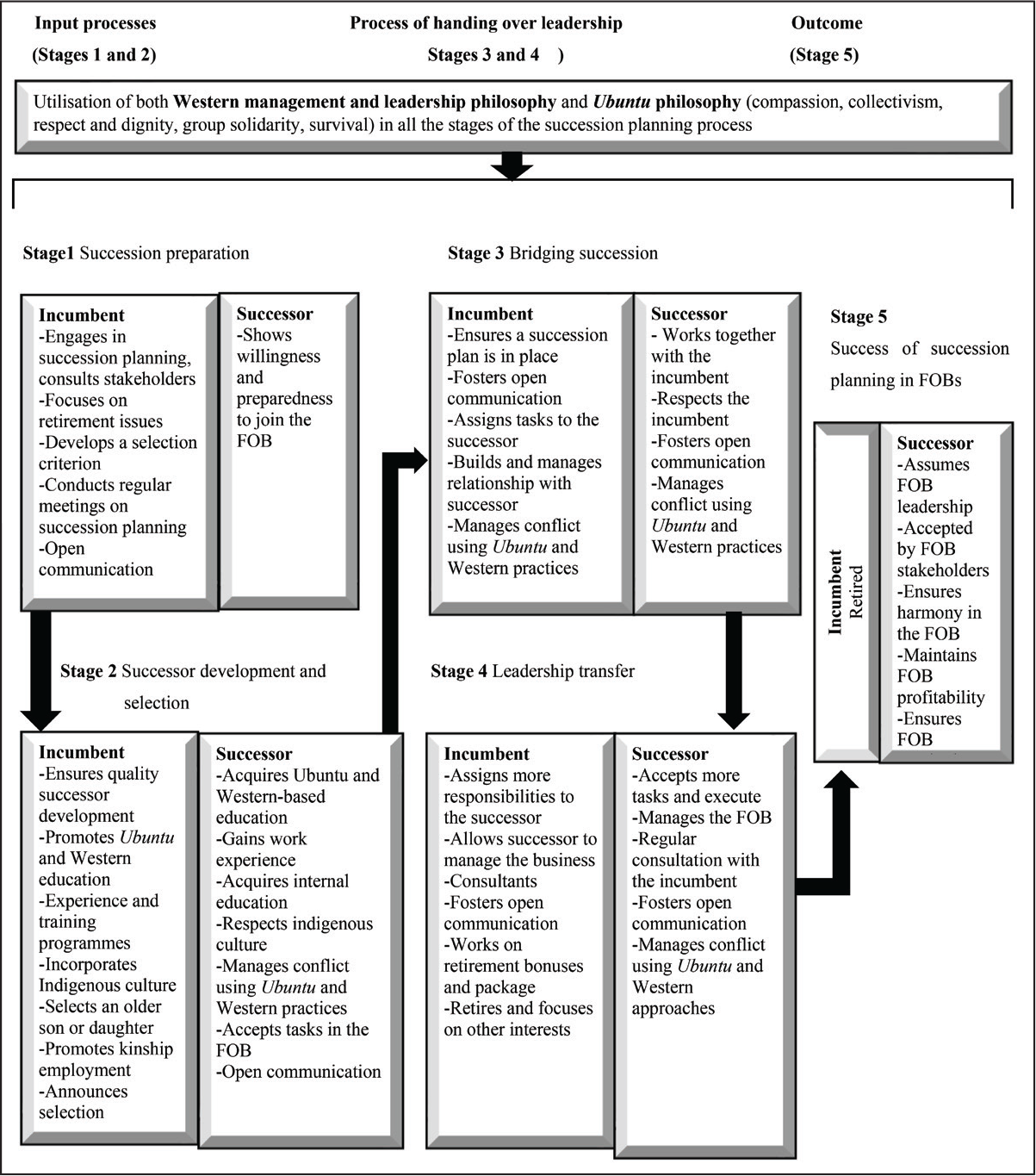
The proposed framework in Figure 1 was developed based on primary and secondary data. This framework includes key succession planning procedures and principles as implemented by research participants, and they were enhanced by know-how drawn from existing literature, which supplemented the findings. Stages 1–5 indicate the FOB leadership succession planning process as it evolves, and in each stage, the expected roles of the incumbent and the successor are outlined.
Explanation of the Framework
Ubuntu Philosophy and Western Management Philosophy
Participants revealed that they utilised both Ubuntu and Western worldviews at different stages of the succession planning process. The use of both Western and African worldviews in sub-Saharan Africa is consistent with Ali and Shishigu (2020); hence, both worldviews should be utilised during the entire process of FOB leadership succession planning. Integrating Ubuntu and Western philosophy in the framework promotes synergy and complementarity to achieve a common good, that is, the success of leadership succession planning in FOBs that may translate into FOB survival, if FOB leaders effectively apply the framework.
Stage 1: Succession Preparation
In this stage, the incumbent crafts a succession plan in consultation with FOB stakeholders and engages in proactive succession planning, such as retirement by planning future needs, such as retirement packages and bonuses. A successor selection criterion is developed in consultation with other stakeholders through open communication. Additionally, meetings are held to update the succession plan and to manage conflicts; however, all stakeholders contribute. At this stage, the successor indicates his or her willingness and preparedness to be a successor.
Stage 2: Successor Development and Selection
The incumbent ensures that a quality successor is developed and selected based on competency, family tradition and culture. The successor must have earned external education through schools and tertiary and higher education institutions. Furthermore, the successor should gain experience by working in other firms before joining the FOB. Internal education is gained by the successor through mentorship by the incumbent as they execute tasks together, where family norms, values and culture are passed on. The successor is expected to respect and dignify the incumbent and other older stakeholders in the business. A successor is selected considering kinship ties, older age and either a son or daughter can be selected; however, in the African context, sons are preferred. The selection is made known to other stakeholders through open communication. Additionally, the incumbent teaches the successor how to manage conflict using both Ubuntu values and Western approaches.
Stage 3: Bridging Succession
This is an extension of stage 2 and the succession plan is fully developed. The incumbent–successor relationship is strengthened as the two continue to lead and manage the business. Ubuntu value of respect and dignity must be honoured by the successor in this relationship. Furthermore, the incumbent gives more responsibilities to the successor, allowing him or her to gain more authority. The incumbent then assesses the successor’s ability to lead and manage the business. Conflict is managed using both African indigenous and Western approaches.
Stage 4: Leadership Transfer
This is an extension of stage 3, where the incumbent gives more difficult tasks to the successor and actually lets the successor manage the FOB as the incumbent acts as a consultant. The incumbent ensures that retention strategies are in place so that the successor commits to leading and managing the business effectively. Furthermore, the incumbent retires and focuses on other life interests. The successor accepts the responsibilities, manages the business and consults the incumbent with respect and dignity whilst communicating openly. Additionally, the successor manages conflict in the family business using both African indigenous and Western approaches.
Stage 5: Success of the FOB Leadership Succession Planning Process
This is the final stage of the FOB leadership succession planning process. The success of the process is indicated by the successor taking full leadership and management of the family business after the incumbent’s retirement, the endorsement of the successor’s leadership by other FOB stakeholders, the existence of harmony among FOB members, and the profitability of the FOB post-succession. Such success, therefore, translates into the intergenerational survival of the family business.
Conclusions and Implications
The study concludes that the use of Western-developed leadership succession planning frameworks or theory in sub-Saharan Africa is a threat to FOB survival. Therefore, the framework developed in this study is a novel contribution of this study to the discourse on FOB theory development. The framework may benefit business practitioners, FOB leaders and entrepreneurs in sub-Saharan Africa in advising and executing leadership succession planning to enhance succession success in an effort to ensure FOB survival. Furthermore, the study concludes that policymakers may benefit from using the framework when developing sound entrepreneurship policies and improving existing ones to ensure that they benefit FOBs to survive intergenerationally.
The effective implementation of the framework may improve the survival of FOBs, implying that more employment will be created, improving individuals’ and households’ incomes, leading to a reduction in poverty levels and crime rates, and improvement in the standards of living of sub-Saharan African people. This therefore contributes to the global effort to achieve the United Nations Sustainable Development Goal (UNSDG) number 1, ending all forms of poverty everywhere; the UNSDG number 8, decent work and economic growth (United Nations, 2015) and to Zimbabwe Vision 2030’s aim to reduce poverty in the country (Government of Zimbabwe, 2018). The study further concludes that the resulting increase in individual incomes enhances infrastructural development in sub-Saharan Africa. This contributes to Africa Agenda 2063’s aim to develop world-class infrastructure for citizens (African Union, 2015). In a nutshell, the survival of FOBs contributes to the economic growth and development of sub-Saharan African countries.
Limitations and Future Research
This study was limited to FOBs in two provinces in Zimbabwe and focused on the first and second generation FOBs. Future research is encouraged including other provinces in Zimbabwe, focusing on FOBs beyond the second generation, and also future research in other sub-Saharan African countries. This may improve the richness of the data collected and the interpretations thereof. In this study, much focus was put on the ability of Ubuntu philosophy to bring out the genuine African perspective and its relevance to the sub-Saharan African context, following Mutwarasibo and Iken (2019) and Mangaliso et al. (2022). Hence, the generalisability beyond the sub-Saharan African context is left for further research.
Footnotes
Declaration of Conflicting Interests
The authors declared no potential conflicts of interest with respect to the research, authorship and/or publication of this article.
Funding
The authors received no financial support for the research, authorship and/or publication of this article.