




Abstract
This article compares micro-enterprises’ performance and the entrepreneurial ability of weavers as perceived by the weavers themselves under two different institutional environments: one dominated by a cooperative society and the other dominated by private traders. Weavers in the private trader-dominated institutional environment are more likely to introduce new designs, develop new products and usher client satisfaction. However, the determinants of overall entrepreneurial ability reveal that after controlling for several factors, the weavers associated with a cooperative society seem to have significantly higher abilities. Analysing the marginal effects of the institutional environment, it is observed that the perceived quality of handlooms, weaver’s ability to bargain for returns and ability to efficiently manage business finances are much better in the cooperative-dominated cluster as compared to the private trader-dominated cluster. Furthermore, the resilience of enterprises during the COVID-19 pandemic was much higher in the cooperative-dominated business environment. Enterprises using more unpaid female household labour were more resilient than others during the pandemic.
Introduction
Entrepreneurship involves mobilising heterogeneous resources from varied sources under uncertainty, asymmetric information and cognitive and behavioural limits (Foss et al., 2019). Other than resource mobilisation, entrepreneurship includes mobilisation of partners and employees, making investments and marketing through entrepreneurial judgements. The classical notion views entrepreneurship as an opportunity to introduce new goods, services, raw materials and organisation methods to make more profits (Casson, 1982). Nevertheless, the institutional environment, including formal and informal rules determining ownership, contract and competition, has a significant bearing on entrepreneurial judgements and abilities. The extant literature overwhelmingly supports the view that institutions affect entrepreneurship by shaping entrepreneurs’ decisions (Urbano et al., 2019). A favourable business environment that reduces uncertainty promotes the growth of small farms in developing countries (Nichter & Goldmark, 2009). In this context, this article examines the role of institutions in entrepreneurial activities based on a survey conducted on self-employed weavers in India. The study considered two institutional environments: one dominated by a cooperative and the other dominated by private traders. Additionally, this article examines the resilience of institutions and enterprises against external shocks, such as the COVID-19 pandemic.
Entrepreneurship in a developing country such as India can be classified into three broadly identifiable stages of economic development such as factor-driven, efficiency-driven and innovation-driven stages (Acs et al., 2008; Porter, 1990; Porter et al., 2002). The factor-driven stage is typically characteristic of low-income countries where small and micro-enterprises emerge as necessary instruments for the survival of the poor and marginalised. Block and Wagner (2010) observed that by understanding the necessity of entrepreneurship, policymakers and governments could make more informed decisions to create the eco-system for formal entrepreneurship, which can lead to self-employment. This article examines the necessity-driven entrepreneurship of self-employed weavers under two different institutional environments.
There are three key institutional pillars that influence organisations: regulative, normative and cultural-cognitive (Scott, 2008). Without a robust regulatory environment in emerging economies, rural enterprises may be constrained to work on innovation independently or with close family members instead of collaborating with external sources (Yu et al., 2013). Small entrepreneurs build legitimacy by developing alliances with large, established firms and people of authority, which provide them with more access to resources. In this process, they may lose control over their business decisions (Street & Cameron, 2007). There is limited research comparing and contrasting entrepreneurs’ ability to make decisions when they partner with external economic agents like traders vis-à-vis cooperatives for raw material or market access. This research attempts to fill this gap.
While institutions may provide a high degree of reliance and stability (Scott, 2008) to small and micro-entrepreneurs under normal conditions, the same institutions may fail during shocks like the COVID-19 pandemic (De et al., 2022). The pandemic caused significant hardships and vulnerability to micro, small and medium-sized enterprises (Takeda et al., 2022), including the weaving enterprises (Das & Sutradhar, 2020). This article examines the resilience of enterprises in the context of two different institutional environments, which is also rarely examined in the extant literature.
Institutional Environment and Entrepreneurship
The institutional environment may constrain the entrepreneurial judgement of entrepreneurs. Studies throughout the world reveal that the institutional environment determines the relevance of an entrepreneur’s skills of networking for financial performance (Sigmund et al., 2015). A high-risk political and economic system may discourage formal alliances of small and medium enterprises (Dickson & Weaver, 2011). India has a long history of traders acting as money lenders in agriculture (Harriss-White, 2019; Roy, 1989) and non-agricultural activities such as weaving (Roy, 1989). Acting as input suppliers, credit traders and buyers of agricultural produce, the traders and processors interlock and control the producers and adversely affect their interests (Harriss-White, 2019; Mishra & Dey, 2018). On the contrary, cooperatives in India maximise community-oriented and market-based logic, leading to democracy, autonomy, efficiency and profitability of organisations (Nath & Arrawatia, 2022). Hence, the following hypotheses have been made.
H1: The performance of the enterprise would be better if weavers were associated with a cooperative than with a trader.
H2: The self-employed weavers would demonstrate more entrepreneurial ability and bargaining strength if they were associated with a cooperative rather than a trader.
A weaver is not an isolated producer but embedded in a network of suppliers of raw materials, buyers of products (traders) and a network of workers, including their own family, forming a socio-technical system (Mamidipudi et al., 2012). There are both pros and cons of networking with traders. Engagement with multiple traders is beneficial to access a variety of information about opportunities, which drives entrepreneurship (Shane, 2000). Contrarily, in the context of trader and producer hierarchy, due to the interlocking of systems, a lack of trust and information flow would inhibit the creativity and inventiveness of producers (Shane, 1992). The lesser the stress on loyalty and conformity, the higher the outward-looking view and freedom for innovation. Prajapati and Biswas (2011) found that networks increase performance, but a highly dense network is counterproductive. Bhagavatula et al. (2010) observed that structural holes in networks of weavers could usher new opportunities outside the local environment. Hence, the following has been hypothesised:
H3: Entrepreneurship ability and enterprise performance are positively associated with the number of suppliers or buyers in the weaver’s network but negatively associated with having direct contact with a large trader to whom the weaver is loyal.
Mamidipudi et al. (2012) argue that institutions such as cooperatives under capable leadership can absorb the vulnerability and external shocks of weavers. Adaptive responses of micro-firms in the wake of foot-and-mouth disease in the United Kingdom revealed that negative revenue and employment effects are better absorbed if entrepreneurs use spouses and other household members as flexible unpaid labour (Bennett & Phillipson, 2004; Phillipson et al., 2004). Hence, the following hypotheses have been made.
H4: The negative economic impact of the COVID-19 pandemic on production and income is lesser for weavers engaged with cooperatives than those engaged with traders.
H5: The higher the use of female household labour, the lesser the reverse economic impact induced by the COVID-19 pandemic.
Methodology
The Context
The Indian state of West Bengal has been selected as it is the largest producer of handloom fabrics, especially handloom cotton sarees (GoI, 2020). West Bengal accounts for 35% of handloom fabrics produced in the country. Moreover, the number of handloom workers is highest in West Bengal after Assam. Nevertheless, the share of handloom household workers affiliated with cooperative societies is only 5% in rural areas and 9% in urban areas. In most clusters, the weavers are unaffiliated. However, there are a few clusters where most weavers are affiliated with a cooperative society. This contrast provides the ground to examine the effect of weaver affiliation to cooperatives on the enterprise’s performance, the entrepreneurial ability of self-employed weavers and ability to absorb shocks. In the present study, the COVID-19 pandemic has been considered as a covariate shock for the weavers.
The study has been conducted during September-November, 2021, in two clusters: the Dhaniakahali cluster in the Hooghly District and the Phulia cluster in the Nadia district of West Bengal. The Dhaniakhali cluster has a cooperative society and most weavers are affiliated to it. In Phulia, most weavers are unaffiliated to cooperatives. They are associated with private traders. They deal with either representatives (small traders) operating under a large trader or the large traders directly.
The Sample
The survey data have been collected from 125 weavers from each cluster, totalling 250 participants. The weavers reside and operate in spatially separated sub-clusters (hamlets) within each cluster. The information about the number of weavers in each sub-cluster was collected from the key informants. In the case of Dhaniakhali, the secretary of the cooperative society was the key informant. In Phulia, a local NGO working with the weavers was the key informant.
A systematic random sampling method was adopted to select the weavers for the survey. The number of survey weavers from each cluster and sub-cluster was proportionate to the total weavers. The weavers were selected with a fixed interval starting from a random starting point. The interval was derived from the ratio of the number of sample weavers to the total number of weavers in the sub-cluster. The survey covered demographic and socio-economic characteristics of households, the supply chain of the weavers, performance of household weaving enterprises, the ability to perform entrepreneurship tasks and variation in production and income due to the COVID-19 pandemic.
Weavers’ Profile
Weaving is considered a male-dominated home-based occupation in the sample clusters. The weavers are typically male household heads (99%). Other household members are engaged in supporting weaving-related activities. Only 12% (21% in Phulia and 4% in Dhaniakhali) of sample weavers do not engage any household member. Of the household members, 95% are female, mainly the wife of the weaver and, in some cases, daughter-in-law or mother. Male household members engaged are adult sons, brothers and fathers.
The weavers in Phulia are considerably younger. While in Dhaniakhali, weavers aged less than 40 years constitute only 6%, the same is as high as 46% in Phulia. Similarly, 35% of the weavers of Dhaniakhali are above 60 years old, while the same is only 10% in Phulia.
The education level of the weavers is considerably low; 18% are illiterate, and 72% have education below the secondary level. The proportion of weavers belonging to backward castes is much higher at 66% in Dhaniakhali than in Phulia at 38%.
Weaving Activity
The number of looms per household ranges from one to eight. Most of the weavers are equipped with only one loom. Multiple looms per weaver are more prevalent in Phulia than in Dhaniakhali. While most weavers in Dhaniakhali own their looms, more than one-third of the weavers in Phulia have looms leased in from traders. There are variations in the intensity of economic activities spread across peak and off-peak months of the year. A comparison of the clusters reveals that weaving is more of a subsistence livelihood activity in Dhaniakhali under the aegis of the cooperative society, but it is a more market-responsive livelihood option in Phulia (Table 1). Nevertheless, due to the norms of cooperatives, the weavers have steadier weaving work throughout the year in Dhaniakhali than in Phulia.
Weavers’ Production and Relationship with Supplier/Buyer (%).
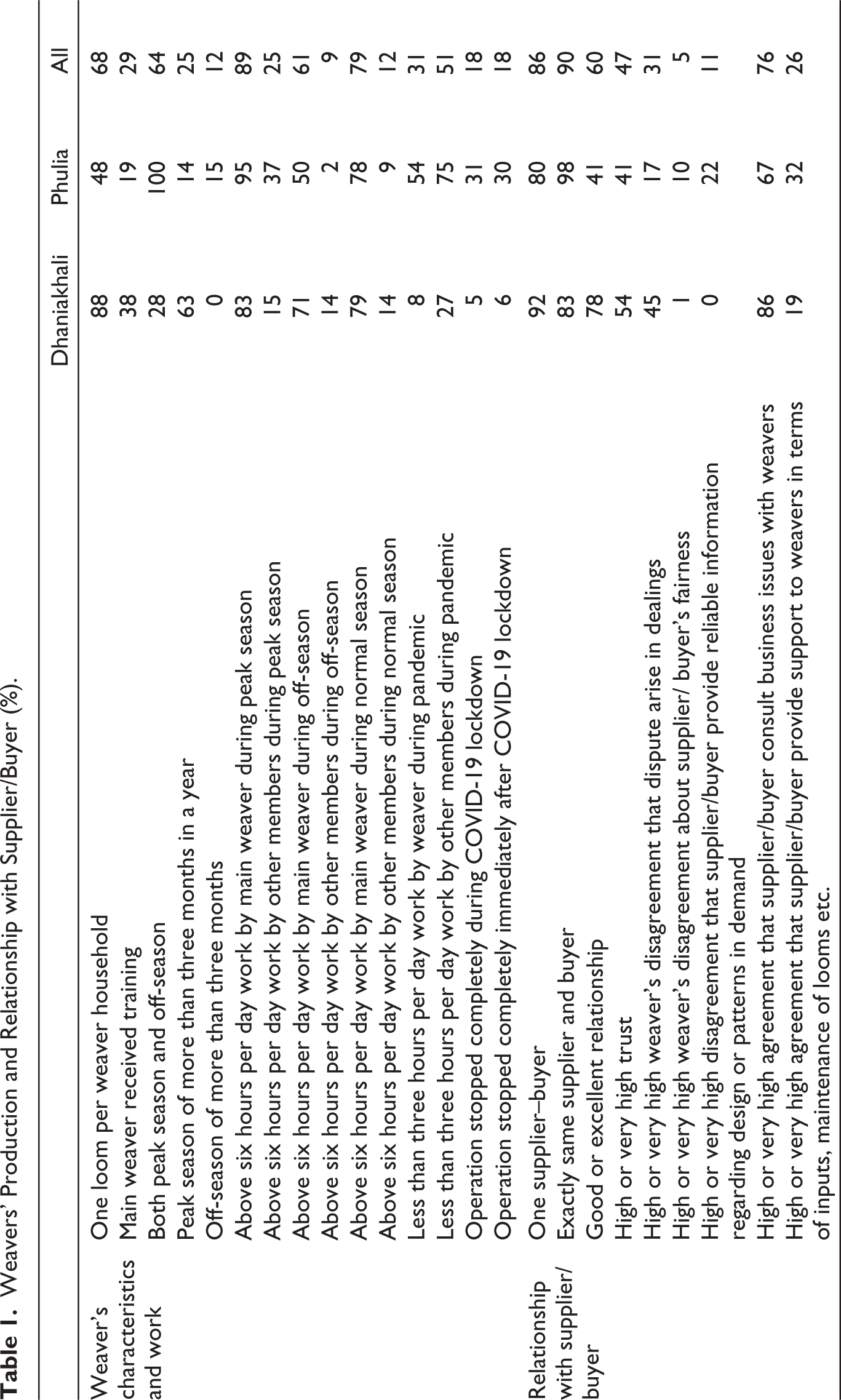
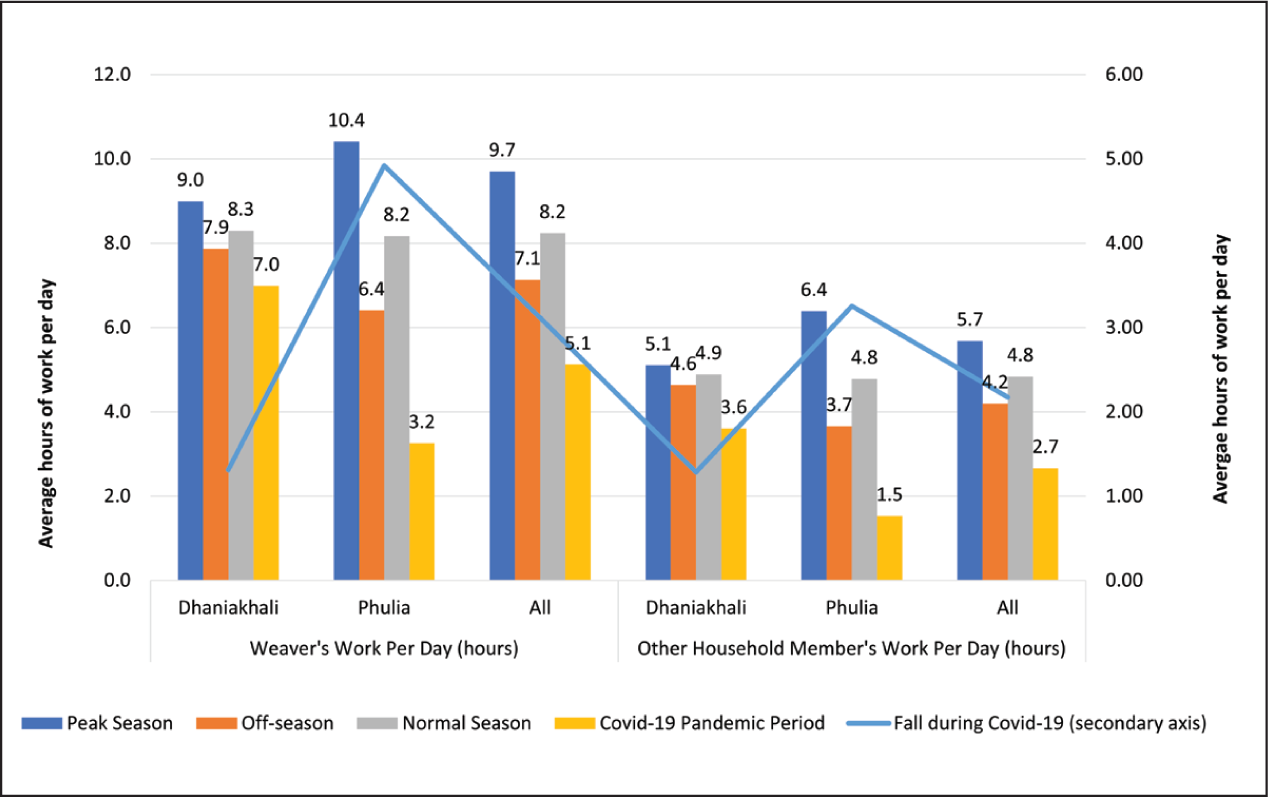
External shocks such as the COVID-19 pandemic have impacted the weavers less in Dhaliakhali, as illustrated in Table 1. In Phulia, the reduction in weaving and weaving-related activities during the COVID-19 pandemic (from 25th March to 20th May 2020) vis-à-vis a normal period averaged 4.92 hours and 3.25 hours per day, respectively; in Dhaniakhali, it was 1.31 hours and 1.28 hours per day. Furthermore, the average work hours for weaving and weaving-related activities were higher in Phulia vis-à-vis Dhaniakhali during peak season and lesser during off-peak and COVID-19 periods. These differences are statistically significant (p < 0.01). The average work hours were not significantly different in the normal season between the two clusters during the pre-COVID-19 period (Figure 1). The results imply that work hours were more stable and resilient in cooperative-dominated Dhanialhali compared to trader-dominated Phulia.
Work hours for Weaving and Weaving Related Activities.
Supply Chain
The weavers in Phulia mainly deal with a single trader acting as a supplier of inputs and buyer of the output. Similarly, in Dhaniakhali, the weavers deal with a single entity, a cooperative, to seek the supply of raw materials and to find a market for their finished goods. Although the institutional structure of the business is interlocked in both clusters, the dealings with traders outside their industrial cluster are much higher in Phulia; 11% of weavers in Phulia while only 2% of weavers in Dhaniakhali engage with traders outside the cluster. A much lesser percentage of weavers in Dhaniakhali agreed that they had received adequate business support from cooperatives than the same received from traders in Phulia.
The weavers of Dhaniakhali have a much healthier and more trustworthy relationship with suppliers or buyers than the weavers of Phulia, as illustrated in Table 1. The supplier or trader provides reliable information and consultation with more weavers in Dhaniakhali than in Phulia. The member-centric governance structure and member control of a cooperative society vis-à-vis trader-controlled market-based supply chain can explain these results.
The external shock of COVID-19 showed a different picture of the clusters. The weavers in Phulia could exercise fewer options to sell their products compared to the weavers in Dhaniakhali. While 16% of weavers in Dhaniakhali could sell their output to buyers other than cooperative, only 2% sold output to buyers other than their fixed trader in Phulia. Hence, the weavers associated with cooperatives are better able to absorb shocks.
Weaving Enterprise and Entrepreneurship
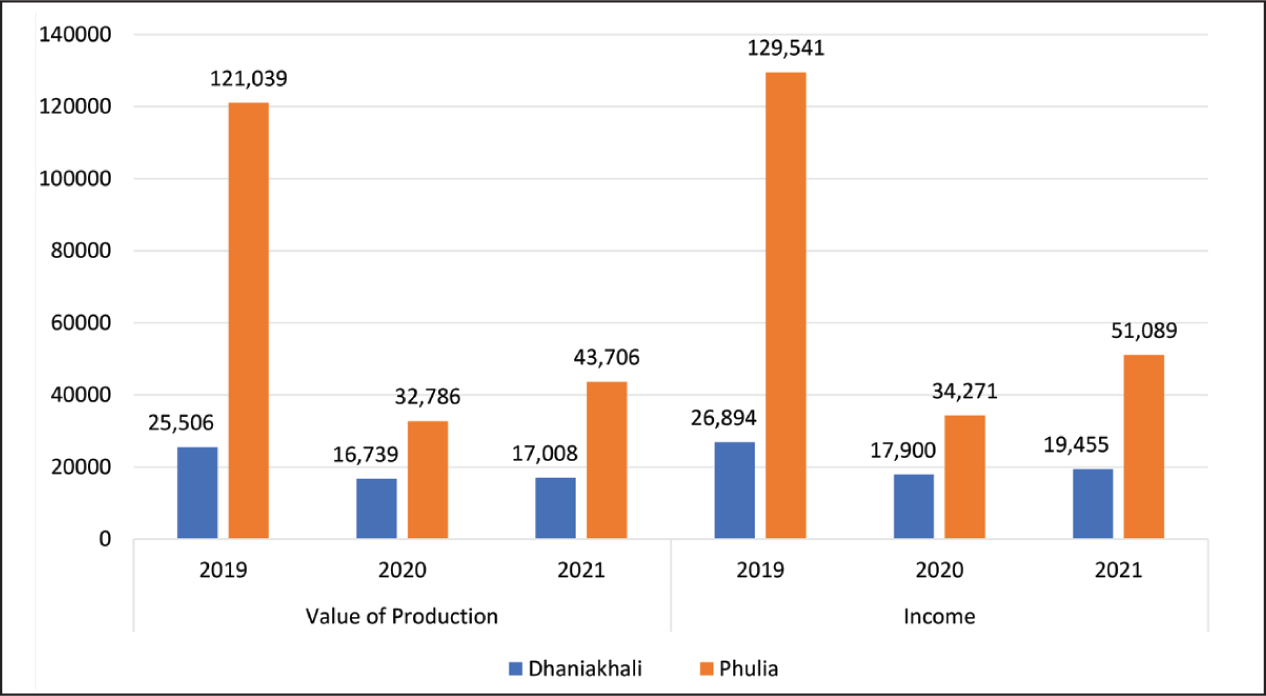
The yearly output and revenue generated per weaver were much higher in Phulia than in Dhaniakhali, especially during the pre-pandemic year (Figure 2). The difference narrowed down considerably in 2020, the first pandemic-affected year. The gap again widened a bit in 2021 when the effect of the pandemic on public life and livelihood started subsiding gradually. The results imply that a market-driven system’s shock absorption capacity is worse than a cooperative-driven system.
Average Value of Production and Income (₹).
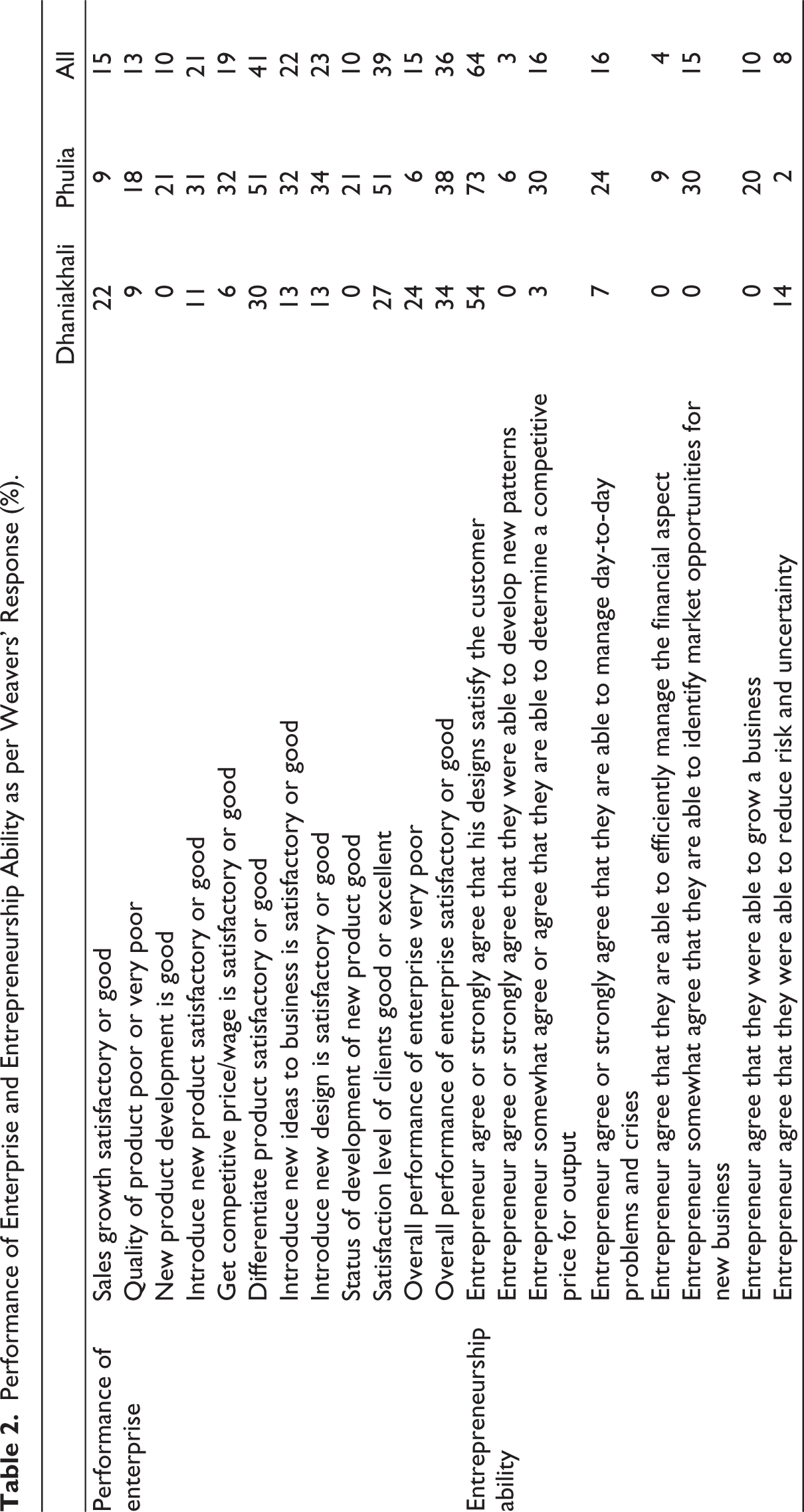
The handloom enterprises’ performance has been analysed through weavers’ perceptions of sales growth, product quality and ability to adapt to new market challenges (Table 2). As per the perception of the weavers, while the quality of output is better in Dhaniakhali, designs are trendier and more vibrant in Phulia. The weavers had perceived more sales growth in Dhaniakhali, but the overall performance of enterprises was perceived to be better in Phulia. The ability of weavers in Phulia to satisfy customers and seek a competitive price was higher, and the engagement with traders helped them in it.
Performance of Enterprise and Entrepreneurship Ability as per Weavers’ Response (%).
Determinants of Entrepreneurship and Resilience
The determinants of performance of weaver’s own home-based enterprise, their entrepreneurship ability and resilience during shock due to the COVID-19 pandemic have been analysed through regression analysis.
The performance of the enterprise is measured through an enterprise performance score based on the response of weavers on ten indicators. The weavers were asked about different aspects of their enterprise or business: sales growth, quality of products, development of new products, the satisfaction of customers or clients, overall performance of the enterprise, getting competitive price or wage, product differentiation, the introduction of new products, the introduction of new ideas into business and introduction of new designs and pattern. The weavers scored the performances on a 5-point scale ranging from 5, indicating excellent, to 1, indicating lowest position. All 10 indicators’ scores were summed up to obtain the overall enterprise performance score. The scores ranged from 12 to 37, with 26 distinct score points.
The entrepreneurship ability of the weavers is measured through nine indicators. The weavers were asked about their agreement or disagreement on statements: product designs satisfy customer needs and wants, they bargain with the trader for returns, deal effectively with day-to-day problems and crises, efficiently manage the financial aspects of their own business, identify market opportunities for a new business, are able to grow a successful business, able to reduce risk and uncertainty, develop new designs and pattern and inspire, encourage and motivate own employees. The responses were recorded on a 5-point scale ranging from 1 to 5. The scores of all these nine indicators are summed up to obtain the overall entrepreneurship score. A higher score suggested a higher degree of entrepreneurship ability. The scores ranged from 14 to 29, with 12 distinct score points.
Vulnerability to shocks is captured by a change in the value of production, proportionate change in production and proportionate change in income between pre-COVID (2019) and COVID years (2020). These changes have been ordered in different categories—the changes in production value ranged from ₹0 to ₹720,000. The changes in production value have been divided into quartiles. The first quartile captures a reduction of more than ₹60,000, and the fourth quartile captures a reduction of production value by less than ₹4,500. The first to fourth quartiles are scored from 1 to 4, indicating that the higher the score, the lesser the vulnerability due to external shock, conversely indicating greater resilience.
The proportionate change in production value and income has been categorised into four and six categories. The proportionate reduction in production value has been categorised as more than 80%, 80%–60%, 60%–40% and less than 40%. Accordingly, the scores assigned for these categories are 1 to 4, respectively. The proportionate income reduction has been categorised as more than 80%, 80%–60%, 60%–40%, 40%–20%, 20%–0% and less than 0% (or a rise). The categories have been scored from 1 to 6, respectively. The higher the score, the lesser the vulnerability caused by external shock, or the higher the resilience.
The regression models consider the following dependent variables
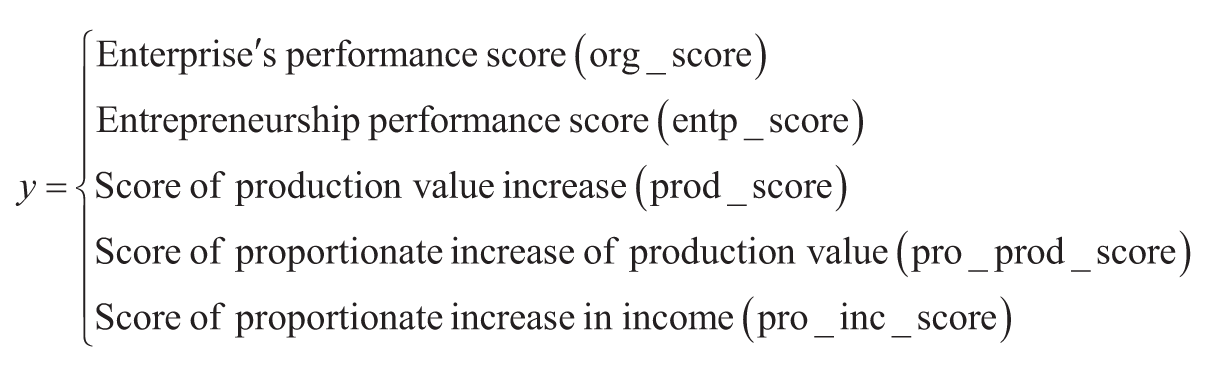
The independent variables are likely to impact performance, entrepreneurship ability and shock. The higher the value of production and the number of looms in 2019, the better the enterprise’s performance and entrepreneurship ability. The scale of operation may provide advantages in terms of costs, but selling may become challenging, especially during the COVID-19 pandemic (De et al., 2022). More network skills are required for higher product sales (Sigmund et al., 2015). The weavers who work with the cooperative have to exercise more entrepreneurial agency to operate at a larger scale, as they can produce and sell a limited number of sarees to the cooperative. They need to find buyers beyond the cooperative.
The engagement of female members of the household who remain unpaid reduces the cost of production. However, such a production structure is subsistent and not market-oriented. Hence, it may not be conducive to enterprises’ performance and entrepreneurship development. Nevertheless, during the COVID-19 pandemic, the same enterprises are more likely to be less affected due to reserve unpaid family labour with minimal opportunity costs. Phillipson et al. (2004) and Bennett and Phillipson (2004) also observed a less negative impact on enterprises during a crisis if they use family labour.
Training in weaving may be less helpful in managing enterprises and developing entrepreneurship. However, as training makes weaving entrepreneurs less risk averse (Goswami et al., 2017), such training may be helpful during crisis periods such as the COVID-19 pandemic to exploit every new opportunity.
Those who use their own purchased looms may exert less agency than those who have looms provided by traders because of the former’s low opportunity cost of underutilised looms owing to the meagre redeemable value of looms (Roy, 1989). When traders provide looms under some contract, the weavers cannot generate alternative networks with other traders, increasing the weaver’s dependence on the traders. With more freedom to capital, the producers are likely to have a less exploitative contract with the traders (Harriss-White, 2019). Weavers who had leased looms from traders, and so the whole production process devoted to serve traders, suffered from the lack of negotiating power. With the traders stopping their operations during the COVID-19 pandemic, those who worked on leased looms became more likely to get severely affected due to COVID-19 shock than those who had their own loom. If the weavers had engaged with multiple key traders, engaged with multiple long-term traders and had traders outside the cluster, they were more likely to get better deals. Hence, their performance and entrepreneurship are likely to be better.
The state of the competitive environment is an important deciding factor in the entrepreneurial performance of the weavers. If the weavers face a lot of competition from their peers, their enterprise’s performance and entrepreneurship will improve. However, during external shocks such as the pandemic, intense competition among peers would deepen the negative impact during the COVID-19 pandemic due to demand constraints.
The weaver–trader relationship gives rise to another set of dynamics that interplays between entrepreneurial performance and economic performance. A better weaver–trader relationship through tangible and intangible means is likely to positively impact performance, entrepreneurship and ability to cope with shocks. At the same time, the weavers may accept deferred payments from traders to avail the prospects of getting continuous work and long-term relationships (Roy, 1989). Weavers may face a shortage of materials during peak demand, indicating high input demand. Hence, deferred payment and shortage of materials are indicators of a vibrant economic environment, which may have a positive effect on performance and entrepreneurship abilities. But they are more likely to be affected during demand-constraint situations in a pandemic.
Weavers receiving business support, such as input and loom maintenance expenses from traders, are more likely to perform better. If weavers receive reliable information on trending designs and patterns from traders, it is likely to improve entrepreneurship skills and demonstrate better entrepreneurial performance. On the flip side, since they easily get the required support and information from the trader, they do not indulge in developing any other business network, which may reduce their ability to cope with shocks.
A strong and direct trader–weaver relationship reduces the bargaining power of the weavers (Harriss-White, 2019). Hence, the performance of enterprise and entrepreneurship of the weavers having direct contact with large traders is likely to be slackened. However, they are likely to be less affected during shocks like the pandemic if they maintain direct contact with cooperative management or major traders (rather than intermediaries) placed at a higher position in the supply chain hierarchy. The fairness of dealing and fewer disputes with traders encourage performance and growth. These relationship characteristics are likely to enhance entrepreneurship and mitigate the negative impact of shocks.
A few independent variables are considered as ‘control variables’. The performance, entrepreneurship and resilience of the weaver may depend on the age, literacy and caste of the weaver (Gong & Yang, 2012; Nichter & Goldmark, 2009).
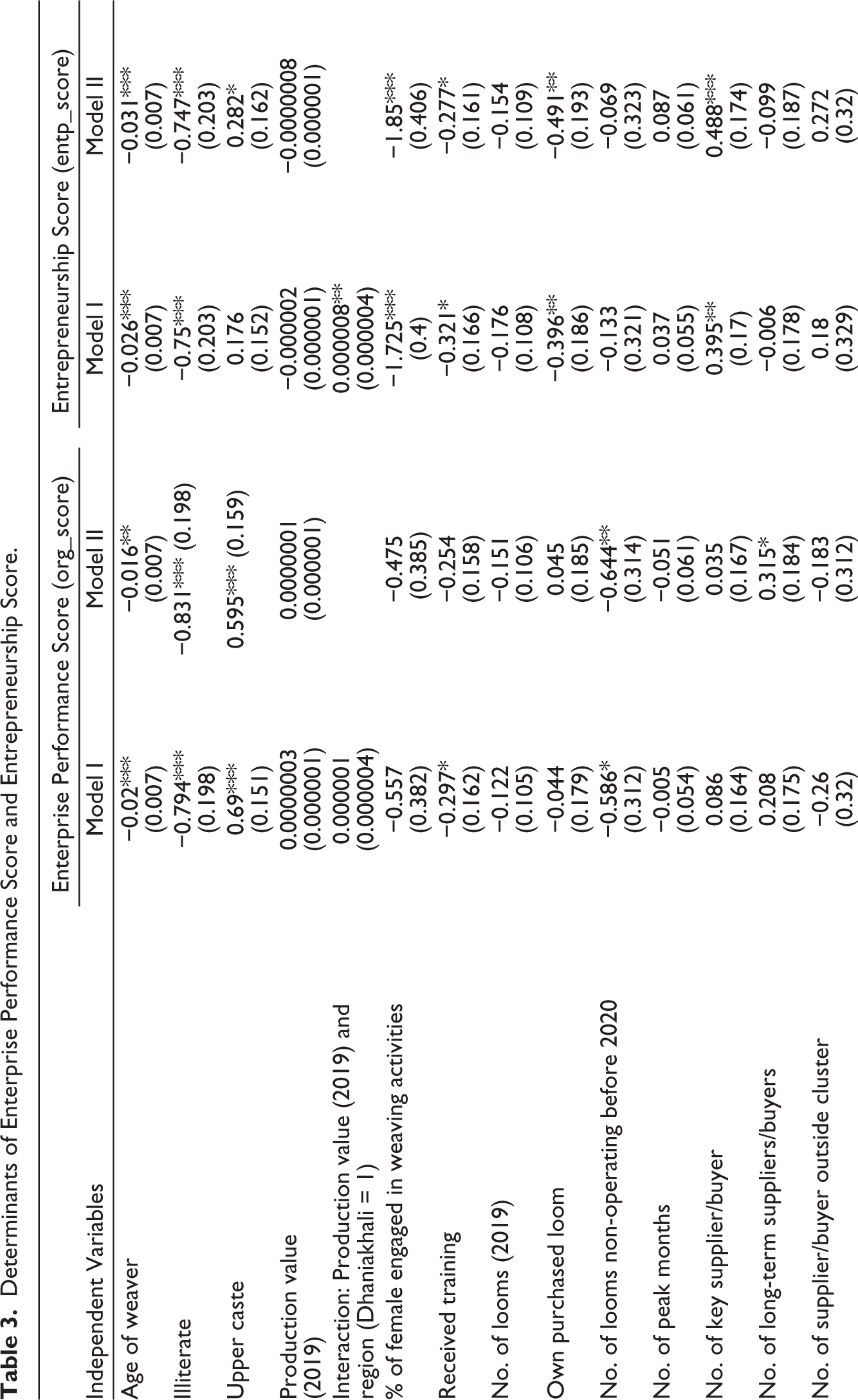
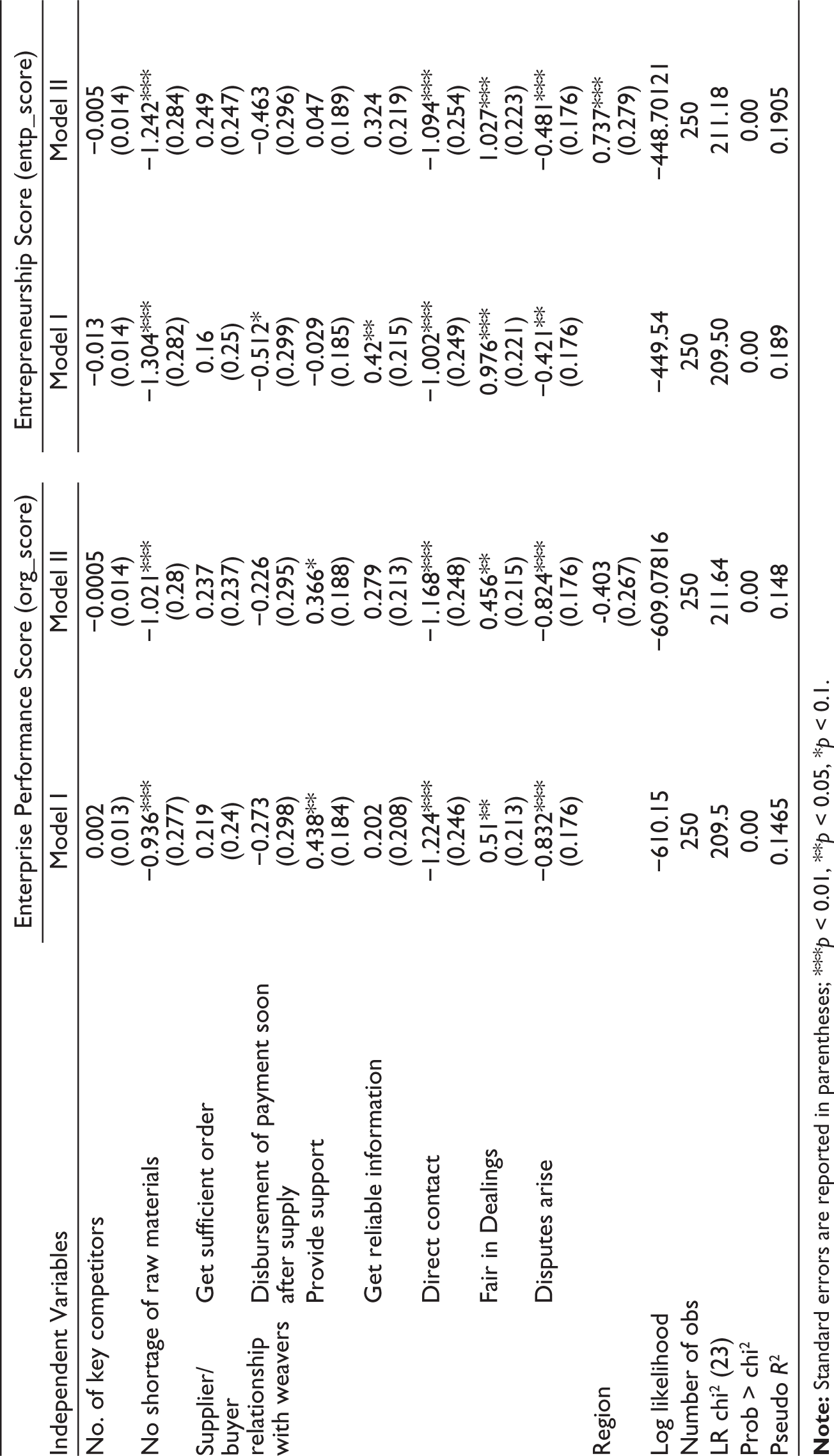
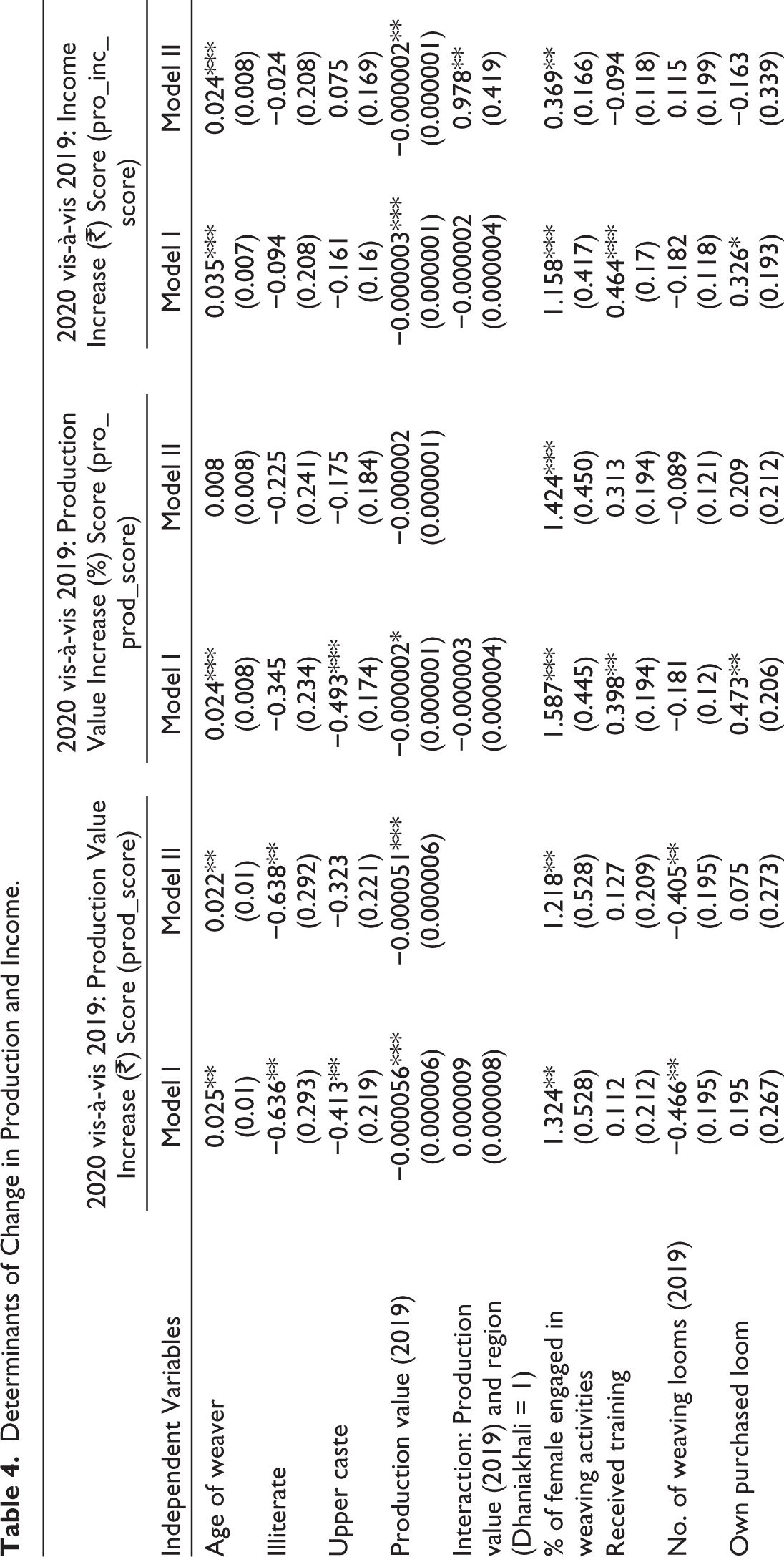
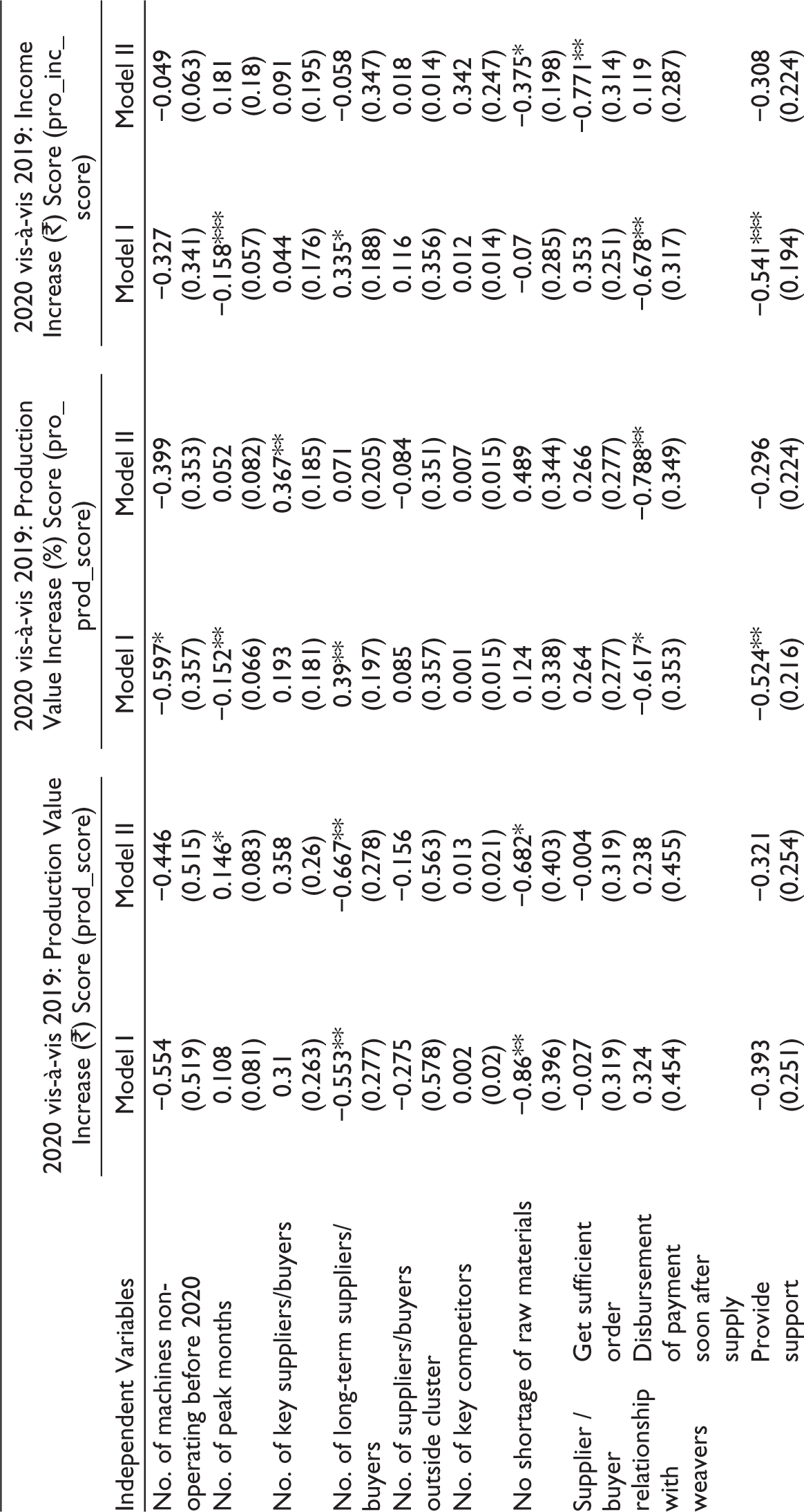
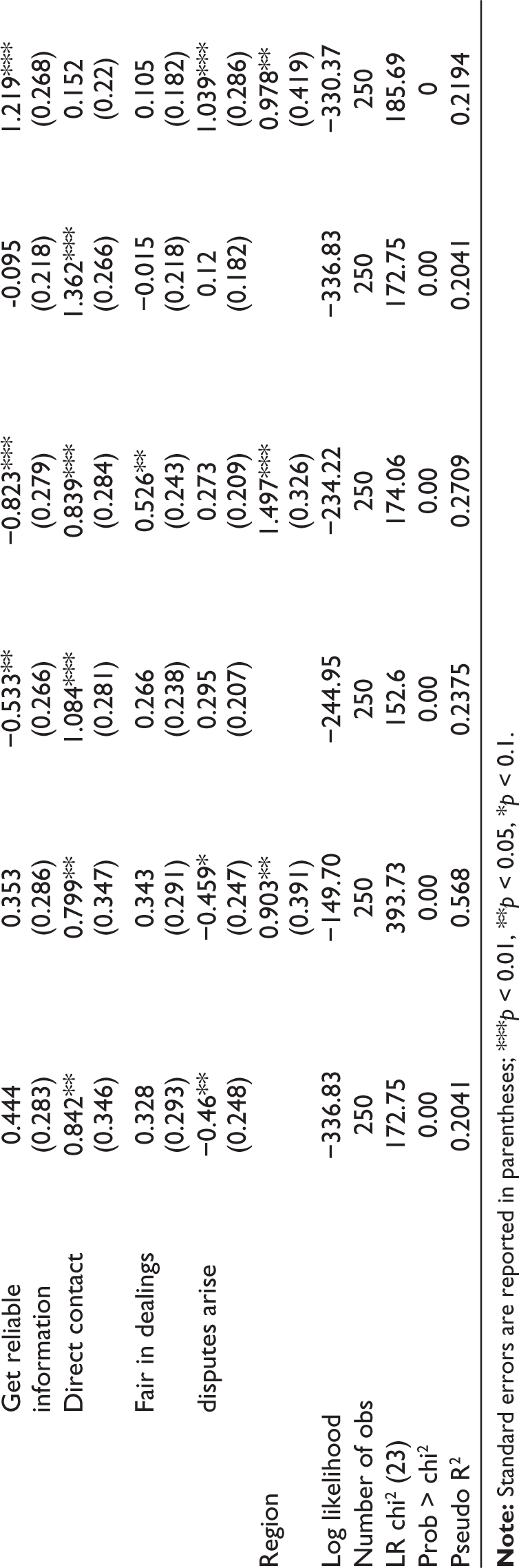
Since all the dependent variables are scores or ordered categories, the coefficients of the regression models have been estimated through an ordered Probit model. The regression models and results are presented in Tables 3 and 4. While the regression results in Table 3 would help assess H1, H2 and H3, the regression results illustrated in Table 4 would assess H4 and H5.
Determinants of Enterprise Performance Score and Entrepreneurship Score.
Determinants of Change in Production and Income.
The interaction of production value (2019) with region and the variable region has been alternatively taken in regression models to avoid the multicollinearity problem.
Effects of Determinants
The regression results reveal that if the weavers have a larger scale of operation and are in a cluster dominated by the cooperative, then their entrepreneurial agency is likely to be higher, which is illustrated by the positive coefficient of the interaction effect of production value and region (β = 0.000008, p = 0.02) when entp_score is the dependent variable (Table 3).
The larger scale of operation negatively impacted production and income during the COVID-19 pandemic (Table 4). Higher production value had a negative impact on prod_score, pro_prod_score and pro_inc_score. Similarly, weavers with a higher number of looms experienced a more significant reduction in production value (prod_score) during the pandemic.
A higher engagement of unpaid household female labour in the production process would negatively impact entrepreneurship under normal circumstances (Table 3). However, during the pandemic, the weavers who engaged more household female labour experienced less loss of production and income (Table 4). This result is robust as the effect of female household labour on production and income is significant in all models when the dependent variable is prod_score, pro_prod_score and pro_inc_score. This result also supports H5.
Weavers who operate with their self-owned loom are likely to have less entrepreneurial agency than those whose looms are provided by traders (Table 3). However, weavers having their own loom were not entirely dependent on the trader and hence were more resilient during the pandemic. Weavers who received training in weaving were less likely to demonstrate better performance in their enterprise and entrepreneurship ability (Table 3). However, as the trained weavers would be able to produce varied products, their ability to cope with shocks was higher.
As demand constraint was a major problem during the pandemic, weavers who generally produced more were likely to be more impacted. It is presented in Table 4 by the negative relationship between the months of peak demand with the proportionate change in production (β = −0.152, p < 0.05) and income during the pandemic (β = −0.158, p < 0.01).
Weavers who have long-term relationships with traders are likely to demonstrate better performance and entrepreneurial agency (Table 3). The impact of many key traders on the entp_score is robust, with p < 0.05 and p < 0.01 in Models I and II, respectively. Hence, this result supports H3. If the weavers have a higher number of long-term traders, they would be less affected by the pandemic (Table 4). The long-term relations with their traders would help in restraining a proportionate fall in production and income. This is revealed by the positive coefficients of number of long-term traders when pro_prod_score (β = 0.39, p < 0.05) and pro_inc_score (β = 0.335, p < 0.1) are dependent variables.
In contrast, the negative relationship between the number of long- term traders and change in production value or prod_score is robust, as illustrated in Model I (β = −0.553, p < 0.05) and Model II (β = −0.667, p < 0.05). This is because the value of production loss was more severe if a higher number of traders reduced business. Nevertheless, long-term relationships with multiple traders saved them from a proportionate downfall of income and production compared to the pre-pandemic position.
As expected, the weavers who received payment soon after supply to the trader demonstrated lesser entrepreneurship or got a lower entp_score (β = −0.512, p < 0.1 in Table 3). Weavers who had sufficient raw materials at their disposal were not able to sell their products due to various reasons, such as their own laxity, delay in production, lack of demand or inability to find buyers.
The results reveal that if the weavers received trader or cooperative support, then the enterprise’s performance (org_score) would be better (Table 3). This result is robust as the variable trader or cooperative provides support, which is significant in both Models I and II. If the traders or cooperatives provide reliable information, entrepreneurship (entp_score) is likely to improve.
As expected, Table 3 demonstrates that direct contact with cooperative management or large traders is likely to reduce the chances of better performance (org_score) and entrepreneurship (entp_score). The results are robust as the independent variable concerning direct contact is significant in all the models. This result is also supportive of H3. If the traders are fair in dealing and the weavers face fewer disputes with traders, then their enterprise’s performance (org_score) and entrepreneurship (entp_score) are likely to be better (Table 3).
The coefficient of the regional dummy evinces that in cooperative-dominated Dhaniakhali the entrepreneurship or entrepreneurial performance (entp_score) of weavers is significantly higher as compared to Phulia, where weavers are mainly engaged with traders (β = 0.732, p < 0.1 in Table 3). This result supports the H2. However, the regional dummy has no statistically significant impact on the enterprise’s performance (org_score). Furthermore, Table 4 illustrates that the regional dummy correlates positively with the rise in prod_score (β = 0.903, p < 0.05), pro_prod_score (β = 1.497, p < 0.01) and pro_inc_score (β = 0.978, p < 0.05). It implies that association with a cooperative society benefits the weavers in their entrepreneurial efforts and reduces production and income vulnerabilities during shocks. This result supports the H4.
Change in Probabilities
The marginal effect of institutional arrangements (captured by region dummy variable in regression), the effect of cooperative vis-à-vis private trader domination, on all the indicators of enterprise’s performance and entrepreneurship separately, as well as on the change in production and income have been looked into. To calculate effects, ordered Probit regressions were used considering indicators of enterprise’s performance (org_score) and entrepreneurship (entp_score) separately and the indicators of vulnerability (prod_score, pro_prod_score and pro_inc_score) as dependent variables. The independent variables in these regression models are exactly the same as mentioned above.
Enterprise’s Performance
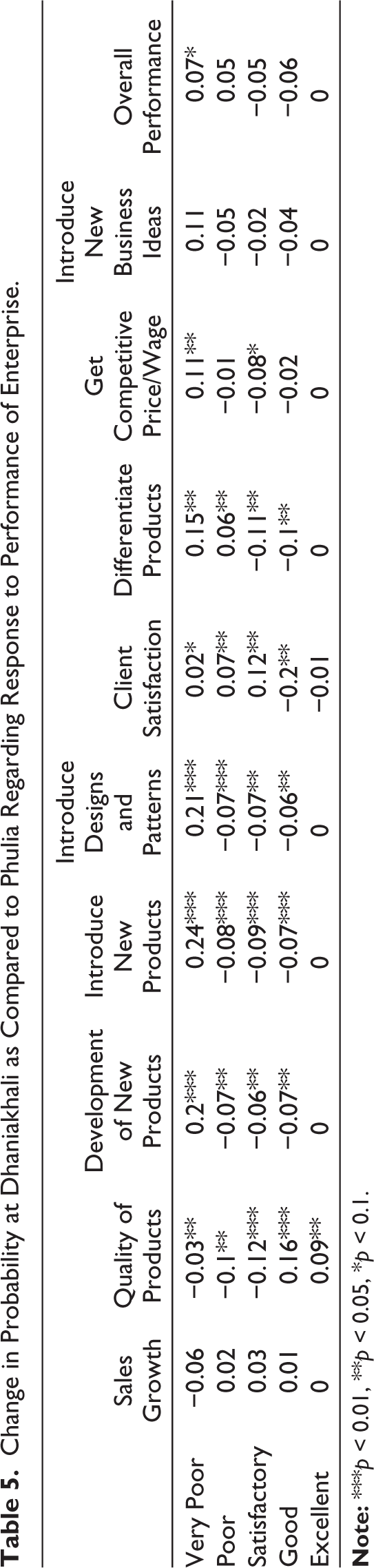
The results reveal that cooperatives have a very significant positive impact on the quality of the product (Table 5). However, the chances of weavers perceiving unsatisfactory results in the development and introduction of new designs and patterns and poor client satisfaction are higher in the cooperative-dominated cluster. The results do not support the first hypothesis (H1).
Entrepreneurship
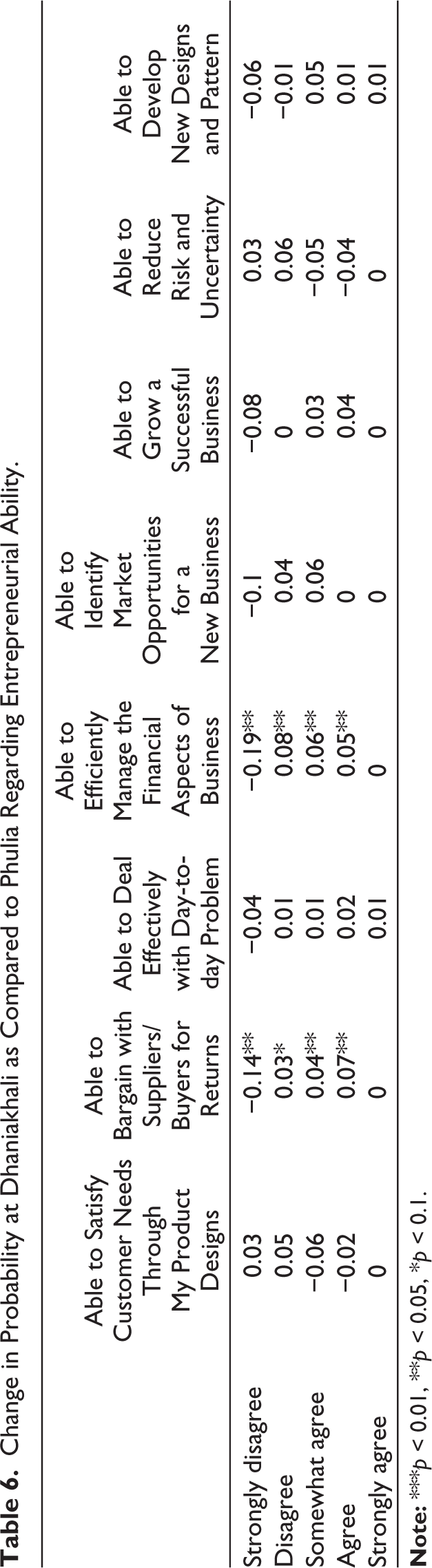
The change in the probability of weaver’s response regarding indicators of entrepreneurship reveals that weavers in Dhaniakhali perceive a greater bargaining strength than weavers in Phulia (Table 6). It again provides evidence in support of H2. This may be because the elected representatives of weavers constitute the governing body of the cooperative society.
Change in Probability at Dhaniakhali as Compared to Phulia Regarding Response to Performance of Enterprise.
Change in Probability at Dhaniakhali as Compared to Phulia Regarding Entrepreneurial Ability.
Absorption of Shocks
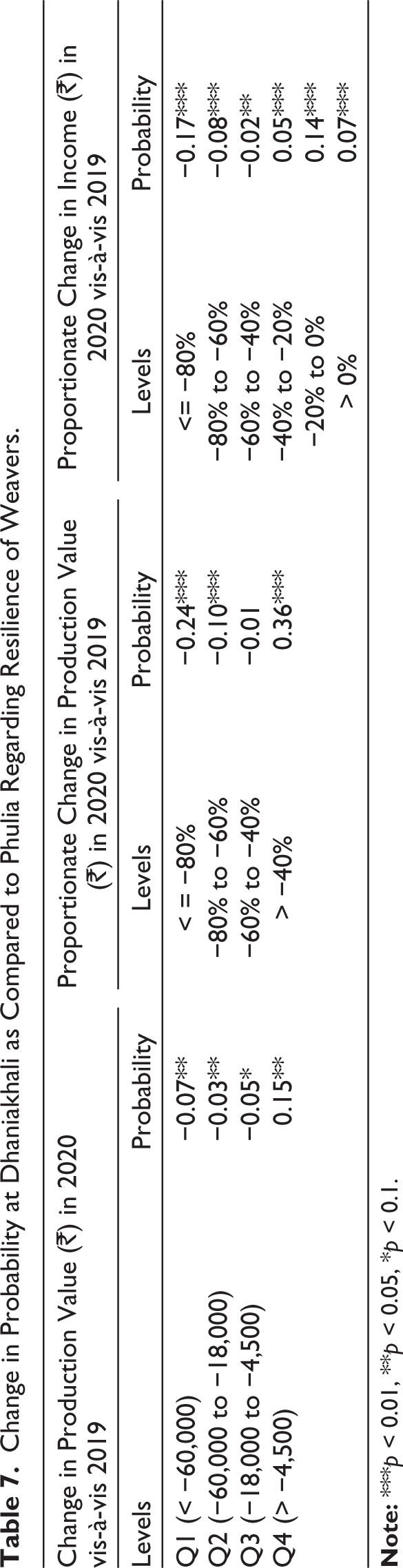
The marginal effects of the region on all the levels of indicators of production and income shocks are statistically significant and follow a consistent pattern. The weavers of Dhaniakhali have experienced a significantly lesser production and income reduction than the weavers of Phulia (Table 7). All these results provide support for H4.
Change in Probability at Dhaniakhali as Compared to Phulia Regarding Resilience of Weavers.
Discussion
Most weavers in both clusters deal with a single supplier-cum-buyer, a cooperative in the case of Dhaniakhali and a private trader in the case of Phulia. Since both suppliers of raw materials and buyers of products are the same entity, the system is interlocked. The relationship with the supplier or buyer is perceived to be better in Dhaniakhali, with higher trust, fewer disputes and more fairness. Hence, the relationship of the weavers with cooperatives is better than with the private trader, mainly attributable to the member centrality of the cooperative. Cooperatives usher in stability in an institutional environment, which in turn helps entrepreneurship. Foss et al. (2019) observed that more stable institutions ensured more predictability and complete contracts, leading to more entrepreneurial projects.
The results of the influence of the institutional environment (cooperative vis-à-vis private trader domination) on the enterprise’s performance and entrepreneurship ability are not uniform. The likelihood of introducing new products and designs, differentiating products, getting better returns and obtaining client satisfaction is higher in private trader-dominated Phulia. Nevertheless, the quality of the products is perceived to be better in cooperative-dominated Dhaniakhali. Due to the contradictions within these indicators of the enterprise’s performance, the effect of the institutional environment on the overall performance of the enterprise is insignificant. On the contrary, entrepreneurship ability in general and ability to bargain in particular is statistically significantly higher for weavers associated with the cooperative-dominated Dhaniakhali.
The results imply that under cooperative, weavers can exercise more bargaining power and choices, although they are more adaptive to market needs under private traders. As weavers under traders hardly have any bargaining power, their adoption and dynamism are commanded by traders to adapt to the market needs. Nath and Arrawatia (2022) found that dairy cooperative in India maximises the market-based logic of self-interest, economic efficiency and profit maximisation and community-oriented logic such as democracy, solidarity and autonomy. Handloom cooperative in Dhaniakhali lacks efficiency due to the lack of a federated structure, which dairy cooperatives have advantaged themselves with.
Lack of entrepreneurial skills is likely to be higher for weavers who are trained in weaving, as also observed by Bhagavatula et al. (2010). If traders provide support and reliable information on trending designs and patterns, it is likely to impact performance and entrepreneurship positively. Engagement with traders enables weavers to access information about opportunities (Share, 2000). The study finds much deeper insights in this regard. Freedom of weavers to deal with multiple traders and for a longer duration positively impacts performance and entrepreneurship. However, direct contact with a large trader may bind their business opportunities only with a single trader. This would reduce the weaver’s bargaining power, also reducing performance and entrepreneurial ability. The findings of McEvily and Zaheer (1999), Hills et al. (1997) and Singh et al. (1999), which resonated with this article’s findings, suggested that weak ties give entrepreneurs better opportunities as new and different information become accessible.
External shocks are likely to make weavers more vulnerable when their scale of operation is larger. Those who produced more and experienced higher demand during peak months suffered more during the COVID-19 pandemic. Weavers who had direct contact with cooperative management or large traders were more resilient. The findings of the study suggest that during a crisis, direct contact with the power centre of economic activity is more helpful than contact with multiple buyers or suppliers. Both the regression results and marginal effects illustrate that the weavers in the cooperative-dominated cluster were better able to cope with the shocks due to the pandemic compared to the weavers in the private trader-dominated cluster.
Conclusions
The results do not have conclusive evidence in support of either a cooperative-dominated or trader-dominated institutional environment impacting an enterprise’s performance. The quality of the product is more likely to be better in the cooperative-dominated cluster. Still, weavers in trader- dominated clusters are more likely to develop and introduce new designs, patterns and products. As a result, the chances of client satisfaction are also higher. Contrary to perception, entrepreneurship abilities are likely to be better in a cooperative-dominated cluster (Dhaniakhali) than in a private trader-dominated cluster (Phulia). Weavers demonstrate superior entrepreneurial skills when they search for more business opportunities after selling the stipulated number of sarees to a cooperative. Further, the bargaining strength and ability to manage business finances are higher for weavers in Dhaniakhali than in Phulia. This implies that weavers have more choices in Dhaniakhali, whereas their counterparts in Phulia adapt as per instructions provided by the private traders. Such adaptation demonstrates the entrepreneurial ability of traders rather than their subordinate weavers.
Cooperatives produce a very stable institutional environment as compared to private traders, which is reflected by a lesser COVID-19–induced loss of production and income of weavers in cooperative-dominated Dhaniakhali compared to private trader-dominated Phulia. The chances of production and income losses were lower for weavers associated with cooperatives vis-à-vis those associated with only traders.
The overall results imply that dealing with multiple key traders improves entrepreneurship ability. However, such engagement did not have any robust effect on resilience during the COVID-19 pandemic. The engagement should be qualitatively better, where the traders are fair and transparent and should provide support and information for better performance and entrepreneurship. Direct contact with traders may lessen entrepreneurial agency, which is caused by a subordinate relationship between the weaver and the private trader. It may also negatively affect the enterprise’s performance. Nevertheless, such direct contact with local trading elites improved resilience during the COVID-19 pandemic. Unpaid female household labour negatively impacts the entrepreneurial abilities of weavers, but it absorbs shocks induced by the COVID-19 pandemic. Training on entrepreneurship along with varied weaving skills may help the weavers to become better entrepreneurs in the future.
Footnotes
Declaration of Conflicting Interests
The authors declared no potential conflicts of interest with respect to the research, authorship and/or publication of this article.
Funding
The authors received financial support for field surveys from Dr. Verghese Kurien Centenary Celebrations Fund at Institute of Rural Management Anand.